
#When to retire a burned domain: repair vs replace cost math
Copy page
TL;DR: Retire a burned domain when recovery time exceeds 6-8 weeks with no upward trend, when spam complaints sit above 0.1% after two full warmup cycles, or when the domain has landed on a major blocklist twice. A new domain costs about $12 a year plus 3-4 weeks of warmup. A stubborn recovery can burn two months of send volume for a coin-flip outcome. Do the math before you fall for the sunk cost.
#Table of contents
- The question nobody wants to answer honestly
- What burned actually means
- The five signals that say retire, not repair
- The cost math: repair vs replace
- The decision framework
- How long a real recovery actually takes
- What retiring a domain does not mean
- Building a domain that does not need this decision
- The retirement checklist
- Where FirstSales fits into this decision
- FAQ
- Conclusion
#The question nobody wants to answer honestly
Every cold email team eventually stares at a domain with a 1.2% spam complaint rate and asks the same question.
Do we fix this, or do we walk away and start over.
Most teams answer wrong.
They keep sending through a sick domain because a new one feels like an admission of failure, and because nobody wants to explain to a manager why three weeks of warmup has to happen again.
That instinct costs more than the domain itself.
A burned domain sending at a fraction of its old rate is not neutral. It is actively teaching Gmail and Outlook that your entire sending pattern is suspicious, and that lesson follows you.
This article gives you the numbers to make the call without the emotion attached to it.
#What burned actually means
A domain is burned when its sender reputation has dropped low enough that mailbox providers route most of its mail to spam by default, regardless of content quality.
That is different from a single bad day. Every domain has fluctuations.
Burned means the pattern is persistent across multiple sends, multiple subject lines, and multiple recipient lists.
Three conditions usually appear together on a genuinely burned domain.
Spam complaint rate has crossed 0.1%, the exact ceiling Google enforces for bulk senders under its 2024 sender guidelines, which are still the operative rule in 2026.
Bounce rate sits above 2%, the second half of Google's bulk sender requirement.
And placement testing (sending to seed accounts you control) shows more than half of messages landing in spam or promotions instead of the primary inbox.
One of these alone is a warning. All three together, sustained for more than two weeks, is a burned domain.
#The five signals that say retire, not repair
Not every burned domain deserves a rescue attempt. Some are worth fighting for. Some are not.
Here are the five signals that tip the decision toward retirement.
#1. Two failed warmup cycles
If you have already run a full 3-4 week warmup cycle, dropped volume, waited two weeks, and the complaint rate climbed right back up when you resumed sending, the domain has a structural problem a second attempt will not fix.
#2. A blocklist hit that repeats
A single Spamhaus or SpamCop listing that clears within 48 hours after you fix the root cause is recoverable.
A domain that gets relisted a second time within 90 days is telling you the underlying sending behavior has not actually changed, and the blocklist providers have started tracking it more aggressively.
#3. Reply rate collapse below 1%
If a domain that used to deliver a 4-6% reply rate is now producing under 1% across multiple campaigns and audiences, inbox placement has likely collapsed even where your dashboard still shows deliveries.
Remember that opens are close to useless as a signal now. Apple Mail Privacy Protection pre-fetches images and inflates open tracking across a huge share of inboxes, so a suspiciously high open rate paired with a dead reply rate is itself a warning sign, not reassurance.
#4. The domain shares infrastructure with a known offender
If the domain sits on a shared IP block, subdomain structure, or ESP account that also sent the campaign that triggered the burn, cleaning the domain alone will not separate it from the tainted neighbors.
#5. Recovery cost now exceeds a new domain's full cost
This is the tiebreaker signal, and it deserves its own section, because it is where most teams get the decision wrong.
#The cost math: repair vs replace
Here is the actual arithmetic, stripped of sentiment.
| Cost factor | Repairing a burned domain | Replacing with a new domain |
|---|---|---|
| Direct cost | $0-15 (domain already owned) | $10-15 per year for the domain |
| Time before full-volume sending resumes | 6-10 weeks (reduced volume + monitoring) | 3-4 weeks (standard warmup) |
| Send volume lost during recovery | 60-80% reduction for the full period | 70-90% reduction, but shorter window |
| Risk of failure | Moderate to high if root cause unresolved | Low if setup follows SPF, DKIM, DMARC alignment |
| Reputation carried forward | Old, damaged reputation persists in some signals | Clean slate, no inherited history |
| Team time and monitoring overhead | High: daily placement checks for 6+ weeks | Moderate: standard warmup monitoring |
✓ Repair makes sense when the burn was a single identifiable mistake (one bad list, one broken authentication record) that you have already fixed and can prove is fixed.
✗ Repair rarely makes sense when the cause is structural (content patterns, sending volume, list quality) and would recur on the same domain even after a clean warmup.
Run the numbers for your own case. Multiply your daily send volume by your average reply rate to get expected replies per week at full health.
Then multiply that same volume by the reduced rate you are seeing during recovery, for however many weeks the recovery has already taken plus your best estimate of weeks remaining.
The gap between those two numbers, in lost pipeline, is the true cost of repair. Compare it against 3-4 weeks of reduced volume on a fresh domain, and the decision usually makes itself.
#The decision framework
Walk through this chart honestly. The trap most teams fall into is skipping the "root cause identified" gate and jumping straight to warmup, which explains why so many second attempts fail the same way the first one did.
#How long a real recovery actually takes
Domain reputation recovery does not happen on a fixed schedule, but the pattern is consistent enough to plan around.
Week one after the root cause is fixed shows almost no visible change. Reputation systems at Google and Microsoft update on a lag, often 5-10 days behind the behavior change that caused them.
Weeks two through four show gradual placement improvement if the fix actually worked, typically climbing from majority-spam to a 50/50 split between spam and inbox.
Weeks five through eight, for a genuine recovery, placement should be back above 80% inbox. If it is not moving by week six, the domain is very likely done.
That six-to-eight-week window is the practical ceiling most experienced deliverability teams use before calling a recovery attempt failed.
Beyond it, the marginal probability of success drops fast enough that continuing rarely beats simply cutting losses.
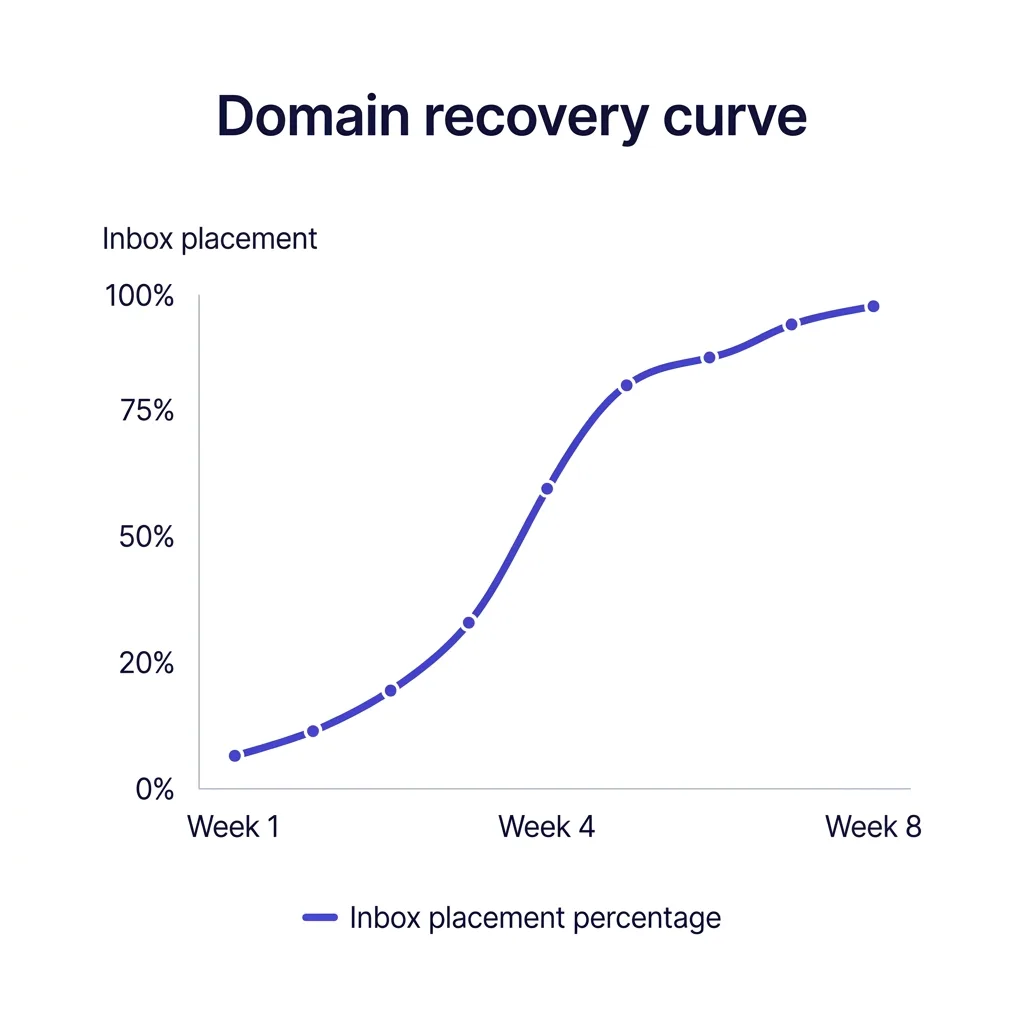 Weekly recovery curve showing inbox placement percentage climbing over an eight week window
#What retiring a domain does not mean
Retiring a domain is not the same as abandoning the brand or losing the email addresses tied to it for other purposes.
You keep the domain registered. You simply stop using it for cold outbound, and you let it sit quiet for months while any residual signals fade on their own.
Many teams eventually repurpose a retired sending domain for a low-volume purpose, like transactional receipts, once enough time has passed and the volume is trivial enough that reputation barely matters.
The mistake is trying to bring a retired domain back into cold outbound within 90 days. Reputation systems have long memories, and a domain that goes quiet and then suddenly resumes high-volume cold sending looks exactly like the pattern spam filters are built to catch.
#Building a domain that does not need this decision
The cheapest fix for domain burn is never having to make this call in the first place, and that starts before the first cold email ever goes out.
Register a dedicated sending subdomain or separate domain rather than sending cold volume from your primary company domain, so a burn never threatens your main brand's email reputation. Our subdomain vs separate domain breakdown covers the trade-offs in detail.
Set SPF, DKIM, and DMARC correctly from day one, since alignment failures are one of the fastest routes to a burn that has nothing to do with content quality. See our full SPF, DKIM, DMARC setup guide for the exact records.
Run continuous warmup, not a one-time ramp before a single campaign. Ongoing email warmup after the initial ramp keeps sending patterns consistent instead of spiking and crashing, which is one of the most common causes of a domain burning in the first place.
Rotate domains proactively on a schedule tied to volume, not reactively after a burn. Our guide on email domain rotation covers how to plan that cadence so you are never stuck with only one domain to protect.
Watch your bounce and complaint numbers daily rather than weekly. The cold email bounce rate guide explains why bounce rate creeps up quietly for weeks before anyone notices, and by then the damage compounds.
#The retirement checklist
Use this before pulling the trigger on a new domain, so you are certain the old one deserves retirement and are not walking away from something recoverable.
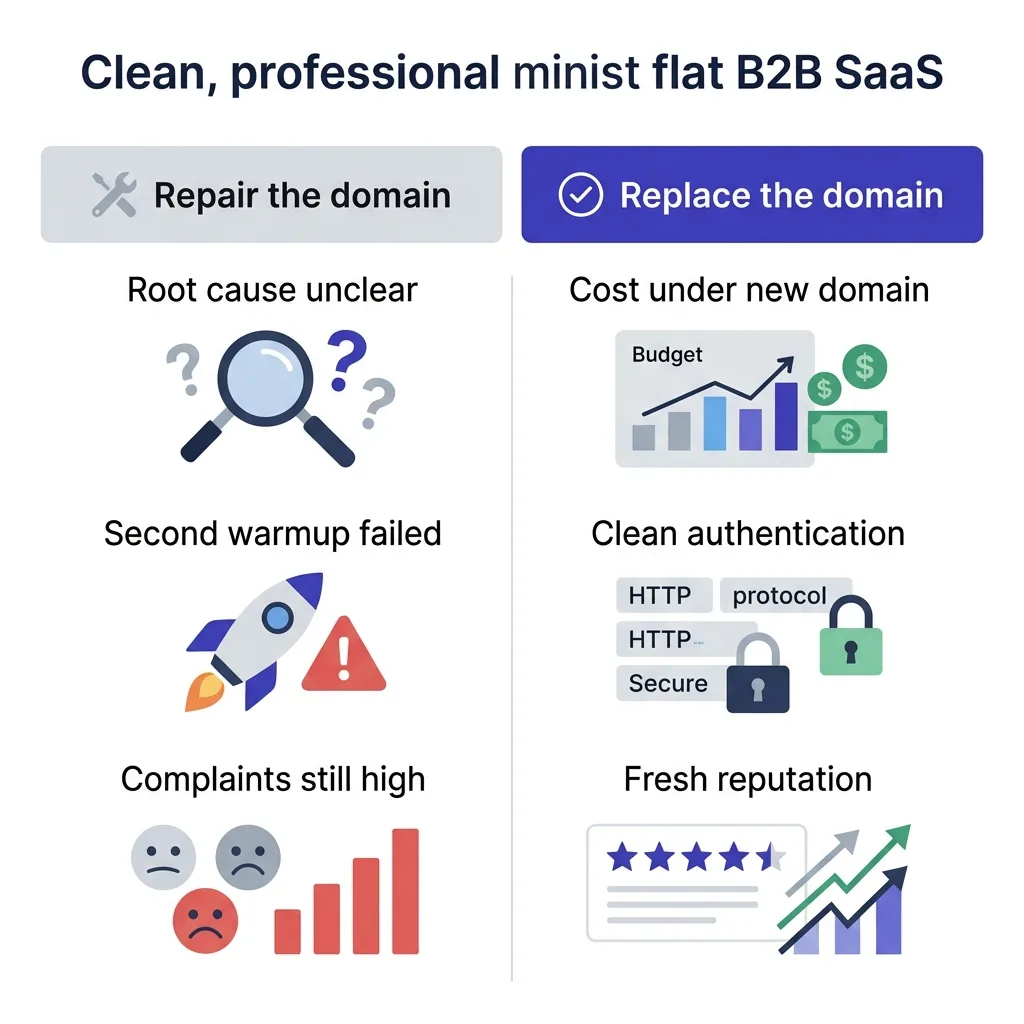 Repair versus replace decision checklist for a burned sending domain
✓ Root cause of the burn has been identified with evidence, not guessed at.
✓ At least one full warmup cycle has already been attempted and failed to restore placement.
✓ Spam complaint rate has stayed above 0.1% for more than two weeks despite the fix.
✓ Placement testing across at least two mailbox providers confirms majority-spam delivery.
✓ You have calculated the lost-pipeline cost of continuing repair against the cost of a fresh domain, and repair loses.
✗ Do not retire a domain after a single bad day of sending. That is noise, not a burn.
✗ Do not retire a domain you have not yet tried to fix. Diagnosis comes before the decision.
#Where FirstSales fits into this decision
Making this call well requires data you can trust, not a gut feeling about whether things "seem better."
FirstSales tracks spam complaint rate, bounce rate, and inbox placement per domain continuously, which is the exact data this decision framework runs on. Without it, most teams are guessing at week four of a recovery attempt instead of measuring.
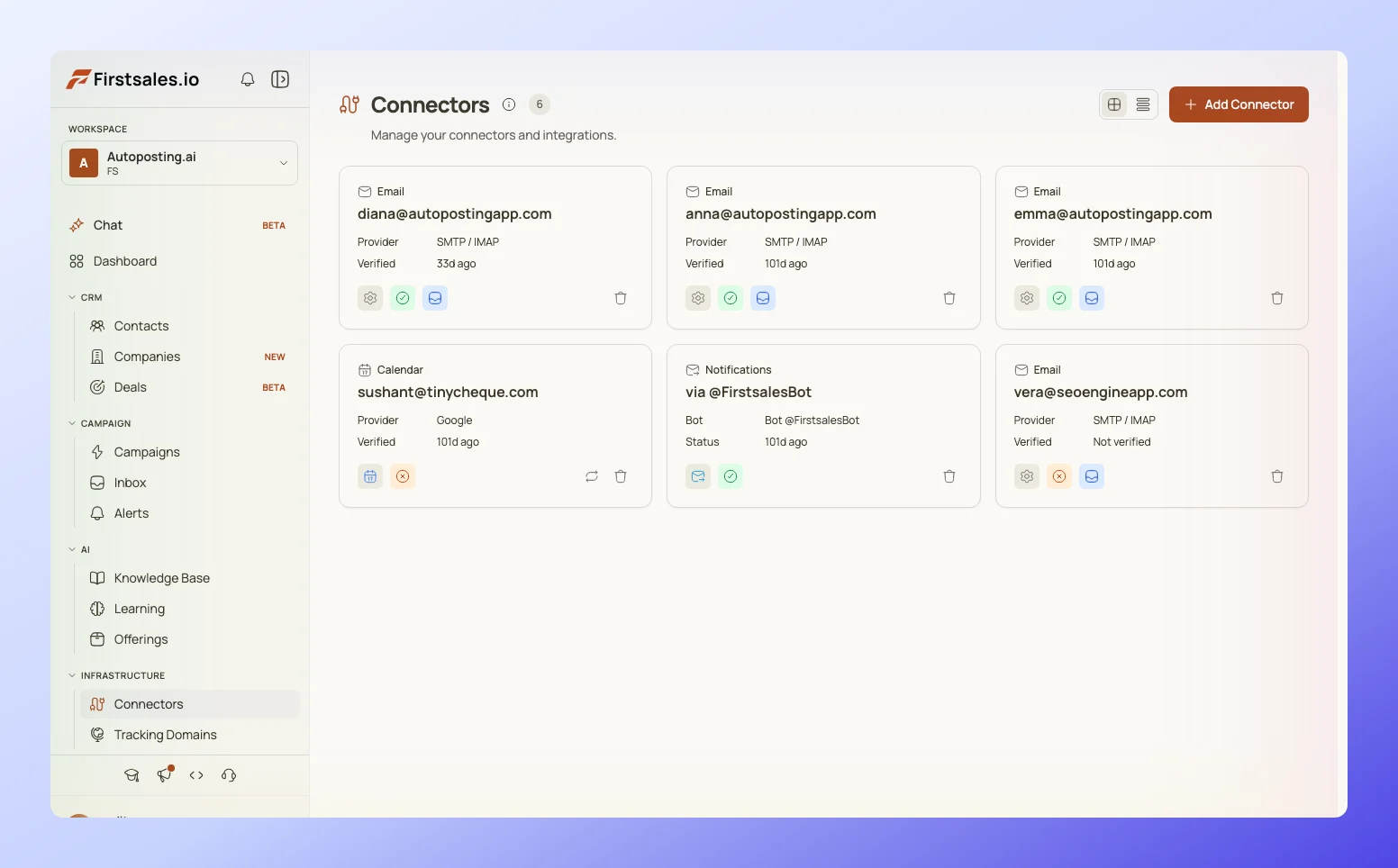 FirstSales deliverability monitor showing per-domain spam complaint and bounce trends
The platform also flags a domain automatically when it crosses the 0.1% complaint threshold, so the retirement conversation starts on schedule instead of two weeks late after a manager finally notices reply rates have cratered.
When a team does decide to replace a domain, FirstSales handles the new domain's warmup sequence and authentication setup so the switch does not add its own operational risk on top of an already disruptive decision.
#FAQ
#How do I know if my domain is burned or just having a bad week?
A bad week affects one campaign or one send. A burned domain shows the pattern across multiple campaigns, multiple subject lines, and more than two weeks of sustained data. Check spam complaint rate and bounce rate over a 14-day window before concluding anything.
#What spam complaint rate counts as burned?
Above 0.1% sustained for two or more weeks is the practical threshold, matching Google's bulk sender ceiling. A single day spike to 0.3% that returns to normal the next day is not a burn.
#Can a domain recover from a Spamhaus listing?
Yes, most first-time listings clear within 48-72 hours once the root cause is fixed and a delisting request is submitted. A second listing within 90 days is a much worse sign and often points to a structural problem rather than a one-off mistake.
#How long should I wait before declaring a recovery attempt failed?
Six to eight weeks after the root cause is fixed. If inbox placement has not climbed above 80% by week six, the odds of success from that point forward drop sharply.
#Is it cheaper to fix a domain or buy a new one?
A new domain costs $10-15 a year plus 3-4 weeks of warmup. A repair attempt that fails can cost 6-10 weeks of reduced volume with no guarantee of success. Run the pipeline-loss math from the cost section above for your own numbers.
#Does retiring a domain mean losing the brand association?
No. You keep the domain registered and simply stop sending cold volume from it. Many teams later reuse a retired domain for low-volume transactional email once reputation signals have faded.
#Can I just switch subdomains instead of the whole domain?
Sometimes, if the burn is isolated to sending behavior on that specific subdomain and the root domain's reputation is unaffected. Check whether your root domain shows any degradation before assuming a subdomain swap will be enough.
#How do I know the root cause of a burn before trying to fix it?
Check three things: authentication alignment (SPF, DKIM, DMARC all passing and aligned), list quality (bounce rate spike often means a bad list), and sending pattern (sudden volume jumps trigger filters even with good content).
#Does IP reputation matter separately from domain reputation?
Yes, especially on a shared IP. If your ESP's shared IP block has been flagged, a new domain on the same IP inherits some of that risk. Check your ESP's IP reputation before assuming a new domain alone solves the problem.
#What happens if I keep sending through a burned domain anyway?
Placement gets worse, not better. Continued sending on a domain marked as suspicious teaches mailbox providers that the pattern is consistent, which extends the eventual recovery timeline even if you stop and try to fix it later.
#Should I warm up a replacement domain before or after retiring the old one?
Always warm up the new domain before fully retiring the old one. Run them in parallel for 3-4 weeks so you have zero gap in outbound capacity, then wind the old domain down once the new one is proven.
#Do inbox placement seed lists actually predict real recovery?
They are a useful proxy but not perfect. Seed accounts you control behave somewhat differently from real prospect inboxes, since seed accounts rarely get marked as spam by an annoyed human. Use seed testing as one signal among several, not the only one. A dedicated seed list guide covers how to build one that is closer to real-world behavior.
#How many domains should a team run to avoid ever needing this decision urgently?
Enough that losing one domain does not stop outbound entirely. Our how many sending domains you need guide has the volume math, but most teams sending meaningful cold volume need at least three to five domains in rotation.
#Is a dedicated IP a fix for a burned domain?
Not by itself. A dedicated IP separates you from other senders' behavior going forward, but it does not erase the domain's own history. Our dedicated vs shared IP comparison covers when the switch is actually worth the cost.
#Can changing my reply-to address help a burned domain?
No. Reply-to routing affects where replies land, not sender reputation. It solves a different problem entirely. That setting controls where replies land, nothing about sender trust.
#What role does mailbox provider diversification play in this decision?
If your entire fleet sends only through Google Workspace and one domain gets flagged, providers sometimes extend suspicion to related domains on the same infrastructure. Spreading sending across Google, Microsoft, and private SMTP, across multiple providers limits how far a single burn spreads.
#Should I tell my sending vendor when a domain gets burned?
Yes, immediately, and check whether your contract has any deliverability guarantees. Deliverability terms should already be in writing before this situation happens.
#What does an incident response plan look like for a burn like this?
It should specify who checks placement daily, at what threshold sending pauses automatically, and who has authority to approve a new domain purchase without a lengthy approval chain. A written runbook should cover exactly that before the next incident hits.
#Does a full infrastructure audit help prevent this situation?
Yes. Most burns trace back to a gap that was visible in an audit weeks earlier: missing DMARC alignment, a shared IP with bad neighbors, or warmup that stopped too early. Run the checklist in our cold email infrastructure audit before volume ramps, not after a burn.
#Conclusion
The decision to retire a burned domain is a math problem wearing an emotional costume.
Teams delay it because a new domain feels like starting over, and starting over feels like losing.
But the numbers do not care about that feeling. A domain stuck below 50% inbox placement for six weeks with no upward trend is not going to fix itself in week seven.
Run the checklist. Check the three signals: complaint rate, blocklist history, and whether this is the first or second failed warmup attempt.
If two or more point toward retirement, buy the new domain the same day. The 3-4 weeks of warmup on a clean domain will cost you less than another month of hoping the old one turns around.
The goal was never to save a specific domain. It was always to protect your ability to reach inboxes at all.