
TL;DR: A dedicated IP only pays off once you send roughly 100,000 to 150,000 cold emails a month, consistently, across at least 3-4 days a week. Below that volume, a shared IP pool with an established reputation outperforms a dedicated IP you have to warm up alone. Most cold email senders, including most agencies and most SDR teams, should stay shared.
Table of contents
- What a dedicated IP actually is
- The default answer: stay shared
- Where the volume threshold actually sits
- What breaks when you go dedicated too early
- The warmup math nobody mentions
- Deciding: a simple flow
- Signals that say you are actually ready
- The overrated idea: "control over your reputation"
- Shared vs dedicated: side by side
- How Google and Microsoft's rules change the calculus
- Monitoring either setup without guessing
- FAQ
- Conclusion
Every cold email tool eventually asks if you want a dedicated IP.
The pitch sounds good. Your own reputation, no neighbors, full control.
Most senders click yes before they have the volume to justify it.
That is the wrong call for almost everyone reading this, and the data backs it up.
#What a dedicated IP actually is
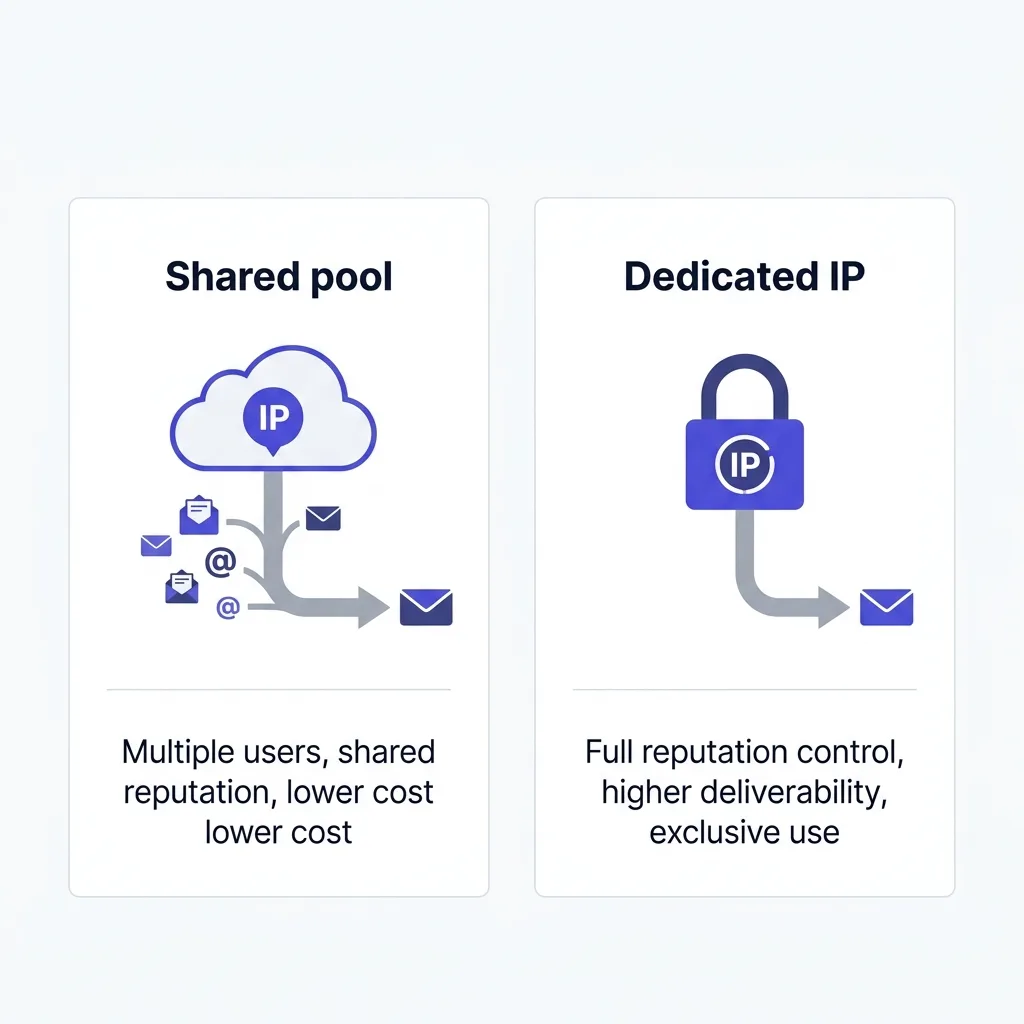
A dedicated IP is a single IP address that only your mail flows through.
A shared IP is a pool of addresses used by many senders on the same platform, with the platform managing overall pool hygiene.
Inbox providers like Gmail and Outlook build a reputation score for every sending IP based on complaint rate, bounce rate, engagement, and volume consistency.
With a shared IP, that score belongs to the pool, not to you alone.
With a dedicated IP, every good and bad signal is yours, and only yours.
That single fact decides almost everything else in this article.
#The default answer: stay shared
Here is the position most vendors will not say out loud: shared IPs are the better choice for the majority of cold email senders in 2026.
A shared pool run by a competent provider has years of accumulated reputation with Gmail and Microsoft.
Your first email rides on that history instead of starting from zero.
A brand-new dedicated IP has no history at all.
Inbox providers treat unknown IPs with suspicion by default, which means a fresh dedicated IP often gets throttled or filtered harder than a shared IP with an established track record.
You inherit years of trust on shared. You inherit a blank slate, and all the risk that comes with it, on dedicated.
This is also why the platform-wide reply rate drop matters here. Cold email replies fell from about 5.1% in 2024 to roughly 3.43% in 2026 across the market.
In a tighter environment, sending on an IP with no proven signal is a worse bet than it was two years ago, not a better one.
#Where the volume threshold actually sits
Providers disagree on the exact number, but they cluster in the same range.
Bird recommends dedicated IPs once a sender reaches roughly 100,000 emails a month with consistent volume. Mailgun ties its threshold to weekly totals, recommending dedicated IPs above 50,000 emails a week, which lands near the same monthly figure. Postmark sets the bar higher, recommending at least 300,000 messages a month before a dedicated IP is worth managing, and Batch reserves the recommendation for senders above 500,000 a month.
That spread exists because "worth it" depends on what you are optimizing for.
Below 100,000 a month, a dedicated IP simply cannot generate enough daily signal for Gmail and Microsoft's reputation systems to build confidence quickly.
You end up in a slower, riskier warmup than a shared pool would give you on day one.
Above roughly 150,000 to 200,000 a month, sent consistently, the math flips. At that volume you generate enough signal on your own IP to build a strong, independent reputation, and you stop being exposed to another sender's mistakes in the same pool.
| Monthly volume | Best fit | Why |
|---|---|---|
| Under 50,000 | Shared | Not enough volume to build IP-level signal at all |
| 50,000-100,000 | Shared | Faster time to sending, inherited reputation |
| 100,000-150,000 | Borderline | Depends on consistency, see next section |
| 150,000+ consistent | Dedicated worth considering | Enough signal to build independent reputation in weeks, not months |
Read this table against your actual mailbox count, not your aspirational one.
If you are running cold email infrastructure audit numbers and the fleet sends 20,000 emails a month across 15 inboxes, the dedicated IP conversation is premature.
#What breaks when you go dedicated too early
The most common failure mode is simple: a team gets a dedicated IP, sends inconsistently, and watches deliverability get worse, not better.
Inbox providers reward predictable, steady sending patterns and penalize spiky ones.
A shared pool absorbs a slow week from you because other senders keep the pool active.
A dedicated IP has no such buffer.
If you send heavily on Monday and Tuesday, then go quiet for the rest of the week, Gmail's reputation model reads that as suspicious, not as a scheduling choice.
The minimum viable pattern for a dedicated IP is sending at meaningful volume at least 3-4 days a week, every week, without long gaps.
Teams running seasonal campaigns, or campaigns that pause between quarters, break this pattern constantly.
That is exactly the profile that should never go dedicated, no matter how big the one-time send is.
The second failure mode is treating a dedicated IP as a fix for an existing reputation problem.
It is not. If your why cold emails land in spam issue is bad list quality or weak personalization, moving to a dedicated IP just gives you a fresh, unproven address to burn the same way.
Fix the content and targeting problem first. Infrastructure changes cannot rescue a broken message.
 Dashboard comparing shared IP pool reputation against a single dedicated IP over time
#The warmup math nobody mentions
A dedicated IP warmup is not the same thing as inbox warmup, and conflating the two causes real damage.
Inbox warmup builds trust for one mailbox address. IP warmup builds trust for the network address that mailbox sends through.
You need both, and they run on different timelines.
A typical dedicated IP warmup runs 4-6 weeks, starting at a few hundred emails a day and stepping up gradually as engagement holds steady.
Skip a step, and Gmail's reputation model resets the clock, sometimes punitively.
This is where the volume threshold argument comes back around: a sender doing 40,000 emails a month does not have enough daily volume to complete a proper warmup ramp in any reasonable timeframe.
You would be trickling a few hundred emails a day through a brand-new IP for months, all while your shared-pool alternative could be sending confidently from day one.
The 22% of teams that fully replaced human SDRs with AI outbound in 2026 learned this the hard way in several documented cases.
Aggressive AI-driven volume scaling, paired with a fresh dedicated IP and no warmup discipline, is a fast way to end up in deliverability incident response mode within the first month.
#Deciding: a simple flow
graph TD
    A[Monthly cold email volume] --> B{Under 100k/month?}
    B -->|Yes| C[Stay shared]
    B -->|No| D{Consistent 3-4+ days/week sending?}
    D -->|No| C
    D -->|Yes| E{4-6 weeks available to warm up?}
    E -->|No| C
    E -->|Yes| F{Existing shared reputation already strong?}
    F -->|Yes, and it works| C
    F -->|Capped by pool neighbors| G[Consider dedicated IP]
Notice how many branches lead back to shared.
That is not an accident. It reflects how the decision actually plays out for most senders who run the numbers honestly.
#Signals that say you are actually ready
A handful of concrete signals matter more than a single volume number.
Your monthly send count has stayed above 150,000 for at least two consecutive months, not one spike.
Your inbox fleet already passes spf dkim dmarc setup 2026 checks cleanly, with DMARC at enforcement, not monitoring only.
You have a dedicated person or process to watch daily deliverability metrics during the warmup window, not a "we'll check next week" plan.
Your shared-pool performance has specifically been capped by other senders in the pool, evidenced by placement drops that correlate with pool-wide spam spikes rather than your own campaign changes.
That last one is the real qualifier.
Most senders who think they have a shared-pool problem actually have a content or list problem, and no infrastructure change fixes that.
#The overrated idea: "control over your reputation"
The single most overrated argument for dedicated IPs is "control."
Vendors sell it as ownership: your reputation, your rules, nobody else can drag you down.
In practice, control cuts both ways, and most teams are not equipped to hold up their end.
On a shared pool, a competent provider is actively managing complaint thresholds, monitoring blocklists, and pruning bad senders from the pool.
On a dedicated IP, that job is now yours.
If your team does not have someone watching bounce rate and spam complaint rate daily during the first two months, "control" just means nobody is steering.
Google's bulk sender rules set a spam complaint ceiling of 0.1% and a bounce rate ceiling under 2%.
Those thresholds apply whether you are shared or dedicated, but on a dedicated IP there is no pool average to soften a bad week.
One bad list import, one aggressive send, and your own dedicated address absorbs the full hit alone.
Control without the operational discipline to use it is not an advantage. It is a liability with better branding.
#Shared vs dedicated: side by side
| Factor | Shared IP | Dedicated IP |
|---|---|---|
| Time to send with confidence | ✓ Immediate, inherits pool reputation | ✗ 4-6 week warmup required |
| Minimum volume to justify | ✓ Works from near zero | ✗ Needs 100k-150k+/month |
| Protection from other senders' mistakes | ✗ Shared risk in the pool | ✓ Isolated, good and bad |
| Operational burden | ✓ Provider manages hygiene | ✗ You manage reputation daily |
| Ceiling on placement at high volume | ✗ Can cap out at scale | ✓ No shared-pool ceiling |
| Recovery from a bad week | ✓ Pool average absorbs it | ✗ You absorb it alone |
| Good fit for seasonal or bursty sending | ✓ Yes | ✗ No, breaks warmup |
| Good fit for sustained six-figure monthly volume | ✗ Can become a bottleneck | ✓ Yes |
#How Google and Microsoft's rules change the calculus
Google's bulk sender requirements did not create the shared-vs-dedicated question, but they raised the stakes on both sides.
SPF, DKIM, and DMARC alignment are now required, not optional, for anyone sending meaningful cold email volume.
Get that wrong on a dedicated IP and there is no pool of well-authenticated neighbors to dilute the damage.
Microsoft's SmartScreen has also gotten more aggressive at detecting sequenced, templated sending patterns, on shared and dedicated IPs alike.
That means the authentication and pattern-consistency work described in google bulk sender rules 2026 is a prerequisite for either path, not a substitute for choosing correctly between them.
Apple's Mail Privacy Protection has quietly made opens an unreliable signal for judging any of this.
Whatever setup you choose, judge it on replies, bounces, and spam complaints. Do not judge it on open rate, which Apple now inflates by proxy-loading tracking pixels regardless of whether a human read the email.
#Monitoring either setup without guessing
Whichever path you pick, the monitoring discipline does not change.
You need bounce rate, spam complaint rate, and placement visibility, updated daily, not reviewed once a month after something has already broken.
This is the part teams underinvest in on both shared and dedicated setups, and it is the part that actually prevents the incidents worth writing a runbook for.
FirstSales tracks these signals per domain and per mailbox automatically, so a reputation dip shows up as an alert instead of a mystery three weeks later.
That matters more on a dedicated IP, where there is no pool average to hide a slow decline, but it matters on shared pools too if you want to catch a problem before it caps your sending.
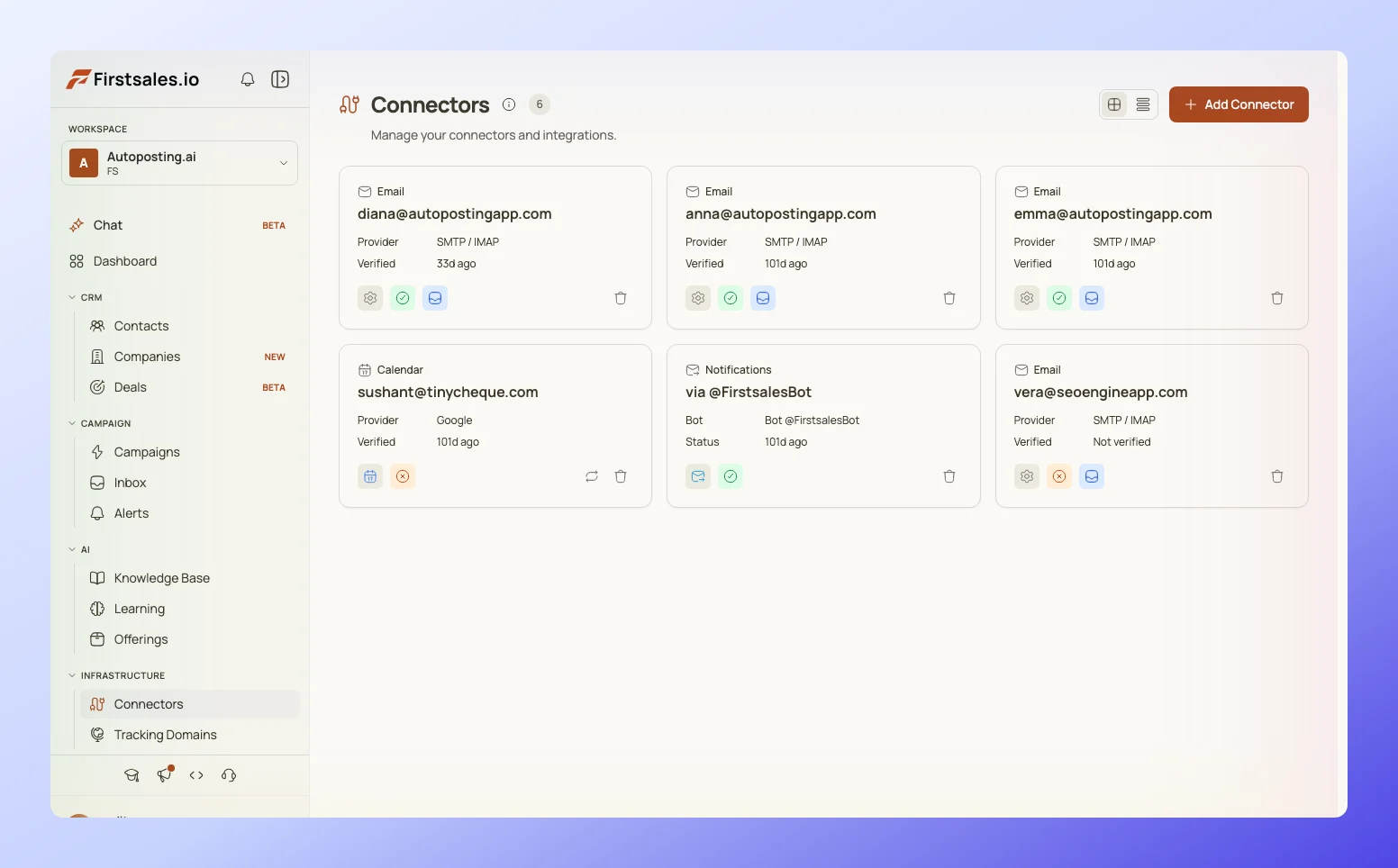 FirstSales deliverability monitoring dashboard showing bounce rate and spam complaint tracking
Teams that skip this step tend to find out about a reputation problem from a sudden drop in replies, which is the slowest, most expensive way to learn it.
If your current tooling cannot tell you spam complaint rate by domain this morning, that gap matters more than the shared-versus-dedicated decision itself.
Fix visibility first. The IP question gets much easier to answer once you can actually see what is happening.
#Domain strategy matters as much as IP strategy
A dedicated IP does not replace the need for a sane domain strategy underneath it.
Whether you go shared or dedicated, how many sending domains cold email volume you actually need is a separate question with its own math.
Most teams over-invest in domain count and under-invest in IP reputation discipline, which is backwards.
Get the domain count right for your volume, keep authentication clean, and the IP decision becomes a smaller lever than either one on its own.
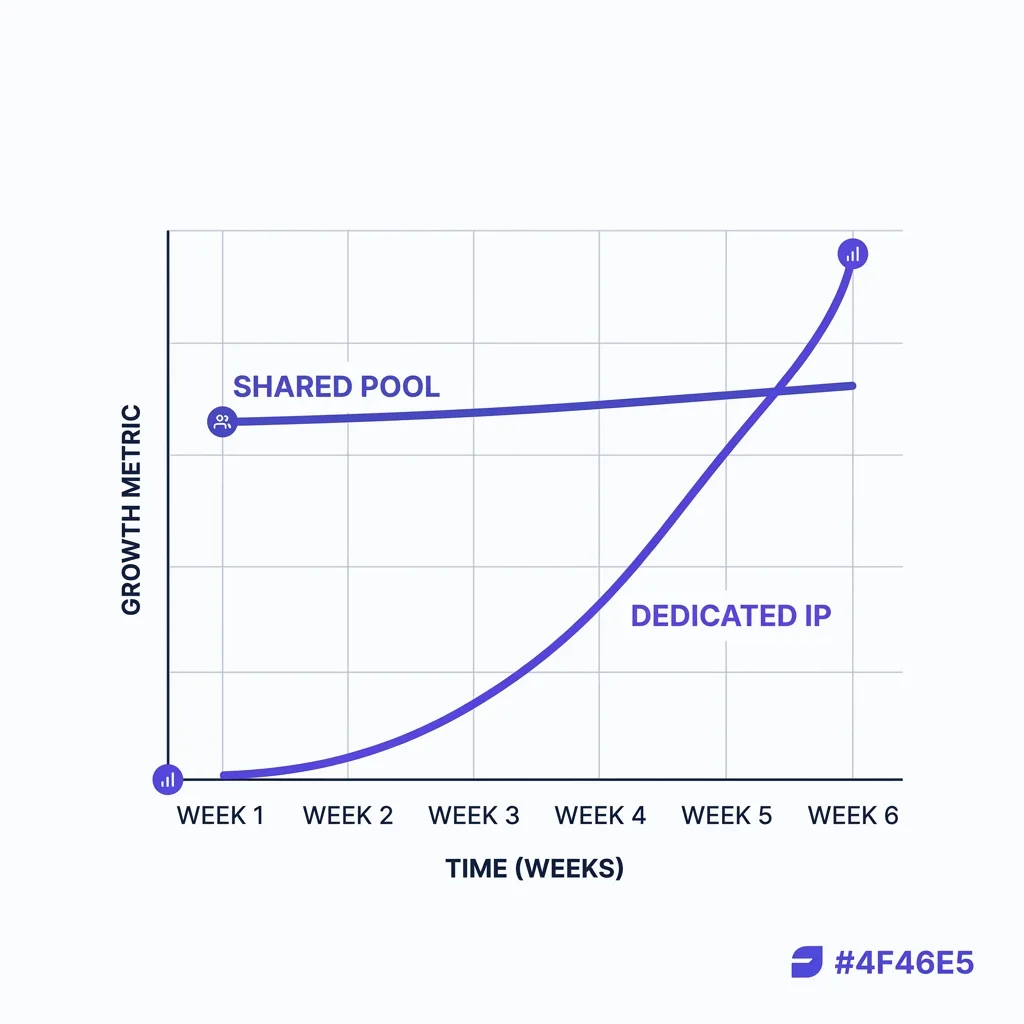 Comparison of email volume growth curves for shared pool versus dedicated IP warmup timelines
#Splitting across providers changes the equation too
One overlooked variable: if your fleet already spans Google, Microsoft, and private SMTP, as recommended in mailbox provider diversification, a single dedicated IP decision has to be made per provider relationship, not once for your whole stack.
A dedicated IP through your ESP affects how Gmail and Outlook see your traffic differently, since each inbox provider runs its own separate reputation model.
Provider diversification and IP strategy are not competing ideas. They solve different failure modes, and most mature senders eventually need both done correctly.
#What we would do differently if we ran this again
If you are under 100,000 emails a month, do not evaluate dedicated IPs at all this year.
Put the energy into cold email deliverability checklist fundamentals instead: authentication, warmup discipline, list hygiene, and send pacing.
Those four things move the needle more than an IP decision at low volume ever will.
If you are already north of 150,000 a month and considering the move, run the warmup on a secondary domain first, not your primary sending identity.
That way a mistake in month one costs you a spare domain, not your main pipeline.
#FAQ
#What volume do I need before a dedicated IP makes sense?
Most providers put the floor between 100,000 and 150,000 emails a month, sent consistently across at least 3-4 days a week. Below that, a shared pool with established reputation outperforms a fresh dedicated IP.
#Is a dedicated IP always better for deliverability?
No. A dedicated IP is only better once you have enough volume and consistency to build its own reputation quickly. Below that threshold, it starts from zero and often performs worse than a mature shared pool.
#How long does it take to warm up a dedicated IP?
Typically 4-6 weeks, starting at a few hundred emails a day and ramping gradually while watching bounce rate and spam complaints. Skipping steps can reset the warmup clock.
#Can I switch from shared to dedicated later without penalty?
Yes, but plan the switch as a full warmup, not a flip of a setting. Run it on a secondary domain first so a mistake does not touch your primary sending identity.
#Does a dedicated IP protect me from Google's bulk sender rules?
No. SPF, DKIM, DMARC alignment, the 0.1% spam complaint ceiling, and the under-2% bounce ceiling apply equally on shared and dedicated IPs. A dedicated IP just removes the pool average that might otherwise soften one bad week.
#Why do agencies often push dedicated IPs to clients?
Some agencies frame it as a premium feature or a way to justify a higher price. For clients under six-figure monthly volume, it usually adds risk and warmup time without a deliverability benefit.
#What happens if I send inconsistently on a dedicated IP?
Inbox providers read gaps and spikes as suspicious behavior on a lone IP, since there is no pool average to smooth the pattern. Reputation can degrade faster on an inconsistent dedicated IP than on a shared pool.
#Do dedicated IPs help with spam folder placement specifically?
Only once the IP has an established, positive reputation. A brand-new dedicated IP with no history can land in spam more often than a shared IP with years of accumulated trust.
#Is a dedicated IP worth it for a single big send, like an event invite blast?
No. A one-time high-volume send is the worst use case for a dedicated IP, since there is no time to warm it up and no ongoing volume to sustain its reputation afterward.
#How many dedicated IPs does a large sender need?
Large senders often split volume across multiple dedicated IPs by content type or list segment, so one bad segment does not damage the reputation of the whole sending operation.
#Does a dedicated IP help with Apple Mail Privacy Protection issues?
No. Mail Privacy Protection affects open-rate tracking regardless of IP setup. Judge deliverability by replies, bounces, and complaints on either path, not by open rate.
#What is the biggest mistake teams make with dedicated IPs?
Treating the move as a fix for a content or targeting problem. A dedicated IP is infrastructure. It cannot repair weak personalization or a bad list.
#Should a new company sending its first cold campaigns ever start dedicated?
Almost never. New senders benefit most from a shared pool's inherited reputation while they build their own list quality and messaging discipline.
#How does a shared IP pool get managed by a good provider?
A competent provider monitors complaint rates and bounce rates across the whole pool, removes bad senders, and keeps blocklist exposure low, work that shifts entirely to your team on a dedicated IP.
#Can pool neighbors on a shared IP hurt my deliverability?
Yes, in principle, if the provider does poor pool hygiene. In practice this is rarer with reputable providers than the marketing for dedicated IPs implies.
#What metrics should I watch during a dedicated IP warmup?
Bounce rate, spam complaint rate, and inbox placement, tracked daily. Open rate is not a reliable signal because of Apple's Mail Privacy Protection.
#Does Microsoft treat dedicated IPs differently from Google?
Both run separate reputation systems, and Microsoft's SmartScreen has gotten more aggressive at detecting templated, sequenced sending patterns on either IP type. Authentication and pacing discipline matter on both.
#Is there a monthly volume where dedicated IPs become mandatory, not optional?
Postmark and Batch put that ceiling much higher, around 300,000 to 500,000 emails a month, where shared pool limits start to actively cap throughput. Below that, dedicated is a choice, not a requirement.
#How do I know if my shared pool is actually capping my results?
Look for placement drops that correlate with pool-wide spam spikes rather than changes to your own campaigns or lists. If your own metrics are clean and placement still drops, the pool may be the ceiling.
#What should I fix before even considering a dedicated IP?
Authentication (SPF, DKIM, DMARC at enforcement), list hygiene, consistent send pacing, and daily visibility into bounce and complaint rates. A dedicated IP without those in place just moves the same risk to a less forgiving setup.
#Conclusion
The dedicated IP question sounds like an infrastructure upgrade, but it is really a volume and discipline question first.
Under 100,000 emails a month, stay shared. The math does not support the switch, no matter how the pitch is framed.
Between 100,000 and 150,000, only move if your sending is genuinely consistent, week over week, with a real plan to run the 4-6 week warmup properly.
Above that, with steady volume and daily monitoring in place, a dedicated IP becomes a reasonable lever, not a required one.
Whatever you choose, the authentication, list hygiene, and monitoring work matters more than the IP decision itself.
Get those right first, watch your numbers daily instead of monthly, and the shared-versus-dedicated question becomes a much smaller decision than it currently feels like.
Sources: