
TL;DR: InMail response rates average 18-25%, with top performers hitting 30-40%, well above the 3-8% cold email now gets from generic sends. But the volume math does not scale the way most teams assume. A single seat gets 50 Sales Navigator credits a month, unused credits cap at 150, and LinkedIn cut Open InMail from roughly 800 sends a month to under 100 in late 2025. Picture a system built to move 250,000 messages a month and you are immediately looking at a different product entirely: Sponsored InMail bought in bulk, not personal credits stretched across a headcount you do not have. This piece walks through the real mechanics, where the volume ceiling actually sits, and what breaks first when a smaller team tries to copy the enterprise playbook without the enterprise budget.
#What InMail actually is, and what it is not
InMail is a paid message that reaches someone outside your network on LinkedIn.
It bypasses the connection request step entirely.
That matters for one specific audience: senior buyers who ignore connection requests from strangers but will open a message that lands directly in their inbox with a subject line worth reading.
There are two products hiding under one name, and most articles about InMail conflate them.
Personal InMail comes from Sales Navigator or Recruiter seats, paid for per user, with a monthly credit allowance.
Sponsored InMail, now folded into LinkedIn's Message Ads product, is bought through the ads platform and billed per send, with no personal seat or credit ceiling attached.
Confusing the two is the single most common reason a team's volume projections fall apart before the first campaign even launches.
#The math nobody runs before scaling
A standard Sales Navigator Core seat gets 50 InMail credits a month.
Unused credits roll over, but the account caps at 150 total, so hoarding only buys three months of runway before the ceiling hits anyway.
Recruiter seats get more, but the number still sits in the low hundreds, not the thousands.
Open InMail, the free-to-send option available to open profiles and certain premium tiers, took a hard cut in late 2025.
LinkedIn dropped the practical limit from around 800 sends a month down to under 100, an 87% reduction in outbound capacity for anyone relying on that route.
Do the arithmetic on a 10-person BDR team running personal Sales Navigator seats.
At 50 credits each, that team can send 500 InMails a month, total, before anyone runs dry.
Getting to five figures of monthly volume through personal credits alone would require dozens of seats, which most mid-market teams simply do not carry on the books.
That gap between what a headcount can produce and what the goal requires is exactly where teams start looking at automation tools, seat pooling schemes, and workarounds that LinkedIn's terms of service do not permit.
#Personal credits vs sponsored InMail: two different products
The honest path to real volume is Sponsored InMail, now sold as part of Message Ads inside LinkedIn Campaign Manager.
It is bought in bulk, priced per send with cost varying by targeting specificity, and it does not touch a personal seat's credit pool at all.
DocuSign ran exactly this play years ago, buying sponsored InMail in bulk for a six-month lead generation push, and reported sales rising from 550 to more than 800 participants in the targeted segment, a 45% lift.
That is the model that actually supports high volume: a paid media buy, run through the ads platform, distinct from the personal outreach a rep sends from their own seat.
| Capability | Personal InMail (Sales Navigator) | Sponsored InMail (Message Ads) |
|---|---|---|
| Volume ceiling | ✓ Predictable, low (50-150/seat) | ✓ Scales with ad budget |
| Sender identity | ✓ Comes from a real rep | ✗ Often comes from a brand page |
| Cost structure | ✓ Fixed per-seat license fee | ✗ Variable, billed per send |
| Personalization depth | ✓ One-to-one, manual or AI-assisted | ✗ Templated at segment level |
| Best for | ✓ Named-account, high-touch outreach | ✗ Awareness and top-of-funnel volume |
| Response rate | ✓ 18-40% when well targeted | ✗ Typically single digits, ad-like |
Sponsored InMail wins on volume.
Personal InMail wins on response rate, because it comes from a human being with a real profile the recipient can check.
Most teams building an outbound motion, not a paid media motion, actually want the second one, run more efficiently, not a bulk buy that reads like an ad because it is one.
#Picture a system built to move 250,000 messages a month
Take that volume as a thought experiment, not a claim about any one company's exact numbers, and the architecture becomes obvious fast.
Getting to 250,000 sends a month through personal credits alone would need roughly 5,000 fully-loaded Sales Navigator seats.
No BDR org runs that headcount for a single channel.
So a system sized to that volume is, structurally, almost entirely a Sponsored InMail buy, layered with a much smaller personal-credit tier reserved for named strategic accounts.
The sponsored layer does the reach.
The personal layer, run by a real team with real seats, does the accounts where a generic ad-style message would actually hurt the deal.
That split is the actual lesson hiding inside any "run InMail at massive scale" pitch: the volume comes from paid media mechanics, and the quality comes from a much smaller, carefully targeted human layer riding alongside it.
Teams that try to hit big volume numbers purely through personal seats end up buying dozens of Sales Navigator licenses for people who are not actually doing sales development work, just clicking send on a queue.
That is an expensive way to rebuild what Message Ads already does more cheaply.
#Response rates by segment, and why yours will differ
InMail's average response rate sits at 18-25%, which is already well ahead of the 3-8% generic cold email now pulls after years of inbox saturation.
Top-performing InMail campaigns, well-targeted and personalized, hit 30-40%.
Cold, templated, unpersonalized InMail with generic subject lines and messages running past 400 characters falls to 3-8%, the same range as bad cold email.
Industry variance is wide.
Recruiting sits at the top of the range, 18-25% on average, because a message about a job opportunity carries built-in relevance that a cold sales pitch does not.
SaaS and software outreach lands closer to 4.77%, reflecting how saturated that buyer segment already is with vendor outreach across every channel.
Prior engagement changes the number more than almost any other lever.
InMail sent to someone who already engaged with your content, a post, a comment, a shared article, performs 2 to 3 times better than the same message sent cold to a stranger.
That is the single highest-leverage move available before writing a single word of copy: build the list from people who have already shown up somewhere, not a static export from a data provider.
graph TD
    A[250k/month target volume] --> B{Which product?}
    B -->|Personal seats| C[5,000 seats needed]
    B -->|Sponsored InMail| D[Ad budget, per-send cost]
    C --> E[Not realistic for most orgs]
    D --> F[Reach at scale, lower response rate]
    D --> G[Small personal layer for named accounts]
    G --> H[18-40% response, human sender]
    F --> I[Single-digit response, ad-like]
#What breaks first when a smaller team copies this
The first thing to break is the credit budget.
A team sees a competitor or a case study running big InMail numbers and buys 20 Sales Navigator seats expecting five-figure monthly volume, then hits the wall at 1,000 sends and wonders where the rest of the plan went.
The second thing to break is message quality under volume pressure.
A rep with a real quota to hit and a shrinking credit pool starts sending faster, personalizing less, and the response rate slides from 25% toward the 3-8% floor, exactly the outcome the credit scarcity was supposed to prevent.
The third thing to break is reply handling.
Response rates above 20% generate a meaningful volume of replies fast, and teams that built the sending motion but not the triage motion end up with threads going stale inside 48 hours, killing exactly the momentum a good InMail response created.
The fourth thing to break is account overlap with email.
Running InMail and cold email into the same account without any coordination produces the exact experience buyers complain about most: two different reps from the same company hitting the same person the same week with unrelated messages.
A multichannel sequence that coordinates timing across email and LinkedIn avoids that collision, but it requires the two channels to actually talk to each other, which most teams bolt together after the fact rather than designing in from the start.
#Where email fits once InMail is doing the heavy lifting
InMail is expensive per send in a way email is not.
Even at the lower end of Sponsored InMail pricing, a single send costs meaningfully more than an email send once infrastructure is already built.
That cost difference argues for a specific sequencing logic: use InMail for the accounts where a human sender and a direct inbox landing genuinely matter, and let email carry the volume for everyone else.
Our breakdown of LinkedIn DMs versus cold email covers the cost and response tradeoff in more depth, but the short version holds here too.
Email scales cheaply and supports far more experimentation on subject lines, timing, and sequencing depth before any single send costs real money.
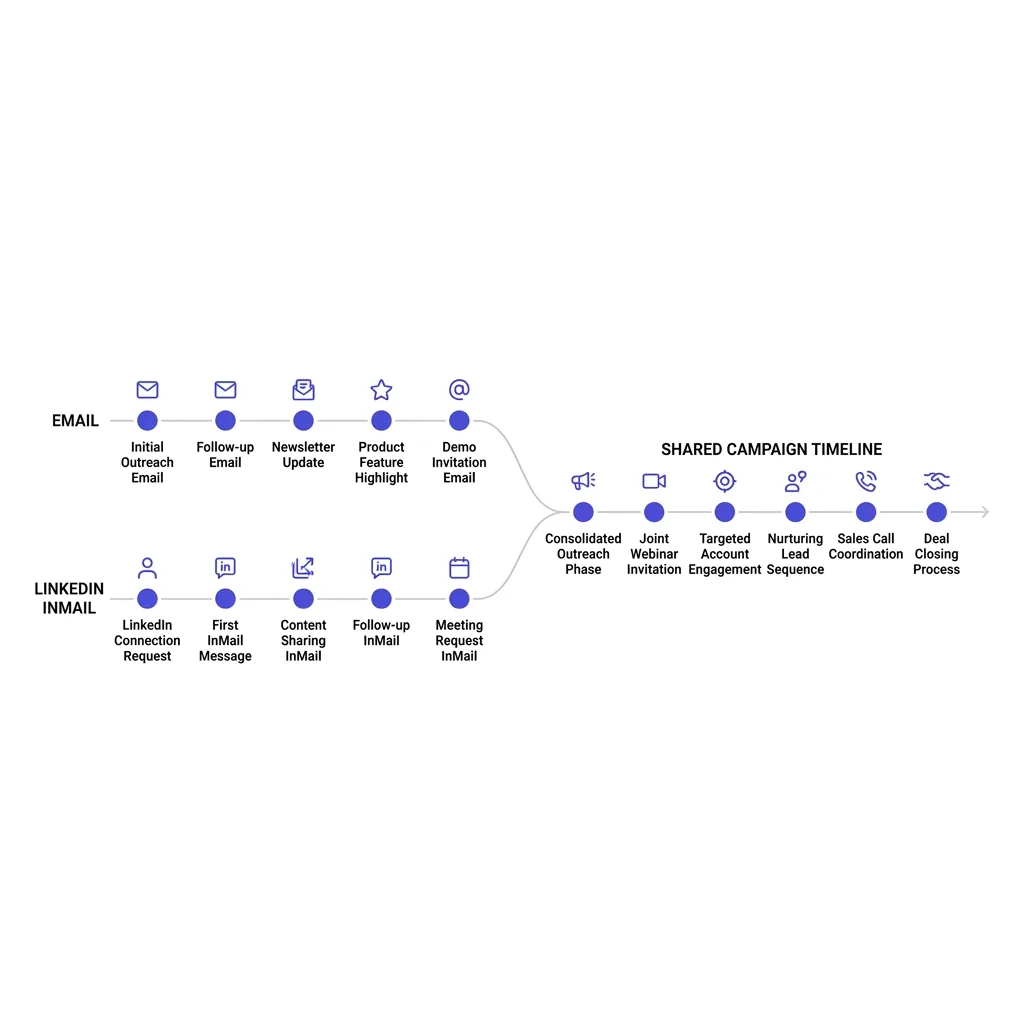 Cold email and LinkedIn InMail sequenced together in a shared campaign timeline
Teams using FirstSales to draft and sequence the email side of a campaign, with a human approving every send before it leaves, often reserve InMail specifically for the accounts that email alone has not moved after two or three touches.
That keeps the expensive channel focused on the accounts that have already earned the extra spend, rather than burning credits on a cold list that has not been tested any other way first.
Below is what that kind of coordinated sequence looks like inside a campaign builder, with email and connection touches mapped against the same timeline rather than run as two disconnected motions.
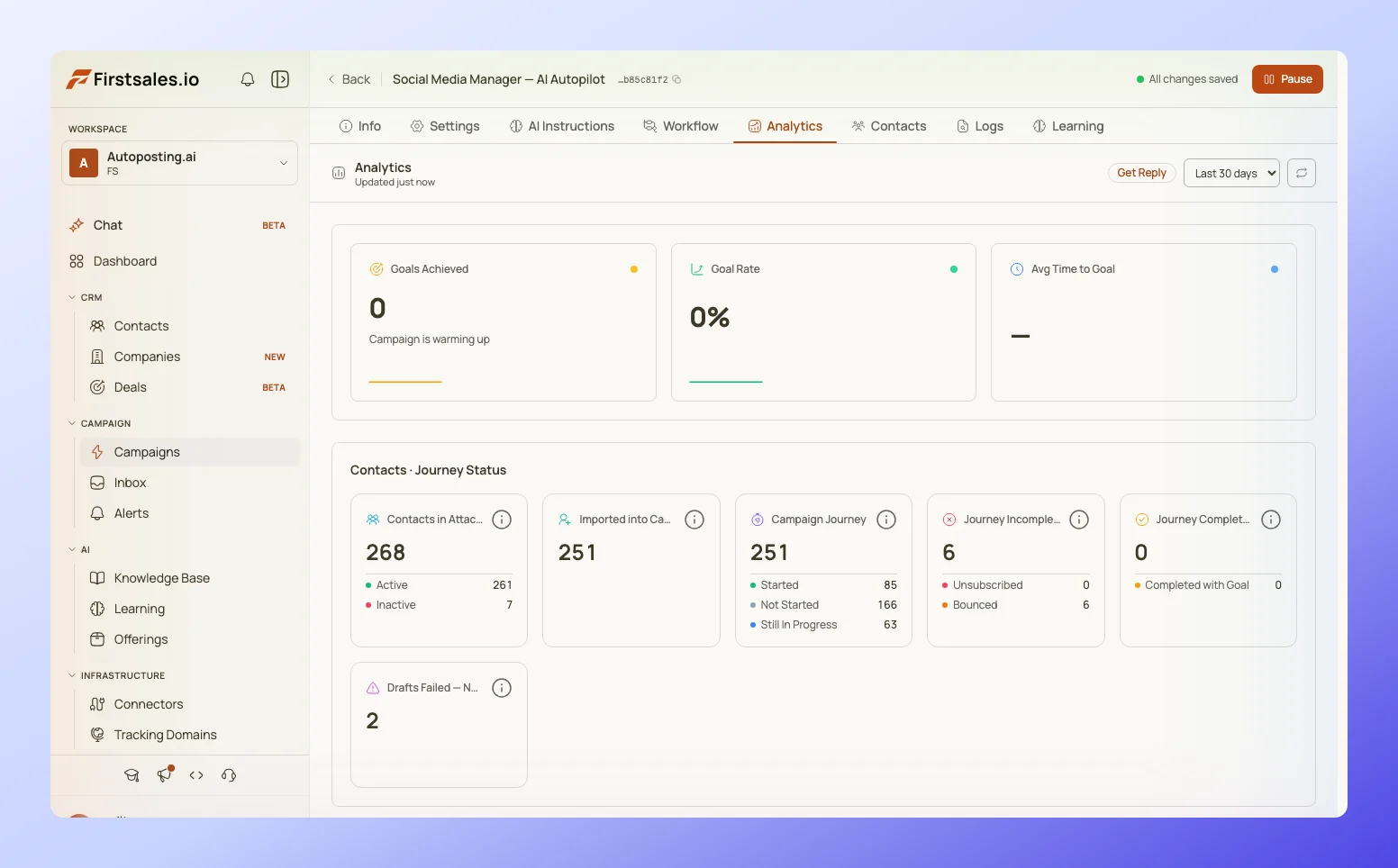 FirstSales campaign sequence builder showing coordinated email and LinkedIn touchpoints on one timeline
#Which accounts actually deserve an InMail credit
Not every account on a list deserves a scarce InMail credit.
Named accounts where a connection request has gone unanswered for two weeks are strong candidates, since the InMail bypasses the exact friction point that stalled things.
Senior buyers, VP and above, who rarely accept cold connection requests but do read a well-targeted message that lands directly in their inbox are another clear fit.
Accounts already showing intent signals, a job posting, a funding round, a platform migration, deserve the credit more than a cold list entry with no context at all.
Our guide on account tiering for outbound sets out a fuller framework for deciding how much research and channel spend each tier earns, and InMail credits should follow that same tiering logic rather than being spent first-come, first-served down a flat list.
Skip InMail entirely for low-tier accounts where a cheap, high-volume email touch can test interest first.
Save the credit for the moment an account has proven it is worth the extra cost, not the moment it first appears on a list.
#Account risk and platform enforcement at volume
LinkedIn tracks messaging behavior at the account level, and unusually high send volume from a personal profile draws attention faster than most reps expect.
Accounts sending at a pace that looks automated, uniform timing, identical message structure, no variation in response to replies, risk restriction regardless of whether an actual tool is involved.
That risk multiplies for teams running connection requests near the platform's published limits at the same time as a heavy InMail push, since the combined signal reads as aggressive account behavior even if each channel individually stays within its own ceiling.
The safer pattern staggers volume across both channels rather than maximizing each independently, and it keeps message variation high enough that no two sends in a day read as copies of each other.
Sponsored InMail carries none of this personal-account risk, since it runs through the ads platform rather than an individual profile, which is one more reason the volume layer and the relationship layer genuinely belong to different tools.
#The operating rhythm that keeps a system like this running
A working InMail motion needs three distinct rhythms running at once, and teams that only build one of them see the whole system stall within a month.
The first rhythm is sourcing: keeping a fresh supply of accounts that meet the tiering bar, so reps are never tempted to spend a scarce credit on a weak fit just to hit an activity number.
The second rhythm is reply triage, ideally same-day given how fast a 20%+ response rate generates volume, since a reply sitting unanswered for 48 hours loses most of the momentum that earned it in the first place.
The third rhythm is credit forecasting, tracked weekly rather than discovered at month's end, since a team that runs out of credits on day 22 has effectively shut down the channel for the last third of every month.
Teams coordinating InMail with parallel channels also need a shared view of who has touched which account and when, the same coordination problem covered in our piece on multithreading a buying committee, since InMail into one stakeholder while email hits a different one at the same company needs a shared timeline, not two reps working blind.
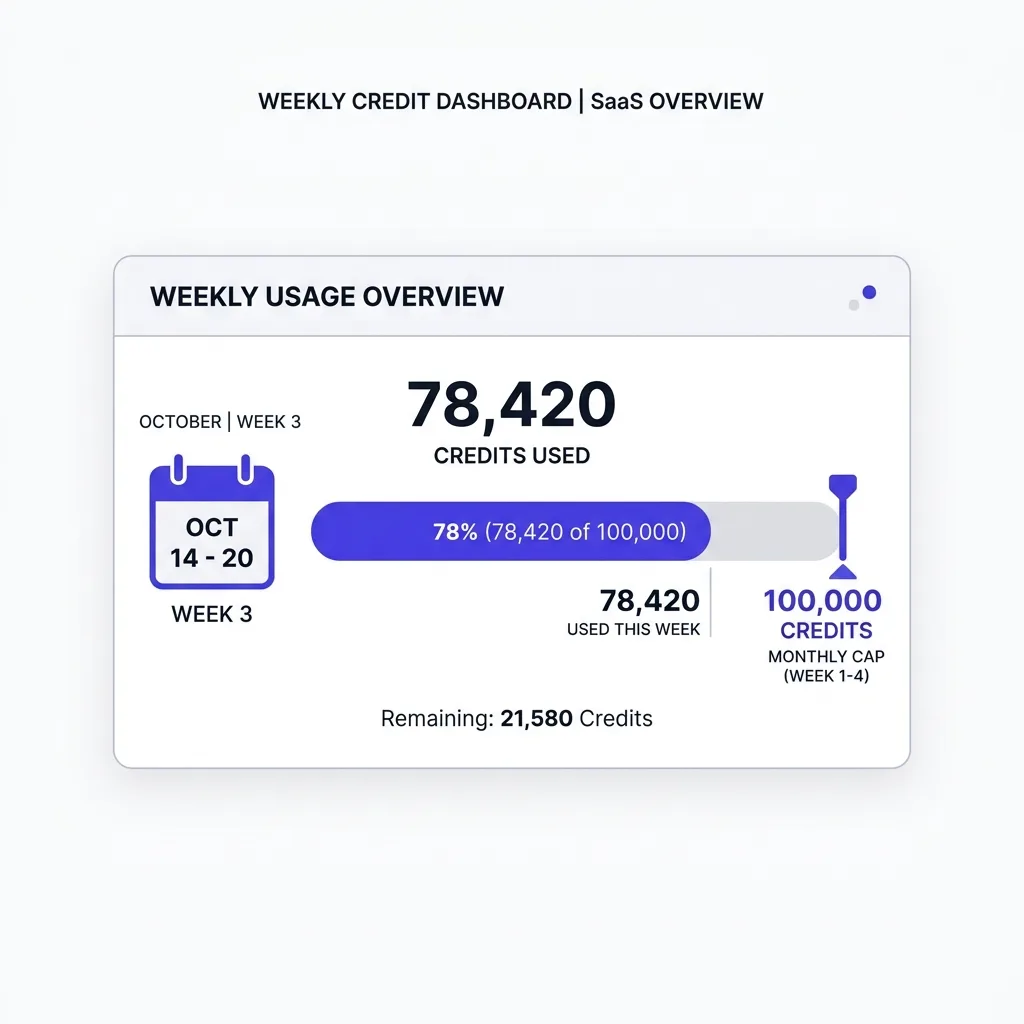 Weekly credit forecasting dashboard tracking InMail send volume against monthly allowance
#A leaner version for teams under 50 seats
Most teams reading this are not running a 5,000-seat operation, and they should not try to build one.
A team under 50 seats gets more value treating InMail as a precision tool reserved for the top 10-15% of accounts by tier, run entirely through personal Sales Navigator credits, with no sponsored layer at all.
At that scale, the 50-credit monthly ceiling per seat is not a constraint worth fighting.
It is a forcing function that keeps the channel disciplined, since a rep who only gets 50 shots a month has to think harder about each one than a rep buying unlimited reach through an ad budget.
Pair that disciplined InMail layer with a broader, cheaper email motion covering the rest of the list, and let a proper outbound cadence built around deal size decide how much of each channel any given account tier actually earns.
That combination, tight InMail on the top tier, volume email everywhere else, produces most of the reply-rate advantage the enterprise systems get, without the ad spend or the headcount those systems actually require underneath the case study numbers.
#Comparing InMail against the rest of a channel stack
Cost per reply is the number that eventually forces a real decision about channel mix, and InMail rarely wins that comparison in isolation once ad spend or seat costs are counted against replies generated.
A framework for running that comparison fairly across email, LinkedIn, phone, and direct mail lives in our piece on channel mix cost per reply, and it is worth running before committing serious budget to any single channel, InMail included.
The honest conclusion most teams reach after running that math is that InMail is a premium tool for a small slice of the list, not the backbone of an outbound motion.
That is not a criticism of the channel.
It is simply what a 50-credit monthly ceiling and a real per-send cost on the sponsored side are telling every team that runs the numbers honestly.
#FAQ
#How many InMail credits does a standard Sales Navigator seat get?
50 credits a month for a Core seat, with unused credits rolling over up to a maximum of 150 total.
#Can InMail credits be pooled across a team?
LinkedIn's terms tie credits to the individual seat they are issued to. Sharing or transferring credits between accounts is not a supported or permitted workaround.
#What happened to Open InMail in 2025?
LinkedIn cut the practical monthly limit on Open InMail from roughly 800 sends down to under 100, an 87% reduction in free outbound capacity for open-profile accounts.
#What is the real difference between personal InMail and Sponsored InMail?
Personal InMail comes from an individual's Sales Navigator or Recruiter seat with a monthly credit cap. Sponsored InMail, sold as Message Ads, is bought through the ads platform, billed per send, with no personal credit ceiling.
#What response rate should I expect from InMail?
18-25% on average, with top campaigns hitting 30-40%. Cold, generic, unpersonalized InMail falls to 3-8%, similar to poor cold email.
#Does industry affect InMail response rates significantly?
Yes. Recruiting sees the strongest average response rates, around 18-25%, while SaaS and software outreach averages closer to 4.77% due to buyer saturation.
#Is it true that 250,000 InMails a month is achievable through personal seats?
Not through personal credits alone. That volume would require roughly 5,000 fully-credited seats. Volume at that scale runs through Sponsored InMail, a different product bought through LinkedIn's ads platform.
#Does InMail work better than a cold connection request?
For senior buyers who ignore connection requests, yes, since InMail lands directly in their inbox without requiring acceptance first. For lower-seniority contacts, a personalized connection request often performs comparably at a much lower cost.
#How much does Sponsored InMail cost per send?
Pricing varies by targeting specificity and is billed through LinkedIn's Campaign Manager auction system, not a fixed per-message rate. Expect it to run meaningfully higher than a personal email send once infrastructure is already built.
#Can automation tools send InMail on my behalf at scale?
Automating sends from a personal LinkedIn account outside LinkedIn's own tools violates the platform's terms of service and carries real account restriction risk.
#Why do engaged prospects respond so much better to InMail?
Prior engagement, a post like, a comment, a shared article, gives the recipient a reason to recognize the name before the message arrives, which raises response rates 2 to 3 times over a fully cold send.
#Should InMail replace cold email in an outbound sequence?
No. The per-send cost and credit ceiling make InMail a poor fit for volume. It performs best as a precision layer for high-tier accounts, running alongside a broader email motion.
#How fast should replies to InMail be handled?
Same day where possible. A response rate above 20% generates real reply volume quickly, and a reply left unanswered for 48 hours loses much of its momentum.
#Does running InMail and connection requests together increase account risk?
Yes, if both are pushed near their individual limits simultaneously, since the combined pattern can read as aggressive automated behavior even when each channel is technically within its own cap.
#What accounts should get priority for a scarce InMail credit?
Named accounts with a stalled connection request, senior buyers unlikely to accept cold requests, and accounts already showing an intent signal like a funding round or job posting.
#Is InMail worth it for a small team under 50 seats?
Yes, treated as a precision tool for the top 10-15% of accounts by tier rather than a volume channel. The 50-credit ceiling naturally enforces that discipline.
#How does InMail length affect response rates?
Messages over 400 characters with generic phrasing tend to fall into the 3-8% cold range. Shorter, specific, personalized messages perform closer to the 18-40% band.
#Can I use InMail credits on accounts outside my target industry?
Nothing technically prevents it, but response rate data shows industry fit matters enormously, from 4.77% in saturated SaaS outreach up to 18-25% in recruiting. Spend credits where the segment data supports it.
#Does AI drafting help with InMail specifically?
AI-assisted drafting can speed up the research and first-draft step, but the credit scarcity argues for keeping a human reviewing every InMail before it sends, since each one costs more to waste than a single email does.
#What is the single biggest mistake teams make copying enterprise InMail case studies?
Assuming the volume came from personal seats and buying dozens of Sales Navigator licenses to chase it, when the real volume almost always runs through a separate, sponsored ad product.
#Conclusion
InMail earns its reputation honestly.
Response rates of 18-40% for well-targeted sends are real, and they hold up against a cold email landscape that has gotten measurably harder over the past two years.
But the volume story that gets repeated in case studies almost never comes from the product most teams think it does.
A 50-credit monthly ceiling per seat is not a bug in the system, it is the entire discipline that makes personal InMail work as well as it does.
Chasing five- or six-figure monthly InMail volume through personal seats alone is not a scaling problem to solve.
It is a sign the team is reaching for the wrong product, when a Sponsored InMail buy or a properly tiered, multichannel sequence would get more real replies for the same budget.
Build the small, disciplined personal layer first.
Add sponsored volume only once the tiering and reply-handling rhythm underneath it can actually keep up.
That order, discipline before scale, is the part every case study skips, and the part that actually determines whether an InMail motion holds up past the first busy month.