
#Buying signals before the funding round hits TechCrunch
Copy page
TL;DR: By the time a funding round shows up in your alert tool, three to eight weeks have already passed since the term sheet was signed, and every other vendor tracking funding-round cold email got there first. The real edge sits in second-degree signals that fire earlier: a burst of senior hires with no announced reason, a sudden run of infrastructure job posts, a leadership team quietly filling out LinkedIn bios, or a company scrubbing its pricing page. None of these alone is proof of a raise. Stacked together, they are a strong enough hypothesis to write a specific, early email instead of a generic congratulations note that lands in the same week as fifty others.
#Table of contents
- Why the funding announcement is the worst time to email
- What actually happens before a round closes
- Signal one: senior hiring bursts with no public reason
- Signal two: infrastructure and ops job posts before the product posts
- Signal three: leadership team page and LinkedIn churn
- Signal four: pricing page and website changes
- Signal five: legal and finance job posts
- Signal six: investor social activity
- How to stack signals instead of trusting one
- A scoring model you can actually run
- What to write once you see the pattern
- Where this breaks
- Signal comparison table
- Building the pipeline without a data science team
- FAQ
- Conclusion
Funding round outbound is the most crowded trigger in B2B sales.
The moment a raise gets announced, every tool tracking it fires an alert to thousands of reps at once.
Your email lands in a stack of fifty near-identical notes, all saying some version of "congrats on the round, want to chat about scaling."
That congestion is the whole problem with treating a funding announcement as a signal instead of as the end of one.
#Why the funding announcement is the worst time to email
A funding announcement is a lagging indicator.
The round closed weeks ago.
Legal finished the paperwork, the press release got scheduled, and the company already had internal conversations about headcount and tooling before a single outlet published the story.
By the time your alert tool tells you, the buyer has often already made the first few decisions the round was meant to fund.
Reply rates on cold email overall have fallen from 5.1% in 2024 to around 3.43% in 2026, and generic sends without a real trigger sit at 1-3%.
A funding-triggered email sent the week of the announcement, competing against dozens of identical messages, behaves like a generic send even though it looks personalized.
Signal-based email that catches something earlier and more specific performs in the 5-18% range instead, because the buyer has not been trained yet to ignore that particular pattern.
The gap is not about having better copy.
It is about which week you show up in.
#What actually happens before a round closes
A funding round is not a single event.
It is a sequence of internal decisions that each leave a small trace, most of them invisible to a tool that only watches press releases.
Term sheets get signed privately, often 30 to 90 days before any public announcement, depending on round size and whether the company wants a quiet or loud close.
During that window, the company already knows the money is coming.
Founders start making commitments they could not make a month earlier: approving headcount plans, greenlighting a platform migration, telling a VP of sales they can finally build out the team they have been asking for.
Those commitments show up as job posts, hiring pushes, LinkedIn title changes, and quiet website edits, all before a single dollar clears escrow.
None of these signals is a funding round by itself.
Each one is also explainable by a dozen other causes: a resignation, a normal hiring cycle, a rebrand that has nothing to do with capital.
The value is in the pattern, not any single data point.
#Signal one: senior hiring bursts with no public reason
Watch for a company posting three or more senior roles (VP, Head of, Director) in a 30-day window when nothing else in the news explains it.
A single VP opening is normal churn.
Three senior openings across different functions, sales, engineering, and finance, at the same small or mid-size company in the same month, is a company that just got budget approval it did not have before.
This differs from a normal hiring signal, which usually tracks headcount growth generally.
The version worth watching here is specifically senior and specifically clustered, because junior hiring waves have too many other causes to be a useful early flag.
Cross-reference against company size.
A 40-person company opening three VP roles at once is a much stronger signal than a 400-person company doing the same thing, because the smaller company's hiring capacity is more tightly bound to available cash.
#Signal two: infrastructure and ops job posts before the product posts
Companies that just raised tend to hire operational and infrastructure roles before they hire the visible, product-facing roles that make headlines.
A DevOps engineer, a data engineer, a systems administrator, or an RevOps hire often shows up in job boards two to four weeks before the sales and marketing roles that everyone notices.
This is the quiet part of a raise.
Leadership knows the team is about to scale and starts fixing the plumbing first, because a broken CRM or an undersized data pipeline becomes a real problem the moment headcount doubles.
If you sell into infrastructure, data tooling, or RevOps categories, this signal fires earlier for you than for a competitor selling brand or marketing tools, which tend to get funded closer to or after the public announcement.
Job-post signals and hiring signals are related but not identical: see job posts versus hiring signals for the distinction, since treating them as the same input wastes sends on the wrong trigger.
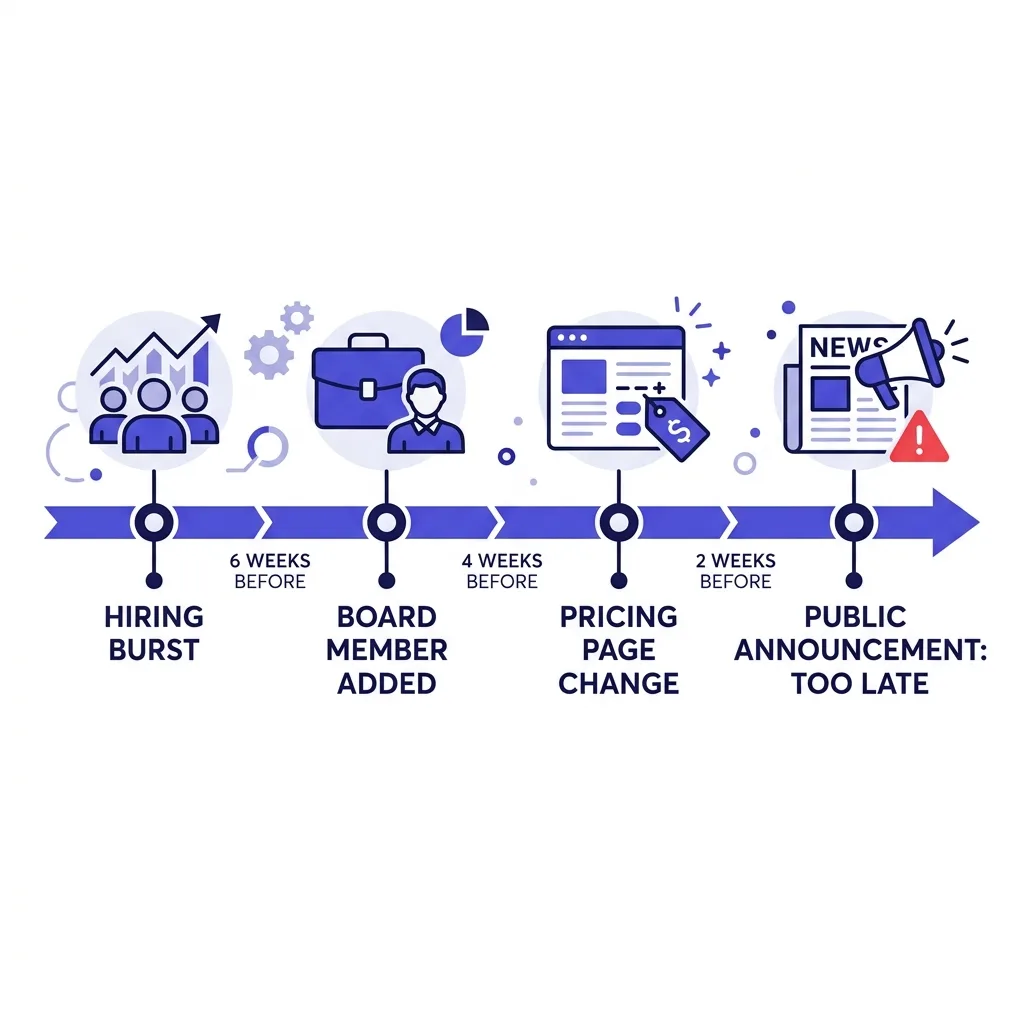 Timeline showing pre-funding signals appearing weeks before a public funding announcement
#Signal three: leadership team page and LinkedIn churn
A company preparing to announce a raise often cleans up its public presentation in the weeks beforehand.
Watch for a "leadership" or "team" page on the company website adding two or three new senior names that are not yet reflected in a press release.
Watch LinkedIn for founders and early executives updating their titles from "Co-founder" to "CEO" or "Co-founder & CEO," a small but real signal that governance is being formalized ahead of a raise closing.
New board members appearing on LinkedIn profiles before any announcement is one of the more reliable single signals in this list, because board seats are usually part of the negotiated terms and get added to a profile once the person is confident the deal is closing.
None of this requires paid tooling.
A manual check of a target account's LinkedIn company page and its top five executives' profiles, run once a week for accounts you actually care about, catches most of this.
#Signal four: pricing page and website changes
Pricing pages quietly change ahead of a raise more often than people assume.
A company moving from published pricing to "book a demo," or the reverse, from opaque enterprise pricing to a self-serve tier, is often testing a new go-to-market motion that a fresh round is meant to fund.
A new "Enterprise" tier appearing where there previously were only two simpler plans usually means the company is preparing to sell upmarket, which requires the exact kind of budget a raise provides.
Website copy shifting from feature-focused language to outcome or ROI language is another tell, often coinciding with a new VP of Marketing brought in during the pre-close hiring wave described above.
These changes are cheap to monitor.
A simple weekly screenshot diff or a change-tracking tool on a target account's pricing and homepage catches most of it without any special data access.
#Signal five: legal and finance job posts
A Controller, a Head of Finance, or in-house counsel appearing as an open role at a company that previously ran finance through an outsourced bookkeeper or a fractional CFO is a strong pre-raise tell.
Companies raising institutional money almost always need to formalize their finance function before the round closes, because due diligence requires clean books and a named person accountable for them.
This signal is slower and less common than the hiring bursts above, but it is also harder to fake or explain away with an unrelated cause.
A company does not typically hire in-house counsel for reasons unrelated to a transaction, whether that transaction is a raise, an acquisition, or a major partnership.
#Signal six: investor social activity
Existing investors sometimes tip their hand before a company does.
Watch for a VC firm's associates or partners following, liking, or commenting on a target company's posts in a pattern that looks more active than a normal portfolio-monitoring relationship.
A new investor account following a company's LinkedIn page, especially one that does not appear in any prior public portfolio list for that fund, can indicate an active or closing deal.
This is the weakest signal on this list taken alone, prone to false positives from normal networking behavior, but it strengthens a hypothesis meaningfully when it appears alongside two or three of the signals above.
#How to stack signals instead of trusting one
The mistake most teams make with early signals is treating any single one as sufficient reason to email.
A single senior job post is noise.
Two senior job posts plus a new board member on LinkedIn plus a pricing page change in the same month is a pattern worth acting on.
This is the same logic behind compound buying signals: no individual trigger carries much weight, but three unrelated triggers converging on the same account in a tight window is meaningfully more predictive than any one of them.
Treat pre-funding signals the same way you would treat any other early-stage hypothesis.
Confirm with at least two independent sources before writing, and be specific about what you actually saw rather than implying certainty you do not have.
#A scoring model you can actually run
You do not need a machine learning model to run this.
A simple weighted checklist, tracked in a spreadsheet or a CRM custom field, works for a target list under a few hundred accounts.
Assign each signal a point value based on how rare and how hard to fake it is: 3 points for a new board member or in-house counsel hire, 2 points for a senior hiring burst or infrastructure job posts, 1 point for a pricing page change or investor social activity.
Treat any account scoring 4 or more points in a 30-day window as a candidate for outbound, and treat anything below that as watch-and-wait.
This kind of lightweight, why-now context belongs somewhere durable, not just in your head. See the why-now field in your CRM for how to store it so the reason for reaching out survives past the first email and into every follow-up.
Feeding this into a waterfall enrichment process, where you check the cheapest sources first and only pay for deeper data on accounts that clear an initial bar, keeps the cost of running this system reasonable even without a large research budget.
#What to write once you see the pattern
The email itself should never claim certainty about a funding round you have not confirmed.
Reference the actual thing you observed, not your inference from it.
"I noticed you're hiring a VP of RevOps and a Head of Data within a few weeks of each other" is a true, specific, checkable statement.
"Congrats on your Series B" when you are guessing is a claim that can be wrong and reads as either lucky or presumptuous depending on the outcome.
Tie the observation to a real problem your product solves for a team at that exact inflection point, not a generic scaling pitch.
A team standing up RevOps infrastructure for the first time has specific, nameable problems: fragmented pipeline data, no shared definition of a qualified lead, a CRM that was fine for ten reps and is not fine for thirty.
Speak to one of those, not to "growth" in the abstract.
This is also where research quality matters more than volume.
Teams running AI-assisted outbound get more mileage from spending research time on fewer, better-qualified accounts than from blasting a wide list the moment a keyword match fires. FirstSales' signal-based prospecting workflow is built around that trade-off: it surfaces accounts showing this kind of pattern and keeps a human in the loop on the actual email, rather than auto-sending the moment a trigger matches a rule.
 FirstSales signal-based prospecting dashboard showing pre-funding hiring and pricing signals stacked on one account
#Where this breaks
This approach fails when you treat correlation as certainty and write as if you know something you do not.
It also fails on companies large enough that hiring bursts and job posts are just normal operating noise rather than a meaningful spike, which is why the size cross-check on signal one matters.
It fails when your target account list is too broad to actually monitor by hand and you have not built even a lightweight tracking process, because six signals nobody is watching are worth nothing.
And it fails, obviously, on companies that never raise external capital at all: bootstrapped, profitable businesses that hire in bursts for entirely unrelated reasons.
Run this against a properly scoped ideal customer profile first, not against every company that shows up in a general search, or you will spend research time chasing patterns on accounts that were never going to buy regardless of funding status.
#Signal comparison table
| Signal | Lead time before public announcement | Reliability alone | Cost to monitor |
|---|---|---|---|
| Senior hiring burst (3+ roles) | 2-6 weeks | ✗ Weak alone | ✓ Free, job boards |
| Infra/RevOps job posts | 3-8 weeks | ✗ Weak alone | ✓ Free, job boards |
| New board member on LinkedIn | 1-4 weeks | ✓ Moderate to strong | ✓ Free, manual check |
| Pricing page or GTM copy change | 2-6 weeks | ✗ Weak alone | ✓ Free, screenshot diff |
| In-house counsel or Controller hire | 4-10 weeks | ✓ Strong | ✓ Free, job boards |
| Investor social activity | Variable, 1-8 weeks | ✗ Weak alone | △ Manual, time-consuming |
| Public funding announcement | 0 weeks (already happened) | ✓ Certain, but too late | ✓ Free, alert tools |
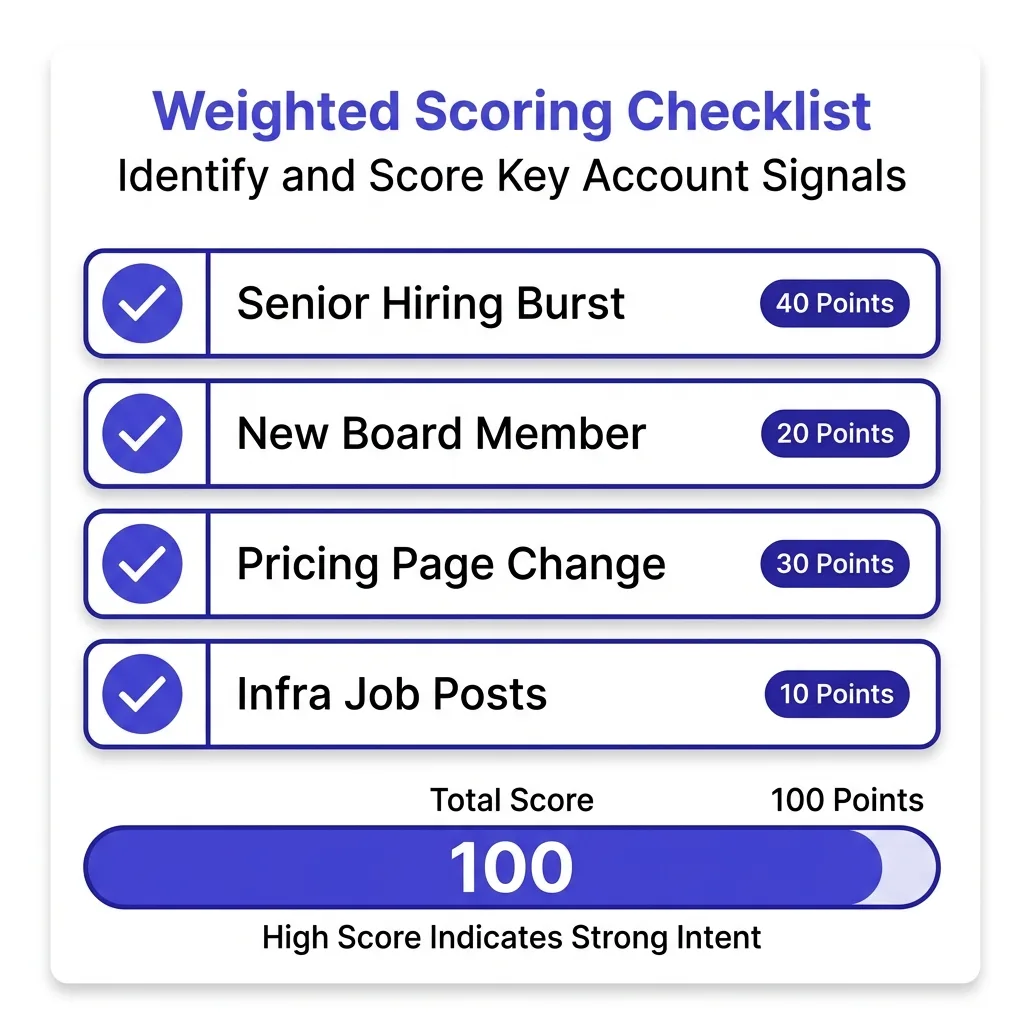 Weighted scoring checklist stacking hiring, board, and pricing signals into one account score
#Building the pipeline without a data science team
Most of this is achievable with tools a small team already has: job board alerts, LinkedIn saved searches on target executives, and a weekly manual pass on a short account list.
The bottleneck is rarely data access.
It is that nobody owns checking these signals consistently, so the process quietly stops after two weeks.
Assign it to a single person or bake it into your enrichment pipeline as a weekly job, not an ad hoc task someone remembers to do when the pipeline looks thin.
If your total addressable market is small enough that you are tracking fewer than 200 accounts closely, this kind of manual signal stacking is genuinely more effective per account than broad automated tools, since the cost of a false positive is a wasted hour, not a wasted send to a thousand-person list. The small TAM outbound playbook covers why volume tactics actively hurt a tightly scoped account list like this.
Whatever tooling sits underneath this, keep the underlying account and contact data current.
Signals mean nothing pointed at a contact who left the company two months ago, which is a list hygiene problem more than a signals problem, and it quietly kills more pre-funding outreach than bad copy does.
#FAQ
#What counts as a pre-funding buying signal?
Any observable change in a company's hiring, leadership, website, or social activity that precedes a public funding announcement, typically by two to ten weeks, and that is consistent with a company preparing to deploy new capital.
#How early can these signals actually be detected?
Infrastructure and finance-related hiring tends to show up the earliest, often four to eight weeks before a public announcement. Board member changes on LinkedIn and pricing page edits tend to appear closer to the announcement, usually within two to four weeks.
#Is it safe to mention a funding round I have not confirmed?
No. Reference the specific signal you observed, such as a hiring pattern or a website change, and let the reader draw their own conclusion. Claiming a funding event you have not verified can be wrong and damages credibility if it is.
#Do I need paid data tools to track these signals?
Not for a small target list. Job board alerts, LinkedIn saved searches, and manual weekly checks on fewer than 200 accounts cover most of this without paid tooling. Paid enrichment becomes worthwhile once your monitored account list grows past what one person can check by hand.
#How many signals should stack before I send an email?
Two independent signals is a reasonable minimum. One signal alone has too many alternative explanations to justify a specific claim in your outreach.
#Does this work for companies that never raise venture capital?
No. This entire framework assumes a company is on a path toward institutional funding. Bootstrapped or already-public companies will show similar hiring and website patterns for unrelated reasons, and applying this framework to them produces false positives.
#What is the single most reliable pre-funding signal?
A new board member or in-house counsel appearing on LinkedIn or a company's site, since both usually reflect negotiated deal terms rather than routine operating decisions.
#How does this differ from tracking a hiring signal generally?
A general hiring signal looks at headcount growth broadly. This framework narrows to senior, cross-functional bursts in a tight time window, which is a much stronger and rarer pattern specific to pre-raise preparation.
#Should I automate outreach the moment a signal fires?
No. Automated, rule-triggered sends the instant a keyword matches produce generic-feeling email even when the underlying trigger is real. A human should confirm the pattern and write a specific line before anything goes out.
#What is the risk of getting this wrong?
Sending a confident, specific claim about a funding event that turns out to be false. Beyond looking foolish, it signals you are guessing rather than paying attention, which undercuts every future email to that account.
#Can this framework apply to signals other than funding?
Yes. The same stacking logic applies to acquisitions, leadership transitions, and major product pivots. Funding is simply the clearest example because the pre-close hiring and legal patterns are well documented.
#How does company size change the reliability of these signals?
Smaller companies show sharper, more visible spikes because their baseline hiring and spending activity is lower. The same three job posts at a 500-person company barely register as a deviation from normal operations.
#What role does timing play in the actual email, not just the research?
Sending within days of confirming two or more signals matters more than perfecting the copy. The advantage of early detection erodes quickly once the round becomes public and every other vendor catches up.
#Is investor social activity worth tracking on its own?
Only as a tiebreaker alongside stronger signals. On its own, it produces too many false positives from ordinary portfolio engagement to justify outreach.
#How do pricing page changes fit into this if I do not sell pricing software?
The change itself is the signal, not the pricing content. A shift toward enterprise tiers or new GTM copy indicates a company is preparing to sell upmarket, which is relevant regardless of what you sell into that account.
#Does this replace fiscal year or budget-cycle timing as a trigger?
No, it complements it. Pre-funding signals tell you a company is about to have new budget. Fiscal year timing tells you when existing budget is most likely to move. Both matter for different reasons.
#How do I avoid wasting time monitoring accounts that will never raise?
Scope your monitored list to accounts that already fit your ideal customer profile and show some baseline growth trajectory. Monitoring random companies for these signals is not a good use of a small team's time.
#What happens if I see all six signals but the company never announces a raise?
It happens. Some rounds fall through after term sheets are signed, and some patterns have unrelated explanations. Treat a strong signal stack as a good reason to prioritize outreach, not as a guarantee.
#Should sales and marketing coordinate on who owns signal tracking?
Yes, ideally one function owns the weekly check and shares flagged accounts with whichever team is best positioned to act, since duplicate, uncoordinated outreach to the same signal is as damaging as no outreach at all.
#Is this worth the manual effort compared to just waiting for the public announcement?
For a small, well-scoped account list, yes. The lead time advantage, often four to six weeks, is large enough that the account gets a genuinely early, specific email instead of competing with fifty identical congratulations notes in the same week.
#Conclusion
Funding announcements are the most heavily gamed trigger in outbound because everyone is watching the same public feed at the same time.
The accounts worth chasing are the ones showing the pattern before that feed lights up: a senior hiring burst, an infrastructure job post, a new board member, a pricing page quietly rewritten for a bigger buyer.
None of it is proof on its own.
Stacked and confirmed, it buys you weeks of lead time that a funding alert tool can never give you, and it gives you something true and specific to write instead of a guess dressed up as insight.