
#Job posts vs hiring signals: what to send on, and when
Copy page
TL;DR: A job post is a literal, dated fact: this company wants to fill this seat. A hiring signal is an inference built from several facts, headcount growth, a new leader, a reorg, that points at a need before any req is posted. Treat them as the same input and you either send too early on a hunch or too late after the req is already closed. Use job posts for role-specific, time-boxed triggers and use broader hiring signals for account tiering and timing, not for the subject line.
#Table of contents
- The confusion that costs you replies
- What a job post actually tells you
- What a hiring signal actually tells you
- The core difference in one table
- Why job posts alone are a weak trigger
- Why hiring signals alone are a weak trigger
- A decision flow for combining both
- Matching the input to the message
- Where FirstSales fits this problem
- The freshness window that most teams get wrong
- A worked example, side by side
- What to stop doing
- FAQ
- Conclusion
#The confusion that costs you replies
Most prospecting tools sell "hiring signals" as if a single job listing counts as one.
It does not.
A job post is a single event with a start date and, usually, an end date.
A hiring signal is a pattern read across multiple events, sometimes including job posts, sometimes not.
Teams that treat every open req as a buying signal end up sending the same generic "I see you're hiring for X" email to companies that posted the role, filled it two weeks ago, and forgot to take the listing down.
That single mistake is one of the most common reasons a job change trigger email style campaign underperforms its own list quality.
The fix is not more data.
It is knowing which of the two inputs you are actually holding, and what each one is and is not qualified to tell you.
#What a job post actually tells you
A job post tells you a company wants to fill one specific seat, as of the date it was published.
That is the entire claim.
It does not tell you the company is growing, only that one role is open.
It does not tell you the role is urgent, some listings sit open for months as evergreen pipeline-building posts with no real hiring pressure behind them.
It does tell you the exact title, which gives you a precise, verifiable reason to reach the hiring manager or a peer of that role.
A req for "Senior RevOps Manager" is a strong, specific hook for a company selling revenue tooling.
The same req tells a company selling office furniture almost nothing useful.
Job posts are high specificity, low context.
They answer "what role" extremely well and answer "why now, structurally" barely at all.
#What a hiring signal actually tells you
A hiring signal is a broader read on organizational momentum.
It can include job posts, but it usually combines several inputs: headcount growth over a quarter, a new executive hire in an adjacent function, a reorg announcement, a funding round, or a jump in LinkedIn employee count for a specific department.
A single new VP of Sales hire is a hiring signal even with zero open reqs posted, because that person almost always restructures the team and the tools within their first 90 to 180 days.
Headcount growth of 20% in engineering over two quarters is a hiring signal even if the individual job posts have already been filled and taken down.
Hiring signals answer "is this account moving" well and answer "which specific role or person to contact" poorly.
They are the right input for account tiering, not the right input for a subject line.
See our piece on buying signals for cold email for how this fits inside the wider signal category beyond hiring specifically.
#The core difference in one table
| Dimension | Job post | Hiring signal |
|---|---|---|
| Specificity | ✓ Exact title, department, sometimes seniority | ✗ Directional, rarely names a role |
| Timing precision | ✗ Can be stale, listings linger after fill | ✓ Trend-based, harder to fake or forget |
| Best use | ✓ Personalized send trigger, role-specific hook | ✗ Weak as a send trigger on its own |
| Best use, alternate | ✗ Weak account-tiering signal alone | ✓ Strong account-tiering and prioritization input |
| Verification cost | ✓ Cheap, one page load confirms it | ✗ Requires combining multiple data points |
| False positive risk | ✗ High, filled-but-live listings are common | ✓ Lower, patterns are harder to fake |
| Volume available | ✓ High, most job boards are scraped easily | ✗ Lower, requires enrichment or headcount tracking |
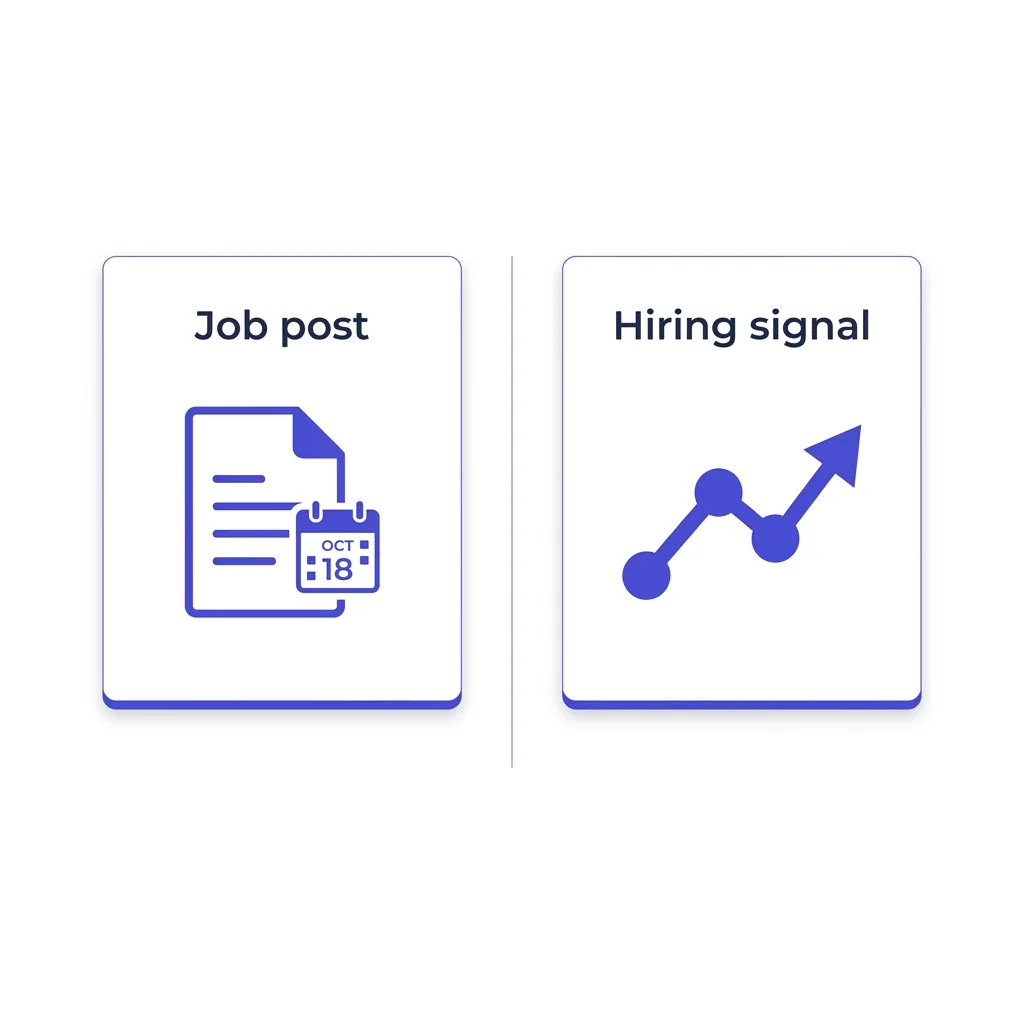 Job post versus hiring signal comparison showing a single dated listing next to a growth trend pattern
Read the table as complementary columns, not as a scorecard where one wins.
A job post gives you the words to write.
A hiring signal gives you the reason to write them now instead of next quarter.
#Why job posts alone are a weak trigger
The single biggest failure mode is sending on a listing that is already closed internally.
Job boards do not reliably remove postings the day a role is filled.
Some postings run for 60 to 90 days as a courtesy to the original poster, or because nobody remembered to take them down.
Reaching out about "your open Head of Growth role" three weeks after that seat was filled reads as sloppy, not personal.
It signals that your list-building process has zero freshness check, which undercuts the exact "we noticed you" premise the message depends on.
The second failure mode is title mismatch.
A posting for "Sales Operations Analyst" does not mean the company has budget for a director-level tool purchase.
Treating every adjacent-sounding title as a buying signal for your specific product inflates your list with accounts that have no real fit, the same data decay problem in a different costume.
#Why hiring signals alone are a weak trigger
Hiring signals fail in the opposite direction.
They are directionally correct but too vague to write a specific, credible opening line.
"I noticed your engineering team grew 20% this quarter" is true and also completely generic once every vendor targeting that company says roughly the same sentence.
A compound buying signal approach helps here, stacking two or three signals so the message earns specificity even without a named role.
Headcount growth plus a new VP hire plus a specific department expansion gives you three real facts to combine into one sentence that could not have been written about any other company.
A single growth percentage alone rarely clears that bar.
#A decision flow for combining both
The two inputs are strongest when you use the hiring signal to decide which accounts deserve attention, and the job post, when one exists, to decide exactly what to say.
This flow keeps you from doing either of the two failure modes on its own.
You never send on a stale listing without a freshness check, and you never send on a single vague growth number without at least one more corroborating fact.
#Matching the input to the message
When you have a fresh, specific job post, write to the hiring manager or the function that role reports into, and name the title directly.
That message can be short, because the fact itself does the convincing.
When you have a stacked hiring signal without a specific role, write to a more senior title, usually the department head, and reference the pattern rather than a guess at a title.
"Your support headcount is up sharply this quarter, and teams at that growth rate usually hit a specific bottleneck around X" works because it names a real, verifiable trend and connects it to a concrete consequence.
That message earns more credibility from being honest about what you actually know than from pretending to know a specific role you cannot verify.
Our guide on signal-based cold email covers the broader mechanics of writing to a trigger instead of a static list, which applies directly here regardless of which of the two inputs triggered the send.
#Where FirstSales fits this problem
The operational cost of doing this correctly by hand is high.
Checking whether a listing is still live, cross-referencing it against headcount trend data, and deciding which message template applies is three separate lookups per account before a single email gets drafted.
FirstSales pulls hiring signals and job posting data into the same prospect research pass, so the freshness check and the role match happen before a draft is generated, not after a rep notices the mistake in a reply.
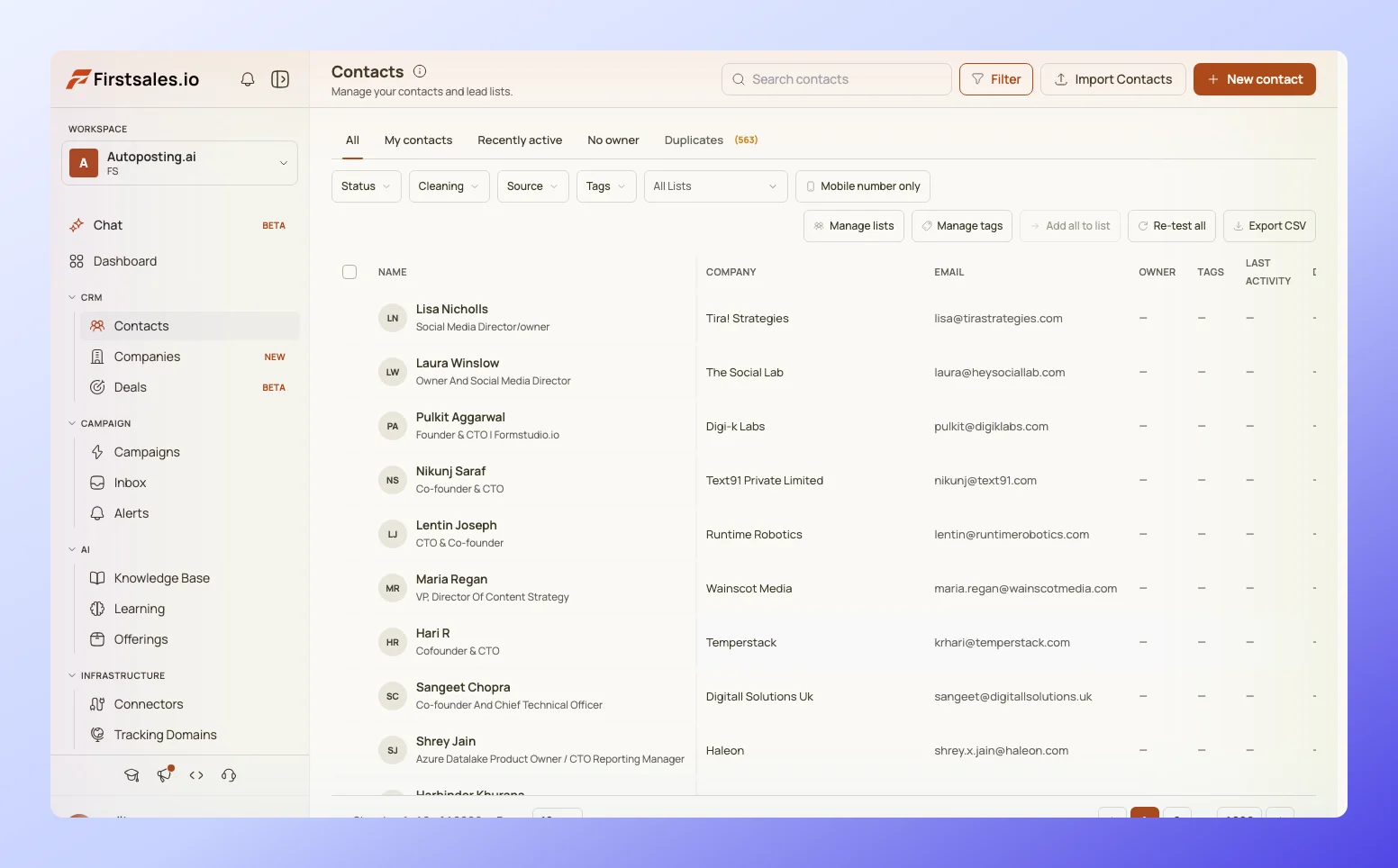 FirstSales signal-based prospecting screen showing hiring and job post triggers for a target account
That matters most at volume, where nobody has time to manually reload forty job board pages to see which listings are still live.
#The freshness window that most teams get wrong
A job post older than 14 days should be treated as a weak signal, not a strong one, regardless of how relevant the title looks.
Most roles that are genuinely urgent get filled or substantially progressed within three to four weeks of posting.
A listing still live past that window is either evergreen pipeline-building, stuck in an approval freeze, or already informally filled with the posting simply not removed yet.
None of those three situations make for a good "I saw you're hiring" opener.
If you cannot verify the post date, or the job board does not expose one, treat that account as a hiring-signal case instead and write to the pattern, not the specific req.
This single freshness rule removes a large share of the awkward, embarrassing sends that make signal-based outreach look worse than a well-run static list.
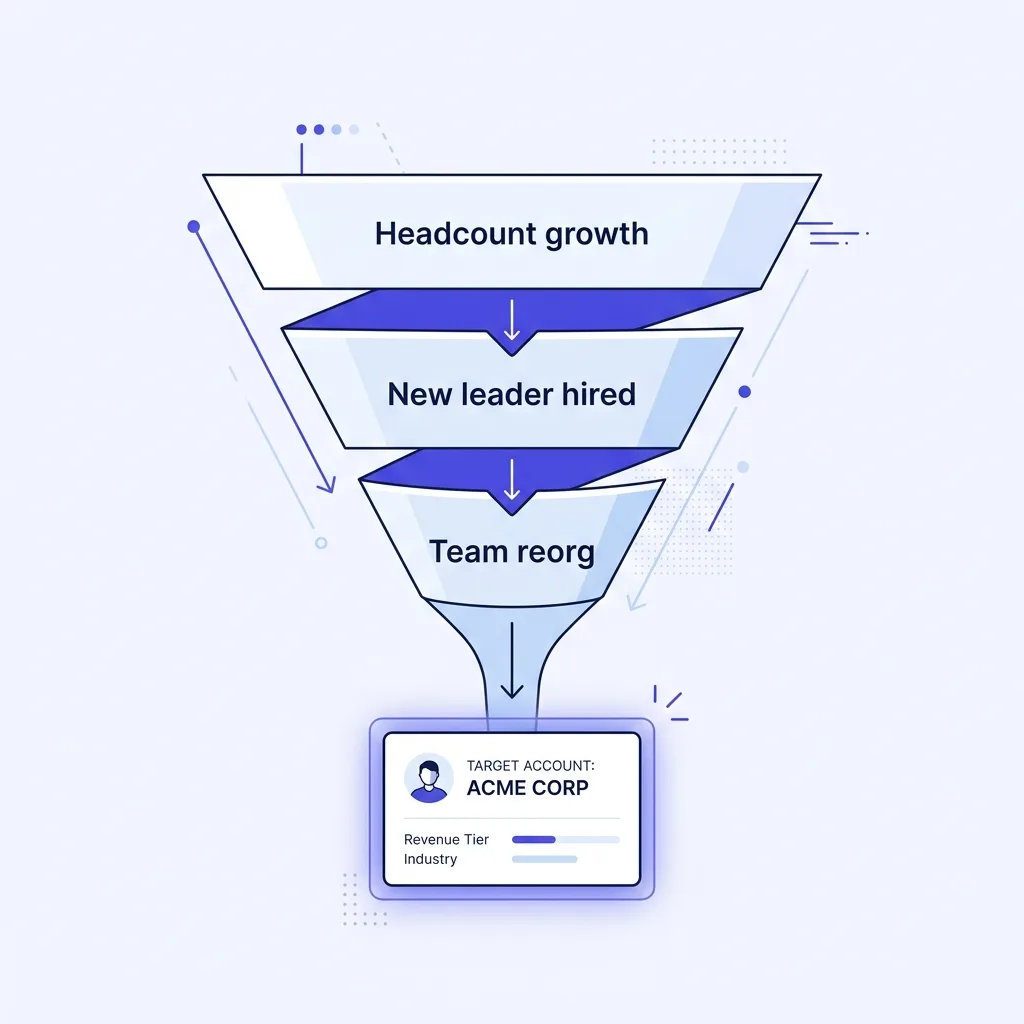 Stacked hiring signals funnel showing headcount growth, new leader hire, and reorg feeding one account
#A worked example, side by side
Company A posted "VP of Customer Success" nine days ago, and the listing includes a start date target of next quarter.
That is a fresh, specific job post.
The right move is a short email to the current head of support or ops, naming the exact title and a one-sentence reason your product matters to a team scaling that function.
Company B has no live customer success job posts, but its support headcount grew 35% over two quarters and it just hired a new COO from a company known for aggressive CS investment.
That is a stacked hiring signal with zero live req to point at.
The right move is a message to the current VP of Support referencing the growth trend and the new COO's known focus area, without pretending to know a title that does not exist yet.
Sending Company A's message to Company B would look presumptuous.
Sending Company B's message to Company A would look like you missed the obvious, specific fact sitting right in front of you.
#What to stop doing
Stop treating "hiring signal" as a single data field in your CRM.
It collapses two genuinely different inputs into one column and guarantees you will misuse one of them regularly.
Stop sending on any job post without checking the post date first.
A ten-second freshness check saves you from the single most common credibility failure in this entire category.
Stop writing generic growth-percentage openers that could apply to five hundred other companies your prospect also hears from.
If a signal is not specific enough to be false for every other company on your list, it is not specific enough to open with.
Track the actual outbound lead scoring model you use for these accounts and separate the job-post score from the broader hiring-signal score, rather than blending them into one number that hides which input actually drove the reply.
#FAQ
#What counts as a hiring signal versus a job post?
A job post is one specific, dated listing for one role.
A hiring signal is a broader pattern, headcount growth, an executive hire, a reorg, that may or may not include a live job post.
#Is a job post always a good reason to reach out?
Only if it is recent, usually under two weeks old, and the title maps clearly to a real need for your product.
Older, vague, or mismatched postings are weak triggers even though they look like strong ones.
#How do I check if a job post is still active?
Reload the original posting URL and check the listed date, or check whether the company's careers page still lists it.
Some job boards show a "reposted" or "still hiring" flag that helps, though not all of them do.
#Why do filled roles stay listed online?
Many companies leave listings up as evergreen pipeline-building, some approval processes lag behind the actual hiring decision, and some postings are simply forgotten after the role closes.
#Can a single hiring signal justify an email on its own?
A single weak signal, one modest headcount bump, rarely justifies a specific claim in an opening line.
Stack two or more corroborating signals before writing to the pattern directly.
#What is the best hiring signal to combine with a job post?
A new executive hire in the function related to the open role is one of the stronger pairings, since new leaders reliably reassess tooling and headcount within their first few months.
#Does company size change how these signals should be used?
Yes.
Smaller companies show sharper percentage swings from a single hire, so treat percentage-based hiring signals with more skepticism at low headcount and more confidence at scale.
#How fresh does a hiring signal need to be to matter?
Most hiring-driven decisions play out over one to two quarters, so a signal from the last 90 days is generally still actionable, longer than the 14-day window that applies to job posts specifically.
#Should the subject line ever mention the exact job title?
Only when the posting is fresh and clearly verified as still live.
Naming a stale title in a subject line is one of the fastest ways to get flagged as a low-effort, automated sender.
#What if the company removed the job post before I could act on it?
Removal by itself is a weak but real hiring signal, since it usually means the role was filled, and a filled role means new tools and new preferences are being set right now.
#How does this interact with buying committees?
A single hiring signal rarely identifies the full buying committee.
Use it to identify one entry point, then apply standard multithreading across the rest of the committee once you have a reply or a confirmed contact.
#Are hiring signals more reliable in some industries than others?
Yes.
Industries with public, well-maintained job boards, tech and professional services among them, give cleaner signal than industries where hiring happens through referral networks and rarely gets posted publicly.
#How do I avoid sounding like every other vendor referencing the same job post?
Combine the post with one additional fact the prospect has not already seen mentioned by five other vendors, a specific team detail, a recent product launch, or a stated priority from a public interview.
#Is it worth building an internal hiring-signal database instead of buying one?
For a narrow, well-defined market, a manually maintained tracker on your top accounts often beats a broad, noisy vendor feed, since most teams have far fewer real target accounts than they think.
#How often should hiring signal scores refresh?
Monthly is usually sufficient for the broader pattern-level signal, while job post freshness needs to be checked at send time, not on a monthly batch schedule.
#Do hiring signals work for downsell or contraction situations too?
A hiring freeze or layoffs is itself a signal, just in the opposite direction, and it should suppress rather than trigger most active outreach to that account.
Use it as a negative signal input the same way you would flag any other risky pattern in your list.
#What is the biggest mistake teams make combining both signals?
Blending them into a single generic score and losing the information about which one is driving the recommendation, which makes it impossible to write a specific message afterward.
#Should the why-now context from either signal live in the CRM?
Yes, and it should live as its own field, not buried in a notes column, so the next rep or the next campaign can reuse the same context instead of re-researching it.
See our note on building a why-now field in your CRM for the structure that keeps this usable long term.
#Can AI tools reliably tell the difference between the two automatically?
Modern tools can flag job post freshness and combine multiple hiring data points automatically, but the judgment call on which message template to use, role-specific versus pattern-based, still benefits from a human review pass before the first sends go out.
#Conclusion
A job post and a hiring signal are not interchangeable, and using them as if they were is why so many signal-based campaigns underperform their own promise.
A job post gives you precision about one role at one moment.
A hiring signal gives you a directional read on momentum across an account.
Use the post to write the specific line when one is fresh and real.
Use the broader signal to decide which accounts deserve that level of attention in the first place.
Keep the two inputs separate in your data, separate in your scoring, and separate in your message templates, and the credibility gap between "obviously automated" and "someone actually looked at this" closes fast.