TL;DR: Most CRMs record who a lead is but not why you are emailing them this week. A why-now field fixes that by making trigger context a structured, queryable property instead of a scribbled note. Generic sends get 1-3% replies. Signal-based emails hit 5-18%. The gap is not the list, it is whether the reason for the send survives long enough to reach the draft.
#What a why-now field actually is
A why-now field is a structured CRM property that captures the specific, time-bound reason a lead qualifies for outreach right now.
Not the ICP fit. Not the firmographic match. The trigger.
Something like "hired a VP of RevOps 11 days ago" or "posted three open sales engineering roles this month" or "raised a Series B on August 14."
It sits next to the standard fields: name, title, company, lead score.
But it answers a different question. Lead score answers "should we ever contact this account." A why-now field answers "why does this week matter."
Most teams have this information somewhere. It lives in a rep's head, a Slack thread, a spreadsheet tab that nobody opens after the first outreach push.
The field exists to move that reason into the system of record, attached to the account, queryable, and visible to whoever writes the email.
#Why most CRMs never built this field
CRMs were designed around static attributes: industry, employee count, revenue band, job title.
Those fields answer "is this the right kind of account." They do not answer "is this the right moment."
That distinction did not matter much when outbound ran on volume. You picked a segment, built a list, and sent the same three-email sequence to everyone in it.
It matters enormously now, because the reply-rate gap between a segment-based send and a trigger-based send is one of the largest levers in outbound.
See our piece on buying signals for cold email for the full breakdown of trigger types.
The technical reason is simpler than it sounds. Signals are perishable. A hiring signal is worth acting on within two to four weeks.
A funding signal has a shelf life measured in months, not quarters.
Static CRM fields do not have a concept of expiry built in, so teams either bolt trigger data onto a free-text note, or they let it live entirely outside the CRM in a spreadsheet, and it gets lost the moment the rep who found it moves to a different account.
#The three problems a why-now field solves
Problem one: the trigger dies in the tool that found it.
A signal tool surfaces a hiring event. Someone screenshots it, mentions it in standup, then it evaporates.
Three weeks later a different rep emails the same account with a generic template because nothing in the CRM told them a trigger existed.
Problem two: the writer cannot see the reason.
Whether the writer is a human rep or an AI drafting assistant, if the trigger is not in a field the writer actually reads, it cannot show up in the email.
You end up with well-researched signals and generic email copy, because the two live in different places.
Problem three: nobody can measure whether triggers work.
If the reason for the send is not structured, you cannot run the query that tells you whether trigger-based sends actually outperform static-list sends for your specific product.
You are stuck citing industry benchmarks instead of your own data.
A why-now field fixes all three by giving the trigger a permanent home that is attached to the record, visible to the writer, and reportable.
#What belongs in the field and what does not
Not everything you learn about a company belongs in this field.
The field is for the trigger, not for general research. General research belongs in your account notes or a research doc, not in the field that drives urgency.
| Content type | Belongs in why-now field | Belongs elsewhere |
|---|---|---|
| Hiring event with a date | ✓ | |
| Funding round with a date | ✓ | |
| Product launch or public announcement | ✓ | |
| Leadership change | ✓ | |
| Generic company description | ✗ (account notes) | |
| Firmographic data (size, industry) | ✗ (standard CRM fields) | |
| Technographic stack detail | ✗ (enrichment fields) | |
| Static pain point guess with no evidence | ✗ (do not fabricate a trigger) | |
| Competitor mention with no recent action | ✗ (account notes) | |
| A signal older than its relevance window | ✗ (expire it, do not keep it) |
The test is simple. If the fact would still be true a year from now, it is not a why-now trigger. It is background.
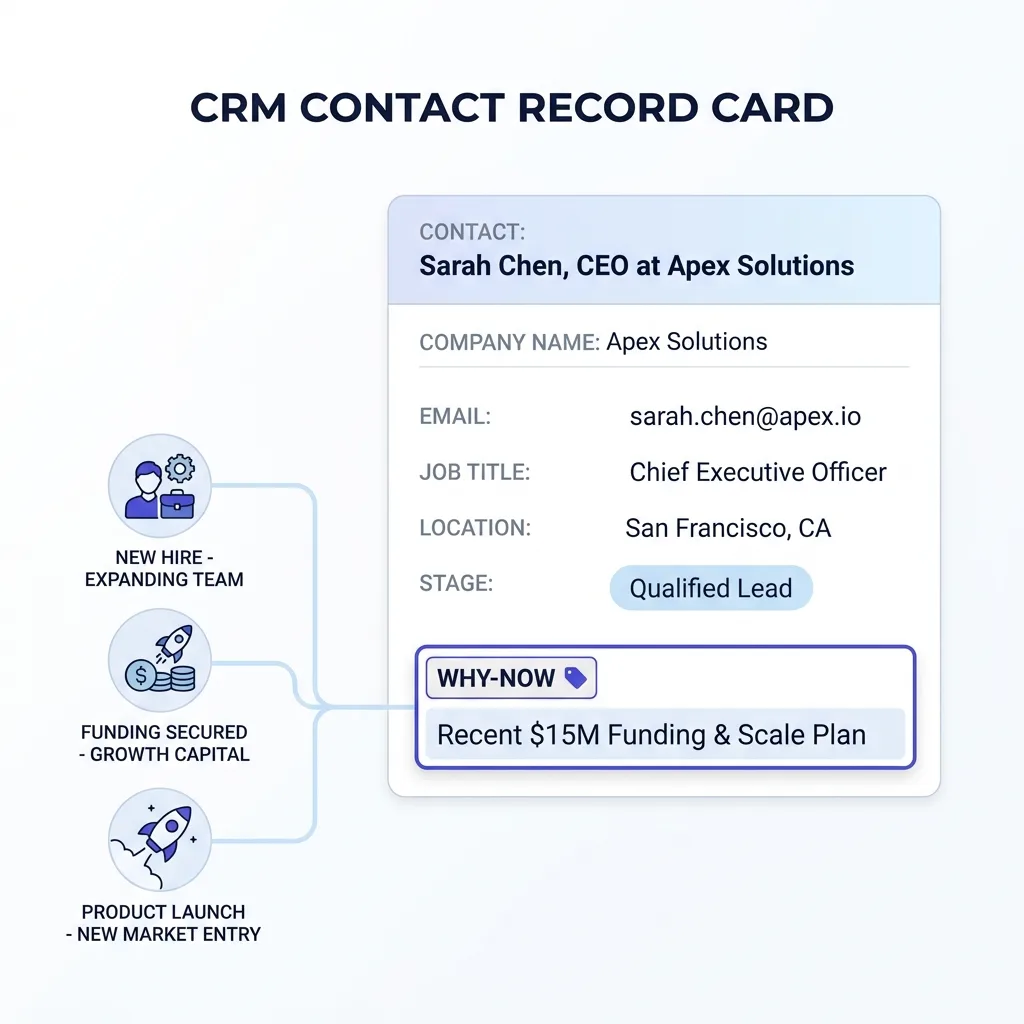 CRM contact record with a why-now field capturing trigger type and date
#A schema you can actually ship
You do not need a complex object model. A why-now field works as five properties attached to the lead or account record.
- Trigger type: hiring, funding, leadership change, product launch, expansion, other.
- Trigger detail: the specific fact, in one sentence, with a date.
- Detected date: when the signal was captured, not when the event happened.
- Source: where the trigger came from, so it can be verified.
- Expiry date: the date after which this trigger should stop driving outreach.
That last field is the one teams skip, and it is the one that prevents the field from turning into another graveyard of stale notes.
A hiring trigger from four months ago sitting in an active field is worse than no trigger at all, because a rep or an AI drafting tool will use it and reference a "recent" hire that is no longer recent.
#Adding it without a platform migration
You do not need to wait for a CRM redesign.
Most platforms support this with a custom field and a naming convention, not a schema migration.
In HubSpot, add a single-line text property or a dropdown for trigger type plus a text field for detail, then a date property for expiry. Surface both on the contact and company record layout.
In Salesforce, the same pattern works as custom fields on Lead and Account, with a validation rule that flags any why-now field older than its expiry date.
In Attio or Pipedrive, a custom text or select field does the job, and both support filtered views, so you can build a list of "active why-now triggers" that expire automatically from the view.
The mechanism matters less than the discipline: one field, one clear question, an expiry date that is respected, not decorative.
#Where the trigger context comes from
The field is a destination, not a source. You still need signals feeding it.
Hiring signals come from job boards, LinkedIn headcount changes, and applicant tracking system leaks. See our comparison of job posts vs hiring signals for why these are not interchangeable inputs, and our deeper look at hiring signal outbound for how to act on them once detected.
Funding signals come from press releases, SEC filings, and funding databases, often with a lag of days to weeks after the actual close.
Our piece on pre-funding buying signals covers the earlier-stage signals that fire before the announcement everyone else is chasing.
Fiscal timing, leadership changes, and product launches round out the common list. Compound signals, where two or three triggers stack on the same account in a short window, tend to outperform any single trigger on its own.
Our post on compound buying signals walks through how to weight a stack instead of treating each trigger independently.
Whatever the source, the discipline is the same: capture the trigger, timestamp it, and route it into the field before it goes stale in someone's inbox or a tool's dashboard.
#From signal to draft: the data flow
The value of a why-now field only shows up if the trigger actually reaches the person or system writing the email.
graph LR
    A[Signal source: job boards, filings, news] --> B[Signal captured with date]
    B --> C[Why-now field on CRM record]
    C --> D{Still inside expiry window?}
    D -->|Yes| E[Writer or AI drafts using the trigger]
    D -->|No| F[Field flagged stale, excluded from draft]
    E --> G[Send]
    F --> H[Account returns to static list or gets re-scanned]
Notice where the field sits: between the signal source and the draft, not off to the side.
If the trigger has to be looked up in a separate tool before someone writes the email, most reps will skip that step under time pressure, and the email reverts to generic.
This is the exact mechanism behind why platforms that draft emails, FirstSales included, pull structured signal fields directly into the draft rather than asking a human to paste research in manually.
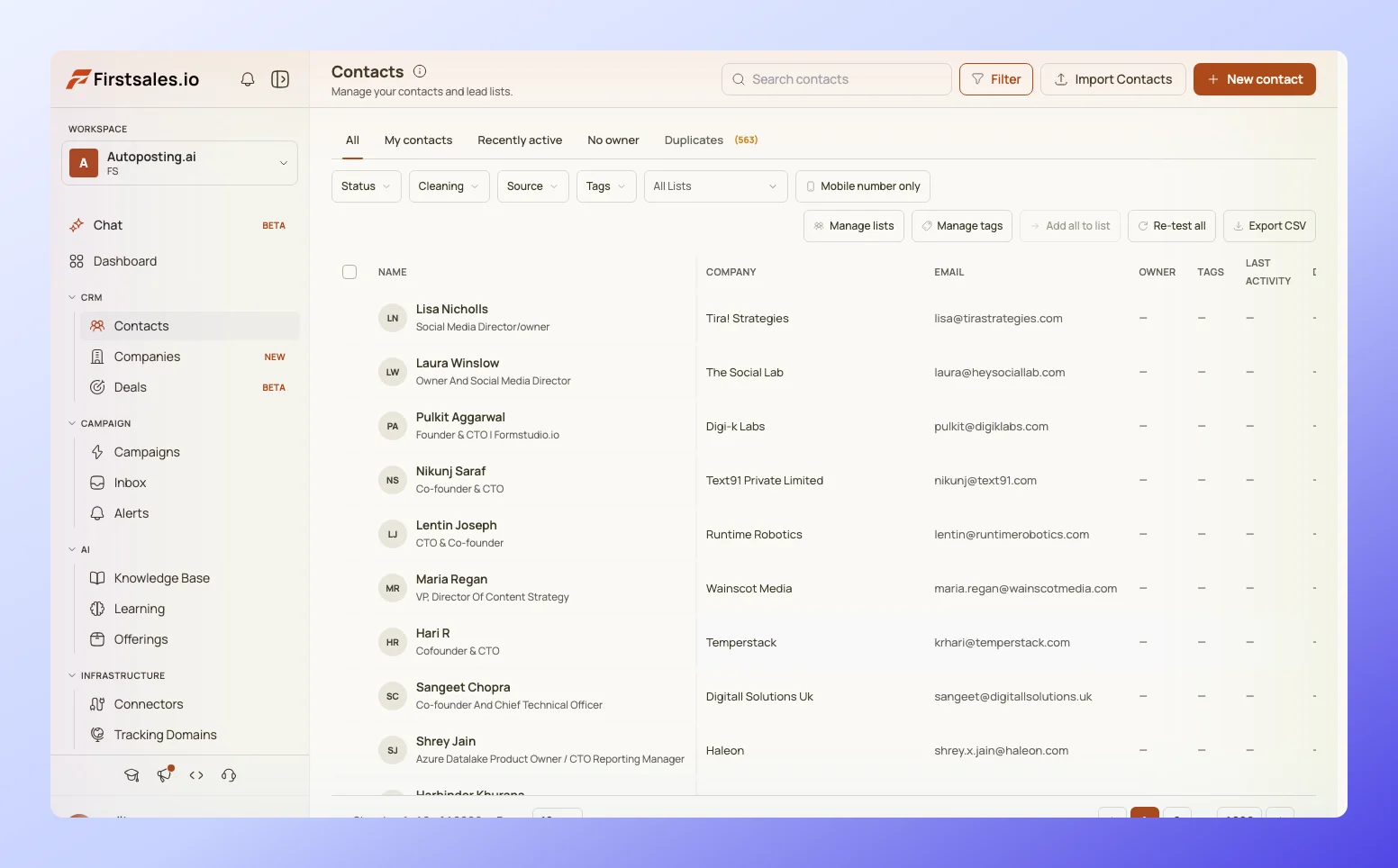 FirstSales campaign view showing signal-based prospecting context attached to a lead
The field is not a nice-to-have metadata layer. It is the thing that determines whether research turns into copy or gets abandoned at the research stage.
#What it does to reply rates
The honest starting point: cold email reply rates across the board have been falling. Platform-wide reply rate dropped from about 5.1% in 2024 to roughly 3.43% in 2026.
Generic, list-based sends with no trigger context now land in the 1-3% range for most senders.
Signal-based emails, where the copy references a specific, recent, verifiable trigger, land in the 5-18% range depending on the signal quality and how well the copy uses it.
Systematised campaigns that combine signal timing with consistent execution report 10-18% replies.
That is not a small gap. It is the difference between a campaign that needs 500 sends to book a meeting and one that needs 60.
The why-now field is not what creates that lift by itself. The signal does, and the copy that uses it does.
What the field does is make sure the signal survives the handoff from research to writing, which is where most trigger-based programs quietly fail without anyone noticing the leak.
Teams that skip the field tend to have great signal tools and mediocre reply rates, because the signal never makes it into the sentence a prospect actually reads.
#The decay problem nobody plans for
A why-now field without an expiry mechanism turns into exactly the mess it was built to prevent.
Signals are worth acting on inside a window. A hiring trigger is strong for two to four weeks. A funding trigger stays relevant for a couple of months. A leadership change has a longer tail, often three to six months, since new leaders tend to make changes for a while after they start.
Past that window, the trigger stops sounding like a reason and starts sounding like stalking, because the prospect no longer remembers the event as recent.
Build the expiry date into the field from day one. When a trigger expires, the account should either fall back to a static-list cadence or get flagged for a fresh signal scan.
Do not let expired triggers sit in an active field where a writer might pick them up months later and reference a "recent" event that is now old news.
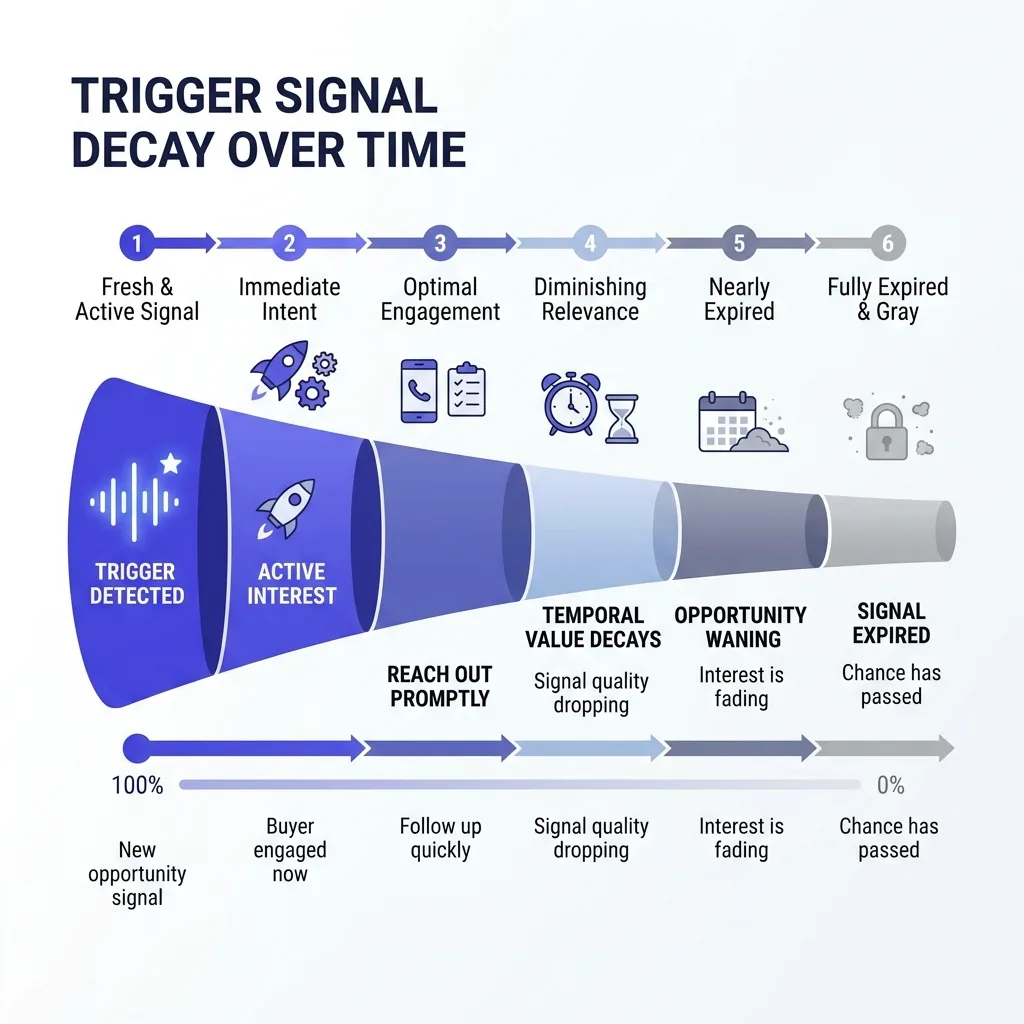 A trigger signal decaying from fresh to expired on a timeline
#Who should own the field
Ownership questions kill more why-now field initiatives than technical ones.
Sales ops usually owns the schema: the field structure, the expiry rules, the dropdown values.
The signal source, whether that is a data provider, a scraping pipeline, or a manual research step, owns populating the field with accurate, dated triggers.
The writer, human or AI, owns using the field correctly: referencing the trigger specifically instead of vaguely, and never fabricating one when the field is empty.
That last point matters more as more of the drafting work shifts to AI. An AI drafting tool with access to a populated why-now field can write a specific, accurate opening line.
An AI tool without that field, under pressure to personalize, will sometimes invent a plausible-sounding but false trigger, which is a compliance and trust problem, not just a quality one.
If you are running AI-assisted drafting, treat an empty why-now field as a hard stop for personalization claims, not an invitation to guess. Our piece on outbound lead scoring models covers a related discipline: scoring should never fabricate signal strength it does not actually have.
#What breaks when you skip this
Skipping the field does not mean you lose the signal entirely. It means the signal survives inconsistently, tied to whichever rep happened to notice it and remember to mention it.
That inconsistency shows up as a reply-rate spread across your own team that looks confusing until you check whether reps are actually using trigger context.
The reps who reference specific, recent triggers outperform the reps sending the same template to everyone, and the difference usually gets attributed to "better writers" when it is actually better access to structured signal data.
It also shows up in your reporting. Without a structured field, you cannot answer the basic question your VP will eventually ask: does trigger-based outbound actually move the needle for us, or is it a story we tell ourselves.
Segment-level answers to that question require segment-level data, and segment-level data requires the trigger to be a field, not a note.
If you have not validated that a signal category converts at all before scaling it, read our piece on segment validation before scaling first, since a why-now field only pays off on segments where the signal is real.
#An honest limitation
A why-now field does not fix a bad offer. If the product is not a fit, a well-timed trigger email still gets ignored, just with slightly better manners.
It also does not replace account tiering. Spending research time populating a why-now field for a low-value account is a bad trade. See account tiering for outbound for how much research each tier actually deserves.
Treat the field as an amplifier for accounts you have already decided are worth researching, not a substitute for deciding which accounts deserve that effort in the first place.
#FAQ
#What is a why-now field in a CRM?
It is a structured property that records the specific, time-bound reason an account or contact is worth emailing right now, separate from static firmographic data like industry or company size.
#Is a why-now field the same thing as a lead score?
No. Lead score answers whether an account fits your ideal customer profile. A why-now field answers whether this week is the right moment to reach out, based on a recent trigger.
#What should go in the trigger detail field?
One sentence with a specific fact and a date: a hire, a funding round, a leadership change, a product launch, or an expansion. Avoid vague descriptions or firmographic data that belongs in other fields.
#How long should a trigger stay active before it expires?
It depends on the trigger type. Hiring signals hold value for roughly two to four weeks. Funding signals last a couple of months. Leadership changes can stay relevant for three to six months.
#Do I need a new CRM to build this?
No. HubSpot, Salesforce, Attio, and Pipedrive all support custom fields and views that can hold trigger type, detail, source, and expiry without a platform migration.
#Who should populate the why-now field?
Whoever or whatever surfaces the signal, whether that is a data provider, a scraping pipeline, or a rep doing manual research. The field should never be filled in by the writer guessing at a plausible reason.
#Can an AI drafting tool use the why-now field?
Yes, and it is one of the more reliable uses of AI in outbound, since the AI is pulling a verified, dated fact rather than inventing personalization. An empty field should stop personalization claims, not prompt a guess.
#What happens if the trigger expires before the email goes out?
The account should fall back to a standard, non-trigger cadence, or get re-queued for a fresh signal scan. Sending an email that references a stale trigger reads as out of date rather than timely.
#Does a why-now field actually improve reply rates?
Signal-based emails that reference a real, recent trigger report reply rates in the 5-18% range, against 1-3% for generic list-based sends. The field itself does not create that lift, but it is what keeps the signal from getting lost before it reaches the draft.
#What is the difference between a trigger and a pain point?
A trigger is a dated, verifiable event. A pain point is an inference about what the company might be struggling with. Triggers belong in the why-now field. Inferred pain points should stay out unless you have direct evidence.
#Should every account have a why-now field populated?
No. Populating this field takes research time. Reserve it for accounts in tiers where personalized research pays off, and use static-list cadences for lower-priority accounts.
#How is this different from a generic "notes" field?
A notes field is unstructured and rarely gets read consistently by every rep or tool touching the account. A why-now field is structured, has defined properties, and can be filtered, reported on, and fed directly into a drafting workflow.
#Can I combine multiple triggers in one field?
Yes, and compound signals, where two or three triggers stack on the same account, tend to convert better than any single trigger. Structure the field to allow more than one entry with its own date and expiry.
#What if the trigger data is wrong?
Always include a source field so a trigger can be verified before it goes into an email. Sending a fabricated or incorrect trigger to a prospect damages trust faster than sending a generic email would.
#Does this apply to inbound leads too?
Less directly, since inbound leads already signaled intent by reaching out. The why-now field matters most for outbound, where you are deciding whether to interrupt someone who has not asked to hear from you.
#How do I measure whether the field is working?
Compare reply rates on accounts with a populated, active why-now field against accounts on a static-list cadence, holding segment and offer constant. If you have not run that comparison yet, that is the first report to build.
#What is the biggest mistake teams make with this field?
Skipping the expiry date. A why-now field with no decay mechanism eventually fills with stale triggers that get used months after they stopped being true, which is worse than having no field at all.
#Can small teams without a data team build this?
Yes. A single custom text field with a manual expiry check is a reasonable starting point. The schema can get more sophisticated later, but the discipline of writing down the trigger and its date is what matters first.
#Does this replace the need for a dedicated signal tool?
No. A why-now field is a destination for signals, not a source of them. You still need a way to detect hiring events, funding rounds, or leadership changes before you have anything to put in the field.
#How does this fit into an AI-assisted outbound workflow?
Platforms that draft cold emails with human approval, including FirstSales, work best when the trigger context is already structured and attached to the record, since that is what turns a generic AI draft into one that references something real and recent.
#Conclusion
A why-now field is a small schema change with an outsized effect on whether your outbound program actually uses the signals it already pays to collect.
The signal tools exist. The trigger detection exists. What most teams are missing is the one field that carries that trigger from discovery to the sentence a prospect reads.
Build five properties: trigger type, detail, detected date, source, and expiry. Attach them to the account or contact record. Respect the expiry date without exception.
That is the entire mechanism. It costs an afternoon to set up and it is the difference between a research process that produces insight and one that produces email copy.
Start with your highest-tier accounts, populate the field honestly, and let the reply-rate data tell you whether it is worth expanding further.