
#Validate a segment before scaling: the 300-account test
Copy page
TL;DR: Before you commit 5,000 accounts and a real budget to a new segment, run 300 through it first. Send a small, honest batch, measure replies against a fixed bar, and only scale the segments that clear it. Most segments that look good on paper fail this test, and finding that out on 300 accounts instead of 5,000 is the entire point.
#Table of contents
- Why segments fail after you have already scaled
- What a segment actually is
- The 300-account test
- Setting the pass bar before you look at results
- Reading the results honestly
- The traps that make a bad segment look good
- What to do with a segment that fails
- Scaling a segment that passes
- A worked example
- FAQ
- Conclusion
Most outbound teams do not test segments.
They build a list, write a sequence, and send it to everyone at once.
If replies come in low, they blame the copy.
Sometimes the copy is the problem.
More often the segment was never going to convert, no matter what the email said.
#Why segments fail after you have already scaled
A segment is a bet about who has the problem your product solves, right now, badly enough to reply to a stranger.
That bet can be wrong in several ways at once: wrong problem, wrong timing, wrong seniority, wrong company size.
You do not find out which one is wrong by sending to 5,000 accounts and watching the aggregate number.
You find out by testing 300 first, at a scale small enough to fail cheaply and fast enough to learn something before the domain takes damage.
The platform-wide cold email reply rate fell from roughly 5.1% in 2024 to about 3.43% in 2026.
That decline is not evenly distributed.
Systematised, well-targeted campaigns still land 10-18% replies.
Generic sends to broad, unvalidated segments get 1-3%, and that is the bucket most untested segments fall into.
The gap between those numbers is not better writing.
It is a segment that was actually worth emailing.
#What a segment actually is
A segment is not a filter you applied in a data tool.
"VP of Sales, 50-200 employees, SaaS" is a filter.
A segment is a specific, falsifiable claim: these people have this problem, at this moment, and will tell you so if you ask the right way.
The filter gets you a list.
The claim is what gets tested.
If you cannot state the claim in one sentence, you do not have a segment yet, you have a spreadsheet.
"Series B SaaS companies that just posted three sales hiring roles have an active outbound gap they are trying to close with headcount" is a claim.
You can test whether that claim holds up.
"Companies with 50-200 employees" is not a claim about anything, and no test will validate it, because there is nothing specific to disprove.
#The 300-account test
The number 300 is not arbitrary.
It is large enough to produce a reply count you can trust, and small enough that a bad segment costs you an afternoon instead of a quarter.
Below 200, a handful of lucky or unlucky replies swings the rate too much to trust.
Above 500, you have usually already spent more time and domain reputation than the answer was worth, and if the segment turns out to be dead you have burned real capacity for nothing.
Here is the sequence.
Three rules make this test worth running.
Pull the 300 without cherry-picking.
If you hand-select the best-fit accounts inside the segment, you are testing your judgment, not the segment.
Pull a random or systematic sample from the full filtered list, the same way you would pull the eventual 5,000.
Use one sequence, not five.
Testing multiple sequences against 300 accounts splits your sample so small that none of the sub-results are trustworthy.
Validate the segment with your best current sequence first.
Test copy variants later, on a segment you already know is real.
Send it as one batch, not trickled over three weeks.
Trickling introduces day-of-week and seasonal noise you cannot separate from segment quality.
A single batch, sent on a normal weekday, gives you a clean read.
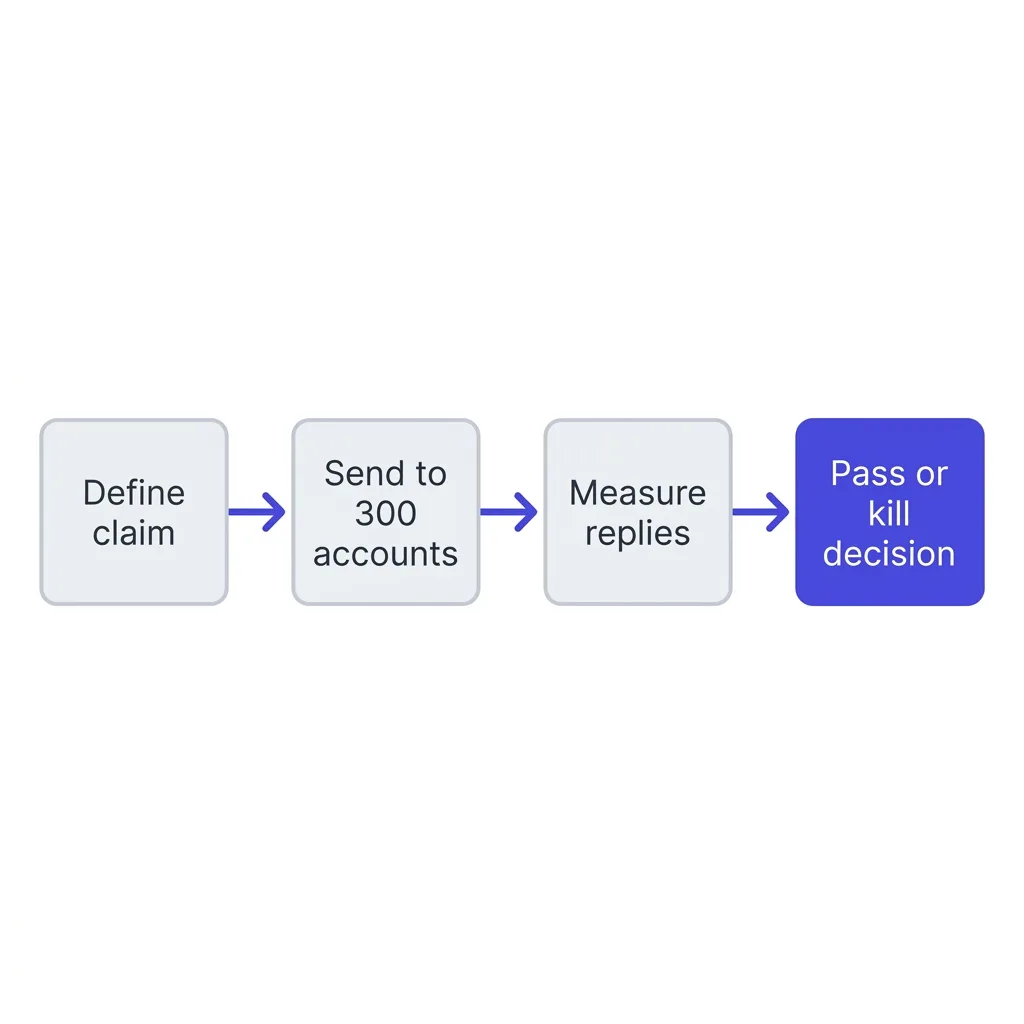 Flow diagram of the 300 account segment validation test before scaling outbound
#Setting the pass bar before you look at results
Set the number before you send, not after you see it.
This sounds obvious and gets skipped constantly, because it is uncomfortable to commit to a number that might kill a segment you already like.
A reasonable starting bar, given current benchmarks: 5% reply rate for a signal-based segment, 3% for a broader firmographic segment.
Signal-based emails, ones referencing a hiring post, a funding round, a product launch, land in the 5-18% range when the signal is genuine and recent.
Generic firmographic segments with no timing signal sit closer to the 1-3% floor, so a 3% bar for those is already asking for above-average performance, not settling for average.
If your segment includes a real signal (job posts, technology changes, expansion moves), 5% is the fair test.
If it is pure firmographic filtering with no signal, 3% is fair, and even 3% means you are outperforming the generic-send average.
Anything scored against a bar you invented after seeing the number is not a test.
It is a story you told yourself to keep sending.
#Reading the results honestly
Replies are not all the same signal.
Split them into three buckets before you count anything: positive, neutral, and negative.
A positive reply expresses interest or asks a real question.
A neutral reply is an out-of-office, a "not right now, check back later," or a forwarded message.
A negative reply is an unsubscribe request, a complaint, or a "please remove me."
Only positive replies should count toward your pass bar.
Counting neutral replies as wins is the single most common way teams talk themselves into scaling a dead segment.
An automated "I am on leave until next month" is not evidence anyone wants to hear from you.
Also check spam complaints and bounces before you touch the reply number at all.
Google's bulk sender rules set a spam complaint ceiling of 0.1% and a bounce rate under 2%.
If your 300-account test blew past either threshold, the segment result is contaminated. Fix the list quality first, then retest.
#The traps that make a bad segment look good
Trap one: measuring opens.
Apple Mail Privacy Protection inflates open rates by pre-fetching images regardless of whether a human ever saw the email.
An open rate of 60% tells you almost nothing about a segment in 2026.
Ignore it entirely and measure replies.
Trap two: one big account skewing the sample.
If three of your 300 accounts happen to be unusually warm (an existing relationship, a referral, a brand name that always replies), their replies can carry the whole test.
Check whether removing your five best responders still clears the bar.
If it does not, the segment did not pass, three lucky accounts did.
Trap three: testing the segment and the offer at the same time.
If you change both the audience and the pitch in the same test, a failure does not tell you which one broke.
Keep the offer constant across segment tests, and only vary the offer once you have a validated audience to vary it against.
Trap four: a stale signal.
A hiring signal that is three months old is not a signal, it is a filter with a date attached.
If your segment claim depends on timing, check that the timing window in your 300-account sample matches the window you plan to use at scale.
Here is the checklist version.
| Check before scaling | ✓ Pass | ✗ Fail |
|---|---|---|
| Sample size | 300, randomly pulled | Under 200 or hand-picked |
| Sequence | One sequence, held constant | Multiple sequences split across the sample |
| Pass bar | Set before sending | Set after seeing the result |
| Reply counting | Positive replies only | Neutral or automated replies counted as wins |
| Spam complaints | Under 0.1% | Above 0.1%, result is contaminated |
| Signal freshness | Signal matches send-time window | Signal is weeks or months stale |
| Outlier check | Bar still clears without top 5 responders | Bar only clears because of a few accounts |
#What to do with a segment that fails
A segment that fails the 300-account test is information, not a wasted afternoon.
The first move is not to rewrite the email and resend it to the same 300 people.
That just burns the same list twice and tells you nothing new, because you have not changed the variable that actually mattered.
Instead, ask what part of the claim was wrong.
Was the problem real but the timing off?
Was the timing right but the wrong person got the email?
Was the company size band too broad, hiding a narrower slice that would have converted?
Sometimes the fix is narrower targeting inside the same list, using a why-now field to separate accounts with a live trigger from accounts that just match the filter.
Sometimes the segment is dead and the only honest move is to stop sending to it and try a different one.
Killing a segment after 300 accounts is cheap.
Killing it after 5,000, a burned sending domain, and three weeks of a rep's attention is not.
#Scaling a segment that passes
A pass at 300 is not a guarantee at 5,000.
Larger volume changes deliverability dynamics, introduces more edge cases in the data, and often dilutes the tight targeting that made the initial 300 work.
Scale in stages, not in one jump.
Move from 300 to roughly 1,000, watch the reply rate and complaint rate hold, then move to the full segment.
If the rate drops meaningfully at each stage, something about the segment quality is degrading as you widen it, usually the data provider running out of well-matched accounts and backfilling with weaker fits.
Track deliverability at each stage the same way you tracked replies.
A segment that passes on replies but pushes your spam complaint rate toward 0.1% is not actually a win, because the complaints will eventually take the whole domain down with it.
This is the point where a monitoring layer matters more than a bigger list.
FirstSales tracks reply quality and complaint signals by segment as you scale, so a degrading batch shows up before it shows up in your domain reputation.
That is a narrower use of the tool than most people expect from an outbound platform, and it is the one that actually prevents the failure mode described above.
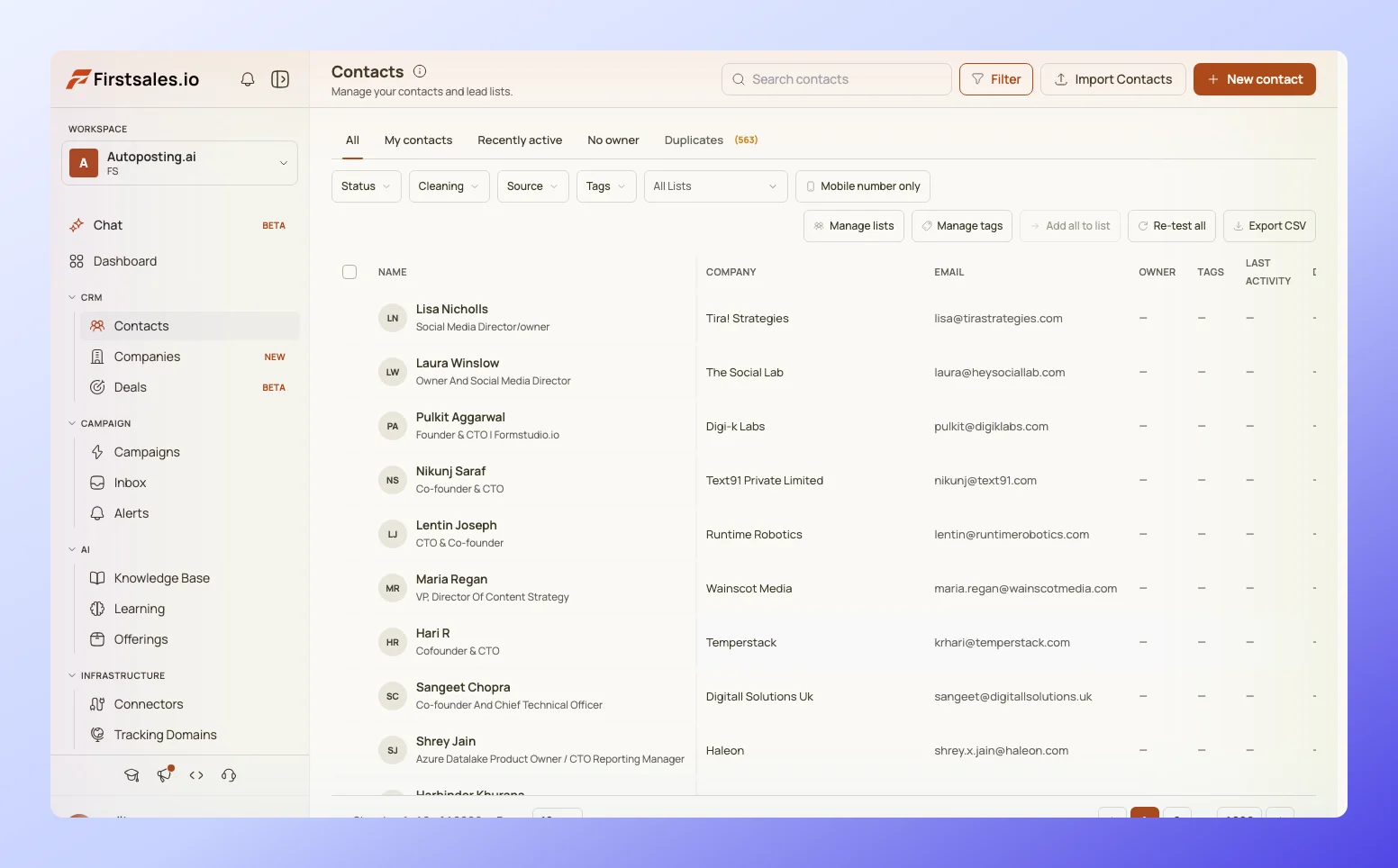 FirstSales campaign dashboard showing segment-level reply and signal tracking
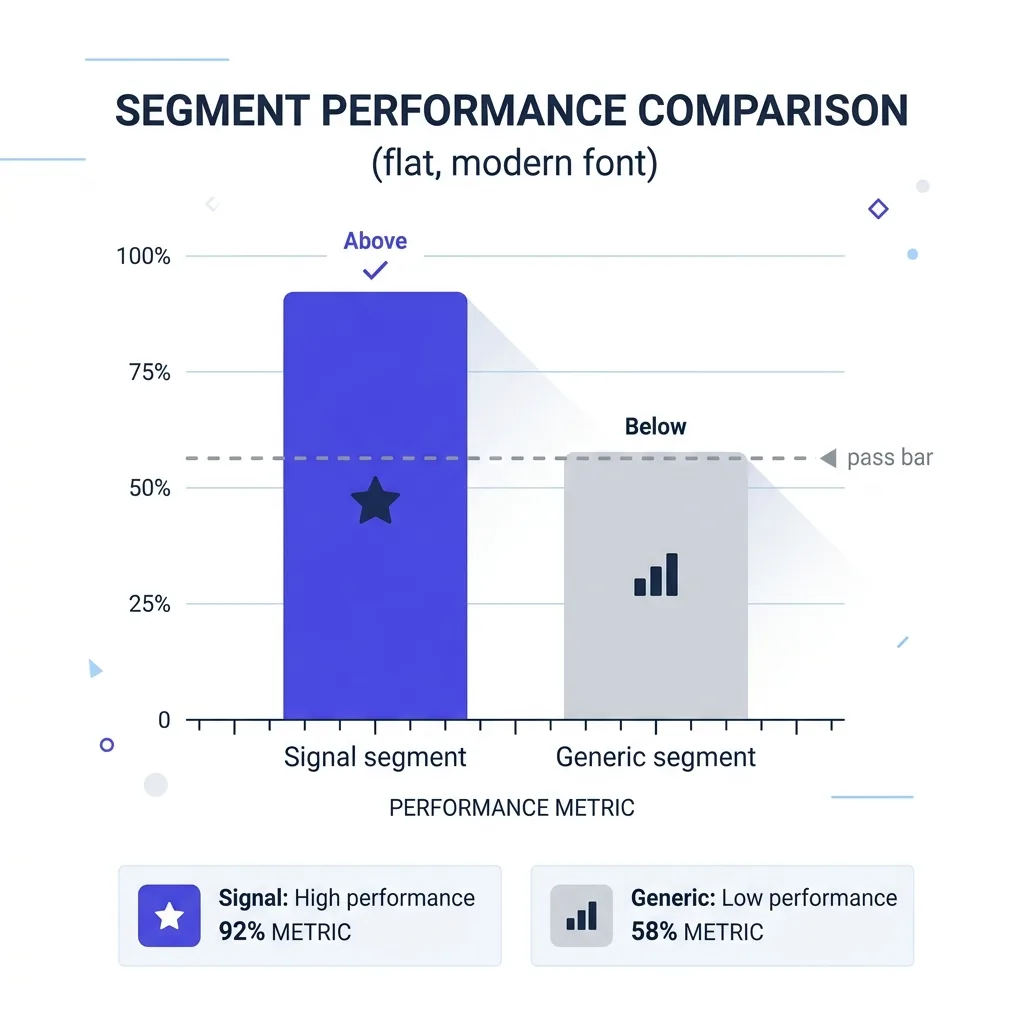 Chart comparing a validated segment against a failed segment across reply rate stages
#A worked example
A B2B security vendor tested a segment of "companies that posted a compliance-related job in the last 30 days," pulling 300 accounts and running a signal-based opener referencing the specific role.
The claim: a company hiring for compliance right now has an active gap your product closes.
The bar, set before sending: 5%, since this was a signal-based segment.
The result: 17 positive replies out of 300, a 5.7% rate, clearing the bar with room to spare, and a 0% spam complaint rate.
They scaled to 1,000 the following week and held at 5.1%.
A second segment from the same list, "companies over 200 employees regardless of hiring activity," tested at the same time with the same sequence structure, returned 4 positive replies out of 300, a 1.3% rate against a 3% bar.
That segment was killed, not rewritten.
The difference was not the copy quality.
Both sequences used the same house style, the same length, the same call to action.
The difference was that one segment carried a real timing claim and the other was a bare firmographic filter dressed up as a segment.
#FAQ
#What sample size do I need to validate a cold email segment?
300 accounts is the practical minimum for a reply-rate signal you can trust without spending weeks on the test.
Below 200, a few lucky or unlucky replies swing the percentage too much.
#Should I test multiple email sequences in the same segment validation run?
No. Hold the sequence constant and vary only the segment across tests.
If you change both the audience and the copy at once, you cannot tell which one caused the result.
#What reply rate counts as a pass for a new segment?
A reasonable starting bar is 5% for a segment built around a genuine timing signal, and 3% for a broader firmographic segment with no signal attached.
Set the number before you send, not after you see the result.
#Do neutral replies like out-of-office messages count toward the pass bar?
No. Count only positive replies that express interest or ask a real question.
Counting automated or neutral replies is the most common way teams convince themselves a dead segment is working.
#How long should I wait before evaluating a 300-account test?
Give it 10 to 14 days from the first send to capture replies that come in after a delay, then close the window and count what arrived.
Waiting much longer mixes in replies driven by a follow-up touch rather than the original signal.
#What if my segment passes replies but has a high spam complaint rate?
Treat the segment as failed regardless of the reply number.
Google's bulk sender threshold is 0.1% spam complaints, and a segment that pushes toward that ceiling will eventually damage the sending domain even if replies look fine today.
#Can I validate a segment using a smaller list if my total addressable market is tiny?
If your full segment is under 300 accounts, you cannot run this test at full statistical strength, so treat any result with wider error margins and weight qualitative signal (call quality, depth of interest) more heavily than the raw percentage.
#Is it fair to compare reply rates across different industries?
Not directly. Baseline reply rates vary by industry and buyer sophistication, so the fair comparison is your segment against your own historical baseline, not against a published cross-industry average.
#Should I test a segment with cold email, LinkedIn, or both at once?
Test one channel first so you know which channel produced the signal.
Running both at once on the same 300 accounts makes it impossible to know whether email or LinkedIn drove the replies.
#What is the difference between a segment and an ICP?
An ICP describes the type of company you want as a customer in general terms.
A segment is a specific, testable slice of that ICP with a stated claim about problem and timing, narrow enough to validate with 300 sends.
#How do I know if my segment claim is specific enough to test?
If you cannot state, in one sentence, why this group has the problem right now, the claim is too vague to fail cleanly, which means a failed test will not tell you what to fix.
#What happens if I skip validation and go straight to scale?
You find out the segment does not convert only after spending the sending capacity, domain reputation, and rep attention that a 5,000-account send requires, instead of the fraction that a 300-account test costs.
#Should I remove the top few responders before judging a test?
Yes, check the result with your top five responders excluded.
If the segment still clears the bar without them, the result is real, not a few warm accounts carrying the average.
#Can a segment that failed once ever be retested later?
Yes, timing and market conditions change, and a segment claim that was too early can become true later.
Retest with a fresh 300-account sample rather than assuming the old result still holds.
#Does the 300-account test work for outbound calling too?
The logic transfers (fixed sample, fixed script, pre-set bar, positive-only counting) but the bar itself should be reset for calling, since connect and conversation rates differ structurally from email reply rates.
#What is a good way to track segment performance without building custom dashboards?
Tag every send by segment at the campaign level and review reply, complaint, and bounce rates per tag rather than per overall campaign, so a strong segment cannot hide a weak one in the blended number.
#How much does list quality versus copy quality matter in segment failure?
For most failed tests, list and timing quality account for more of the gap than copy quality, because cold email personalization cannot manufacture relevance that was never there in the underlying claim.
#Is a 300-account test still useful if my sending volume is very small?
Yes, if anything it matters more at small volume, since a small sender has less room to absorb a burned domain from scaling a bad segment blind.
#What is the biggest mistake teams make when running this test?
Setting the pass bar after seeing the number, which turns the test into a justification exercise rather than a real check on the segment.
#Conclusion
A segment is a claim, not a filter, and claims are supposed to be tested.
300 accounts, one sequence, one pre-set bar, positive replies only.
That is the whole method, and most of the value comes from doing it before you scale, not from any complexity in the test itself.
Segments that pass this test are worth the domain reputation and rep time a full send costs.
Segments that fail it are worth an afternoon, and nothing more.
The teams still hitting 10-18% reply rates in 2026 are not writing better subject lines than everyone else.
They killed the segments that would have dragged their average down before those segments ever reached full scale, and kept sending only into the ones the 300-account test already proved.
For more on separating a real trigger from a filter dressed up as one, see buying signals for cold email and intent-based prospecting versus static lists.
If your addressable market for a segment is naturally small, the same discipline still applies at a smaller scale, covered in the small TAM outbound playbook.