
#AI-assisted vs autonomous outbound: the 2.8x pipeline gap
Copy page
TL;DR: AI-supported human SDR teams built 2.8x more pipeline than manual-only teams, but fully autonomous outbound has a much rockier record, with 40-60% of pilots paused or shut down inside 90 days. The gap is not about which model writes better copy. It comes from where the human checkpoint sits in the pipeline, and most teams put it in the wrong place or skip it entirely.
- What the 2.8x number is actually measuring
- Two different bets on the same problem
- Why autonomous outbound breaks first
- Where the 2.8x gap actually comes from
- What a real human checkpoint looks like
- What to review and what to skip
- The cost math behind the checkpoint
- AI-assisted vs autonomous, side by side
- Signs your checkpoint is miscalibrated
- Moving from autonomous back to a checkpoint
- What is overrated in this debate
- Building the checkpoint into a real stack
- FAQ
- Conclusion
#What the 2.8x number is actually measuring
The comparison that gets quoted most in 2026 is simple.
AI-supported human SDR teams built 2.8x more pipeline than manual-only teams.
That is not autonomous AI against human reps.
It is human reps with AI tooling against human reps with none, and the gap is large enough that most sales leaders stopped debating whether to add AI and started debating how much control to hand it.
Meanwhile the market has quietly split into three camps.
About 22% of sales teams report fully replacing human SDRs with AI.
Around 45% run a hybrid model where AI drafts and humans decide.
Only about 2% of the fully autonomous attempts make it stick past the first year.
That last number is the one worth sitting with.
Full autonomy is the loudest pitch in the market and the least durable outcome in practice.
#Two different bets on the same problem
AI-assisted outbound and autonomous outbound solve the same bottleneck, research and drafting at volume, but they make opposite bets about where judgment belongs.
AI-assisted keeps a person as the last gate before anything reaches a prospect's inbox.
The AI does the slow work: pulling signals, drafting the first version, flagging what changed since the last touch.
A human reads it, fixes what is wrong, and decides whether it goes out.
Autonomous outbound removes that gate.
The system researches, drafts, and sends without a person in the loop, betting that scale and speed outweigh the risk of a bad send slipping through.
That bet pays off in a narrow set of conditions: extremely well-defined ICPs, low-stakes offers, and message templates that barely vary account to account.
It fails everywhere else, which is most of B2B outbound.
The confusion between these two models is not accidental.
Vendors have a strong incentive to blur the line, because "autonomous" sounds more impressive on a sales call than "assisted."
A tool that drafts and waits for a human to click send gets marketed with the same language as a tool that drafts and sends on its own, and buyers rarely find out which one they bought until something goes wrong.
That is part of why the AI SDR versus AI-assisted SDR distinction keeps coming up in buying conversations. The category label tells you almost nothing about where the send decision actually sits.
Ask that one question in a demo, who or what clicks send, and the answer usually resolves the ambiguity faster than any feature comparison.
#Why autonomous outbound breaks first
Three things go wrong with full autonomy, and they compound.
First, quality drifts without anyone noticing.
A model prompted once in month one starts producing slightly generic copy by month two, a pattern covered in detail in our piece on AI SDR prompt drift. Nobody catches it because nobody is reading the output anymore.
Drift is gradual by nature, which is exactly why it survives so long in an unreviewed pipeline.
Reply rates do not fall off a cliff.
They slide a point or two a week, and a team watching a weekly dashboard often does not notice until a full quarter has passed and the number has quietly halved.
Second, deliverability takes the hit.
Autonomous systems send at a pace and pattern that inbox providers increasingly recognize, and Google's bulk sender rules now require SPF, DKIM, and DMARC alignment with a spam complaint ceiling of 0.1% and bounce rates under 2%.
An autonomous system that keeps sending after a segment goes cold burns through that budget fast, because nothing in the loop tells it to slow down before the complaint rate crosses the line.
Microsoft SmartScreen is more aggressive about flagging detected automated sequences than it was two years ago, which narrows the margin further for a system sending on autopilot.
By the time a domain reputation dashboard shows the damage, the sending pattern that caused it has usually been running unchecked for weeks.
Third, and most damaging, autonomous mistakes compound at the account level.
A wrong fact in one email is embarrassing.
The same wrong fact repeated across a sequence to the same buying committee, because no human caught it on send one, reads as either careless or dishonest.
That is the mechanism behind why AI SDRs fail more often than the pitch decks suggest, and it explains why 40-60% of pilots get paused inside 90 days.
#Where the 2.8x gap actually comes from
The instinct is to credit the 2.8x pipeline lift to better copy.
That is not the main driver.
The real driver is that a human checkpoint turns AI output into a filter instead of a firehose.
Without a checkpoint, volume goes up and quality regresses to the mean, and the mean for unreviewed AI copy is closer to the 1-3% reply rate that generic sends get across the market in 2026.
With a checkpoint, a rep spends their time on judgment instead of typing: does this claim hold up, is this the right hook for this account, is the timing right.
That judgment layer is exactly what pushes signal-based, reviewed email into the 5-18% reply range instead of the generic floor.
The platform-wide average reply rate fell from 5.1% in 2024 to about 3.43% in 2026, which means the floor for unreviewed, generic outbound keeps dropping.
The ceiling for reviewed, signal-based outbound has not moved nearly as much, and that widening spread is the 2.8x gap in a different unit.
Our breakdown of AI drafts, human sends covers the mechanics of that split in more depth.
#What a real human checkpoint looks like
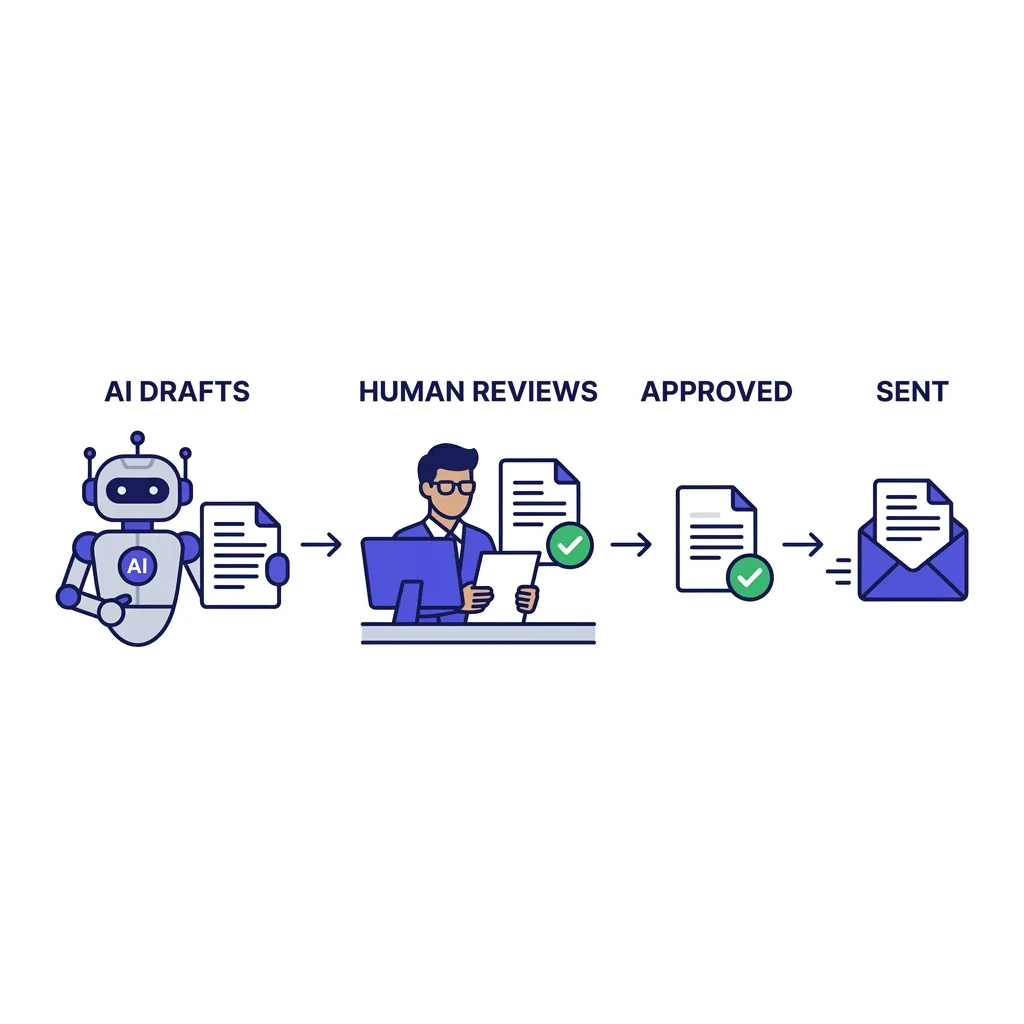 A human reviewer approving an AI-drafted outbound email before it sends
A checkpoint is not a person reading every word of every email before it sends.
That does not scale past a handful of reps, and teams that try it burn out the reviewer within a quarter.
A working checkpoint has three properties.
It reviews a sample, not every unit, sized to catch drift before it compounds rather than to catch every single error.
It reviews the parts of the message that carry the most risk: the specific claim, the trigger reference, and the call to action, not the greeting or the sign-off.
It gets faster over time because the review feeds back into the prompt, the ICP definition, or the eval set, which is the loop covered in building an eval set for outbound AI.
Teams that skip that feedback loop end up reviewing the same mistakes every week instead of shrinking the review surface.
#What to review and what to skip
The diagram above is the actual decision a checkpoint needs to make on every draft, not a vague "review it" instruction.
New accounts and new segments get a full read.
Established, already-validated segments get a sample, not a full read, because the risk profile is lower once a pattern has proven out.
Any draft missing a specific, checkable fact gets rejected before it reaches a human at all, which is the job of the automated pre-send checks layer sitting in front of the reviewer.
That triage is what keeps the checkpoint from becoming the bottleneck it replaced.
#The cost math behind the checkpoint
The objection to a human checkpoint is almost always cost.
A reviewer's time is expensive, and every minute spent reading a draft is a minute not spent on a call or a follow-up.
That objection only holds up if you count the review cost and skip the cost of what an unreviewed mistake causes.
A wrong claim that reaches one account costs a reply, maybe a relationship.
The same wrong claim reaching a hundred accounts through an autonomous sequence, because nobody caught it on send one, costs a segment, a chunk of domain reputation, and the time to rebuild both.
Sized correctly, review time should shrink as a percentage of total volume even as total volume grows, because the sample shrinks for proven segments while staying full for new ones.
Teams that see review cost rising in lockstep with send volume have not sized the checkpoint correctly. That is a sign the sampling logic in the earlier decision tree is not being applied.
The 2.8x pipeline lift has to be read against this backdrop.
It is not 2.8x more pipeline for free.
It is 2.8x more pipeline for a review cost that is a fraction of the pipeline it protects, which is a very different trade than the "AI does everything" pitch implies.
#AI-assisted vs autonomous, side by side
| Factor | AI-assisted (human checkpoint) | Fully autonomous |
|---|---|---|
| Pipeline vs manual baseline | ✓ 2.8x reported lift | ✗ Inconsistent, rarely benchmarked publicly |
| Survives past 90 days | ✓ Common | ✗ Only about 2% stick long term |
| Catches a wrong or outdated fact | ✓ Before it reaches the account | ✗ Only after a reply or complaint |
| Deliverability control | ✓ Human can pause a bad segment fast | ✗ Keeps sending until a threshold trips |
| Cost per send | ✗ Higher, human time in the loop | ✓ Lower per unit |
| Speed to first send | ✗ Slower by design | ✓ Faster |
| Compliance sign-off | ✓ Built into the review step | ✗ Needs a separate audit layer |
| Works for low-stakes, templated offers | ✓ Works, arguably overkill | ✓ Genuinely the better fit here |
The table is not a blowout in one direction.
Autonomous wins on cost and speed for a narrow set of low-stakes, high-volume, templated use cases.
It loses on almost everything else, which is why the segment where it actually fits is much smaller than the marketing around it implies.
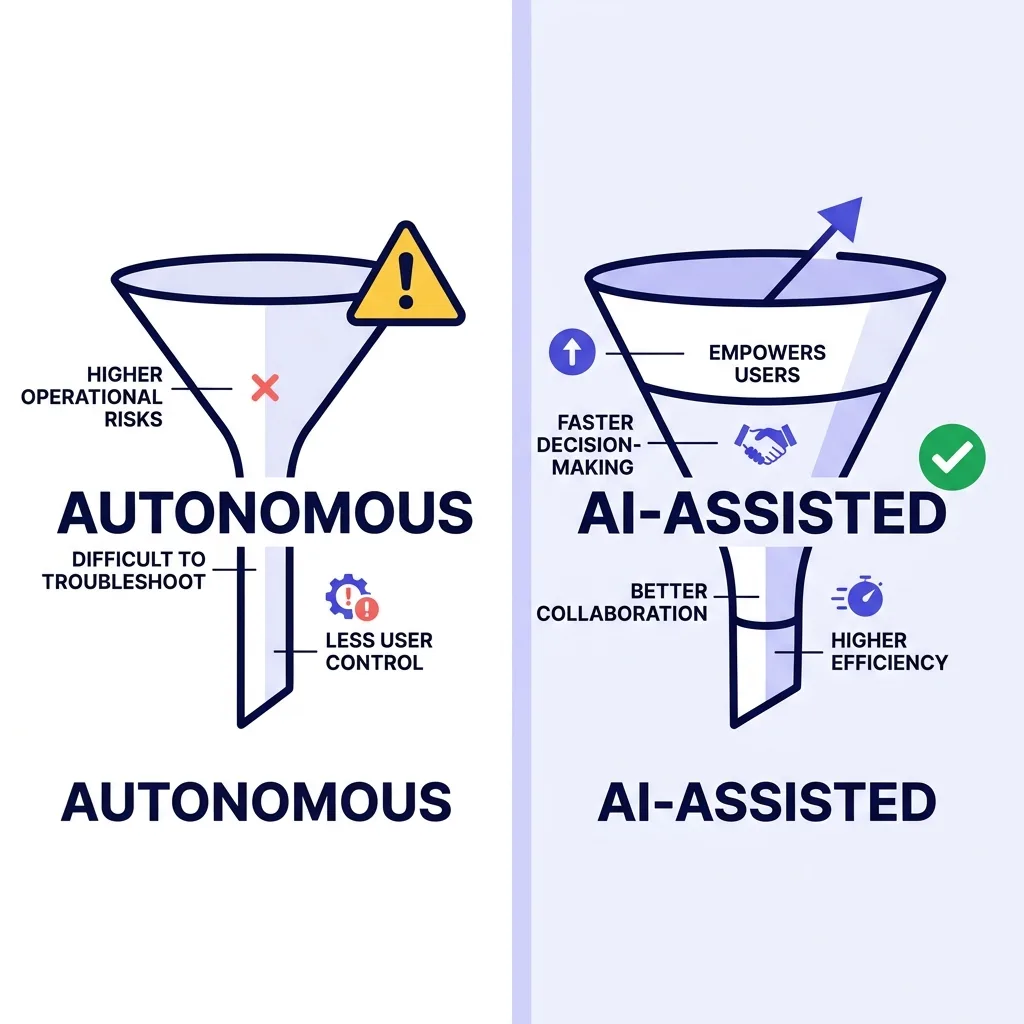 Funnel comparison showing autonomous outbound narrowing versus AI-assisted outbound widening
#Signs your checkpoint is miscalibrated
A checkpoint that is too heavy shows up as a backlog: drafts pile up waiting for review and reps start rubber-stamping to clear the queue.
Rubber-stamping is worse than no review at all, because it creates the illusion of oversight while providing none.
A checkpoint that is too light shows up differently.
Reply quality drops, prospects start replying to point out a wrong detail, and nobody catches the pattern until human review rates get audited weeks later.
The right calibration point is a moving target tied to how proven the segment is, not a fixed percentage set once and forgotten.
Account tiering for outbound is the same idea applied to research depth, and the same tiering logic works for review depth: your highest-value accounts get the fullest read, and volume segments get the lightest sample the data supports.
#Moving from autonomous back to a checkpoint
Teams that launched fully autonomous and got burned rarely tear the whole system down.
They add the checkpoint back in stages, usually starting with the highest-risk segment first.
The first stage is almost always a full stop on new-account sends until a human reviews the draft, while proven, already-validated segments keep running lighter.
That single change catches most of the compounding-mistake risk described earlier, because new accounts are exactly where an unverified claim does the most damage.
The second stage is rebuilding the eval set from the mistakes the autonomous run actually made, not from a generic template.
Real failed sends, the ones that got a complaint or a pointed correction from a prospect, make a far better training signal than a hypothetical list of what could go wrong.
The third stage is deciding, segment by segment, how much sampling the data actually supports rather than reviewing everything indefinitely out of caution.
Teams that skip this last stage end up with a checkpoint as heavy as full manual review, which defeats the purpose of adding AI in the first place.
#What is overrated in this debate
The fully autonomous pitch is overrated, and the data backs that up plainly: only about 2% of teams that go fully autonomous keep it running past a year.
Fully manual outbound is also overrated at this point, given the 2.8x gap.
What is genuinely underrated is the plumbing that makes a checkpoint fast enough to not become its own bottleneck: pre-send checks, a shrinking review sample as segments prove out, and a feedback loop from review back into the prompt.
Most of the AI SDR conversation focuses on the drafting model.
The teams actually getting the 2.8x lift are focused on the review layer instead, and that is the less exciting, more durable part of the system.
#Building the checkpoint into a real stack
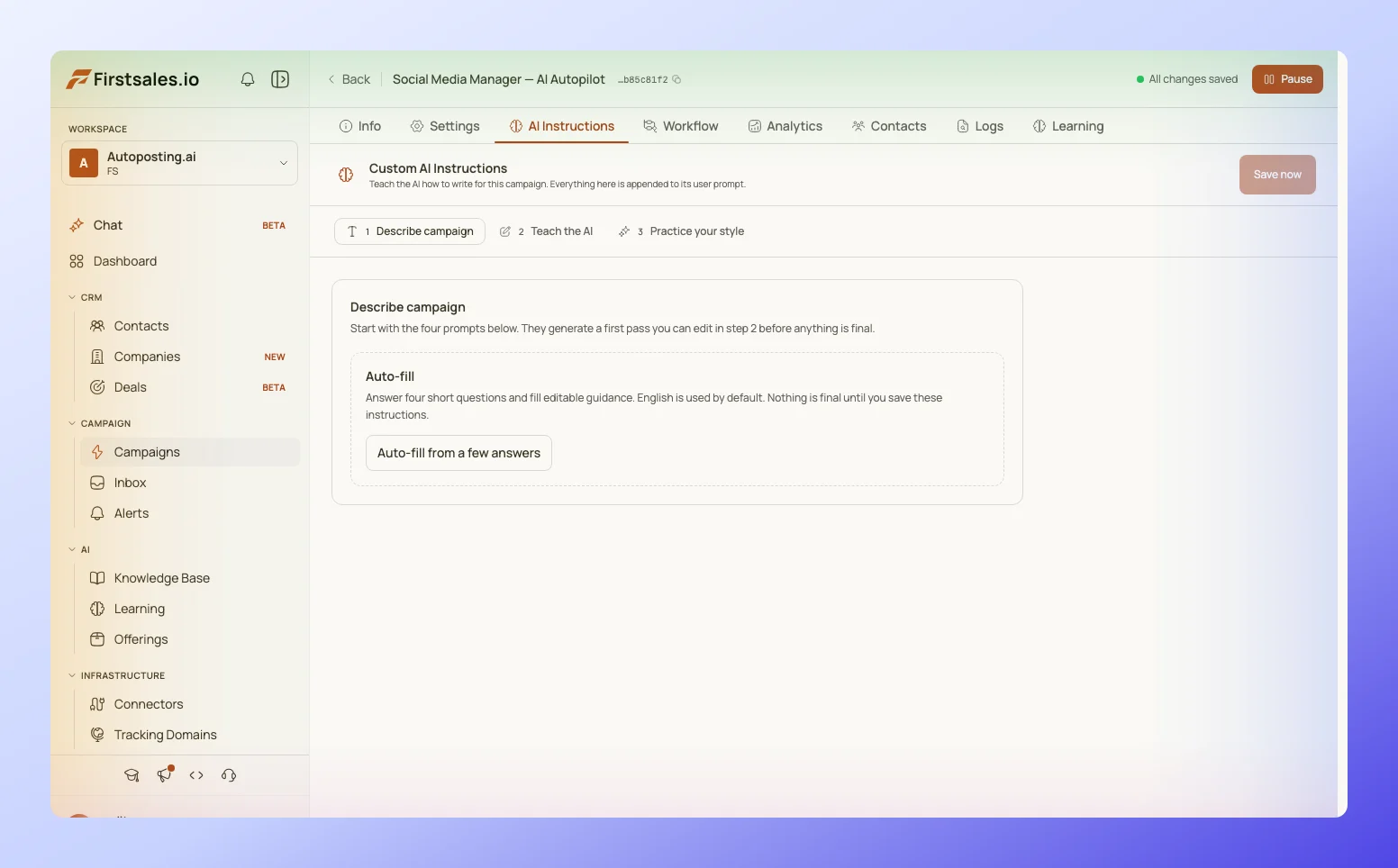 FirstSales AI draft approval screen showing a human reviewing a drafted email before send
The screenshot above shows what the checkpoint looks like in practice inside FirstSales: an AI-drafted email sitting in an approval queue, with the specific claim and trigger highlighted for the reviewer before the send decision.
That is the shape a working checkpoint takes, not a separate spreadsheet, not a Slack channel someone forgets to check.
FirstSales builds the review step into the same flow that does the research and drafting, so the reviewer sees the source signal next to the claim it produced.
Teams comparing a full sales engagement platform against a dedicated AI SDR tool should weigh this specifically: does the platform make review faster over time, or does it just generate more volume for a human to wade through.
The AI SDR versus AI-assisted SDR distinction matters here too, because vendors use both terms loosely and the actual difference is exactly the checkpoint described in this piece.
Ask any vendor pitching autonomy where the human sits in their pipeline, and if the honest answer is nowhere, treat the 2.8x number as a reason to be skeptical, not a reason to skip review entirely.
#FAQ
#What does the 2.8x pipeline figure actually compare?
It compares AI-supported human SDR teams against manual-only teams, not autonomous AI against humans.
The comparison is human plus AI tooling versus human alone.
#Is fully autonomous outbound ever a good fit?
Yes, for narrow cases: low-stakes offers, well-proven ICPs, and highly templated messages where variation adds little value.
Outside that narrow band, the failure rate climbs fast.
#Why do 40-60% of AI SDR pilots get shut down within 90 days?
Most get shut down because quality drifted, deliverability took a hit, or a compounding factual error damaged an account relationship before anyone caught it.
All three trace back to a missing or too-light review step.
#How big a sample should a human checkpoint review?
Size the sample to the segment's maturity. New segments and new accounts get a full read.
Proven segments can move to a smaller spot check, often as low as one in ten sends.
#Does AI-assisted outbound cost more per send than autonomous?
Yes, because a human's time is the more expensive input.
The tradeoff is that the higher per-send cost buys a much lower failure rate on the sends that matter most.
#What is the difference between AI-assisted and human in the loop?
They describe the same structure in most vendor language, a human reviewing or approving AI output before it acts.
Human in the loop is the more precise term; AI-assisted is the marketing-friendly version of it.
#Can autonomous outbound catch its own mistakes?
Only after the fact, through reply patterns, complaint spikes, or bounce thresholds tripping.
By the time those signals fire, the mistake has usually already reached multiple accounts.
#How does prompt drift relate to this gap?
Drift happens whether a human reviews the output or not, but only a reviewed pipeline catches drift before it shows up in reply rates.
Autonomous pipelines usually notice drift only once performance has already dropped.
#Do reply rates actually differ between AI-assisted and autonomous sends?
Generic, unreviewed sends cluster around 1-3% replies across the market in 2026.
Reviewed, signal-based sends run 5-18%, and systematized campaigns with a tight review loop hit 10-18%.
#Is the human checkpoint the same thing as compliance review?
They overlap but are not identical.
Compliance review checks legal exposure and claims; the outbound checkpoint also checks accuracy, tone, and fit, which is a broader net.
#What should a reviewer actually look at first?
The specific claim or trigger the email is built around, since that is where factual errors and stale signals hide.
The greeting, sign-off, and formatting matter far less and rarely need a human's attention.
#Does hybrid mean 50/50 human and AI effort?
No. Hybrid usually means AI does most of the research and drafting volume, and a human spends a smaller amount of focused time on review and judgment calls.
The split in effort is closer to 80/20 in favor of AI-generated volume.
#How does account tiering affect the checkpoint?
Higher-tier accounts justify a full human read on every send because the downside of a mistake is larger.
Lower-tier, higher-volume accounts can run on a lighter spot check without meaningfully raising risk.
#What happens if a checkpoint is skipped for cost reasons?
Short-term savings usually get erased by the deliverability and reputation cost of unreviewed mistakes reaching multiple accounts.
The 40-60% pilot shutdown rate is largely this tradeoff playing out in real teams.
#Can a small team run a human checkpoint without slowing everything down?
Yes, if pre-send automated checks filter out the drafts missing a specific fact before a human ever sees them.
That filtering step is what keeps a small team's review time proportional to actual risk instead of total volume.
#Is AI-assisted outbound slower to get to first send than autonomous?
Slightly, since a human still reviews before the first sends in a new segment go out.
That slower start is usually recovered within a few weeks once the segment is proven and review can lighten up.
#Does this gap apply the same way to LinkedIn and email?
The mechanism is the same, but email carries the extra deliverability layer that LinkedIn does not.
A bad LinkedIn message costs a connection; a bad email pattern can cost domain reputation.
#How do I know if my current checkpoint is actually working?
Track reply quality and complaint rates by segment over time, not just volume sent.
A checkpoint that is working shows shrinking review time per send alongside stable or improving reply rates.
#Should every company build a checkpoint from scratch?
No. Most teams are better served adopting a platform that already builds the review step into the drafting flow, rather than bolting review onto a pipeline that was built for full autonomy.
Building the plumbing from scratch is the part most teams underestimate the cost of.
#Conclusion
The 2.8x figure gets used as an argument for adding more AI to outbound, and that reading misses the actual lesson.
The lift comes from a human still deciding what goes out, not from replacing that decision entirely.
Autonomous outbound has a real but narrow home: low-stakes, well-proven, templated sends where the review overhead does not pay for itself.
Everywhere else, the checkpoint is the product, not an afterthought bolted onto a drafting model.
Get the checkpoint right, sized to segment risk and fed by a real eval loop, and the 2.8x gap stops being a headline number and starts being a design spec.