TL;DR: A buyer decides whether your cold email is worth a real read in under two seconds, based on the subject line, the first six words of the body, and whatever is bolded or broken into its own line. Everything else is a formality. The platform-wide reply rate has fallen from 5.1% in 2024 to about 3.43% in 2026 partly because most emails are written for a reader who does not exist, someone with time to read paragraph three. Write for the skim first, then let the full read be a bonus for the few who give you one.
#What the skim test actually measures
The skim test is a simple question.
If a buyer reads only the subject line and the first sentence, does your email still make sense and still earn a second look.
Most cold email advice talks about structure, length, and formatting as separate topics.
The skim test folds all three into one check, because a buyer never experiences them separately.
They experience your email as one glance, then a decision to keep reading or move on.
That glance happens before your open rate, your click rate, or your reply rate can even be measured.
It happens in the inbox preview pane, often before the email is even opened.
#Why two seconds is not an exaggeration
The platform-wide cold email reply rate fell from 5.1% in 2024 to about 3.43% in 2026.
That drop did not happen because buyers got busier.
It happened because inboxes got fuller, spam filters got stricter, and buyers got faster at pattern-matching a template.
Systemized campaigns built around real signals still hit 10 to 18% replies.
Signal-based emails, the ones referencing something specific and current about the recipient, land in the 5 to 18% range.
Generic sends, the ones that read the same to everyone, sit at 1 to 3%.
That spread is not explained by list quality alone.
A generic email and a signal-based email can go to the same list and get wildly different results, because the difference shows up in the first two seconds, not the tenth.
Open rate is not a useful proxy for any of this anymore.
Apple Mail Privacy Protection pre-fetches images and inflates opens across the board, so an open no longer tells you a human looked at anything.
The skim test replaces open rate as the metric that actually matters, because it describes what happens in the seconds after a human, not a privacy proxy, actually looks at the message.
#The four things a buyer's eyes hit first
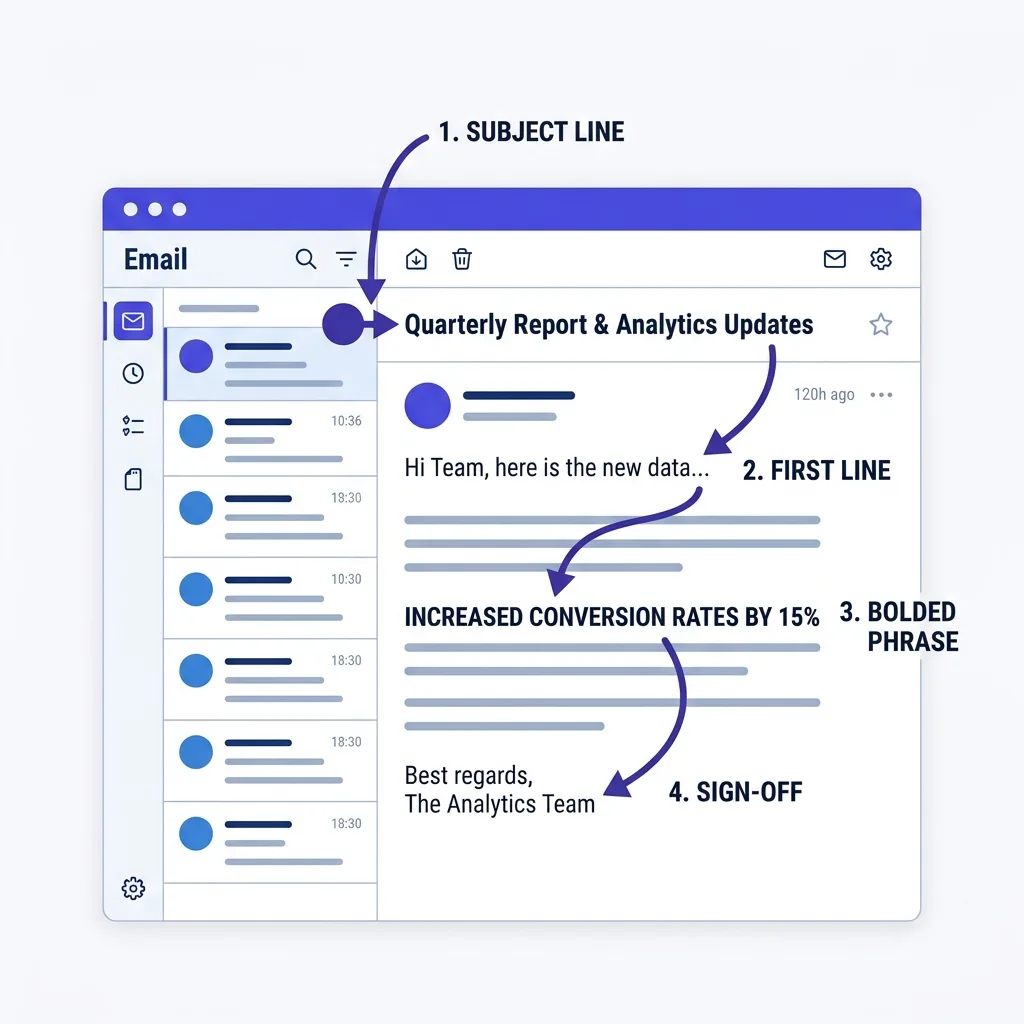 The eye scan path a buyer follows through a cold email during the skim test
Eye-tracking research on email and web content consistently shows readers scan in a predictable pattern before they commit to reading.
For cold email, four elements absorb almost all of that scanning attention.
The subject line decides whether the email opens at all.
The first line, visible in the preview pane on most clients, decides whether the open turns into a read.
Anything bolded, put in its own short paragraph, or placed as a question mark grabs attention out of sequence, meaning it gets read even if the buyer skips everything around it.
The sign-off and any obvious call to action get a fast glance last, mostly to check what is being asked before deciding whether to respond at all.
flowchart TD
    A[Subject line] --> B{Worth opening?}
    B -->|No| Z[Deleted, unread]
    B -->|Yes| C[First line in preview pane]
    C --> D{Makes sense fast?}
    D -->|No| Z
    D -->|Yes| E[Scan for bold, short lines, questions]
    E --> F[Glance at sign-off and ask]
    F --> G{Passes the skim?}
    G -->|No| Z
    G -->|Yes| H[Full read or a reply]
Everything between the first line and the sign-off gets read only if the first three checkpoints pass.
That is the uncomfortable part for most writers, because it means the middle of the email, the part that took the most effort to write, is the part least likely to be read on the first pass.
#The skim test checklist
Run every draft against this before it goes out.
| Element | ✓ Passes the skim | ✗ Fails the skim |
|---|---|---|
| Subject line | States a specific reason tied to the recipient | Generic phrase like "quick question" |
| First line | Makes a complete point on its own | Warms up with a greeting or self-introduction |
| Paragraph length | 1 to 2 lines, one idea each | Blocks of 4+ lines |
| Bolded text | None, or one word that matters | Multiple bolded phrases fighting for attention |
| The ask | One clear, specific ask near the end | Buried in the middle or vague ("let me know your thoughts") |
| Sentence structure | Short, direct, active voice | Long compound sentences with clauses |
| Visual density | White space between every idea | Wall of text with no breaks |
A draft that fails three or more rows on this table is not a copy problem you can fix with better adjectives.
It needs restructuring before it needs better words.
#Rewriting for the skim without gutting the message
The instinct when someone says "make it skimmable" is to cut everything down to bullet points.
That is usually the wrong move.
Bullet-heavy cold emails have become their own tell, the visual signature of a template pulled from a swipe file or generated by a tool without a human pass.
A buyer who has seen a hundred bulleted cold emails this quarter skims past the format itself, not just the content inside it.
The better fix is sentence-level, not format-level.
Cut every sentence that exists to lead into another sentence.
Cut every clause that restates something the subject line already implied.
Put the single most important fact, usually the reason you are writing to this specific person right now, in the first six to eight words of the body.
Our guide on one-line cold emails pushes this to its extreme, showing what survives when you are forced to say the whole thing in a single sentence.
Most emails do not need to go that far, but writing a one-line version first and then expanding it by exactly one supporting sentence keeps the skim test intact.
The subject line and the first line should feel like they were written by the same person in the same breath, not like the subject line is a headline and the body is a different article.
#Where AI drafting helps the skim test and where it hurts it
AI-generated first drafts are good at hitting length and structure targets, and bad at knowing which single fact actually matters most to a specific recipient.
That gap is exactly where the skim test breaks.
A model will often produce three roughly equal sentences about a prospect's company, when the skim test needs one sentence that outranks the other two and gets placed first.
This is why human review before send is not a compliance step, it is a skim-quality step.
 A person reviewing an AI-drafted cold email before approving it to send
Reviewing an AI draft against the skim test takes under a minute per email: read only the subject and first line, decide if that alone would earn a reply, then check the rest.
FirstSales builds that review step into the drafting flow itself, so the AI proposes a draft and a human confirms or edits the opening before anything sends, rather than approving a full paragraph and hoping the first line survived the pass.
That single checkpoint catches most skim failures before they reach an inbox, because it forces a reviewer to read the email the way a buyer actually will.
Teams running fully autonomous sends skip that checkpoint, which is one reason autonomous cold email agents tend to drift toward generic phrasing over a few weeks, since nothing in the pipeline is scoring the first line specifically.
The fix is not slowing the whole pipeline down to a manual crawl.
It is narrowing the review to the one part of the email that decides everything: does this opening line survive being read alone, out of context, by someone who has never seen your product before.
That narrower review is realistic to keep up even at volume, where reviewing every full paragraph of every draft is not.
#Personalization that survives a skim versus personalization that does not
Personalization only helps the skim test when it is visible in the first line.
A detail buried in paragraph two does nothing for the two-second decision, even if it took real research to find.
The most common personalization mistakes almost all involve putting the specific, earned detail in the wrong place, usually after a generic opening line that the reader has already tuned out by the time the real point arrives.
Move the earned detail to the first sentence, and cut the sentence that used to sit in front of it.
That single edit does more for reply rates than adding a second or third personalized detail further down, because the second detail only gets read if the first one already worked.
#Mobile changes the skim, not the rule
Most cold email gets read on a phone first, where the preview pane shows even less of the first line than a desktop client does.
That makes the first six to eight words carry more weight, not less, since a long lead-in clause might get cut off before the reader even taps to open.
Plain text renders more predictably across mobile clients than heavily formatted HTML, which is one reason the plain text versus HTML debate keeps favoring plain text for cold outreach specifically.
Formatting that looks fine on a wide desktop screen, like a bolded phrase near the start of a long line, can wrap awkwardly on mobile and land mid-sentence, breaking the exact skim path you were trying to control.
Test every draft in a narrow preview window before sending, not just in a full-width email client.
#The skim test is a diagnostic, not a style
Here is the part most advice gets backward.
The skim test is not a mandate to write short emails.
It is a mandate to write emails where the short version, the one a skimmer actually reads, is also the true version.
A longer email can pass the skim test perfectly well if the first two sentences carry the entire argument and the rest is optional supporting detail for someone who chooses to keep reading.
A three-sentence email can fail the skim test if none of those three sentences make a complete point on their own.
Length is a lagging indicator of what actually determines skim performance, which is whether the first idea in the email can stand alone.
Writers who chase word count targets instead of that structural test end up cutting good context to hit a number, while leaving the actual skim-breaking problem, a slow-starting first sentence, untouched.
Check the cold email offer clarity framework if the skim keeps failing even after a rewrite, since sometimes the first line is slow because the offer underneath it is not clear yet, not because the sentence is badly written.
And if you are choosing to lead with a stance instead of a pain point, our piece on point of view cold email covers when that approach passes the skim test and when it reads as too clever to parse in two seconds.
#Common failures that fail the skim test every time
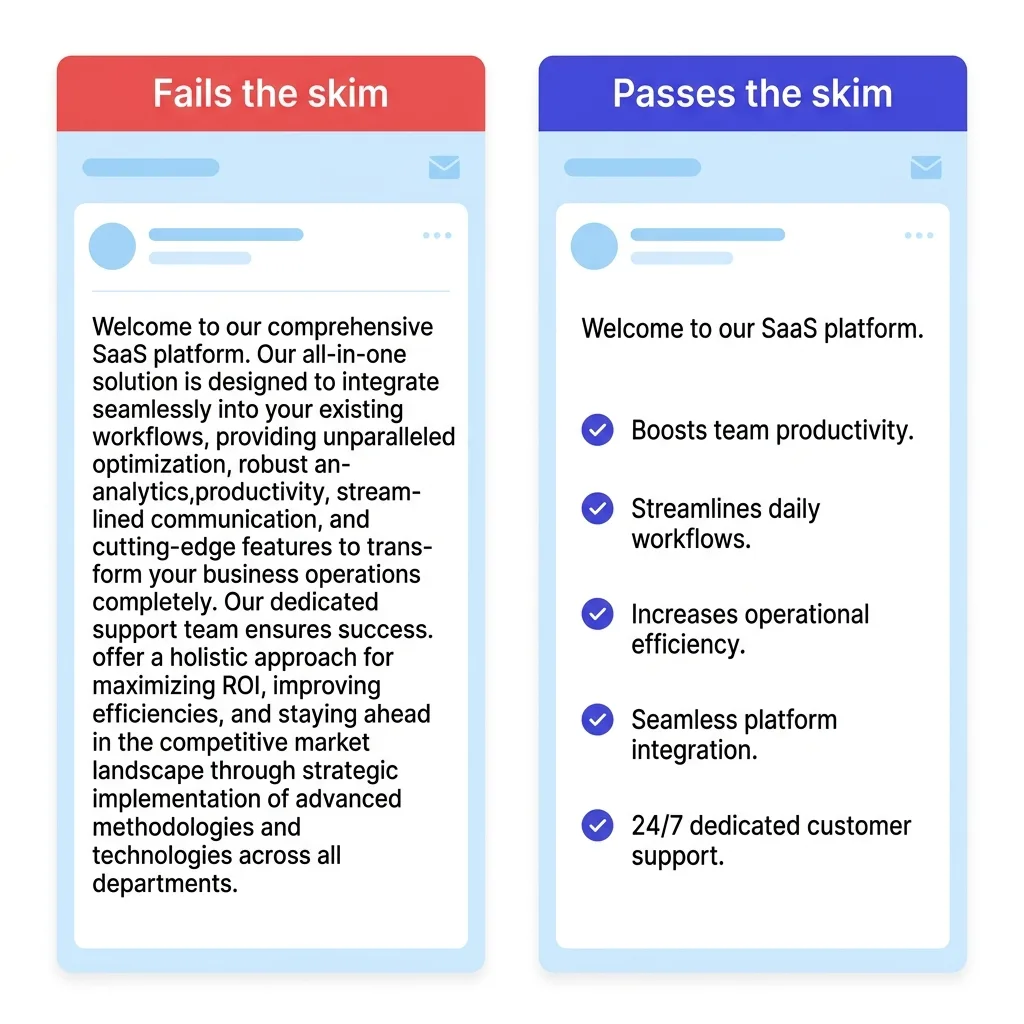 A side by side comparison of a cold email that fails the skim test and one that passes it
A greeting-first opener is the single most common failure.
"Hope you're doing well" or "My name is" burns the entire first-line budget on a sentence that carries zero information.
A compound first sentence is the second most common failure, one sentence trying to establish who you are, what your company does, and why you are writing, all before the reader has decided to care about any of it.
A vague ask is the third.
"Let me know if you'd like to chat" gives a skimming reader nothing concrete to react to, so there is nothing to say yes or no to quickly.
Our collection of bad cold email examples documents these patterns with real annotated samples, which is a faster way to spot them in your own drafts than reading advice about them in the abstract.
A ps line that repeats the main point rather than adding a new one is a smaller failure, but it wastes one of the few spots in the email that a skimming reader's eye naturally lands on last.
#FAQ
#What is the cold email skim test exactly?
It is the check of whether a buyer reading only your subject line and first sentence would understand your point and want to keep reading, since that is what most recipients actually do before deciding whether to read the rest.
#How long does a buyer actually spend on a cold email before deciding?
Most buyers form a keep-or-delete decision within two seconds of seeing the subject line and preview text, before the email is even fully opened.
#Does a shorter email automatically pass the skim test?
No. A short email with a slow, vague first sentence fails the same way a long email does. The test is about the strength of the first idea, not the word count.
#Why do bullet points sometimes hurt more than they help?
Heavy bullet formatting has become a visible pattern associated with templated or AI-generated outreach, so experienced recipients can skim past the format itself without reading the content inside it.
#Where should the most important detail go in the email?
In the first six to eight words of the body, not the subject line alone and not buried in a supporting paragraph further down.
#Does personalization help if it is not in the first line?
Rarely. A personalized detail placed in paragraph two only gets read if the first line already earned a real read, so it should usually move to the front.
#How does mobile change what I should write?
Mobile preview panes show less text before the tap to open, so the first sentence needs to make sense even when it gets cut off early.
#Is plain text better than HTML for passing the skim test?
Plain text renders more predictably across mobile and desktop clients, which protects the exact line breaks and emphasis you planned, so it generally supports the skim test better for cold outreach.
#Should I bold my key sentence to help it get skimmed?
One bolded phrase can work if it is the single most important fact in the email. Multiple bolded phrases compete with each other and defeat the purpose.
#How does open rate relate to the skim test?
It does not, not reliably. Apple Mail Privacy Protection inflates opens by pre-fetching images regardless of whether a human looked at the email, so open rate cannot tell you whether your first line actually landed.
#Can AI drafting tools write emails that pass the skim test?
They can produce structurally sound drafts, but they are not reliably good at ranking which single fact matters most to a specific recipient, which is exactly what the skim test checks. Human review of the opening line closes that gap.
#What is the single most valuable edit for a failing draft?
Rewrite the first sentence so it can stand completely alone, then check whether every sentence after it still needs to exist.
#Does the skim test apply to follow-up emails too?
Yes, and it matters more there, since a recipient who ignored the first email has even less patience for a slow opening on the second or third touch.
#How do I know if my subject line is failing the skim test?
If it needs the body of the email to make sense, or if it could be sent to any recipient without changing a word, it is likely too generic to earn the open in the first place.
#Should every cold email have a bolded call to action?
No. One clear, specific ask near the end works better than a bolded button-style line competing for attention with the rest of the email.
#Is a question in the subject line good for skimmability?
A specific question tied to the recipient's situation can work well, since questions draw the eye out of sequence during a scan. A generic question like "quick question?" does not.
#How often should I re-test my templates against the skim test?
Any time reply rates drop for two or more consecutive weeks on the same template, since inbox behavior and buyer patience both shift over time even if your list quality has not changed.
#Does the skim test work the same way for a signal-based email as a generic one?
The mechanics are the same, but a signal-based email has a real advantage: the specific trigger you are referencing gives the first line something true and concrete to say, which is harder to fake in a generic send.
#Does the skim test change based on which sending tool I use?
No. The skim test happens in the recipient's inbox, not in your sending tool. What a tool like FirstSales can change is how consistently your team catches a slow-starting first line before it ships, since that review step is easy to skip when volume climbs and easy to keep when it is built into the send flow.
#What should I do first if my reply rate drops but my list quality has not changed?
Pull your last ten sent emails and read only the subject line and first sentence of each, out loud. A skim test failure usually shows up immediately once you isolate those two lines from the rest of the copy.
#Conclusion
The skim test is not a writing trick.
It is an honest description of how your email actually gets read, whether you plan for it or not.
Every cold email you send already gets this test applied to it by the person receiving it.
The only choice you have is whether you write for that reality or write for an imaginary reader who commits to your full paragraph three.
Run your next draft through the checklist above before you send it.
Read only the subject line and the first sentence, out loud, and ask whether a stranger would keep going.
If the answer is no, fix that one sentence before you touch anything else in the email.