
TL;DR: A point-of-view cold email opens with a claim about how the buyer's world works, not a description of their pain. It works when you actually have evidence for the claim and the reader has a stake in whether it is true. It backfires when the stance is generic, when you have no data behind it, or when you send it to a buyer who has never questioned the status quo you are attacking. Reply rates on generic cold sends sit around 1-3%, and a sharp point of view is one of the few things that can pull a send above that floor without more volume.
#What a point-of-view email actually is
A point-of-view opener makes a specific, falsifiable claim in the first two sentences.
Not a question, not a compliment, not a fact about the reader's company pulled from a scrape.
A claim.
Something like "most teams doing outbound at your headcount are burning more on tooling than on the reps who use it" is a point of view.
"I saw your company just raised a Series B, congrats" is not.
The difference matters because a claim invites a reaction.
Readers either think "yes, that is exactly my situation" or "no, that is wrong, and here is why," and both reactions are worth more than silence.
A compliment or a fact invites nothing.
It just confirms you did five seconds of research, which every other email in the inbox also did.
#Why pain-point openers stopped working as well
The platform-wide cold email reply rate fell from 5.1% in 2024 to about 3.43% in 2026.
Part of that drop is volume, since more senders are running more campaigns through the same inboxes.
Part of it is pattern recognition.
Buyers have read "are you struggling with slow deployment cycles" so many times that the sentence no longer registers as a real observation.
It registers as a template.
Once a phrasing pattern becomes recognizable as a template, the brain stops processing it as information and starts filtering it as noise, the same way banner ads disappear from a page you have visited a hundred times.
A point of view is harder to template because it has to be specific to be interesting.
You cannot write a generic version of "the way you're staffing outbound will stop working within two quarters" the way you can write a generic version of "are you struggling with X."
The specificity is the whole point, and it is also the reason most teams do not do it well.
#The anatomy of a point-of-view opener
A working point-of-view opener has four parts, and skipping any one of them turns it back into a generic hot take.
A claim about the reader's world, stated flatly. Not hedged with "I think" or "in my experience." State it like a fact and let the reader push back if they disagree.
A reason the claim is true, in one sentence. This is where most people either skip the reasoning or bury it in three sentences. One sentence, tied to a mechanism, not a vibe.
A number or specific detail that makes the claim checkable. A stance with no evidence reads as an opinion. A stance with a number reads as a finding, even if the number is modest.
An implicit invitation to disagree. You do not need to write "let me know if you disagree." The tone of a genuine claim already implies it. Adding the line explicitly usually weakens it.
Here is a version that hits all four:
"Most Series B sales orgs I talk to are running the same three-touch sequence they used at 10 reps, now with 40. The sequence was never the constraint, headcount was, and now that headcount is gone the sequence is showing its age. Teams that redesigned around 6-8 touches before hiring saw meeting volume hold steady through the scale-up. Curious whether that split matches what you're seeing on your side."
That is five sentences, a claim, a reason, a number, and a low-pressure invitation, without a single question mark doing the actual work of the opener.
#Where it lifts replies
Point-of-view openers work best in three situations.
The buyer has an active internal debate. If a team is already arguing about whether to build or buy, whether to hire another SDR or invest in signal-based prospecting, your stance lands inside a conversation that is already happening. You are not introducing a new topic, you are taking a side in one that exists.
You have real data behind the claim. A point of view backed by a number from your own customer base, your own experiments, or a credible third-party source reads as expertise. The same claim with no evidence reads as an opinion from a stranger, and strangers' opinions are cheap.
The reader is a decision-maker, not an operator. Operators want to know how to fix something today. Decision-makers are more willing to engage with a claim about direction, because deciding direction is literally their job. A VP of sales is more likely to reply to a stance about GTM strategy than an SDR would be, because the SDR did not choose the strategy and cannot change it.
Systematised campaigns that lean on this kind of specificity are hitting 10-18% replies in 2026, well above the 1-3% floor that generic sends get stuck at.
That gap is not entirely the opener's doing, but a sharp, evidence-backed stance is one of the few copy-level changes that moves a send meaningfully inside that range.
#Where it backfires
The failure modes are just as sharp as the upside, and they are worth naming plainly.
The stance is actually just a repackaged pitch. "Most companies don't realize how much time they waste on manual prospecting" is not a point of view. It is a pain-point opener wearing a costume, and readers spot the seam immediately.
You have no evidence and it shows. A claim with a hedge like "I think" or "in my opinion" in the first line signals you are guessing. Readers do not owe a reply to a stranger's guess about their business.
The buyer has never questioned the thing you are attacking. If you tell a team their process is broken and they genuinely believe it is working, you have not opened a debate, you have insulted their judgment. This is the single most common way a point-of-view email backfires. It reads as arrogance rather than insight.
It is targeted at the wrong seniority. Sending a strategic claim about GTM direction to an individual contributor who has no say in that direction gets ignored, or worse, forwarded internally with a note that says "who is this."
The tone tips into contrarian for its own sake. A stance that exists only to be provocative, with no real reasoning behind it, reads as a growth-hacking trick rather than expertise. Readers have gotten good at telling the difference between someone who has thought about a problem and someone who is performing confidence.
This is closely related to the pattern covered in naming competitors in cold email: a stance that names a specific vendor, tool, or approach as wrong needs the same evidentiary bar, or it reads as an attack rather than an argument.
#Point of view vs pain point, side by side
| Situation | ✓ Point of view works | ✗ Pain point works better |
|---|---|---|
| Buyer is mid-debate on strategy | Land inside the debate with a stance | Naming pain restates what they already know |
| You have real data to back a claim | Lead with the finding | Data with no stance reads as a report, not an opener |
| Reader is a senior decision-maker | Strategic claims match their job | Operators want tactics, not direction debates |
| You lack strong evidence | Avoid it, it reads as a guess | State the observable pain instead |
| Category is brand new to the buyer | Confusing without an anchor first | Naming the pain grounds an unfamiliar category |
| Enterprise, multiple stakeholders | Risky, one wrong reader kills the thread | Safer, pain points are harder to misread as arrogance |
| SMB, single decision-maker | High upside, fast to test | Works fine but blends into every other opener |
The pattern in that table is not "point of view always wins."
It is that a stance is a higher-variance play, and variance only pays off when you have earned the right to make the claim.
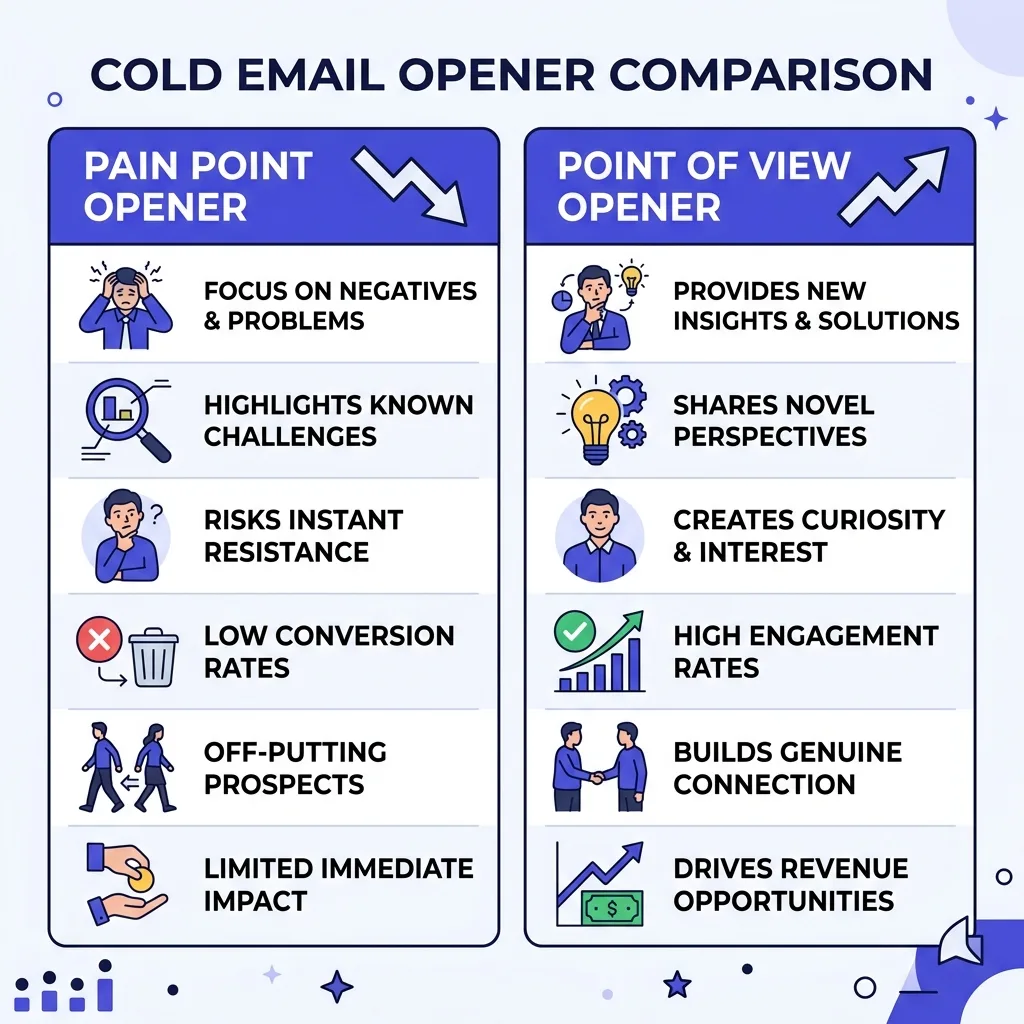 Comparison of a pain point cold email opener versus a point of view cold email opener
#How to build a defensible stance
Most teams that try point-of-view copy fail at the sourcing step, not the writing step.
You cannot write a sharp claim if you have nothing to base it on, and inventing a number to sound credible is the fastest way to lose trust the moment a reader checks it.
Start with your own data.
If you have run enough campaigns to see a real pattern, that pattern is your stance.
"Accounts that replied within 48 hours of a hiring signal converted at twice the rate of accounts we reached after two weeks" is a real, defensible claim if you actually measured it.
If you do not have your own data yet, borrow from a credible, named source and be explicit that it is not yours.
Never dress a third-party number up as your own finding.
If you have neither, do not force a number into the email.
Write the stance without one, and let the reasoning carry it instead.
A stance built on a mechanism, "the reason X breaks at scale is Y," can stand on logic alone if the logic actually holds up under a skeptical read.
This is the same discipline covered in how to write cold emails: specificity beats confidence, and a specific, honest claim beats a bold, unsupported one every time.
#The decision flow before you send one
flowchart TD
    A[Draft a point-of-view opener] --> B{Do you have real evidence for the claim?}
    B -->|No| C[Rewrite as pain-point opener instead]
    B -->|Yes| D{Is the buyer a decision-maker on this topic?}
    D -->|No| E[Send pain-point or tactical opener]
    D -->|Yes| F{Would the claim insult their current approach?}
    F -->|Yes, and they are confident in it| G[Soften to a question, not a flat claim]
    F -->|No, it opens a real debate| H[Send the point-of-view opener]
Running a draft through that flow catches most of the failure modes before they cost you a send.
The step people skip most often is the evidence check, because it is uncomfortable to admit a stance is just a hunch dressed up in confident language.
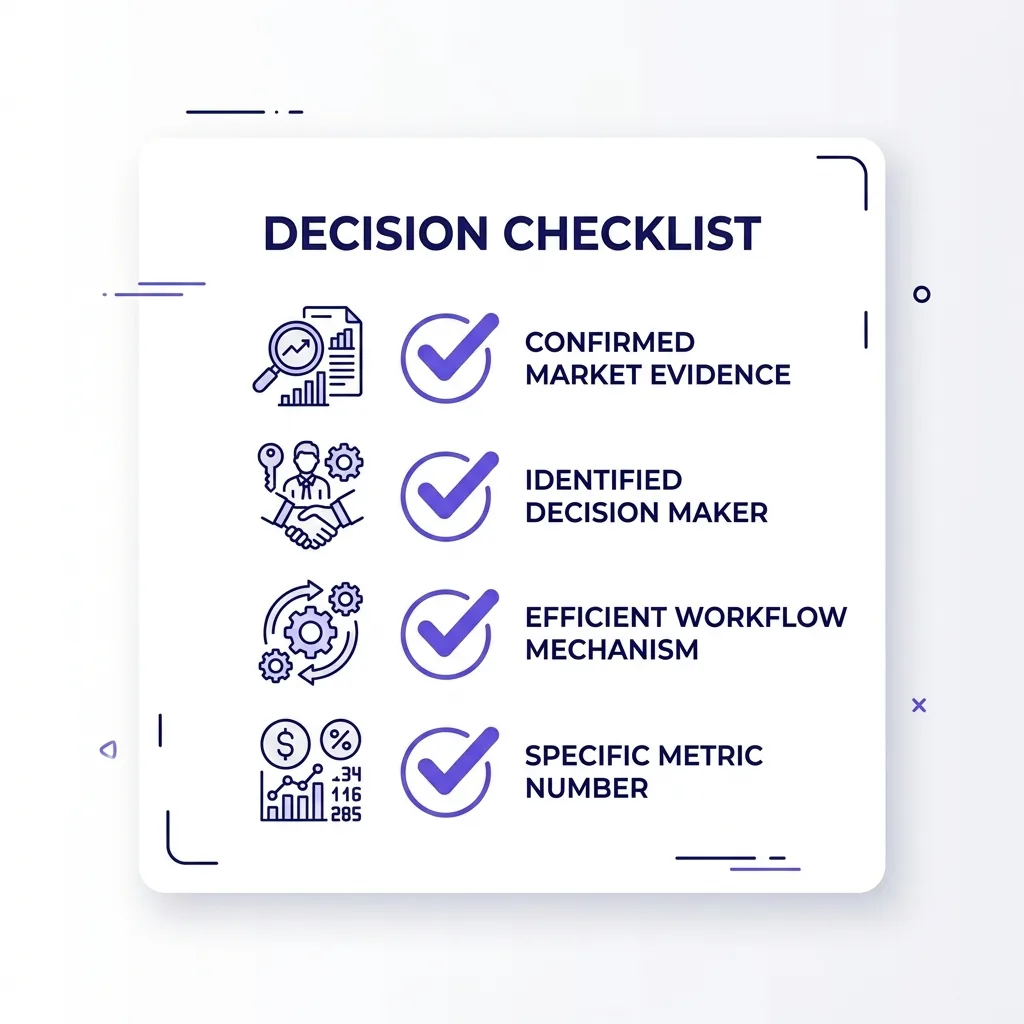 Checklist card for testing whether a point of view cold email claim is defensible before sending
#Testing a point-of-view opener without wrecking your list
Do not swap your entire sequence to point-of-view openers in one move.
Run it as a segment test against a control group using the same list, the same offer, and the same send window, changing only the opening two sentences.
Track reply rate and reply sentiment separately, because a point-of-view opener can lift replies while also increasing the share of negative or defensive replies if the stance is landing wrong.
A rising reply count with a rising share of "who is this" or "not interested, and honestly a bit annoyed" replies is a signal to soften the claim, not to declare the test a win.
Give the test at least 200 sends per variant before drawing a conclusion, since anything smaller is noise dressed up as a pattern, which is exactly the mistake a good point-of-view stance is supposed to avoid making about anything else.
Watch inbox placement rate during the test too.
A sharper, more opinionated subject line and opener can shift open behavior in ways that interact with spam filtering, and you want to isolate that from the reply-rate signal you are actually testing for.
#Where FirstSales fits
The hard part of point-of-view copy is not the writing template, it is knowing whether your draft is actually specific or just confidently generic.
That distinction is exactly the kind of thing that benefits from a second set of eyes before a send goes out, especially at volume.
FirstSales routes AI-drafted opening lines through a human approval step before they leave, so a stance that reads as insight to the model but as an unsupported guess to an actual buyer gets caught before it reaches an inbox.
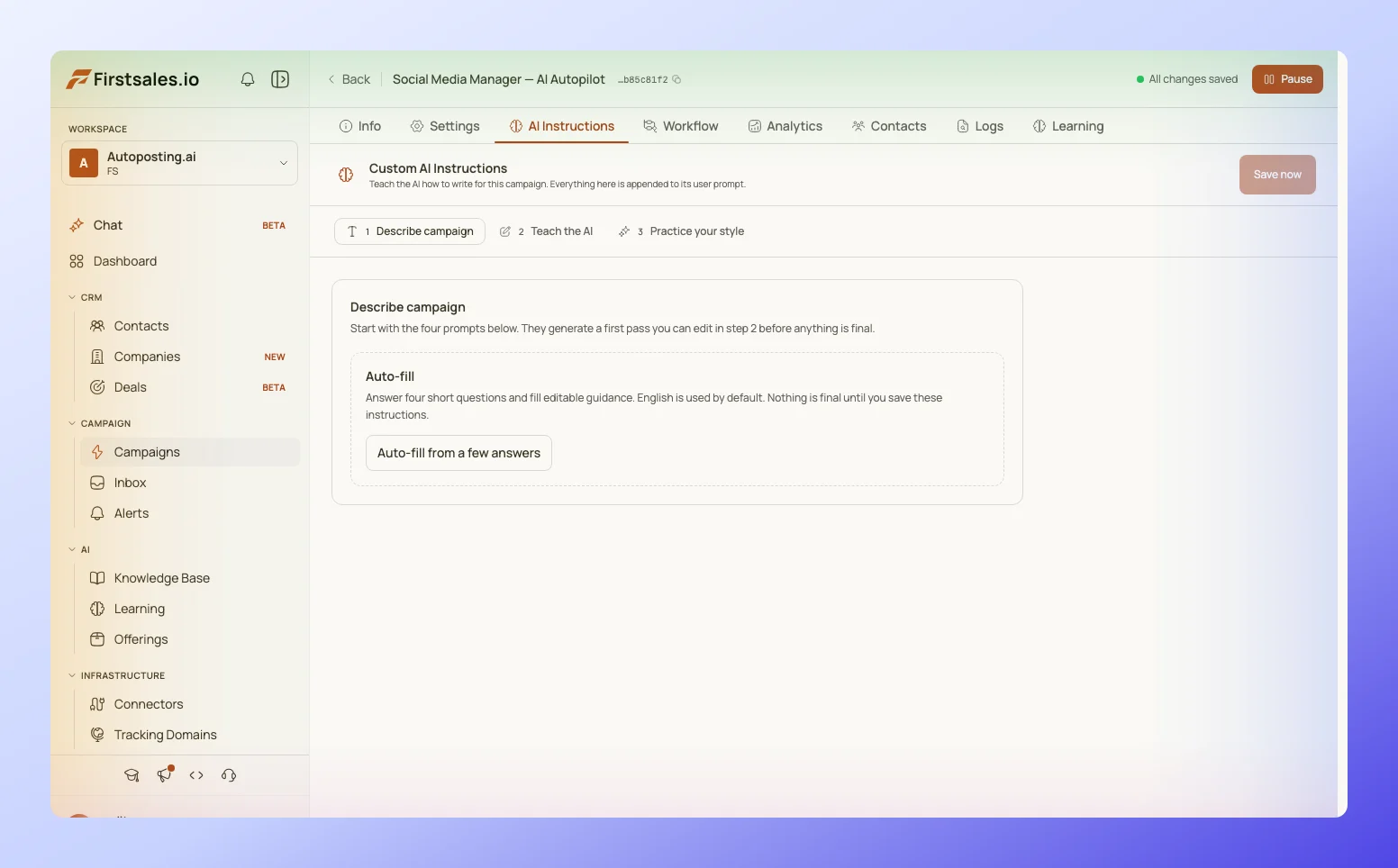 FirstSales AI draft approval screen showing a point-of-view cold email opener awaiting human review
That review step matters more for point-of-view copy than for almost any other opener style, because the cost of a wrong, unsupported claim is higher than the cost of a bland one.
A generic opener that misses just gets ignored.
A confident, wrong opener gets remembered, and not in the way you want.
#FAQ
#What is a point-of-view cold email?
It is a cold email that opens with a specific, falsifiable claim about the buyer's market, process, or upcoming decision, rather than a description of a pain point the reader already knows they have.
#Is point-of-view copy better than pain-point copy?
Neither wins universally. Point of view works better against decision-makers with real evidence behind the claim. Pain-point copy is safer for unfamiliar categories, enterprise multi-stakeholder threads, and situations where you lack the data to back a stance.
#How do I find a real point of view if I don't have much campaign data yet?
Borrow a credible, named third-party number and say plainly that it is not your own finding. Or build the claim on a mechanism, explaining why something breaks at scale, rather than leaning on a statistic you do not have.
#Can a point-of-view email work as a true first touch?
Yes, more often than a voice note or a heavier personalization play, since it only needs two or three sentences to land. It works best when the claim maps directly to something the recipient's role would actually care about.
#What is the biggest way a point-of-view opener backfires?
Telling a buyer their current approach is wrong when they are confident it is working. That reads as arrogance, not insight, and it is the single most common reason these emails get a hostile reply instead of a curious one.
#Should I ever use a question mark in a point-of-view opener?
Sparingly. The strongest version states the claim flatly and lets the tone imply the invitation to disagree. A closing question can work as the final sentence, but a claim that hedges with "don't you think" in the opening line weakens it.
#How long should a point-of-view opener be?
Four to six sentences: the claim, the reason, a supporting number or detail if you have one, and a low-pressure close. Longer than that and it reads as a manifesto rather than an opener.
#Does this work for cold LinkedIn messages too?
Yes, with the length compressed further. LinkedIn messages get skimmed faster than email, so the claim needs to land in the first line rather than the first paragraph.
#What industries respond best to point-of-view openers?
Categories where the buyer already has opinions about how their function should work: sales, marketing, and product tend to respond well. Categories with more procurement-driven buying, like facilities or compliance, respond less to a stance and more to a documented process.
#Is naming a specific number risky if it might be slightly off?
A specific, honestly-sourced number that turns out to be slightly off is far less damaging than a vague claim with no number at all. Cite your source, round conservatively, and you are covered.
#How do I avoid sounding contrarian for its own sake?
Anchor every claim to a mechanism or a data point, not just a strong opinion. If you cannot explain in one sentence why the claim is true, it is a hot take, not a point of view, and readers can tell the difference.
#Does personalization still matter if I lead with a stance?
Yes. A stance without any connection to the specific recipient reads as a mass broadcast. The claim should be general enough to be defensible but framed toward something true about the recipient's segment, stage, or role.
#What happens if the reader disagrees with my claim?
That is a good outcome. A reply that says "actually, we've found the opposite" is an open door to a real conversation, and it gives you information about their situation you would not have gotten from a pain-point opener.
#Can I use point-of-view copy in a follow-up rather than the first email?
Yes, and it can work especially well as a second-touch reset when a pain-point opener went unanswered. It signals a different kind of message, which can break through where a repeated ask did not.
#How does this interact with subject lines?
The subject line should hint at the stance rather than summarize it. A subject that gives away the whole claim removes the reason to open the body, and a subject that contradicts the tone of the claim creates dissonance before the reader even starts reading.
#Should the stance ever be about the reader's competitor rather than their own process?
It can be, but that version needs even more evidence, since you are making a claim about a market dynamic rather than something the reader can verify from their own experience alone.
#Is this the same as thought leadership content repurposed as an email?
Not quite. Thought leadership is usually broad and written for an audience. A point-of-view opener is narrow, written for one recipient's specific situation, and built to prompt a direct reply rather than general agreement.
#Does AI-generated copy struggle with this format specifically?
Yes, more than most formats. Models default to hedged, generic claims unless directed otherwise, and this is one of the clearer tells covered in how prospects spot AI-written emails. A flat, evidence-backed claim is harder for a model to produce without a human tightening it.
#How do I know if my draft is a real point of view or just a repackaged pain point?
Read the opening two sentences and check whether a reasonable person could disagree with them. If the sentence is just restating a known problem, no one disagrees, they just recognize it, which means it is a pain point wearing different words.
#Conclusion
A point-of-view opener is not a copywriting trick, it is a bet that you actually know something the reader does not, or at least see it more clearly.
That bet pays off when the claim is specific, backed by real evidence, and aimed at someone with a real stake in whether it is true.
It fails the same way overconfidence always fails: loudly, and in front of the person you were trying to impress.
The discipline is not writing a better opener template.
It is being honest with yourself about whether you have earned the stance before you put it in front of a stranger, the same discipline that separates a genuinely sharp offer from the offer clarity problems that quietly kill most cold sends, and the same read-in-two-seconds standard covered in the cold email skim test.
Test it in a segment, watch the reply sentiment as closely as the reply rate, and be willing to admit when a claim you were proud of just was not true enough to send again.