TL;DR: When a campaign gets zero or near-zero replies, the first suspect should be the offer, not the list. A reader can only act on an email once they understand what you are asking them to do and why it matters to them specifically. Most cold emails fail that test before the reader reaches the second sentence. This piece gives you a diagnosis framework to tell offer problems apart from list problems, deliverability problems, and timing problems, plus the fixes for each.
#The default assumption is wrong
Every team that sends cold email and gets no replies reaches for the same explanation first: the list is bad.
Wrong contacts, stale data, wrong titles.
Sometimes that is true. But list quality is the easiest thing to check and the hardest thing to fix quickly, so it becomes the default excuse because fixing it feels like real work is happening.
Meanwhile the actual problem sits in plain sight, in the email itself, and nobody rereads it with a stranger's eyes.
Platform-wide cold email reply rates fell from about 5.1% in 2024 to roughly 3.43% in 2026. That decline is real and it is partly about inbox filtering getting sharper.
But the campaigns still hitting 10-18% replies in 2026 are not doing it with a better list. They are doing it with an offer a specific reader can understand in one read and act on without effort.
A list problem produces a specific pattern: emails bounce, or they land but no human ever opens them because the domain reputation is shot.
An offer problem produces a different pattern: emails deliver fine, people open them, and then nothing happens. That gap between open and reply is where offer clarity lives or dies.
#What "offer" actually means in a cold email
An offer is not your product description. It is not your value proposition slide condensed into two sentences.
An offer is a specific trade you are proposing to a specific person: here is what I am giving you, here is what it costs you to find out if it is worth it, here is what you need to do next.
Three things have to be clear for an offer to work.
What the reader gets. Not a category ("better outbound"). A concrete outcome ("cut your deliverability incident response time from three days to same-day").
What it costs the reader right now. Not money, usually. Attention. A 15-minute call. A yes/no answer. The ask has to be smaller than the value being implied.
Why this reader, why now. A generic offer sent to 10,000 people reads as generic no matter how good the copy is. A buying signal tied to a specific trigger makes the same offer read as relevant.
Miss any one of the three and the email survives the open but dies at the decision point.
#The four-quadrant diagnosis
Before touching the copy, separate the symptom from the cause. Four numbers tell you where the problem sits: delivery rate, open rate, reply rate, and reply sentiment.
flowchart TD
    A[Campaign underperforming] --> B{Emails delivering?}
    B -->|No, high bounce| C[List or deliverability problem]
    B -->|Yes| D{Emails opening?}
    D -->|No, low opens| E[Subject line or sender reputation problem]
    D -->|Yes, opens are fine| F{Getting replies?}
    F -->|No replies at all| G[Offer clarity problem]
    F -->|Replies, mostly no| H[Offer mismatch or wrong timing]
    F -->|Replies, mixed positive| I[Offer is working, tune volume and targeting]
This is the sequence most teams skip. They see a bad number, assume the cause, and rewrite the wrong thing.
A team with a 2% bounce rate and a 40% open rate but zero replies does not have a list problem. The list is delivering and getting opened. The offer is the failure point.
A team with a 15% bounce rate has a list problem, full stop, and no amount of offer rewriting will fix that until the bounce rate comes down.
Apple Mail Privacy Protection inflates open numbers by pre-loading images, which makes open rate a weaker signal than it used to be. Treat a healthy open rate as "delivery is fine," not as proof the subject line worked.
#Symptom one: opens happen, replies do not
This is the clearest offer-clarity failure. Someone opened the email, which means the subject line and sender reputation did their job.
Then they read it and did nothing. No reply, not even a no.
This usually means one of three things happened inside the email body.
The reader could not tell what you wanted from them. They finished the email unsure whether you wanted a call, a reply, a click, or nothing at all.
The value was there but buried under three paragraphs of company background before the actual point arrived.
The ask was too big for a cold relationship. "Can we get 30 minutes on your calendar this week" from someone the reader has never heard of is a big ask for zero trust built.
Check your own last five cold emails. Read only the first two lines out loud. If those two lines do not make clear what you want and why, the reader never got to the interesting part.
#Symptom two: replies happen, but they are all no
This is a different problem and a better one to have, because at least the offer got processed.
A pattern of polite declines ("not a priority right now," "we're not looking at this") usually means the offer is clear but mistimed or mistargeted, not badly written.
Compare this against a pattern of confused declines ("I don't think this applies to us" from someone who is clearly your ICP). That is an offer clarity problem wearing a targeting costume.
The fix differs by which pattern you see. Mistimed offers need better trigger detection, tied to signals like funding, hiring, or a leadership change rather than a static list pull.
Confused declines need the offer rewritten so the value connects to something the reader already cares about, not something you assume they should care about.
#Symptom three: nothing happens at all
No bounces, decent opens, zero replies, and the campaign just goes quiet. This is the hardest pattern to diagnose because it gives you the least information.
Run the skim test here: have someone outside your team read the email once, for three seconds, then tell you what you were asking for.
If they cannot answer, the offer failed the most basic test a cold email has to pass. It is not about being clever. It is about being parseable in the time a busy person actually spends.
A second check: does the email mention a benefit before it mentions the sender's product name. Emails that lead with "we built X" instead of "you get Y" lose readers in the first sentence, before offer clarity even gets evaluated.
#The clarity test
Run every draft through five questions before it sends. This takes two minutes and catches most offer failures before the reader ever sees them.
Can a stranger state your ask back to you after one read, in one sentence, without rereading?
Is the value specific enough that it could not apply to literally any company in your target list?
Is the ask smaller than the value implied? A 15-minute audit call for a company facing a real, expensive problem is proportionate. A 45-minute discovery call for an unproven claim is not.
Does the email answer "why me, why now" or could this exact email have been sent to this person a year ago with no change?
Would you personally reply to this email if a stranger sent it to you cold? Most senders skip this question because the honest answer is uncomfortable.
#Rewriting an offer step by step
Start with the vague version most teams actually send, then narrow it in three passes.
Pass one: name the specific outcome. Replace "improve your outbound" with "cut time-to-first-reply from four days to same-day." Specificity is the entire fix here, not tone or wordplay.
Pass two: size the ask correctly. If the value claim is unproven to this reader, the ask should be small: a reply with a yes or no, not a scheduled call. Earn the bigger ask on the next touch.
Pass three: add the "why now." Reference the specific trigger that made this email timely: a new hire in the relevant role, a product launch, a funding announcement, a competitor's public misstep.
Here is the same offer through all three passes, side by side, so the improvement is visible rather than described.
Vague: "We help sales teams improve their outbound performance with AI-powered tools."
Better: "Teams using signal-based sends hit 5-18% replies versus 1-3% on generic lists. Worth a look at what's driving that gap for accounts like yours?"
Best: "Saw [Company] posted three SDR roles this month. Most teams hiring at that pace are trying to hit a number with headcount instead of process. Curious if that's the plan, or if there's room for a different approach. One line back either way is fine."
The third version names the trigger, states an assumption the reader can correct or confirm, and shrinks the ask to "one line back." That is what a clear offer looks like in practice.
#Vague offer versus clear offer
| Trait | ✓ Clear offer | ✗ Vague offer |
|---|---|---|
| Value statement | Specific number or outcome | Category claim ("better," "smarter") |
| Ask size | Matches trust already built | Bigger than the relationship justifies |
| Relevance | Tied to a real, named trigger | Generic, could go to anyone |
| Readability | Understood in one skim | Requires rereading to parse the ask |
| Sender focus | Leads with reader's benefit | Leads with company or product name |
| Proof | One concrete number or example | Adjectives with no evidence |
| Next step | One clear, low-friction action | Multiple asks or no ask at all |
#When the ask is the problem, not the pitch
Sometimes the value proposition is genuinely clear and the reader still does not reply, because the ask itself is wrong for where the relationship stands.
Cold email works on a trust ladder. A first touch to a stranger can reasonably ask for a reply. It cannot reasonably ask for 30 minutes of calendar time from someone who has never heard of you.
Teams that get this wrong often have decent copy and terrible reply rates, because every email asks for the same big commitment regardless of touch number.
A question CTA versus a meeting CTA makes a measurable difference here. A question is a smaller commitment and gets answered more often, even from readers who would never book a call cold.
Save the meeting ask for touch two or three, after the reader has already engaged once. Sequencing the ask size correctly does more for reply rate than any line-level copy edit.
#How AI drafting changes this diagnosis
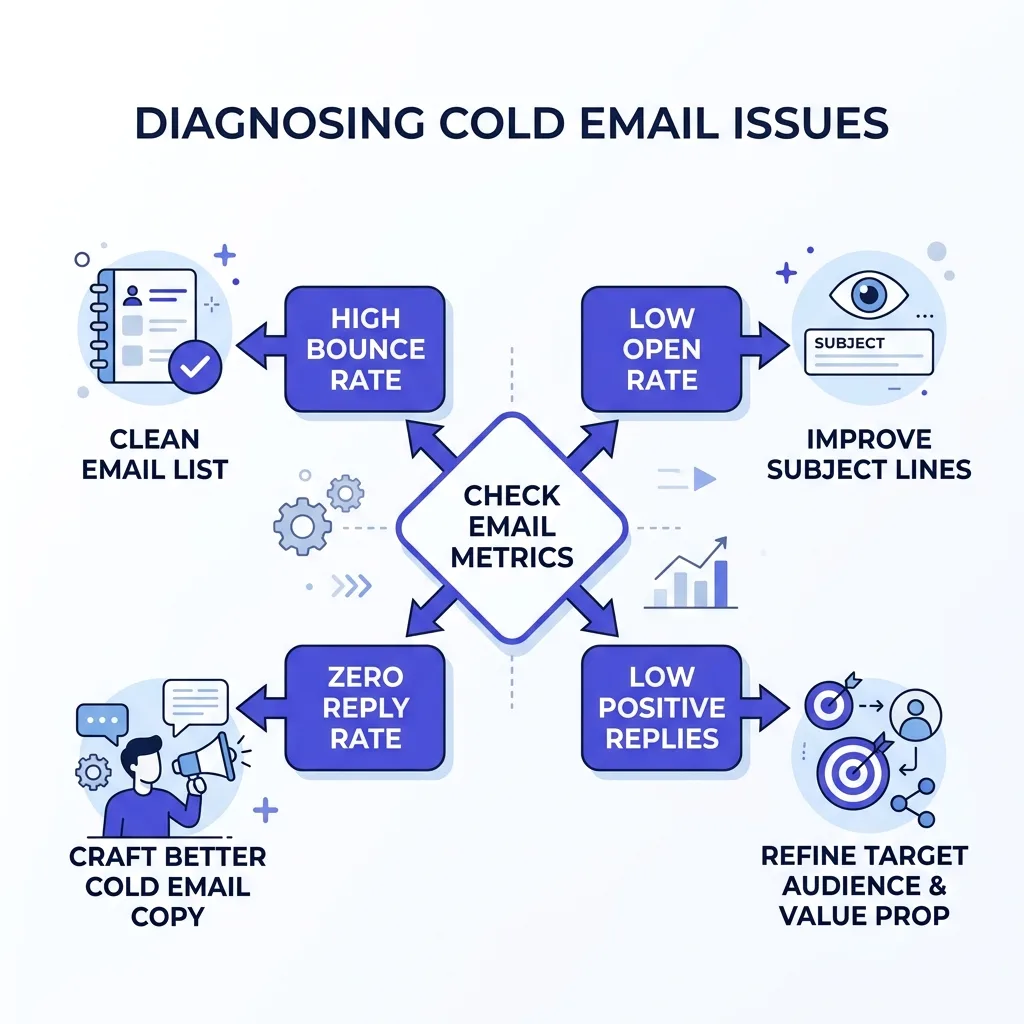 Cold email diagnosis framework showing four failure branches
AI-drafted email introduces a specific version of the offer clarity problem: fluent, grammatically correct paragraphs that say nothing specific.
A model asked to "personalize this email" will often insert a fact about the company (their industry, their headcount, a recent press mention) without connecting that fact to an actual reason the offer matters to them.
That produces emails that read as personalized on the surface and vague underneath, which is arguably worse than an obviously generic template, because it wastes the reader's attention on detail that goes nowhere.
The fix is not avoiding AI drafting. It is keeping a human review step that specifically checks for offer clarity, not just tone and grammar, before a draft sends.
This is where a human-in-the-loop step earns its keep. The reviewer is not proofreading. They are asking the same five questions from the clarity test above, on every draft, before approval.
FirstSales builds this check into the draft approval step itself, so a reviewer looks at the specific claim and ask on each email rather than approving a batch on tone alone. The AI writes the draft; a person still confirms the offer makes sense for that account before it sends.
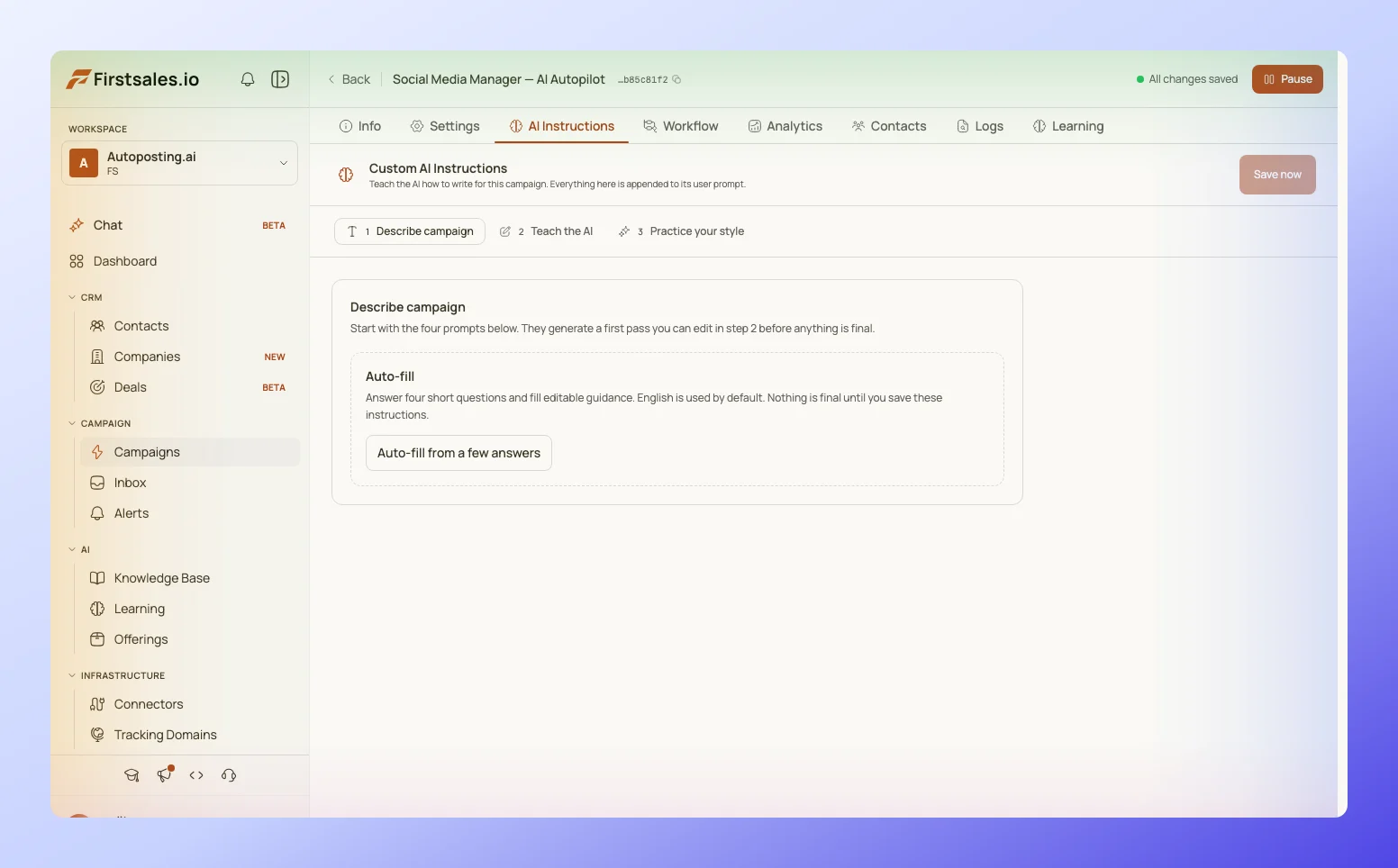 FirstSales AI draft approval screen showing a single email pending human review
That review step matters more as AI drafting scales volume. A vague offer sent to 50 people is a bad week. A vague offer sent to 5,000 people by an unreviewed AI pipeline is a bad quarter, and it burns domain reputation on the way down.
Teams running AI-assisted outbound that still hit strong reply rates are not skipping review. They are making the review fast and specific to the offer, not slow and focused on style.
#A worked example
A mid-market HR software company was sending 2,000 emails a week with a 1.8% reply rate, mostly declines. Deliverability checked out clean: 1% bounce, 38% open rate.
The original email opened with two sentences about the company's founding story, then pivoted to "we'd love to show you how our platform can transform your HR workflows."
Nothing in those two sentences told the reader what outcome they would get or why this email arrived on this day. "Transform your workflows" could describe almost any HR product on the market.
The rewrite cut the founding story entirely, opened with a specific number ("teams using structured onboarding checklists cut new-hire ramp time by roughly two weeks"), and closed with a question instead of a meeting request: "is ramp time something you're actively trying to shorten, or is this not the priority right now?"
Reply rate on the rewritten version rose to 6.4% over the following four weeks on the same list, same domains, same send volume. Nothing about the list or the infrastructure changed. Only the offer did.
That gap, 1.8% to 6.4% on an identical list, is the clearest argument for running the diagnosis framework before touching anything else.
#FAQ
#How do I know if it's the offer and not the list?
Check delivery and open rates first. If bounces are low and opens are healthy but replies are near zero, the list is doing its job and the offer is the likely failure point.
#What's a good reply rate benchmark to compare against?
Generic sends without signal targeting land around 1-3% in 2026. Systematised, signal-based campaigns hit 5-18%, a wide enough gap that it should change how you weigh a low reply rate.
#Can a great subject line save a weak offer?
No. A great subject line gets the email opened, which is a separate problem from the offer. If opens are healthy and replies are not, the subject line already did its job.
#Should I A/B test the offer or the copy style first?
Test the offer's core claim first: the specific outcome and the ask size. Copy style, tone, and formatting matter far less than whether the reader understands what you're proposing.
#How long should a cold email be if the offer is clear?
There's no fixed length rule, but a clear offer usually fits in 60-90 words because there's nothing extra to explain. Length balloons when the writer is trying to justify a vague claim.
#Is it bad to state a number I'm not fully sure is representative?
Only use a number you can defend if asked. A specific but wrong number damages trust worse than a vague claim, because it invites the reader to check and find you wrong.
#Does personalization fix offer clarity on its own?
No. Personalization without a connected reason ("I saw you raised a Series B" with no link to why that matters to your offer) reads as surface-level and does not fix a vague ask underneath it.
#What if my product genuinely helps almost every company in my list?
Then the offer needs a specific entry point, not a universal one. Pick the trigger or symptom most common in your ICP and lead with that, even if the product solves more than that one thing.
#How do I size the ask correctly on a first touch?
Default to the smallest ask that still moves the conversation forward: a one-line reply, a yes or no, a "worth a look?" Save the calendar link for a later touch once some trust exists.
#Can offer clarity problems show up as spam complaints?
Not usually. Spam complaints track more with sending frequency, relevance mismatch, and general deliverability hygiene than with offer wording. A vague offer gets ignored more than it gets reported.
#Is a case study a good way to prove the offer is real?
A specific outcome or number does more work than a named case study in a cold first email. Save a fuller case study for a follow-up once interest exists.
#Should the offer change based on company size?
Often yes. The value claim, the ask size, and the proof point that lands can all differ meaningfully between an enterprise buyer and an SMB buyer, even when the underlying product is identical.
#How many times should I test a rewritten offer before judging it?
Give a rewritten offer at least 200-300 sends before drawing conclusions, since smaller samples produce noisy reply rates that can mislead you either direction.
#What's the single biggest offer mistake you see?
Leading with the sender instead of the reader. "We built X" in the first sentence signals a pitch before the reader has any reason to care what was built.
#Does mentioning a competitor help or hurt offer clarity?
It can sharpen the offer when done carefully, since a named alternative gives the reader a concrete comparison point. It backfires when the comparison reads as an attack rather than context.
#Can pricing be part of a clear offer, or should it stay out of a cold email?
It depends on deal size and market norms. Sometimes a number builds trust, sometimes it triggers an early no before context exists, and the right call usually varies by segment.
#If I'm selling something genuinely new, how do I make the offer clear?
Anchor the offer to a problem the reader already recognizes, even if your category doesn't exist for them yet. Frame the outcome, not the label, since the label has no meaning to them yet.
#How do I build a library of offers that are known to work?
Keep a running file of every email that got a reply, tag what made the offer specific in each one, and reuse the structure rather than the exact wording. A swipe file built from your own replies beats a generic template library.
#Does a point-of-view opener count as an offer, or is it something else?
A strong point of view can be the hook that earns attention, but it still needs a connected ask behind it. The stance draws the eye, the offer still has to close the loop.
#What should I check first when a previously good offer suddenly stops working?
Check whether the market shifted (the trigger you were using got less common) before rewriting the offer itself. A working offer that suddenly underperforms is more often a targeting or timing drift than a copy problem.
#Conclusion
A bad list produces bounces. A bad offer produces silence after a clean open, and that silence is the signal most teams misread.
Run the four-quadrant check before rewriting anything: delivery, opens, replies, and sentiment tell you which failure you actually have.
Most zero-reply campaigns pass the delivery and open checks and fail at the ask itself, because the value was too vague, the ask was too big, or the "why now" never showed up.
Fix the offer with the three-pass method: name a specific outcome, size the ask to the trust already built, and connect it to a real trigger. Then rerun the clarity test on every draft before it sends, whether a human wrote it or an AI did.
The list was probably never the problem.