TL;DR: Soft, question-based CTAs beat hard meeting requests on the first touch because they ask for less. Meeting CTAs earn their keep later in a sequence, once curiosity has already been spent, and with higher-intent segments where the ask matches what the prospect already wants.
A question CTA asks for a reply. A meeting CTA asks for a calendar slot.
Those sound like two flavors of the same close. They are not.
A prospect can answer "worth a look?" in four seconds without opening their calendar. Answering "got 15 minutes Tuesday?" requires them to check availability, weigh whether this is worth a real block of time, and commit to a stranger before they know if the product solves their problem.
That gap in required effort is the whole story behind why these two CTA types perform so differently depending on where they sit in a sequence.
#The two CTA types, defined
A question CTA invites a low-friction response. It does not ask for time, a decision, or a commitment.
Examples: "worth a look?", "is this even on your radar right now?", "curious if this is a priority for Q4?"
A meeting CTA asks for a specific, bookable action. It names a format (call, demo, chat) and often a time window.
Examples: "got 15 minutes Tuesday at 2pm?", "open to a quick call this week?", "worth a 20 minute demo?"
The difference is not tone. Both can be warm, both can be terse.
The difference is the size of the yes you are asking for.
#The psychology behind the gap
Behavioral researchers call this the foot-in-the-door effect. A small first request makes a person more likely to agree to a larger one later, because saying yes once creates a sense of consistency they want to keep.
Cold email sequences run on the same logic, whether or not the sender knows the term for it. A prospect who replies "sure, send it over" to a soft ask has already taken a small action tied to your name.
That small action changes how the next email lands. The prospect is no longer a stranger deciding whether to engage, they are someone who already engaged once and is now deciding whether to go further.
Skip the small step and ask for the calendar slot first, and you remove the on-ramp entirely. Most prospects will not build the on-ramp themselves mid-inbox-scroll, so the sequence has to build it for them.
#Why soft CTAs often win the first touch
Cold email is a first-date problem. Nobody agrees to dinner before they have decided you are worth a coffee.
A question CTA lets the prospect say yes to almost nothing. They can reply "yeah, tell me more" without any real commitment, and that low bar is exactly why more of them clear it.
Average cold email reply rates sit around 3.4% across senders, with top-performing segments reaching 10 to 20%. Sequences that lead with a small ask consistently land closer to the top of that range than campaigns that open by asking for a meeting cold.
The mechanism is basic reciprocity and effort matching. A first-touch email from a stranger has earned zero trust, so the ask has to match that zero.
Meeting CTAs on a first touch also create a specific failure mode: the prospect who is mildly interested, but not yet interested enough to open a calendar, just does not reply at all. A question CTA gives that same person a way to say "maybe, tell me more" instead of forcing a binary in/out decision they are not ready to make.
There is a second reason soft CTAs work early: they generate signal you can use. A reply, any reply, tells you the prospect read the email and had a reaction. That reply becomes the input for your reply handling playbook, which is worth more at this stage than a stalled meeting request nobody answered.
#Why hard CTAs win later in the sequence
By touch four or five, the calculus flips.
A prospect who has opened three emails and ignored two soft asks already knows who you are and roughly what you are offering. Asking them again "worth a look?" reads as repetitive, not respectful of their time.
At that point, the ambiguity of a soft CTA starts working against you. The prospect thinks "sure, I'd look," and then nothing happens, because "look" was never a real commitment with a deadline attached.
A meeting CTA forces resolution. It converts vague interest into a scheduled action or a clear no, and both outcomes are more useful to you than another round of polite silence.
This is also where sunk familiarity helps. Someone who has seen your name four times treats a meeting request from you differently than they would treat the same request from a total stranger in email one.
Sequence design research backs this shape up directly: a well-built outbound cadence by deal size typically escalates from a soft opener to a direct ask across the touches, rather than repeating the same CTA type on every email. Repetition of the same unanswered ask reads as nagging by touch three.
#What 2026 inbox rules mean for CTA choice
Google, Yahoo, and Microsoft now enforce bulk sender rules that score mail before a human ever opens it: SPF, DKIM, and DMARC alignment, complaint rates under 0.3%, bounce rates under 2%.
That scoring runs on engagement signals, and a reply is one of the strongest engagement signals an inbox provider can see. A question CTA that generates more replies is not just a copywriting win, it is quietly protecting sender reputation on every domain in the sequence.
A meeting CTA that gets ignored produces no such signal. The email sits read (or unread, since Apple's Mail Privacy Protection makes even that uncertain) and does nothing to tell Gmail or Outlook that a real human is engaging with this sender.
This is one more reason soft CTAs make sense early: they are not just optimizing for reply rate on that one email, they are building the engagement history that keeps every later email in the sequence out of the spam folder in the first place.
#How deal size changes which CTA wins
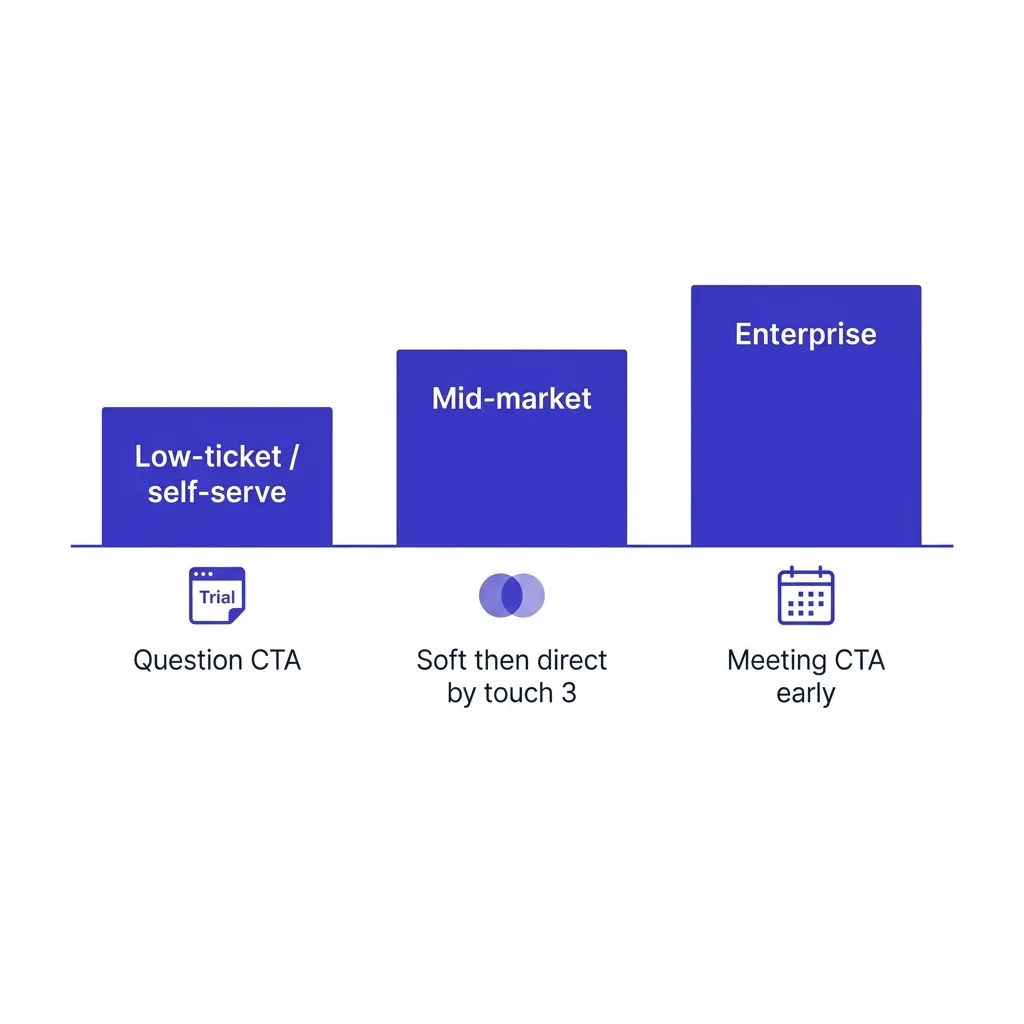 How deal size changes which CTA wins
Deal size sets the size of commitment a prospect is willing to make on a cold ask, and that ceiling matters more than most sequence templates admit.
For low-ticket, self-serve-adjacent products, a meeting is often overkill on any touch. The prospect wants to try the thing, not sit through a 30-minute call to be told what it does.
For enterprise deals with multiple stakeholders and procurement involved, the opposite is true. A vague "worth a look?" reply from one champion does not move a six-figure deal forward, because nothing happens until someone books a call with the right people in the room.
A useful rule of thumb: the larger the deal, the more the sequence needs to convert interest into a booked meeting relatively early, because enterprise buying committees move through scheduled conversations, not email threads. Mid-market deals sit in between, where a soft first touch followed by a direct ask by touch three tends to outperform either extreme.
This is also where contacts per company matters. Enterprise sequences that multithread with 2 to 3 contacts can use one contact's reply (even a soft one) as social proof when pitching the meeting to a second, more senior contact.
#How buyer awareness changes which CTA wins
Deal size is one lever. Where the prospect sits on the awareness spectrum is the other, and it often matters more.
A prospect who has never heard of your category is not ready for a meeting request, no matter how big their company is. They need a question CTA that lets them self-identify interest first.
A prospect actively evaluating tools in your category, maybe pulled from a buying signal like a job posting, a funding round, or a tech stack change, is often ready for a direct meeting ask on touch one. Their intent is already established before you ever emailed them.
This is why signal-based sourcing changes CTA strategy at the source, not just at the sequence level. A cold list built from firmographic filters alone should default to soft CTAs early. A list built from active buying signals can skip straight to a meeting ask, because the prospect's own behavior already did the warming.
Sales methodologies built around buyer readiness reflect the same logic. MEDDIC treats the identified pain and economic buyer as gating criteria before a meeting is worth pursuing, which is effectively a formal version of "match the ask to the readiness."
#CTA formulas for question CTAs
Soft CTAs work best when they are specific about the topic and vague about the commitment. The prospect should be able to picture answering in one line.
Relevance check: "worth a look, or is this not a priority for your team right now?"
Binary opt-in: "want me to send the two-minute version?"
Timing question: "is this even on the radar for this quarter?"
Permission to continue: "should I follow up, or is this the wrong lane?"
Curiosity gap: "curious how [company] is handling this today, worth comparing notes?"
Each of these shares a structure: name the topic, then ask a question that resolves in one word. That structure also pairs well with one-line cold emails, where the entire message is built around a single low-friction ask instead of a paragraph of pitch followed by a CTA tacked on at the end.
#CTA formulas for meeting CTAs
Hard CTAs work best when they remove friction from the scheduling step itself. Every extra decision the prospect has to make (which day, what format, how long) is a chance for them to close the tab instead.
Named slot: "got 15 minutes Tuesday at 2pm or Wednesday at 10am?"
Scoped format: "worth a 15 minute call to see if this is a fit, no pitch deck?"
Low-commitment demo: "want a 10 minute screen share this week? I'll show you the exact setup."
Direct booking link: "grab a slot here if it's useful: [link]. No pressure either way."
Conditional ask: "if [pain point] is real for you, worth 15 minutes to compare notes?"
Notice the pattern: specificity goes up (exact minutes, exact format, exact days), while pressure language goes down. "No pressure either way" and "no pitch deck" are doing real work, because they lower the perceived cost of saying yes without lowering the size of the ask itself.
A P.S. line is a good place to soften a meeting CTA that appears earlier in the body, giving the prospect a second, lower-stakes way back in if the main ask felt too big.
#Comparison: question CTA vs meeting CTA
| Factor | Question CTA | Meeting CTA |
|---|---|---|
| Best sequence position | Touch 1 to 2 | Touch 3 and later |
| Cold, unqualified list | ✓ | ✗ |
| Prospect showing an active buying signal | ✗ | ✓ |
| Enterprise, multi-stakeholder deal | ✗ (as opener) | ✓ (by touch 2 to 3) |
| Low-ticket, self-serve product | ✓ | ✗ |
| First touch to a total stranger | ✓ | ✗ |
| Re-engagement after a soft reply | ✗ | ✓ |
| Generates usable reply signal early | ✓ | ✗ |
| Forces a clear yes/no resolution | ✗ | ✓ |
| Works well in a single-email sequence | ✓ | ✗ |
That last row matters more than it looks. Testing on single-email sequences has shown reply rates as high as 8.4% in one dataset, almost entirely with soft, low-commitment CTAs, because a one-shot email has no room to build the trust a meeting ask usually needs.
#A decision path for choosing the CTA
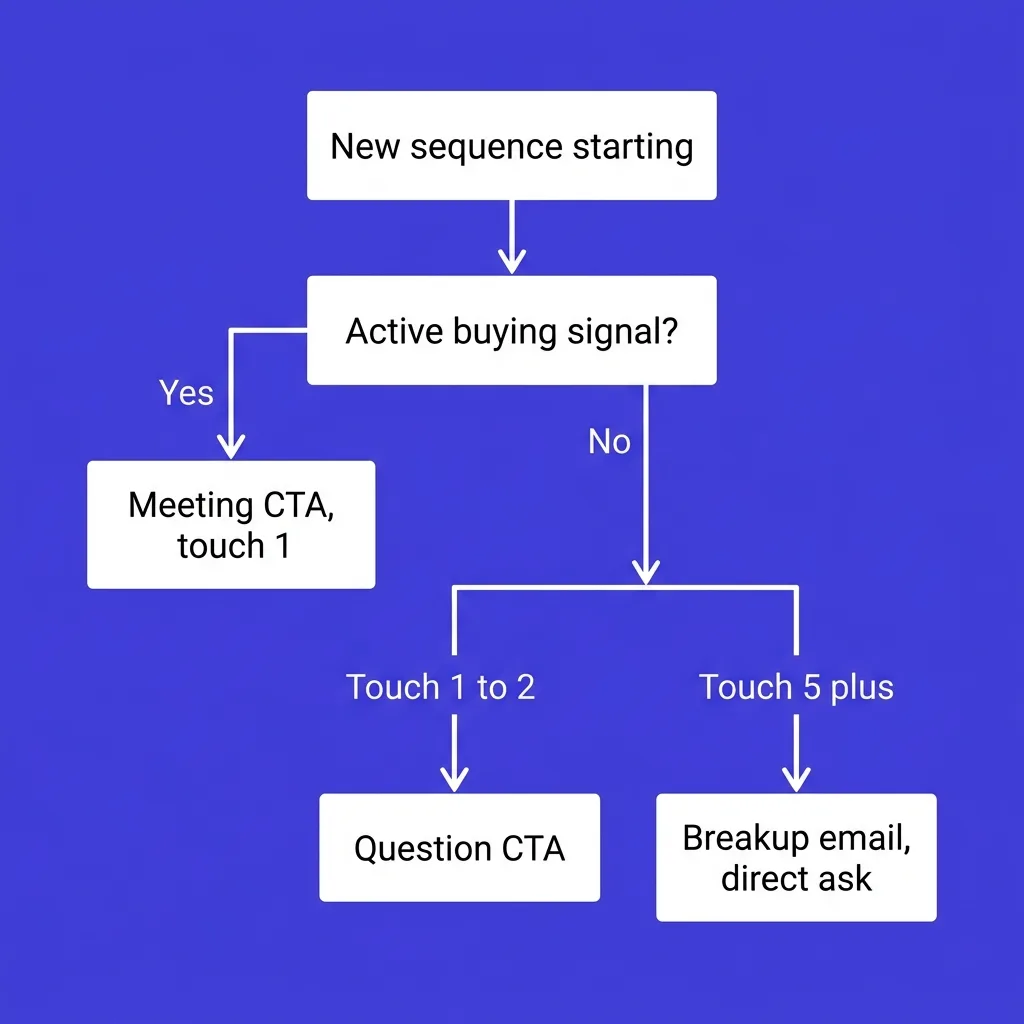 A decision path for choosing the CTA
flowchart TD
    A[New sequence starting] --> B{Prospect shows an active buying signal?}
    B -- Yes --> C[Meeting CTA, touch 1]
    B -- No --> D{What touch number is this?}
    D -- "Touch 1 to 2" --> E[Question CTA]
    D -- "Touch 3 to 4" --> F{Did they reply softly before?}
    F -- Yes --> G[Meeting CTA]
    F -- No --> H[Question CTA, different angle]
    D -- "Touch 5 plus" --> I[Breakup email, direct ask]
    E --> J{Deal size}
    J -- Enterprise --> K[Escalate to meeting CTA by touch 2 to 3]
    J -- Mid-market --> K
    J -- Low-ticket / self-serve --> L[Stay on question CTA, offer trial instead of meeting]
That last branch, a breakup email with a direct ask, is where meeting CTAs often perform best of all. A breakup email works because it is the one point in the sequence where a clear, closing-the-file ask feels earned rather than pushy, since the prospect knows this is the last one.
#Common CTA mistakes
The vague ask. "Let me know your thoughts" is not a CTA. It gives the prospect nothing to react to and no reason to respond today instead of never.
Two asks in one email. "Worth a look, or want to grab 15 minutes?" forces the prospect to pick between two decisions instead of making one easy choice. Pick one CTA per email and commit to it.
Asking for too much too soon. A cold, first-touch email that opens with "can we get 30 minutes on your calendar this week?" skips the step where the prospect decides you are worth their time at all.
CTA and subject line mismatch. If the subject line promises a quick question and the body demands a meeting, the prospect feels baited. That mismatch shows up as opens without replies.
No CTA at all. Some senders assume a strong pitch sells itself. It does not. Every email needs an explicit next step, even a soft one.
Repeating the identical CTA on every touch. Sending "worth a look?" five times in a row reads as a template, not a person. Vary the angle even when you keep the same CTA type.
Ignoring the reply you already got. If a prospect replies "maybe later" to a question CTA, sending the exact same question CTA again on the next touch wastes the signal they already gave you. That reply should change the next ask, not repeat it.
Naming a meeting format the prospect has to decode. "Worth a sync?" or "open to a discovery call?" makes the prospect guess what that actually involves before they can say yes. Name the format plainly: a 15 minute call, a screen share, a demo.
Treating the CTA as separate from the offer. A meeting CTA attached to a vague pitch ("we help companies grow") gives the prospect nothing concrete to say yes to. The CTA only works when the line above it earns the ask, which is also why objection handling templates exist for the replies a weak pitch generates.
#Consider a hypothetical: two versions of the same email
Imagine two identical five-touch sequences targeting the same list of 500 mid-market prospects, differing only in the CTA on touch one.
Sequence A opens with "worth a look?" Sequence B opens with "got 15 minutes this week?"
If sequence A's early soft ask generates more replies, some of those replies will be a flat no, and some will be genuine interest that never would have surfaced from a meeting request nobody was ready to answer. Sequence B's harder ask, sent cold, mostly produces silence rather than explicit no responses, because ignoring a meeting request costs the prospect nothing.
Explicit no replies still matter, even when they sting. A hard no you can log and move past, while silence just leaves the prospect sitting in the sequence for four more touches with no real signal either way.
#How to test CTA type systematically
Run the comparison as a real A/B split, not a gut call. Hold the subject line, opener, and body constant, and change only the CTA sentence.
Split the list 50/50 by contact, not by day, so day-of-week and time-of-day noise does not skew either arm. Run both variants at the same volume and through the same domains.
Track replies, not just opens, since open rates stopped being a reliable metric after Apple's Mail Privacy Protection and bot prefetching flooded that data with false positives. A CTA test lives or dies on reply rate and, further down funnel, on booked-meeting rate.
Segment the results by touch number before you draw a conclusion. A meeting CTA that underperforms on touch one might be the clear winner by touch four, and averaging across the whole sequence would hide that.
Segment again by list source. A soft CTA winning on a cold firmographic list and a hard CTA winning on a signal-sourced list are both true findings, they just apply to different lists.
Run the test for at least two full sequence cycles before acting on it. Reply rates on any single day can swing 2 to 3 points from noise alone, and a one-week read is usually just noise wearing a conclusion's clothes.
Watch for seasonal distortion too. A CTA test run heading into Q4 budget-flush season, when prospects are actively looking to spend leftover budget, can make a meeting CTA look stronger than it would in a slower month, since intent is already elevated across the whole list regardless of copy.
Check your reply rate benchmarks against your own segment before deciding a CTA underperformed. A 4% reply rate on an enterprise cold list might be a strong result even if it looks low next to a 12% rate on a warm, signal-sourced list running a different CTA entirely.
Platforms like FirstSales that draft with AI and route every send through human approval make this kind of test easier to run cleanly, because the CTA variant is the one line a rep actually checks before a draft goes out, and every other variable in the email stays untouched.
Once you have a winner for a given touch and segment, lock it in as the default and keep testing the next variable, whether that is the P.S. line, the subject, or the send time. CTA is one lever among several, not the whole machine.
#Where AI drafting fits into CTA testing
Manually writing five sequence variants with different CTAs at each touch, for every segment and deal size, does not scale past a handful of campaigns. That is the part of testing that stalls most teams before they get a clean read.
An AI pre-call research workflow can pull the buying signal or awareness stage automatically, then route the prospect into the sequence variant with the matching CTA before a human ever drafts the email. A rep still approves the send, but the CTA selection itself becomes systematic instead of a coin flip at write time.
That matters most for teams juggling an SDR prompt library across dozens of segments, where remembering which CTA type wins for which segment by hand is the first thing that breaks down at volume.
#FAQs
#What is a question CTA in cold email?
A question CTA is a call to action that asks the prospect for a reply instead of a scheduled meeting, such as "worth a look?" or "is this a priority right now?"
#What is a meeting CTA in cold email?
A meeting CTA asks the prospect to book a specific, time-bound action such as a call, demo, or screen share, often naming exact days or times.
#Which CTA type gets more replies on the first email?
Question CTAs tend to outperform meeting CTAs on a first touch because they ask for a smaller commitment from a prospect who does not know you yet.
#When should I switch from a question CTA to a meeting CTA?
Most sequences see the switch pay off around touch three or four, once the prospect has seen your name multiple times and a soft ask has already been tried without a hard conversion.
#Does deal size change which CTA works better?
Yes. Enterprise and multi-stakeholder deals generally need a meeting CTA earlier in the sequence, since a vague reply from one contact rarely moves a large deal forward on its own.
#Do meeting CTAs hurt reply rates on cold, unqualified lists?
Often yes, because a prospect with no prior context has no reason to hand over calendar time before they know what you are offering.
#Should I ever use a meeting CTA on touch one?
Yes, when the prospect is sourced from an active buying signal, such as a recent job posting for a role your product supports or a funding announcement that suggests new budget.
#How do I know if my CTA is too vague?
If the CTA does not name a specific action the prospect can complete in under 10 seconds, either a one-word reply or a two-click booking, it is too vague.
#Is it a mistake to include two CTAs in one email?
Yes. Two CTAs force the prospect to choose between decisions instead of making one, and most will choose neither.
#How does buyer awareness affect CTA choice?
A prospect unaware of your category needs a soft, self-identifying question first, while a prospect actively evaluating solutions in your space can often handle a direct meeting ask right away.
#What is the ideal CTA for a single-email sequence?
A soft, low-commitment question CTA works best in a single-email format, since there is no room in a one-shot send to build the trust a meeting ask usually requires.
#Should the CTA match the subject line?
Yes. A subject line promising a quick question paired with a body that demands a 30-minute meeting creates a mismatch that reads as bait and lowers trust.
#How do I A/B test question CTAs against meeting CTAs?
Hold every other line constant, split the list 50/50 by contact, and compare reply rate by touch number and by list source rather than averaging across the whole sequence.
#Why did my meeting CTA test show no difference?
Testing across a mixed sequence without segmenting by touch number often hides a real difference, since a meeting CTA can lose on touch one and win clearly by touch four.
#Does a breakup email work better with a meeting CTA?
Often yes, because the closing-the-file framing makes a direct ask feel earned rather than pushy, since the prospect knows this is the final touch.
#How many touches before a meeting CTA outperforms a question CTA?
There is no universal number, but many sequences see the crossover between touch three and touch five, depending on list warmth and deal size.
#Can a P.S. line carry a CTA that differs from the main body?
Yes. A softer P.S. CTA can give a prospect a second, lower-stakes way back in when the main body carries a more direct meeting ask.
#Should low-ticket, self-serve products ever use a meeting CTA?
Rarely. A trial link or a question CTA usually converts better than a meeting request, since the product is meant to be tried, not explained on a call.
#How does signal-based prospecting change CTA strategy?
A list built from active buying signals arrives with intent already established, so the sequence can open with a direct meeting ask instead of the usual soft first touch.
#What metric should I actually track when testing CTAs, since open rate is unreliable?
Track reply rate and booked-meeting rate by touch and segment. Open-rate data is inflated by Apple Mail Privacy Protection and automated security scanners, so it no longer reflects real prospect behavior.
#The CTA is a lever, not a formula
There is no single winning CTA. There is a winning CTA for this touch, this segment, this deal size, and this list's awareness level.
The teams that get this right are not the ones with the cleverest CTA line. They are the ones running the segmented test long enough to know which CTA wins where, and building that answer into how the sequence escalates from touch one to the last one.