#Cold email for a new category: how to sell what buyers can't name
Copy page
TL;DR: When you sell a new category, the buyer has no existing budget line, no search term, and no mental folder to file your email into. Standard cold email fails here because it assumes recognition. The fix is to anchor your pitch to a category the buyer already understands, name the specific cost of the old way, and ask for a much smaller commitment than a demo. Expect lower reply rates than a mature category and a longer education arc before pipeline shows up.
#Table of contents
- Why new-category cold email breaks the usual playbook
- The core problem: no mental slot
- Anchor to an old category on purpose
- What the buyer's mental model looks like before and after
- What works and what backfires
- The three-email arc for category creation
- Write the subject line for confusion, not curiosity
- Pick signals that predict curiosity, not budget
- Where AI drafting helps and where it does not
- Common mistakes founders make selling a new category
- Ask for less than a demo
- Measure the right thing for the first two quarters
- When cold email is the wrong first channel
- FAQ
- Conclusion
#Why new-category cold email breaks the usual playbook
Most cold email advice assumes the reader already knows what you are.
They have a job title that matches your buyer persona.
They have searched for something close to your product before, or a competitor has already trained them on the category.
None of that is true when you are creating a category.
The reader has never typed a query that would have surfaced you.
There is no line item in next year's budget with your product's name near it, because nobody has decided this is a thing worth budgeting for yet.
That changes almost every rule in how to write cold emails that assumes shared vocabulary between sender and reader.
You are not competing for attention against other vendors in a known category.
You are competing against the reader's assumption that the problem you are describing does not need a new tool at all.
That is a harder sale, and pretending otherwise wastes the first three sends of every sequence you write.
#The core problem: no mental slot
Cognitive scientists call it a schema: a mental bucket the brain uses to sort incoming information fast.
"CRM" is a schema. "Payroll software" is a schema.
When an email matches an existing schema, the reader's brain does the categorizing work in under a second and moves to deciding whether to open it.
When an email does not match any schema, the brain has two options.
It can do the expensive work of building a new category on the spot, or it can discard the email as noise.
Most inboxes choose discard, because building a new mental category takes real cognitive effort and a stranger's email has not earned that effort yet.
This is why do cold emails work is a different question for a known category than for a new one.
A known-category email just needs to be relevant and well timed.
A new-category email needs to first get classified as worth classifying, before relevance even gets evaluated.
#Anchor to an old category on purpose
The fix researchers and product marketers keep landing on is deliberate anchoring: describe the new thing in terms of an old thing the reader already understands, then explain the one difference that matters.
"It's like a CRM but built for construction crews with no laptops" gives the reader an instant schema to attach to, then a single delta to process.
That is far cheaper cognitively than "an intelligent field operations coordination layer," which asks the brain to build a category from nothing.
The anchor category does not need to be a perfect fit.
It needs to be close enough that the reader's brain can reuse most of an existing schema and spend its limited attention on the one part that is actually new.
Pick the anchor the reader already has, not the anchor that flatters your product the most.
Founders often resist this because the old category carries baggage they are trying to escape.
That resistance is understandable and it is also the reason a lot of category-creation cold email gets ignored: it optimizes for founder ego over reader comprehension.
#What the buyer's mental model looks like before and after
The whole job of a new-category cold email is moving the reader from the right branch of that diagram to the left one, before you ask for anything else.
Every line in the email should serve that single move.
Once the schema exists, you are back to a normal relevance and timing problem, the one signal-based cold email already solves well.
Skip the anchoring step and every later line of the email is being read by a brain that still has not decided what kind of thing it is looking at.
#What works and what backfires
| Practice | ✓ Works | ✗ Backfires |
|---|---|---|
| Opening line | Anchors to a category the reader already knows | Leads with your product's invented category name |
| Framing the gap | Names one specific old-way cost in dollars or hours | Says the old way is "inefficient" or "outdated" |
| Proof | References a comparable company's result, named if you have permission | Cites vague "leading companies" without a name |
| Ask | Asks for a reaction, a question, or a two-minute call | Asks for a 30-minute demo on the first touch |
| Vocabulary | Uses words the reader already searches for | Invents new terminology the reader has to learn |
| Length | Short enough to read in the time it takes to decide it is worth a reply | Long enough to explain the whole category thesis |
| Volume | Small, hand-picked list with real research per account | List pulled from a firmographic filter with no category fit signal |
The pattern across every row: category creation cold email should feel smaller and more careful than known-category cold email, not bigger and more explanatory.
A confused reader does not read more. They read less, then archive.
#The three-email arc for category creation
A single cold email rarely does the whole job of introducing a category, explaining the delta, and asking for time.
Split it into three shorter emails instead of one long one.
Email one anchors to the old category and names one specific cost of staying there. No pitch, no product name if you can avoid it. The only goal is getting classified correctly.
Email two, sent three to five days later only to people who opened or clicked email one, introduces the one-sentence delta and a single comparable result. This is where the product name can appear for the first time.
Email three asks for a small, low-friction next step: a reaction to a two-minute video, a one-question reply, or a short call framed around a specific decision the reader is already making this quarter.
This mirrors the logic in follow-up email strategy, but the stakes are higher here because email one is doing categorization work a mature-category follow-up sequence does not need to do at all.
Do not compress this into one email because it feels more efficient.
Compressing it means asking the reader to classify, understand, and commit in the same sixty seconds, and most will drop out at the first step.
#Write the subject line for confusion, not curiosity
Subject line advice for known categories usually optimizes for curiosity: a question, a specific number, a name drop.
New-category subject lines have a different job first: reduce confusion enough that the email gets opened at all.
A subject line like "the way you're doing X is about to change" works in a mature category because the reader already knows what X's category looks like.
In a brand-new category, that same line reads as vague marketing noise, because the reader cannot picture what "the change" even is.
Better to anchor the subject line itself: name the old category, name the specific pain, and let the body do the reframing.
See cold email subject line for the mechanics that still apply underneath this, deliverability-safe formatting, avoiding spam trigger words, keeping it under 50 characters.
#Pick signals that predict curiosity, not budget
Standard buying-signal research, like the guidance in buying signals for cold email, looks for evidence that someone is actively shopping: a job posting, a tool switch, a funding round.
None of those signals exist yet for a category nobody is shopping for.
Instead, look for evidence that someone is already frustrated with the old category in a public way: a complaint on a forum, a churn announcement from a competitor's customer, a job posting that describes a role your product would make unnecessary.
Those are curiosity signals, not budget signals, and they matter more here because the first job of the email is getting read, not getting funded.
Building the ideal customer profile for a new category usually starts narrower and gets revised more often than for a mature category, because you are learning who feels the old-category pain acutely enough to read past an unfamiliar pitch.
#Where AI drafting helps and where it does not
AI drafting tools are good at pattern matching against categories that already exist in their training data.
That is exactly the wrong strength to lean on when the whole point of the email is describing something the model has not seen framed that way before.
Left alone, a generic AI draft will often reach for the nearest known category and describe your product as a feature of it, flattening the exact distinction you are trying to create.
Where AI genuinely helps is drafting the anchor sentence itself once a human has decided which old category to anchor to, and running that sentence past ten different account contexts to check it still reads clearly to a construction-industry reader and a healthcare-ops reader alike.
FirstSales structures drafting this way: the model proposes a draft, a human reviews and edits the anchor line before it sends, and the account research underneath it stays automated.
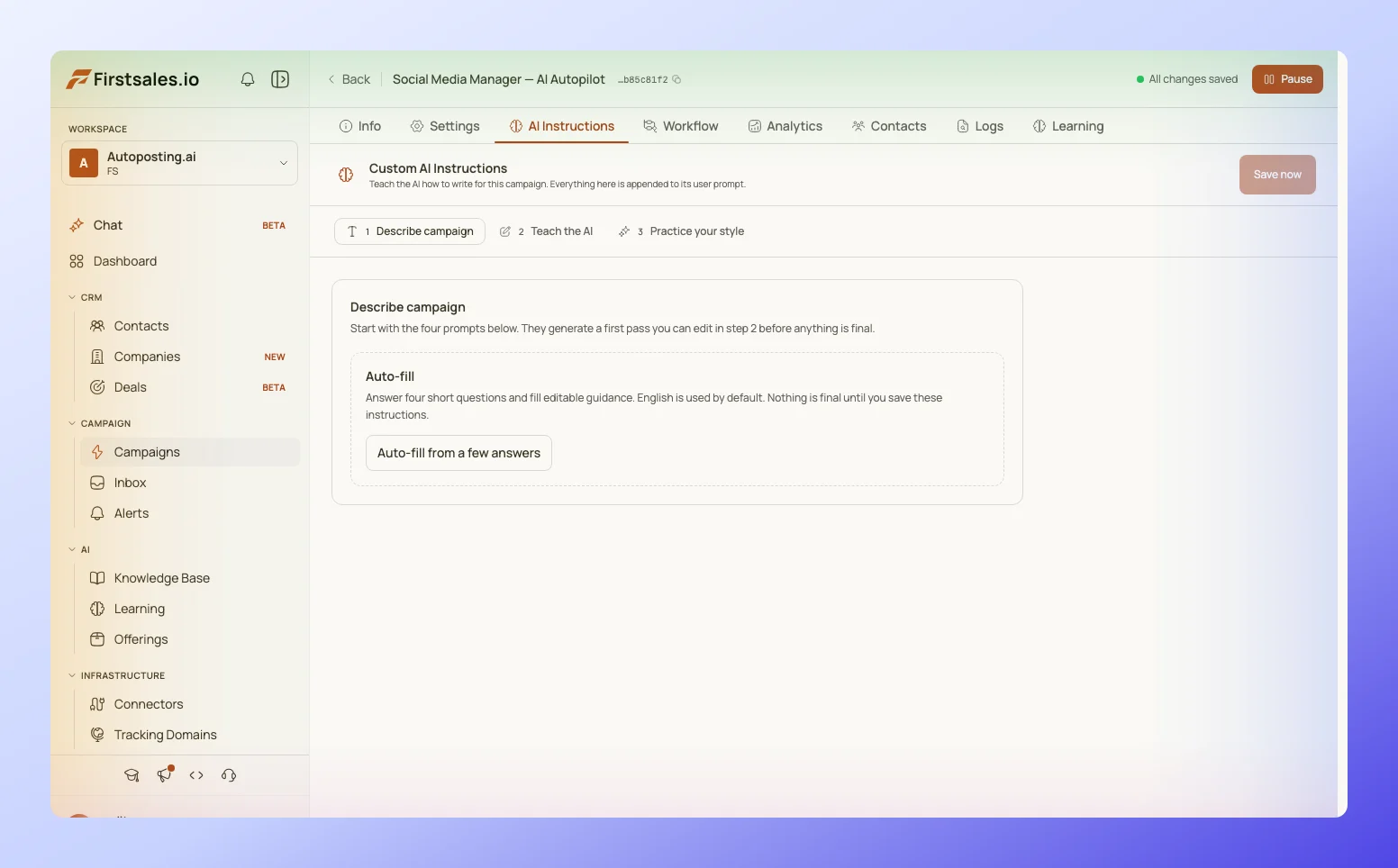 FirstSales draft approval screen showing an AI-drafted email pending human review
That review step matters most exactly where category creation is hardest, the single sentence that decides whether the reader classifies your email correctly or archives it.
Full autonomy is the wrong setting for this kind of email.
An autonomous cold email agent optimizing for volume will happily send a thousand emails using a category framing that tested wrong, because nothing in the loop is checking whether the anchor actually lands for a stranger who has never heard of you.
#Common mistakes founders make selling a new category
The most common mistake is inventing a category name before validating that the pain is felt widely enough to need one.
A catchy category name does not create demand. It just gives existing demand a label once that demand is already there.
The second mistake is writing the email the way you'd pitch an investor: broad market thesis first, product second.
Investors are paid to sit through category theses. A cold prospect is not, and will not.
The third mistake is assuming the first reply tells you the category is working.
Early replies in a new category often come from a narrow set of people who already had the exact pain articulated somewhere else, sometimes a competitor's marketing.
That is a real signal but a small one, and treating it as proof the whole market is ready leads teams to scale a list before the anchor sentence has been tested on people outside that narrow group.
The fourth mistake is copying the ai sdr mistakes pattern of over-personalizing surface details, a mutual connection, a recent post, while leaving the actual category framing generic.
Surface personalization earns an open. It does not survive the moment the reader realizes they still do not understand what you sell.
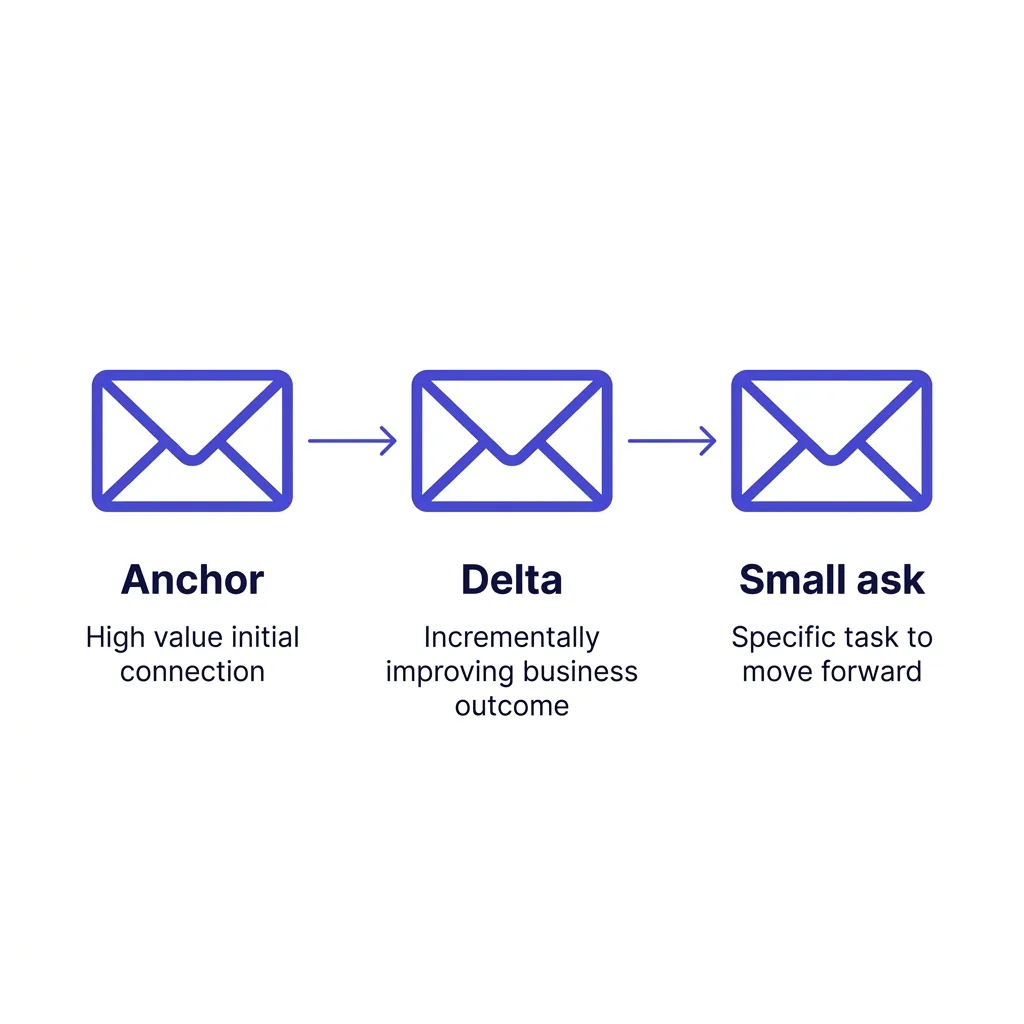 Three-email sequence for introducing a new category: anchor, delta, small ask
#Ask for less than a demo
A demo is a large ask for a stranger who is still deciding whether your category is real.
It also front-loads the wrong kind of proof: a demo shows the product works, but the reader has not yet decided the problem it solves is worth solving with a new tool at all.
A smaller ask fits earlier in that decision.
A one-question reply ("does this match what you're dealing with, yes or no") gives you a data point and costs the reader five seconds.
A two-minute recorded walkthrough sent instead of a live call lets a curious but unconvinced reader self-qualify on their own time.
This is a direct extension of the logic in question cta vs meeting cta: the lower the reader's confidence that the category is real, the smaller the commitment the call to action should ask for.
Save the full demo ask for email two or three, after the reader has already confirmed the pain is theirs.
#Measure the right thing for the first two quarters
Reply rate benchmarks built from mature categories will make a new-category campaign look broken even when it is working.
Platform-wide cold email reply rates have fallen from about 5.1% in 2024 to roughly 3.43% in 2026, and that number already assumes the recipient understands what they are being pitched.
A new-category campaign in its first two quarters should expect to sit below that average on raw reply rate, because a meaningful share of opens end in "I don't think this applies to us," which is a correct and useful response, not a failed send.
Track forwards, not just replies.
A reader who does not need the product but forwards the email to someone who might is a stronger signal of correct category framing than a lukewarm reply.
Track the specific wording prospects use when they do reply, and watch for a repeated phrase or complaint across unrelated accounts. Teams running this on FirstSales usually pull that wording straight from the reply thread log rather than relying on memory.
That repetition is the early evidence that a real category is forming rather than a one-off coincidence, and it should shape the next round of the cold email swipe file you are building from actual replies rather than assumed pain points.
Expect the arc from first send to first closed deal to run longer than a mature-category benchmark predicts, often by a full sales cycle, because education has to happen before evaluation can start.
#When cold email is the wrong first channel
Cold email is not always the right first channel for a category nobody has named yet.
If the pain is genuinely private, something a buyer would not admit to a stranger over email, a warmer channel earns more honesty faster.
A warm intro pipeline or founder-led conversations at a relevant event will surface the real language people use for the pain, language you can then feed back into cold email once you have it.
If the total addressable market is small enough that every account matters individually, treat outreach the way a small tam outbound playbook recommends: fewer, deeper touches instead of list volume, since a botched first impression on one of forty accounts is a real cost.
Cold email earns its place once you have a validated anchor sentence, a real complaint pattern from real replies, and a list large enough that volume math starts to matter.
Before that point, cold email is a research tool for finding the right words, not a pipeline engine.
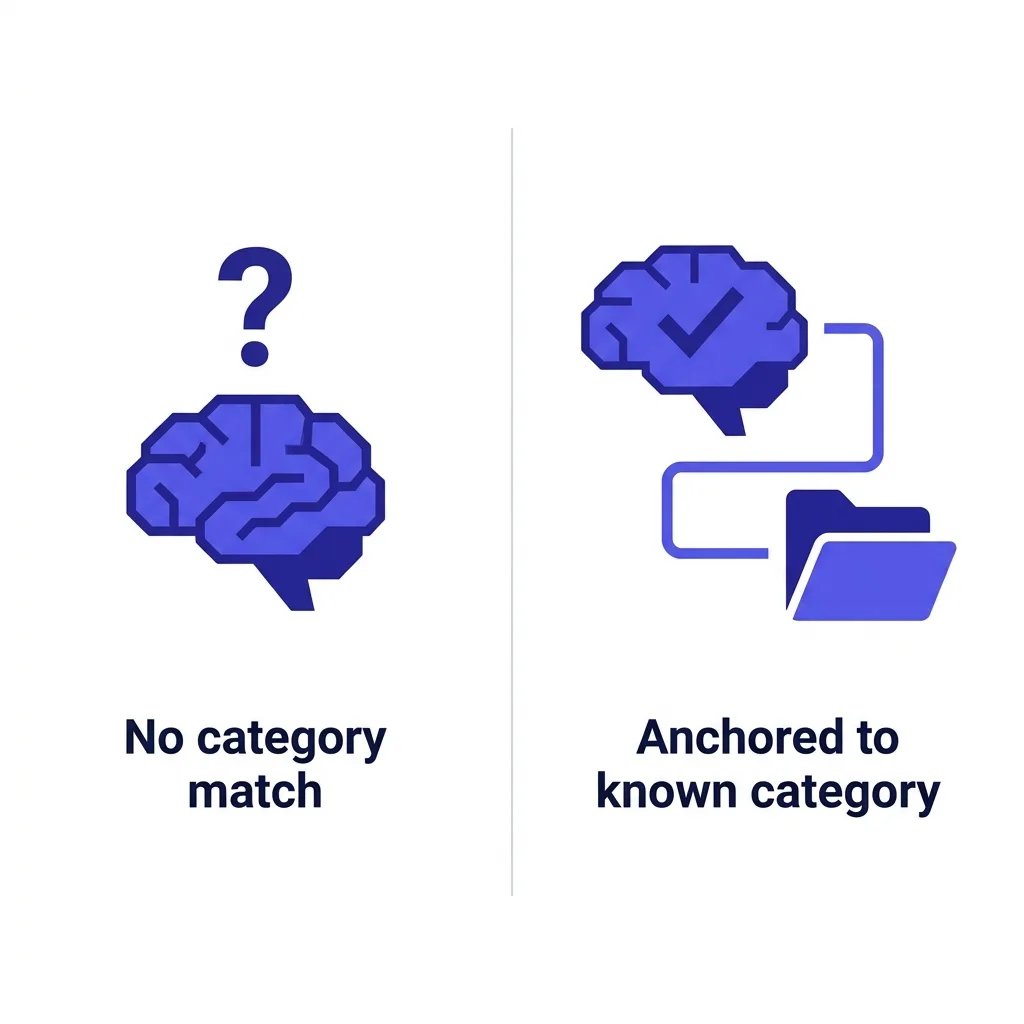 Buyer confusion before and after category anchoring in cold email
#FAQ
#What makes cold email different when selling a brand-new category?
The reader has no existing mental category to file the email under, so the email has to do classification work before it can do persuasion work.
#Should I invent a name for my new category before I start cold emailing?
Not until you have validated the pain across enough accounts that a name adds clarity instead of adding a new word the reader has to learn.
#How do I anchor a new category to something the reader already knows?
Describe your product in terms of the closest existing category, then state the one specific difference that matters, in a single sentence.
#Is it bad to mention my product name in the very first email?
It is not fatal, but it usually helps to lead with the pain and the anchor category first, and introduce the product name once the reader is oriented.
#What reply rate should I expect for a new-category cold email campaign?
Expect to sit below the general platform average, since the average assumes the reader already recognizes what is being pitched.
#How long should the first email in a new-category sequence be?
Short. Long enough to name the old category and the specific cost of staying there, no longer.
#Should I ask for a demo in the first email?
No. Ask for something smaller, a one-question reply or a reaction to a short video, and save the demo ask for a later touch.
#What is a curiosity signal versus a buying signal?
A buying signal shows someone is actively shopping. A curiosity signal shows someone is already frustrated with the old way, even if they have not started shopping yet.
#Where do I find curiosity signals for a category that does not exist yet?
Public complaints about the old category, competitor churn announcements, and job postings describing a role your product would make unnecessary.
#Can AI fully automate cold email for a new category?
Not well. AI tends to default to the nearest known category framing unless a human sets and checks the anchor sentence first.
#How many emails should the introduction sequence be?
Three works well: one to anchor the category, one to introduce the delta and a comparable result, one to ask for a small next step.
#What if nobody replies to the first email?
Check whether the anchor category is the wrong one before assuming the pain does not exist. A mismatched anchor gets ignored regardless of how real the pain is.
#Should the list be large or small for a new-category campaign?
Small and hand-picked at first. Volume math only makes sense after the anchor sentence has been tested and refined.
#How do I know if the category is actually real and not just a name I invented?
Look for a repeated phrase or complaint pattern across replies from unrelated accounts. That repetition is the evidence.
#Is a forward as good as a reply?
In some ways better. A forward means the reader understood the category well enough to recognize someone else who needs it.
#Does personalization matter more or less in a new category?
Surface personalization, a mutual connection or recent post, matters less than getting the category framing itself right.
#Should the subject line be curious or clear?
Clear first. Curiosity only helps once the reader already has a schema to attach the curiosity to.
#How long until a new-category cold email program produces closed deals?
Plan for a longer arc than a mature-category benchmark suggests, often an extra full sales cycle, because education precedes evaluation.
#Is founder-led outreach better than an SDR team for a new category?
Often yes early on, since founders usually have the clearest, least diluted version of the anchor sentence and can adjust it in real time based on replies.
#When should I stop cold emailing and switch to a warmer channel?
When the pain is private enough that a stranger's email will not get an honest reaction, or when the addressable market is small enough that a warm introduction is worth the extra effort per account.
#Conclusion
Selling a category the buyer cannot yet name is a classification problem before it is a persuasion problem.
Anchor to a category they already understand, name one specific cost of the old way, and ask for less than you think you need to ask for on the first touch.
Expect a slower arc to pipeline than a mature-category benchmark predicts, and read replies for language patterns, not just reply rate.
The category becomes easier to sell the moment enough people have heard your framing that it stops needing an anchor at all.