
TL;DR: Warm intro leads convert at roughly 15-25%, well above cold outbound, and referred deals tend to close on a shorter cycle. Most founders treat this as a one-time favor instead of a channel, which is why it stalls after the first twenty customers. Build it like a pipeline: a sourced list of intro paths, a repeatable ask, tracking that survives past the founder's personal memory, and a cadence that runs every week instead of only when pipeline is thin.
#Why warm intros still outperform cold email
Cold email reply rates have been sliding for two years.
The platform average sits around 3.43% now, down from 5.1% in 2024, and generic sends without any personalization or signal often land closer to 1-3%.
A warm intro skips that entire fight.
The person receiving the message already trusts whoever sent it, so the email is read as a recommendation, not an interruption.
Referral and warm intro leads convert at roughly 15-25% in B2B, which is not a small edge over cold outbound, it is a different category of lead.
Referred deals also tend to move faster through the pipeline, since a chunk of the trust-building that normally happens over three or four calls has already been done by the connector.
None of this means warm intros replace cold email or signal-based prospecting.
They do not scale the same way, and a small network runs out of intro paths fast.
But most companies leave this channel almost entirely unmanaged, which means they are leaving a 15-25% conversion channel on the table in favor of a 3% one they at least have infrastructure for.
#The mistake: treating intros as a favor instead of a channel
Ask most founders how their warm intro pipeline works and you get a shrug.
"I message people I know when I need a meeting" is not a pipeline, it is a habit that runs dry the moment the founder gets busy or the easy contacts are used up.
There is no list of who has reach into the target market.
There is no template for the ask, so every message gets written from scratch under time pressure, which means it is usually worse than it should be.
There is no tracking, so nobody can say how many intros were requested last quarter, how many converted, or which connectors are worth going back to.
And there is no loop back to the connector, so the same person who sent you three good intros last year never gets asked again, because nobody remembers they exist.
Every one of those gaps is fixable with process, not more relationships.
The network most companies already have is bigger than the deals it is currently producing, because the bottleneck is not reach, it is that nobody built a system around it.
#The five stages of a warm intro pipeline
A warm intro pipeline has the same shape as any other sourcing channel: identify targets, make contact, track the outcome, close the loop, and feed the result back into sourcing the next round.
graph TD
    A[Map connectors with reach into ICP] --> B[Score and prioritize by fit]
    B --> C[Send the ask, one specific person requested]
    C --> D{Connector responds}
    D -->|Makes intro| E[Track thread to meeting or close]
    D -->|Declines or silent| F[Log and revisit later]
    E --> G[Close the loop with connector]
    G --> H[New customer becomes next round's connector]
    H --> A
Skipping any one of these stages is why most warm intro efforts stay stuck at "occasionally useful" instead of becoming a real line on the pipeline report.
#Stage one: map who actually has reach into your ICP
Start with a real list, not a mental one.
Pull your investors, advisors, existing customers, former colleagues, and anyone in your extended network who has spent real time inside your ideal customer profile.
For each person, note two things: how many people they actually know in that ICP, and how strong that relationship is.
A board member who has one warm relationship with a target VP is often more useful than a LinkedIn connection who knows fifty people at the target company but barely at a nodding-acquaintance level.
Rank connectors by expected intro quality, not raw network size.
Investors are usually the most valuable connectors early on, since they have a professional interest in your success and often sit on multiple boards inside your ICP.
Customers come next.
A happy customer's intro carries more weight than almost anyone else's, because the receiving prospect knows the customer has no reason to lie about the product working.
This list should live somewhere durable, a CRM field or a lightweight spreadsheet, not in the founder's head.
#Stage two: the ask, written so it gets forwarded
The single biggest lever in this whole channel is how the ask is written.
A vague request, "let me know if you know anyone at companies like X," produces almost nothing, because it puts the mental work of finding a match on the connector.
Do that work yourself.
Name the specific company, the specific role, and, if you can find it, the specific person you want introduced to.
Write the ask as a two-sentence forward the connector can send with almost no editing: who you are, what you do in one line, and why this specific person might care right now.
That last part matters more than most templates account for.
A generic "we help companies with X" line gets forwarded as an obligation.
A specific reason tied to something real, a buying signal, a shared conference, a mutual competitor conversation, gets forwarded because the connector believes it is actually useful to both sides.
Keep the ask to one target per message when possible.
Asking for "anyone who might be a fit" produces vague half-efforts.
Asking "can you introduce me to Sarah at Acme, I think our deliverability monitoring is relevant to what they're dealing with post-Series B" produces either a clear yes or a clear no, both of which are more useful than a maybe.
#Stage three: tracking that outlives the founder's memory
This is where almost every informal warm intro effort falls apart.
The founder remembers who they asked last month, mostly, until the list grows past a dozen names and the details blur.
Track every ask like a pipeline stage: who was asked, who the target was, the date, and the outcome.
A simple table works.
| Field | Track it | Skip it |
|---|---|---|
| Connector name and relationship | ✓ Yes, every time | ✗ Never rely on memory |
| Specific target requested | ✓ Yes, name the person | ✗ Never leave it vague |
| Date asked | ✓ Yes | ✗ |
| Outcome (intro made, declined, silent) | ✓ Yes | ✗ |
| Follow-up date if silent | ✓ Yes, 10-14 days out | ✗ Never chase within a week |
| Deal outcome if intro converts | ✓ Yes, tie back to connector | ✗ Never lose the attribution chain |
Attribution back to the connector is the part most teams skip, and it is the part that makes the channel compound.
If you cannot say which connector's intros actually turn into revenue, you cannot tell who to prioritize asking again.
This is also where the channel starts to resemble the rest of your sales funnel metrics.
Treat "warm intro requested" as a top-of-funnel event with its own conversion rate through meeting, opportunity, and close, tracked separately from cold outbound so the two channels do not get blended into one misleading number.
#Stage four: closing the loop with the connector
Every intro deserves a follow-up to the connector regardless of outcome.
If the meeting happened, say so and say what came of it, even briefly.
If the prospect went quiet, say that too.
Connectors who never hear back stop making intros, not because they are annoyed, but because they have no signal that the effort mattered.
A two-line update, sent within a week of the meeting, keeps the relationship active for the next ask.
This is also the moment to say thank you specifically, not generically.
"Thanks for the intro to Sarah, we're now in a pilot conversation with her team" does more for the relationship than "thanks for the intro!" ever will, because it shows the connector their time produced a real outcome.
#Stage five: turning customers into the next round of connectors
The most valuable connector you will ever have is a customer who is getting real value from the product.
Most companies ask for a testimonial or a logo and stop there.
The better ask, timed after the customer has seen a result worth talking about, is a direct request for an intro into their network.
"You mentioned your peer at [company] was dealing with the same problem before you fixed it, would you be open to a quick intro" converts at a far higher rate than a cold reference request, because it is specific and low effort for the customer.
This is the step that turns warm intros from a founder-dependent tactic into an actual flywheel.
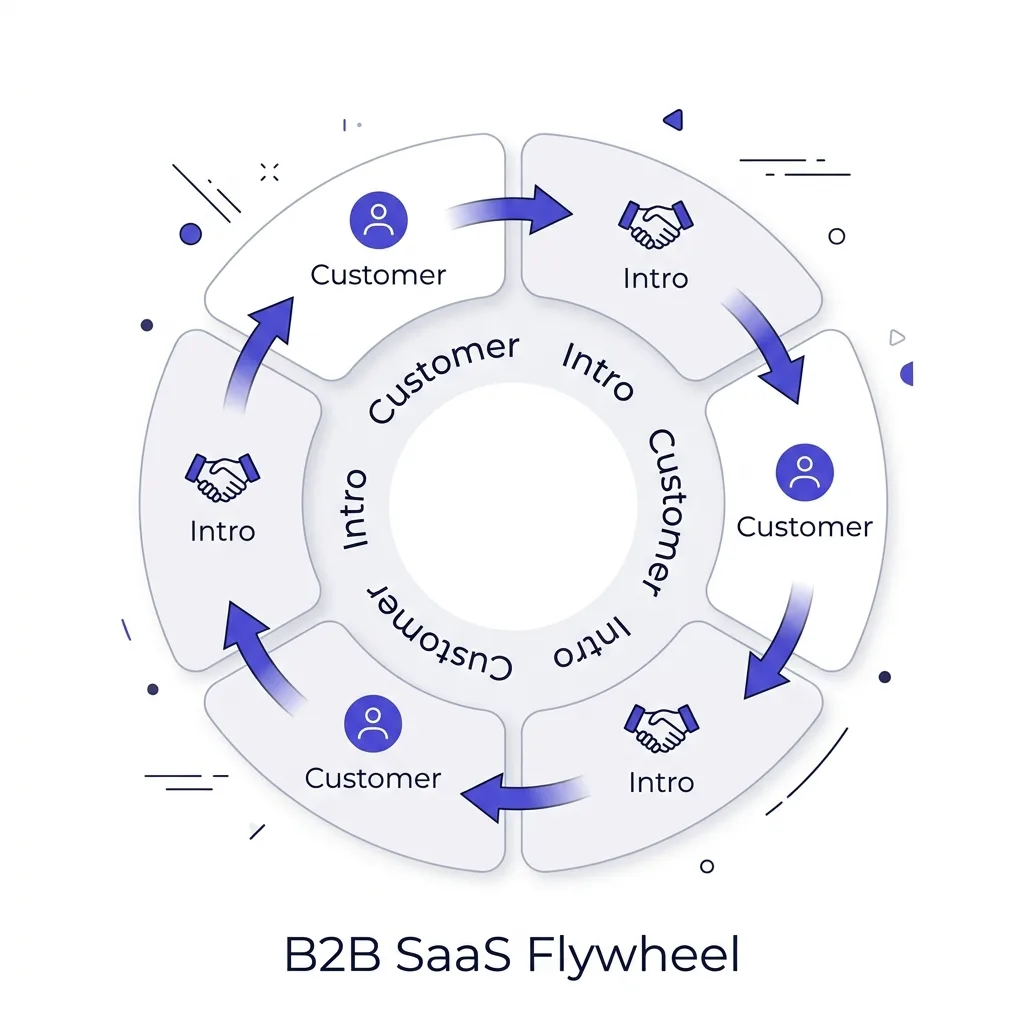 Flywheel diagram showing a warm intro pipeline turning customers into new connectors
Every closed deal becomes a source of the next two or three intro paths, and the pipeline widens on its own instead of depending entirely on the founder's original network, which is finite and gets exhausted.
Pair this with account tiering for outbound so the customers most similar to your best accounts get asked first, since their intros are more likely to land in the same ICP.
#Warm intro versus cold email versus paid: the real comparison
None of these channels should carry the whole pipeline alone, but they are not interchangeable either.
| Channel | Typical conversion | Scales past 50 leads a month | Requires ongoing rep time |
|---|---|---|---|
| Warm intro | ✓ 15-25% | ✗ Limited by network depth | ✓ Yes, moderate |
| Signal-based cold email | ✓ 5-18% | ✓ Yes | ✓ Yes, moderate |
| Generic cold email | ✗ 1-3% | ✓ Yes, but low quality | ✓ Yes, high volume |
| Paid acquisition | ✓ Varies by CAC target | ✓ Yes | ✗ Mostly budget, less rep time |
The honest read is that warm intros are the highest-converting, lowest-volume channel most B2B companies have access to.
They should run in parallel with a scalable cold channel, not instead of one, because a network of even a hundred strong connectors will not fill a full quarter's pipeline on its own.
Where warm intros earn their keep is at the top of the funnel for your highest-value accounts, the ones you would otherwise spend disproportionate research time on inside a multithreaded buying committee anyway.
Spend the manual effort where the conversion math justifies it, and let a structured outbound cadence by deal size handle the volume the network cannot reach.
#Where automation helps and where it wrecks the channel
Automation has a real, narrow role in a warm intro pipeline, and a much bigger way to ruin it if applied carelessly.
It helps with the boring parts: tracking every ask and outcome in a shared system instead of a founder's inbox, flagging connectors who have not been asked in six months, and surfacing which customers recently hit a milestone worth an intro request.
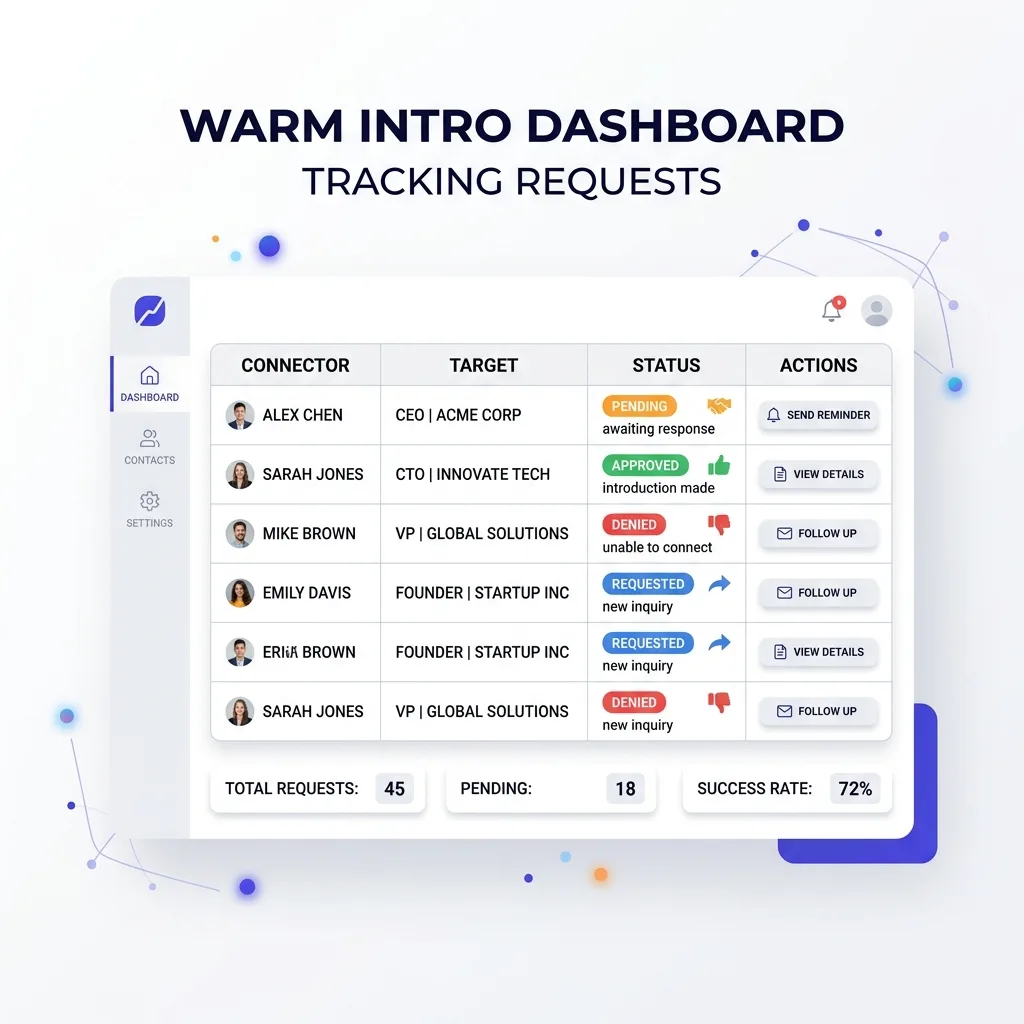 Automation dashboard showing tracked warm intro asks and outcomes
It wrecks the channel the moment it touches the ask itself.
A mass-personalized "hey, know anyone at these 40 companies" message sent to your whole investor list reads exactly like what it is, a form email dressed up as a personal favor, and it burns the relationship faster than simply not asking at all.
The ask has to stay one-to-one, specific, and written like the founder actually thought about that one connector and that one target.
Where a platform like FirstSales fits is on the other side of the intro, once the connector has made the introduction and the prospect is now a warm lead in your inbox.
That is exactly the moment automated research and AI-assisted drafting earn their place, since the human trust has already been established by the connector and the next email just needs to move the conversation forward without wasting the goodwill that got it there.
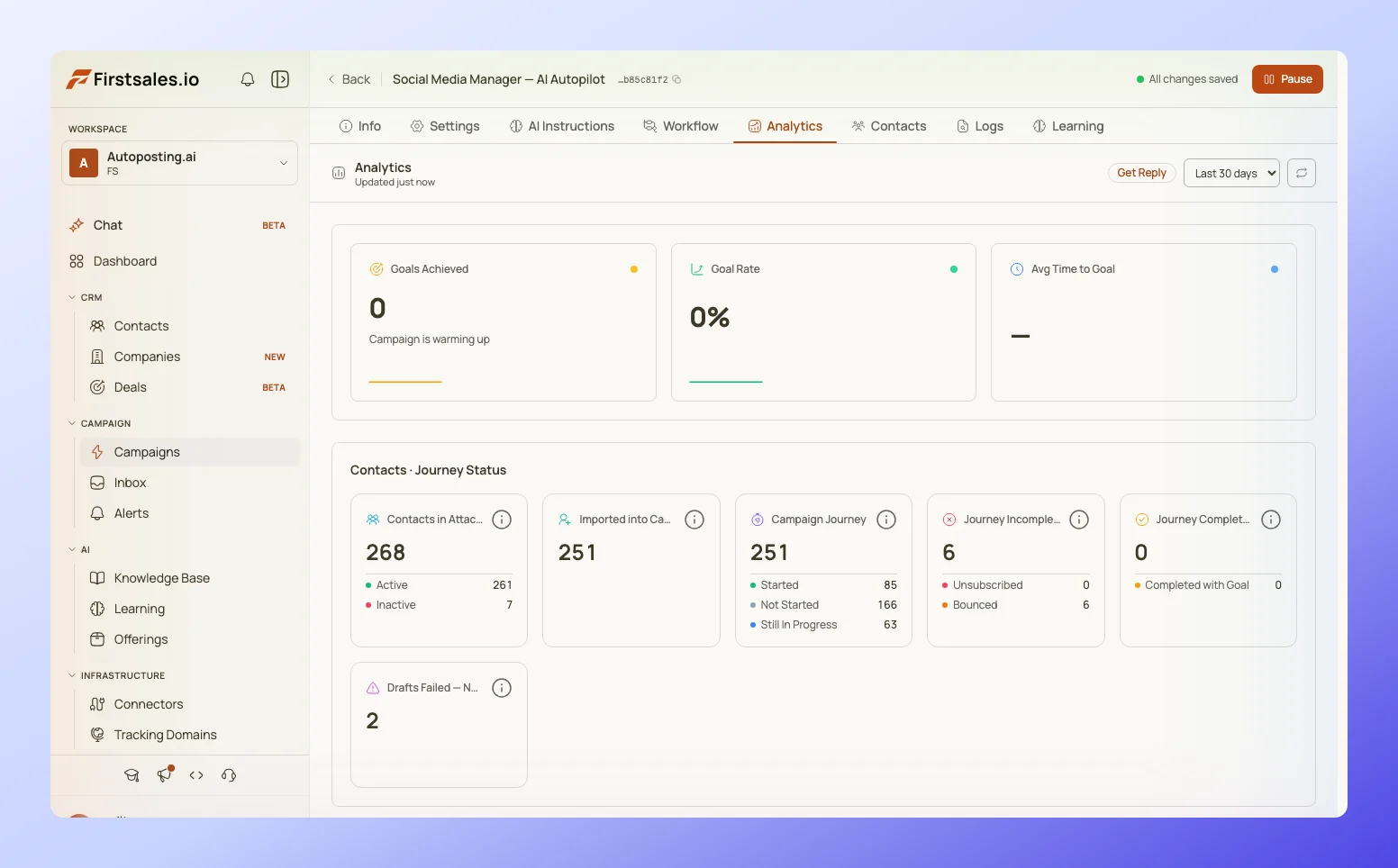 FirstSales campaign sequence view used to continue a warm intro thread
Keep the ask manual.
Automate everything downstream of the yes.
#Incentives: when to pay for an intro and when not to
Most B2B warm intro programs should not involve cash.
A customer who genuinely believes in the product will make an intro because it costs them almost nothing and reflects well on them if it works out.
Paying cash for that intro can actually undermine it, since the receiving prospect may sense the recommendation is compensated rather than genuine, which cuts against the entire reason a warm intro converts better than a cold one in the first place.
Where incentives make sense is structured affiliate or partner programs, a different mechanism entirely from the founder-network intro pipeline this article covers, usually involving a formal agreement and ongoing commission rather than a one-off favor.
For the informal network channel, the better currency is reciprocity and recognition: intros back into their network, a public shoutout, early access to a feature they care about, or simply being the kind of company people are proud to have vouched for.
Track who has made intros and make sure they get something back, even if it is not money.
That is what keeps the flywheel in stage five turning.
#Common mistakes that kill warm intro programs
The most common failure is asking too broadly.
"Let me know if you hear of anyone" produces almost nothing because it offloads the targeting work onto the connector.
The second most common failure is asking only when pipeline is desperately thin.
Connectors notice when the ask only shows up during a rough quarter, and it reads as need rather than a genuine belief the connection would help both sides.
Run the cadence on a schedule, not a panic trigger.
The third failure is no tracking, which means the same three connectors get asked repeatedly while a dozen others who could help never get approached, simply because nobody has a full list.
The fourth failure is skipping the loop back.
An intro that goes unacknowledged, win or lose, is the fastest way to make sure that connector never bothers again.
The fifth failure is trying to scale this like a cold channel with automation on the ask itself.
The entire value of a warm intro is that it does not feel automated, and any attempt to template the ask at scale strips out the exact thing that made it convert better than cold outreach.
#FAQ
#What conversion rate should I expect from warm intros compared to cold email?
Referral and warm intro leads convert at roughly 15-25% in B2B, compared to 1-3% for generic cold email and 5-18% for well-targeted signal-based outreach.
#How many people do I actually need in my connector network to make this worthwhile?
There is no fixed minimum, but a dozen strong connectors with real reach into your ICP will usually produce more usable intros per quarter than a hundred weak LinkedIn connections.
#Should founders be the only ones asking for intros?
No. Once you have customers seeing real value, they often make better connectors than the founder, since their recommendation carries direct proof the product worked.
#How specific should the ask be?
As specific as possible. Name the exact company, role, and ideally the exact person, along with a real reason the timing makes sense right now.
#Is it rude to ask the same connector for multiple intros over time?
Not if each ask is specific, spaced out, and the connector has heard back on how previous intros went. Silence after an intro, not repeated asking, is what damages the relationship.
#Should I pay connectors for warm intros?
Generally no for informal network intros. Cash can undermine the authenticity that makes the intro convert well. Reciprocity and recognition work better for this channel.
#How do I track warm intros without a heavy CRM setup?
A simple shared spreadsheet with connector, target, date, and outcome columns is enough to start. The discipline of tracking matters more than the tool.
#What is the biggest reason warm intro pipelines stall after the first year?
The founder's original network gets exhausted and nobody built the flywheel of turning new customers into the next round of connectors.
#Can warm intros scale to hundreds of leads a month?
Rarely on their own. Treat warm intros as a high-conversion, limited-volume channel that runs alongside a scalable cold or signal-based channel.
#How soon after closing a deal should I ask the customer for an intro?
Wait until the customer has a real result to point to, not immediately after signing. A specific, recent win makes the ask land better than asking on day one.
#What should the follow-up to a connector look like after a meeting happens?
A short, specific update: what happened, and where things stand. Two lines is enough. Generic thanks without an update does less for the relationship.
#Does industry affect how well warm intros convert?
Yes, somewhat. Categories with tight-knit professional communities, like certain vertical SaaS or regulated industries, tend to see even stronger lift from warm intros than more fragmented markets.
#Should sales reps have their own warm intro process, or is this founder-only?
It should extend past the founder as the company grows. Reps with strong personal networks in their target accounts can run the same process at smaller scale.
#How do I prioritize which connector to ask first when I need a specific intro?
Prioritize by relationship strength with the specific target, not by how well you know the connector generally. A weak overall relationship with a direct path to the exact person can outperform a strong relationship with only a loose connection.
#What role does LinkedIn play in a warm intro pipeline?
LinkedIn is useful for confirming a connector actually has a real relationship with a target before you ask, and for the connector to make the intro itself. See LinkedIn InMail at scale for how that channel behaves at volume.
#Is it worth building this pipeline if my company is very early stage?
Often more valuable early than later, since a founder's personal credibility is highest before the company has scaled and the network is still small enough to manage manually.
#How does a warm intro pipeline interact with account tiering?
Reserve warm intro effort for your highest-tier accounts, where the manual time investment is easiest to justify against deal size.
#What is the single most common reason a connector stops making intros?
Never hearing what happened to the ones they already made. Close the loop every time, regardless of outcome.
#Can automation help with sourcing which connectors to ask?
Yes, for surfacing who in your existing network overlaps with target accounts and flagging connectors who have not been asked recently. The ask itself should stay manual and specific.
#How does a warm intro pipeline fit alongside a GTM engineer role?
A GTM engineer can own the tracking and sourcing infrastructure behind this channel, freeing the founder or reps to focus on the actual relationship and ask.
#Conclusion
A warm intro is not a lucky break, it is a channel with a conversion rate most companies would kill for on any other line of the funnel.
The reason it underperforms in practice has nothing to do with the strength of the underlying relationships and everything to do with process.
No list of who can actually help, no specific ask, no tracking, no loop back to the people who did the favor.
Fix those four gaps and the channel starts compounding instead of running dry after the first easy round of contacts.
Keep the ask manual and specific, track it like any other pipeline stage, and treat every closed customer as the start of the next round of connectors rather than the end of the relationship.
Compare the real cost per outcome across channels using something like a channel mix cost per reply model, and warm intros usually earn a permanent, if modest, line in the plan once the process actually exists to support them.
The network was never the bottleneck. The system around it was.