
TL;DR: A GTM engineer builds the systems that used to require a data analyst, a RevOps hire, and a chunk of an SDR team's manual busywork. They write SQL and Python, wire APIs between the CRM and the data warehouse, and turn enrichment, scoring, and outbound triggers into pipelines that run without a human clicking through a spreadsheet. The median posted salary is $127,500 in 2026, with senior GTM engineers at AI-native companies clearing $250,000 to $350,000 in total comp. This piece gives you the real job spec, the stack, where the role stops, and when hiring one is the wrong call.
#What a GTM engineer actually is
A GTM engineer is not a rebrand of RevOps and not a technical SDR with a fancier title.
The job is building the pipes: the enrichment jobs, the scoring models, the routing logic, and the outbound triggers that connect your data warehouse to your CRM to your sending tools.
They write code that runs on a schedule or a webhook, not decks that get presented in a Monday standup.
Think of the difference this way. A RevOps person configures a Salesforce field and documents a process. A GTM engineer writes a script that watches for a job change signal, enriches the new company through three data providers, scores it against your ideal customer profile, and drops a ready-to-send sequence into the queue.
Nobody clicked anything. That is the whole point of the role.
The title emerged out of a real gap. Marketing ops people know tools but rarely write real code. Data engineers know code but rarely understand the revenue motion. GTM engineers sit in the middle, and demand for that combination grew fast enough that job boards now track it as its own category.
#GTM engineer vs RevOps vs SDR
These three roles get confused constantly, so here is the actual split.
RevOps maintains what already exists. They own the CRM configuration, the reporting layer, and the process documentation. They optimize a system someone else built.
A GTM engineer builds the system RevOps later maintains. They write the enrichment pipeline, the lead scoring model, and the outbound trigger logic from scratch, usually in SQL, Python, and whatever API the tool exposes.
An SDR executes inside the system. They personalize the email a GTM engineer's pipeline already drafted, they make the call, they handle the reply.
| Function | RevOps | GTM engineer | SDR |
|---|---|---|---|
| Writes SQL or Python daily | ✗ | ✓ | ✗ |
| Owns CRM field configuration | ✓ | ✗ | ✗ |
| Builds the enrichment pipeline | ✗ | ✓ | ✗ |
| Talks to prospects | ✗ | ✗ | ✓ |
| Ships scoring models | ✗ | ✓ | ✗ |
| Runs the weekly pipeline report | ✓ | ✗ | ✗ |
| Debugs a broken webhook | ✗ | ✓ | ✗ |
The overlap that confuses people: a GTM engineer's output feeds both RevOps dashboards and SDR queues. But the person doing the building is neither of those two roles.
If your job description asks for "Salesforce admin experience plus some scripting," you are hiring a RevOps generalist, not a GTM engineer.
If it asks for API integration, SQL, and the ability to own a data pipeline end to end, that is closer to the real spec.
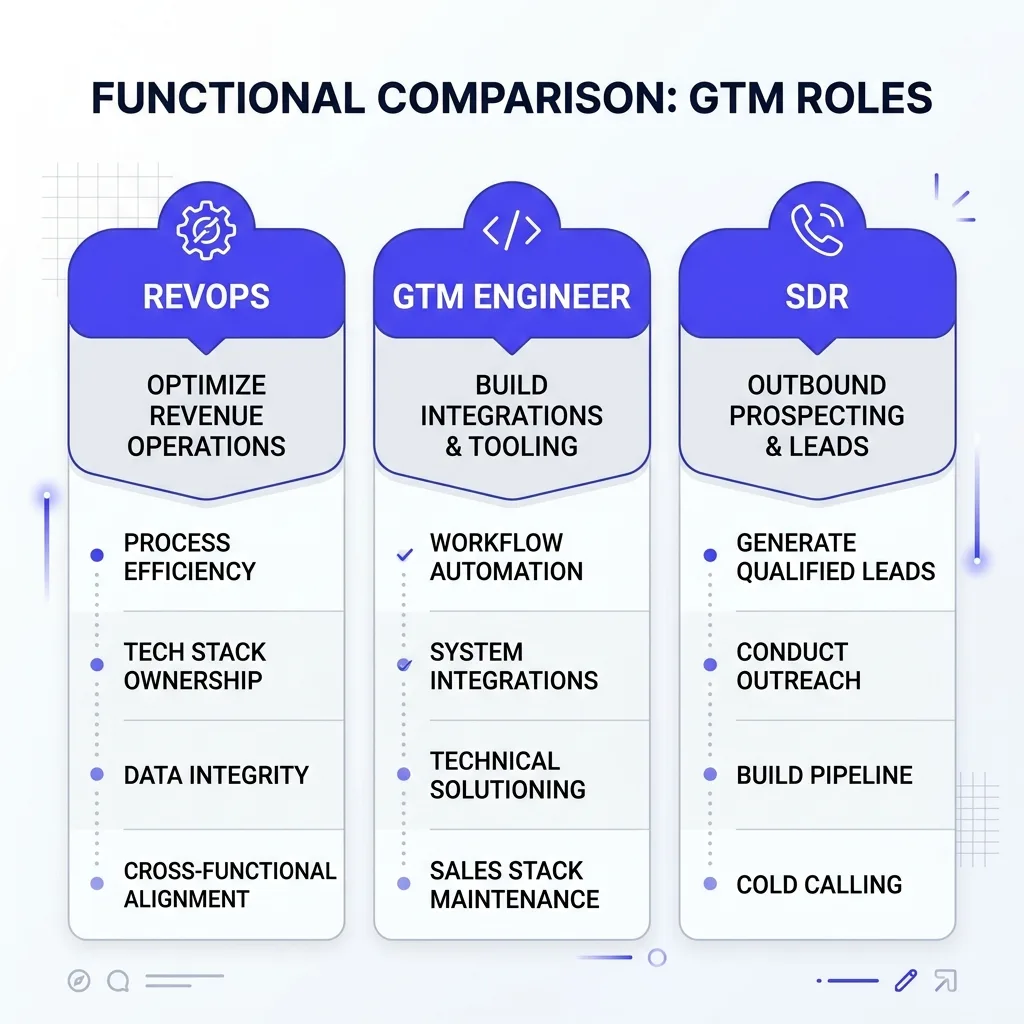 Diagram comparing the GTM engineer role against RevOps and SDR responsibilities
#The real job spec
Most public GTM engineer postings blur together the same handful of responsibilities. Here is what they actually cover, stripped of the buzzwords.
Data pipeline ownership. Connecting the data warehouse, the CRM, and third-party enrichment providers so that account and contact records stay current without a human refreshing a list. This is the highest-weighted skill area in the role, and it is the part most postings underspecify.
Signal detection and scoring. Building the logic that decides which accounts matter this week: a hiring signal, a funding event, a tech stack change, a job change trigger. This overlaps heavily with what we cover in outbound lead scoring, except the GTM engineer is the one who codes the model instead of just consuming its output.
Outbound trigger automation. Wiring the moment a signal fires to the moment a sequence gets queued, without a rep manually pulling a list every Monday morning.
Internal tooling. Slack bots that alert a rep when a target account visits the pricing page. Internal dashboards that show data freshness, not just pipeline value. Scripts that catch broken enrichment before it silently corrupts a week of outbound.
AI workflow integration. Increasingly, wiring an LLM into the pipeline for drafting, summarizing call notes, or flagging accounts that match a pattern from closed-won deals. This is closer to training AI on your own closed-won deal history than it is to prompt engineering.
What is notably absent from the real spec: writing the cold email copy itself, managing a rep's quota, or running the sales process. A GTM engineer's users are the reps and marketers who depend on the system, not the prospects on the other end of it.
graph LR
    A[Signal source: hiring, funding, tech stack] --> B[GTM engineer pipeline]
    B --> C[Enrichment: firmographic + contact]
    C --> D[Scoring model]
    D --> E{Score above threshold?}
    E -->|Yes| F[Sequence queued in outbound tool]
    E -->|No| G[Held in nurture pool]
    F --> H[Rep or AI draft review]
#The stack a GTM engineer runs
The stack is where the title earns its "engineer" half. This is not a list of SaaS logos on a slide, it is a working system with actual code between the pieces.
Data layer. A warehouse, usually Snowflake or BigQuery, holding the account and contact universe. This is the source of truth everything else reads from and writes back to.
Enrichment and waterfall providers. Multiple data vendors chained together so that when one provider misses a contact, the next one fills the gap. This is exactly the pattern in waterfall enrichment for B2B data, and building that waterfall logic is a core GTM engineering task, not a vendor feature you toggle on.
Reverse ETL. Tools like Census or Hightouch that push warehouse data back into the CRM and sales tools, so the CRM stays a consumer of clean data instead of the place data gets manually entered.
CRM and sequencing tools. Salesforce or HubSpot as the system of record, plus a sending platform for the actual outbound motion.
Signal and intent sources. Job change feeds, funding databases, hiring trackers, website visitor identification tools. The GTM engineer decides which signals are worth building a pipeline around, which is the same judgment call behind deanonymizing website visitors for outbound.
Automation and orchestration. Zapier or n8n for lighter glue work, Python scripts and Airflow-style scheduling for anything that needs to run reliably at scale.
AI layer. An LLM API wired into the pipeline for drafting, classification, or summarization, with human review sitting on top of the output. FirstSales fits here as the outbound execution layer: it takes the scored, enriched accounts a GTM engineer's pipeline produces and turns them into drafted sequences that a human still approves before anything sends.
That stack list looks long, but the skill APIs (59% of postings), SQL (47%), and Python (45%) show up far more often than any specific tool name. The tools change. The ability to connect them with code does not.
#What replacing an outbound team with this role actually looks like
The pitch you hear is "one GTM engineer replaces a five-person SDR team." That is true in a narrow, specific sense and false in a broader one worth being honest about.
What actually gets replaced: the manual list-building, the copy-paste enrichment, the spreadsheet-based scoring, and the "who do I contact this week" triage that used to eat the first two hours of every SDR's day.
What does not get replaced: the judgment call on messaging, the actual conversation once a prospect replies, and the relationship work on larger accounts. A pipeline can score an account as hot. It cannot run the discovery call.
The honest version of the claim is closer to this: a GTM engineer plus a smaller number of reps or an AI drafting layer replaces a larger, purely manual SDR team, because the manual busywork that used to require headcount now runs as code.
That tracks with what shows up in broader data on hybrid AI and human teams. AI-supported human SDR teams built 2.8x more pipeline than manual-only teams, which is a compounding effect of exactly this kind of pipeline work, not a single tool doing the whole job. That is the mechanics behind pairing AI drafts with a human who still sends.
It is also worth saying plainly: this only works when someone is still reading the drafts before they go out. A pipeline with no review step is exactly how AI-generated slop ends up in a prospect's inbox at scale, which burns the exact reputation the pipeline was built to protect.
 Flowchart of the signal to pipeline to outbound stack a revenue team automates
#Salary and hiring market in 2026
GTM engineer compensation in the US runs roughly $100,000 to $180,000 in base salary, with total compensation between $130,000 and $260,000 once bonus and equity are included.
The median posted salary across GTM engineering job listings sits at $127,500.
Senior and staff-level GTM engineers at AI-native companies clear $250,000 to $350,000 or more in total comp. Some of the highest publicly listed postings have come from companies like Vercel and OpenAI, in the $250,000 range for the role.
That range is wide because the job title covers two genuinely different jobs at different companies. At a 20-person startup, a GTM engineer is a generalist wearing three hats. At a company with a dedicated growth engineering function, it is a specialized, senior technical role competing for the same talent pool as a backend engineer.
If a posting pays closer to $70,000 to $90,000 and lists mostly tool configuration, that is a RevOps or sales ops role with a trendier title, not the engineering-heavy version of the job.
(Salary figures per Apollo's 2026 GTM engineer compensation research and job market analysis. See sources at the end of this article.)
#Where the role breaks
The role fails in three predictable ways, and knowing them before you hire saves a bad first six months.
Hiring for tools instead of engineering fundamentals. Someone who knows five SaaS tools but cannot write a SQL join or debug an API response will hit a wall the first time a vendor changes their schema without warning.
No clear owner of the AI review layer. If the pipeline auto-generates outbound and nobody is checking output quality, deliverability erodes before anyone notices. This is the same trap covered in why AI SDRs get blocked, and a GTM engineer's pipeline is not exempt from it just because a human built the plumbing.
Treating it as a one-person department. A single GTM engineer building the entire revenue data infrastructure with no backup is a bus-factor problem. When they leave, the pipelines they wrote in idiosyncratic Python become undocumented legacy code nobody else can touch.
The companies getting this right pair the GTM engineer with a lightweight review process and at least one other person who understands the pipeline well enough to keep it running if the original builder moves on.
#How to hire one
Screen for engineering ability first, tool familiarity second.
A strong candidate can describe a real pipeline they built end to end: the data source, the transformation logic, the failure modes they hit, and how they fixed them.
A weak candidate describes a stack of tool names with no code in between.
Ask them to walk through how they would build a scoring model from a set of closed-won and closed-lost deals. The answer should mention actual features and actual SQL, not a vague description of "using AI to find patterns."
Check whether they have opinions on data quality, not just data volume. List hygiene and data decay is a boring topic, but a GTM engineer who has never had to deal with a stale enrichment record has probably never run a pipeline at real scale.
Finally, be honest with the candidate about scope. This role sits closer to SDR roles and responsibilities reimagined as infrastructure than to a pure data engineering job, and candidates coming from either extreme sometimes struggle with the hybrid nature of it.
If you are building the cold outbound tech stack around this hire, budget time for integration work that nobody quotes in the sales demo. Wiring three tools together always takes longer than any single vendor's onboarding call suggests.
Compensation structure matters here too, and if you are building a hybrid team around this role, how to pay a hybrid AI and human SDR team is worth reading before you finalize the offer, since a pipeline-building hire and a quota-carrying rep should not be on the same comp plan.
Building the eval layer for whatever AI component sits in the pipeline is also part of the job description now, even when it is not written down. Building an eval set for outbound AI is the kind of task a good GTM engineer will bring up unprompted in an interview, because they have already been burned by shipping an unmonitored prompt change.
 Reply analytics dashboard showing sequence performance data a GTM engineer's pipeline feeds into
A dashboard like this is the downstream output of the pipeline, not the pipeline itself. The GTM engineer's actual work is invisible: the enrichment job that ran at 3am, the scoring model that decided which accounts made the cut, the trigger that queued the sequence before a human ever saw it. FirstSales sits at the execution end of that chain, turning the scored account list into drafted, human-approved outbound rather than a spreadsheet someone has to work through manually.
#FAQ
#What does a GTM engineer actually do day to day?
They write and maintain data pipelines connecting the CRM, data warehouse, and outbound tools. A typical day includes debugging a broken enrichment job, writing SQL to build a new scoring segment, and reviewing whether an AI-generated draft batch is meeting quality thresholds.
#Is a GTM engineer the same as a sales engineer?
No. A sales engineer supports the sales process for a technical product, often on live customer calls. A GTM engineer builds internal revenue infrastructure and rarely, if ever, talks to a prospect directly.
#Does a GTM engineer need to know how to code?
Yes, in a meaningful way. SQL and Python show up in the majority of real postings, and the job requires writing and debugging actual scripts, not just configuring no-code tools.
#What is the difference between a GTM engineer and RevOps?
RevOps maintains and reports on systems that already exist. A GTM engineer builds the systems from scratch, including the pipelines RevOps later relies on for reporting.
#How much does a GTM engineer earn in 2026?
Median posted salary is around $127,500, with typical total compensation between $130,000 and $260,000. Senior roles at AI-native companies can reach $250,000 to $350,000 or more.
#Can a GTM engineer fully replace an SDR team?
Not entirely. The role removes manual list-building and enrichment work, which shrinks the headcount needed for that part of the job, but conversation and judgment work on replies still needs a human or a carefully reviewed AI layer.
#What tools does a GTM engineer typically use?
A data warehouse such as Snowflake or BigQuery, a reverse ETL tool such as Census or Hightouch, a CRM, enrichment providers, an automation tool like Zapier or Python scripts, and increasingly an LLM API for drafting or classification.
#Where does this role usually sit in the org chart?
Most commonly under RevOps or growth, sometimes reporting into a Head of Growth or VP of Sales, occasionally into a data or engineering leader at more technical companies.
#Is GTM engineering a stable long-term career path?
The title is new enough that its long-term shape is not settled. The underlying skills, SQL, API integration, and pipeline building applied to revenue data, are durable regardless of what the role gets called in five years.
#What is the biggest mistake companies make hiring for this role?
Hiring for tool familiarity instead of engineering fundamentals. A candidate who only knows how to click through five SaaS dashboards cannot debug a pipeline when a vendor changes their API without notice.
#Does a small company need a dedicated GTM engineer?
Usually not as a first hire. Below a certain deal volume, the manual process a GTM engineer would automate is not happening often enough to justify the build cost. It becomes worth it once list-building and scoring are eating real hours every week.
#How is this different from a data analyst role?
A data analyst mostly reports on what already happened. A GTM engineer builds systems that act on data in near real time, triggering outbound before a human even looks at a dashboard.
#What signals should a GTM engineer's pipeline prioritize?
That depends on the business, but hiring signals, funding events, and tech stack changes are common starting points. The judgment on which signals actually predict a deal, not just which ones are available, is where the real skill shows up.
#Can AI tools replace the need for a GTM engineer?
AI tools handle pieces of the job, drafting and classification especially, but someone still has to wire those tools into a working pipeline and monitor whether the output is any good. That wiring and monitoring work is the GTM engineer's job.
#What happens when the GTM engineer who built the pipeline leaves?
Whatever they built in idiosyncratic scripts becomes undocumented legacy infrastructure. This is why pairing the role with at least one other person who understands the pipeline is worth the redundancy cost.
#Should a GTM engineer report to sales or to data and engineering?
There is no universal answer, but the reporting line should reflect where the role's actual work sits. If most of the job is pipeline building and debugging, an engineering-adjacent reporting line tends to reduce friction over a pure sales chain of command.
#How does a GTM engineer's work show up in outbound results?
Indirectly, through better-targeted lists, faster response to buying signals, and less time wasted on accounts that were never going to convert. It rarely shows up as a single visible metric on its own.
#What is a red flag in a GTM engineer job posting?
Vague requirements like "some technical aptitude" paired with a list of tool names and no mention of SQL, Python, or API work. That combination usually means the company wants a RevOps hire but is using the more fashionable title.
#Does the role require managing other people?
Not typically at the individual contributor level. Senior or staff GTM engineers occasionally lead a small team, but the core job is building and maintaining systems, not managing headcount.
#Conclusion
The GTM engineer title will probably shift or fade over the next few years, the way "growth hacker" did before it.
What will not fade is the underlying shift: revenue teams increasingly need someone who can write real code to connect data, signals, and outbound execution, instead of relying on a rep to do that work by hand every morning.
If you are evaluating whether to hire one, the test is simple. Look at how much of your outbound motion still depends on a human manually pulling a list, enriching it, and deciding who gets contacted this week.
If that number is high, the ROI on this hire is usually there. If it is already low because your stack handles it, you probably need a maintainer, not a builder, and that is a different job entirely.
Sources: