
#AI SDR team compensation: pay plans for hybrid outbound (2026)
Copy page
TL;DR: Most SDR comp plans still pay for activity that AI now does for free. If a model researches the account, drafts the email, and books the slot, paying a human commission on "meetings booked" rewards the wrong step. The fix is not a pay cut. It is moving the variable dollars off volume and onto judgment: research accuracy, message quality, and the deals that actually progress. Base stays roughly where it was. Variable gets smaller in headcount and heavier in weight per person, because fewer people are doing more decision work.
#Table of contents
- Why the old comp plan breaks first
- What the machine actually replaced
- Current SDR pay benchmarks
- The four hybrid comp models
- A worked example: 55/45 to hybrid
- What to measure instead of activity
- Where this breaks down
- Rolling it out without a walkout
- FAQ
- Conclusion
Most sales comp plans were built around one assumption: a person did all the work between "here is a list" and "here is a meeting."
That assumption is no longer true on a growing share of outbound teams.
An AI system now does the list building, the account research, the first draft, and often the follow-up sequencing.
The human either approves what the machine produced, or steps in when the machine gets stuck.
Comp plans have not caught up. Most still pay commission on meetings booked, as if the SDR wrote every word and found every prospect by hand.
That mismatch is the subject of this article.
#Why the old comp plan breaks first
A classic SDR comp plan pays a base salary plus a bonus per qualified meeting, sometimes with an accelerator once someone clears quota.
The logic was sound when booking a meeting required real, hard-to-automate effort: finding the account, finding the right contact, writing something that did not sound like everyone else's template, and following up four or five times without giving up.
Take AI out of the picture and that effort curve is roughly linear. More meetings meant more hours of grinding.
Put AI research and AI drafting into the pipeline and the curve breaks.
A rep working with an AI-assisted, human-in-the-loop pipeline can now approve or lightly edit twenty to forty drafted, researched emails in the time it used to take to hand-write eight.
If the comp plan still pays $50 per meeting regardless of how the meeting got sourced, two things happen at once.
First, reps start optimizing for volume of approvals, not quality of judgment, because that is what the plan rewards.
Second, the plan quietly overpays for what is now cheap (typing and light editing) and underpays for what is now scarce (catching a bad AI claim before it reaches a real buyer).
That second point is the actual problem. Comp plans are supposed to price scarcity. When the scarce skill shifts, the plan has to shift with it, or it pays for the wrong thing.
#What the machine actually replaced
Before changing a comp plan, it helps to be precise about what got automated and what did not.
AI systems in a modern outbound stack typically take over:
- List building and firmographic filtering
- Signal detection (funding, hiring, job changes, tech stack shifts)
- First-draft personalization based on that research
- Sequencing and send-time optimization
- Basic reply classification (interested, not now, unsubscribe, out of office)
What has not been automated reliably, based on how hybrid teams actually operate:
- Judging whether a signal is a real reason to reach out or noise
- Catching a hallucinated or half-true personalization claim before it sends
- Handling an ambiguous reply that needs tone-reading, not classification
- Building the account plan for a genuinely strategic target
- The actual sales conversation once someone replies
That last list is where the money should now concentrate. It is also why a purely research-agent-vs-writing-agent split inside the AI stack matters for comp: the more the machine's research is trusted blindly, the more the human's real job becomes catching what the machine got wrong, not writing from scratch.
Read how AI-assisted and fully autonomous outbound differ in practice before deciding how much of this list your team has actually delegated. Most teams overestimate how autonomous their setup really is.
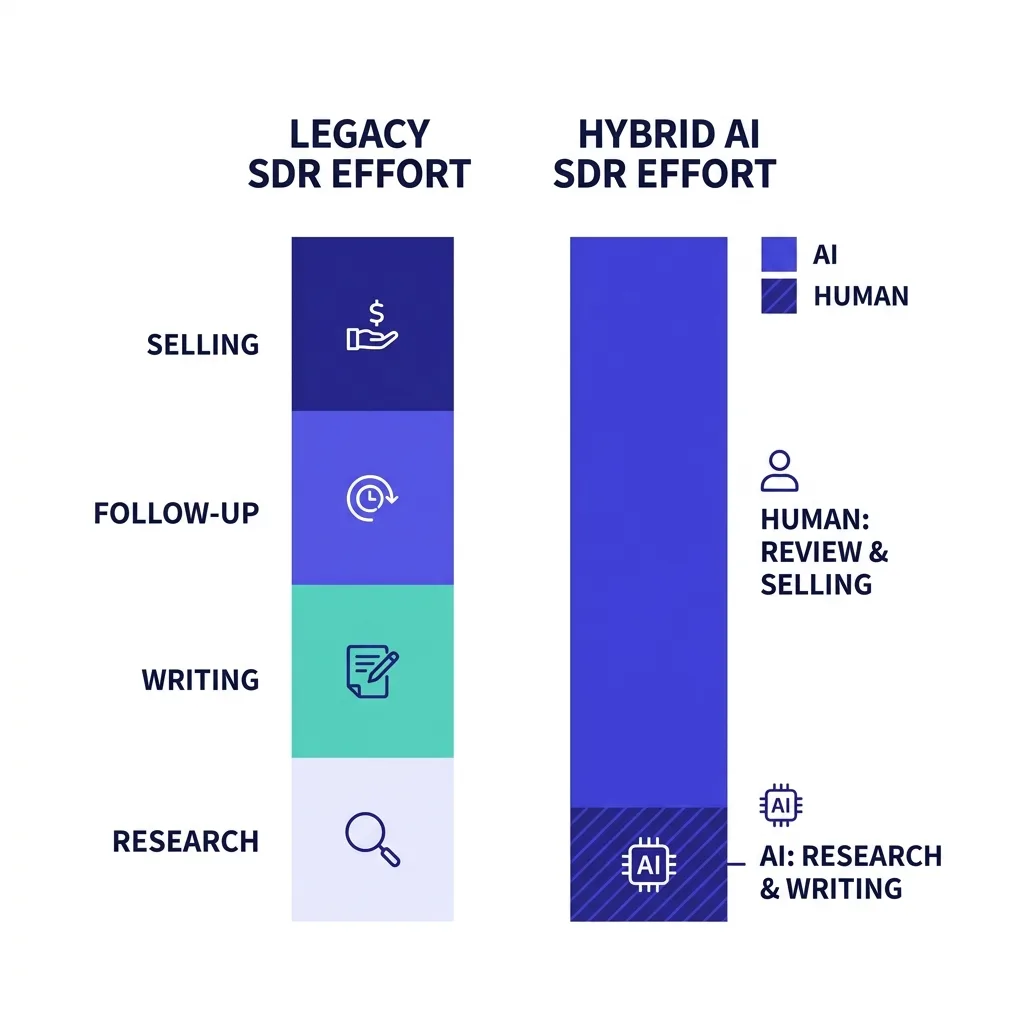 Diagram comparing old SDR effort split against AI-assisted SDR effort split
#Current SDR pay benchmarks
Before redesigning anything, it helps to know what a plan is being redesigned from.
US B2B SaaS SDR base salary in 2026 runs roughly $55,000 to $65,000 for a solid offer, with a wider market range of $45,000 to $82,000 across entry-level through senior SDRs.
On-target earnings (OTE) for the same role typically land between $85,000 and $95,000, with a market median around $85,000 and a top quartile, usually including accelerators, reaching $120,000 to $135,000.
The base-to-variable split has converged around 70/30, meaning commission and bonus usually make up 30 to 40 percent of OTE, not half.
One number matters more than the headline figures: most SDRs realistically earn 60 to 80 percent of OTE, not the full number, because quota attainment is uneven across a team in any given quarter.
That last point matters for hybrid design. If a new AI-adjusted plan claims a higher OTE ceiling but makes it structurally harder to hit, reps will notice within one quarter, regardless of what the offer letter says.
These figures are U.S. benchmark ranges gathered from current compensation research, not a claim about what any specific company pays. Treat them as a planning anchor, not a mandate.
#The four hybrid comp models
There is no single right way to pay a hybrid team. Four structures show up repeatedly across companies that have actually made the shift, each with a real tradeoff.
#Model 1: same plan, smaller headcount
Keep the exact legacy structure (base plus per-meeting bonus), but run it with fewer reps managing a much larger AI-assisted book.
This is the path of least resistance. It requires no plan redesign, no new metrics, no retraining of finance on how to model payouts.
The tradeoff: it still pays for volume, and volume is now cheap. It also tends to produce a strange outcome where a rep's income depends heavily on how good their AI tooling is that quarter, not on their own skill.
#Model 2: quality-weighted meeting bonus
Keep the per-meeting structure, but weight the bonus by a quality score instead of a flat rate. A meeting that came from a strategic, well-researched account and converts to a next step pays more than a meeting from a low-fit account that ghosts immediately.
This requires an actual scoring rubric, ideally one built from your own won and lost deal history rather than a generic template.
Building an eval set from your own AI outbound history is the same underlying discipline this comp model depends on: you cannot weight quality if you cannot score it consistently.
#Model 3: research-plus-judgment split pay
Split the role explicitly into two comp components: a smaller flat rate for approving AI-drafted sends at volume, and a much larger bonus tied to strategic account work that genuinely required a human, like a multi-threaded enterprise account or a hand-built account plan.
This model works best on teams that have already separated research-heavy accounts from high-volume, lower-touch accounts, which is exactly the kind of tiering discussed in most account-tiering frameworks.
#Model 4: outcome-only, no activity bonus at all
Pay a higher base, drop the per-meeting bonus entirely, and pay variable comp only on pipeline that reaches a defined stage (say, a second meeting or a proposal), regardless of channel or how the first touch was sourced.
This is the most radical option and the hardest to sell to a team used to per-meeting bonuses. It also removes almost all incentive to game AI output for volume, because volume alone pays nothing.
Below is how the four stack up on the dimensions that actually decide whether a plan survives contact with a real quarter.
| Model | Rewards judgment over volume | Easy for finance to model | Reps accept it without a fight | Punishes bad AI tooling fairly |
|---|---|---|---|---|
| Same plan, fewer reps | ✗ | ✓ | ✓ | ✗ |
| Quality-weighted meeting bonus | ✓ | ✗ | ✓ | ✓ |
| Research-plus-judgment split | ✓ | ✗ | ✗ | ✓ |
| Outcome-only, no activity bonus | ✓ | ✓ | ✗ | ✓ |
None of these is universally correct. A seed-stage team with two reps and one AI tool should not run the same plan as a 40-person SDR org with three tiers of accounts.
#A worked example: 55/45 to hybrid
This is a worked example for illustration, not a benchmark claim. Use your own numbers.
Assume a legacy SDR plan: $60,000 base, $30,000 target variable, all of it paid at $75 per qualified meeting against a quota of 400 meetings a year.
That rep spends most of a normal week finding accounts, researching them, drafting outreach, and chasing replies. The $75 per meeting roughly compensates for that entire chain of effort.
Now assume the same rep adopts an AI-assisted pipeline that drafts and researches most outbound. Their realistic output at the same quality bar rises to 700-800 approved sends worth chasing, not because they work more hours, but because drafting stopped being the bottleneck.
Under the old flat-rate plan, if meeting volume rises proportionally, this rep's variable comp roughly doubles for doing meaningfully less original research and writing per meeting. That is the overpay-for-cheap-work problem in action.
A hybrid version of the same plan keeps the $60,000 base, but restructures variable to $20,000 at a flat rate for volume up to the old baseline of 400 meetings, plus a separate $15,000 pool paid only on meetings tagged as coming from accounts the rep personally researched and hand-qualified, or meetings that progressed past a second call.
Total target OTE goes from $90,000 to $95,000, roughly flat to slightly up, matching current market OTE benchmarks.
But the composition shifted: less money for pure volume, more money gated behind the parts of the job that still require a human.
#What to measure instead of activity
A comp plan is only as good as the metric behind it. Moving off raw "meetings booked" means picking something that is both measurable and hard to game.
A few options that hybrid teams have converged on:
Meeting-to-second-call rate. Filters out meetings that only happened because a calendar link got clicked, not because the prospect was actually a fit.
Human-catch rate. How often a rep flags and corrects a factual error or a bad personalization claim before a draft sends. This directly measures the judgment work that replaced writing from scratch, and it is the same discipline covered in guidance on setting a human review rate for AI-generated email.
Pipeline sourced per hour of human time, not per send. This reframes the unit of productivity around scarce human attention instead of abundant machine output.
Deal survival past discovery. A meeting that dies at discovery because the account was never a real fit should not pay the same as one that survives to a proposal.
None of these require exotic tooling. Most are derivable from a CRM plus whatever tagging the AI drafting tool already applies to flag human edits versus untouched sends.
#Where this breaks down
Reframing comp around judgment sounds clean until it meets a real team, so it is worth naming where the approach actually struggles.
Small teams cannot build a scoring rubric worth trusting. A quality-weighted bonus needs enough historical won and lost data to calibrate against. A two-person SDR team with eleven closed deals does not have that yet, and a rubric built on that little data is closer to a guess with a scorecard attached.
Reps distrust anything that feels subjective. A flat per-meeting rate is easy to audit: count the meetings, multiply by the rate. A quality score that a manager can adjust is a plan reps will suspect is rigged, whether or not it actually is.
AI tool quality varies by no fault of the rep. If the research agent degrades or a data source goes stale mid-quarter, a rep's output quality can drop for reasons entirely outside their control. A plan that punishes that without any floor is not fair, and reps will correctly identify it as such.
Finance hates variable payout formulas that are hard to forecast. Anything gated on subjective review or multi-stage pipeline progression is harder to model in a budget than a flat per-unit rate. That friction is real and should be priced into the rollout timeline, not ignored.
The honest takeaway is that no hybrid comp model is free of tradeoffs. The question is which tradeoff your team can tolerate, not which model is theoretically purest.
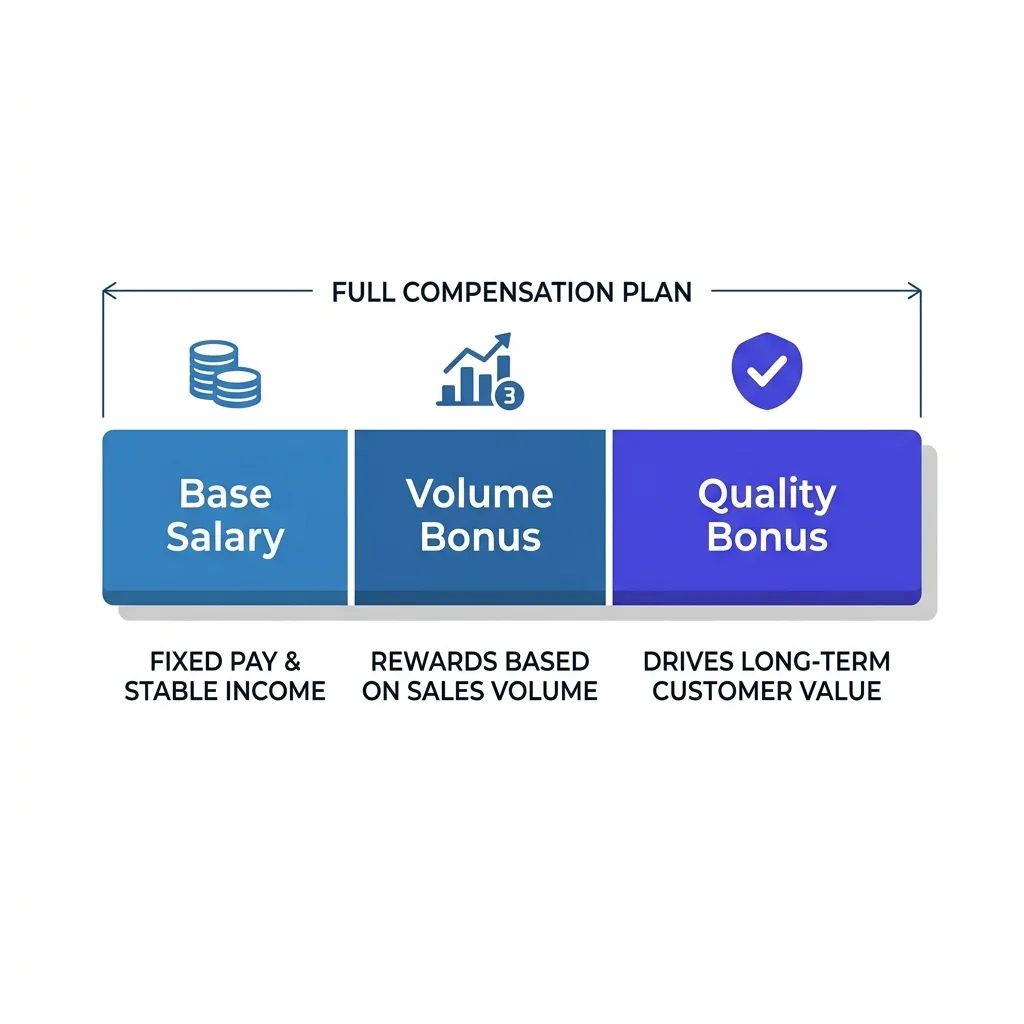 Chart showing base, variable, and quality-weighted bonus split in a hybrid SDR pay plan
#Rolling it out without a walkout
Changing a comp plan is one of the fastest ways to lose a sales team's trust if it is handled badly, hybrid AI angle or not.
A few things that reduce that risk in practice.
Never cut take-home pay in the same quarter as the plan change. Run the new structure in parallel for a full quarter, paying whichever plan yields more for each individual rep, then switch fully once people have seen a real paycheck under the new model.
Show the math, not just the new number. Reps who understand why the plan changed, using their own historical numbers plugged into the new formula, accept it far more readily than reps who are just handed a new comp letter.
Separate the comp conversation from the tooling rollout. If a team is adjusting to a new AI drafting tool and a new comp plan in the same month, they will conflate frustration with the tool as frustration with the pay plan, and vice versa. Stagger the two changes by at least a few weeks where possible.
Revisit quarterly, not annually, for the first year. Comp plans built around a shifting AI baseline go stale faster than legacy plans did, because the underlying tooling capability is still moving. A plan set once and left alone for a full year risks locking in assumptions that were already wrong by month four.
This is also a moment to be honest about role definition, not just pay. The role definition and day-to-day scope of an SDR has shifted alongside the comp question, and a plan that pays for a role description nobody actually performs anymore will keep producing confusion regardless of the formula.
One platform note, since this is where FirstSales tends to come up in these conversations: teams running FirstSales for AI-drafted, human-approved sends already have the human-edit and approval data needed to build a human-catch-rate metric, because every correction to a draft is logged as part of the approval step. That log is the raw material for Model 2 or Model 3 above, not a separate reporting project.
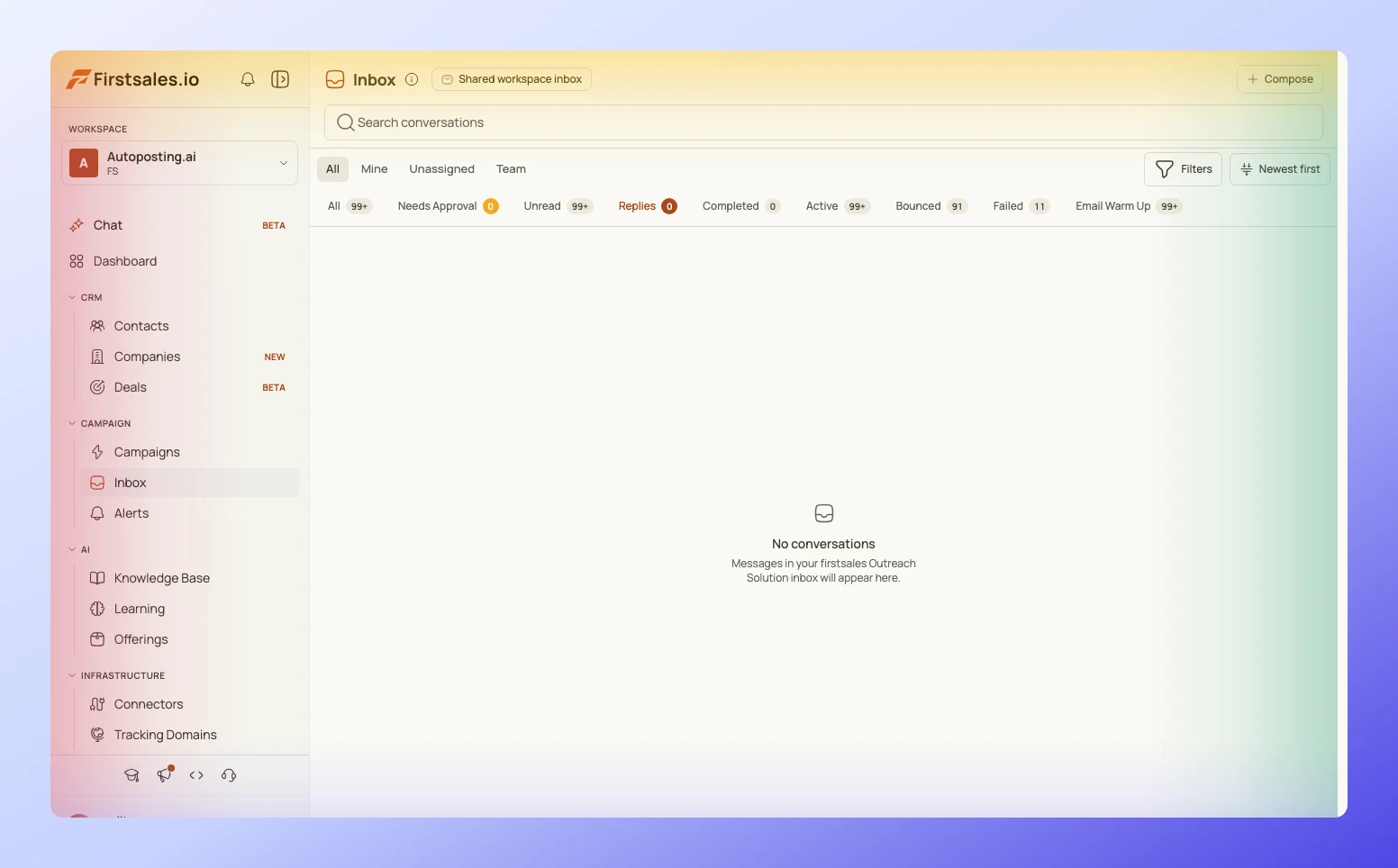 FirstSales reply analytics dashboard showing draft approval and reply outcome data
Comparing AI SDR platforms against AI-assisted SDR tooling is worth doing before locking a comp plan to a specific tool's output, because the two categories produce very different human workloads and therefore very different pay structures.
And before finalizing new variable targets, run the numbers through a real cost-per-opportunity model that includes the AI tooling spend, not just headcount cost. A comp plan that looks generous in isolation can still be cheaper per opportunity than the legacy plan it replaced, once tooling savings are counted.
None of this replaces good sales team management fundamentals. A bad comp plan on a well-managed team causes friction. A good comp plan on a badly managed team will not fix retention on its own.
Full transparency matters more here than in a normal comp change, precisely because "the AI does some of your job now" is a sentence that lands badly if a team hears it secondhand instead of directly from a manager who has already thought through what it means for their paycheck.
#FAQ
#Should SDR base salary go up or down when AI takes over research and drafting?
Base salary should stay roughly flat or rise slightly. Current 2026 US SDR base benchmarks sit at $55,000 to $65,000 for a solid offer. Cutting base to reflect "less work" ignores that the remaining work (judgment, error-catching, real conversations) is harder to hire for, not easier.
#What percentage of OTE should be variable in a hybrid AI SDR plan?
Most current SDR plans run a 70/30 base-to-variable split, with variable making up 30 to 40 percent of OTE. There is no evidence yet that hybrid AI teams need a fundamentally different ratio, though the metric variable is tied to should change.
#Is it fair to lower per-meeting commission if AI books more meetings?
It can be fair, but only if the total OTE stays roughly flat and the lower per-meeting rate is offset by a new bonus for the judgment work AI did not automate. Lowering the rate without adding a replacement variable component is a pay cut in disguise, and reps will read it that way.
#How do you stop reps from just approving every AI draft to farm volume?
Tie a meaningful share of variable comp to what happens after the send, not the send itself. A meeting-to-second-call rate or a deal-survival metric removes the incentive to approve low-quality drafts purely for volume credit.
#Can a two-person SDR team run a quality-weighted comp plan?
Not reliably. A quality rubric needs enough closed-deal history to calibrate against. Below roughly a few dozen closed deals, a simpler outcome-based model (pay on pipeline progression, not a subjective quality score) is more defensible.
#What happens to SDR headcount as AI takes over more of the pipeline?
Most hybrid teams reduce headcount per unit of pipeline, not necessarily total headcount, since account volume and territory size often grow at the same time. The role shifts toward fewer, more senior people doing more judgment-heavy work per account.
#Should AI tooling cost come out of the SDR comp budget?
No. Tooling cost and comp budget should be modeled separately, then compared together in a blended cost-per-opportunity figure. Folding tooling spend into the comp pool creates a false tradeoff between paying people and paying for software.
#Do accelerators still make sense in a hybrid plan?
Yes, but they should trigger on the harder-to-automate metric (deal progression, strategic account wins) rather than raw send or meeting volume, since volume accelerators are the easiest part of a plan for AI-assisted output to trivially clear.
#How often should a hybrid comp plan be revisited?
Quarterly for at least the first year. AI tooling capability is still shifting fast enough that a plan calibrated once and left alone for twelve months will likely be misaligned with actual workload by the second or third quarter.
#What is a human-catch rate and why does it matter for comp?
It is the rate at which a human reviewer flags and corrects a factual error, bad personalization, or risky claim in an AI-drafted email before it sends. It is a direct measure of the judgment work that comp should reward, because it is the one step in the pipeline that still clearly requires a person.
#Should junior and senior SDRs be paid differently in a hybrid model?
More so than before, since the gap between someone who can catch a subtle AI error and someone who cannot is now a bigger driver of output quality than raw hours worked. Compressing pay bands too tightly in a hybrid model tends to underpay the people doing the highest-leverage work.
#Does moving to AI-assisted outbound reduce total SDR compensation cost for the company?
Usually, but through fewer heads at similar or slightly higher per-head OTE, not through lower pay per person. Companies that try to cut per-person pay purely because AI does more of the work tend to see the best reps, the ones best at catching AI errors, leave first.
#How do you comp a rep who manages a strategic account list versus one running high volume?
Split the comp structure by tier. A strategic-account rep should be paid more like the research-plus-judgment split model, weighted toward account-plan quality and multi-threading, while a high-volume rep can run closer to a quality-weighted meeting bonus.
#What is the risk of an outcome-only comp plan with no activity bonus?
It can feel punishing during a slow pipeline month that is not the rep's fault, since there is no partial credit for solid activity that has not converted yet. It works best paired with a healthy base and clear communication about pipeline timing.
#Should commission be paid on meetings sourced entirely by an AI agent with no human research?
This depends on how much human judgment went into approving and correcting the draft. A meeting from a lightly-edited AI-drafted send still involved human review; a fully autonomous send with zero human touch is a different case and should carry a smaller commission, if any, reserved instead for the review-and-correction step.
#How do you explain a comp plan change to a team without triggering turnover?
Run the new plan in parallel for a full quarter, pay whichever plan is higher for each individual, and walk through the actual math with each rep using their own historical numbers, not a generic example.
#What is the biggest mistake companies make when redesigning SDR comp for AI?
Treating the change as a cost-cutting exercise instead of a metric-realignment exercise. The goal is to stop paying for volume that got cheap and start paying for judgment that stayed scarce, not to shrink the total pay pool.
#Does a hybrid comp plan need new CRM fields or reporting?
Usually yes, at minimum a way to flag whether a send was sent as-drafted or corrected by a human, and a way to tag which accounts received deep human research versus AI-only sourcing. Most teams build this incrementally rather than all at once.
#Are hybrid comp plans standard yet, or still experimental?
Still experimental. Given that roughly 22% of sales teams have fully replaced human SDRs with AI and about 45% run some hybrid model, but only around 2% report the change sticking cleanly, most companies are still iterating on comp structure alongside everything else about the role.
#Conclusion
The old SDR comp plan paid for effort that used to be the bottleneck: finding accounts, writing drafts, chasing replies.
AI now handles a meaningful share of that effort, which means a flat per-meeting rate increasingly pays for something that is no longer scarce.
The fix is not to slash pay. It is to move the variable dollars toward the parts of the job AI still cannot reliably do: judging fit, catching a bad claim before it reaches a buyer, and doing the account work that a strategic deal actually requires.
Keep base roughly where market benchmarks put it, somewhere around $55,000 to $65,000 with OTE in the $85,000 to $95,000 range, and redesign the variable component around judgment metrics instead of raw volume.
Run any new plan in parallel with the old one for a quarter before fully switching, and revisit it quarterly for the first year, because the tooling underneath the role is still changing faster than an annual comp cycle can track.
Pay for what is still hard. That has not changed. What counts as hard has.
Sources: