
TL;DR: Nobody reads 100% of AI-drafted outbound at scale, no matter what the sales page says. The real question is what percentage you review, at what stage, and for which risk tier, and most teams get this wrong by reviewing everything at low volume and almost nothing once volume climbs.
#The number nobody wants to say out loud
There is no universal correct review rate.
Anyone who tells you "review 20% of everything" without asking about your risk tier is guessing.
The honest range across teams running AI-assisted outbound at real volume sits between 5% and 100%, and it should move constantly as trust in the model builds or breaks.
New campaign, new prospect segment, or new claim in the copy: review climbs back toward 100% until the model proves itself again.
Established segment, boilerplate structure, low-stakes audience: review can drop to a spot check.
The mistake is picking one number and freezing it.
We wrote about the split between fully autonomous and human-checked outbound in AI-assisted vs autonomous outbound, and the review rate is the actual mechanism behind that 2.8x pipeline gap between AI-supported human teams and manual-only teams.
Teams that build a real review rate schedule outperform teams that pick a fixed percentage and never touch it again.
#Why 100% review always collapses
A human reading a cold email draft carefully, checking the claim, the personalization hook, and the tone, takes 45 to 90 seconds per email.
At 50 sends a day that is manageable.
At 500 sends a day that is 6 to 12 hours of pure reading, every single day, with no time left for actual selling.
Teams that start with "we review every single draft" almost always quietly stop within three to four weeks.
The stopping is never announced.
Someone gets busy, skips a batch, nothing breaks, and the habit of skipping becomes permanent without anyone deciding it should.
This is the exact failure mode behind why AI SDRs get blocked and behind a chunk of the 40-60% of AI SDR pilots that get paused or shut down inside 90 days.
The review process was never wrong on day one.
It was wrong on day thirty, when nobody rebuilt it for the volume it was actually running at.
If your review rate depends entirely on one person's bandwidth, you do not have a review process.
You have a bottleneck that happens to also catch some mistakes.
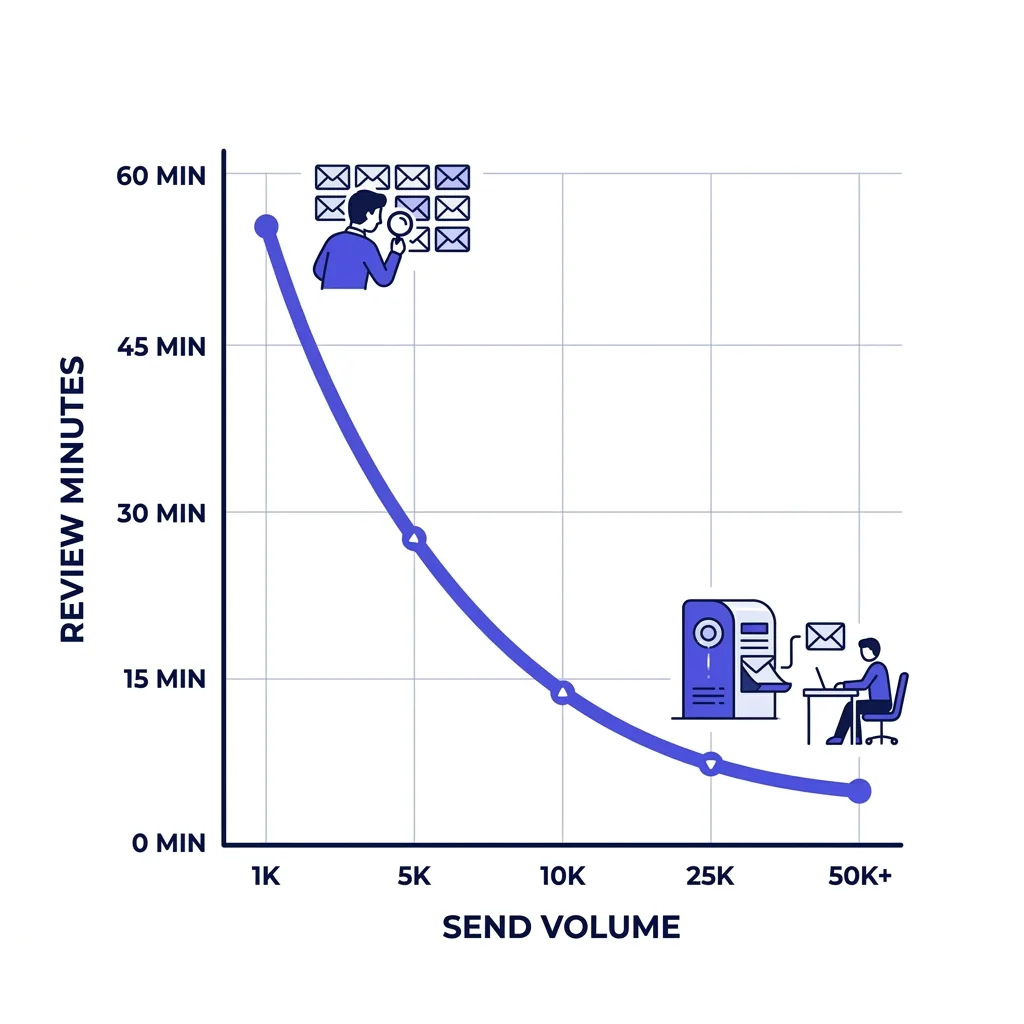 Chart showing human review time collapsing as AI email send volume increases
graph TD
    A[Draft generated] --> B{Risk tier}
    B -->|High: new segment, new claim| C[100% human review]
    B -->|Medium: established copy, new list| D[Stratified sample review]
    B -->|Low: proven template, warm segment| E[Spot check + automated gates]
    C --> F[Send]
    D --> F
    E --> F
    F --> G[Reply and bounce data feeds back]
    G --> B
#The three review models that actually work
Three models cover almost every real setup we have seen work past the pilot stage.
Full gate. Every draft gets human eyes before it sends. This is correct at launch, for any new claim, and for any account above a defined deal-size threshold. It is not correct forever.
Stratified sample. A fixed percentage of drafts get reviewed, but the percentage is not flat. New segments and new claim types get a higher sample. Proven templates on warm segments get a lower one.
Exception-only. Automated checks flag anything unusual (a claim without a source, a name mismatch, an unusual length), and a human only sees the flagged subset. Everything else sends on an automated pass.
Most mature teams run all three at once, split by segment.
A new vertical gets full gate.
A proven vertical with a stable template gets stratified sampling at 10-15%.
A high-volume, low-stakes segment (say, a re-engagement sequence to a cold subscriber list) runs exception-only, which we cover in more depth in cold subscriber list reactivation.
The mistake is running one model across every segment regardless of risk.
| Capability | Full gate | Stratified sample | Exception-only |
|---|---|---|---|
| Catches novel factual errors | ✓ | ✓ | ✗ |
| Scales past 500 sends a day | ✗ | ✓ | ✓ |
| Needs a defined risk tier first | ✗ | ✓ | ✓ |
| Depends on automated pre-screening | ✗ | ✗ | ✓ |
| Right fit for a brand-new segment | ✓ | ✗ | ✗ |
| Right fit for a proven template | ✗ | ✓ | ✓ |
#Risk tiers change the review rate
Not every email carries the same downside if it is wrong.
A generic "checking in" follow-up that is slightly off in tone costs you a reply.
A factual claim about a prospect's company that is wrong costs you the account and possibly a public complaint.
| Risk factor | Low risk | High risk |
|---|---|---|
| Claim type | Generic value prop | Specific fact about the prospect |
| Segment maturity | Proven, warm | New, cold, unproven |
| Deal size | Under $5k ACV | Enterprise, multi-year |
| Regulatory exposure | None | Healthcare, finance, legal |
| Personalization depth | Template with token fill | Deep research-based hook |
High-risk rows on this table push review toward 100%.
Low-risk rows can run at 5-10% sampling with automated gates doing the rest.
This is the same logic behind compliance sign-off, which we go into in compliance review for AI email: regulated claims do not get sampled, they get checked every time, full stop.
Deal size matters more than most teams admit.
A $200k enterprise account deserves full review on every touch. A $2k self-serve account does not, and treating them the same wastes review capacity on the accounts least likely to need it.
#Where review breaks even when someone is doing it
Review rate is only half the problem.
The other half is review quality, and it degrades in predictable ways even when someone is technically doing the job.
Reviewer fatigue. After roughly 40-60 minutes of continuous draft review, error catch rate drops noticeably. Reviewers stop reading and start pattern-matching against the last five emails they saw.
Approval drift. A reviewer who has approved 200 drafts in a row without rejecting one is not catching more good drafts. They have stopped actually evaluating and started rubber-stamping.
Wrong reviewer. The person reviewing needs to know the account and the claim being made. A generalist reviewer catches tone problems but misses factual errors about a specific prospect's business, which is the exact gap covered in ai reply misclassification from the other direction.
No feedback loop. Review that never gets fed back into the prompt or the eval set just repeats the same catch, over and over, without the model ever improving. This is the core argument in build an eval set for outbound AI, and it is the single biggest lever most teams skip.
A review process with a 100% coverage rate and none of these four fixed is worse than a 20% coverage rate with all four handled.
Coverage is the easy number to report to a manager.
Quality is the number that actually protects your domain and your deal pipeline.
#First touch versus follow-up: review rate should not be flat across a sequence
Most teams apply one review rate across an entire sequence, first email through fifth.
That is backwards.
The first email in a sequence carries the highest risk. It is the prospect's first impression, it usually contains the most research-based personalization, and it is the message most likely to include a specific claim about the prospect's business.
A follow-up two or three steps later is almost always shorter, more templated, and lower stakes. It references the earlier email rather than introducing new claims.
Splitting review by sequence position lets you run full review on step one and a much lighter sample, sometimes automated-only, on steps three through five.
This is one of the practical arguments behind human-in-the-loop cold email: the "loop" does not need to mean the same human checkpoint at every step, it means the checkpoint sits wherever the risk actually concentrates.
Teams that flatten review across a sequence end up either over-reviewing throwaway follow-ups or under-reviewing the one email that actually needed the extra pass.
Weighting review toward step one and easing off by step three typically cuts total review hours by 30-40% without any measurable increase in factual errors, since the highest-risk content was already getting the closest look.
#Sampling math: how many drafts you actually need to check
You do not need to read every draft to catch most systematic problems, and you do not need complex statistics to figure out a working sample size.
A simple working rule: to catch a defect that occurs in roughly 5% of drafts with 95% confidence that you would have seen at least one instance, you need to review about 60 drafts from that batch.
If your defect rate is closer to 1% (rarer, but still a real problem), that number climbs past 300 drafts to catch it with similar confidence.
This means a small daily batch of 50 emails cannot be meaningfully sampled. Review it in full or not at all.
A batch of 2,000 can be sampled at 3-15% and still catch systematic errors, the kind that show up across many drafts because of a bad prompt or bad data, rather than a one-off fluke.
The practical takeaway: below roughly 100-150 drafts a day, sampling does not save you real time, so review everything or automate the gate entirely.
Above that volume, a stratified sample by segment and risk tier catches almost everything a full review would, at a fraction of the hours.
#Building a review queue that does not rot
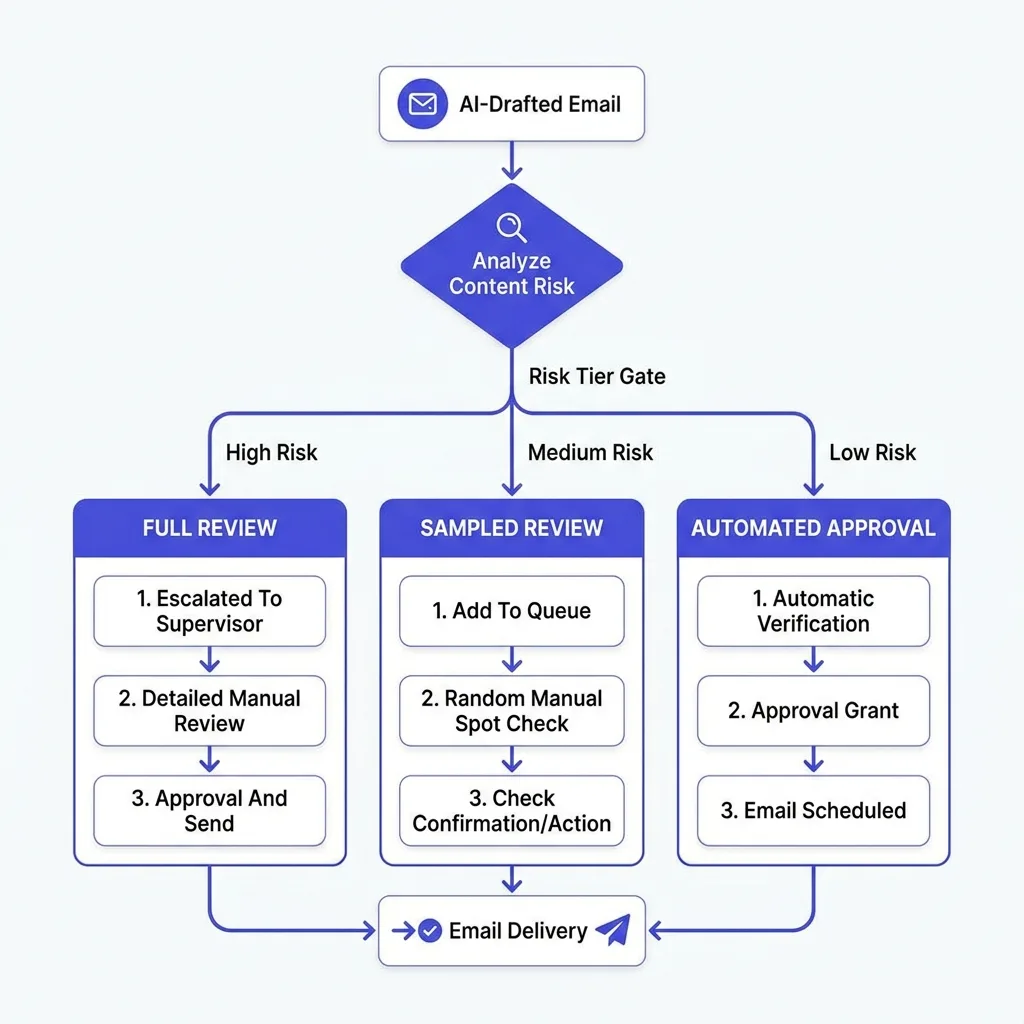 Diagram of a review queue routing AI drafts by risk tier to full review, sampling, or automated approval
A review queue that works six months from now needs three things a Slack channel with "please check this" does not have.
A defined SLA. Drafts sit in queue for a maximum window (say, 4 hours) before they either get reviewed or auto-escalate. Queues with no SLA grow silently until someone notices sends have stalled for two days.
A visible reject reason. Every rejected draft gets tagged with why: factual error, tone mismatch, wrong claim, personalization failure. Untagged rejections cannot feed back into the prompt.
A rotating owner, not a single person. One reviewer becomes the bottleneck and the single point of fatigue described above. Two or three people rotating through review keeps fresh eyes on the queue and prevents the approval drift problem.
Teams running this well typically report reject reasons weekly and adjust the prompt or the data source that keeps causing the same reject category.
That loop, reject reason to root cause to prompt fix, is what turns review from a cost center into something that actually raises draft quality over time.
Without it, you are paying reviewer hours to catch the same three mistakes every single week, forever.
#Where FirstSales fits into review
 FirstSales AI draft approval queue showing a pending email awaiting human review
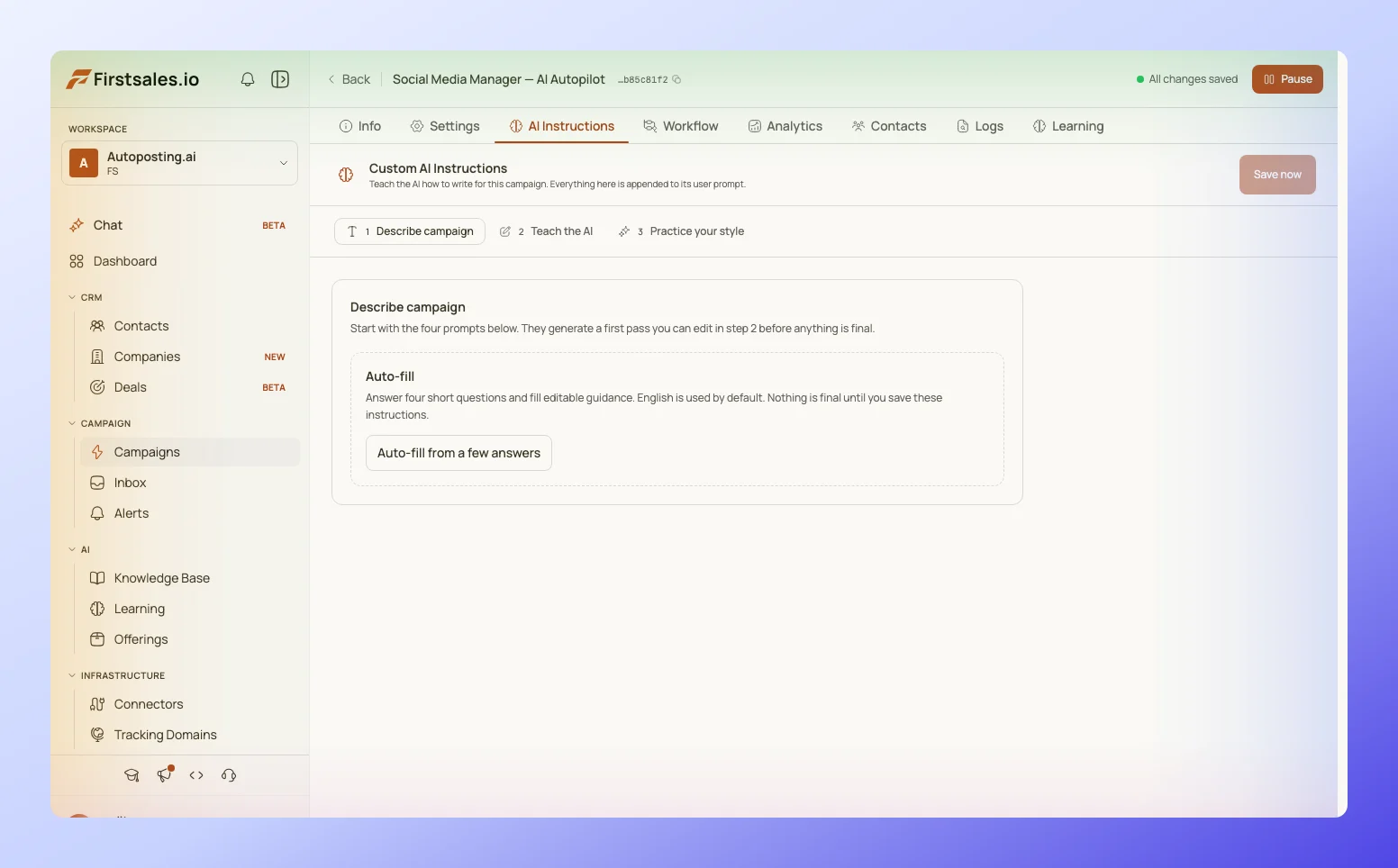
FirstSales builds the approval step into the sending pipeline itself, rather than treating review as a separate manual process bolted on afterward.
Drafts route to a human approval queue before send, with the option to set review coverage by segment, so a new list gets full review while a proven, warm segment can run on a lighter sampling pass.
The platform also flags drafts against automated checks (claim consistency, personalization token failures, length outliers) before a human ever sees the queue, which cuts review time per draft roughly in half for teams that have proven-out a segment.
That combination, automated pre-screen plus a tiered human queue, is what makes a 2,000-send day reviewable without turning one person into a full-time proofreader.
It does not replace judgment on the high-risk tier. It removes the low-value reading time so the judgment gets spent where it actually matters.
#What is overrated about human review
"Review everything" is the most overrated piece of advice in AI outbound, and it is overrated because it sounds responsible while being operationally impossible past a small volume.
A team that claims 100% human review at 1,000 sends a day is either lying, running reviewers to burnout, or not actually reading what they approve.
Also overrated: treating review rate as a fixed policy instead of a dial that moves with trust and risk.
The teams getting this right are not the ones with the highest review percentage.
They are the ones whose review percentage tracks measured error rate by segment, drops when the data proves a segment is safe, and snaps back to full gate the moment something changes, a new list, a new claim, a new market.
Review rate is a control system, not a compliance checkbox.
#FAQ
#What percentage of AI-drafted emails should a human review?
There is no fixed correct number. Review 100% for new segments, new claims, and high deal sizes, and drop toward 5-15% sampling only once a segment has a proven low error rate over real send volume.
#Does human review slow down an outbound campaign?
Full review adds real time, roughly 45-90 seconds per draft. Sampling and automated pre-screening cut that overhead substantially while still catching most systematic errors.
#What is the difference between human-in-the-loop and human review?
Human-in-the-loop usually means every draft passes through a person before sending. Human review is broader and includes sampling, exception-only checks, and periodic audits without gating every single send.
#How many drafts do I need to review to catch a systematic error?
To catch a defect occurring in about 5% of drafts with reasonable confidence, review roughly 60 drafts from that batch. Rarer defects around 1% need closer to 300 drafts sampled to catch reliably.
#Should review rate be the same across all campaigns?
No. Risk tier should set the rate. New segments, regulated industries, and large deal sizes need higher review coverage than proven, low-stakes, warm segments.
#What causes reviewers to stop catching errors over time?
Fatigue after 40-60 minutes of continuous review, and approval drift, where a long run of approvals without a single rejection turns review into rubber-stamping instead of actual evaluation.
#Can automated checks replace human review entirely?
Not for high-risk drafts. Automated checks are effective at catching structural problems (missing personalization, length outliers, claim inconsistency) but cannot judge tone, relevance, or whether a specific fact about a prospect is actually true.
#How do I know if my current review rate is too low?
Track your reject rate at your current sampling level. If it holds steady or drops as you widen the sample, your rate was already close to sufficient. If reject rate climbs sharply with a wider sample, you were under-reviewing.
#Does deal size matter for review rate?
Yes. Larger deals justify heavier review because the downside of a bad email is proportionally larger. Treating a $2k account and a $200k account the same wastes review capacity.
#What is exception-only review?
A model where automated checks flag unusual drafts (missing sources, name mismatches, length or tone outliers) and only the flagged subset reaches a human. Everything else sends on the automated pass.
#How often should review policy be updated?
Whenever a segment's error rate changes meaningfully, whenever a new claim type is introduced, or at minimum monthly, since prompt drift and data source changes can silently raise error rates between audits.
#What should a rejected draft log capture?
The specific reject reason (factual error, tone mismatch, wrong claim, personalization failure), not just a pass or fail. Untagged rejections cannot be traced back to a root cause in the prompt or data.
#Is a single reviewer enough for a growing campaign?
No. A single reviewer becomes both a bottleneck and a fatigue risk. Rotating two or three reviewers keeps error catch rates higher and avoids one person's blind spots defining the whole queue.
#How does review rate relate to AI SDR pilot failure?
A large share of paused or shut-down AI SDR pilots trace back to a review process that worked at pilot volume and quietly collapsed once volume scaled, without anyone redesigning it for the new load.
#Should compliance-sensitive industries sample review at all?
No. Regulated claims (healthcare, finance, legal) should get full review every time regardless of segment maturity, since the cost of one wrong claim outweighs any time saved by sampling.
#What is the biggest mistake teams make with review rate?
Picking one fixed percentage and never adjusting it, instead of treating review rate as something that should tighten or loosen based on measured error rate, risk tier, and how new the segment is.
#Can review rate be too high?
Yes, in the sense that reviewing a proven, low-risk segment at 100% wastes reviewer hours that could go toward a genuinely new or high-risk segment that needs the attention more.
#Does personalization depth affect review rate?
Yes. Deep, research-based personalization has more surface area for factual error than a template with a simple token fill, so it warrants a higher review rate even within an otherwise proven segment.
#How do reply and bounce data feed back into review policy?
Reply quality and bounce spikes are the clearest signal that an error rate has changed. A sudden drop in replies or a bounce spike on a segment that was previously sampled lightly is the trigger to move that segment back toward full review.
#What tools help manage a human review queue at scale?
Platforms that build the approval step into the send pipeline directly, with automated pre-screening and segment-level review settings, cut review time per draft compared to a manual review process bolted on outside the sending tool.
#Conclusion
There is no single correct human review rate for AI-drafted email, and any vendor or consultant handing you one flat number is skipping the actual work.
Start every new segment, every new claim, and every high-deal-size account at full review.
Drop toward stratified sampling only once the error rate on that specific segment has actually earned it, and build the reject-reason feedback loop that keeps the model improving instead of just catching the same mistake every week.
Review rate is a dial you adjust constantly, not a policy you set once and forget.