TL;DR: Most teams review AI-generated cold email for tone and typos, not for compliance risk. That gap is where the real exposure lives: false claims, missing opt-out mechanics, and no audit trail showing a human actually looked at what went out. This piece lays out who should sign off, what to log, and what a regulator or a legal team actually asks for when something goes wrong.
Table of contents
- Why compliance review is different from quality review
- What can go wrong in an AI-drafted email
- Who should sign off, by company size
- What to log, and for how long
- The review workflow
- What regulators actually check
- Where sampling review breaks down
- Building the checklist into the send pipeline
- What this costs versus what it prevents
- FAQ
- Conclusion
Every team that adopted AI drafting for cold email solved the same first problem: does this email sound like a person wrote it.
Almost none of them solved the second problem.
Does this email say something true, something the company can stand behind if a prospect forwards it to their legal department.
Those are different questions, and most review processes only ask the first one.
#Why compliance review is different from quality review
A quality review checks whether an email reads well. Grammar, tone, length, whether the hook lands.
A compliance review checks whether the email can get the company in trouble. Those are not the same checklist, and running one does not cover the other.
The confusion happens because both reviews often sit on the same person's desk. An SDR manager scans a batch of AI drafts, fixes an awkward sentence, approves the batch, and moves on.
Nobody assigned them to check whether the AI invented a customer count, claimed a certification the company does not have, or dropped the unsubscribe language a template was supposed to include.
The underlying legal question, whether the send was even permitted, matters just as much as what the email says. Our guide on whether cold email is legal in 2026 covers the baseline rules a compliance review should assume before it even gets to claim-level checking.
That is not a training failure. It is a role design failure. The job of catching tone problems and the job of catching legal exposure need different attention, and often a different person.
Our piece on human review rate for AI email covers how much output actually gets read before it sends. Compliance review is a subset of that read, but a stricter one, with a different failure mode if it gets skipped.
#What can go wrong in an AI-drafted email
Large language models are fluent, confident, and occasionally wrong in ways that read as completely plausible. That combination is the entire risk surface.
Here are the failure patterns that show up most often in AI-drafted outbound.
Fabricated specifics. The model invents a customer name, a percentage improvement, or a case study detail that does not exist, because the prompt asked for a concrete result and the model produced one anyway.
Overstated claims about the product. "Guaranteed to double your pipeline" is a promise a legal team would never approve in a human-written email. An AI draft can produce it without anyone noticing, because it reads like normal sales copy.
Missing required disclosures. CAN-SPAM in the US requires a working opt-out mechanism and a physical postal address in every commercial email. A template drift or a prompt change can silently drop one of these, and nobody catches it until a complaint arrives.
Implying a relationship that does not exist. Personalization based on scraped or inferred data can produce a sentence that implies the sender already talked to the prospect, follows their company closely, or has inside knowledge they do not actually have.
Regulated-industry language. Financial, healthcare, and legal services outbound has specific rules about what can be claimed or implied. An AI model with no domain guardrail will happily draft language a compliance officer in that industry would immediately flag.
Inconsistent factual claims across a sequence. Touch one says one number, touch three says a different one, because each draft was generated independently without a shared source of truth.
None of these are exotic. They are the direct consequence of a model optimizing for a persuasive, specific-sounding sentence, without knowing which specifics are real.
#Who should sign off, by company size
The right sign-off structure scales with team size and regulatory exposure. There is no single correct answer, but there is a wrong one: nobody with sign-off authority reviewing before send.
Solo founder or two-person team. The founder is the compliance reviewer. There is no one else. The discipline that matters here is a checklist, not a second person, because a checklist catches what a tired brain skips.
Small team, five to twenty reps. One person, usually the sales lead or an ops hire, owns compliance sign-off for every new template and every prompt change. Individual sends inside an approved template do not each need a human compliance check if the template itself was reviewed.
Mid-size team with a compliance or legal function. Legal or compliance signs off on templates and claim libraries, not individual emails. Sales ops owns the pipeline that enforces which claims are approved for use, and flags anything the AI generates outside that approved set.
Regulated industries: financial services, healthcare, insurance, legal. A named compliance officer signs off on every template before it goes live, and a sampling process reviews live output on a schedule, not just at launch. This is the one tier where "we reviewed it once" is not defensible if an examiner asks.
The pattern across all four tiers: sign-off happens at the template and prompt level, with sampling on live output, not a line-by-line read of every single email before it sends. That is the only version of this that scales past a handful of reps.
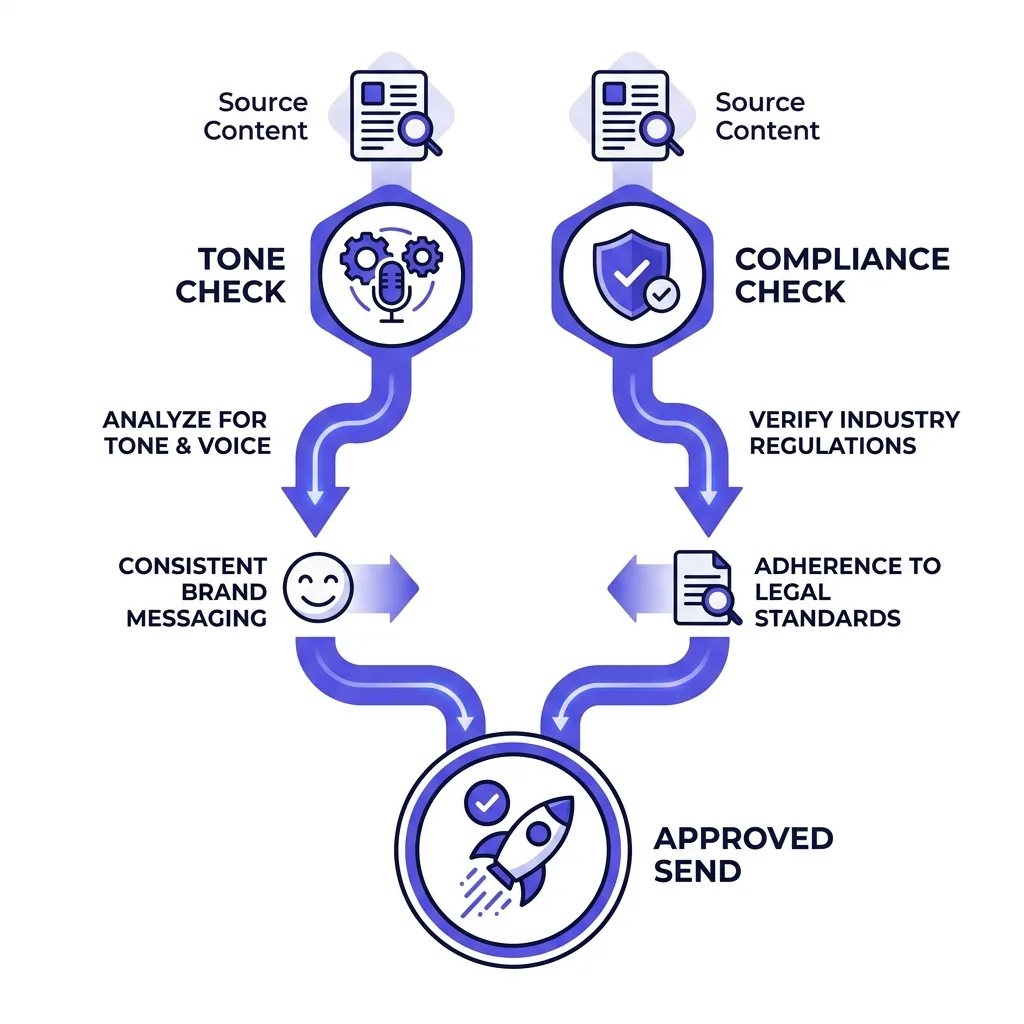 Diagram of tone review and compliance review as separate lanes feeding into one approved send
#What to log, and for how long
If something goes wrong, "we're pretty sure someone looked at it" is not an answer anyone wants to give.
Here is the minimum logging set that makes a compliance review defensible after the fact.
- The prompt or template version used, with a version number or timestamp, so you can reconstruct exactly what instructions produced a given email.
- The model and model version, since output behavior changes between model updates, and a claim problem introduced by a model update needs to be traceable to that update.
- Who approved the template, with a name and a date, not just "approved" as a status flag.
- The claims library the draft was checked against, if your process uses one, so a reviewer can see what was allowed at send time.
- Sample review records, showing which batches were spot-checked, by whom, and what was found.
- Opt-out and suppression list state at send time, proving the send respected an unsubscribe request that predated it.
Retention depends on your jurisdiction and industry, but a defensible floor is the length of your longest applicable statute of limitations for a deceptive-practices or spam complaint, which in most US contexts runs two to four years. Regulated industries often carry longer requirements set by their specific regulator.
The point of logging is not paperwork for its own sake. It is the difference between "we can show exactly what we approved and when" and "we hope our story matches what actually happened."
This is also where a human in the loop process earns its keep. A human touchpoint that leaves no record is barely different, from an audit standpoint, from having no human touchpoint at all.
#The review workflow
A workflow that actually gets followed needs to be shorter than the temptation to skip it. Here is a version that holds up without becoming its own bottleneck.
flowchart TD
    A[AI drafts email from template + prospect data] --> B{Claim check: does it match approved claims library?}
    B -->|Fails| C[Reject, flag for prompt fix]
    B -->|Passes| D{Required disclosures present?}
    D -->|Missing| C
    D -->|Present| E[Human spot-check: tone, accuracy, fit]
    E -->|Flagged| C
    E -->|Approved| F[Send]
    F --> G[Log: prompt version, approver, timestamp]
    G --> H[Periodic sample audit of sent batches]
The claim check is the step most teams skip, and it is the one doing the actual compliance work. Tone and fit checks catch awkward emails. Claim checks catch the ones that create legal exposure.
FirstSales runs approved drafts through a human approval step before send, with the draft, the source data it pulled from, and the reasoning it used all visible in one screen, so a reviewer is checking the actual claim trail rather than re-reading a wall of text from scratch.
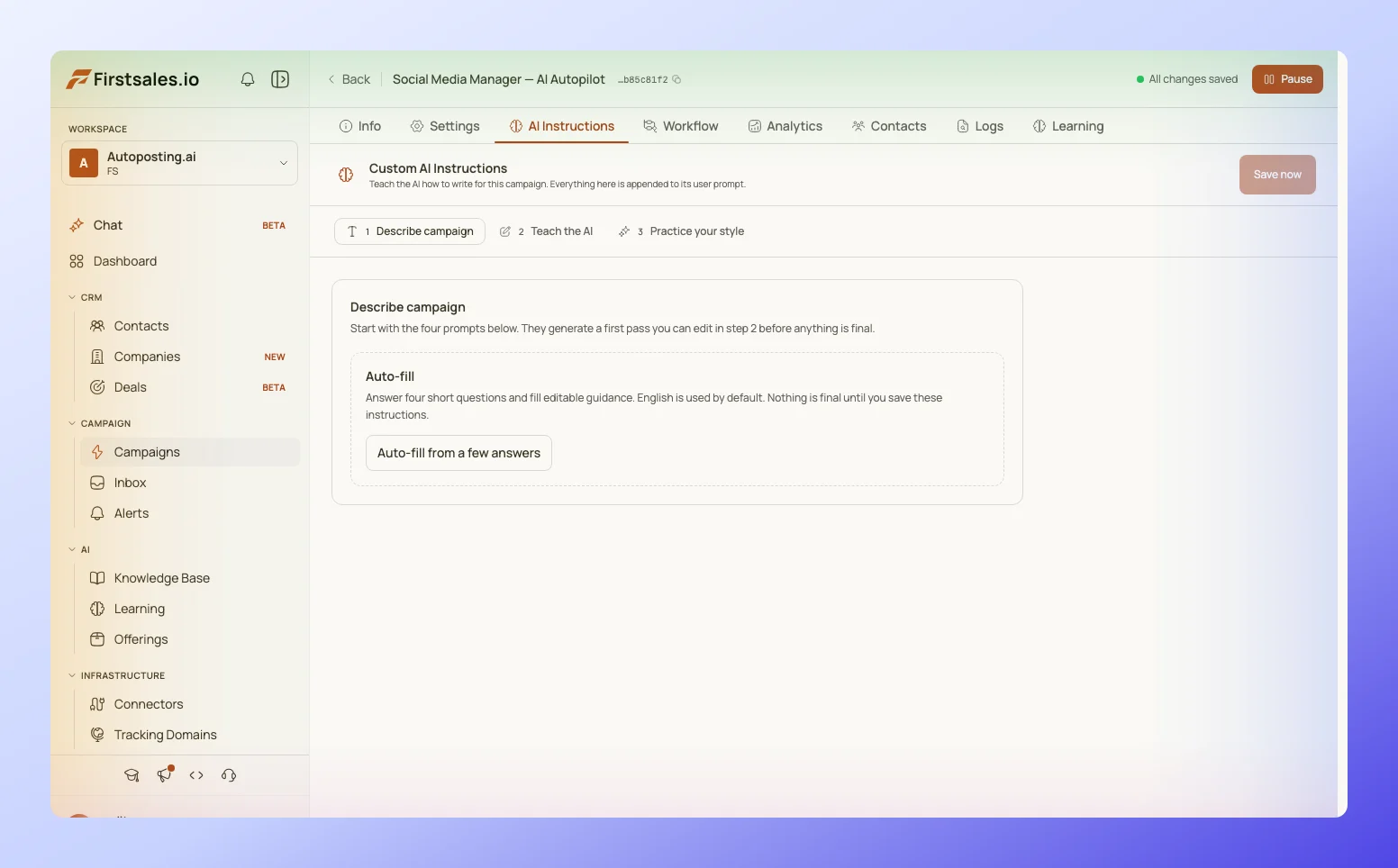 AI draft approval screen showing a generated email with source data and approve or edit actions
That visibility matters more than the approval click itself. A reviewer who cannot see where a claim came from is approving on faith, and faith is not a compliance control.
#What regulators actually check
Regulatory attention on AI-generated outbound is still forming, but the enforcement patterns that already exist give a clear signal of what gets checked.
The FTC's stance on AI claims. The US FTC has been explicit that AI does not create a new category of exemption from existing deceptive-practices law. A false claim generated by a model is still a false claim, and the company that sent it is still liable, not the AI vendor.
CAN-SPAM enforcement basics. Working opt-out, honored within the required window, a valid physical address, and no misleading subject lines. These requirements predate AI drafting entirely and do not change because a model wrote the copy.
GDPR and consent-based regimes. In the EU and UK, the compliance question is less about what the email says and more about whether you had a lawful basis to contact the recipient at all, and whether personalization used data the recipient would recognize as legitimately available to you. See our piece on cold email compliance penalties for how these penalties actually get applied in practice.
Disclosure of AI involvement. This is the newest and least settled area. Some jurisdictions are moving toward requiring disclosure when a consumer-facing communication was substantially AI-generated. B2B cold email sits in a gray zone here, but the direction of travel across most regulatory bodies is toward more disclosure, not less.
Data provenance for personalization. If a regulator asks where a personalization detail came from, "the AI found it" is not an answer. You need to be able to trace it to a specific, lawfully obtained source.
None of this is exotic once you list it out. The failure mode is not that the rules are unclear. It is that AI drafting makes it easy to generate volume faster than a compliance process built for human-written email can keep up with.
#Where sampling review breaks down
Sampling is the only realistic review model at any real volume, but it has known failure points worth naming honestly.
Sample size too small to catch rare but severe errors. A 5% sample catches the pattern that shows up in one in ten drafts. It will not reliably catch the pattern that shows up in one in two hundred, which is exactly the profile of a rare but serious fabrication.
Sampling the wrong stage. Reviewing templates at launch and never again means a prompt drift six weeks later, covered in our piece on AI SDR prompt drift, goes undetected until volume has already gone out under the drifted version.
Reviewer fatigue on repetitive batches. A person scanning the fortieth near-identical email in a sitting stops reading closely, which is precisely when a fabricated detail slips through unnoticed.
No mechanism to escalate a finding. A reviewer who flags a problem but has no clear path to pause the sending pipeline or fix the source prompt just watches the same error recur in the next batch.
The fix for all four is not more sampling volume. It is treating sampling as a detection layer for a specific, named failure mode, not a general-purpose safety net you can point to and say "we review things."
#Building the checklist into the send pipeline
A checklist that lives in a document nobody opens is not a control. A checklist enforced by the pipeline itself is.
| Control | ✓ Enforced in pipeline | ✗ Left to memory or a doc |
|---|---|---|
| Opt-out link present | Template validation blocks send without it | Reviewer has to remember to check |
| Claims match approved library | Automated diff against claims list | Reviewer eyeballs for anything that sounds off |
| Suppression list respected | System checks before every send | Manual list cross-reference |
| Prompt version logged | Attached automatically to every draft | Nobody records which prompt generated what |
| Sign-off recorded | Required field before batch releases | Verbal approval in a Slack thread |
| Physical address included | Template-level requirement | Assumed to already be in the footer |
The right side of that table is where most compliance failures actually happen. Not because anyone was careless, but because a step depended on a person remembering it under normal daily pressure.
Moving even three or four of these into the pipeline removes the most common single point of failure: a busy person on a Friday afternoon approving a batch faster than they meant to.
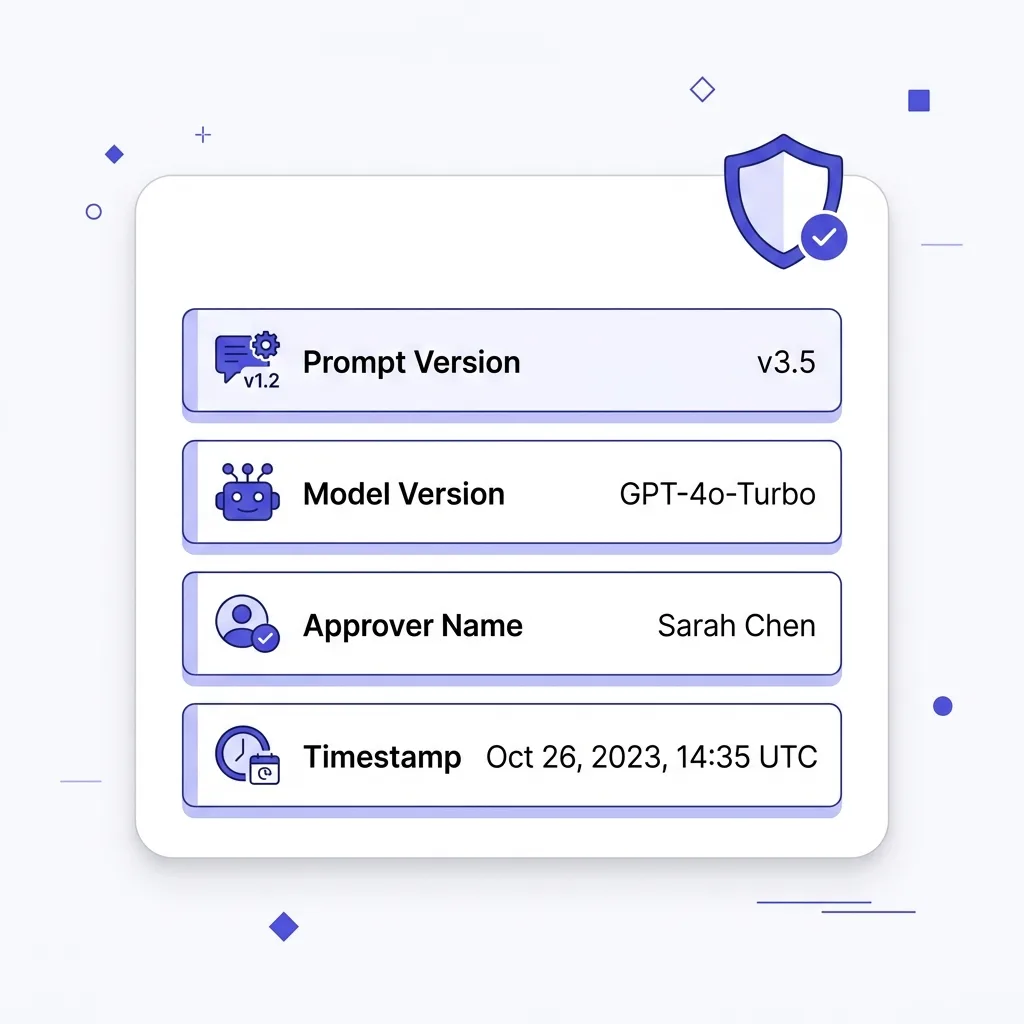 Audit trail card showing prompt version, model version, approver, and timestamp fields
#What this costs versus what it prevents
Building this review layer takes real time. A claims library needs to be written and kept current. A logging system needs someone to own it. A sign-off step adds friction to a pipeline that AI was supposed to speed up.
That friction is smaller than it looks against the alternative.
A CAN-SPAM violation carries per-email penalties that scale into real money at any meaningful send volume, and a pattern of violations invites more than a fine. It invites the kind of regulatory attention that makes every future campaign harder to run.
A fabricated claim that reaches a prospect who checks it costs something different: it costs the deal, and it costs the credibility of every future email from that domain, which compounds against the deliverability work covered in our cold email deliverability checklist.
The teams that get this right do not review every email. They build a pipeline where the risky failure modes are structurally hard to produce, and they spend their limited human attention on the sample that actually needs judgment rather than pattern-matching.
#FAQ
#Does AI-generated cold email need a legal disclaimer saying it was written by AI?
Not currently under US federal law for B2B cold email, but some state-level AI disclosure rules are emerging and a few jurisdictions in the EU are moving in that direction. Check your specific state and country requirements rather than assuming a blanket answer.
#Who is legally liable if an AI drafts a false claim in a cold email?
The sending company, not the AI vendor. The FTC has stated plainly that using AI does not create a liability shield for deceptive claims. The person or team who approved the send carries that responsibility internally.
#How often should a compliance officer review live AI email output, not just templates?
A monthly sample review is a reasonable baseline for most teams, moving to weekly in regulated industries or immediately after any prompt or model change.
#What is the minimum required disclosure in a US cold email under CAN-SPAM?
A working opt-out mechanism honored within ten business days, a valid physical postal address, and a subject line that does not mislead about the email's content.
#Can an AI model be trained to avoid making false claims automatically?
Prompt constraints and a claims library reduce the frequency significantly but do not eliminate the risk. A model constrained to only use pre-approved claims still needs a validation step, because a model can paraphrase an approved claim into an unapproved one.
#Does a small B2B sales team really need a formal compliance review process?
Yes, in a lighter form. A one-page checklist and a single named approver is enough at small scale. The mistake is having no named owner at all, not the size of the process.
#What happens if a prospect forwards a non-compliant AI email to their legal team?
At minimum, a lost deal and a data point the prospect's company may share internally about how you operate. At worst, a formal complaint that triggers a regulatory review of your sending practices.
#Should the same person review for tone and review for compliance?
They can be the same person, but they should use two separate checklists at two separate moments, because a compliance check run as an afterthought inside a tone check gets skipped under time pressure.
#How do you catch a fabricated case study or customer name before it sends?
A claims library that lists every approved customer reference, case study, and statistic, checked against the draft before send, either manually or through an automated diff.
#Is it a compliance risk if an AI infers something about a prospect that turns out to be wrong?
It is a quality and trust risk more than a compliance one, unless the incorrect inference implies a relationship, credential, or fact that misleads the prospect about who is contacting them or why.
#What should be in the audit trail for a single sent email?
The prompt version, the model version, the source data used for personalization, who approved the template, and the timestamp and suppression list state at send.
#Do compliance requirements differ between cold email and warm follow-up email?
Yes. Warm follow-ups to someone who has already engaged typically carry a stronger existing relationship, which changes the consent analysis in the EU and UK, though CAN-SPAM's mechanical requirements still apply to any commercial email in the US.
#How long should sent-email compliance logs be retained?
A defensible floor is two to four years for most US contexts, aligned with common statute-of-limitations windows, longer if a specific regulator in your industry sets a different requirement.
#Does using a third-party AI SDR platform shift compliance liability to that vendor?
No. Liability generally stays with the company that sends the email and controls the messaging, regardless of which tool generated the draft. Read vendor contracts carefully, since some allocate specific responsibilities contractually, but this rarely removes your own regulatory exposure.
#What is the biggest compliance mistake teams make when adopting AI drafting?
Treating the existing tone-and-quality review process as sufficient compliance coverage, when it was never designed to catch fabricated claims or missing disclosures in the first place.
#Should compliance review slow down send volume?
A well-built pipeline barely slows it down, because most checks move into automated validation at the template level. What it should slow down is how fast an unreviewed prompt change reaches full volume.
#Can sampling review actually catch a rare but severe fabrication?
Rarely, by design. Sampling is built to catch common patterns, not rare severe ones. Rare severe errors need a structural control, like a claims library check, not a bigger sample size.
#What role does the sales rep play in compliance review if AI drafts the email?
The rep who owns the account is often the best person to catch a wrong specific fact, since they know the prospect and the deal context better than a generic reviewer would.
#How does compliance review change once a company scales past one AI SDR into a full hybrid team?
The review shifts from checking individual output to auditing the system that produces output, because at scale no team can read every email, so the controls have to live in the pipeline itself.
#Conclusion
AI drafting did not create a new category of compliance risk. It just made the old risks easier to produce at higher volume, faster than most review processes were built to handle.
The fix is not slower sending or more manual reading. It is separating tone review from compliance review, naming an actual owner for sign-off, and logging enough that you can reconstruct exactly what happened if a prospect, a regulator, or your own legal team ever asks.
Teams running AI-assisted outbound through a platform like FirstSales get a head start here, since the approval step already surfaces the draft alongside its source data before anything sends.
That visibility is the actual control. The approval click is just where it gets recorded.