
TL;DR: AI SDR prompt drift is the slow decay of draft quality that happens after a system has been live for 60 to 90 days, driven by unreviewed prompt edits, stale examples, and small tweaks that never get tested against a baseline. You detect it with a scored sample of drafts pulled weekly, not by trusting your gut. You reset it by freezing the prompt, rebuilding the example set from recent won deals, and re-running the eval before you ship anything new.
#What prompt drift actually is
Prompt drift is the gap between the prompt you think is running and the prompt that is actually running, plus the gap between the examples the model was tuned against and the examples it now needs to handle.
It has two components, and most teams only think about the first one.
The first is literal prompt drift: someone edits the system prompt to fix one bad email, and that edit changes behavior on the other 40 email types the prompt also handles.
The second is context drift: the reference examples, the "here is what a good email from us looks like" block, get stale as your product, pricing, and ICP shift, and the model keeps writing against an outdated picture of your company.
Neither one announces itself. A single prompt edit rarely tanks quality on its own.
It is the accumulation, edit after edit, each one reasonable in isolation, that produces a system in month three that no longer resembles the one that got approved in month one.
#Why month two is the breaking point
Month one is honeymoon math. The system is new, someone is watching every draft, and the prompt has not been touched since launch.
Reply rates from a freshly launched, carefully tuned system tend to sit near the high end of what is achievable. Systematised AI-assisted campaigns are hitting 10 to 18% replies right now, well above the roughly 3.43% platform-wide average for 2026.
That gap between a tuned system and the average sender is real, and it is also fragile.
Somewhere around week six to nine, three things happen at once. The person who built the prompt stops reviewing every draft because volume has scaled past what one person can read.
A sales lead asks for "just one small change" to fix a specific complaint. And the initial example set, built from the first 20 to 30 hand-picked deals, starts to feel thin against a pipeline that has moved into new segments the prompt was never tuned for.
Each of those three is manageable alone. Together, they compound, and month two is roughly when the compounding becomes visible in your metrics.
graph TD
    A[Launch: tuned prompt, tight review] --> B[Week 2-4: volume scales, review loosens]
    B --> C[Week 4-6: first ad-hoc prompt edit]
    C --> D[Week 6-9: second and third edits, no re-test]
    D --> E[Week 8-12: examples stale against new segments]
    E --> F[Drift visible: reply rate falls, nobody can say why]
    F --> G[Reset: freeze, rebuild examples, re-eval]
    G --> A
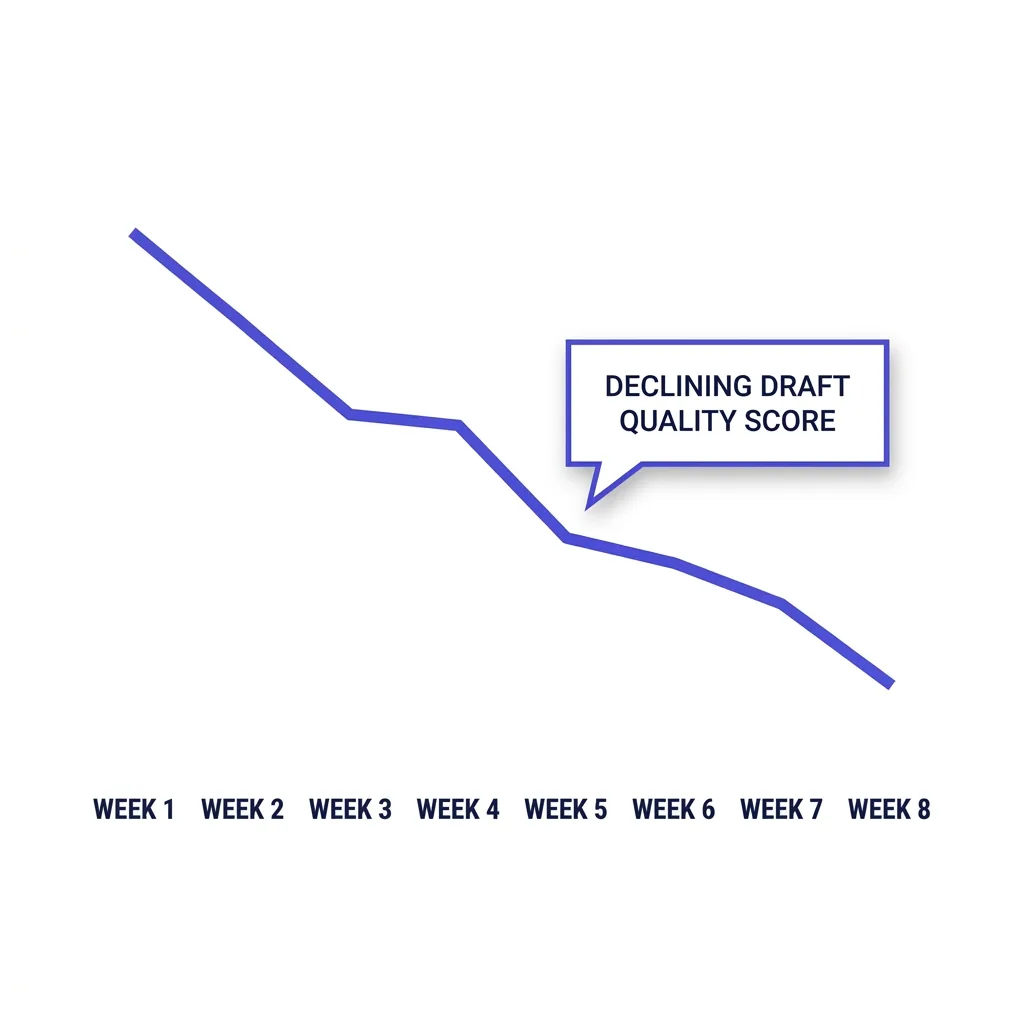 A dashboard showing a declining AI SDR draft quality score trend line over eight weeks
#The five causes of drift
Drift is not one thing. It is five separate failure modes that all produce the same symptom.
Uncontrolled prompt edits. Someone opens the prompt file, changes a sentence to fix a specific complaint, and ships it without testing against the other draft types it also touches. No version history, no before-and-after comparison.
Stale reference examples. The "write like this" examples baked into the prompt were pulled from your first month of deals. Eighteen months later, your product has two new tiers and the examples still reference the old one.
Training an AI SDR on your own won deals fixes this at the source, but only if the training set gets refreshed on a schedule, not once and forgotten.
Segment creep. The prompt was tuned for one ICP. Sales expands into a second vertical, feeds the same prompt new leads, and nobody adjusts the instructions for the new segment's vocabulary or pain points.
Model version changes. The underlying model gets upgraded by the vendor. Output tone, length, and personalization style can shift even when your prompt text stays byte-for-byte identical.
Feedback loop poisoning. Reps mark drafts as "good" or "bad" in a review tool, and that signal gets fed back into future prompt tuning. If review effort drops as volume scales, the feedback loop is now training on a smaller, less representative sample than it was at launch.
#How to detect drift before your reply rate tells you
Waiting for the reply rate to drop is the slowest, least useful detection method available, because by the time it moves, weeks of bad sends have already gone out.
A scored sample catches drift two to three weeks earlier. Pull 30 to 50 drafts every week, score them against a fixed rubric (specificity, claim accuracy, tone match, length), and plot the score over time.
Building an eval set from your own outbound turns this from a subjective spot check into a repeatable number you can trust week over week.
A flat or declining score line over three consecutive weeks is your earliest reliable drift signal, arriving well before reply rate or booked-meeting counts show any movement.
Watch these three secondary signals alongside the score.
Draft length creeping up or down more than 20% from baseline without anyone deciding to change it. Human edit rate rising, meaning reps are rewriting more of what the AI produces before sending. And claim specificity dropping, meaning drafts reference the prospect's company less often and generic categories more often.
| Signal | Healthy range | Drift warning |
|---|---|---|
| Eval score trend (3-week rolling) | Flat or rising | ✓ Stable |
| Human edit rate | Under 25% of drafts touched | ✓ Stable |
| Draft length variance | Within 20% of baseline | ✓ Stable |
| Claim specificity | Named detail in 80%+ of drafts | ✓ Stable |
| Prompt edit log | Every change tested pre-ship | ✓ Stable |
| Example set age | Refreshed within 60 days | ✓ Stable |
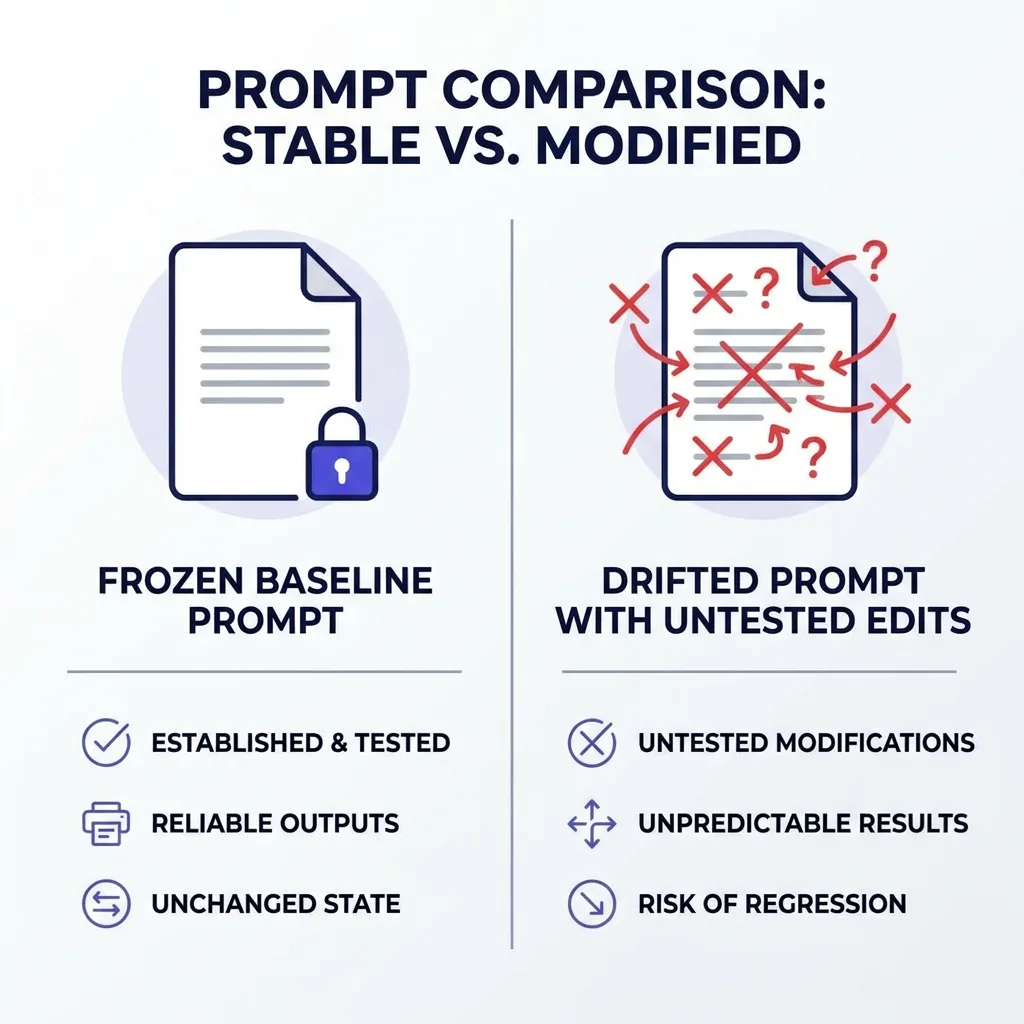 A comparison of a frozen baseline prompt against a drifted prompt with edit history flagged
#The reset process
A reset is not a rewrite from scratch. It is a controlled return to a known-good state, plus a rebuild of what actually went stale.
Start by freezing the current prompt. No further edits until the reset is complete, because editing a system you are actively diagnosing makes it impossible to know which change fixed what.
Pull the last 90 days of closed-won and closed-lost threads and rebuild the reference example set from the most recent 20 to 30 deals, not the original launch set. This is the same discipline covered in training an AI SDR on your own won deals, applied as maintenance rather than a one-time setup step.
Run the new prompt version against your eval set before it touches a real prospect. Compare the score to the frozen baseline. Ship only if the new version scores equal or higher on every dimension, not just the average.
Reintroduce human review at launch-week intensity for the first two weeks after any reset, even if volume has scaled past what that review level covered originally. Sample a fixed percentage instead of trying to read everything.
Setting the right human review rate matters more right after a reset than at any other point, because this is exactly when new failure modes surface.
Document every prompt change from this point forward with a date, the reason, and the eval score before and after. This single habit is the difference between catching the next drift cycle in week six instead of week twelve.
#What to freeze and what to keep flexible
Not every part of the system should be locked down equally hard. Some things need to move with the business. Others need to stay stable so you have a fixed point to measure against.
Freeze the core instruction structure, the sections of the prompt that define tone, length limits, and claim rules. These should change on a quarterly review cycle, not an ad-hoc one.
Keep flexible the reference examples and segment-specific context, refreshed on a rolling 60-day basis pulled from recent deals rather than a static library.
Freeze the eval rubric itself. If you change what "good" means every month, you lose the ability to compare month three to month one at all.
Keep flexible the human review sampling rate, which should flex up right after any prompt change and can taper down once two to three weeks of stable scores confirm the change held.
#Drift vs a genuinely bad prompt
These get confused constantly, and the fix for one makes the other worse.
A bad prompt from day one produces consistently poor output from launch. The eval score is low immediately and stays low. That calls for a rewrite, not a reset, because there is no "known good" state to return to.
Drift produces a declining trend from a genuinely good starting point. The eval score was fine at launch and degraded over weeks. That calls for the reset process above, because the fix already exists in your history.
Confusing the two wastes real time. Teams try to "reset" a prompt that was never good, which just restores a mediocre baseline. Or they rewrite a drifted prompt from scratch, throwing away months of tuning that only needed a fresh set of examples.
Post-mortems on shut-down AI SDR pilots consistently show teams misdiagnosing drift as a fundamentally broken approach and abandoning a system that a two-hour reset would have saved.
#What is overrated in prompt maintenance
Constant prompt tinkering is overrated. The instinct to open the prompt file every time one email looks off produces exactly the accumulation of small, untested edits that causes drift in the first place.
A stable prompt reviewed on a fixed cadence beats a prompt that gets poked weekly by whoever noticed the last bad draft.
Bigger models as a drift fix are also overrated. Swapping to a newer, more capable model does not fix stale examples or an untested edit history. It just adds a third source of behavior change on top of the two you already had, making the next drift cycle harder to diagnose.
And fully autonomous sends without any review checkpoint are overrated for exactly this reason. Unsupervised AI outbound removes the one signal, human eyes on a sample of drafts, that catches drift weeks before it shows up in aggregate metrics. The hybrid model where AI drafts and a human sends is not a compromise position. It is the detection mechanism.
Where a tool like FirstSales earns its place here is in making that review checkpoint cheap rather than optional. When draft approval is a fast in-line action instead of a separate export-and-review workflow, teams actually keep doing it past week two, which is exactly when most homegrown systems let review slide.
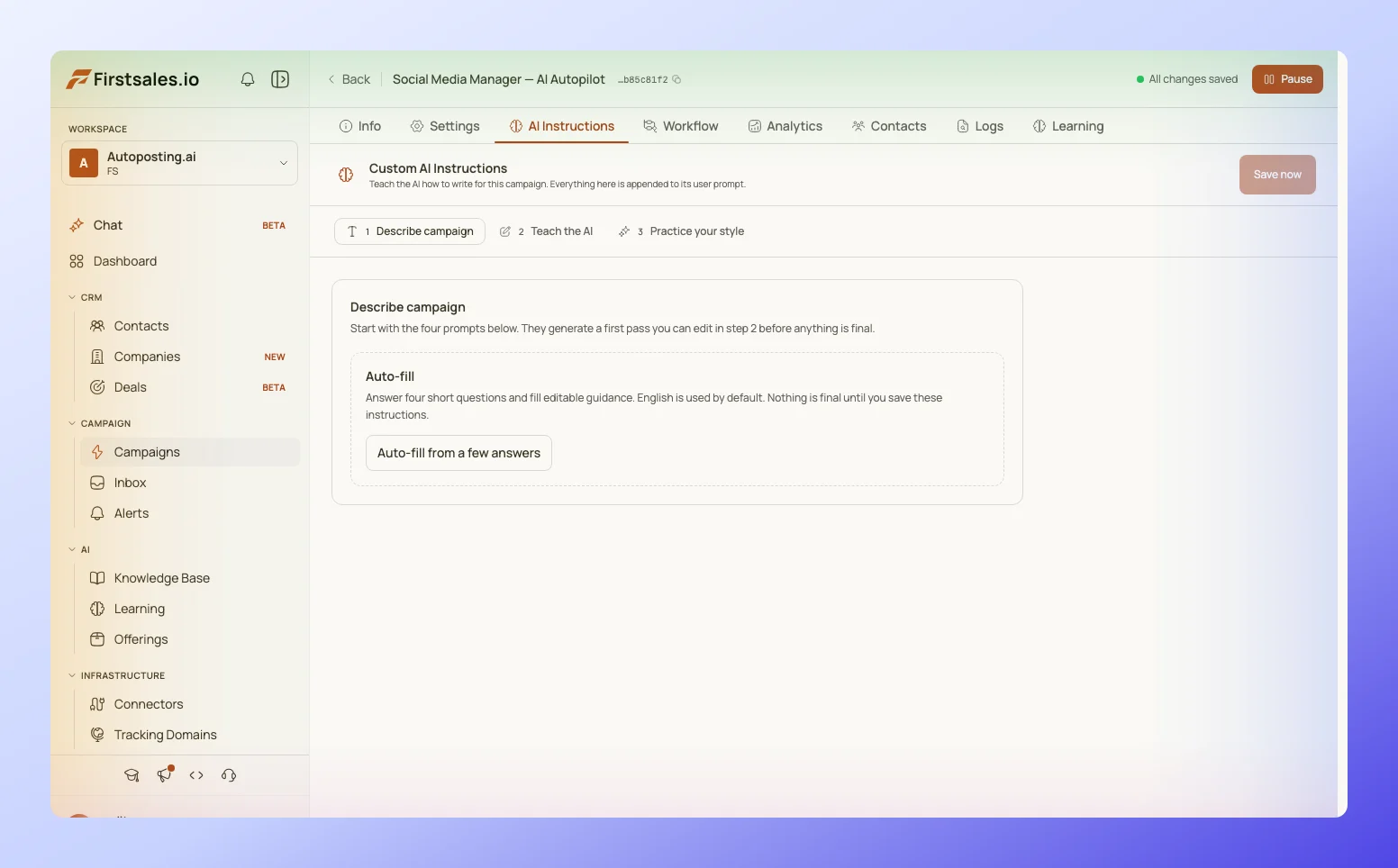 FirstSales AI draft approval screen where a human reviews and edits an AI-generated cold email before it sends
#FAQ
#What is AI SDR prompt drift?
AI SDR prompt drift is the gradual decline in output quality from an AI drafting system, caused by accumulated untested prompt edits, stale reference examples, and expanding use cases the original prompt was never tuned for.
#How long does it take for prompt drift to show up?
Most teams see the earliest signals in a scored eval sample around week four to six, with visible impact on reply rate or booked meetings appearing around week eight to twelve.
#Can prompt drift happen even if nobody edits the prompt?
Yes. Context drift, meaning stale examples and an expanding ICP the original prompt never covered, causes quality decline even with a byte-for-byte unchanged prompt file. A vendor model version upgrade can also shift output without any prompt change at all.
#How do I know if my AI SDR has drifted versus was just never good?
Check the eval score history. A prompt that scored well at launch and declined over weeks has drifted. A prompt that scored poorly from day one was never tuned correctly and needs a rewrite, not a reset.
#What is the fastest way to detect drift?
Pull 30 to 50 recent drafts weekly and score them against a fixed rubric. A three-week declining trend in that score is the earliest reliable signal, arriving before reply rate moves.
#Should I fix drift by editing the prompt again?
Not directly. Freeze the current prompt first, rebuild the reference examples from recent deals, test the new version against your eval baseline, then ship only if it scores equal or better.
#How often should reference examples be refreshed?
Every 60 days is a reasonable default for most B2B teams, tighter if your product, pricing, or ICP changes faster than that.
#Does upgrading to a newer model fix drift?
No. A model upgrade changes behavior on top of whatever drift already exists in your prompt and examples, which usually makes the cause harder to isolate rather than easier.
#Is drift a bigger risk with higher email volume?
Yes. Higher volume means fewer drafts get human eyes per capita, which is exactly the condition that lets small prompt problems compound unnoticed.
#What is the single best leading indicator of drift?
A three-week declining trend in your eval score, checked before reply rate or meeting count, because those downstream metrics lag the actual quality change by two to four weeks.
#Can drift happen to a fully human-written sequence too?
Less commonly, but yes, in a diluted form. Reps updating a template repeatedly without testing produces a similar slow decline, though it happens more slowly than with an AI system generating unique output per send.
#Should every prompt edit be tested before shipping?
Yes. An edit that fixes one bad draft can change behavior across every other draft type the prompt handles. Testing against your eval set before shipping is the single habit that prevents most drift.
#What is context drift specifically?
Context drift is when the reference examples, product details, or ICP description inside a prompt no longer match current reality, even though the instruction text itself has not changed.
#How many drafts should I sample for a weekly eval check?
30 to 50 drafts per week is enough to catch a meaningful trend without turning the review into a full-time job.
#Does a human review checkpoint actually catch drift, or just bad individual emails?
Both, but at different speeds. A human catches an individual bad email immediately. A scored sample over time catches the slower trend that a spot check on any single day would miss.
#What percentage of AI SDR pilots fail for reasons related to drift?
There is no published breakdown isolating drift specifically, but 40 to 60% of AI SDR pilots are paused or shut down within 90 days, a window that lines up closely with when drift typically becomes visible.
#Should I keep a changelog of prompt edits?
Yes. Date, reason, and eval score before and after each change. Without this, you cannot tell which edit in a chain of five caused a quality drop.
#Is a prompt freeze the same as never improving the prompt?
No. A freeze means edits go through a test-and-compare process before shipping, not that the prompt is permanently locked. Quarterly structural review plus rolling example refresh is a normal cadence.
#What role does the sales team play in causing drift?
Ad-hoc "just fix this one email" requests, made without running the fix through an eval, are one of the most common drift triggers, especially when they come from someone outside the team maintaining the prompt.
#Can drift explain a reply rate drop even when lead quality and market conditions stayed the same?
Yes, and it is worth ruling out before blaming the list or the market. If your segments and volume are stable but reply rate fell, a scored draft sample will usually show the quality decline before you need to look anywhere else.
#Conclusion
Prompt drift is not a dramatic failure. It is a slow one, built from edits that each looked fine on their own and examples that quietly stopped matching the business.
The fix is not more caution about touching the prompt. It is a scored eval sample checked weekly, a frozen rubric to compare against, and a habit of testing every change before it ships.
Teams that treat their AI SDR prompt like a piece of infrastructure, versioned, tested, reviewed on a schedule, catch drift in week six. Teams that treat it like a document anyone can edit catch it in week twelve, usually after the reply rate has already told them something was wrong.