#Why AI SDRs Get Blocked: The Deliverability Trap
Copy page
TL;DR: AI SDRs get blocked because they do exactly what spam filters are trained to catch - sudden volume spikes from cold domains, template-identical messages sent at machine cadence, zero inbox warmup, and complaint rates that blow past Google's 0.10% threshold inside weeks. The fix is not a better AI. It is a deliverability-first infrastructure with human oversight baked in from the start.
#Table of Contents
- The Promise vs. the Reality of AI SDRs
- How Mailbox Providers Actually Decide What Gets Blocked
- The Volume Spike Problem
- Template Cloning: Why Identical Emails Kill Domains
- No Warmup, No Reputation
- The 0.10% Spam Complaint Cap and Why AI SDRs Breach It Fast
- Domain Burn: The Monthly Tax on Lazy Infrastructure
- Authentication Gaps That Make It Worse
- The Behavioral Signal Problem
- How to Run AI-Assisted Outbound Without Getting Blocked
- FAQs
- Conclusion
#The Promise vs. the Reality {#the-promise-vs-the-reality}
The pitch for AI SDRs is seductive. Plug in your ICP, connect a few inboxes, let the bot prospect and personalize at scale while you focus on closing. No more grinding through lead lists at midnight.
No more copy-paste sequences. Revenue on autopilot.
Then, about three to six weeks in, something quietly breaks. Open rates crater. Reply rates drop to near zero.
You check your sending domain in Google Postmaster Tools and the reputation bar has turned red. A prospect forwards your email with a note that says it went to their junk folder. Another unsubscribes even though they never received anything - because Gmail auto-classified the message and moved it before they saw it.
This is not bad luck. It is a predictable, mechanistic outcome that plays out the same way for almost every team that deploys an AI SDR without understanding the deliverability infrastructure underneath it.
The fundamental problem is this: the behaviors that make an AI SDR "efficient" are precisely the behaviors that modern spam filters are built to detect and penalize. Volume, uniformity, speed, and lack of human touch are the four hallmarks of spam. They are also the four core features of an unchecked AI SDR pipeline.
Understanding why AI SDRs get blocked means understanding how filters work, why your domain reputation is fragile, what the 0.10% complaint cap actually means in practice, and why "set it and forget it" is not a cold email strategy - it is a domain cremation schedule.
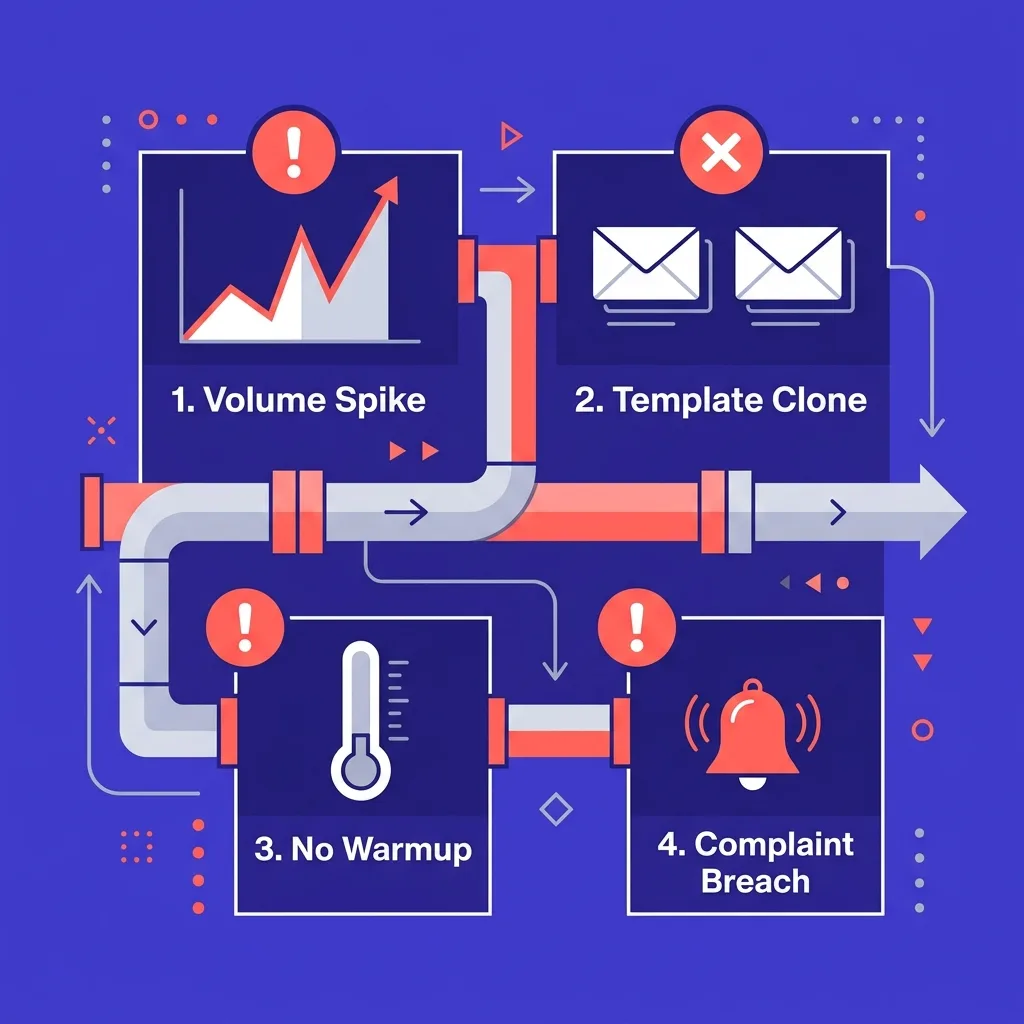 Diagram showing an AI SDR pipeline with four failure points: volume spike, template clone, no warmup, and complaint threshold breach
#How Mailbox Providers Actually Decide What Gets Blocked {#how-mailbox-providers-decide}
Before you can fix the problem, you need to understand the system you are operating inside. Gmail, Outlook, and Yahoo do not use a simple keyword blocklist. They run layered machine-learning models that evaluate hundreds of signals simultaneously.
The signals split into two broad categories: authentication signals and behavioral signals.
Authentication signals are the table-stakes requirements. SPF, DKIM, and DMARC records verify that the sending domain is legitimate and that the email has not been tampered with in transit. Since February 2024, Google has required SPF and DKIM for all bulk senders, with DMARC enforcement following shortly after.
Missing any of these does not just hurt your score - it can result in outright rejection at the gateway level before your message is ever processed.
Behavioral signals are where AI SDRs most reliably destroy themselves. These include:
- Sending velocity - How many emails does this domain send per hour, per day, and how does that compare to its historical baseline?
- Reply rate - Are recipients actually responding, or is the mail one-directional?
- Complaint rate - How often do recipients mark messages from this sender as spam?
- Engagement rate - Are messages being opened, or do they sit unread in inboxes?
- Bounce rate - What percentage of addresses are invalid or unreachable?
- Unsubscribe rate - Are recipients opting out at unusually high rates?
- Sending pattern consistency - Does the volume arrive in uniform machine-timed batches, or does it look like a human being at a keyboard?
Google's RETVec system, which improved Gmail spam detection by 38%, does not just read email text - it processes text as visual patterns, catching the mathematical signatures that large language models leave in generated content. The system processes more than 15 billion unwanted messages daily across Gmail alone. Your AI SDR is not operating in an obscure corner of the internet.
It is competing with adversarial actors who have been trying to beat these filters for years, and the filters have been trained on all of them.
Modern spam detection now analyzes over 60 distinct message features, including sentence rhythm, punctuation patterns, and lexical variety. A batch of 500 emails all generated from the same prompt, even with variable fill-ins for name and company, will produce a detectable statistical fingerprint. The messages look different to a human reader, but they look identical to a model reading the underlying language distributions.
#The Volume Spike Problem {#the-volume-spike-problem}
One of the fastest ways to get a sending domain blacklisted is to take it from zero to high volume overnight. This is exactly what happens when a team purchases an AI SDR subscription, connects their inboxes, imports a 10,000-contact list, and hits "start campaign."
Domain reputation is built over time through consistent, predictable sending patterns. Mailbox providers track the historical baseline of every sending domain. A domain that has been sending 20-30 emails per day for three months has established a pattern.
If that domain suddenly sends 500 emails in a single day, the anomaly triggers automated scrutiny. The provider does not know whether this is a legitimate business that suddenly got busy or a compromised account being used to blast spam. Because it cannot tell, it treats the spike as a risk signal and degrades inbox placement accordingly.
The safe recommended limit for cold outreach in 2026 is 30-50 emails per warmed inbox per day for well-aged domains. For new domains in their first four weeks, the ceiling is much lower - start at 5-10 per day and ramp up by 10-15 per week. The Google Workspace technical limit is 2,000 emails per day per account, but sending anywhere near that volume with a cold outreach configuration will land you in spam.
The technical limit and the safe operating limit are completely different numbers.
Analysis of 1.5 million emails found that AI-SDR-style sending pushed approximately 6.4 times the volume of manually-managed campaigns, at approximately 38% lower reply rates. More volume, worse outcomes, and accelerating domain damage all at once.
The right structure if you want to run autonomous cold email agents at scale is not one domain with one inbox maxed out. It is multiple warmed domains with multiple inboxes each, all sending at moderate volume, with sending spread across business hours rather than delivered in identical time-stamped batches.
Refer to our guide on email sending limits for the specific per-platform thresholds and how to stay within safe ranges across Google Workspace and Microsoft 365.
#Template Cloning: Why Identical Emails Kill Domains {#template-cloning}
Most AI SDR platforms generate emails by taking a base template and injecting personalization variables - name, company, industry, a line pulled from a LinkedIn profile or recent news. The structure, tone, sentence flow, and call-to-action are identical across every message in the batch.
This is a problem for two reasons.
First, spam filters flag high volumes of structurally similar email from the same sending source. When Gmail's systems detect that 400 messages sent from the same domain in the same hour share 85% of their text structure, they treat it as an indicator of bulk automated sending. This does not automatically mean your email goes to spam, but it contributes to a reputation score that trends downward over time.
Second, and more immediately damaging: recipients who receive these emails recognize the pattern and mark them as spam. Even if your "personalization" includes the recipient's first name and their company's recent funding round, a seasoned B2B buyer who receives dozens of AI-generated cold emails per week will identify the template underneath in under five seconds. When they hit "report spam" rather than just deleting the email, that complaint counts against your sending domain's complaint rate.
A handful of complaints from a single batch can push your rate above the 0.10% threshold that Google has set as the line between acceptable outreach and bulk spam.
The average cold email reply rate in 2026 has dropped to 3.43%, down from 5% the year before, and the decline is driven largely by inbox saturation from low-effort AI-generated outreach. Prospects are not just ignoring these emails - they are actively penalizing the senders.
A well-structured cold email personalization at scale approach does not use the same base template for every contact. It varies subject line structure, opening hook strategy, value proposition angle, and call-to-action format across different segments - not just the fill-in variables.
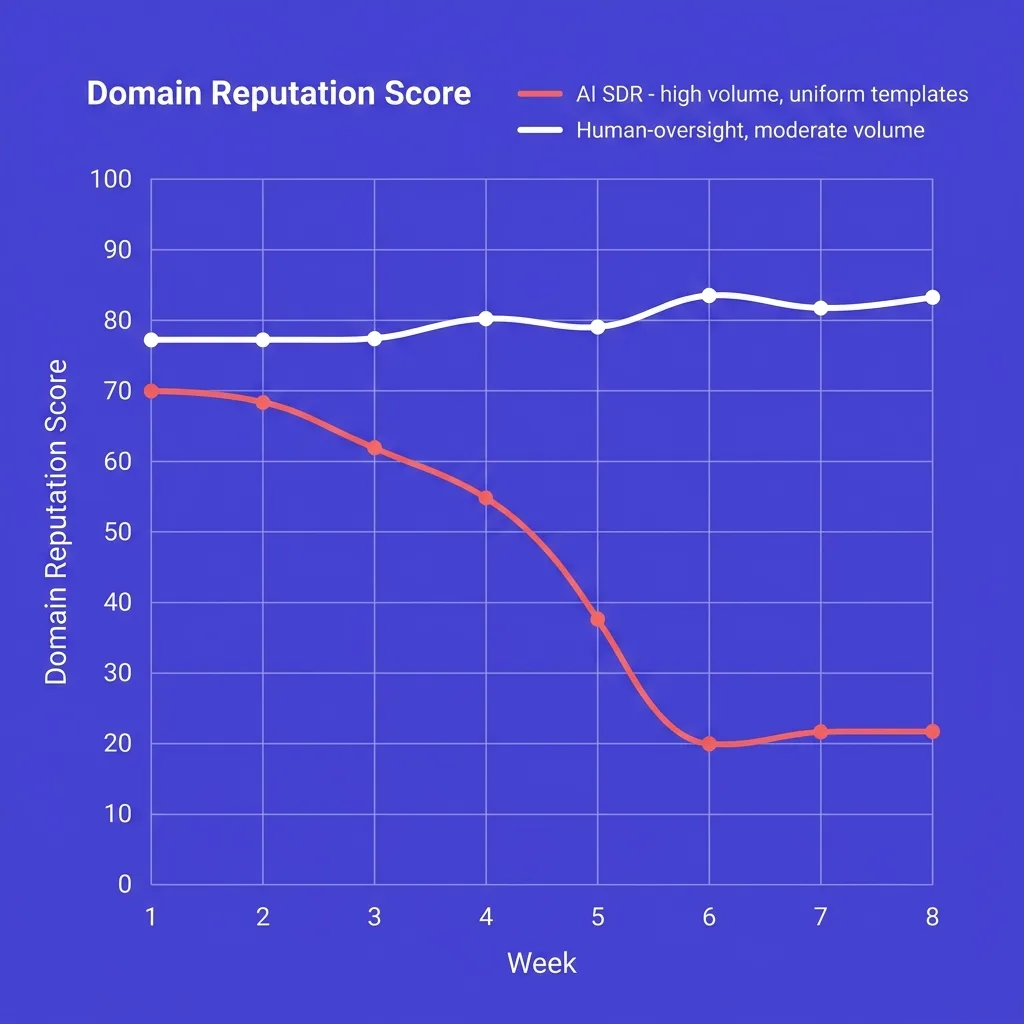 Chart showing domain reputation decline over time with high-volume identical sends vs. varied, moderate-volume sends
#No Warmup, No Reputation {#no-warmup-no-reputation}
Email warmup is the process of gradually establishing a sending reputation for a new domain or inbox by starting with low volume, high-engagement email exchanges and slowly increasing volume over four to six weeks. Without warmup, a new domain has no reputation history whatsoever - and in the world of inbox providers, no history looks exactly like a spam domain trying to fly under the radar before it gets blacklisted.
Many AI SDR deployments skip warmup entirely because it takes time and the vendor's onboarding flow does not require it. You connect your Google Workspace account, configure the sequences, and start sending. The tool does not warn you that your brand-new sending domain just went from zero emails to 80 per day on day one.
The recommended warmup ramp looks like this for a new inbox:
- Weeks 1-2: 5-10 emails per day
- Weeks 3-4: 15-25 emails per day
- Weeks 5-6: 30-40 emails per day
- Week 7 and beyond: 40-50 emails per day maximum for cold outreach
That is a 45-day minimum before you hit even moderate cold email volume. AI SDRs that skip this step start sending at 10x the safe volume from day one. The domain gets flagged, inbox placement drops below 85%, and every subsequent email - even the well-written ones - lands in spam.
The global average inbox placement rate is approximately 84%, according to Validity's 2025 Email Deliverability Benchmark Report, meaning roughly one in six legitimate cold emails never reaches an inbox even under normal conditions. An unwarm domain sending at AI-SDR volume can see inbox placement rates drop below 30% within two to three weeks.
#The 0.10% Spam Complaint Cap and Why AI SDRs Breach It Fast {#the-010-spam-complaint-cap}
This is the number that matters most in 2026, and most AI SDR buyers have never heard of it before their domain gets burned.
Google's bulk sender requirements - now in full enforcement following the February 2024 rollout and November 2025 tightening - require that senders keep their spam complaint rate below 0.10%. The recommended operating buffer is below 0.08% to give yourself headroom. The hard failure threshold is 0.30% - that is three complaints per 1,000 emails sent.
At 0.30%, Google will block your domain from Gmail delivery entirely.
To understand why AI SDRs hit this threshold so fast, do the math.
If your AI SDR sends 500 emails per day from a single inbox and just two people per day click "report spam," your daily complaint rate is 0.40% - already above the hard-failure threshold. Two complaints out of 500 sends. That is not a fluke.
With a generic, template-generated email going to a contact list that has not been scrubbed for engagement likelihood, getting two complaints per 500 sends is entirely realistic.
At scale - say, 2,000 emails per day across four inboxes - you need to stay below two total complaints per day to hold the line at 0.10%. One batch of emails to a bad list segment, one sequence that got forwarded to a spam-aware gatekeeper, one auto-classification by a corporate email filter that counts as a user complaint, and you are over the limit.
Read our deeper breakdown on spam complaint rate threshold to understand how Google calculates the rate, what counts as a complaint, and what does not.
Here is a comparison of how complaint rates accumulate across different outbound configurations:
| Configuration | Daily Volume | Complaints to Hit 0.10% | Complaints to Hit 0.30% |
|---|---|---|---|
| Manual SDR, targeted list | 50 emails/day | 0.05 (essentially zero) | 0.15 (essentially zero) |
| AI SDR, warm domain, curated list | 200 emails/day | 0.2 per day | 0.6 per day |
| AI SDR, cold domain, mass list | 500 emails/day | 0.5 per day | 1.5 per day |
| AI SDR, no warmup, 3 inboxes | 1,500 emails/day | 1.5 per day | 4.5 per day |
| Fully automated, max volume | 3,000 emails/day | 3 per day | 9 per day |
The problem is stark. A fully automated AI SDR running at scale needs to keep complaints to three or fewer per thousand sends, every single day, indefinitely. One segment of poor-fit contacts, one off-message sequence, one week of degraded targeting - and the domain goes red.
Check the Google bulk sender rules 2026 page for the complete enforcement timeline and what actions Google takes at each threshold level.
#Domain Burn: The Monthly Tax on Lazy Infrastructure {#domain-burn}
The end state of unchecked AI SDR sending is domain burn. This is when a sending domain's reputation degrades so severely that it can no longer reliably reach inboxes at any volume. The domain is not technically blacklisted everywhere, but its Google Postmaster reputation score is "Bad," its Outlook deliverability is compromised, and any email from that domain is treated with heavy skepticism by recipient servers.
Once a domain burns, recovery is slow and uncertain. You can try gradually rebuilding reputation by sending only to highly-engaged contacts at very low volume, but many teams find it faster and cheaper to retire the domain and start fresh with a new one. That means new domain registration, new DMARC/DKIM/SPF setup, new warmup period, new waiting period for domain age credibility - and then the cycle potentially repeats.
Research suggests that 10-20% of active sending domains degrade or become effectively unusable per month among teams running high-volume automated outbound without proper infrastructure. At that rate, a team running eight sending domains would lose one or two per month. If your AI SDR is burning domains faster than your ops team can spin up new ones, your outbound program is running at a deficit.
See our detailed breakdown of cold email domain burn rate for the mechanics of why domains die and the infrastructure approach that extends their useful life.
The unsupervised AI outbound pattern is the most common cause of domain burn. Read more about why unsupervised AI outbound creates compounding infrastructure damage that compounds over time.
#Authentication Gaps That Make It Worse {#authentication-gaps}
Even if your volume and complaint rate are within acceptable ranges, missing or misconfigured authentication records can single-handedly tank your deliverability. In 2026, SPF, DKIM, and DMARC are not optional for cold email. They are prerequisites.
SPF (Sender Policy Framework) tells receiving mail servers which IP addresses are authorized to send email on behalf of your domain. A missing or misconfigured SPF record means receiving servers cannot verify your email's legitimacy. This does not automatically mean spam folder, but it contributes to a lower trust score.
DKIM (DomainKeys Identified Mail) adds a cryptographic signature to outgoing email that allows recipients to verify the message was not tampered with in transit. Without DKIM, your email loses the authentication signal that proves it came from you and was not forged.
DMARC (Domain-based Message Authentication, Reporting, and Conformance) ties SPF and DKIM together by specifying what should happen to email that fails authentication. Google now requires a DMARC record for all bulk senders. Without one, your messages face automatic deliverability penalties even if your SPF and DKIM are correctly configured.
One-click unsubscribe is the fourth requirement Google enforces for bulk senders in 2026. Messages that do not include a functioning one-click unsubscribe mechanism - as specified by RFC 8058 - face reduced inbox placement. Most AI SDR platforms include this by default, but it is worth verifying, especially when using custom sending infrastructure.
Many AI SDR tools configure these records automatically during onboarding, but they configure them for the platform's shared infrastructure rather than your custom domain. Verify that DKIM alignment is correct and that your DMARC policy is set appropriately for your sending volume and risk tolerance.
#The Behavioral Signal Problem {#the-behavioral-signal-problem}
Authentication is the floor. Behavioral signals are what actually separates a well-regarded sender from one that gets filtered out. And behavioral signals are where AI SDRs are structurally disadvantaged.
Human-managed outbound creates natural variation. You write different emails on different days. You spend more time on one prospect and less on another.
You follow up after a delay because you were in a meeting. You reply to a response immediately because you were watching your inbox. This variation - the irregular cadence, the varying message length, the non-uniform sending times - looks like a human being to a machine learning model trained on the difference between human and automated senders.
AI SDRs create the opposite pattern. Emails go out at regular intervals. Subject line length distribution clusters tightly around the AI's preferred range.
Messages follow a predictable three-paragraph structure. Follow-ups arrive at exactly three or exactly seven-day intervals. The sending time distribution follows whatever schedule the tool defaults to, which often means a burst at 8:00 AM and another at 1:00 PM every weekday.
When a spam filter sees these patterns, it does not know whether you are a legitimate business doing a well-organized outreach campaign or a bot trying to look organized. It assigns risk based on the statistical correlation between these patterns and spam behavior in its training data. The more uniform and machine-like your sending behavior, the higher the risk score, and the lower your inbox placement.
The fix is deliberate variability. Send times should vary by 10-30 minutes around a target window, not batch-fire at a fixed time. Message lengths should vary by 15-25% across a sequence.
Subject line structures should rotate across your campaign. Follow-up intervals should include variation rather than a fixed cadence. None of this is hard to implement, but most AI SDRs do not do it by default.
This is also why the hybrid model - AI drafts the message, a human reviews and sends it - performs dramatically better than fully autonomous AI SDR deployments. The human review step introduces the kind of variation and judgment that keeps behavioral signals in the acceptable range. For more on why why cold emails land in spam, this behavioral signal problem is one of the primary mechanisms.
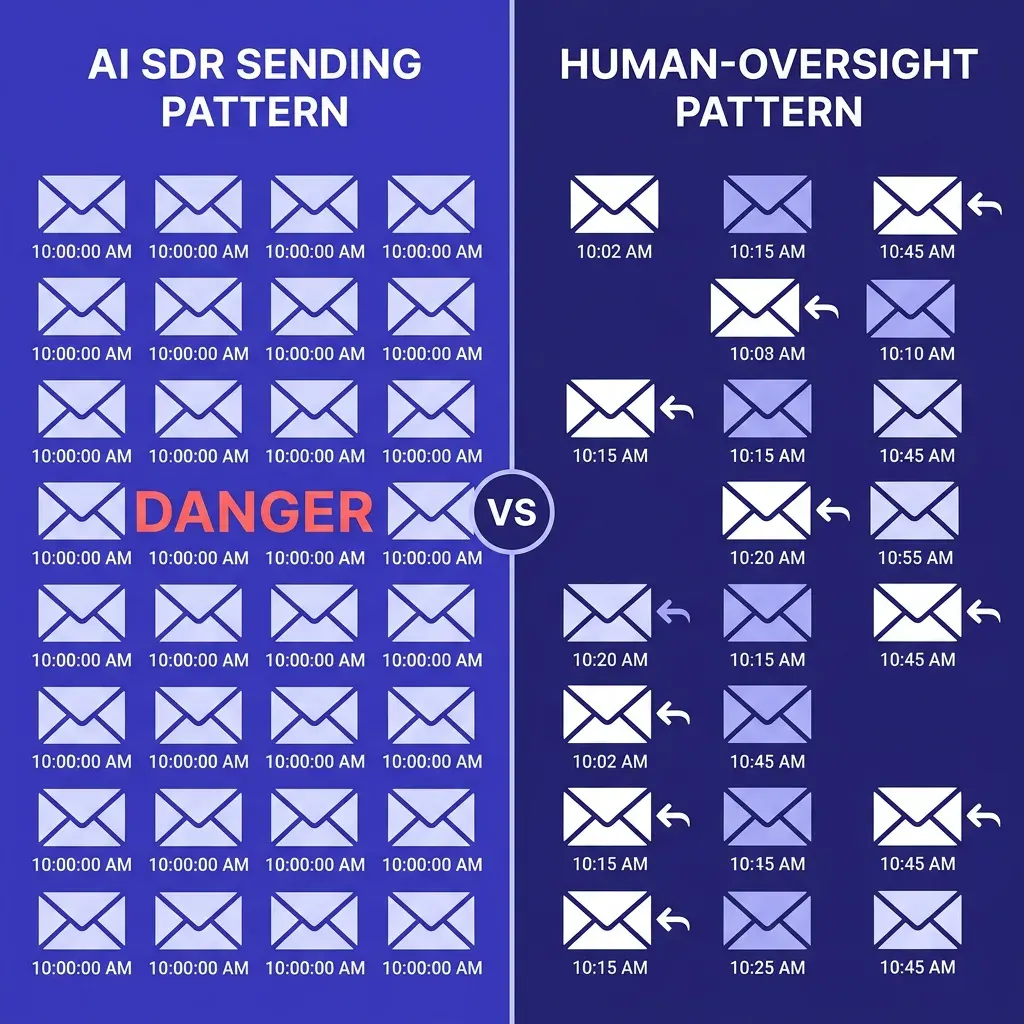 Infographic comparing behavioral signal patterns: AI SDR uniform machine cadence vs. human-variation cadence with natural timing spread
#How to Run AI-Assisted Outbound Without Getting Blocked {#how-to-run-ai-assisted-outbound}
The goal is not to avoid AI in your outbound process. AI genuinely accelerates prospecting, drafting, and personalization research. The goal is to use AI in the places where it helps without allowing it to drive the behaviors that mailbox providers penalize.
Here is the framework that works in 2026:
1. Build your sending infrastructure before you turn on automation
Register sending domains at least 30 days before your first campaign. Set up SPF, DKIM, and DMARC on every domain. Run a proper warmup that takes 4-6 weeks and ends with each inbox sending no more than 30-50 emails per day.
If you are using FirstSales's sending infrastructure, this is handled for you with automated warmup schedules and reputation monitoring built in.
2. Keep per-inbox volume in the safe range
The safe ceiling for cold email is 30-50 emails per warmed inbox per day. If you want more volume, add more inboxes and domains rather than pushing existing inboxes above their safe limit. A team sending 300 emails per day should be using at least six warmed inboxes across two or three domains.
3. Monitor your spam complaint rate in Google Postmaster Tools
Set up Google Postmaster Tools for every sending domain. Check your spam rate weekly. If it rises above 0.05%, pause sending to that domain and review your list quality and targeting.
Do not wait until you hit 0.10% to intervene - by then, damage has already been done to your domain reputation.
4. Use AI to draft, human to approve
Let the AI write first drafts and pull personalization signals from prospect data. Have a human review every draft before it sends - not to rewrite it entirely, but to apply judgment about fit, timing, and tone. This single step catches the off-target messages that generate complaints and introduces enough variation to keep behavioral signals in the human range.
5. Vary your sequence structure, not just the fill-ins
Rotate across at least three or four distinct email frameworks in your sequences. One might open with a question about a known pain point. Another might open with a relevant piece of company news.
A third might open with a peer-comparison observation. The body structure should genuinely differ, not just swap the company name and call-to-action.
6. Clean your list before every campaign
Verify every email address before sending. Bounces above 2% degrade domain reputation quickly. Use an email verification service to remove invalid addresses, role-based addresses (info@, support@), catch-all domains that might not deliver, and contacts who have previously complained or unsubscribed.
7. Respect unsubscribes instantly
One-click unsubscribe must function correctly and process instantly. A recipient who unsubscribes and then receives another email is extremely likely to report spam. That complaint is preventable.
#FAQs
#Why do AI SDRs get flagged by spam filters even when the emails look legitimate?
Spam filters do not just evaluate content - they evaluate behavioral signals including sending volume, cadence uniformity, complaint rate, and domain reputation history. AI SDRs trigger these behavioral signals by sending at machine speed, in uniform batches, from domains with no warmup history, often at volumes that exceed what mailbox providers consider safe for cold outreach. The content might be legitimate, but the pattern looks like spam.
#What is the 0.10% spam complaint rate and how does it affect my AI SDR?
Google's bulk sender rules require senders to keep their spam complaint rate below 0.10% - that is one complaint per thousand emails sent. The recommended buffer is below 0.08%. At 0.30%, Google will block your domain from Gmail delivery.
AI SDRs running at high volume with broad lists can hit this threshold in a matter of days if even a small fraction of recipients mark messages as spam. Two complaints per 500 sends is already a 0.40% rate.
#How many emails per day can an AI SDR safely send from one inbox?
The safe ceiling for cold outreach from a warmed inbox is 30-50 emails per day. Some sources cite up to 100 on well-aged, reputation-clean domains with strong engagement history, but 50 is the conservative ceiling for most outbound programs. Going above this - especially without warmup - triggers deliverability issues even with perfect authentication.
For higher volume, use multiple inboxes across multiple domains.
#Does email warmup actually solve the AI SDR deliverability problem?
Warmup is necessary but not sufficient. Warmup builds domain reputation so that when you start sending cold outreach, you start from a position of credibility rather than zero. But warmup does not protect you from high complaint rates, template-identical messages, bad lists, or sending above the safe daily volume.
It is the foundation, not the full solution.
#Can AI SDRs learn to avoid triggering spam filters over time?
Current AI SDR platforms do not autonomously adapt their sending behavior in response to deliverability feedback in real time. They send according to configured rules. The human operator needs to monitor Google Postmaster Tools, watch inbox placement rates, review complaint signals, and adjust configuration accordingly.
This is why human oversight is not optional - it is the feedback loop that keeps the system within safe operating parameters.
#What happens to a domain once it gets blocked by Gmail?
A blocked domain faces permanent rejection of messages to Gmail addresses, not just spam-folder relegation. Some blocks are temporary and lift after complaint rates return to safe levels for a sustained period. Others, particularly for domains with sustained 0.30%+ rates, result in permanent reputation damage that is effectively unrecoverable.
Many teams retire burned domains and start fresh, which means losing the domain age credibility that contributes to reputation scores - creating a compounding cost.
#Conclusion
The deliverability trap that catches AI SDRs is not complicated, but it is rarely explained clearly before purchase. These tools are marketed on output - emails sent, leads contacted, pipeline generated. The infrastructure reality underneath is left to the buyer to figure out, usually after the first domain burns.
The mechanics are consistent: no warmup means no reputation, high volume means instant scrutiny, template-identical messages mean detectable behavioral fingerprints, and complaint rates above 0.10% mean Google starts blocking your domain before most of your prospects ever see your email. Why AI SDRs get blocked comes down to the same four failures repeating across every underprepared deployment.
The teams that make AI-assisted outbound work in 2026 treat deliverability as infrastructure, not an afterthought. They warm every inbox. They keep per-inbox volume under 50 per day.
They monitor Postmaster Tools weekly. They use AI to draft and humans to approve. They rotate sequence structures, not just fill-in variables.
They clean their lists before every campaign.
If you want to run your first deliverability-safe campaign this week without rebuilding your infrastructure from scratch, start with FirstSales for $1 and get access to pre-warmed sending infrastructure, built-in complaint rate monitoring, and human-in-the-loop review flows that keep your domains clean while your AI SDR does the heavy lifting. Start at app.firstsales.io.