
#Email sunset policy: when deleting subscribers helps deliverability
Copy page
TL;DR: An email sunset policy automatically moves subscribers who stop engaging out of your regular send list, and eventually suppresses or deletes them, before they drag down sender reputation. Under 2026 bulk sender rules from Google, Yahoo, and Microsoft, a bloated list of unengaged addresses hurts every campaign on the domain, not just the ones sent to those addresses. Deleting the wrong subscribers feels like giving up. Keeping them costs you deliverability for everyone else.
More subscribers used to mean more reach. In 2026, more subscribers can mean worse deliverability.
Gmail, Yahoo, and Microsoft now weight engagement heavily in deciding where mail lands. A domain sending to a large share of unengaged addresses looks like a lower-value sender, and that judgment applies across the whole domain, not just the specific send to cold contacts.
A sunset policy is the fix: a rule-based system that identifies dormant subscribers, gives them one last chance to re-engage, and removes them if they do not. This guide covers how to build one, what windows to use, and the mistakes that turn a sunset policy into an accidental list-shrinking disaster.
#What you will learn
- Why sunset policies matter more under 2026 sender rules
- What a sunset policy actually does
- Choosing the right engagement window
- The 3-stage sunset flow
- Sunset policy models compared
- Setting up automated sunset rules
- Segmenting engaged from unengaged correctly
- Exceptions: who should not be sunsetted
- Sunset policy vs full list reactivation
- Measuring the impact of a sunset policy
#Why sunset policies matter more under 2026 sender rules {#why-it-matters}
Google and Yahoo's bulk sender requirements set a hard floor: spam complaint rates under 0.3%, bounce rates under 2%, and correctly configured SPF, DKIM, and DMARC. Miss any of these and deliverability drops across the entire sending domain.
Unengaged subscribers push a sender toward those limits from multiple directions. They are statistically more likely to mark mail as spam out of irritation or forgetting they signed up. Their addresses are more likely to have become invalid or abandoned, driving up bounce rate. And their lack of opens or clicks lowers the domain's average engagement score, which inbox providers use as a proxy for whether your mail belongs in the primary inbox at all.
A sunset policy removes that drag before it accumulates. Waiting until a deliverability problem shows up in the numbers means the damage is already done. A proactive sunset policy prevents the problem instead of reacting to it.
Consider what happens without one. A list grows steadily for three years, gathering new subscribers every month, but nobody ever removes the ones who stopped engaging. By year three, a meaningful share of the list is effectively dead weight, invalid addresses, abandoned mailboxes, subscribers who forgot they ever signed up. Every campaign now sends to that dead weight alongside the genuinely engaged core, and inbox providers read the blended engagement rate, not just the rate among people who actually care. The result is a slow, often invisible decline in inbox placement that many teams misattribute to content quality or subject line performance, when the real cause is a list that was never pruned.
#What a sunset policy actually does {#what-it-does}
Definition block: An email sunset policy is an automated rule set that identifies subscribers who have not engaged within a defined window, attempts a final re-engagement, and then moves non-responders to suppression or deletion, removing them from regular sends permanently.
It is not the same as a one-time list cleanup. A cleanup is a manual, occasional event. A sunset policy runs continuously, catching newly-dormant subscribers as they cross the inactivity threshold, month after month, without requiring a manual project every time.
The three outcomes a sunset policy produces:
- Reactivated subscribers who respond to the final re-engagement attempt and return to the active list
- Suppressed subscribers whose records are kept but who receive no further mail
- Deleted subscribers whose records are removed entirely, typically after an extended suppression period
#Choosing the right engagement window {#engagement-window}
The right window depends on how often you send. A weekly newsletter and a quarterly product update need very different definitions of "gone quiet."
| Send frequency | Suggested sunset trigger | Rationale |
|---|---|---|
| Daily or multiple times weekly | 60-90 days no engagement | High frequency means dormancy shows up fast |
| Weekly | 90-120 days no engagement | Standard window for most newsletters |
| Monthly | 180 days no engagement | Lower frequency needs a longer observation period |
| Quarterly or seasonal | 12 months no engagement | Infrequent sends require patience before declaring someone cold |
Do not copy another company's window blindly. A B2B newsletter sent weekly to a niche technical audience will have different natural engagement rhythms than a consumer ecommerce list sent three times a week. Pull your own engagement decay curve (the rate at which opens and clicks drop off after signup) and set the window where the curve clearly flattens out.
To build that curve, chart weekly or monthly click rate against subscriber tenure for a large cohort, say everyone who joined in the same quarter a year or two ago. Most lists show a sharp early decline followed by a long, flatter tail. The point where the curve flattens, where remaining subscribers are either consistently engaging or consistently not, is a defensible place to set your sunset trigger. Setting the window earlier than that point risks removing subscribers who were still in a normal early decline, not genuinely gone.
#The 3-stage sunset flow {#sunset-flow}
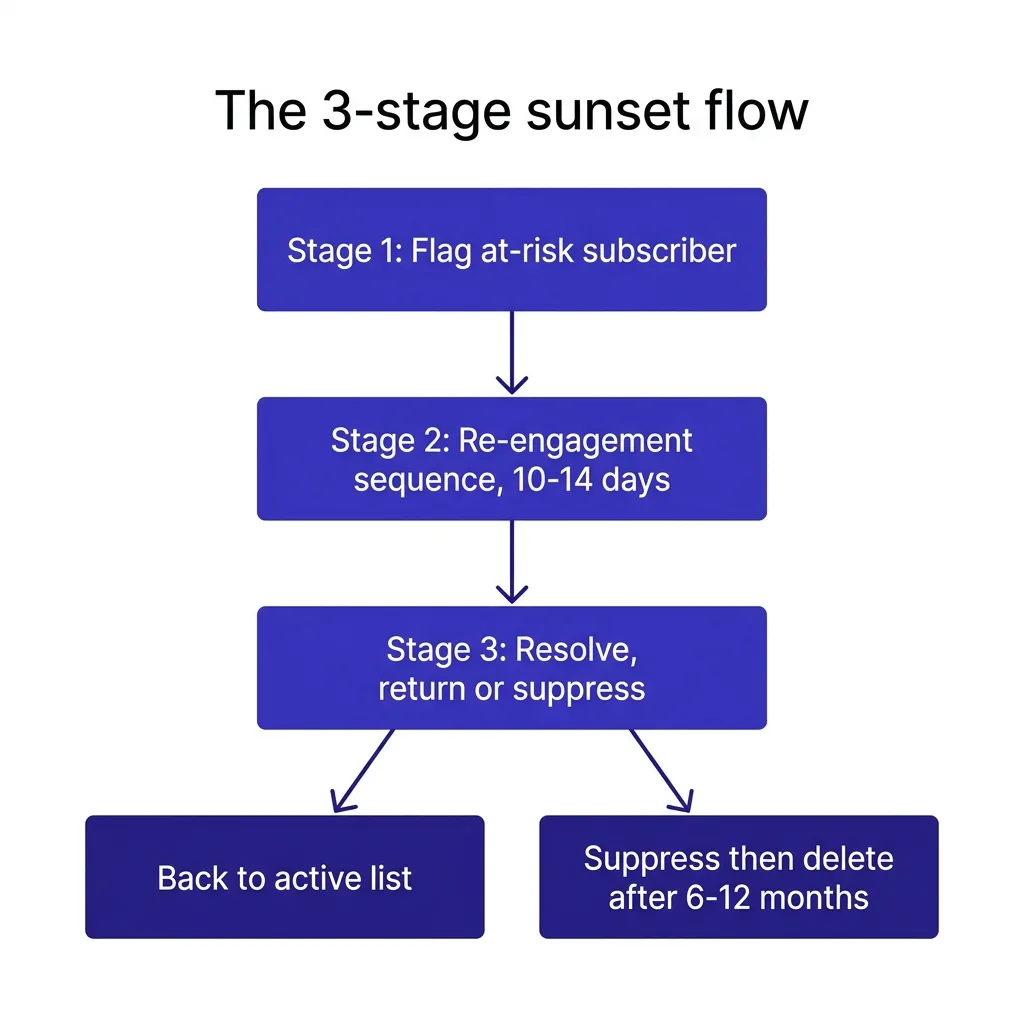 The 3-stage sunset flow {#sunset-flow}
A sunset policy should never jump straight from "unengaged" to "deleted." Build in a re-engagement stage first.
Stage 1: Flag. Once a subscriber crosses the inactivity window, tag them as "at risk" and stop sending them regular campaigns. Move them to the sunset track instead.
Stage 2: Re-engage. Send a short, focused re-engagement sequence (see reactivating a cold subscriber list for the full sequence structure). Give them 10 to 14 days to respond.
Stage 3: Resolve. Anyone who engages during stage 2 returns to the active list. Anyone who does not moves to suppression, and after a further defined period (commonly 6 to 12 months of suppression), to deletion.
This staged approach is what separates a deliberate sunset policy from an accidental list purge. Removing subscribers without ever attempting re-engagement wastes recoverable subscribers who may have simply missed a few emails during a busy period.
#Sunset policy models compared {#models-compared}
| Model | List size impact | Deliverability impact | Effort to run | Best for |
|---|---|---|---|---|
| No sunset policy | ✗ Grows unchecked | ✗ Degrades over time | ✓ None | Not recommended for any sender in 2026 |
| Fixed 90-day sunset | ✓ Controlled shrinkage | ✓ Strong protection | ✓ Low, easy to automate | Weekly senders, straightforward lists |
| Tiered by segment | ✓ Precise | ✓ Strongest protection | ✗ Higher setup effort | Senders with distinct audience segments |
| Manual annual cleanup | ✓ Periodic correction | ✗ Gaps between cleanups | ✓ Low, but inconsistent | Small lists, early-stage senders |
A fixed, automated sunset policy consistently outperforms a manual annual cleanup, because deliverability damage from a bloated segment accumulates continuously between cleanup cycles, not just once a year.
#Setting up automated sunset rules {#automation}
Most modern email platforms (Klaviyo, HubSpot, Customer.io, Mailchimp) support engagement-based segmentation and automation triggers, which makes a sunset policy achievable without custom engineering for most senders.
Basic setup steps:
- Define your engagement window based on send frequency (see the table above)
- Build a segment for "no open or click in [window]"
- Create an automated flow that removes flagged subscribers from regular sends and enrolls them in the re-engagement sequence
- Set a suppression trigger for non-responders after the re-engagement sequence ends
- Set a deletion trigger for suppressed records after a further defined period, if your data retention policy calls for it
Test the automation on a small segment before turning it on for the full list. An automation with an error in the trigger logic, flagging active subscribers as dormant by mistake, can silently damage your best relationships if it runs unchecked across the whole list.
Run the initial test against a segment of 1,000 to 2,000 subscribers you already know the engagement status of, and manually spot-check the output before scaling. Confirm that subscribers you know are active did not get flagged, and that subscribers you know have gone quiet for months did. Only after that manual check passes should the automation move to the full list, and even then, watch complaint and bounce rates closely for the first cycle.
#Segmenting engaged from unengaged correctly {#segmentation}
Engagement measurement got harder in 2026. Apple Mail Privacy Protection pre-fetches images regardless of whether a human actually opened the email, inflating open counts across the board. See why open rates stopped being a reliable metric for the underlying mechanics.
Build your sunset segmentation on a blended signal, not open rate alone:
- Clicks (a much stronger signal than opens, harder to fake through prefetching)
- Replies, for lists where two-way communication is common
- On-site activity tied to the email address, like a login or a purchase, if you can join that data
- Explicit preference confirmations, if you run periodic preference-center check-ins
A subscriber who opens every email but never clicks anything for a year is a borderline case, not a clear "engaged" signal anymore, given how unreliable open tracking has become. Weight clicks and replies more heavily than opens when building the sunset trigger logic.
#Exceptions: who should not be sunsetted {#exceptions}
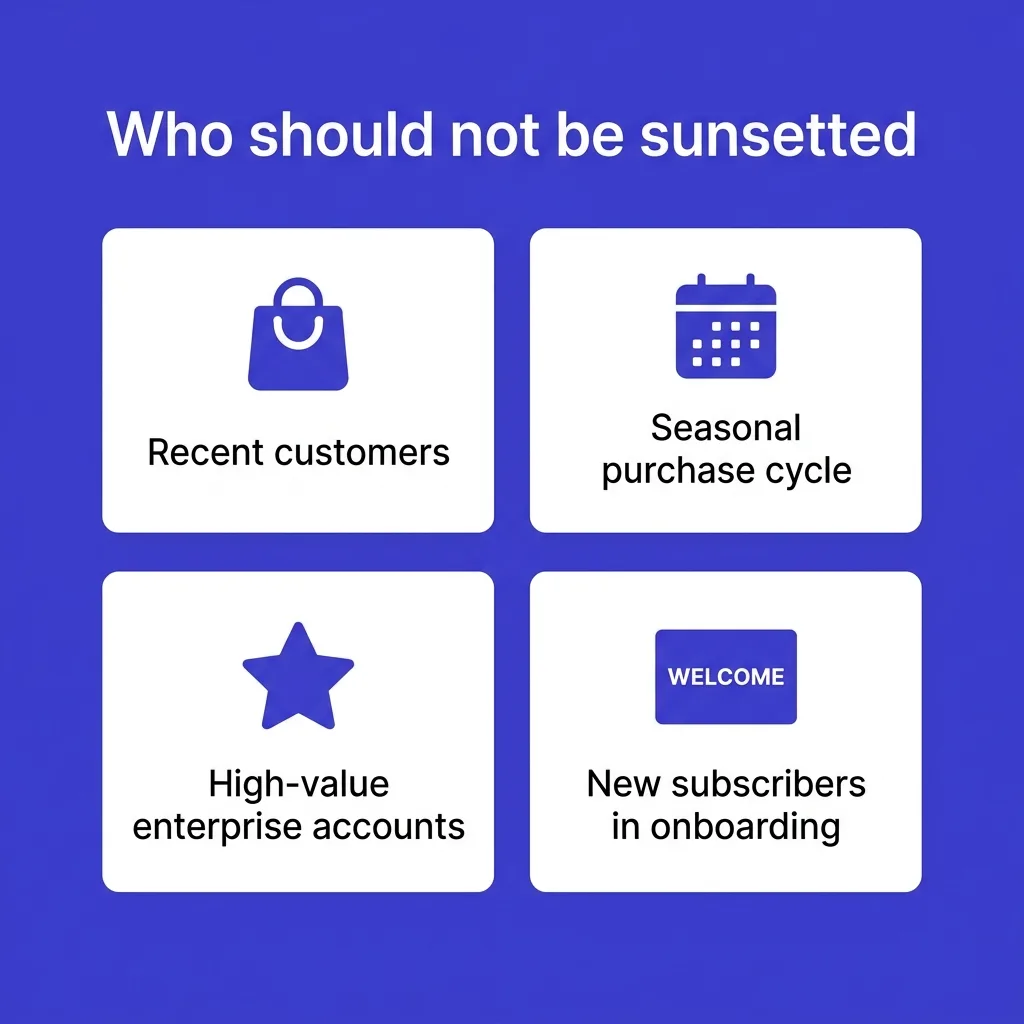 Exceptions: who should not be sunsetted {#exceptions}
Not every dormant-looking subscriber belongs in the sunset flow.
Recent customers or active users, even if they have not opened a marketing email, since transactional or product-usage signals may indicate they are still engaged with the brand through channels other than email.
Subscribers on a seasonal purchase cycle, like a company that buys once a year around a specific renewal date. A 90-day sunset window would wrongly flag them as cold every year, right before their next natural engagement point.
High-value segments identified through other data, like enterprise accounts or known decision-makers, where the cost of losing the relationship outweighs the deliverability benefit of removing one low-engagement address from a large list.
For these exception segments, consider a lighter-touch alternative to full sunset: reduce send frequency rather than removing them entirely, or move them to a separate low-volume track reserved for major announcements only. This preserves the relationship while still limiting how much of your regular sending volume goes to a segment unlikely to engage with routine campaigns.
Recently added subscribers still inside their welcome sequence. Applying sunset logic before someone has even completed onboarding penalizes new signups for a window they have not had a fair chance to engage within yet.
#Sunset policy vs full list reactivation {#vs-reactivation}
These two practices work together but solve different problems.
A sunset policy is an ongoing, automated system that catches subscribers as they go cold, one small batch at a time, continuously.
A list reactivation campaign is typically a larger, deliberate project run against an already-accumulated backlog of dormant subscribers, often because a sunset policy was never in place to begin with.
The ideal setup runs both. A sunset policy prevents future backlog from building up. A one-time reactivation campaign clears whatever backlog already exists before the sunset policy takes over ongoing maintenance.
If you are building a sunset policy for the first time on a list that has never had one, expect the first pass to remove a larger share of subscribers than any future pass will, since you are clearing years of accumulated dormancy in one motion.
Some teams find the first-pass number alarming enough that they hesitate to proceed. A list of 100,000 subscribers might reveal that 35,000 or more have not engaged in over a year. That number reflects years of accumulated dormancy, not a sudden failure, and it is exactly the segment that has been quietly suppressing your inbox placement the whole time. Removing it is not losing 35,000 potential customers. It is removing 35,000 addresses that were never going to convert and were actively working against the 65,000 who might.
#Measuring the impact of a sunset policy {#measurement}
Track these metrics before and after implementing a sunset policy:
- Overall list open and click rates (should rise as the average shifts toward engaged subscribers)
- Spam complaint rate (should fall, since dormant subscribers are disproportionately likely to mark mail as spam)
- Bounce rate (should fall, since dormant records are more likely to include invalid addresses)
- Inbox placement rate, if your platform reports it, as the clearest downstream proof that deliverability actually improved
Expect a short-term dip in raw subscriber count and total email volume. That is the policy working as intended, not a failure. The relevant question is whether the remaining list performs better, not whether the list stayed the same size.
Report results to stakeholders in terms of quality, not size. A revenue-focused executive who only sees the subscriber count drop by 20% will read that as a loss unless the reporting also shows click rate rising, complaint rate falling, and inbox placement improving in the same period. Frame the metric that matters (deliverability health) alongside the metric that looks alarming (list size) so the full picture lands correctly.
If your team runs cold outbound prospecting in addition to a marketing list, keep the sunset logic for each entirely separate. Marketing list sunset policies deal with opted-in subscribers going quiet. Cold outbound has its own separate cadence and suppression logic tied to reply behavior and campaign-level opt-outs, which a platform like FirstSales handles through its own deliverability and warmup systems rather than a marketing sunset policy.
#Common sunset policy mistakes {#mistakes}
Using a single window for the entire list, regardless of segment. A B2B list with a high-consideration purchase cycle and a transactional receipt list have completely different natural engagement rhythms, and forcing one sunset window across both produces bad decisions in both directions.
Basing the entire trigger on open rate. Given how unreliable open tracking has become since Apple Mail Privacy Protection, an open-only sunset trigger will misclassify subscribers in both directions, flagging engaged clickers who rarely open images, and failing to flag genuinely dormant subscribers whose opens are all bot-driven prefetches.
Skipping the re-engagement stage entirely. Jumping straight from "flagged as dormant" to "deleted" throws away subscribers who might have simply missed a few emails during a busy stretch and would have responded to one honest check-in.
Running the sunset policy once and never again. A policy that ran successfully 18 months ago but has not executed since is not actually protecting the list anymore. It needs to run continuously, catching new dormancy as it appears month over month.
Forgetting to exclude recent purchasers or active product users. Email engagement is not the only signal of a real relationship. A customer who bought last month but has not opened a marketing email should not be treated the same as someone who has never interacted with the brand at all.
No internal owner. A sunset policy without someone responsible for reviewing its output periodically tends to drift, either over-aggressively removing subscribers due to a logic error, or quietly failing to run at all after a platform migration or integration change.
#How sunset policies interact with list growth {#interaction-with-growth}
A sunset policy and a list growth strategy might seem to pull in opposite directions, one removing subscribers, one adding them, but they actually reinforce each other.
A list actively shedding dormant subscribers gives new signups a cleaner engagement baseline to be measured against. When most of a list is disengaged, inbox providers apply that lower baseline reputation to new subscribers too, even ones who are genuinely interested. A well-maintained, actively sunsetted list gives fresh signups a fair shot at strong inbox placement from their very first email.
Think of it as continuous maintenance rather than a one-time tradeoff. Growth brings new subscribers in through the front door. Sunset policy clears out the ones who stopped answering the door years ago. Running both together keeps the list's average engagement quality consistently higher than running growth alone ever could.
Teams that focus purely on growth metrics, and never look at the sunset side, often end up chasing a vanity number while their actual deliverability quietly erodes underneath it. A list-growth report that only tracks new signups, without a matching report on dormancy and suppression, tells half the story at best.
Pair the two reports in every regular review. Show new subscribers gained alongside subscribers suppressed or deleted in the same period, and track net engaged list size as the headline number instead of raw total subscribers. That single change in reporting habit tends to shift internal conversations away from vanity growth and toward the metric that actually predicts inbox placement, and it makes the sunset policy's value visible instead of hidden behind a shrinking subscriber count nobody explains to the wider team. Make this pairing a standing agenda item, not a one-off slide someone builds once and forgets.
#Sunset policy for cold outreach lists versus newsletter lists
A sunset policy looks different depending on whether the list is opted-in subscribers or cold prospects.
For a newsletter or nurture list, the sunset window measures engagement over months, since these contacts already chose to hear from you and disengagement is a slower, quieter signal.
For a cold outreach list, the clock runs faster. A prospect who has not opened or replied across a full sequence of 4 to 6 emails within 2 to 3 weeks is telling you something immediately, not gradually.
Cold sequences should build their own sunset rule directly into the sequence logic, stopping sends after the final step rather than letting an unresponsive prospect sit in an active cadence indefinitely.
The suppression period also differs. A cold prospect who never engaged at all can often be re-approached sooner, with a different angle, than a subscriber who engaged for years and then went quiet.
Keeping these two policies separate prevents a newsletter's more patient timeline from letting a cold list's dead contacts linger past their useful window.
#Frequently asked questions
#What is an email sunset policy?
An automated rule set that identifies subscribers who stop engaging within a defined window, attempts one final re-engagement, and then suppresses or deletes those who do not respond, protecting overall sender reputation.
#How long should a sunset window be?
It depends on send frequency. Weekly senders typically use 90 to 120 days of no engagement. Monthly senders often extend that to 180 days. Match the window to your own engagement decay curve rather than copying another company's number.
#Does a sunset policy hurt list size too much?
It reduces raw subscriber count, but that count was inflated with dormant addresses that were hurting deliverability anyway. A smaller, more engaged list consistently outperforms a larger, unengaged one on inbox placement.
#Should I delete subscribers or just suppress them?
Suppress first, since it preserves a compliance record. Consider deletion after an extended suppression period (commonly 6 to 12 months), partly to reduce database size and partly to support data minimization requirements under regulations like GDPR.
#How is a sunset policy different from list reactivation?
A sunset policy is an ongoing, automated system that catches dormant subscribers continuously. List reactivation is typically a larger, one-time project aimed at an already-accumulated backlog of cold subscribers.
#Will a sunset policy improve my open rate?
It should raise the blended average, since you are removing subscribers who rarely or never engage. Keep in mind that open rate itself has become a less reliable metric due to Apple Mail Privacy Protection.
#What metrics prove a sunset policy is working?
Falling spam complaint rate, falling bounce rate, rising click rate on the remaining list, and improved inbox placement rate if your platform reports it.
#Should new subscribers be included in sunset logic right away?
No. Exclude anyone still inside their onboarding or welcome sequence window, since they have not had a fair opportunity to engage yet.
#What about subscribers on a seasonal buying cycle?
Flag these as an exception in your sunset logic. A fixed 90-day window would incorrectly mark an annual buyer as cold every single year, right before their next natural purchase or renewal.
#Can I automate a sunset policy without custom development?
Yes, in most cases. Platforms like Klaviyo, HubSpot, Customer.io, and Mailchimp support engagement-based segmentation and automated flows that cover the core sunset logic without custom engineering.
#Is a sunset policy required by law?
No specific law mandates a sunset policy, but data minimization principles under GDPR support periodically deleting inactive records, and the deliverability benefits make it a practical necessity for any serious sender under current bulk sender rules.
#What should the re-engagement email in a sunset flow say?
Acknowledge the gap honestly, ask directly whether the subscriber still wants to receive email, and state clearly what happens if they take no action (removal from future sends).
#How often should I review my sunset policy settings?
At least annually. Send frequency, audience behavior, and inbox provider rules all shift over time, and a window set two years ago may no longer match your current engagement patterns.
#Does a sunset policy apply to transactional emails too?
No. Transactional emails (receipts, password resets, account notifications) operate under different rules and expectations, and sunset logic should apply only to marketing and lifecycle sends.
#What happens if I never implement a sunset policy?
Dormant subscribers accumulate indefinitely, gradually dragging down average engagement metrics and increasing bounce and complaint risk, both of which can degrade inbox placement for the entire sending domain over time.
#Can a sunset policy accidentally remove engaged subscribers?
Yes, if the trigger logic is flawed or based on an unreliable signal like open rate alone. Test any new automation on a small segment first, and weight clicks and replies more heavily than opens.
#How does a sunset policy relate to bulk sender requirements from Google and Yahoo?
Those requirements set hard thresholds for complaint and bounce rates. A sunset policy directly reduces both by removing the subscribers statistically most likely to complain or bounce, which helps keep a domain comfortably under those thresholds.
#Should B2B and B2C companies use different sunset windows?
Often yes. B2B audiences may have longer natural engagement cycles tied to buying committees and budget timing, while B2C audiences typically show faster, clearer engagement decay. Base the window on your own data rather than a general B2B or B2C assumption.
#What is the first step to building a sunset policy from scratch?
Pull your engagement decay data, identify where opens and clicks clearly flatten out after signup, and use that point to set your initial sunset trigger window before building the automation.
#Do sunset policies apply the same way to every industry?
The core logic applies broadly, but the window and exceptions vary. A retailer with seasonal buying cycles, a B2B company with long sales cycles, and a daily news publisher each need windows and exception rules tuned to their own engagement patterns rather than a single fixed standard.
#Key takeaways
- An email sunset policy automatically catches dormant subscribers before they drag down deliverability for the whole domain.
- Match the engagement window to your own send frequency and decay curve, not a generic industry number.
- Use a 3-stage flow: flag, re-engage, then suppress or delete, never jump straight to deletion.
- Weight clicks and replies more heavily than opens when defining "unengaged," since open tracking has become unreliable.
- A sunset policy and a one-time list reactivation campaign work together: reactivation clears the backlog, sunset prevents it from rebuilding.
Set the window, automate the flow, and expect a smaller but healthier list once the policy has run its first full cycle.