#Community-led outbound: selling in Slack and Discord safely
Copy page
TL;DR: Slack and Discord communities are full of your buyers, and almost every seller who tries to reach them gets banned, muted, or quietly shadow-ignored within a week. The ones who work is small: give value in public for weeks before any DM, never pitch in the channel, and treat every community as a landlord's property, not a lead list you own. Done right, community-led outbound produces warmer replies than cold email, at a fraction of the volume, because the trust is already partly built before you say a word.
#Table of contents
- Why communities became a channel at all
- The failure mode everyone hits first
- The rule that actually matters
- A map of where this works and where it does not
- Building presence before you need it
- The sequence from lurker to conversation
- What a good in-community DM looks like
- Checkmark and cross table: what gets you banned
- Running this across multiple communities at once
- Where FirstSales fits after the community touch
- Measuring a channel that resists measurement
- Discord-specific mechanics
- Slack-specific mechanics
- When community-led outbound is the wrong tool
- FAQ
- Conclusion
#Why communities became a channel at all
Email inboxes are worn out.
Reply rates on plain cold sends have fallen from 5.1% in 2024 to about 3.43% in 2026, and every buyer with a job title worth targeting gets forty pitches a week that all sound the same.
LinkedIn is heading the same direction as more teams automate connection requests and templated DMs at scale.
Slack and Discord have not gotten there yet, and that gap is the entire reason this channel exists.
A well-run niche community, a founder Slack, a specific vertical Discord, a tool's user community, still has a working social contract.
People post because they expect a real conversation back, not a funnel.
That contract is fragile. It breaks the first time someone treats the channel like a list to blast, and once it breaks for a community, moderators lock it down for everyone who comes after.
This piece is about staying on the right side of that line while still getting something real out of it.
#The failure mode everyone hits first
Almost every seller who tries community outbound makes the same mistake in the same order.
They join a Slack or Discord, post an intro that mentions their product in the second sentence, then DM ten people who reacted to their intro with the same pitch.
Moderators see this pattern constantly. It is the single most recognizable spam signature in any community with more than a few hundred members.
The result is predictable. A ban within days, sometimes hours, and a quiet note in the moderator channel naming your company so the next mod on shift bans you faster next time.
Worse than the ban itself is the reputation cost. Founders and operators talk to each other across communities.
A company that gets known for spamming three Slack groups earns a reputation that follows it into the fourth one before anyone from that company ever posts there.
#The rule that actually matters
Every workable version of this channel comes down to one rule: earn the right to DM before you use it.
That right is earned through visible, unpaid contribution in the public channel, not through joining and immediately asking to help.
Concretely, that means answering questions in your area of expertise, sharing something useful without a link back to your product, and being present long enough that regulars recognize your name before you ever slide into someone's DMs.
There is no shortcut on the timeline. Communities that matter enough to prospect in are usually small enough that members notice a new face acting transactional within the first week.
The teams that make this channel work treat the multi-week build-up as the actual cost of the channel, the same way they would budget for a warmup period on a new sending domain.
You are warming up trust instead of a mailbox, but the mechanic is the same: slow, visible, consistent, before any ask.
#A map of where this works and where it does not
Not every community is worth this investment, and picking the wrong one wastes weeks before you find out.
The best fits are communities built around a specific tool, role, or narrow problem, where members show up because they need something concrete, not because they want general networking.
A Discord for a specific dev framework, a Slack for RevOps leaders at Series B companies, a community for people running a specific compliance process, these have buyers who talk shop and reveal real pain in public.
General "founders" or "entrepreneurs" Slacks look tempting because of size, but they are usually saturated with other sellers doing the exact same play, which means moderators are already primed to ban fast.
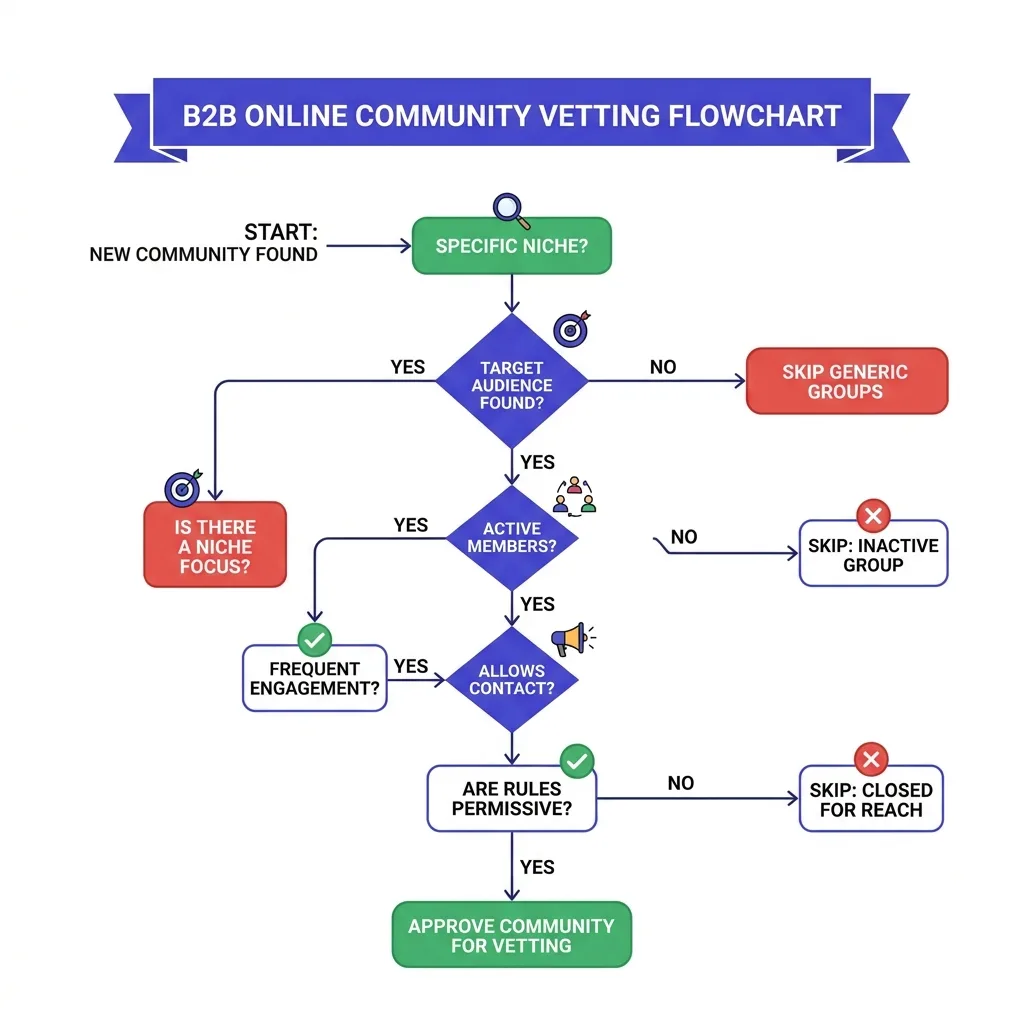 Decision path for vetting a community before joining it for community-led outbound
Before joining anything new, check whether the community even allows commercial activity at all.
Some Discords for open source projects ban any business contact outright, and violating that rule burns a channel you might want later for support or recruiting, not just sales.
#Building presence before you need it
The single most valuable move in this channel is joining communities before you have anything to sell in them.
A founder who has been an active, generous member of a niche Slack for six months has a completely different starting position than one who joins the week their product launches.
That head start compounds. Regulars already know your name, your company, and roughly what you are good at, so a first DM lands as a continuation of an existing relationship instead of a cold approach.
This is the community equivalent of building a warm intro pipeline: the work happens well before the ask, and the payoff shows up months later when it looks almost effortless from the outside.
Teams that only think about community when pipeline is short are always working from a worse position than teams that treated it as ongoing infrastructure.
If you are starting from zero, pick two or three communities maximum. Trying to build presence in ten at once means genuine contribution in none of them, and members can tell the difference between a real regular and someone spreading thin across a dozen servers.
#The sequence from lurker to conversation
The path from joining to a real conversation has a consistent shape across the teams that do this well.
Week one is pure observation. Read the pinned rules, the channel topics, and at least a week of history before posting anything.
Weeks two through four are contribution only. Answer questions, share a genuinely useful resource with no link, react and engage like any other member.
Somewhere around week three or four, a natural opening usually appears: someone posts a problem your product actually solves, in public, unprompted.
That is the signal to act on, not a calendar reminder to start pitching.
The response to that public post should stay public where possible: a helpful answer in the thread, with an offer to continue in DMs only if they want more detail.
That framing matters. "Happy to share what worked for us if useful, DM me" reads as help offered. A cold DM with no public precedent reads as a pitch.
#What a good in-community DM looks like
When a DM is warranted, the content looks nothing like a cold email.
It references the specific thing they posted, skips any company pitch entirely in the first message, and offers something concrete: a template, a five-minute answer, an intro to someone else in the community who solved the same problem.
A DM that says "saw your post about X, we help with that, want to hop on a call" gets ignored or reported almost every time, because it collapses the community relationship into a sales motion the moment it goes private.
A DM that answers the actual question first, then mentions the product only if it comes up naturally, keeps the relationship intact even if it never converts.
The best operators in this channel treat the DM as an extension of the personal branding trust they built in public, not a new pitch surface with different rules.
If the conversation moves toward a real evaluation, that is the point to take it off-platform entirely, into email or a call, where a normal sales process can run without violating the community's norms.
#Checkmark and cross table: what gets you banned
| Behavior | Community reaction |
|---|---|
| Answering questions for weeks with no pitch | ✓ Builds standing, gets you remembered |
| Sharing a template or resource with no link back | ✓ Reads as generous, not transactional |
| Responding publicly to a signal before DMing | ✓ Feels earned, not cold |
| DMing everyone who reacts to your intro post | ✗ Reported as spam within days |
| Posting your product in the first message | ✗ Instant mod flag in most communities |
| Joining ten communities the week before launch | ✗ Reads as opportunistic, not a member |
| Pitching in the public channel after being told not to | ✗ Permanent ban, often with a note to other mods |
| Using a bot to auto-DM new joiners | ✗ Bans the account and often the whole domain |
| Mentioning the product only when it is asked for | ✓ Normal, expected community behavior |
#Running this across multiple communities at once
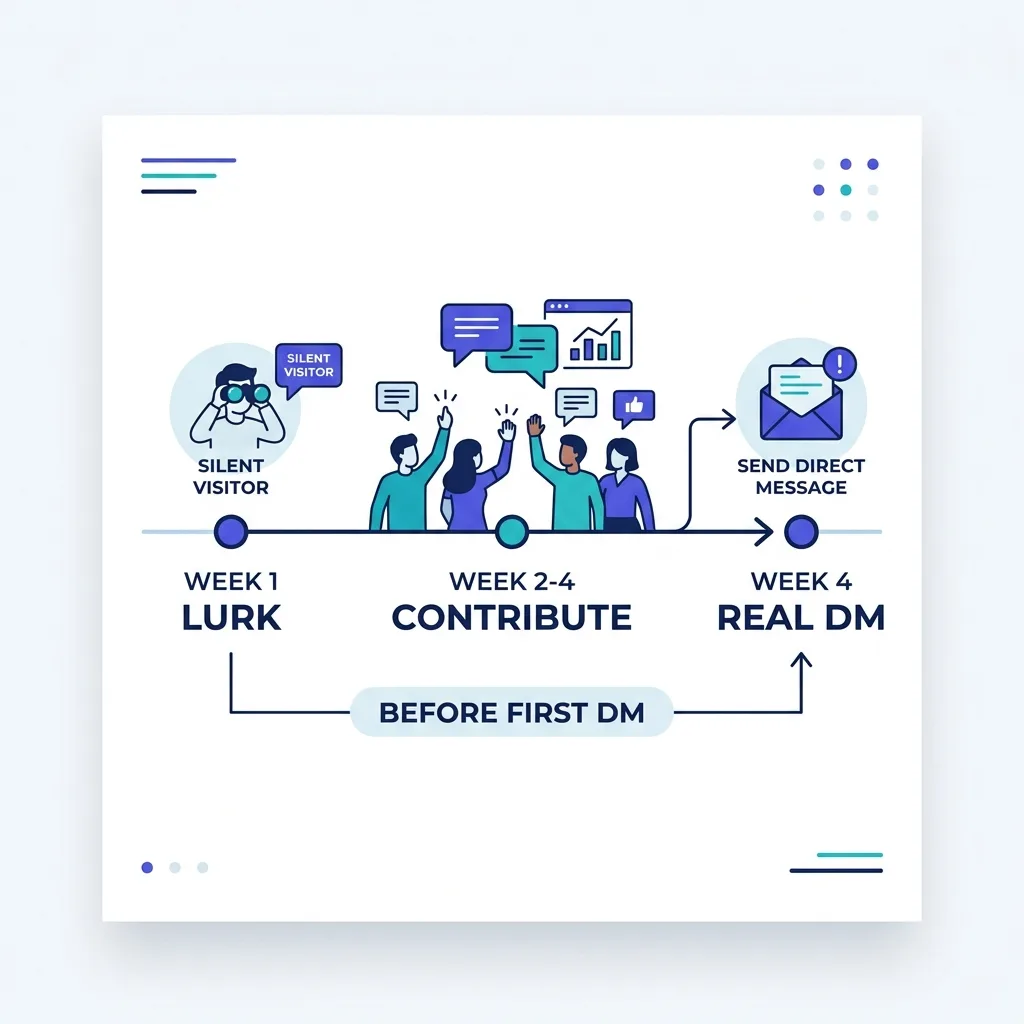 Timeline showing weeks of contribution before a DM in a Slack or Discord community
Once one community works, the temptation is to copy the exact playbook into five more at the same time.
That usually fails, because the thing that made the first community work was specific, earned context, and context does not transfer between servers.
A better model treats each community as its own small research project: different pain language, different regulars, different tolerance for commercial activity, even within the same industry.
The teams that scale this well assign one person to own no more than three communities, deep enough to actually recognize regulars and remember past conversations, rather than spreading five people thin across fifteen.
This mirrors the account-tiering logic used in account tiering for outbound: depth on a short list beats shallow coverage of a long one, and the cost of getting it wrong is higher here because a ban is permanent and public.
Track community activity the same way you would track any outbound cadence: who you helped, what they posted, and when a DM makes sense, in a simple log rather than memory.
#Where FirstSales fits after the community touch
Community-led outbound is not a replacement for a structured pipeline. It is a warm entry point into one.
Once a conversation moves off Slack or Discord and into email, the same discipline that made the community approach work still applies: specific, no filler, one clear ask.
This is where a tool like FirstSales earns its place, not by automating the community DM, which should stay manual and human, but by picking up the thread once it moves to email.
A prospect who replied warmly in a Discord DM still needs a proper follow-up sequence, deliverability that does not tank the moment volume grows, and a draft that references what they actually said rather than a generic template.
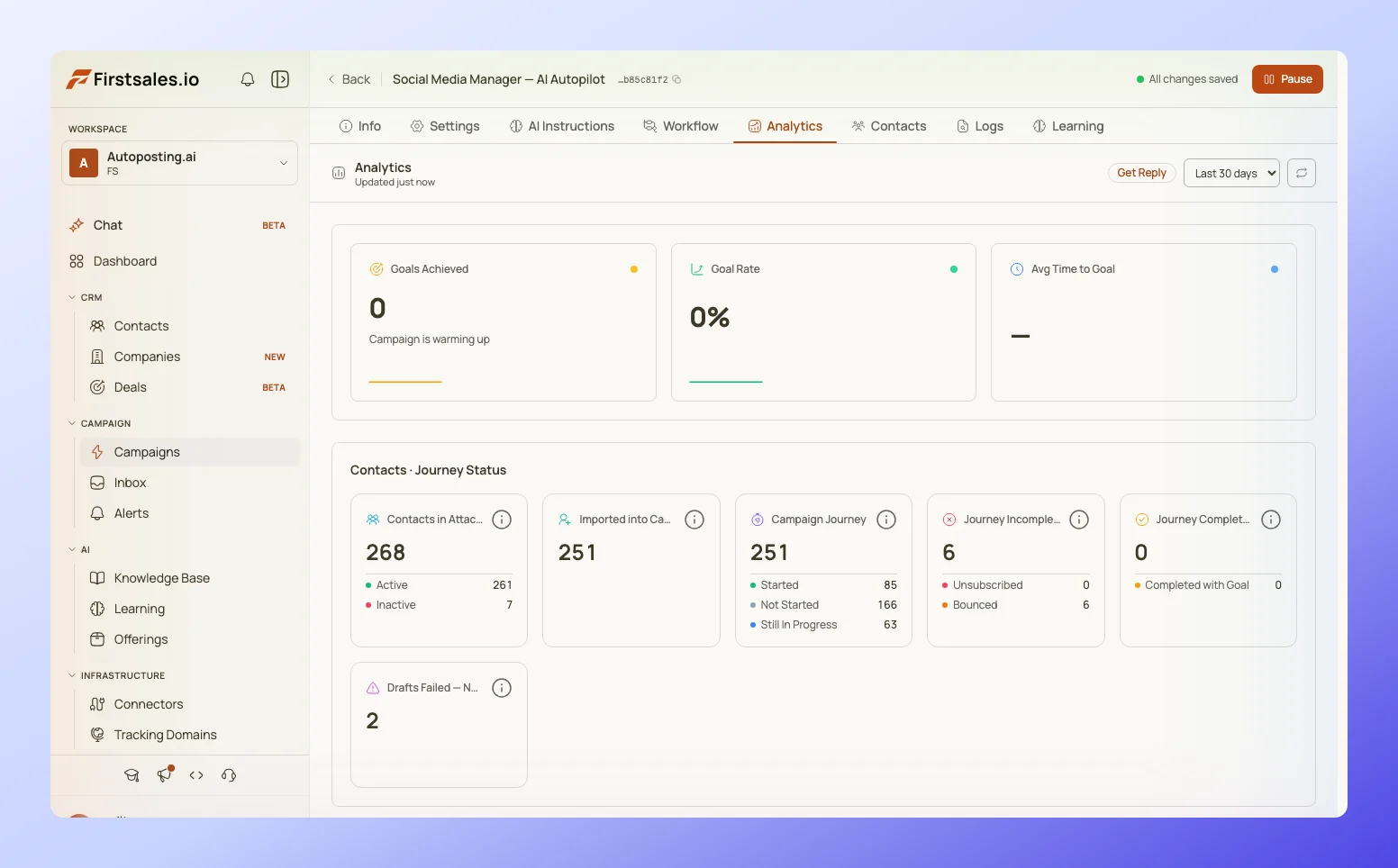 FirstSales campaign sequence view for following up after a warm community conversation
That handoff, from a genuine community relationship into a tracked sequence, is the part most teams drop because they treat community and email as separate tools with no shared record of who said what.
#Measuring a channel that resists measurement
Community-led outbound does not fit neatly into the metrics that work for email or LinkedIn.
There is no send count, no open rate, and often no clean way to attribute a closed deal back to a Discord conversation from four months earlier.
The honest way to measure it is a lightweight log: which communities you are active in, roughly how many real conversations per month came out of each, and which of those became a pipeline opportunity.
That is a much smaller number than an email list, and that is fine. This channel is not a volume play. Ten genuine community relationships a quarter can outperform a thousand cold sends if the fit is right.
Compare it honestly against your other channels using the same framework as channel mix cost per reply: count the actual hours spent contributing, not just the DMs sent, because the contribution time is the real cost of this channel.
If a community has produced zero real conversations after two months of genuine contribution, that is a signal to reallocate the time, not a reason to push harder with more DMs.
#Discord-specific mechanics
Discord communities skew younger, more technical, and less tolerant of anything that reads as corporate.
Server rules are usually explicit and pinned, and violating a stated no-solicitation rule gets you banned immediately with no warning, because Discord mods have seen the pattern too many times to give a first offense the benefit of the doubt.
Voice channels and stage events are an underused entry point. Showing up to talk, not pitch, in a community voice call builds recognition faster than weeks of text messages, because members put a voice and personality to your username.
Bots that auto-DM new members on join are common in larger servers, and using one to reach out is one of the fastest ways to get an entire company's domain blocked from a server permanently.
Stick to manual, one-to-one messages sent by an actual human account with real history in the server.
#Slack-specific mechanics
Slack communities tend to skew more professional and closer to the actual buying committee, which makes the payoff higher but the tolerance for missteps lower.
Many professional Slack communities have an explicit no-DM-solicitation rule in their guidelines, and members report violations to admins more readily than in looser Discord servers, because the community often doubles as a professional reputation space.
Threaded replies matter more in Slack than Discord. Answering inside the original thread, rather than starting a new top-level message, signals that you actually read the context instead of skimming for a sales opening.
Slack Connect channels, shared between two companies, are a different animal entirely and usually only happen after a relationship already exists, so they are a late-stage tool, not a prospecting surface.
#When community-led outbound is the wrong tool
This channel is not a fit for every business, and forcing it wastes real time.
If your buyer does not participate in any community that fits your niche, and most enterprise buyers over a certain seniority genuinely do not, this channel returns close to nothing no matter how well it is run.
If your sales motion depends on high volume and short cycles, the multi-week trust-building requirement makes this channel too slow to matter at the pace the business needs.
And if your team cannot commit a real person to sustained, unpaid contribution over months, half-hearted community presence is often worse than no presence, since a low-effort account that shows up occasionally to pitch reads as exactly the spam pattern moderators watch for.
In those cases, the honest move is to put the time into channels that scale more predictably, like a properly run email and LinkedIn multichannel sequence, and treat community as opportunistic rather than a core motion.
#FAQ
#Is it against the rules to sell in a Slack or Discord community?
It depends entirely on the specific community's stated guidelines, which are usually pinned or linked in an onboarding channel.
Some explicitly ban any commercial DM, others tolerate it if disclosed, and violating a stated rule is the fastest way to get permanently banned.
#How long should I lurk before posting anything?
At least a week of reading history and pinned posts before your first post, so you understand the tone and avoid repeating a question already answered.
#How many communities should one person manage at a time?
No more than two or three if the goal is genuine depth, since real contribution takes time and spreading thinner produces shallow, noticeable presence in all of them.
#What is the fastest way to get banned from a community?
DMing multiple members with a product pitch shortly after joining, or posting your product link in a public channel that has a stated no-solicitation rule.
#Do moderators actually talk to each other across communities?
Yes, especially in overlapping niches. A reputation for spamming one community follows a company into adjacent ones faster than most sellers expect.
#Should I disclose that I work for a company when I join?
Generally yes, in your profile or intro post if the community asks for one. Hiding your affiliation and then getting outed later reads far worse than being upfront from the start.
#What counts as a valuable contribution instead of a pitch?
Answering a specific question with a real, useful answer, sharing a template or resource with no link attached, or connecting two members who could help each other.
#Is Discord or Slack better for B2B community prospecting?
Slack communities tend to skew more professional and closer to actual buyers, while Discord skews more technical and younger, so the right choice depends entirely on where your buyer actually spends time.
#How do I know when a DM is finally appropriate?
When someone posts a specific problem your product solves, in public, and your response would naturally continue in a private message because the detail is too long for the channel.
#Can I use automation or a bot to manage community outreach?
No. Auto-DM bots on new joins are one of the most common bans in larger servers, and this channel only works because it is manually human.
#What is a realistic conversion rate from community DMs?
There is no reliable public benchmark for this channel because it varies enormously by community fit, but the operators who use it report needing far fewer DMs than cold email to get a genuine reply, since trust is partly pre-built.
#Should sales reps or founders run this channel?
Founders usually get more mileage from it early, since a founder's presence in a niche community carries more weight, but a dedicated rep can run it well once they have real product and customer knowledge.
#How do I track community activity without a CRM built for it?
A simple log works: community name, date joined, contributions made, and any DM conversations, updated weekly rather than tracked in a formal CRM record.
#What if a community bans commercial activity entirely?
Respect it. Some open source and technical communities exist specifically to be commerce-free, and treating that as a loophole to route around burns the channel for good.
#Does community-led outbound replace cold email?
No. It is a smaller, slower, higher-trust channel that feeds warm leads into the same email and call process you already run, not a replacement for it.
#How do I handle it if someone calls out my company for spamming?
Apologize directly, stop the behavior immediately, and do not argue the point publicly. Defending a spam callout in the channel almost always makes the ban permanent instead of temporary.
#Is it worth joining a community with fewer than 500 members?
Sometimes, if it is precisely targeted at your buyer. A small, active, niche community can outperform a large, generic one because the signal-to-noise ratio is higher.
#What should the first message in a new community look like?
A short, honest intro: who you are, what you do, and what you are hoping to learn or contribute, with no product pitch or link.
#How do I move a community relationship into a real sales process?
Once a real conversation starts, offer to continue by email or a short call, and use that channel for anything that needs scheduling, proposals, or documentation.
#Does this work for recruiting the same way it works for sales?
The same trust-building rules apply, and recruiters who spam DMs in tech communities face the exact same bans as sellers who do it.
#Conclusion
Community-led outbound rewards patience in a way almost no other channel does anymore.
The teams that get real pipeline out of Slack and Discord are the ones who showed up for months before they needed anything, answered questions because they were useful, and only slid into a DM when the community itself handed them the opening.
Everyone else gets banned, and their company's name gets remembered for the wrong reason.
Pick two or three communities where your actual buyer spends time, commit a real person to genuine contribution, and let the DMs come from earned recognition instead of a spreadsheet of usernames.
Once a real conversation moves off-platform, treat it with the same care you would any warm lead: a specific, human follow-up, not a generic sequence, and a system like FirstSales to keep that thread organized once it becomes a real pipeline opportunity instead of a Discord message you forgot to follow up on.