#Cold emailing your way into a sales job: what actually works
Copy page
TL;DR: Cold emailing hiring managers directly outperforms standard job applications by a wide margin, with response rates around 15% to 25% versus 2% to 5% for online applications, according to 2025-2026 recruiting data. The email that works looks like a sales pitch, because getting hired into a sales role is, functionally, a sales process where you are the product.
#Table of contents
- Why cold email beats the application portal
- Finding the right hiring manager to email
- What a hiring-manager email actually needs to say
- Proving sales skill inside the email itself
- The follow-up sequence that gets interviews
- What happens after a reply
- Common mistakes job seekers make
- Using cold email even without an open role
- Tools for running a job search like a campaign
- FAQs
#Why cold email beats the application portal
The job market for sales roles has grown more competitive every year, with hundreds of applicants routinely landing on a single posted opening within days.
Standing out through the application portal alone has become nearly impossible for candidates without an unusually strong or well-known background.
Online job applications route through applicant tracking systems that filter on keywords before a human ever reads them.
A resume that does not match the exact phrasing an ATS expects gets discarded regardless of actual fit.
Cold email skips that filter entirely by reaching a human directly.
Cold emails sent directly to hiring managers see response rates of 15% to 25%, compared to just 2% to 5% for standard online applications, according to outreach data compiled by Woodpecker.co and Mailshake in 2025.
For sales roles specifically, this approach carries extra weight. A candidate who cold emails a hiring manager effectively is demonstrating the exact skill the job requires, not just describing it on a resume.
#Finding the right hiring manager to email
HR and recruiting inboxes get flooded, and a generic application there competes with hundreds of others.
The hiring manager, usually the sales manager or VP the role reports to, is far less flooded and much more likely to read a specific, relevant email.
Search LinkedIn for the sales leadership at target companies, filtering by title (Sales Manager, VP Sales, Head of Sales) and team size relevant to the role level you are targeting.
Company "about" or leadership pages, plus a quick search of recent LinkedIn posts from that person, often reveal what they currently care about, which becomes useful material for personalization.
Verify the email format the company uses (firstname.lastname@, firstinitiallastname@) using a tool that checks deliverability before sending, the same discipline covered in email verification before sending, since a bounced email to a hiring manager wastes a limited, valuable shot.
| Approach | ✓ Works | ✗ Fails |
|---|---|---|
| Recipient | ✓ Direct hiring manager or sales leader | ✗ Generic careers@ or HR inbox |
| Subject line | ✓ Specific and relevant to their team | ✗ "Job application" or "Resume attached" |
| Proof | ✓ Real numbers from past roles | ✗ Vague claims like "hardworking" or "team player" |
| Length | ✓ Under 150 words | ✗ Full cover letter pasted into the email body |
| Ask | ✓ Small: 15 minutes to discuss fit | ✗ "Please consider me for any open roles" |
| Follow-up | ✓ 2 to 3 touches with new information each time | ✗ One email, then silence |
#What a hiring-manager email actually needs to say
Open with a specific, relevant reason you are reaching out to this person, at this company, right now.
"I saw [Company] is expanding into [market/segment], and I closed $400K in new business in a similar expansion at [Past Company]" beats a generic "I am interested in sales roles" every time.
Lead with a number. Sales hiring managers evaluate candidates on quantifiable performance, so quota attainment, deal size, or pipeline generated should appear in the first two sentences, not buried at the bottom.
Keep the email itself short, under 150 words, and treat the resume as a supporting attachment, not the main pitch.
End with a small, specific ask: a 15-minute call to discuss whether there is a fit, not a broad request to "be considered" for anything open.
Avoid attaching a full cover letter to the email body. If the email reads like a cover letter, it reads like every other application the hiring manager already ignores.
#Proving sales skill inside the email itself
The strongest cold emails for sales jobs do not just describe sales skill, they demonstrate it in real time.
Research the company enough to reference something specific: a recent product launch, a funding round, a competitor move, or a market shift relevant to their business.
Structure the email the way a strong cold sales email would: a relevant hook, a credible proof point, and a clear, low-friction next step, following the same principles covered in how to write cold emails.
A candidate who writes a generic, unfocused email is implicitly showing the hiring manager exactly the kind of rep they do not want representing their pipeline.
A candidate who writes a tight, relevant, proof-backed email is showing, not telling, that they understand how to earn attention from a busy stranger, which is the entire job.
#The follow-up sequence that gets interviews
A single email, even a strong one, often is not enough. Hiring managers are busy and email gets buried.
Follow-up 1, sent 4 to 5 days after the first email, adds new information: a specific accomplishment not mentioned before, or a relevant article or insight about their industry.
Follow-up 2, another 5 to 7 days later, can reference a specific, recent company update if one has happened, showing continued genuine interest rather than a repeated ask.
Follow-up 3, the final touch, is a short, low-pressure note acknowledging the timing may not be right, which mirrors the breakup email approach used in sales sequences and often generates a late reply from managers who were simply buried.
Three to four total touches is enough. More than that starts to read as desperate rather than persistent, especially in a job search context where the power dynamic differs from a typical sales relationship.
#What happens after a reply
 What happens after a reply
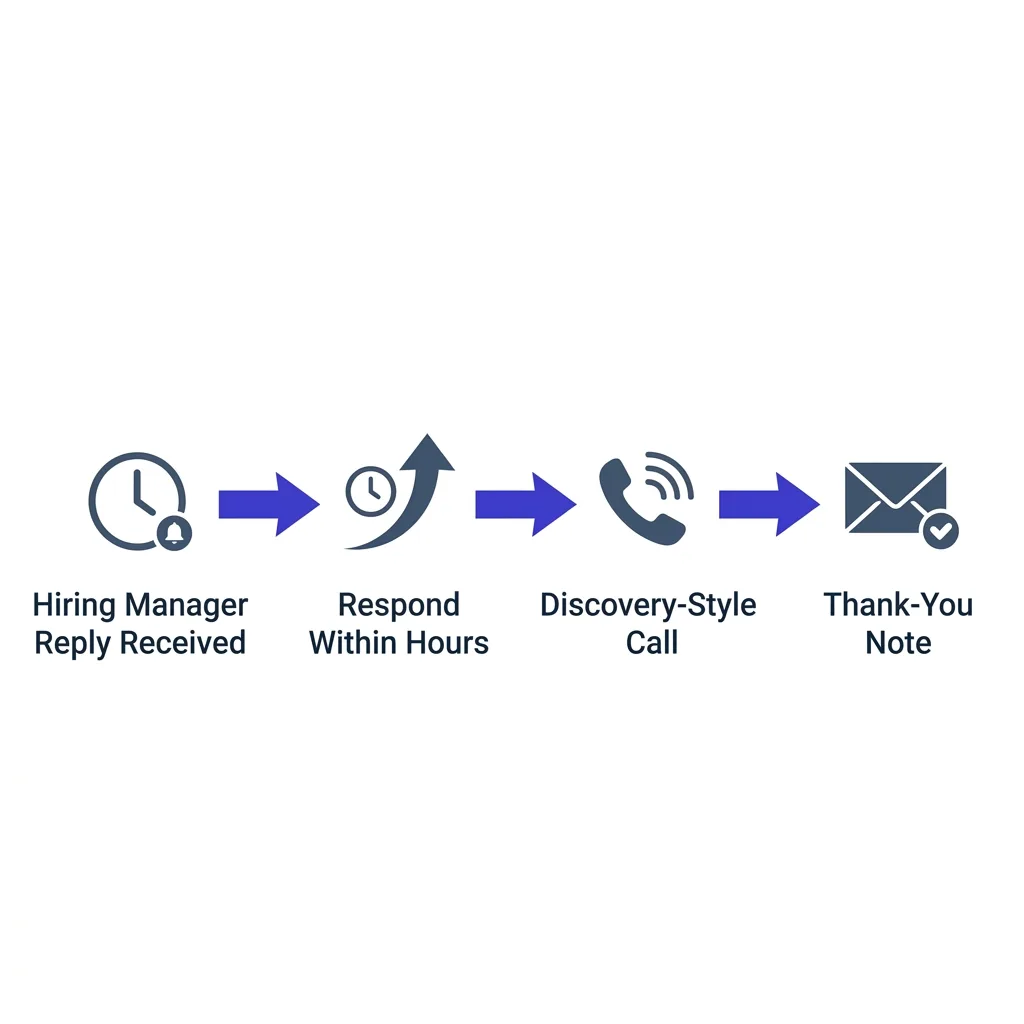
A reply, even a skeptical or lukewarm one, is a real opening.
Respond within hours, not days, since hiring managers who took time to reply are testing whether that same responsiveness shows up consistently.
Come to any call prepared with two or three specific questions about their team's current challenges, not just questions about compensation or benefits.
Treat the phone screen like a discovery call: understand their pain points, their current pipeline challenges, and what a successful hire looks like in the first 90 days, then connect your specific experience directly to those points.
Send a short, specific thank-you note within a few hours of any call, referencing something concrete discussed, not a generic "thank you for your time."
#Common mistakes job seekers make
Sending the same generic template to every hiring manager, with only the company name swapped, produces the same poor results a generic sales template produces.
Leading with what the candidate wants (a role, growth, compensation) instead of what the hiring manager needs (a rep who can hit quota and understand their specific market).
Using vague, unquantified claims like "results-driven" or "proven track record" without a single actual number to back them up.
Emailing HR or a generic careers inbox instead of the actual hiring manager, missing the entire advantage cold email offers over the standard application process.
Giving up after one email when the data clearly shows most replies in outbound sequences come from touches two through four, not the first message.
#Using cold email even without an open role
Some of the strongest opportunities come from companies with no publicly posted opening.
A well-targeted email to a growing company's sales leader, proposing a conversation even without a confirmed open role, tests whether growth or turnover has created an unlisted need.
This works especially well at companies showing clear growth signals: recent funding, expansion announcements, or visible headcount growth on LinkedIn, similar to the logic behind hiring signal outbound used in B2B sales prospecting.
Frame the email around value, not need: "I noticed [Company] is expanding into [segment], and that's exactly the kind of build-from-scratch sales motion I've run before" positions the candidate as someone solving a problem, not asking for a favor.
Even when no role exists yet, staying on a hiring manager's radar for a future opening beats waiting for a job posting to appear and then competing with hundreds of other applicants.
#Three real email structures for different situations
The career changer, moving into sales from another field, should lead with transferable proof rather than apologizing for lacking a sales title.
Something like "I generated $1.2M in referral revenue as a customer success lead, and I'm now looking to move that skill into a closing role" reframes the transition as an asset, not a gap.
The experienced rep targeting a step up, moving from SMB to mid-market or enterprise, should lead with the specific deal complexity they have already handled, since hiring managers at the next level worry most about whether a candidate can handle longer cycles and bigger stakeholders.
"I've closed six-figure deals involving 4-plus stakeholders, and I'm looking to bring that to a team selling into [target company's specific market]" speaks directly to that concern.
The candidate with a warm connection, even a weak one like a mutual LinkedIn connection or shared alma mater, should mention it briefly in the first line, since even a loose warm signal measurably lifts reply rates compared to a fully cold email.
"[Mutual contact] mentioned your team is scaling the mid-market segment" works as an opener even if the mutual connection has not personally introduced you yet.
#Handling rejection and staying in the pipeline
A "not right now" reply is far more common than an outright no, and it is worth treating differently than silence.
Ask directly whether it would be reasonable to check back in a specific number of months, since this gives explicit permission to follow up later rather than guessing.
Stay visibly active in ways the hiring manager might notice: relevant LinkedIn posts, engaging thoughtfully with the company's content, or sharing a genuinely useful industry insight occasionally.
When a role does open up later, a candidate who stayed lightly visible over those months starts the new conversation as someone familiar, not another cold name in the inbox.
Full silence after multiple attempts is a legitimate signal to move on for now, but it does not mean the door is closed permanently, especially at a company still growing.
#Pairing email with LinkedIn for more coverage
Cold email and LinkedIn outreach work better together than either does alone for a job search, similar to the pattern described in LinkedIn DMs vs cold email for sales outbound generally.
A LinkedIn connection request with a short, specific note sent around the same time as the email increases the odds the hiring manager sees the outreach at all, since inboxes and LinkedIn notifications compete for different attention windows.
Engaging genuinely with a hiring manager's recent posts before sending outreach, rather than immediately after, builds a small amount of familiarity that measurably improves reply odds.
Avoid sending the identical message on both channels. A slightly different angle on LinkedIn, focused on a quick professional observation rather than a full pitch, complements rather than duplicates the email.
#Industry-specific considerations
 Industry-specific considerations
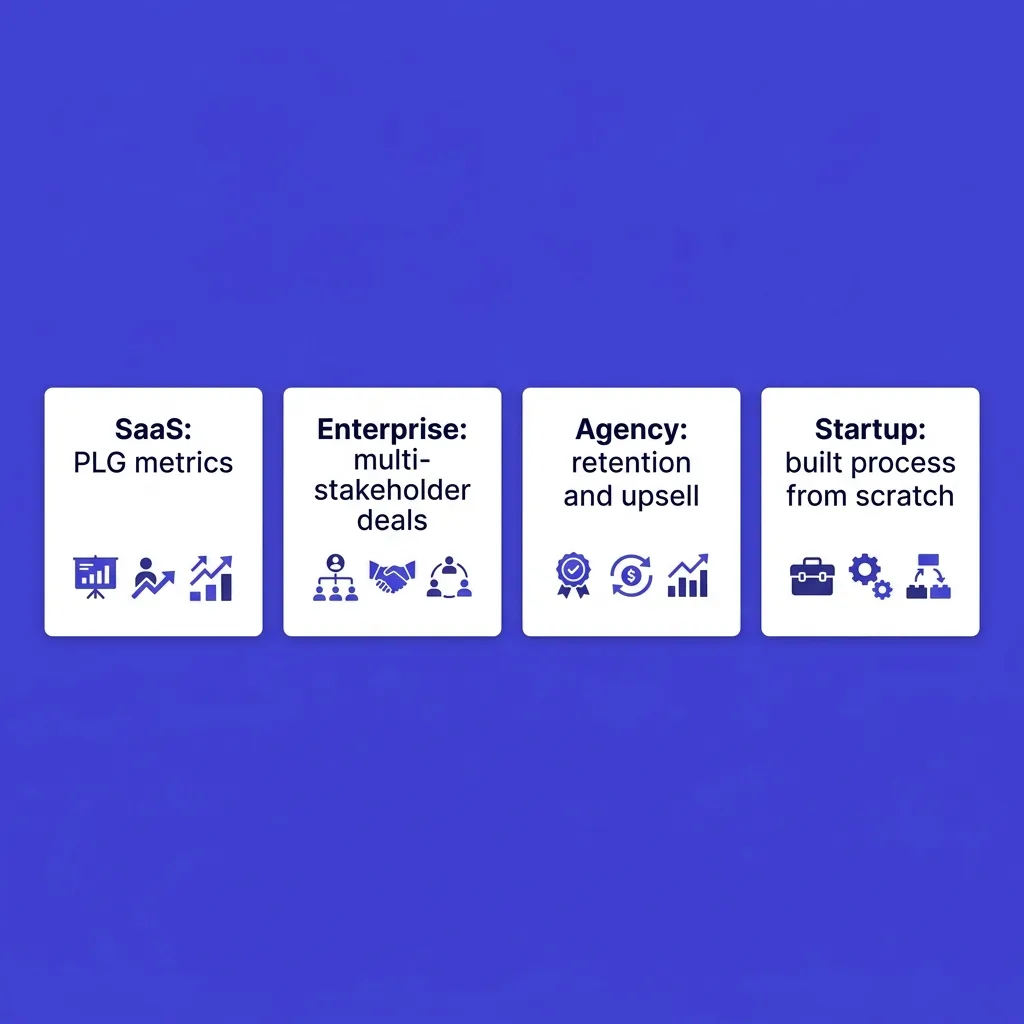
SaaS sales hiring managers respond well to specific product-led growth or PLG-to-sales-assist transition metrics, since that motion is common across the industry and immediately legible to them.
Enterprise sales hiring managers care most about multi-stakeholder deal experience and long-cycle management, so emphasize account-based selling and executive-level relationship building over raw deal count.
Agency and services sales roles respond to relationship longevity and account growth numbers (net revenue retention, upsell rates) more than pure new-logo acquisition, since the role usually blends hunting and farming.
Startup sales roles, especially early-stage, respond to evidence of building process from scratch, since early sales hires often need to create playbooks rather than execute an existing one.
Tailoring the proof point to what actually matters at that specific type of company, rather than sending the same generic pitch everywhere, is what separates candidates who get replies from those who do not.
#Tools for running a job search like a campaign
Treating a job search like an outbound sales campaign means applying the same tracking discipline: who was contacted, when, and what the next follow-up date is.
A simple spreadsheet or lightweight CRM tracking company, contact, email dates, and reply status prevents good leads from falling through the cracks the way a disorganized job search often does.
Email verification tools reduce bounces on a short, high-value list where every wasted attempt matters more than in a high-volume sales campaign.
AI-assisted drafting tools, used carefully with heavy personal editing rather than blind copy-paste, can help draft a first pass faster, though a job search email needs the individual specificity that only real personal research provides.
Set a weekly target, such as 10 to 15 new hiring manager emails per week alongside consistent follow-ups, to keep the search moving with the same discipline a sales rep applies to their own pipeline.
#Building a target company list before writing anything
Random outreach to any company hiring for a sales title wastes effort compared to a filtered, thoughtful target list.
Start with companies where the product, market, and stage genuinely fit the candidate's actual experience and interests, since a hiring manager can tell within one sentence whether a candidate researched the company or applied everywhere.
Rank target companies into tiers, similar to the tiering approach used in outbound sales prospecting: a small group of ideal-fit companies to research deeply, a broader group of good-fit companies for a lighter-touch approach, and any speculative companies worth trying without heavy investment.
Set aside more research time for the top tier. A single, deeply researched email to a dream company outperforms ten generic emails sent to companies chosen only because they had a posting live.
Revisit the target list every few weeks during an active search, since company growth signals, funding news, and new postings change quickly enough that a static list from week one goes stale by week four.
#What good looks like: a full example
A candidate targeting a mid-market SaaS company's VP of Sales might write: "Subject: Question about your mid-market expansion.
Hi [Name], saw [Company] just closed a Series B and is building out the mid-market segment.
I ran a similar build at [Past Company], taking mid-market ARR from $800K to $3.1M in 18 months by rebuilding the outbound motion from scratch.
Would it be worth a quick call to see if there's a fit for your team as you scale that segment?"
That structure hits every principle covered above: specific and current company context, a real quantified result, and a small, clear ask, all in under 90 words.
Compare that to a typical application email opening with "I am writing to express my interest in the Account Executive position," which contains no specific detail, no proof, and no reason for the hiring manager to prioritize reading further.
The gap between those two approaches is the entire reason cold email outperforms the standard application by 3x to 5x in response rate.
#Breaking in with zero prior sales experience
Not having a sales title on your resume is not the obstacle it feels like, but it does change what your email needs to prove.
A hiring manager reading a cold email from someone without sales experience is not looking for a work history that matches the job description.
They are looking for evidence that you can research a company, write clearly, and follow up without being asked twice, since those are the exact skills the job itself demands every single day.
The email you send is itself the proof, not a claim you make inside it.
Do not write "I am a fast learner with strong communication skills."
Instead, demonstrate it: reference something specific and current about the company, keep the email under 120 words, and follow up exactly when you said you would.
A hiring manager who receives that email has already seen you perform the job in miniature, which is a far stronger signal than any line on a resume claiming you would be good at it.
Lean on adjacent experience instead of pretending sales experience exists where it does not.
Retail, hospitality, tutoring, customer support, and even competitive extracurriculars like debate all involve persuasion, objection handling, or sustained follow-through, and naming the specific moment from one of those roles where you changed someone's mind is more convincing than a vague claim of "people skills."
If you have none of that either, build a small body of proof before you start emailing.
Cold email three or four companies you are not even applying to yet, purely as practice, and track your own response rate the way a rep would track a campaign.
By the time you write to a role you actually want, you will have already learned what works in your own voice, rather than guessing for the first time on the email that matters most.
Keep a simple log of what you sent, when, and what happened, the same way a rep tracks a live pipeline.
That log becomes your own version of a track record, and it is exactly the kind of proactive habit a hiring manager wants to see in someone joining a sales team.
#Frequently asked questions
#Does cold emailing hiring managers actually work for sales jobs?
Yes. Cold emails sent directly to hiring managers see response rates of 15% to 25%, compared to 2% to 5% for standard online applications, according to 2025 recruiting outreach data.
#Who should I email instead of HR?
Email the hiring manager directly, usually the sales manager or VP the role reports to, since HR and recruiting inboxes get flooded and are far less likely to result in a personal response.
#How do I find a hiring manager's email address?
Search LinkedIn for sales leadership titles at target companies, then verify the likely email format with a deliverability check tool before sending.
#What should the first line of a sales job cold email say?
Open with a specific, relevant reason for reaching out, ideally including a real number or accomplishment tied to something happening at the target company right now.
#Should I attach my full resume and cover letter to the email?
Attach the resume as supporting material, but keep the email body itself short and focused, since an email that reads like a full cover letter gets ignored the same way generic applications do.
#How many follow-ups should I send after the first email?
Two to three follow-ups, spaced about a week apart, each adding new information rather than repeating the same ask, is usually enough.
#Should I email companies with no posted job opening?
Yes, especially companies showing growth signals like recent funding or headcount expansion, since many roles get filled before a public posting ever goes up.
#What number should I lead with in a sales job cold email?
Quota attainment, deal size, or pipeline generated in a past role, placed in the first two sentences rather than buried at the bottom of the email.
#How is a sales job cold email different from a regular cover letter?
It is shorter, leads with a specific proof point instead of general qualifications, and demonstrates sales skill through its structure rather than just describing sales experience.
#What is a good subject line for a hiring manager email?
A subject line specific to the recipient's team or company situation works far better than "Job application" or "Resume attached," which reads as generic and gets ignored.
#How quickly should I respond if a hiring manager replies?
Within hours, not days, since a quick, professional response demonstrates the same responsiveness a hiring manager expects from a rep working live pipeline.
#What should I ask on a first call with a hiring manager?
Ask about their team's current challenges and what success looks like in the first 90 days, then connect your specific experience directly to those points.
#Is it too aggressive to cold email a hiring manager?
No, when the email is researched, specific, and respectful of their time, cold email is a normal and increasingly expected way to stand out in a sales job search.
#What is the biggest mistake job seekers make with cold email?
Sending a generic, unpersonalized template to every hiring manager, which undermines the entire premise of demonstrating sales skill through the outreach itself.
#How long should a sales job cold email be?
Under 150 words, treating the resume as the supporting detail rather than repeating the same information at length in the email body.
#Should I use AI tools to write my job search emails?
AI tools can help draft a starting point, but each email needs heavy personal editing and real research, since generic AI output undermines the specificity that earns a reply.
#How many hiring managers should I email per week?
Around 10 to 15 new emails per week, combined with consistent follow-ups on prior outreach, keeps a job search moving with real momentum.
#What should a final follow-up email say if there has been no response?
A short, low-pressure note acknowledging the timing may not be right often generates a late reply from managers who were simply buried, rather than uninterested.
#Does this approach work for entry-level sales roles too?
Yes, though entry-level candidates should lead with concrete effort and initiative (internship results, competition wins, extracurricular sales experience) instead of formal quota numbers they may not yet have.
#How do I track my job search outreach effectively?
A simple spreadsheet or lightweight CRM tracking company, contact, dates, and reply status keeps a job search organized the same way a sales rep tracks their own pipeline.
#Timing outreach around hiring cycles
Sales hiring often follows predictable seasonal patterns, and timing outreach around them improves odds meaningfully.
Q4 and early Q1 frequently bring new headcount approvals as budgets reset for the new fiscal year, similar to the planning cycle discussed in fiscal-year timing as a buying signal for B2B sales.
Companies that just closed a funding round often approve new sales headcount within the following one to two quarters, making that window a strong time to reach out even before a role is posted.
Avoid assuming summer or December are dead periods for hiring outreach entirely. Some hiring managers use quieter periods to interview candidates for roles that will open once budget resets, so a well-timed message can land ahead of the rush rather than during it.
Tracking company news, funding announcements, and earnings calls for public companies gives a real-time signal for when to prioritize outreach to a specific target, rather than sending on a fixed schedule regardless of context.
#Key takeaways
Cold emailing hiring managers directly outperforms standard applications by a wide margin because it skips ATS filters and reaches a human who can actually decide.
For sales roles specifically, a tight, proof-backed, well-researched email does double duty: it gets a reply, and it demonstrates the exact skill the job requires.
Treat the search like a campaign, track it like one, and follow up like one, since most interviews come from the second or third touch, not the first email sent.
Sources: