#Enterprise vs SMB outbound effort: same work, bigger swing
Copy page
TL;DR: Writing, researching, and multithreading a single enterprise account takes roughly the same hours as running outbound to fifty SMB accounts. The difference is the payoff on the other end. One enterprise deal can be worth 20 to 100 times an SMB deal, so the same effort budget produces a wildly different return depending on where you point it. Most teams split effort wrong, not because the math is hard, but because SMB outbound feels more productive day to day even when it is not.
#Table of contents
- The effort is closer than people admit
- What a worked hour actually buys you
- Why SMB outbound feels more productive
- The multithreading tax on enterprise accounts
- A side by side comparison
- The math, with stated assumptions
- Where the AI SDR conversation gets this wrong
- How to decide your own split
- Signals that say you are misallocated
- A hybrid model that actually works
- What changes as your ACV grows
- FAQ
- Conclusion
Most sales leaders talk about enterprise and SMB outbound as if they are different sports.
They are not.
They are the same sport, played on a field where the goalposts moved.
The actual hours of prospecting work, list building, research, drafting, sending, and following up, land in a surprisingly similar range whether the target is a 40-person startup or a 4,000-person enterprise account.
What changes is not the effort per touch.
What changes is the size of the prize waiting at the end of the sequence.
#The effort is closer than people admit
Picture two reps, same week, same forty hours.
Rep A is running SMB outbound: a list of 300 companies under 100 employees, a fairly generic pain point, and a sequence that leans on volume and light personalization pulled from firmographic data.
Rep B is running enterprise outbound: a target list of 8 named accounts, each requiring individual research, a multithreaded contact plan across three or four roles, and messaging tuned to each account's specific situation.
Both reps work forty hours.
Both reps send roughly the same number of total touches once you count every email, LinkedIn message, and call attempt.
The difference is where those hours went.
Rep A spent maybe two minutes of research per contact and let a sequence tool carry the volume.
Rep B spent two to four hours of research per account before writing a single line of outreach copy.
Neither rep is being lazy.
They are following the correct playbook for their segment.
The mistake shows up when a company applies the SMB playbook to enterprise accounts, or the enterprise playbook to SMB accounts, without adjusting the volume math to match.
#What a worked hour actually buys you
An hour of SMB outbound effort buys you reach.
You can qualify, personalize lightly, and send to 15 to 25 new contacts in that hour if your data and tooling are decent.
An hour of enterprise outbound effort buys you depth on a single account.
You might spend that whole hour reading a 10-K, checking recent leadership changes, and mapping who actually owns budget for the problem you solve.
Neither hour is wasted, but they are not interchangeable.
The critical error is measuring both with the same yardstick, usually "number of emails sent this week," and then wondering why the enterprise rep looks unproductive next to the SMB rep.
Number of emails sent is the wrong metric for enterprise work.
The right metric is closer to accounts meaningfully engaged, meaning at least two stakeholders in a buying committee have responded or taken a meeting.
#Why SMB outbound feels more productive
SMB outbound produces fast, visible signals.
You send 200 emails on Monday, you get 8 replies by Wednesday, you book 2 meetings by Friday.
That loop is satisfying and it is real progress, since systematized campaigns are landing 10-18% reply rates against a platform average that has fallen closer to 3.43%.
Enterprise outbound produces slow, quiet signals for weeks.
You research 8 accounts, send carefully crafted messages to 3 stakeholders per account, and by Friday you might have zero replies and one LinkedIn view.
That is not a failure.
That is week one of an enterprise sequence that typically needs multiple touches across multithreading the buying committee before anyone responds.
The problem is psychological, not mathematical.
A manager watching a dashboard sees SMB volume as motion and enterprise quiet as stalling, even when the enterprise rep is exactly on pace for a deal worth forty times more.
#The multithreading tax on enterprise accounts
Enterprise deals rarely close off one relationship.
A typical enterprise buying committee runs 6 to 10 people once you count the economic buyer, the technical evaluator, the end users, procurement, security, and legal.
Reaching even half of that committee with a relevant, individually contextualized message is not a volume problem, it is a research and sequencing problem.
That is the actual source of the effort gap people misdiagnose as "enterprise takes longer to write."
It is not the writing.
It is the mapping: figuring out who those six to ten people are, what each one cares about, and in what order to approach them so the message from the second contact references and reinforces the first.
SMB deals, by contrast, often close off one or two people.
The founder, or the founder and one operator, can say yes without a procurement cycle.
That collapses the multithreading step almost entirely, which is the single biggest reason SMB outbound can run at higher volume with less friction per account.
#A side by side comparison
| Factor | SMB outbound | Enterprise outbound |
|---|---|---|
| Research time per account | ✓ 2-5 minutes | ✓ 2-4 hours |
| Stakeholders to reach | ✓ 1-2 | ✗ 6-10, often more |
| Personalization depth | ✓ Firmographic, light | ✓ Individual, deep |
| Volume per rep per week | ✓ 100-300 accounts | ✗ 5-15 accounts |
| Sales cycle length | ✓ Days to weeks | ✗ Months to a year |
| Typical deal size multiplier | ✗ 1x baseline | ✓ 20x to 100x baseline |
| Effort per closed dollar | Depends on execution | Depends on execution |
| Tolerance for a bad list | ✗ Low, volume masks quality gaps | ✗ Very low, one wrong account wastes hours |
| Best fit for automation | ✓ High, sequencing and research assist | ✓ Moderate, research assist, human close |
Neither column wins outright.
The table is not saying enterprise is better or SMB is better.
It is saying the failure modes are different, and copying one segment's playbook into the other segment breaks the model.
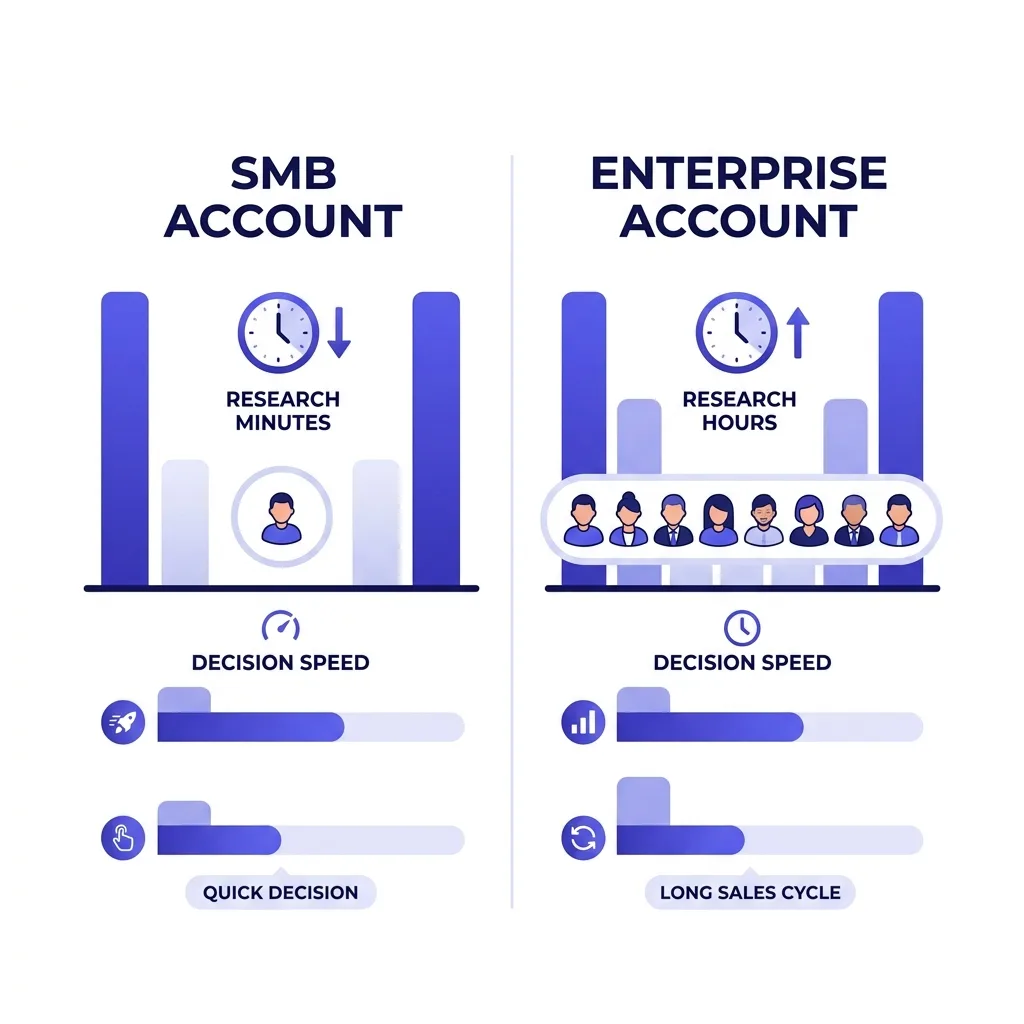 Comparison of research hours and buying committee size across SMB and enterprise accounts
#The math, with stated assumptions
This is a worked example, not a universal formula.
Swap in your own numbers.
Assumptions for this example:
- SMB average contract value: $6,000 annual
- Enterprise average contract value: $180,000 annual, a 30x multiple
- SMB outbound: 250 accounts touched per rep per week, 3% reply rate, 30% of replies convert to a meeting, 20% of meetings close
- Enterprise outbound: 10 accounts touched per rep per week, 15% of accounts produce at least one stakeholder reply within the sequence window, 40% of engaged accounts convert to a meeting, 15% of meetings close, over a longer cycle
SMB weekly math:
250 accounts times 3% reply rate is about 7.5 replies.
7.5 replies times 30% meeting conversion is about 2.25 meetings.
2.25 meetings times 20% close rate is 0.45 deals per week, worth 0.45 times $6,000, or about $2,700 in expected weekly pipeline value converted to revenue over time.
Enterprise weekly math:
10 accounts times 15% engagement is 1.5 engaged accounts.
1.5 engaged accounts times 40% meeting conversion is 0.6 meetings.
0.6 meetings times 15% close rate is 0.09 deals per week, worth 0.09 times $180,000, or about $16,200 in expected weekly pipeline value.
In this specific worked example, enterprise outbound produces roughly six times the expected value per rep per week, despite touching 25 times fewer accounts.
Change the ACV multiple to 10x instead of 30x and the two channels come out close to even.
Change it to 100x, which happens in some enterprise software categories, and enterprise outbound dominates the comparison even with a far lower hit rate.
The lesson is not "enterprise always wins."
The lesson is that the deal size multiple is the lever that decides the answer, and most teams never run this calculation with their own real numbers.
#Where the AI SDR conversation gets this wrong
A lot of the current AI SDR pitch assumes volume is the constraint and that removing a human from drafting solves the enterprise problem the same way it solves the SMB problem.
It does not.
Roughly 22% of sales teams have fully replaced human SDRs with AI, with 45% running a hybrid model, and only about 2% of the full-replacement attempts stick past the trial period.
The teams where full automation sticks are almost always running high-volume, lower-ACV motions where the research depth per account is genuinely shallow and a model can approximate it well.
The teams where it fails fastest are enterprise motions, where the research depth requirement is exactly what current AI struggles to fake convincingly, and where AI-supported human teams are building 2.8x more pipeline than either fully manual or fully autonomous setups.
FirstSales is built around that split deliberately.
The platform drafts and researches, but a human approves every send, which matters more the higher the deal size climbs and the more a single bad line can sink months of relationship building with a buying committee.
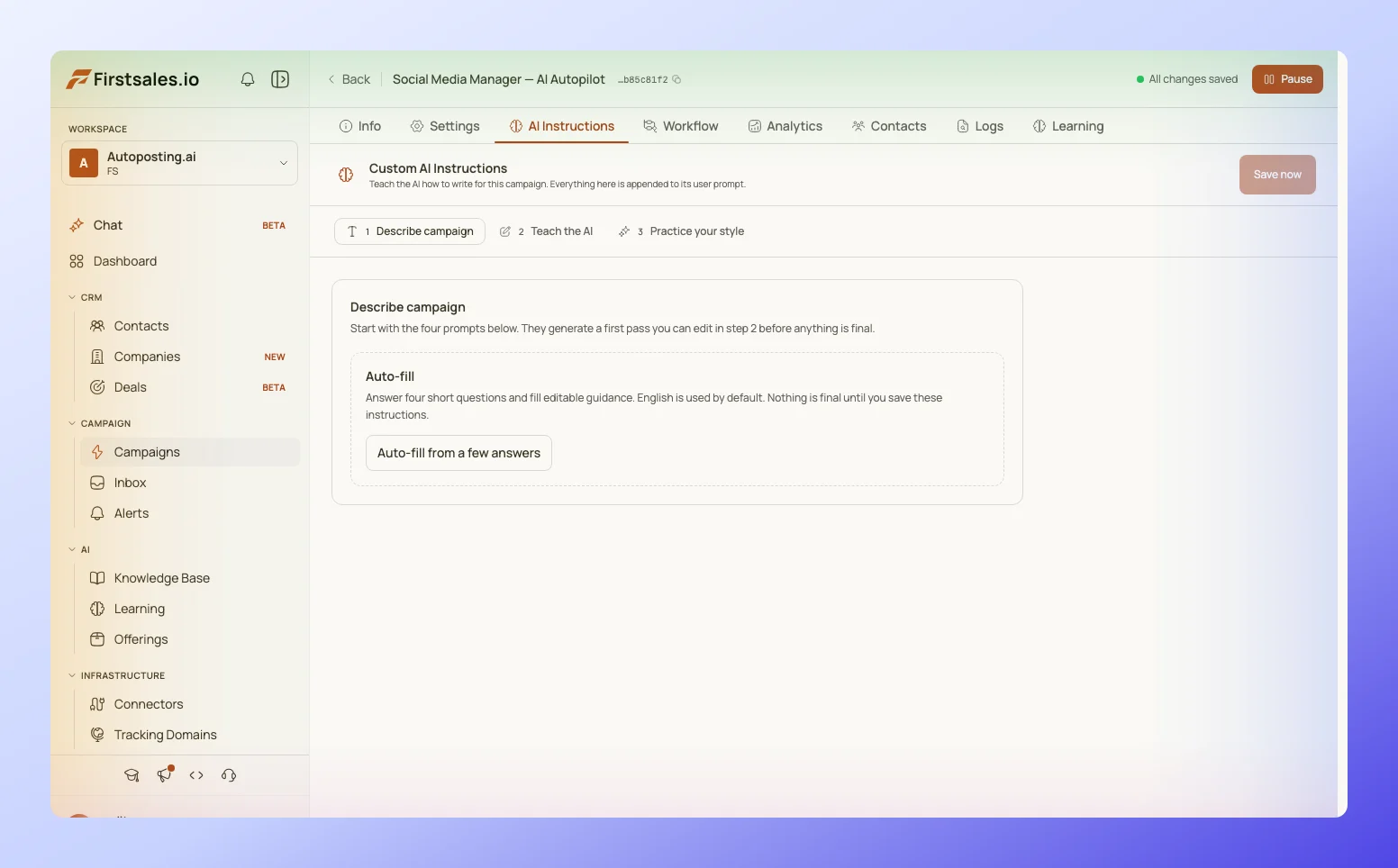 AI draft approval screen showing a human reviewing an outbound email before it sends
That approval screen is where the enterprise motion earns its keep, since a rep can scan the research context the tool assembled and adjust one line before it reaches a stakeholder who only gets one first impression.
For SMB volume, that same human-in-the-loop step is lighter touch, mostly a spot check rather than a line-by-line review, because the cost of one bad email is a lot lower.
#How to decide your own split
Start with your actual ACV distribution, not your target market slide.
Pull your last 20 closed-won deals and sort them by contract value.
If the top quartile is worth more than 10 times the bottom quartile, you likely have two different outbound motions hiding inside one team, and they need different effort allocations, not one blended sequence.
Second, count your actual buying committee size on won deals.
If deals close with one or two signatures, you are running an SMB-shaped motion regardless of company size on the label.
If deals require three or more approvals, you are running enterprise-shaped, and volume tactics will underperform no matter how good the copy is.
Third, look at your sales cycle length.
A cycle under 30 days tolerates and rewards volume.
A cycle over 90 days rewards depth, because the compounding cost of a wasted early touch on a wrong stakeholder shows up months later as a stalled deal, not an immediate bounce.
#Signals that say you are misallocated
Watch for these patterns.
If your SMB reps are spending more than 15 minutes per account on research, they are probably over-investing in a motion where volume is the actual lever.
If your enterprise reps are hitting weekly send-volume targets built for a transactional motion, they are being measured against the wrong scoreboard, and the incentive will push them toward shallow, low-context messages that a real buying committee ignores.
If your reply rates on enterprise accounts sit near your SMB reply rates, something is off, because true enterprise personalization should produce a different, usually higher, reply rate per touch even at much lower volume, given how much context and pre-call research goes into each message.
#A hybrid model that actually works
Most companies selling into both segments run one team with one playbook, which is the root of the misallocation.
A cleaner split assigns dedicated capacity: a volume-focused pod running SMB with automation doing most of the research and drafting, and a smaller depth-focused pod running enterprise with automation handling research assembly while a human owns the sequencing strategy and every send.
The volume pod should be measured on pipeline generated per rep per week.
The depth pod should be measured on accounts meaningfully engaged and stakeholders reached, not on emails sent.
Reporting the same metric across both pods guarantees someone looks unproductive who is not, and that manager perception problem is often what kills enterprise programs before they get the runway to prove out.
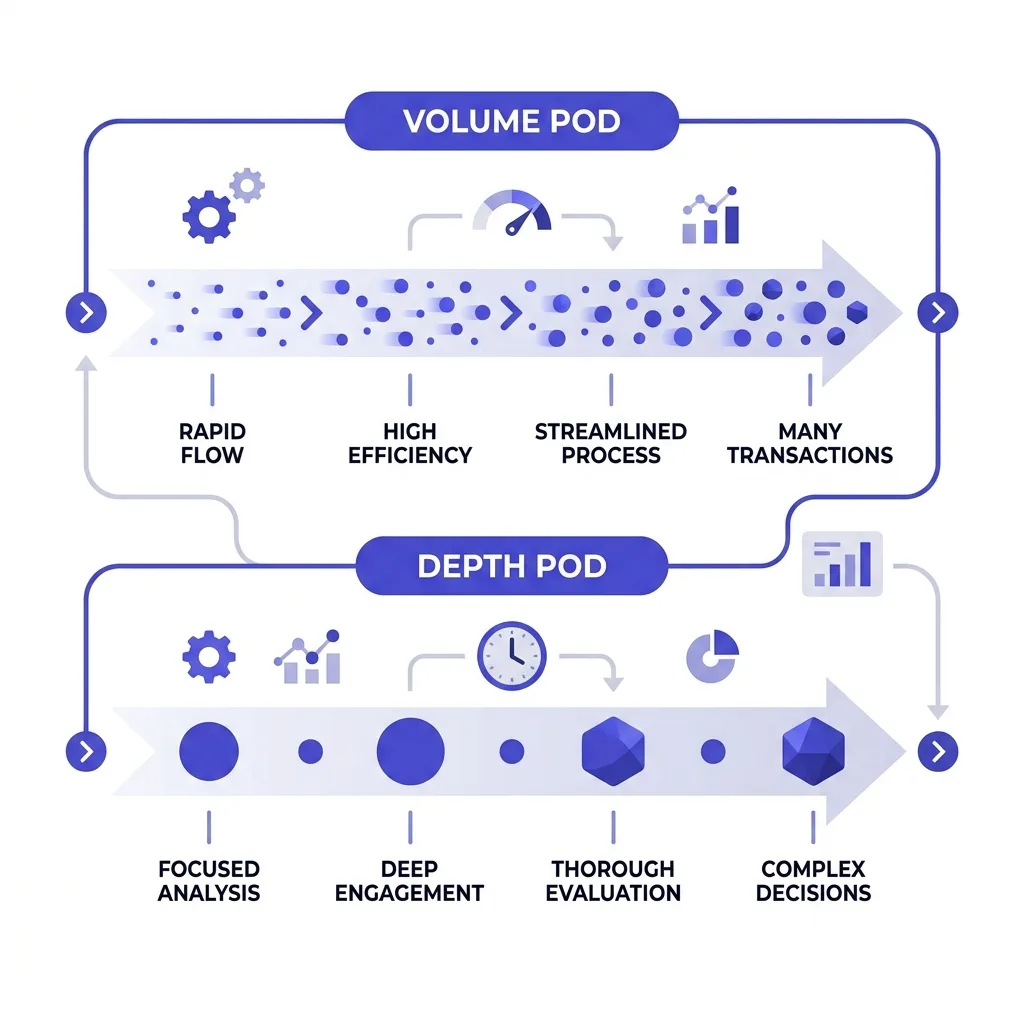 Two outbound pods split by volume and depth with separate metrics for each
#What changes as your ACV grows
As a company's average deal size grows over time, usually through moving upmarket, the correct effort split should shift with it.
A company at $6,000 ACV should run mostly SMB-style volume outbound.
The same company two years later at $60,000 average ACV, having moved upmarket, needs to shift a meaningful share of outbound capacity toward the depth model, even if the absolute account count served drops.
Teams that do not make this shift keep running volume plays against buying committees that need depth, and the reply rate decay looks like market fatigue when it is actually a mismatch between motion and account type.
Revisit the split at least twice a year, tied to a real look at your closed-won ACV distribution, not a gut feeling about which segment "feels" like the growth story.
Teams running FirstSales across both motions usually keep the tagging simple: one campaign type for volume accounts, one for depth accounts, so the review workload and the reporting match the actual work being measured.
#FAQ
#Is enterprise outbound always worth more effort than SMB?
Not always. It depends on your ACV multiple between segments. Run the math in this article with your own numbers before assuming enterprise wins.
#How much research time should an SMB account get?
Typically 2 to 5 minutes using firmographic and technographic data, enough to personalize one or two lines without slowing down volume.
#How much research time should an enterprise account get?
Commonly 2 to 4 hours per account before the first outreach touch, covering company situation, buying committee mapping, and role-specific context.
#Why does enterprise outbound feel slower even when it is working?
Because the feedback loop is longer. Replies and meetings take weeks to show up, while SMB volume produces visible replies within days.
#What is the biggest mistake companies make mixing the two motions?
Measuring both segments on the same metric, usually emails sent, which punishes enterprise reps who are doing the right amount of research per account.
#Should the same rep handle both SMB and enterprise outbound?
It is possible at small scale, but the two motions reward different daily habits, and most teams get better results splitting into dedicated pods once volume allows it.
#How many stakeholders does an enterprise deal usually need?
Commonly 6 to 10 people across the economic buyer, technical evaluator, end users, procurement, security, and legal, though this varies by industry and deal size.
#Does AI automation help enterprise outbound the same way it helps SMB?
Partially. AI speeds up the research assembly step for both, but enterprise sequencing and stakeholder judgment still benefit heavily from human review before each send.
#What reply rate should I expect on enterprise cold outreach?
There is no single verified industry figure for enterprise-specific reply rates; expect it to vary widely by account fit and personalization depth, and track your own baseline rather than benchmarking against a generic number.
#How do I know if my segment split is wrong?
Sort your last 20 closed deals by contract value. A wide spread between the top and bottom quartile signals two motions hiding inside one team.
#Is volume ever the right strategy for enterprise accounts?
Rarely for the initial outreach. Volume can work for later-stage nurture touches to a buying committee that already knows you, but not for cold first contact.
#Why do SMB reply rates look better than enterprise reply rates?
Lower stakes and fewer approvals mean a prospect can respond quickly without checking with anyone else, which shortens the decision to reply at all.
#How long should an enterprise sales cycle run before I call a deal stalled?
This varies by industry and deal size, so use your own historical median cycle length rather than a generic number, and flag a deal only once it exceeds that median by a meaningful margin.
#Can a small company run an enterprise-style motion?
Yes, if the target ACV justifies the research time per account. Company size selling is less relevant than target account size and buying committee complexity.
#What is the fastest way to test which motion fits a new segment?
Run a small controlled batch, described in our piece on validating a segment before scaling, before committing a full team's capacity to either playbook.
#Does deal size alone decide the right motion?
No. Deal size combined with buying committee size and sales cycle length together determine whether volume or depth wins for a given segment.
#How do I stop managers from misjudging a depth-focused pod as unproductive?
Report on accounts meaningfully engaged, not raw send volume, and set that expectation with leadership before the pod starts, not after the first quiet week.
#Should account tiering apply within the enterprise segment too?
Yes. Not every enterprise account deserves the same research budget. See our guide on account tiering for outbound for a scoring approach.
#What tools help most with the enterprise research burden?
Tools that assemble account and stakeholder context automatically save the most time, since the mapping step, not the writing step, is where enterprise hours actually go.
#Is it worth running both motions if my company only serves one segment today?
No. Build the discipline for the segment you actually sell into now, and add the second motion only when your ACV distribution shows a real second segment forming.
#Conclusion
The hours look similar on a spreadsheet.
Two hundred and fifty light-touch accounts and ten deep-research accounts can both fill a forty-hour week.
What decides whether that week was well spent is the deal size waiting on the other end, the size of the buying committee standing between you and a signature, and whether your team is measuring the right thing for the motion it is actually running.
Do the math on your own ACV distribution before you decide where the next quarter's effort goes.
The answer is rarely as close as it feels day to day.