**TL;DR: A job change is one of the highest-converting signals in B2B cold email. New executives evaluate new vendors 3-5x more often than incumbents and initiate technology decisions within their first 90 days. There are two distinct plays - follow your champion to their new company, or catch an incoming decision-maker before they settle into their predecessor's stack.
Signal-personalized job-change emails achieve 18% reply rates versus 3.4% for generic outreach. The plays, templates, timing rules, and automation setup are all below.**
#Why the 90-Day Window Is Real
When someone new steps into a VP, Director, or C-suite role, the clock starts immediately. The board, the CEO, or their own ambition is watching. They need to demonstrate momentum.
They audit what the previous person built, decide what stays and what goes, and start bringing in solutions that match how they like to work.
This is not theory. Research from UserGems found that new executives initiate technology evaluations three to five times more often in their first year than incumbents holding the same seat. A separate analysis of enterprise software purchases showed that a majority were preceded by a related leadership change within the previous 90 days.
The new executive arrives with their own tool preferences, their own performance targets, and - critically - a mandate to improve on whatever came before.
The buying window is not evenly distributed across those 90 days. Most practitioners who work job-change signals break the timeline into three recognizable phases.
Days 1 through 30 are the listening phase. The new exec is orienting - building relationships, assessing the team, reading through whatever internal documentation exists. They are curious about what vendors are in the mix, but they are not making decisions yet.
Cold outreach during this window needs to be soft and awareness-oriented.
Days 31 through 60 are the evaluation phase. The exec now has enough context to form opinions. They know what is working and what is painful.
They are starting to have conversations with vendors and asking for demos. This is the highest-leverage window for a first meaningful outreach. Reaching them here means you land in their inbox during active consideration.
Days 61 through 90 are the decision phase. Evaluations are wrapping up. Budgets are being committed.
If you have not had a conversation by day 60, you are fighting uphill. You are now competing against someone who got in earlier and already has a relationship.
After 90 days, the window does not slam shut, but it narrows significantly. The new executive has started to build their own stack and preferences. Displacing a vendor they just chose is harder than being the option they chose in the first place.
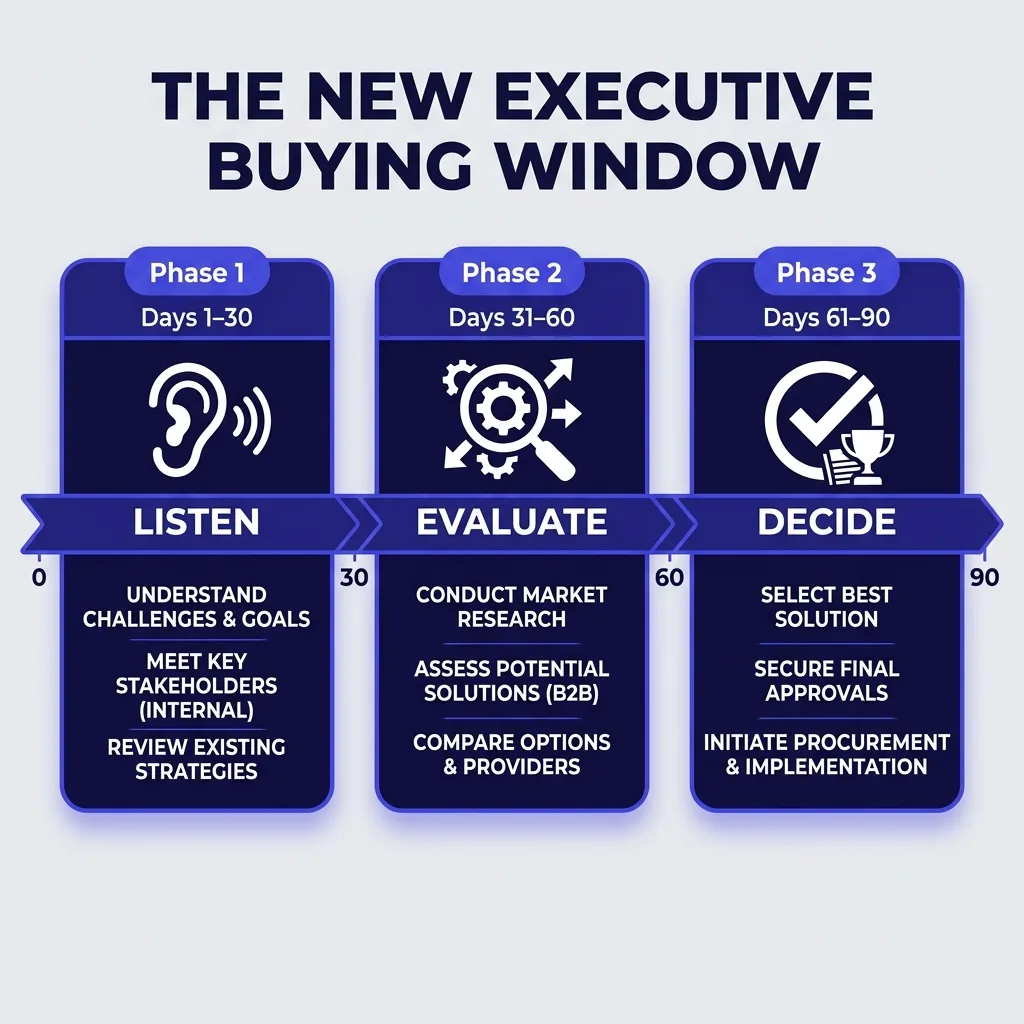 90-day window phases for new executive vendor evaluation
Cold email benchmarks in 2026 put the average reply rate at 1 to 5% for untargeted outbound. Signal-personalized emails anchored to a job change hit 18% reply rates in head-to-head comparisons. Stack the job-change signal with another signal - a hiring surge at the new company, or a funding round that predates the hire - and reply rates climb toward 25 to 40%.
That difference does not come from better writing alone. It comes from reaching the right person at the right moment with a message that connects to something real happening in their world.
This is what makes job change trigger emails different from most cold email. The signal does most of the heavy lifting. Your job is to not ruin it.
Understanding this signal-based approach fits squarely into signal-based cold email strategy, where timing and relevance replace volume as the engine of results.
#The Two Job-Change Play Types
There are two fundamentally different situations that get grouped under "job-change outreach," and they require completely different strategies, different tones, and different timing.
The first play is following your champion. You had a relationship with someone at a company - they were a user, an advocate, a buyer, or even just someone who evaluated your product and liked it. They just moved to a new role at a different company.
You reach out to reconnect and introduce your product to their new environment.
The second play is catching the incoming buyer. Someone just joined a company that is already in your target account list, or fits your ICP perfectly. You have no prior relationship with them.
They are new to their role, and you want to reach them before they settle into the existing vendor stack.
Both plays are legitimate. Both work. But conflating them leads to generic outreach that fits neither context well.
The rest of this article will treat them separately.
#Play 1 - Follow Your Champion
A champion is anyone who had a meaningful, positive interaction with your product or your company. This includes:
- Customers who actively used your product at a previous employer
- Champions who advocated internally for your tool even if the deal never closed
- Prospects who went through a detailed evaluation and expressed genuine interest before budget ran out or priorities shifted
- Power users who gave strong referrals or case study material
When a champion moves to a new company, they carry institutional knowledge of your product that no cold prospect has. They understand your value proposition without needing to be educated. They know what problems your product solves.
And in their new role, they often have more budget authority and more mandate to make changes than they did in their previous position.
Champion tracking data from UserGems reports that having a prior champion in the buying group increases your probability of closing a deal by 114%. Their analysis of champion-led deals shows close rates around 3x higher than comparable cold opportunities. The champion is essentially a pre-sold internal advocate - the only task is getting them re-engaged with your product in the context of their new situation.
The psychology of following a champion is important. This is not a cold email in the traditional sense. It is a warm reconnection.
The person knows you, or at least knows your product. The opening of your email should reflect that. Referencing the history directly - without being presumptuous about it - creates immediate context and goodwill.
The key risk in following a champion is moving too fast. Some champions land in a new role and immediately want to re-implement tools they loved. Others need weeks to assess the existing environment before they can advocate for new spend.
The first email should open a conversation, not push for a demo.
Let them tell you where they are.
A secondary risk is assuming that what worked at their previous company will automatically fit their new one. A champion who used your sales engagement platform at a 50-person startup may have moved to a 2,000-person enterprise with existing contracts, security reviews, and procurement processes. Acknowledge that the context is different and ask questions before you pitch.
#Play 2 - Catch the Incoming Buyer
This play has nothing to do with prior relationships. A new leader just stepped into a role at a company that matches your ICP. You have never spoken with them.
Your job is to reach them during the evaluation window - ideally between days 30 and 60 - before they have cemented their vendor preferences.
The advantage of this play is timing, not familiarity. You are not relying on a prior relationship. You are relying on the structural reality that new executives change vendors and you are showing up at the right time.
This play requires sharper research than the champion play, because you do not have a relationship doing any of the heavy lifting. You need to understand:
- What the company looks like and what pain points are visible from the outside
- What the new exec's background suggests about their priorities (their previous employer, their LinkedIn activity, their stated areas of focus)
- What the prior person in this role was known for, and where the gaps might be
The tone of this email is not "I know you" - it is "I know what you're walking into." Position your outreach around the challenges that are predictable given their role, their company's situation, and the transition they just made.
One reliable angle: new executives in revenue-facing roles (VP Sales, CRO, Head of Marketing) almost always arrive to find that the existing outbound motion is either underperforming or not instrumented well. If your product addresses outbound quality, pipeline generation, or signal-based prospecting, you have a natural hook.
Connecting this play to other signals sharpens it further. A new VP of Sales who joined a company that is also actively using hiring signals for outbound - posting sales rep roles, for example - is a company in growth mode with budget to spend. A new exec at a company that just raised a Series B combines two powerful signals.
The funding round cold email play and the job-change play can be run in parallel or combined into a single message.
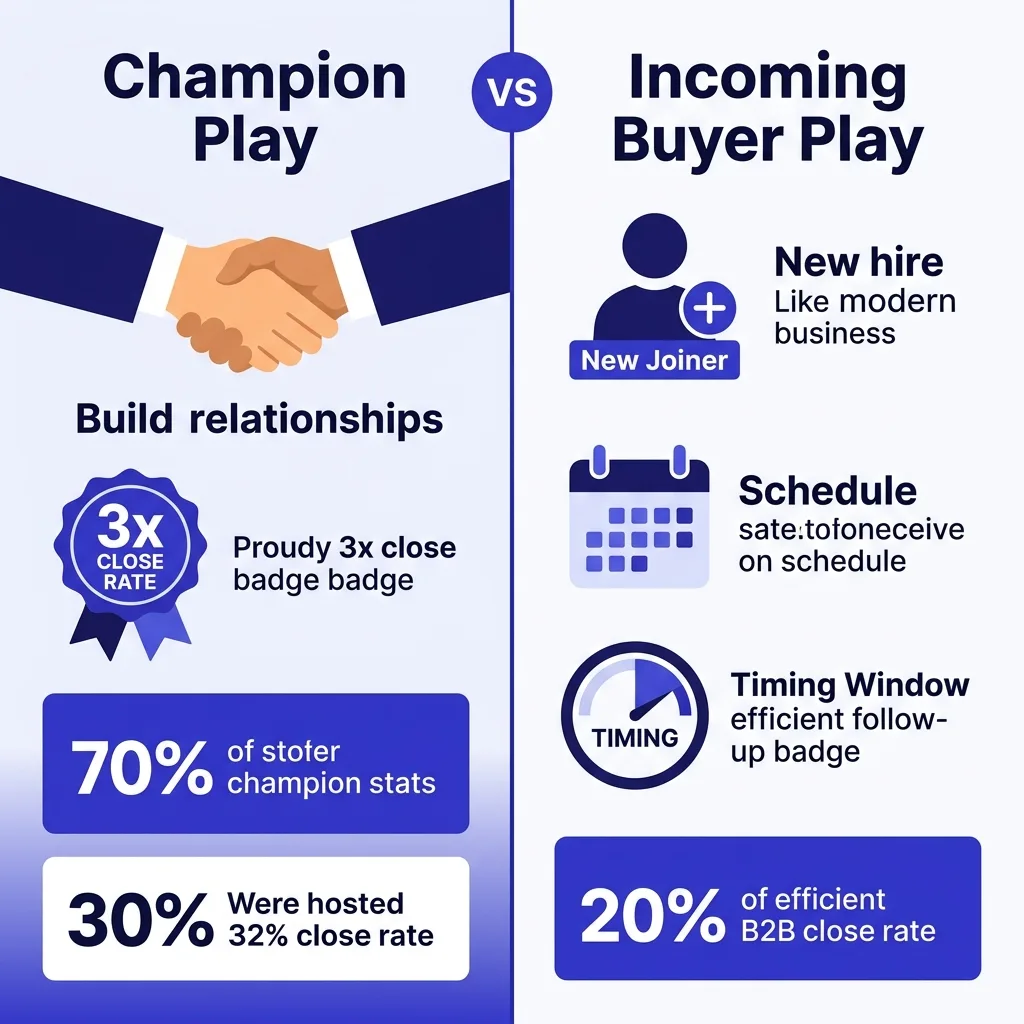 Champion tracking versus new buyer prospecting play comparison diagram
#How to Track Job Changes at Scale
Manually monitoring LinkedIn for job changes across hundreds of target accounts is not a sustainable process. There are several categories of tooling that automate this.
CRM-native alerts. Most modern CRMs can trigger workflows when a contact's title or company field changes. The limitation is that this only works if someone is already in your CRM and has a LinkedIn connection that feeds the data.
Dedicated champion tracking tools. Tools like UserGems, Champify, and Surfe monitor your CRM contacts and existing customer base for job changes, then automatically create new records at the new company and alert account owners. These are purpose-built for the champion play.
Enrichment and signal aggregation platforms. Tools like Clay can pull job change signals from LinkedIn data providers (Proxycurl, PDL, Coresignal) and route them into sequences automatically. This works for both the champion play and the incoming-buyer play when you are monitoring target account lists.
LinkedIn Sales Navigator. The "Job Change" filter in Sales Navigator lets you search for people at target accounts or in target roles who have changed positions in the last 90 days. This is a manual but effective starting point for building lists.
Alert-based monitoring. Google Alerts on executive names, LinkedIn notifications from your first-degree connections, and news monitoring tools can surface job changes for senior leaders who are likely to be announced publicly.
For most B2B sales teams running job-change outreach at meaningful scale, the workflow looks like this: a signal aggregation layer (Clay or a similar tool) monitors a defined set of contacts and companies, enriches job change events with current role and contact information, and routes them into a CRM with an automated sequence trigger or an account owner alert depending on deal size.
The faster you act on a job change signal, the better. Reply rates for job-change outreach drop measurably after 30 days from the detected change. After 60 days, the contact is no longer "new" in a meaningful sense and the signal has substantially decayed.
Speed to lead matters here just as much as it does in inbound. The speed-to-lead data for outbound consistently shows that being first into a conversation dramatically raises the probability of winning it. The same logic applies to job-change signals.
#Timing Table - When to Send What
The right message depends heavily on where the new executive is in their 90-day arc. Sending a product demo request on day 3 is as likely to annoy as it is to convert. Sending a soft awareness email on day 75 is leaving money on the table.
| Days Since Job Change | Executive Phase | Recommended Action | Goal |
|---|---|---|---|
| 1 - 7 | Orientation | Congratulations + awareness only | Plant the flag, do not sell |
| 8 - 21 | Early listening | One soft value email, no ask | Establish relevance |
| 22 - 45 | Evaluation opening | First direct outreach with specific angle | Book discovery call |
| 46 - 75 | Active evaluation | Follow-up sequence, case study, proof | Push toward demo |
| 76 - 90 | Decision phase | Urgency + social proof | Close the conversation |
| 91 - 180 | Post-window | Standard nurture cadence | Remain visible |
The congratulations message in the first week deserves special attention. A short, genuine note acknowledging the new role - with no ask at all - does something that most cold email fails to do: it creates a positive association before you need anything from them. The bar is low because almost no one sends this kind of message without an agenda attached.
Doing it authentically puts you in a different category in the contact's memory.
By the time you send your first substantive email in the evaluation window, the person may already have a dim memory of your earlier message. That memory does real work.
For the champion play specifically, the timing rule shifts. You can move faster because the relationship provides context. A champion who loved your product does not need you to wait 30 days before reaching out.
A same-week message celebrating the new role and noting that you would love to reconnect is entirely appropriate.
#Email Templates for Each Play
The templates below follow the core rules of buying signals for cold email - they are specific, short, and tied directly to the signal.
#Champion Follow Play - Week 1
Subject: Congrats on the [Company] role
Hi [Name],
Saw the news about your move to [New Company] - congratulations. Well deserved.
We worked together briefly when you were at [Previous Company] - you were evaluating [your product category] at the time. Not reaching out to pitch anything. Just wanted to say congrats and mention that if you ever want to pick up where we left off, I am easy to find.
Good luck with the transition.
[Your name]
#Champion Follow Play - Days 22-45
Subject: Getting [New Company]'s outbound off the ground
Hi [Name],
Hope the first few weeks have been good. You are probably deep in figuring out what is working and what needs fixing at [New Company].
When you were at [Previous Company], one of the things we talked about was [specific pain point]. That tends to follow people from one role to the next.
Happy to do a quick 20-minute call to show you what we have built since then - things have moved. Would that be useful?
[Your name]
#Incoming Buyer Play - Days 22-45
Subject: New to [Company] - one thing worth knowing
Hi [Name],
Congrats on the [Title] role at [Company]. I have been following [Company] for a while - you are joining at an interesting time given [specific relevant context: recent growth, product launch, funding, etc.].
One thing I have heard from other [their function] leaders coming into new roles is that [relevant pain point that is predictable given their situation]. We help [ICP description] solve exactly that.
Worth a 20-minute conversation in the next few weeks while you are still shaping your approach?
[Your name]
#Incoming Buyer Play - Fallback (Day 50-60)
Subject: Following up - [specific angle]
Hi [Name],
Reached out a few weeks back when you first joined [Company]. Understand things are busy during onboarding.
We work with [similar companies or roles] on [specific outcome]. If [pain point] is on your radar as you build out your plan, I would be happy to share what we have seen work.
Either way, congrats again on the new role.
[Your name]
The templates are short on purpose. New executives receive a lot of email. A message that reads like a press release will be deleted.
A message that is clearly written by a human, references something specific, and asks one small thing has a reasonable chance of getting a reply.
#What to Avoid
Most job-change outreach fails not because the signal is wrong but because the execution undermines the timing advantage.
Do not over-reference the job change. Mentioning the transition once is human. Building the entire email around "I noticed you just joined..." and then making it about you feels surveillance-like to the reader. Let the signal inform your timing and angle - do not make it the centerpiece.
Do not lead with product. The first email in the champion play is a reconnection. The first email in the incoming-buyer play is an introduction. Neither one should open with a feature list or a demo request.
Get permission for the conversation first.
Do not assume the previous tool stack was broken. New executives do not always arrive to fix disasters. Sometimes they are upgrading a function that is already working. If your pitch assumes they inherited a mess, you will lose credibility fast with someone who knows the previous state was fine.
Do not flood the contact with multiple emails in week one. One congratulations message is appropriate. A follow-up sequence starting three days later reads as automated and erases the goodwill the first message generated. Let the first message breathe.
Do not ignore the company context. A new VP of Sales at a 10-person startup and a new VP of Sales at a 500-person company are in fundamentally different situations. The signal is the same; the message needs to be different. Do the extra five minutes of research.
Do not skip enrichment verification. LinkedIn data on job changes can lag by days or weeks. Before sending, verify that the contact actually started their new role. Congratulating someone on a job they left three months ago is worse than not reaching out at all.
These pitfalls are well-documented in cold email personalization research. The patterns that make outreach feel robotic rather than human apply with extra weight when the recipient knows you are working a trigger.
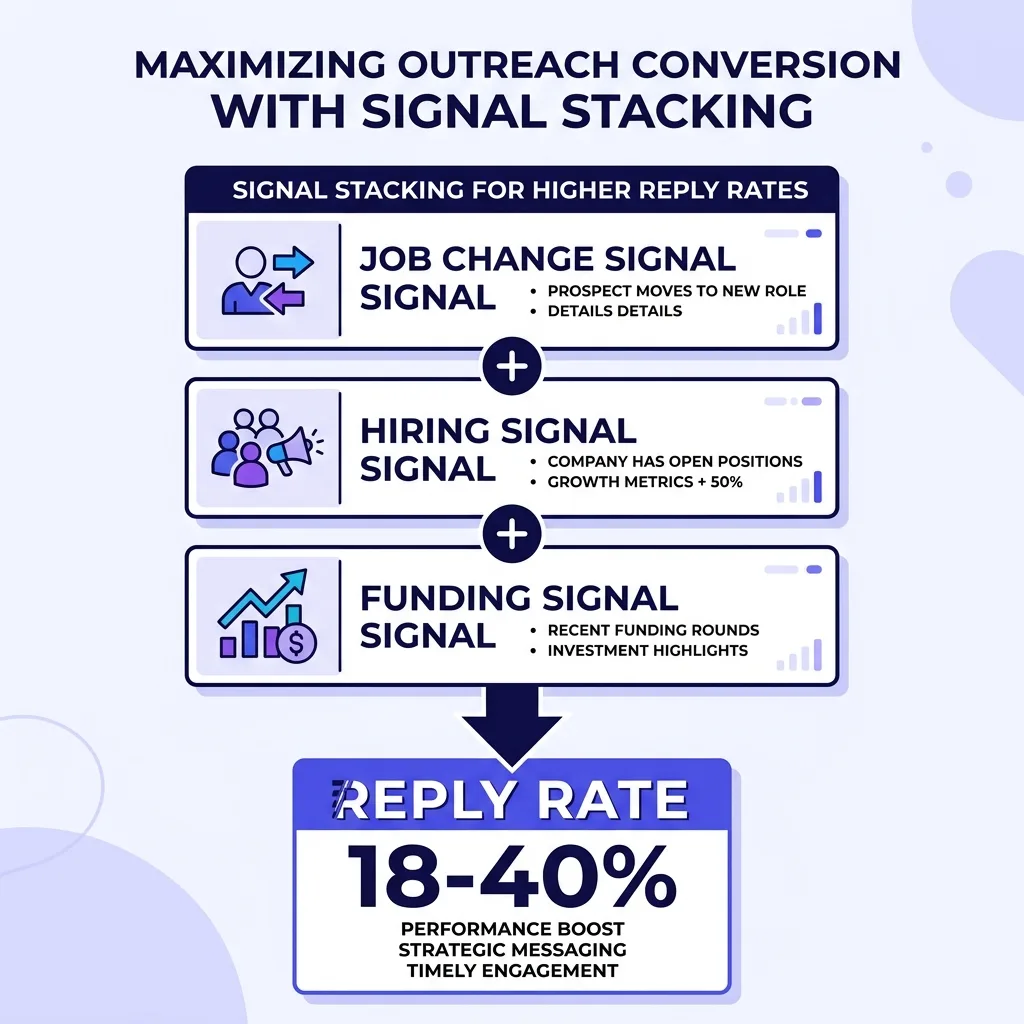 Infographic of timing, signal types, and email play mapping for job-change outreach
#Connecting Job-Change Signals to Other Triggers
Job change signals work well in isolation, but they compound with other signals. The best job-change campaigns in 2026 are not running the signal by itself - they are layering it against account-level context to sharpen both the targeting and the message.
Job change plus hiring activity. When a new VP of Sales joins a company and the company is also posting SDR and AE roles aggressively, that company is building out a sales team. Budget is allocated. The new leader has a mandate.
Any product that helps sales teams perform - outbound tools, enablement platforms, data providers - has a natural opening. The hiring signal for outbound is a companion signal that validates the job-change opportunity.
Job change plus funding. A company that just raised a round and hired a new leader is in build mode. The combination of a fresh executive mandate and new capital is about as strong an account signal as exists in B2B. A funding round cold email strategy that also incorporates the new executive's arrival is targeting an account at its most receptive moment.
Job change plus intent data. Third-party intent data from providers like Bombora can show that the new executive's company is actively researching topics relevant to your category. If a new VP of Sales just joined a company that is consuming content about "sales engagement platforms" and "outbound automation," the intent signal tells you they are already in buying mode. Your job-change-triggered email arrives in a context where the company is actively looking.
Job change plus speed. The speed-to-lead principle applies directly here. Reaching a new executive in week two versus week eight is not a marginal difference - it is often the difference between shaping their thinking and competing against a vendor they already chose.
Running these signals through a tool like Clay means you can score and prioritize job-change events by the number of signals stacked. A new VP of Sales with no other signals gets one sequence. A new VP of Sales at a funded, hiring, intent-positive account gets a different, higher-priority treatment.
This layered signal approach is a core part of what modern AI SDR platforms do automatically - scoring inbound leads and triggering the right outreach play based on signal combinations rather than static lists.
#Measuring and Iterating
Job-change outreach is measurable in ways that most cold email is not, because the signal creates a natural cohort. Every contact who entered your sequence via a job-change trigger is trackable against contacts who entered via other means.
The metrics worth watching:
Reply rate by play type. Champion play should outperform incoming-buyer play on reply rate. If it does not, you may have a sourcing problem - the contacts classified as "champions" may not actually have a meaningful prior relationship.
Reply rate by time-since-change. Track whether contacts who entered the sequence within 14 days of a job change reply at higher rates than those who entered at 30 or 60 days. This validates the 90-day window assumption for your specific market.
Meeting rate versus reply rate. High reply rates that do not convert to meetings suggest the opening is compelling but the follow-up or qualification is failing. Low reply rates with high meeting conversion suggests the sequence is too short.
Outcome by role type. A new VP of Sales may respond differently than a new Head of Marketing or a new IT Director. Track conversion rates by the type of executive you are targeting to learn where your strongest job-change plays are.
Champion close rate versus cold incoming-buyer close rate. If champion-sourced pipeline is closing at 2-3x the rate of incoming-buyer pipeline, that tells you where to concentrate your tracking and tooling investment.
Most teams that start running job-change outreach discover within 90 days that it outperforms their standard outbound sequences on nearly every metric. The iteration work then shifts from "does this signal work" to "which combinations and timings work best for our ICP."
The data from these campaigns also feeds back into your broader signal intelligence. Knowing which job-change scenarios convert helps you build the account prioritization logic that makes your entire outbound system smarter over time. That kind of compound learning is one of the structural advantages of signal-based cold email over volume-based approaches.
#FAQs
#How long does the 90-day window actually last for different roles?
The 90-day figure is an average, and it varies by role level and company size. C-suite executives at larger companies often have longer evaluation windows - sometimes 120 to 180 days - because their decisions involve more stakeholders, longer procurement cycles, and larger contracts. Director-level executives at growth-stage companies tend to move faster, sometimes making vendor decisions within 45 to 60 days.
The 90-day framing is a useful default, but adjust your sequencing cadence based on the deal complexity typical for your market.
#What is the best way to find job change signals without expensive tooling?
LinkedIn Sales Navigator's "Job Change" filter is the most accessible option. You can filter by title, company size, and time period to surface recent role changes. Google Alerts on executive names at target accounts is a free complement for senior-level moves that get press coverage.
For previous customers and prospects already in your CRM, a weekly export and comparison of job title fields can surface changes before automated tools do. None of these scale as well as purpose-built champion tracking software, but they are viable for teams running smaller volumes.
#Should I reach out to the executive's new company even if it is outside my ICP?
Generally, no. The job-change signal does not override ICP fit. A champion moving from a well-qualified account to a two-person startup is not a buying opportunity in most cases.
Filter your champion tracking by the ICP qualification of the new company before routing into a sequence.
Some teams maintain a lighter-touch champion nurture sequence for out-of-ICP moves - a brief congratulations with no ask - just to maintain the relationship for when they move again.
#How do I handle it if my champion is now at a competitor?
Congratulate them and keep the relationship warm, but do not pitch your product. The relationship itself has long-term value. People move multiple times over a career.
A champion who is at a competitor today may be at a perfect-fit account in 18 months. Sending a genuine congratulations with no agenda is the right move and reinforces that you care about the person, not just the deal.
#What if I find out about a job change weeks after it happened?
Use the timing table above. If you are discovering the change at day 45, go directly to the evaluation-phase email rather than starting with the congratulations message. Sending a congratulations note at day 45 reads as hollow and automated.
Acknowledge where they are in the transition and focus the message on their current evaluation context rather than the change itself.
#How does job-change outreach fit into a broader signal-based strategy?
Job changes are one of several high-value trigger signals, alongside funding rounds, hiring surges, technology stack changes, and intent data. The best outbound teams build a signal scoring system that weights multiple signals simultaneously. A contact who triggers a job-change signal alone gets one treatment; a contact who triggers three signals simultaneously gets a higher-priority, more personalized treatment and faster follow-up.
Job-change signals tend to be strongest for the champion play and work best in combination with account-level signals for the incoming-buyer play.
#Conclusion
The 90-day window after a job change is one of the most reliable buying triggers in B2B outbound. New executives arrive with mandates to improve, preferences shaped by what worked before, and a window where vendor decisions are genuinely open. Signal-personalized outreach during this window achieves reply rates of 18% or higher - compared to 1-5% for generic cold email - not because the writing is better, but because the timing is right.
There are two plays. Follow your champion to their new company, where the prior relationship gives you an enormous head start. And catch the incoming buyer during the evaluation phase, where showing up early and relevant gives you positioning advantage over everyone who reaches out after the stack is set.
Both plays require good sourcing, fast execution, and messages that are built around the executive's situation rather than your product features. Do not let the signal do all the work and then ruin it with a generic pitch.
If you want to put job-change trigger emails to work without building the tooling from scratch, FirstSales handles signal detection, sequence routing, and sending infrastructure in one place. Start for $1 and run your first job-change campaign this week at https://app.firstsales.io.