**TL;DR: A funding round is one of the highest-value buying signals in B2B sales. Companies that just raised have fresh budget, growth mandates, and active vendor evaluation windows that last 60-90 days. Signal-based emails referencing a specific raise achieve reply rates of 15-25%, compared to 1-3% for generic blasts.
The playbook: find the signal fast (within 48 hours), identify the right buyer, write a short email that connects the raise to a concrete pain, and follow up twice over two weeks. Miss the window and you are competing against five vendors who got there first.**
#Why a Funding Round Is a Buying Window, Not Just News
Most salespeople see a TechCrunch funding announcement and think "cool story." The ones booking meetings see a clock start ticking.
When a company closes a Series A, B, or C, three things happen simultaneously that matter for anyone selling B2B software or services:
Budget gets unlocked. Finance teams that said "not this quarter" six months ago suddenly have capital approved for headcount, tooling, and infrastructure. The number that was aspirational in Q4 is now allocated. Vendor decisions that were stalled get fast-tracked because growth depends on getting the right stack in place before the new hires arrive.
Growth mandates become concrete. Investors don't hand over $10 million or $50 million without a plan for what happens next. That plan almost always involves scaling revenue, expanding into new markets, or building product. Each of those goals requires buying things.
Sales software, marketing tools, recruiting platforms, data providers, legal services, compliance tooling - the list is long and the budget just appeared.
Evaluation windows open. The 90 days post-announcement is when newly funded companies make most of their major software decisions. According to prospecting data from 2025 and 2026, 67% of newly funded companies make at least one major software purchase within 90 days of their funding announcement. After that window closes, budgets are committed, vendors are locked in, and switching costs make everyone defensive.
This is why signal-based cold email consistently outperforms static list outreach by three to five times. You are not interrupting someone with a pitch they did not ask for. You are reaching a buyer who has money and is actively looking at their vendor stack, at the exact moment they need to make decisions.
The alternative - sending the same sequence to an un-triggered list - lands you in an inbox where the recipient has no context, no urgency, and no particular reason to respond today versus never. Funding signals create a "today" where none existed before.
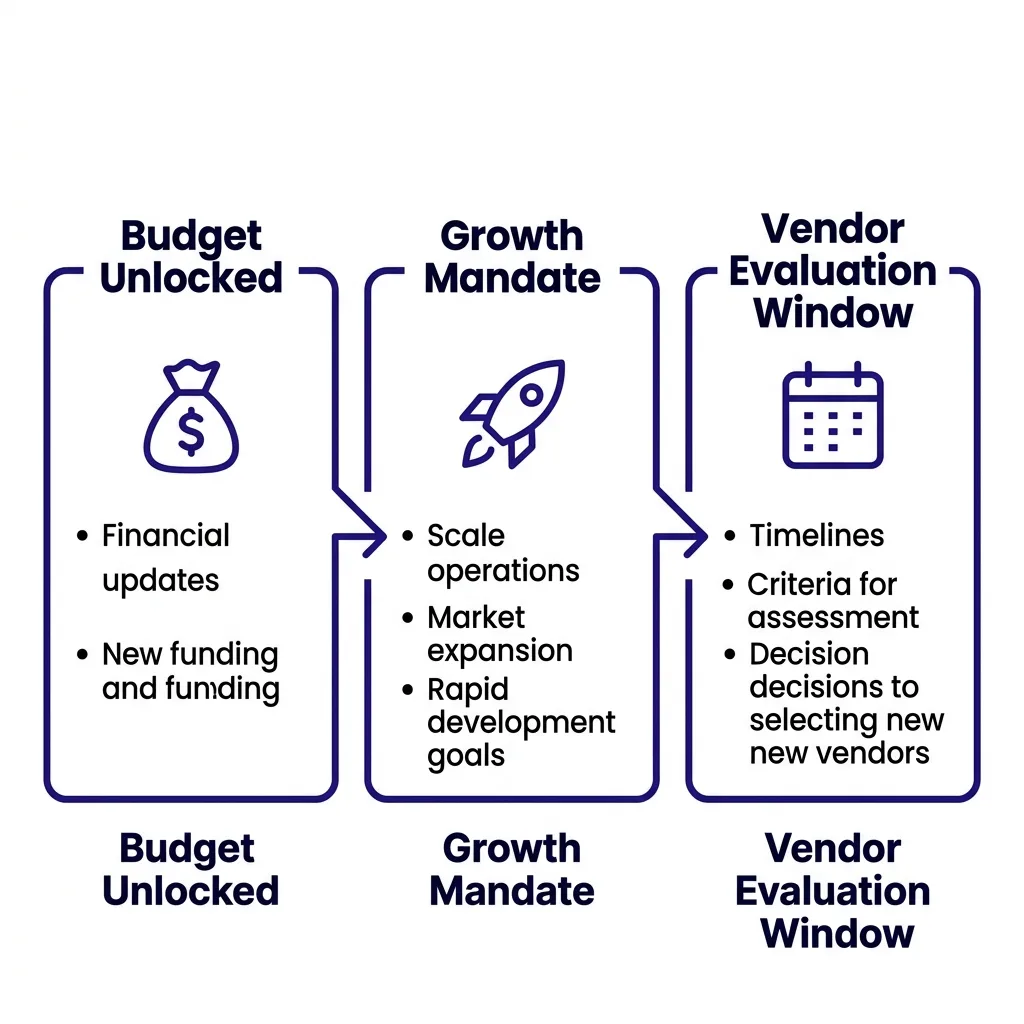 Diagram showing the three forces unlocked by a funding round: budget allocation, growth mandate, and vendor evaluation window
#The 60-Day Clock: Timing Your Outreach
Speed matters more with funding signals than almost any other trigger in outbound sales. Here is why: the first vendor to reach a newly funded company has a 3x higher close rate than the fifth vendor to reach them. When you show up fourth or fifth, you are walking into a process that has already mentally ranked you.
The sweet spot for first contact is within 48 hours of the announcement going public. At that point:
- The founder and leadership team are still celebrating the close
- Press coverage is live and the round is front-of-mind
- Budget conversations are happening right now, not hypothetically
- They have not yet been buried by other outbound (though this window is getting shorter every year)
After 48 hours, reply rates start dropping. After two weeks, you have already missed the initial surge of excitement. After 30 days, the team is deep in execution mode and less receptive to new vendor conversations.
After 60 days, most major decisions are made or in advanced evaluation. After 90 days, the window is largely closed.
That said, the 30-60 day zone is not dead. If you missed the first wave, you can still use the funding context in your email - but you need to frame it differently. Instead of congratulating them on the raise, you reference the growth challenges they are now facing three months in and connect your solution to those specific pressures.
The cadence that works:
- Day 0-2 after announcement: Send initial email (fastest wins)
- Day 5-7: First follow-up (reference something new - a hire posted, a product update)
- Day 12-14: Second and final follow-up (short, one-line breakup message)
Three touches over two weeks, then move on. Do not hammer them weekly for a month. Newly funded companies are legitimately busy, and aggressive follow-up sequences signal that you are not the kind of vendor they want to work with long-term.
#Where to Find Funding Signals Before Your Competitors Do
The best funding round cold email you will ever send is the one that arrives before your competitor's. That means monitoring signals in real time, not checking Crunchbase manually once a week.
Primary sources:
Crunchbase Pro ($29-99/month depending on tier) is the most comprehensive database for startup funding. You can filter by funding stage, industry, geography, and date range, then set up email alerts when companies matching your ICP close rounds. The alert latency is usually 24-48 hours after a round is announced publicly.
LinkedIn Sales Navigator is underused for this. The Company Spotlight filter surfaces recently funded accounts if you set it up correctly. Filter by Funding in Past 12 Months under Spotlights, combine with your ICP filters (headcount, industry, geography), and you get a working list of warm accounts.
Set saved search alerts so new companies matching the criteria hit your queue automatically.
Secondary sources:
TechCrunch, VentureBeat, and The Information cover the larger rounds. For seed and early Series A, AngelList and specialized newsletters like SaaStr, TLDR Tech, and Mattermark Daily often pick up deals before mainstream press does.
SEC EDGAR filings (Form D) are public records that often appear before a company issues a press release. A Form D filing means money has legally changed hands. This gives you a 24-72 hour head start over competitors who wait for the TechCrunch post.
Google Alerts are free and underrated. Set up alerts for "[your target industry] Series A funding" or "[city] startup raised" and you will catch announcements the same day they publish.
Data enrichment tools:
Apollo.io, Clay, and Seamless.ai all surface recently funded accounts and let you filter your ICP simultaneously. Apollo specifically has a "Recently Funded" filter that cross-references Crunchbase data and enriches with contact details, so you can go from "saw the announcement" to "have the VP of Sales email" in one workflow.
For teams doing intent-based prospecting vs static lists, funding signal monitoring is one of the fastest ways to build a continuously refreshing pipeline of accounts that are actually in market.
#Which Rounds Should You Target?
Not every funding round is equally relevant to your outreach. The stage of the raise tells you a lot about what the company is ready to buy and who the right person to contact is.
Pre-seed and Seed ($500K - $3M): Very early. Teams are tiny, founders are doing everything, budgets are tight. Unless you sell a core infrastructure product (CRM, email, dev tools), this is not your best use of effort.
Wait for Series A.
Series A ($3M - $20M): The best target for most B2B software. Series A companies are past product-market fit and now need to scale. They are actively hiring their first sales team, their first marketing hire, and often their first head of RevOps.
This is when they buy the tools those hires need to operate. If you sell sales software, marketing tools, recruiting platforms, HR tech, or anything in the revenue stack, Series A is your highest-intent cohort.
Series B ($15M - $75M): Scaling hard. At this stage, they have a sales team but it is outgrowing its original toolset. They are replacing starter tools with enterprise-grade platforms.
They are adding integrations, compliance requirements (especially if they are moving upmarket), and operational infrastructure.
Larger deal sizes, longer cycles, more stakeholders - but higher ACV if you can get in.
Series C and beyond ($75M+): Enterprise procurement is now involved. Longer cycles, more red tape, and they already have incumbent vendors for most categories. Can still be valuable if you have a specific wedge or a displacement story, but the spontaneous buying window is much smaller than at Series A or B.
Growth equity and debt rounds: Often overlooked, but a company taking on growth equity or venture debt is also signaling active investment in scaling. Worth monitoring for the right ICP.
#How to Write the Funding Round Cold Email
The structure of a high-performing funding trigger email is different from a standard cold outreach sequence. You have one asset your generic counterpart does not have: a legitimate, timely, specific reason for reaching out. Do not bury it.
Subject line: Short and specific. Reference the round directly. Examples:
- "Congrats on the Series B, [first name]"
- "[Company] + [your company] - post-raise timing"
- "Quick question after the [amount] round"
- "Scaling [specific function] after the raise?"
Avoid clickbait, fake familiarity, or anything that sounds like a mass email ("Saw your exciting news!" - delete). Trigger-event subject lines that reference specific events achieve open rates around 54%, compared to 38% for generic subject lines.
Opening line: The single most important sentence in the email. It must prove you actually read about their round and thought about what it means for them - not just that you ran a mail merge against a list of funded companies.
Bad: "Congratulations on your recent funding!"
Good: "Saw the $18M Series A - congrats. A round that size usually means you're about to triple your outbound headcount."
The good version shows you understand their world. It implies context and forces the reader to agree or correct you, both of which create engagement.
The pivot - your relevant angle: One or two sentences connecting the raise to the specific problem you solve. Do not list features. Name the pain that growth-stage companies in their position typically feel, and connect it to the outcome you deliver.
"That kind of growth usually hits the email deliverability stack hard - more domains, more inboxes, more sequences, and suddenly reply rates fall off a cliff."
The ask: Low-friction and specific. "Worth a 15-minute call?" is better than "Let's schedule a discovery call to discuss your needs." Do not ask them to do work to respond.
Length: 60-120 words for the initial email. No exceptions. A newly funded founder or VP getting 50 outbound emails a day will not read your four-paragraph intro.
Short emails read on mobile in five seconds perform better than polished essays.
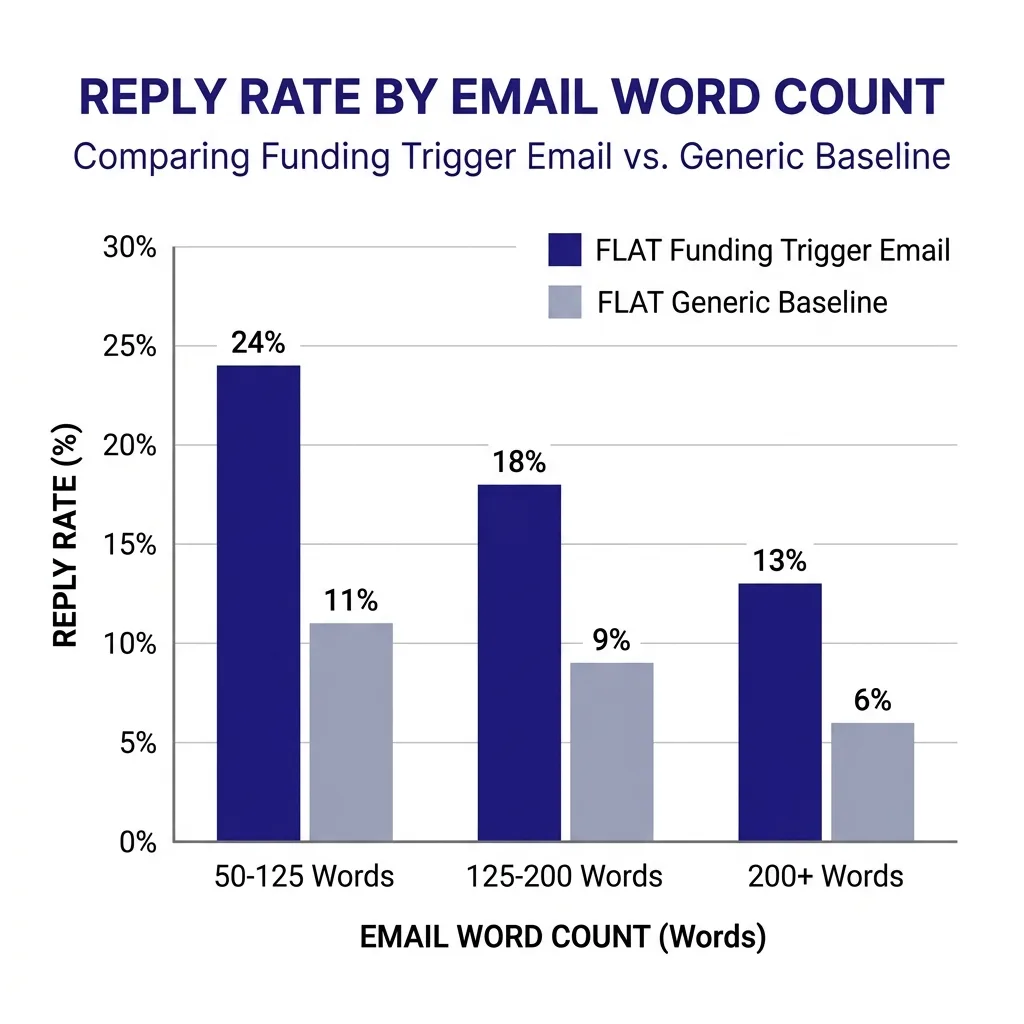 Chart comparing cold email reply rates by email length: 50-125 words (peak performance), 125-200 words (moderate), 200+ words (sharp drop-off), with annotations for funding trigger vs generic baseline
#Funding Round Email Templates (Copy and Adapt)
These are working templates, not hypotheticals. Adapt the specifics to your ICP and product. The key is keeping the opening hyper-specific and the ask minimal.
Template 1: Founder / CEO at Series A
Subject: Congrats on the Series A, [first name]
Hi [first name],
Saw the [amount] round - congrats. Series A usually means the next 90 days are spent standing up the sales and marketing stack you've been putting off.
We help [ICP description] set up cold email infrastructure that doesn't burn domains or tank deliverability when you start scaling sequences.
Worth a quick call this week?
[Your name]
Template 2: VP of Sales at Series B
Subject: [Company] sales stack after the $[amount]M raise
Hi [first name],
Congrats on the Series B. A round that size usually means your current outbound setup is about to hit its ceiling - more reps, more sequences, more domains, and all of a sudden reply rates start sliding.
We've helped [similar company type] rebuild their outbound infrastructure post-raise so the ramp doesn't drag. Happy to show you what that looks like in 15 minutes.
Would [day] or [day] work?
[Your name]
Template 3: Head of Marketing at Series A
Subject: Scaling outbound after the raise - quick question
Hi [first name],
Saw [Company] just closed [amount] - exciting. I work with marketing leaders at Series A companies who are about to 3x their outbound volume and need their email infrastructure to scale with it.
One thing that usually breaks first: domain reputation, once you add more sending accounts without a proper warmup setup.
Open to a 15-minute call on how others in your position have handled it?
[Your name]
Template 4: 14-day follow-up (if no reply)
Subject: Re: [original subject]
[first name] - following up. Still relevant if [Company]'s scaling outbound post-raise.
If not the right time, just let me know.
[Your name]
Template 5: Final breakup email (day 14)
Subject: Closing the loop
[first name] - last note from me. If the timing isn't right for [Company], no hard feelings.
If outbound becomes a priority as you scale, happy to pick this up then.
[Your name]
The breakup email is not optional. It recovers 10-15% of non-replies from people who meant to respond but got buried. The low-pressure framing often triggers replies from prospects who felt guilty ignoring you.
For teams using an AI SDR to draft and sequence these emails, the critical discipline is still human review of each funding-specific opener before it sends. The trigger context needs to be accurate and specific - AI hallucinating the wrong round size or getting the company stage wrong will destroy your credibility instantly.
#Reply Rate Benchmarks: Signal vs. Generic Outreach
The performance difference between signal-based and generic cold email is not marginal. It is categorical.
| Outreach Type | Avg. Reply Rate | Notes |
|---|---|---|
| Generic batch-and-blast | 1-3% | No signal, high volume, low targeting |
| Basic personalization (name, company) | 5-9% | ICP fit, no trigger |
| Advanced personalization (industry pain) | 9-15% | Pain-aware, no specific trigger |
| Funding round trigger email | 15-25% | Specific signal, correct timing |
| Signal stacking (funding + hire + intent) | 25-40% | Multiple concurrent signals |
| Missed window (60+ days post-raise) | 5-10% | Signal still referenced but stale |
The 15-25% reply rate range for funding trigger emails is consistent across multiple data sources for 2025-2026. Instantly's benchmark report shows average cold email reply rates of around 3.4% for untargeted outreach. Snov.io and Autobound data puts signal-based sequences at 3-5x that baseline, which tracks with the 15-25% figures seen in funding-specific campaigns.
These are reply rates, not conversion rates. Meetings booked from those replies depend on the quality of your follow-through, your ICP fit, and how well your product matches the growth stage of the company you are targeting. But a 15% reply rate gives you the at-bats.
A 2% reply rate means you are sending 50 emails to get one conversation.
For broader context on what these numbers mean against 2026 industry averages, see cold email reply rate benchmarks 2026.
#Signal Stacking: Combine Funding With Other Triggers
A funding round is powerful on its own. Combined with a second or third concurrent signal, it becomes the highest-quality outbound trigger available.
Signal stacking means reaching out when a company shows multiple buying signals at the same time. The combination reduces false positives (companies that raised but are not actually in-market for your category) and dramatically increases conversion rates. Teams using multi-signal targeting report sequence reply rates of 8-15% compared to 2-5% for single-trigger approaches.
Funding + hiring: The most common and powerful stack. A company that closed a Series A and has 12 open SDR roles is buying a sales engagement platform. Period.
The job postings tell you exactly what function they are scaling and therefore exactly what pain they are about to feel. See how to layer hiring signal outbound into your prospecting workflow.
Funding + leadership change: A new VP of Sales hired two weeks after a Series A close is in the honeymoon period where they have political capital and a mandate to change things. They are actively auditing the current stack and looking for vendors who can help them hit the board's targets. Job change trigger emails to new executives at recently funded companies are among the highest-performing sequences in B2B outbound.
Funding + technology signal: If a company raised and their job postings list specific tech that competes with or complements your product, that is a direct buying signal. A company hiring "must have experience with Outreach.io" is either planning to replace Outreach or deeply committed to it - either is useful context.
Funding + intent data: Third-party intent data (G2 Crowd, Bombora, TechTarget) showing that a recently funded company's employees are researching your category is about as warm as outbound gets. They are actively comparing options. Your email is an answer to a question they are already asking.
The workflow for signal stacking: Start with your funding signal list (Crunchbase alert, LinkedIn filter, Apollo), then cross-reference against hiring data, then layer in leadership change data, then optionally enrich with intent signals. Each layer reduces the list size but raises the probability of a meeting booked from each email sent.
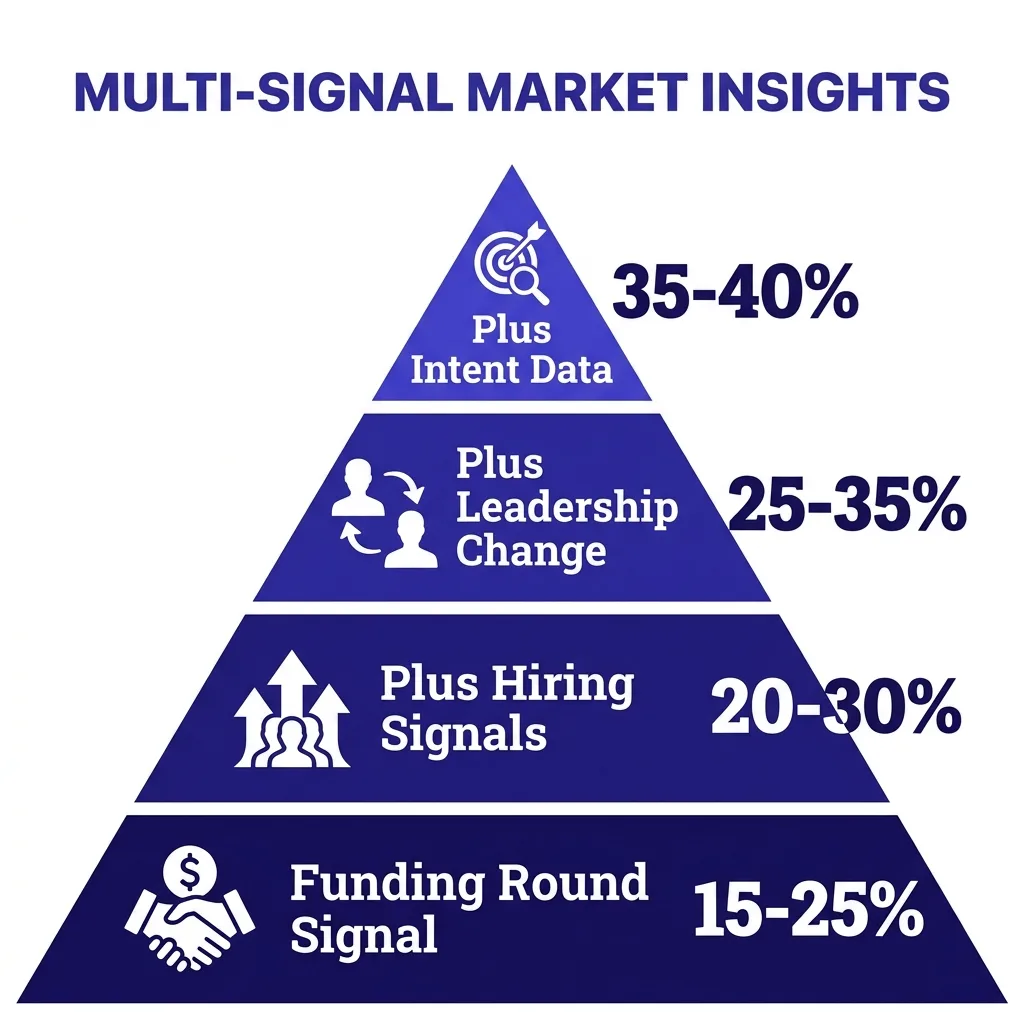 Infographic showing signal stacking pyramid: funding round at base, hiring signals above, leadership changes above that, intent data at apex, with reply rate percentages climbing at each level: 15-25%, 20-30%, 25-35%, 35-40%
#What NOT to Do: Common Mistakes That Kill Replies
Getting the trigger right is half the equation. The other half is not destroying the opportunity with a poorly executed email. These are the patterns that waste good signals.
Referencing the raise and then pivoting immediately to a product pitch. This is the most common mistake. You open with "Congrats on the $20M!" and then the very next sentence is "We help companies like yours with [feature list]." The prospect sees through it instantly.
The congratulations was just a Trojan horse. Lead with the implication of the raise for their specific role, not your product.
Getting the details wrong. If you say "Congrats on the $15M Series B" and they raised $12M in a Series A, you have proven you did not actually read the announcement - you just ran a mail merge. Check the amount, the round stage, and the lead investor. Getting even one of these wrong is worse than not referencing it at all.
Sending too late. Sending a "Congrats on your recent raise!" email six weeks after the announcement with no acknowledgment of the time gap looks lazy and out of touch. If you missed the window, change the angle: focus on where they are now (scaling pains) rather than the announcement itself.
Over-personalizing to the point of creepiness. There is a line between showing you did your research and making someone feel surveilled. Referencing their funding round: great. Referencing their funding round, the co-founder's LinkedIn post from 3am, and the specific hire they made last Tuesday: too much.
One or two specific details are enough.
Writing long emails. Newly funded founders and VPs are among the busiest humans in B2B. An 800-word cold email about their funding round is going to hit archive before the third paragraph. Keep initial emails under 120 words. Every word past that threshold costs you.
Using AI-generated openers without human review. AI tools can draft funding trigger emails at scale, and when they are accurate and specific, they work well. But AI gets company details wrong, invents funding rounds, misidentifies the round stage, or produces openers that are technically correct but tonally flat. Every funding-specific email needs a human eye on the first two sentences before it sends.
The buying signals for cold email are only valuable if the email that references them is credible.
Blasting the entire leadership team simultaneously. Sending the same email to the CEO, CFO, VP Sales, and VP Marketing at the same company in the same week makes you look desperate and disorganized. Pick one target, get a reply or a clear no, then move to a second contact if needed. Multi-threading is a sales motion for active opportunities, not for first-touch cold email.
Ignoring deliverability. The best funding trigger email in the world is useless if it lands in spam. If you are scaling outbound to freshly funded companies, you need proper domain setup, warmed inboxes, and a clean sending reputation before you start. A 0.3% spam complaint rate will get your sending domain flagged regardless of how good your targeting is.
#Building a Repeatable Funding Signal Workflow
One-off funding trigger emails booked from manual Crunchbase checks are better than nothing. A systematic workflow that catches every relevant raise in your ICP and routes it into a sequenced outreach campaign is worth ten times more.
Here is the operational setup that works at scale:
Step 1 - Define your ICP with funding-specific parameters. Not just "B2B SaaS companies" but "B2B SaaS companies raising Series A or B, 10-200 employees, US-based, in categories that need outbound sales tooling." The more specific you are, the higher the signal quality from your alert stack.
Step 2 - Set up multi-source monitoring. Crunchbase alerts (primary), LinkedIn saved search with Funding Spotlight filter (secondary), Google Alerts for target industry + funding keywords (tertiary), and SEC Form D RSS feeds if you have the technical setup. Redundancy matters because no single source catches everything.
Step 3 - Build a triage queue. Funding alerts come in daily. You need a place to capture them (a simple CRM column, a Notion database, or a Clay table) and a daily review ritual (15 minutes every morning) where you evaluate which alerts match your ICP and route them to outreach.
Step 4 - Enrich with contact data. For each qualifying company, identify the right buyer persona (VP Sales, Head of Marketing, RevOps lead - whatever matches your product). Use Apollo, Clay, or LinkedIn Sales Navigator to pull contact data and verify email addresses before sending.
Step 5 - Write or review the opener. Use a template framework (like the ones above) as a starting point, then customize the first two sentences to reference the specific round details. If you are using AI to draft at scale, set a review gate for every funding-specific opener before it enters the sequence.
Step 6 - Sequence and send. Load the contact into your email sequence tool with the custom opener. Three touches: day 0-2, day 5-7, day 12-14. Then move on.
Step 7 - Track signal-specific performance. Tag every contact that came from a funding signal so you can measure the reply rate and meeting rate separately from your broader outbound pool. If funding triggers are outperforming your other signals by 3x (they usually are), you have data to justify increasing investment in monitoring and outreach velocity.
The teams that build this workflow as a repeatable system rather than an ad-hoc project stop competing on who sent the most emails and start competing on who identified the right moment fastest. For a broader view of how this fits into a signal-first outbound strategy, see our guide on intent-based prospecting vs static lists.
#FAQs
#How long after a funding announcement should I send my cold email?
Send within 48 hours of the announcement going public if at all possible. The first vendor to contact a newly funded company has a 3x higher close rate than the fifth. Reply rates start declining after the first two weeks and drop significantly after 30 days.
If you miss the initial window, you can still reference the raise but should shift your angle from congratulating them to addressing the scaling challenges they are now facing.
#Who should I email at a recently funded company?
Target the person responsible for the problem you solve, not the CEO by default. If you sell sales software, reach the VP of Sales or Head of Revenue Operations. If you sell marketing tools, target the VP of Marketing or CMO.
At early Series A companies with 10-30 employees, the CEO or co-founder is often still running sales, so they may be the right person. Avoid blasting the entire leadership team simultaneously - pick one person per company for the first touch.
#What should the subject line say for a funding trigger email?
Short and specific. Reference the round directly without being generic. "Congrats on the Series A, [name]" works.
"Quick question after the $12M raise" works. "Scaling your outbound post-raise?" works. Avoid subject lines that sound like mass email ("Saw your exciting news!", "Following up on your recent funding round") - these are instantly recognizable as templates and get lower open rates than direct, specific references.
#What is the ideal length for a funding round cold email?
60-120 words. Research consistently shows that emails in the 50-125 word range achieve the highest reply rates in B2B cold outreach. A newly funded founder or VP is receiving dozens of cold emails per day.
A concise, specific email that takes 20 seconds to read will always outperform a detailed pitch that requires three minutes. Save the detail for the call.
#Should I mention the funding amount and investors in my email?
Yes, if they are relevant and accurate. Mentioning the round size shows you actually read the announcement rather than just running an automated alert. Mentioning the lead investor can be useful if it is a well-known firm and you can connect it to something meaningful ("With [investor name] backing you, I imagine ARR growth targets are significant").
Do not mention investors just to name-drop - it reads as filler. Always verify the details before hitting send. Getting the amount or stage wrong destroys credibility.
#How is a funding round cold email different from regular cold outreach?
The core difference is timing and context. A standard cold email needs to manufacture urgency and relevance from nothing. A funding trigger email has a built-in "why now" that the prospect already knows is true.
This makes the email feel responsive to their world rather than intrusive. It also means the email can be shorter, because you do not need three paragraphs to establish why the prospect might care - the raise already did that work for you. The structural discipline is the same: short, specific, low-friction CTA.
The advantage is purely in the signal.
#Conclusion
A funding round cold email is not a clever trick or a growth hack. It is a straightforward recognition that companies with fresh capital are in an active buying window, and reaching them at the right moment with a relevant, short, specific message is one of the highest-ROI motions in B2B outbound.
The playbook is concrete: monitor signals in real time (Crunchbase, LinkedIn, Form D filings), triage daily, identify the right buyer, write a 60-120 word email with a hyper-specific opener that proves you read the announcement, and follow up twice over two weeks. Tag your funding trigger sequences separately so you can measure the 15-25% reply rates against your generic outbound baseline and build the case for doubling down on signal-based prospecting.
The companies booking the most meetings in 2026 are not sending more emails than everyone else. They are sending better-timed emails to companies that are actually in market. Funding rounds are the clearest real-time signal that a company has money, a mandate, and a decision to make.
Start for $1 and run your first funding trigger campaign this week at FirstSales - the infrastructure is already set up for signal-based sequences that don't burn your domains.