
#Compound Buying Signals: Why Stacking Triggers Wins
Copy page
TL;DR: A single buying signal is mostly noise. Forrester found that 50% of teams using intent data drown in false positives, and some studies put single-signal accuracy below 20%. Stacking changes the math.
One real signal gets you 8-15% reply rates. Two overlapping signals push that to 15-25%. Three or more reach 25-40%, a 7x to 12x jump over the 3.43% generic cold email average.
The reason is simple: a company that just raised a Series B, hired a VP of Sales, and posted six SDR roles is not maybe in-market. It is in-market right now. The catch is timing.
Most signals lose half their value within 48 hours to two weeks, so the stack only pays off if you act while it is still warm.
#Table of Contents
- What are compound buying signals?
- Why one signal is mostly noise
- The math of stacking signals
- A signal taxonomy with relative strength
- The signal-combination table
- Decay windows: why 48 hours decides the deal
- How to score a stacked signal
- Controlling false positives in the stack
- Single signal vs compound signal, side by side
- How FirstSales acts on stacked signals
- FAQs
- Conclusion
#What are compound buying signals?
Compound buying signals are two or more independent buying triggers that fire on the same account inside a short window. A funding round is one trigger. A new VP of Sales is another. A spike in job posts for SDRs is a third.
On their own, each one is a weak hint. Together, on the same company in the same month, they stop being a hint and start being a pattern.
The single-signal version of outbound is the one most teams already run. You pull a list of companies that just raised money, or just hired in a department you sell to, and you send. It works better than spraying a static list.
It also generates a lot of swing-and-miss, because one event rarely means a company is ready to buy your specific thing this quarter.
Signal stacking fixes the precision problem. You wait for overlap. A company that raised funding and hired a relevant leader and started building the exact team your product supports is telling you three separate times that something is happening.
The point is not that any one signal got stronger. The point is that the odds of a coincidence collapse when three things line up at once.
This is the difference between signal-based cold email at the entry level and the compound version that the best outbound teams run in 2026. The entry level reacts to events. The compound version reacts to convergence.
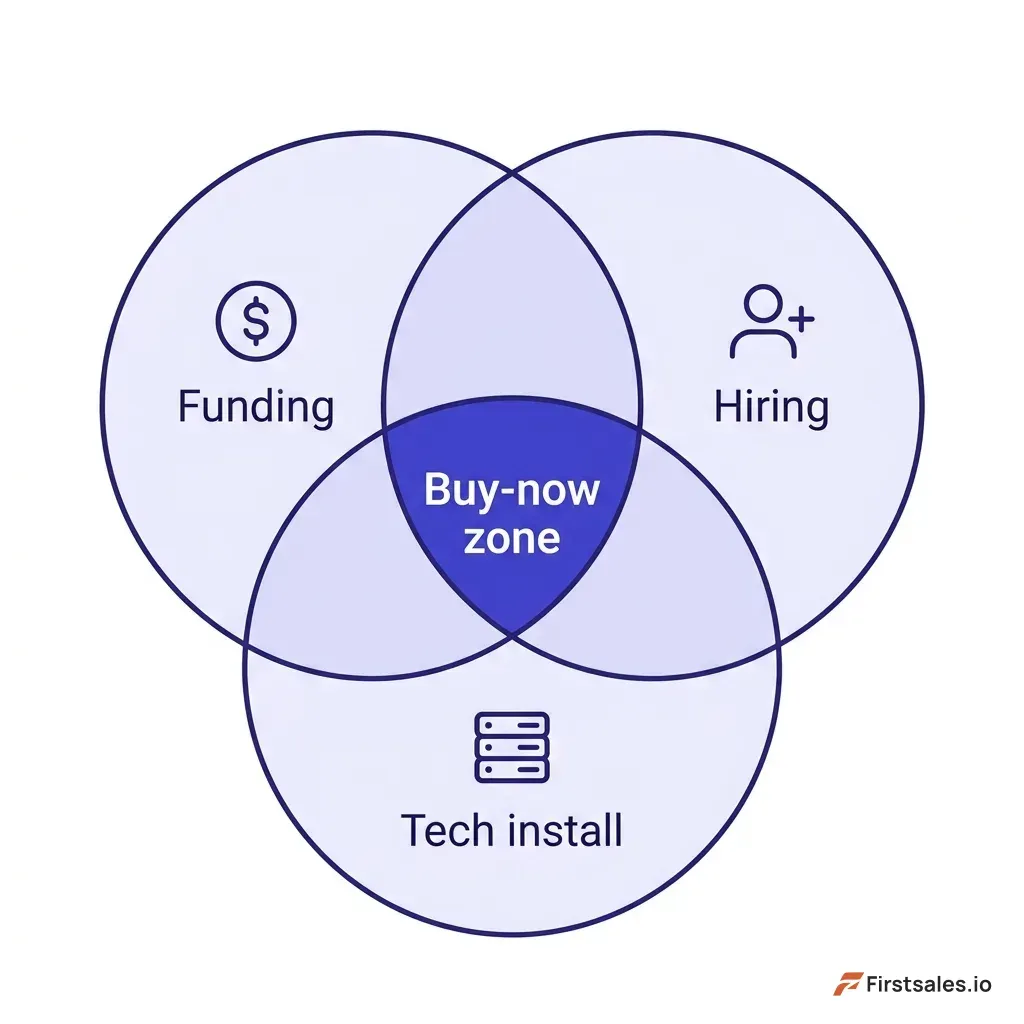 Venn diagram with three overlapping circles labeled funding, hiring, and tech install, the center overlap shaded deep indigo and labeled buy-now zone
#Why one signal is mostly noise
Here is the uncomfortable data. Forrester's Q1 2025 Intent Data Providers Wave reported that 50% of companies using B2B intent data say they get too many false positives. Lift AI has gone further, arguing that the practical accuracy of raw intent signals sits below 20% once you account for researchers, students, and competitors triggering the same events as real buyers.
A page view is not a buyer. A page view is a person. That person could be a job seeker checking out your careers page, an analyst writing a market report, a competitor pricing their next deck against yours, or an actual prospect.
The signal looks identical in all four cases. You cannot tell them apart from the event alone.
The same problem hits every category. A funding announcement gets covered by every sales tool on the planet within 24 hours, which means your "I saw you raised a Series A" email lands in an inbox already holding forty identical notes. A single job post might be backfill for someone who quit, not a sign of expansion.
A technology install detected by one source might be a misread of a tracking pixel.
Single actions, taken out of behavioral context, are statistically unreliable predictors of readiness to buy.
That sentence, paraphrased from Unify's signal-based selling guide, is the whole case for stacking. The fix for an unreliable predictor is not a better single predictor. It is a second and third independent predictor that has to agree before you act.
Precision is the metric that matters here. In intent data, precision measures what share of the accounts you flagged as in-market actually are. Raw single signals run anywhere from 60% to 95% precision depending on the source, and the low end of that range is where most teams live.
Requiring a second positive signal before you flag an account is the cheapest precision upgrade available, because coincidences do not stack.
#The math of stacking signals
The reply-rate ladder is the most useful number in this entire topic, and the data across Autobound, Salesmotion, and Prospeo lines up tightly.
- Generic cold email from a static list: 3.43% average reply rate (Instantly's 2026 benchmark, echoed across the industry)
- One active buying signal: 8-15% reply rate
- Two stacked signals: 15-25% reply rate
- Three or more stacked signals: 25-40% reply rate
That top tier is a 7x to 12x improvement over the generic baseline. It is not a rounding-error gain. It is the difference between a campaign that books meetings and one that quietly burns your domain reputation.
Salesmotion's framework puts hard cadence tiers on each rung. One signal earns a spot in a Tier 2 cadence with semi-personalized outreach. Two signals promote the account to Tier 1 with a fully personalized, multi-channel sequence.
Three or more signals get your highest-priority, multi-threaded play, the one where you research the account by hand and write every line yourself.
A separate breakdown from signal-driven personalization research found accounts with two or more signals replying at 22% against 8% for a single signal. Stacked plays on marketing-qualified accounts drove 20% reply rates against 5% on product-qualified plays that lacked the overlap. The exact figures shift by source and segment.
The shape never does. More independent signals on the same account means a higher probability that the account is genuinely in motion.
There is a speed dividend on top of the precision dividend. Roughly 35% to 50% of B2B deals go to the vendor that responds first to a buying signal. When three signals converge, the account is not just likely to buy.
It is likely to buy soon, from whoever shows up first with a relevant message. Compound signals tell you which accounts deserve a same-day response instead of a same-week one.
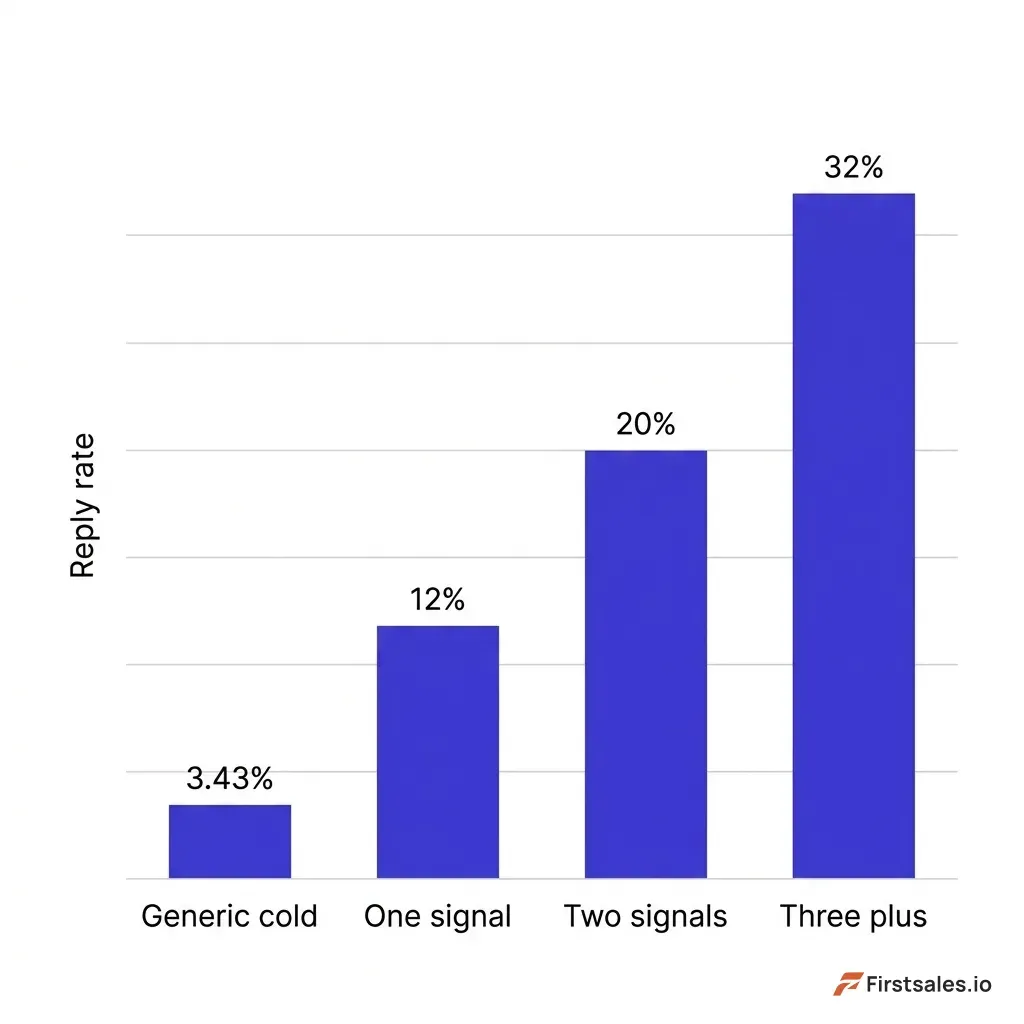 Bar chart comparing reply rates: generic cold email 3.43%, one signal 12%, two signals 20%, three or more signals 32%, bars in deep indigo on white
#A signal taxonomy with relative strength
Not every signal carries the same weight, and you cannot stack intelligently until you know what each trigger is actually worth. The cleanest way to organize the field is by source, then by strength.
There are four source categories. First-party signals are things people do on your own properties: pricing page visits, demo requests, repeat product usage, reply opens. These are the strongest because the person already knows you exist. Third-party intent signals are research behavior off your site, like a surge in category searches or G2 comparison activity. These are useful but noisy, since you only see aggregate topic interest, not a named buyer. Firmographic-change signals are company-level events: funding, expansion, acquisitions, tech-stack changes. Relationship or people signals are human-level moves, mainly a champion or decision-maker changing jobs.
Within those categories, strength is not uniform. Sales teams that score signals tend to land on a similar hierarchy. A decision-maker job change rates around 9 out of 10 for predictive strength.
A funding round rates around 9 as well. A pricing page visit from a named account sits near the top of first-party intent. A single third-party topic surge sits much lower, often a 4 or 5, because it is aggregate and anonymous.
Time sensitivity is the second axis, and it cuts the other way. A funding announcement has a long relevance window of 90 to 180 days because the money takes months to deploy. A pricing page visit has a window of hours, because the person is comparing options right now.
A job change opens a 30 to 60 day window while the new hire audits the stack they inherited.
The practical takeaway is that you stack across categories, not within them. Three first-party signals on one account is good but tells you one story. A first-party signal plus a firmographic signal plus a people signal tells you three independent stories that happen to agree.
That independence is what drives the precision gain. Understanding the full menu of buying signals for cold email is the prerequisite for knowing which ones are worth combining.
#The signal-combination table
This is where the strategy becomes operational. The table below maps common signal stacks to their combined strength and the play each one deserves. The reply-rate ranges follow the Autobound and Salesmotion tiers cited earlier.
| Signal combination | Stacked strength | Likely reply rate | Suggested play |
|---|---|---|---|
| Funding + relevant department hiring | Very high | 25-40% | Same-day Tier 1, multi-threaded. Reference the build, not the raise. |
| Job change + new company fits ICP + pricing page visit | Very high | 25-40% | Same-day personal note to the new hire about the evaluation they inherited. |
| New VP/Director + tech-stack change | High | 15-25% | Next-day outreach tied to the stack decision the new leader now owns. |
| Pricing page visit + third-party intent surge | High | 15-25% | Fast, low-commitment ask. The account is actively comparing. |
| Funding + competitor displacement signal | High | 15-25% | Position against the incumbent the new budget can replace. |
| Hiring spike + repeat website visits | Medium-high | 15-25% | Tier 1 cadence referencing the specific roles and the page they viewed. |
| Single funding round (no overlap) | Medium | 8-15% | Tier 2, semi-personalized. Treat as a watch-list, not a hot lead. |
| Single third-party topic surge | Low | 3-8% | Nurture only. Wait for a second, named signal before you send. |
The bottom two rows are the ones worth staring at. A lone funding round, the bread and butter of most "signal-based" lists, lands in the same medium tier as a warm-but-not-hot lead. A lone third-party surge barely beats generic cold email.
Neither justifies your best rep's time until a second signal confirms it.
The top rows are where compound outreach earns its name. Funding plus relevant hiring is the canonical buy-now flare, because money plus the act of building the exact team your product serves is about as close to a stated intent as outbound ever gets. The hiring signal in outbound is strong on its own.
Paired with fresh funding, it moves from a good reason to reach out to a reason to reach out today.
#Decay windows: why 48 hours decides the deal
A stacked signal is only worth acting on while it is still fresh, and freshness has a brutally short half-life. This is the part most teams get wrong. They build a beautiful scoring model, then route the lead through a weekly review, and by the time a rep sends, the signal is cold.
The numbers are specific. A funding announcement loses most of its urgency after the first 48 hours of press coverage, and acting inside that window has been tied to roughly 4x higher conversion. Pricing page visits lose about 50% of their value within 24 to 48 hours.
Third-party intent surges decay roughly 50% within 14 days. New executive hires create a longer 30 to 60 day window, since the audit takes time. Across most trigger events, conversion rates drop by about 80% after five days.
A freshness-first approach changes the connect math directly. One framework reported connection rates climbing from 18% to 34% and time-to-first-meeting falling from nine days to three when teams responded to signals in hours rather than days. Same signal.
Same account. Different outcome, decided entirely by speed.
mermaidgraph TD
    A[Signal detected] --> B{How many signals on this account?}
    B -->|One signal| C[Tier 2 cadence, respond within the week]
    B -->|Two signals| D[Tier 1 cadence, respond next day]
    B -->|Three or more| E[Top priority, respond same day]
    C --> F[Watch for a second signal]
    F --> B
    E --> G{Acted within decay window?}
    G -->|Yes| H[15-40% reply rate]
    G -->|No, over 5 days| I[Conversion drops ~80%]
The decay reality is also why volume and signal stacking pull in opposite directions. You cannot hand-research three converging signals for 3,000 accounts in a 48 hour window. You do not need to.
A handful of genuinely stacked accounts, hit fast, outproduces a giant list hit slow. The constraint is not how many emails you can send. It is how fast you can spot and act on overlap before it decays.
#How to score a stacked signal
Binary thinking kills signal-based outbound. An account either triggered or it did not, and everything that triggered goes into the same bucket. That model wastes your best signals on the same cadence as your weakest ones.
Composite scoring fixes this. Instead of treating each signal as on or off, you assign a weighted score to each one and add them up. A simple version evaluates every signal on three dimensions:
- Intent strength. How directly does this signal predict a purchase? A demo request scores high. A topic surge scores low.
- Time sensitivity. How fast does it decay? A pricing visit is urgent. A funding round has a longer fuse.
- Exclusivity. How many other vendors see this signal too? A public funding round is seen by everyone. A first-party product event is yours alone.
You sum the weighted scores into one composite number, then route by total. Cross a high threshold and the account earns same-day, multi-threaded outreach. Land in the middle and it gets a Tier 2 cadence.
Stay low and it waits for a second signal. The key design choice is that the model should require multiple positive signals before flagging an account as high priority. That single rule, requiring overlap rather than a single trigger, is what keeps the false-positive rate down while still catching the accounts that are genuinely in-market.
A practical scoring detail matters for confidence. A technology install confirmed by three or more independent sources carries a confidence score above 90%, while a single-source detection should be flagged for manual review or routed to a lower-priority lane. The same logic applies to the whole stack.
Confidence is not just how strong each signal is. It is how independently each one was confirmed.
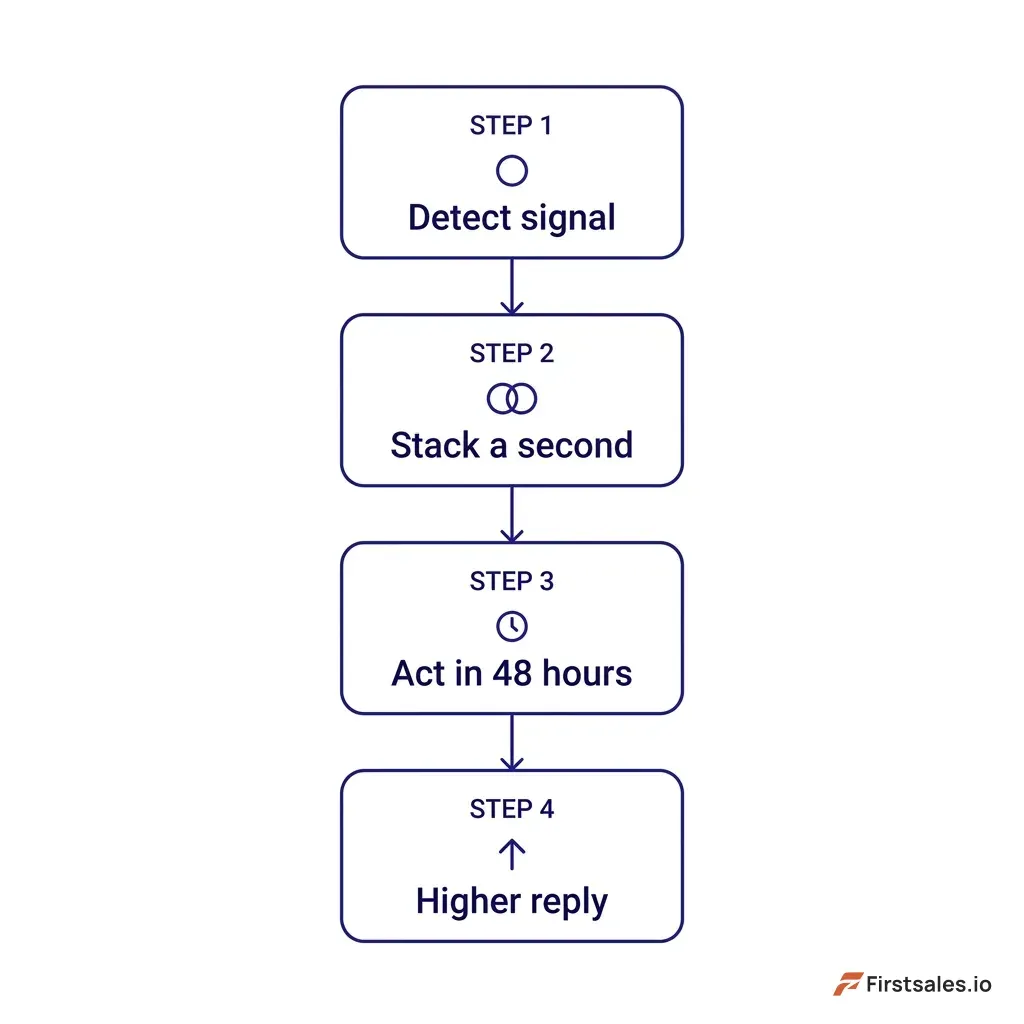 Infographic showing the four-step signal stacking flow: detect a signal, stack a second, act within 48 hours, reach a higher reply rate, deep indigo and white flat design
#Controlling false positives in the stack
Stacking reduces false positives, but it does not eliminate them, and a sloppy stack can manufacture new ones. Two accounts can both show "funding plus hiring" while meaning completely different things. One raised a growth round and is scaling the exact motion you support.
The other raised a bridge round and is backfilling churned reps. Same surface signals, opposite intent.
Three habits keep the stack honest.
First, demand independence. Two signals that are really the same event wearing two outfits do not count as a stack. A funding press release and a LinkedIn post about that same funding are one signal, not two.
Real stacking needs signals from different categories that could each be true without the others.
Second, confirm the firmographic fit before you trust the behavioral signal. A pricing page visit from a company that does not match your ICP is probably a competitor or a job seeker, and stacking a strong behavioral signal on top of a bad-fit account just produces a confident wrong answer. Fit is the gate.
Signals are what you do after the account passes it.
Third, set a recency floor for every signal in the stack. A funding round from eight months ago and a job change from last week are not a fresh compound signal. They are one stale event and one live one.
For two signals to count as compound, both should sit inside their own decay windows at the same moment. This is exactly why teams moving from intent-based prospecting versus static lists see the biggest gains, because static lists carry no recency at all, while a properly dated signal stack carries it on every record.
#Single signal vs compound signal, side by side
The contrast is sharp enough to put in one table. This is the case for why the extra discipline pays off.
| Factor | Single signal | Compound signal (2-3 stacked) |
|---|---|---|
| Reply rate | 8-15% | ✓ 15-40% |
| False-positive risk | High, often researchers or competitors | ✓ Low, coincidences do not stack |
| Precision (share genuinely in-market) | 60-95%, low end common | ✓ Materially higher |
| Personalization material | One event to reference | ✓ A connected story across events |
| Priority clarity | Everything looks equal | ✓ Clear Tier 1 vs Tier 2 routing |
| Volume needed | Large lists | ✓ Small, hand-picked accounts |
| Domain reputation risk | Higher, more irrelevant sends | ✓ Lower, fewer and better sends |
| Time per account | Under a minute | ✗ 5-10 minutes of research |
The one row where single signals "win" is time per account, and it is a false economy. Spending one minute on an account that replies at 8% is more expensive per meeting than spending ten minutes on an account that replies at 30%, once you count the domain damage and wasted follow-ups from the low-precision approach. The math that looks cheap up front is the one that costs the most by the end of the quarter.
#How FirstSales acts on stacked signals
The hard part of compound signals is not the theory. It is the operations. Spotting overlap across funding feeds, hiring boards, technographic data, and first-party web activity, then acting inside a 48 hour decay window, is more than a person scrolling tabs can do reliably.
This is the job FirstSales is built for. It watches multiple signal sources on your target accounts, flags where two or three triggers converge on the same company, and surfaces those stacked accounts before the window closes. The draft outreach references the actual convergence, the funding and the hiring and the page visit, not a generic "I saw you raised" line that forty other tools already sent.
A human reviews and sends, so the message that goes out is fast, relevant, and still written like a person wrote it.
The result is the model the data keeps pointing at. Fewer sends. Higher precision.
Reply rates in the range where outbound actually works, instead of the 3.43% average that defines the rest of the market. A job change trigger email sent the day a champion lands at an ICP-fit account, stacked with the pricing page visit that followed, is the kind of compound play that turns into a booked meeting.
You can start a campaign for $1 at app.firstsales.io and watch what happens when you only send to accounts where the signals agree.
#FAQs
#What is a compound buying signal?
A compound buying signal is two or more independent buying triggers that fire on the same account within a short window, such as a funding round plus relevant hiring plus a pricing page visit. Each signal on its own is a weak predictor. Together, they sharply raise the odds that the account is genuinely in-market, because three unrelated events agreeing on the same company at the same time is unlikely to be a coincidence.
#How much do stacked signals improve reply rates?
Across Autobound, Salesmotion, and Prospeo benchmarks, one active signal produces 8-15% reply rates, two stacked signals produce 15-25%, and three or more produce 25-40%. That top tier is a 7x to 12x improvement over the 3.43% average for generic cold email sent to a static list.
#Why is a single buying signal unreliable?
Forrester's Q1 2025 research found 50% of intent-data users report too many false positives, and Lift AI estimates raw single-signal accuracy can fall below 20%. A single event like a page view looks identical whether it came from a real buyer, a job seeker, an analyst, or a competitor. You cannot tell them apart without a second, independent signal to confirm intent.
#Which signal combinations are the strongest?
Funding plus relevant department hiring is the canonical buy-now flare, since money plus building the exact team your product serves is close to a stated intent. A decision-maker job change plus ICP fit plus a pricing page visit is equally strong. Both combinations consistently land in the 25-40% reply tier when acted on quickly.
#How fast do buying signals decay?
Funding announcements lose most urgency after 48 hours and acting inside that window is tied to roughly 4x higher conversion. Pricing page visits lose about 50% of their value within 24 to 48 hours, third-party intent surges decay about 50% within 14 days, and new executive hires hold a 30 to 60 day window. Across most trigger events, conversion drops about 80% after five days.
#How do you score a stacked signal?
Assign each signal a weighted score across three dimensions: intent strength, time sensitivity, and exclusivity. Sum the weighted scores into one composite number, then route accounts by total, with the highest scores earning same-day multi-threaded outreach. The model should require multiple positive signals before flagging an account as high priority, which keeps false positives down.
#What counts as two independent signals versus one?
Two signals are only independent if they come from different categories and could each be true without the other. A funding press release and a LinkedIn post about that same funding are one signal in two formats, not a stack. A funding round plus a separate job change plus a pricing visit are three independent signals, which is what creates the precision gain.
#Does signal stacking mean lower outbound volume?
Yes, and that is the point. You cannot hand-research converging signals for thousands of accounts inside a 48 hour decay window, but you do not need to. A small set of genuinely stacked accounts, hit fast, outproduces a large list hit slowly, with far less domain reputation risk and a higher reply rate per send.
#How does signal stacking reduce false positives?
Coincidences do not stack. The chance that a single non-buyer triggers one signal is meaningful, but the chance they independently trigger two or three unrelated signals at once is small. Requiring overlap before you flag an account, plus confirming firmographic fit and signal recency, filters out most of the researchers, students, and competitors that pollute single-signal lists.
#What is the difference between intent data and buying signals?
Intent data is a subset of buying signals that describes third-party research behavior, such as reading a G2 review or searching a topic across a publisher network. Buying signals is the broader category that also includes first-party engagement on your own site, firmographic changes like funding and hiring, and people signals like job changes. Compound signals usually combine across these types.
#Conclusion
The reason compound buying signals work is not complicated. One trigger is a guess. Two or three triggers on the same account, inside the same window, are a pattern.
The data is consistent across every major source: single signals reply at 8-15%, stacked signals at 15-40%, and the gap over generic cold email runs 7x to 12x.
The discipline behind the result is where most teams fall short. Stacking only pays off when you respect three rules. Demand independent signals from different categories, not the same event twice.
Score the stack instead of treating every trigger as equal. Act inside the decay window, because a signal that gets a response on day five is a signal you missed.
Here are the takeaways worth keeping:
- One buying signal is mostly noise. Up to 50% of intent-data users drown in false positives, and single-signal accuracy can fall below 20%.
- Stacking two or three independent signals lifts reply rates to 15-40% and sharply cuts false positives, because coincidences do not stack.
- Decay is the constraint. Most signals lose half their value within 48 hours to two weeks, so speed decides the outcome.
- Score by intent strength, time sensitivity, and exclusivity, and require overlap before you route an account to your best play.
If your current outbound runs on single-signal lists, the fastest improvement is to stop sending until a second signal confirms the first. Your reply rate will climb, your domains will stay healthy, and your reps will spend their hours on accounts that are actually in-market. FirstSales watches the signals, flags the overlap, and drafts the outreach so you can act before the window closes.
Start a campaign for $1 at app.firstsales.io.