TL;DR: Cold calling did not die. It got harder, and then the math shifted again. Connect rates in 2026 sit around 6-9% on generic data and 18-22% on verified mobile direct dials, while AI voice agents can run 100-500 lines at once instead of a human's 15-25 dials an hour.
The honest read: AI voice is excellent at volume, research, and voicemail drops, and still weak at live conversations that need a human ear. The teams winning let AI handle the dialing grind and signal research, then hand warm, live answers to a person. That hybrid model is 3.7x more likely to hit quota than going all-AI or all-human.
#Is cold calling actually back in 2026?
Cold calling never left. It just got quieter while everyone argued about email open rates. Now the phone is loud again, and the reason is partly the email channel falling apart and partly a new class of tools that make dialing cheap.
Here is the number that ends the debate. Over half of B2B leads still start with cold outreach, and decision makers keep saying they prefer a phone conversation to a pitch buried in their inbox. Cold call to meeting conversion ticked up to 3.5% in 2026, from 2.8% in 2023, according to ZoomInfo's benchmark data.
That is a small move, but it points the right direction after years of decline.
The channel did not get easier. People answer unknown numbers less than they used to. What changed is the cost of trying.
A human SDR makes 15 to 25 dials an hour. An AI voice agent can hold 100 to 500 calls at the same moment. When the cost of a dial drops toward zero, the question stops being "can we afford to call" and becomes "who should actually talk to a live human when someone picks up."
That is the real story of the cold calling comeback. Not that the phone got better. That the economics of getting to a live conversation got rewritten.
If you want the channel comparison in full, the trade-offs between cold calling vs cold email explain why most 2026 teams run both instead of betting on one.
#What an AI voice SDR really is
An AI voice SDR is software that places outbound sales calls, talks to whoever answers using a synthetic voice, and either qualifies the person or routes them to a human. It runs on a large language model for the conversation, a text to speech engine for the voice, and a dialer for the phone lines. Some handle the full call. Most do the boring 80% and pass the interesting 20% to a rep.
The category grew fast. 41% of enterprise B2B teams reported at least one AI SDR running in production in Q1 2026, up from 12% a year earlier, per Auto Interview AI's 2026 calling data. Voice agent usage grew roughly 9x across 2025. And 73% of sales leaders said they plan to put more money into AI calling this year.
It helps to separate three things people lump together. A power dialer just calls numbers one after another so a human does not waste time dialing. A parallel dialer rings several numbers at once and connects the human to whoever picks up first.
An AI voice agent removes the human from the call entirely and talks on its own.
These are different tools with different risk profiles, and the compliance rules treat them differently too.
The thing to hold onto: an AI voice SDR is not one feature. It is a stack. The dialer decides how many people you reach.
The voice decides whether they stay on the line. The model decides whether the conversation goes anywhere. Most failures trace back to one weak layer, usually the data feeding the dialer.
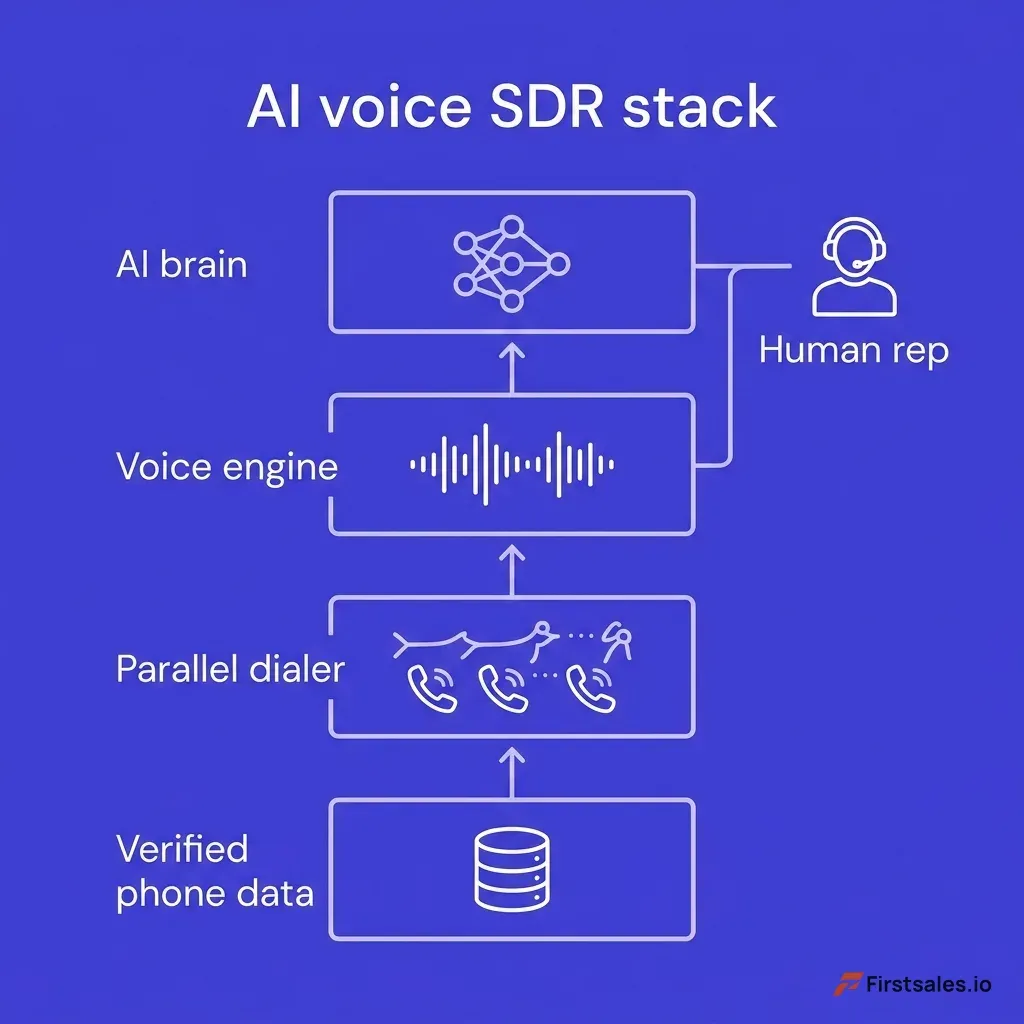 Diagram of the AI voice SDR stack showing four layers stacked vertically: verified phone data feeding a parallel dialer, the dialer feeding a text-to-speech voice engine, the voice engine feeding a language model brain, and the brain routing live answers to a human rep
#2026 connect and conversion benchmarks
Connect rate is the first wall. It measures how often a dial reaches a live person, and almost everything else depends on it.
The average US B2B cold call connect rate in 2026 runs 8-12% on generic data and 18-22% on verified mobile direct dials, according to Skipcall's benchmark study. Gong Labs, after analyzing more than 300 million cold calls, puts the average closer to 5.4%, with top quartile reps hitting 13.3%. The spread tells you most of what you need to know.
Below a 7% connect rate, the problem is almost always technical: bad data, wrong timing, or a flagged caller ID. It is rarely the rep.
Then comes conversion. The average cold call to meeting rate is about 2.5%, or one meeting per 40 dials, and top performers reach 5-8%, per Optifai's analysis of 939 companies. But the source of the list swings that number hard.
A pure cold list converts at 1.5-2%. A marketing qualified lead converts at 4-6%. A warm intro or referral converts at 15-25%.
Same rep, same script, wildly different math depending on who is on the other end.
AI voice changes the volume, not the per dial odds. AI cold calling books a meeting on roughly 1-3% of dials for pure cold lists, and that climbs to 4-7% when the calls are tied to intent signals or inbound follow up. The agent does not persuade better than a human.
It dials so many more times that the absolute meeting count goes up while the per call rate stays flat.
| Metric | Human SDR (manual dial) | AI voice agent | Parallel dialer + human |
|---|---|---|---|
| Dials per hour | 15-25 | 100-500 simultaneous | 60+ |
| Live conversations per hour | 3-4 | High volume, low per-call quality | 8-12 |
| Connect rate, verified mobile | ✓ 18-22% | ✓ 18-22% (same data) | ✓ 18-22% |
| Meeting booked per dial, cold list | 1.5-2% | 1-3% | 1.5-2% |
| Meeting booked per dial, signal-led | ✓ 4-6% | ✓ 4-7% | ✓ 4-6% |
| Handles live objection well | ✓ Strong | ✗ Weak | ✓ Strong |
| Cost per qualified lead | ~$177 | ✓ $3-5 | ~$50-90 (blended) |
| Compliance risk (TCPA AI rules) | ✓ Lower | ✗ Higher | ✓ Lower |
| Best time windows lift | +47% (8-9am, 4-5pm) | +47% (same windows) | +47% (same windows) |
Two rows deserve a second look. The cost per qualified lead drops from about $177 for human only pods to $3-5 for an AI agent on raw telephony and model cost. That gap is why finance teams keep pushing AI dialing even when sales teams resist.
And the compliance row is where the cheap option gets expensive fast, which the regulation section covers below.
One more benchmark worth taping to your monitor. Best calling windows of 8 to 9am and 4 to 5pm local time lift connect rates by 47%, and Wednesday and Thursday beat Monday and Friday by 15%. Timing is free.
Most teams still ignore it.
#Where AI voice agents genuinely help
Start with the work humans hate. AI voice earns its keep on the parts of cold calling that are repetitive, low judgment, and high volume.
Dialing volume is the obvious win. A parallel dialer averages 8-12 live conversations an hour against a power dialer's 3-4 at the same 5.3% pickup rate, per Titanx data. On a full SDR day, parallel dialing produces about 60% more booked meetings per rep and frees two hours for prep and follow up. Real teams show the lift.
Vanta moved its best segment connect rate from 5% to 18%. Landbase pushed dial to connect from 5% to 15% and grew demos 60% in two weeks. Most of that came from verified data plus higher dial volume, not a smarter pitch.
Research before the call is the underrated win. The "3x3 research" method, three relevant facts found in three minutes, raises conversion by 82%. AI does that research in seconds. It can scan a company's funding news, recent hires, and tech changes, then write the opening line that references them.
This is the same engine behind good autonomous cold email agents, pointed at the phone instead of the inbox.
Voicemail drops and first touches scale cleanly. Roughly 80% of sales need five or more follow up calls, yet 44% of reps quit after one. An AI agent does not get discouraged on touch four. It leaves a consistent voicemail, logs the attempt, and schedules the next try.
The patience problem in cold calling is mostly a human stamina problem, and software does not have that problem.
Qualification on inbound and warm lists works well. When someone already raised a hand, an AI voice agent can confirm fit, capture basic details, and book time without a human babysitting the call. This is close to speed to lead outbound done by machine: a fresh signal comes in, the agent calls within minutes, and the lead never goes cold waiting for a rep to notice.
Notice the pattern. AI voice wins where the work is structured and the stakes per call are low. The moment the call needs real listening, the picture changes.
#Where AI voice agents fail and creep people out
A live cold conversation is improvisation. The prospect interrupts, goes quiet, gets sarcastic, asks something off script, or floats an objection that hides the real one. This is exactly where current AI voice agents stumble.
The complaint in 2026 is no longer that the voice sounds robotic. The voices got good. The problem moved to timing and feel. The agent is often too fast in a moment where a human would pause, or it interrupts like a machine instead of waiting like a person. When the tone and the rhythm do not match what a human expects, the illusion collapses and the prospect feels something is off.
That is the uncanny valley, and on a sales call it reads as untrustworthy.
The mood around AI did not help. A March 2026 Quinnipiac poll found 55% of Americans think AI will do more harm than good in daily life, up from 44% in April 2025. People are primed to feel wary. An AI that hides what it is, then gets caught, converts that wariness into resentment.
Buyers report feeling deceived when they learn a natural sounding voice was synthetic, and that feeling sticks to your brand, not the vendor's.
There is also the objection problem. A skilled rep hears "we already have a tool for that" and knows whether it means "go away" or "show me why yours is different." An AI agent tends to take the words at face value and either pushes a canned rebuttal or gives up.
The 5 minute 50 second successful call that Gong documented, versus 3 minutes 14 for failed calls, is built almost entirely on the kind of back and forth AI handles worst.
So the failure mode is predictable. AI voice fails on depth, nuance, and trust. It fails on the exact 20% of calls that actually generate revenue.
Pretending otherwise burns prospects you cannot get back.
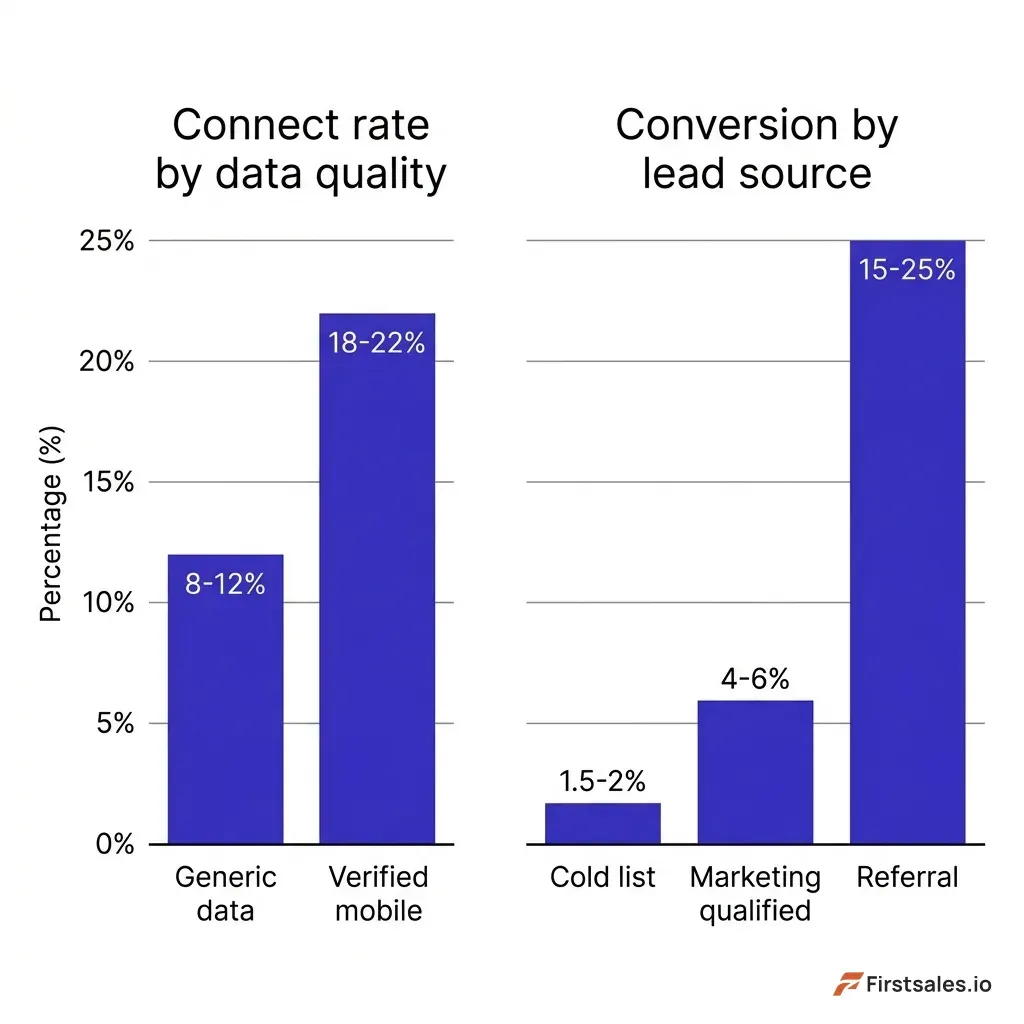 Bar chart comparing connect rates across data quality and conversion by lead source, showing generic data at 8 to 12 percent, verified mobile at 18 to 22 percent, cold list conversion at 1.5 to 2 percent, marketing qualified at 4 to 6 percent, and referral at 15 to 25 percent
#The compliance problem nobody can skip
This is the part that turns a cheap AI dialer into a legal liability. In 2024, the FCC confirmed that the TCPA's rules on "artificial or prerecorded voice" cover AI generated voices. That single ruling reshaped the whole category.
Calls that use an AI generated voice for marketing now require prior express written consent before you dial a mobile number. Not implied consent. Not a pre checked box. Written, specific, revocable consent.
And an existing business relationship does not save you. The established business relationship exemption covers manual calls, but the AI voice itself triggers the consent requirement regardless of your history with that person.
The penalties are not theoretical. The TCPA carries strict liability with statutory damages of $500 to $1,500 per violation, and the plaintiff does not need to prove any financial harm. Run an AI voice agent across 10,000 unconsented mobile numbers and the exposure math gets ugly fast.
There is more coming. The FCC has a pending proposal that would require a clear, plain language disclosure at the start of any AI generated call, telling the person they are talking to AI. The UK is already strict.
AI cold calling there sits under PECR, UK GDPR, Ofcom rules, and the EU AI Act for any EU resident, which means prior consent, screening against the Telephone Preference Service, identifying your company, disclosing the AI, and running a data protection assessment before you launch.
The practical takeaway is blunt. A fully autonomous AI voice agent calling cold mobile numbers is a compliance risk in most US states and much of Europe. A parallel dialer that connects a real human, or an AI agent calling only consented or inbound contacts, lives on much safer ground.
The cheapest looking option carries the most legal weight, which is why the hybrid model is not just better for conversion. It is safer.
#The hybrid model that actually works
The winning structure is not subtle. Let AI handle the volume and the research. Let humans handle the live conversation.
Stop forcing one tool to do both jobs.
The data backs it cleanly. Organizations where automation handles volume and humans handle depth are 3.7x more likely to hit quota than teams using either approach alone. Cost per qualified opportunity fell from $487 in human only pods to $224 in hybrid AI plus human pods, a 55-75% reduction depending on setup.
You get the cheap dialing and the human close in the same motion.
Here is the workflow most high performers converge on:
graph TD
    A[Buying signal detected] --> B[AI does 3x3 research]
    B --> C[Parallel dialer rings list]
    C --> D{Live person answers?}
    D -->|No| E[AI voicemail drop + log + reschedule]
    D -->|Yes| F[Human rep takes the live call]
    F --> G{Qualified?}
    G -->|Yes| H[Book meeting]
    G -->|No| I[Nurture via email + LinkedIn]
    E --> C
Read that flow and the division of labor is clear. AI finds the reason to call, dials the volume, and absorbs the rejection. The human shows up only when there is a live person worth a conversation.
The voicemail and the reschedule loop happen without a rep lifting a finger.
This mirrors what already works in email. The strongest results come from human in the loop cold email, where AI drafts and a person reviews before sending. The phone version is the same idea: AI does the structural work, the human owns the moment that needs judgment.
The supervision layer is not overhead. It is the part that makes the output convert.
And the channels reinforce each other. A prospect who ignored two calls might answer the third after seeing a relevant message land first. Running the phone alongside email and LinkedIn multichannel outreach raises the odds that one of the touches connects, because it takes about eight touches on average to book a first meeting and almost nobody books it on a single channel.
#How signal timing changes the whole equation
Volume without a reason is just noise at scale. The variable that separates a 1.5% cold list from a 6% signal led list is whether something is actually happening at the account when you call.
The richest signals in 2026 are the same ones that move email: a funding round, a hiring spike in a department your product serves, a new leader in the buying seat, a visible tech change. When one of those is true, the call has a real opening line. "Saw you just brought on a VP of Sales last month" beats "checking in to see if you're the right person" every time, because the first one proves you looked.
This is where FirstSales fits the picture. It watches for those buying signals, finds the people behind them, and times the outreach to the moment relevance exists rather than blasting a static list. The AI does the research and the drafting.
A human stays in the loop on what actually goes out.
That is the same discipline this whole post argues for, applied across email and phone instead of one channel in isolation.
The reason signal timing matters more for voice than email is the cost of a wasted call. A bad email gets deleted and forgotten. A badly timed AI voice call to someone who never consented is an annoyance at best and a TCPA claim at worst.
Calling on a real signal, to a contact who fits, at a window when people pick up, is how you keep the cheap volume without paying the trust tax.
Put plainly: the signal decides whether the call is welcome. The dialer decides how many you make. The human decides whether the live one closes.
Get all three right and the comeback is real for you, not just in the headlines.
#Slop dialing vs signal calling, side by side
The same gap that wrecked cold email is now playing out on the phone. One approach treats AI as a volume cannon. The other treats it as a research and routing layer with a human at the sharp end.
The slop version looks like this. Buy a generic list, point an autonomous AI voice agent at every mobile number, skip the consent check, and measure success by dials placed. It is cheap per dial and expensive everywhere else: low conversion, brand damage, flagged caller IDs, and legal exposure under the TCPA AI ruling.
The signal version looks different. Wait for a real trigger, let AI research and dial, drop voicemails on no answers, and route live pickups to a human who can actually have the 5 minute conversation that books meetings. Lower volume, higher conversion, durable caller reputation, and a compliance posture that holds up.
The numbers separating them are not close. Signal led, human closed calling converts at 4-7% per dial against 1-3% for autonomous cold blasting, at a fraction of the legal risk. The teams hitting quota are not the ones who dialed the most.
They are the ones who dialed the right accounts at the right moment and put a human on the calls that mattered.
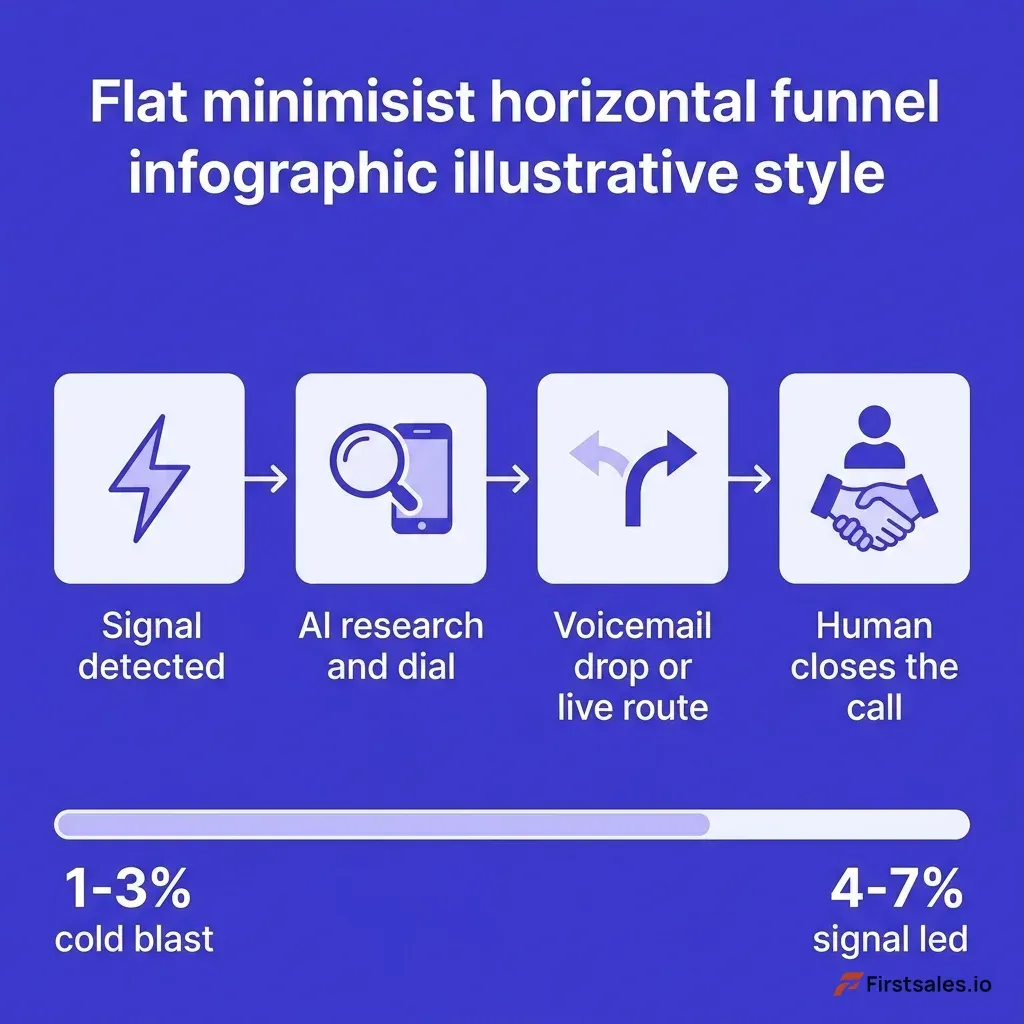 Infographic showing the hybrid AI voice SDR funnel in four stages: signal detected, AI research and dial, voicemail drop or live routing, human closes the warm call, with conversion lifting from 1 to 3 percent at cold blast to 4 to 7 percent at signal led across the stages
#FAQs
#Is cold calling still effective in 2026?
Yes. Over half of B2B leads still start with cold outreach, and cold call to meeting conversion rose to 3.5% in 2026 from 2.8% in 2023, per ZoomInfo. Decision makers still prefer a phone conversation for sales discussions.
The channel rewards verified data, good timing, and persistence more than it ever has.
#What is a good cold call connect rate in 2026?
On generic data, 8-12% is normal. On verified mobile direct dials, 18-22% is achievable, and top performers reach 25% or higher. Gong's analysis of 300 million calls puts the average at 5.4% with top quartile reps at 13.3%.
If you are under 7%, the cause is almost always data, timing, or caller ID, not your reps.
#Can an AI voice agent actually book meetings?
It can, mostly on volume. AI voice books a meeting on roughly 1-3% of dials for cold lists and 4-7% when calls are tied to intent signals or inbound follow up. The per dial odds are similar to a human.
The advantage is that the agent makes far more calls, so the absolute meeting count rises even though the conversation quality per call is lower.
#Where do AI voice agents fail on sales calls?
They fail on live, unscripted moments: handling a real objection, reading a pause, knowing when "we already have that" means no versus tell me more. The voices sound human now, but the timing often feels off, too fast or interrupting like a machine. That mismatch reads as untrustworthy on a cold call.
#Are AI voice cold calls legal under the TCPA?
In the US, an AI generated voice used for marketing requires prior express written consent before you dial a mobile number, after the FCC's 2024 ruling that TCPA covers AI voices. An existing business relationship does not exempt AI calls. Violations carry $500 to $1,500 in statutory damages each.
A parallel dialer connecting a live human, or AI calling only consented contacts, carries much lower risk.
#Do I have to disclose that a call uses AI?
Increasingly, yes. The FCC has a pending proposal to require a clear, plain language disclosure at the start of any AI generated call. The UK already requires disclosing AI use under PECR and Ofcom rules.
Beyond the law, disclosure reduces backlash. Buyers feel deceived when they learn a natural voice was synthetic, so labeling the call protects your brand.
#What is the difference between a power dialer and a parallel dialer?
A power dialer calls numbers one at a time so a human does not waste time dialing, averaging 3-4 live conversations an hour. A parallel dialer rings several numbers at once and connects the human to whoever answers first, averaging 8-12 conversations an hour. Above 60 daily dials, parallel usually wins.
Neither replaces the human on the call.
#Is the hybrid AI plus human model really better?
The data says clearly yes. Teams where AI handles volume and humans handle depth are 3.7x more likely to hit quota than all-AI or all-human teams. Cost per qualified opportunity drops from about $487 to $224 in hybrid pods.
AI dials and researches cheaply, the human takes the live conversation that needs judgment.
#When is the best time to make cold calls in 2026?
The windows of 8 to 9am and 4 to 5pm local time lift connect rates by 47%. Wednesday and Thursday outperform Monday and Friday by about 15%. Timing costs nothing to fix and most teams still call at random hours, which is one reason their connect rates sit below benchmark.
#How does signal timing improve cold call results?
Calling on a real trigger, like a funding round, a key hire, or a leadership change, lets you open with a specific, relevant reason. That moves a list from 1.5-2% conversion toward 4-7%. The 3x3 research method, three facts in three minutes, raises conversion by 82%.
AI can do that research instantly, which is why signal led calling beats volume for volume's sake.
#Conclusion
Cold calling is back, but not the way the headlines suggest. The phone did not get better. The cost of reaching a live person collapsed, and that rewrote the strategy underneath it.
Here are the takeaways worth keeping:
- Connect rates in 2026 are 8-12% on generic data and 18-22% on verified mobile, so data quality and timing matter more than script.
- AI voice agents win on volume, research, voicemail drops, and qualifying warm lists, where the work is structured and low stakes.
- AI voice loses on live objections, nuance, and trust, the exact 20% of calls that book real meetings.
- The TCPA now covers AI voices, so autonomous cold dialing of unconsented mobiles is a real legal risk, not a gray area.
- The hybrid model, AI for volume and research plus humans for the live close, is 3.7x more likely to hit quota and far safer.
The shape of the answer is simple even if the execution is not. Let the machine do the dialing and the digging. Put a human on the conversation.
Call on a real signal, at a time people answer, to a contact who fits. That is the version of the cold calling comeback that holds up past the first quarter.
FirstSales is built for that model: signal based prospecting, AI drafted outreach across email and phone, and a human in the loop on what actually goes out. Start your first campaign for $1 at https://app.firstsales.io and put the volume on autopilot while keeping the conversations human.