
#Does spintax still work for cold email in 2026?
Copy page
TL;DR: Spintax still helps you avoid the exact-duplicate-message signal that spam filters flag, but it no longer disguises a cold email from modern content classifiers. Gmail's filtering models now analyze sentence structure, rhythm, and semantic meaning across 60-plus features, which means shallow word-swapping fools nobody. Real personalization, not synonym rotation, is what actually moves reply rates in 2026.
#What you will learn
- What spintax actually does
- Why it worked from 2018 to 2021
- What changed in spam filtering
- Where spintax still has a narrow use
- What replaced it
- Comparison table: spintax vs AI personalization vs static
- Decision flow: should you use spintax at all
- How to test if your variation is being flagged
- Migrating from spintax to real personalization
- FAQs
A sales team asked us last month if they should still bother wrapping their templates in spintax braces.
The honest answer is that the question itself is a decade out of date. Spam filters stopped caring about exact-duplicate detection as their primary signal years ago.
They read meaning now, not just text fingerprints.
That shift caught a lot of sending tools flat-footed. Several still ship spintax as a headline deliverability feature, marketing it with case studies from a filtering era that no longer exists.
The gap between what those tools promise and what actually happens once a message hits a 2026 Gmail or Outlook filter is the reason this question keeps coming up on every sales team's Slack channel.
#What spintax actually does
Spintax, short for spin syntax, wraps alternative word or phrase choices in braces so a sending tool picks one at random per recipient.
A line like
{Hi|Hey|Hello} {name}, {I noticed|I saw|I came across} your {post|update|announcement}The goal was always the same: make each outbound message look unique enough that spam filters and blocklists could not fingerprint it as a mass send.
Early tools like GMass and Mailshake built spintax support directly into their editors because, for a while, it worked.
#Why it worked from 2018 to 2021
Older spam filters leaned heavily on hash-based duplicate detection. If a filter could compute a near-identical hash across thousands of inboxes, it flagged the sender.
Spintax broke that fingerprint cheaply. A tool could generate 500 unique-looking hashes from a single template in seconds.
Reports from that era, including deliverability vendor case studies, cited inbox placement rate gains in the 20 to 40% range for spun campaigns versus identical-body sends. That gap is real, but it measures spun mail against the worst possible baseline: literally identical text sent to thousands of addresses.
Any variation, spun or otherwise, would have beaten that baseline. The comparison flattered spintax more than the technique deserved.
Deliverability forums from that period are full of screenshots showing spun campaigns landing at 85 to 90% inbox placement against unspun controls landing at 40 to 50%. Those numbers were real for the filtering technology of the time, and they are the reason spintax got baked into so many sending tools as a default feature that persists today.
#A quick history of the arms race
Spam filtering has always been a cat-and-mouse cycle, and spintax fits neatly into one loop of it.
Bayesian filters in the early 2000s counted word frequency, so spammers padded messages with random unrelated text to dilute the signal. Filters adapted by weighting phrase patterns instead of individual words.
Hash-based duplicate detection came next, spintax's original target, and filters adapted again by moving to behavioral and reputation signals: sending velocity, engagement rates, and authentication status.
The current stage, semantic and structural analysis powered by machine learning, is the filters' answer to a decade of increasingly sophisticated text obfuscation. Each loop closes the previous generation's loophole, which is exactly what happened to spintax.
Understanding this cycle matters for more than nostalgia. It predicts what happens next: as more senders adopt AI-generated personalization, filters will eventually train on the fingerprint of low-effort AI drafting too, which is why grounding drafts in real, verifiable facts about the recipient, not just varied sentence structure, is the part of this shift that actually lasts.
#What changed in spam filtering
Filtering moved from pattern matching to semantic understanding, and the shift happened faster than most sending tool vendors updated their marketing copy.
Gmail now runs machine learning models, built on TensorFlow, that process more than 15 billion unwanted messages a day and block over 99.9% of spam, phishing, and malware before it reaches an inbox, according to Google's own transparency reporting.
Those models evaluate more than 60 distinct message features: sentence complexity, punctuation rhythm, structural patterns, and semantic coherence, not just literal text matching.
That last part is the problem for spintax specifically. Swapping "Hi" for "Hey" changes the hash. It does not change the underlying sentence structure, rhythm, or the statistical fingerprint of template-generated text, which modern classifiers are explicitly trained to detect.
A November 2025 shift made this concrete for senders. Gmail began issuing hard SMTP rejections for non-compliant bulk senders instead of quietly routing messages to spam, which means a template that reads as synthetic now risks an outright bounce, not just poor placement.
Spintax also does nothing about the newer detection layer: AI-generated content classifiers. Filters increasingly look for the statistical fingerprint of templated or machine-assembled prose, and spintax output, by definition, is templated prose with a thin layer of lexical noise on top.
#What the classifiers are actually measuring
Perplexity and burstiness are two of the underlying statistical measures that content classifiers borrow from AI-detection research, and both apply directly to spintax output.
Perplexity measures how predictable each word is given the words before it. A spun sentence, built from a small, fixed set of synonym options, produces unusually low perplexity because the underlying structure repeats even as individual words change.
Burstiness measures variation in sentence complexity across a document. Human writing naturally mixes short and long sentences, simple and complex structures. Template-generated text tends to flatten that variation, which is itself a detectable signal separate from the actual words used.
Neither of these measures cares about synonym choice. They both measure structural properties that spintax, by construction, cannot change.
#Where spintax still has a narrow use
 Where spintax still has a narrow use
None of this means spintax is worthless. It just does a much smaller job than it used to.
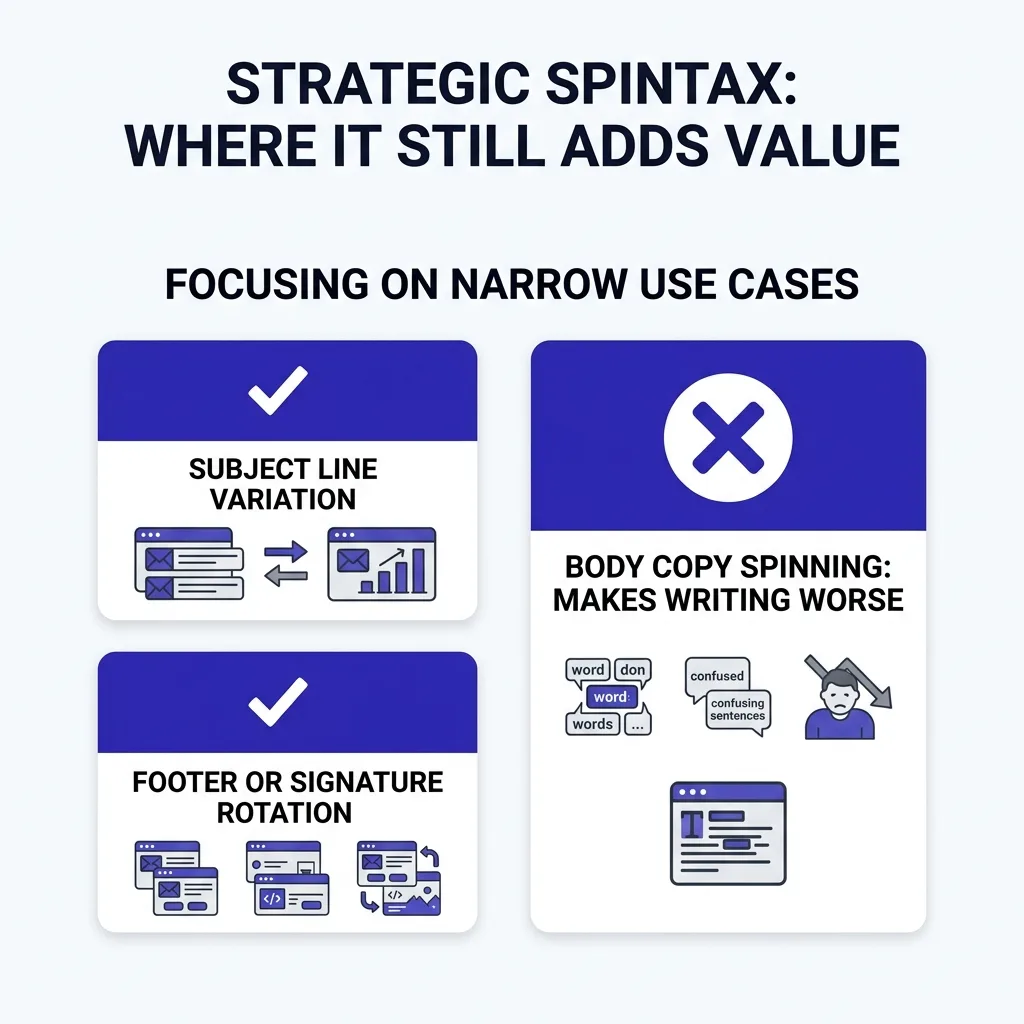
Subject line variation is the one place it still earns its keep. Rotating three or four genuinely different subject line framings across a send reduces the chance that a single subject line pattern gets flagged as repetitive, and subject lines are short enough that even simple variation reads naturally.
Footer and signature micro-variation (rotating a closing line or a signature format) can still help avoid literal-string matching on the parts of an email that carry no real information anyway.
Beyond that, spintax applied to the body copy of a cold email in 2026 mostly just makes the writing worse. Braces force awkward phrasing to fit multiple synonym slots, and the resulting sentence rhythm often reads as noticeably synthetic to both filters and human readers.
#List-splitting instead of content-spinning
A related but distinct technique still holds up: splitting a single send across multiple sending domains and inboxes rather than varying the content itself.
This addresses volume-per-sender thresholds directly, which is what cold email sending frequency limits actually police, rather than trying to disguise content that is fundamentally the same message.
Combining reasonable list-splitting with genuine content personalization, instead of synonym spinning, covers both the volume signal and the content signal that modern filters evaluate separately.
#What replaced it
Real personalization replaced spintax, and the shift is measurable in how top-performing teams operate.
Instead of rotating synonyms inside a fixed template, modern outbound tools generate a genuinely different message per recipient, grounded in that recipient's actual context: a recent funding round, a job change, a specific product mention, a shared connection.
This is the difference between cold email personalization at scale done properly and the shallow version most teams still practice, which common personalization mistakes covers in more detail.
AI drafting tools, when paired with real research inputs rather than just a name-merge field, produce structurally distinct emails instead of one template with swapped words. That distinction matters because it is exactly what modern classifiers are built to tell apart.
FirstSales, for example, builds each draft from signal-based research on the specific prospect rather than starting from a fixed template and rotating synonyms, which is the structural difference that keeps messages reading as genuinely individual rather than templated. A human still approves the send, which keeps the human-in-the-loop safeguard that fully autonomous cold email agents often skip.
#Comparison table: spintax vs AI personalization vs static templates
| Approach | Beats hash-based duplicate detection | Beats semantic classifiers | Reads naturally to a human | Setup effort |
|---|---|---|---|---|
| Static template, no variation | ✗ | ✗ | ✓ | Low |
| Spintax (synonym rotation) | ✓ | ✗ | ✗ | Low |
| Manual per-recipient personalization | ✓ | ✓ | ✓ | Very high |
| AI drafting with research inputs | ✓ | ✓ | ✓ | Medium |
The setup-effort column is the one that actually explains spintax's staying power. Teams under quota pressure default to the cheapest option available, and for over a decade that was spintax.
AI drafting tools closed that gap by moving the effort from writing time to research automation, which is why the medium-effort column now produces the same quality outcome the very-high-effort manual approach used to require.
#Decision flow: should you use spintax at all
#How to test if your variation strategy is being flagged
 How to test if your variation strategy is being flagged
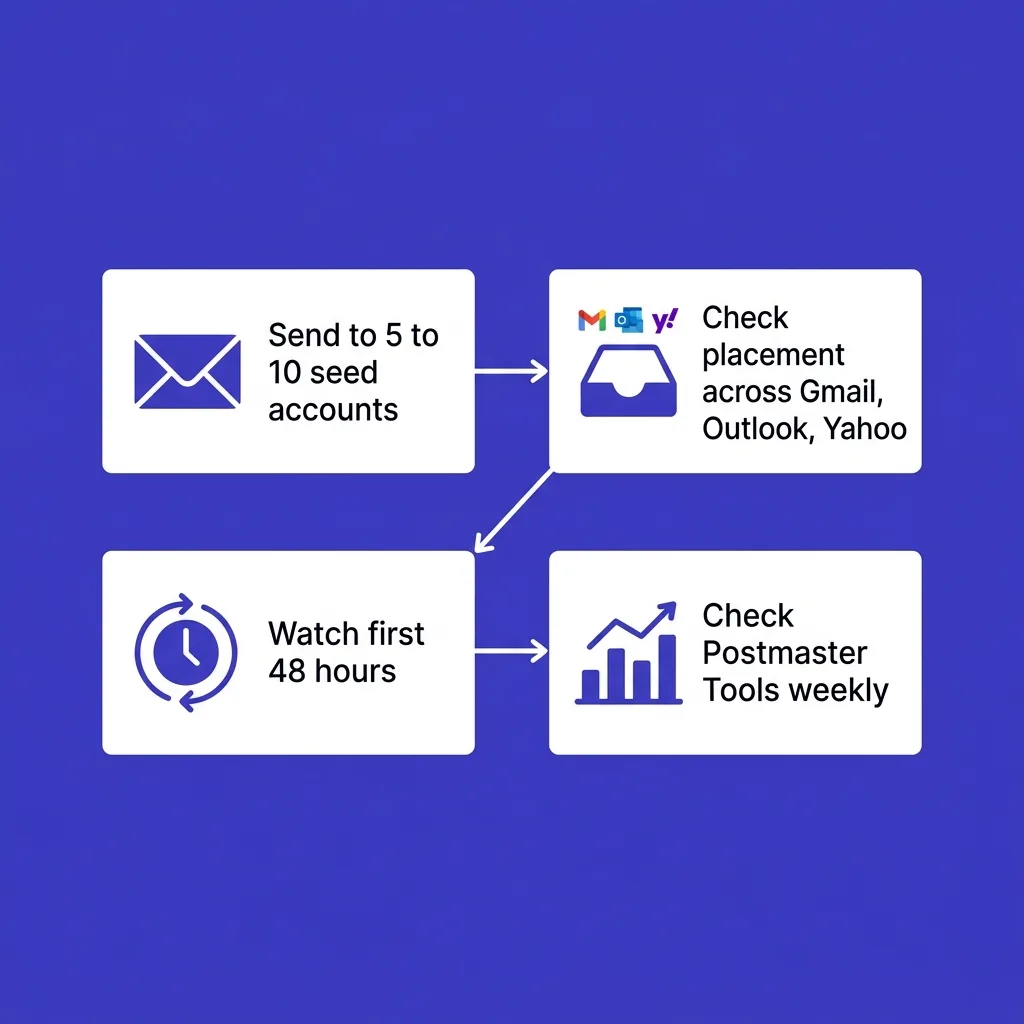
Run a seed test before scaling any new template or spinning strategy. Send the sequence to five to ten accounts you control across Gmail, Outlook, and Yahoo, and check actual placement, not just delivery.
Watch cold email bounce rate and spam folder placement specifically for that campaign over the first 48 hours, since that window is when most filtering systems finish evaluating a new sender pattern.
If placement drops sharply only for the spun template and not for a genuinely rewritten control version, the sentence structure is still being detected regardless of the swapped synonyms.
Check Google Postmaster Tools domain reputation weekly during this test. A reputation dip that coincides with a template change is a strong signal the template itself is the problem.
#What a seed test actually reveals
A seed test cannot tell you everything, since your own controlled inboxes will not generate the complaint-based signals that come from real, unpredictable recipient behavior at scale.
What it does reveal reliably is placement (inbox, promotions, spam) and any immediate authentication or content-quality flags that a filter surfaces before the message even reaches a folder decision.
Run the same seed test again after any meaningful template change, not just once at launch, since filtering models retrain continuously and a pattern that passed cleanly three months ago is not guaranteed to pass today.
#The economics of spintax versus real personalization
Spintax is nearly free to set up once, then free to run forever, which is the entire source of its appeal.
Building one template with variation points takes a rep maybe 15 minutes. Sending it to 5,000 prospects costs nothing extra in time, since the tool handles the variation automatically.
Real personalization used to mean a human researching and writing each message by hand, at roughly five to ten minutes per prospect for a rep doing it properly. At 5,000 prospects, that is 400 to 800 hours of work, which is obviously not viable at outbound scale.
AI-assisted personalization changes that math without reverting to the spintax shortcut. A tool that pulls real signals (funding, hiring, job changes, content the prospect published) and drafts from those signals compresses the research-and-write step to seconds per prospect while still producing a structurally distinct message.
The cost comparison that matters is not setup time, it is reply rate per hour invested. A spun campaign at a 1 to 2% reply rate and near-zero time cost still produces fewer total replies per hour of team effort than a properly personalized campaign at 5 to 8%, once you account for the time saved by automating the research step instead of the writing shortcut.
There is also a downstream cost spintax rarely gets charged for: domain reputation. A campaign that trains an inbox provider's model to associate your sending domain with templated, low-engagement mail makes every future campaign from that domain start from a worse baseline, an effect that does not show up in any single campaign's report but compounds across cold email reply rate benchmarks over time.
#Common spintax mistakes that make detection worse
Beyond the structural detection problem, poorly built spintax templates create their own giveaways.
Nested braces that do not account for grammar agreement produce sentences like "I noticed you're company" instead of "your company," since the swap logic does not track possessive versus contraction forms.
Overlapping variation points sometimes generate contradictory statements within the same message, such as referencing "your recent post" in one line and "your recent announcement" in another when the tool was meant to pick one consistent noun throughout.
Templates built by non-native English speakers or copied from shared "spintax libraries" circulating in outbound communities often contain awkward phrasing that reads as foreign or stilted regardless of which variation gets selected, which is its own reply-rate killer independent of any filtering effect.
#Migrating from spintax to real personalization
Moving off spintax does not require rebuilding your entire sequence overnight.
Start with your highest-volume sequence, the one sending the most messages per week, since that is where detection risk and reply-rate upside both concentrate.
Replace the spun body copy with a structure that pulls in one specific, verifiable fact about the recipient (a recent LinkedIn post, a company announcement, a shared mutual connection) rather than a synonym-swapped opener.
Keep your cold email templates as a structural skeleton (the argument, the proof point, the ask) but let the specific language change per recipient based on real research, not a synonym bank.
Watch cold email sending frequency alongside this transition. A sequence that used to send at high volume because spintax made bulk-send risk feel lower should be re-evaluated against the cold email volume trap, since real personalization takes more time per message and often performs better at lower volume anyway.
Build a research step into your workflow, whether manual or tool-assisted, before drafting. An SDR prompt library built around research and drafting prompts gives reps a repeatable way to generate genuinely different openers without falling back to a synonym rotation out of time pressure.
#A migration checklist
Work through this in order rather than trying to fix an entire outbound program in one pass.
First, audit which active sequences still use body-copy spintax and rank them by weekly send volume, since the highest-volume sequence carries the most detection risk and the most reply-rate upside if fixed.
Second, define the two or three research inputs you can realistically gather per prospect at scale: a job title change, a recent post, a company milestone, a shared connection.
Third, rebuild the top sequence's opener around one of those inputs instead of a synonym-swapped greeting, and run it as a controlled test against the existing spun version on a comparable list segment.
Fourth, measure reply rate and spam-complaint rate after two weeks, not two days, since inbox providers need a sending history to fully evaluate a changed pattern before their reputation scoring stabilizes.
Fifth, roll the winning approach out to the next sequence down the priority list, and repeat.
#A short walkthrough
Here is a hypothetical example that mirrors what most teams see when they make this switch: imagine a five-rep team running a single spun template across 2,000 prospects a week, generating a 1.8% reply rate.
They rebuild the opener to reference each prospect's most recent LinkedIn post, sourced through an automated research step rather than manual lookup, keeping the rest of the message structure intact.
Reply rate on the rebuilt sequence lands at 4.9% over the following month, more than double the spun version, while spam complaint rate drops slightly because messages that reference something real earn fewer "this isn't relevant to me" reports than generic synonym-swapped openers.
The lesson in this scenario is not the specific percentages, it is that the single opening line carried almost all of the difference, since the rest of the template stayed the same.
#Frequently asked questions
#Does spintax still get emails delivered in 2026?
It still helps avoid exact-duplicate hash detection, but it does not reliably beat semantic content classifiers, which is the primary filtering layer at Gmail, Outlook, and Yahoo today. Delivery and inbox placement are different outcomes, and spintax's remaining benefit applies mostly to the first, not the second.
#Is spintax banned or against any platform's terms?
No major inbox provider explicitly bans spintax by name. The risk is indirect: templated text that reads as synthetic gets penalized by content-quality filtering regardless of the technique used to generate it.
#Can spintax hurt reply rates even if it does not get flagged?
Yes. Awkward, forced phrasing from cramming multiple synonym options into one sentence structure reads as unnatural to human recipients, which lowers reply rates independent of any filtering effect.
#What is the difference between spintax and AI-generated variation?
Spintax swaps individual words or phrases inside a fixed sentence structure. AI-generated variation, done properly, produces genuinely different sentence structures grounded in different facts about each recipient.
#Do spam filters actually read the meaning of an email?
Yes. Modern classifiers, including Gmail's, evaluate semantic coherence and structural patterns, not just keyword or hash matching, which is why synonym-level tricks no longer work as well as they once did.
#Is subject line spintax still useful?
More than body spintax. Subject lines are short enough that even simple rotation reads naturally, and varying them reduces repetitive-pattern signals without the awkward phrasing risk that body spintax creates.
#How can I tell if my emails read as AI-generated or templated?
Read a sample out loud. Forced synonym choices, oddly generic phrasing, and sentences that could apply to any recipient are the tells; see how prospects spot AI-written emails for more specific patterns.
#What replaced spintax for teams sending at scale?
AI drafting tools that generate a distinct message per recipient from real research inputs, reviewed by a human before sending, rather than a single template varied by synonym substitution.
#Does using AI to write cold email count as spintax with extra steps?
Only if the AI is prompted to rewrite one fixed template with synonyms. Used properly, AI drafting starts from recipient-specific research and produces a structurally different message each time, which is a different mechanism entirely.
#Will spintax get my domain blacklisted?
Not directly. Spintax itself is not a blacklist trigger; the underlying causes covered in email blacklist removal, like spam trap hits or complaint spikes, are unrelated to whether your copy is spun.
#Do inbox providers penalize AI-written email specifically?
Not explicitly by policy, but content that reads as generic, low-effort, or templated (whether written by a human or an AI) gets penalized the same way through engagement and complaint signals.
#How many message variations does a spun template actually produce?
A template with five swap points and three options each produces 3^5, or 243 surface variations. All 243 share the exact same underlying sentence structure, which is what semantic classifiers detect regardless of the surface count.
#Should I remove spintax from an old sequence that is still performing well?
Test before removing. If a legacy sequence is still hitting the inbox and generating replies, the risk of a change outweighs a theoretical improvement; test a personalized variant on a subset of the list first.
#Does spintax help with A/B testing?
Not really. Spintax variations are random, not controlled, which makes them unsuitable for A/B testing since you cannot isolate which specific change drove a result.
#What is the fastest way to move a sequence off spintax?
Start with the single highest-volume active sequence, rewrite its opener to pull in one verifiable recipient-specific fact, and keep the rest of the structure intact while you measure the change.
#Can I combine light spintax with AI personalization?
Yes, typically in subject lines or closing lines where structural repetition matters less. Keep the body copy fully personalized rather than spun.
#Does spintax reduce writing time compared to AI drafting?
Initially yes, since building the template takes less setup than configuring research inputs. Over time, AI drafting tools that automate the research step usually end up faster per genuinely personalized message.
#Why did spintax tools stay popular even after it stopped working as well?
Habit and inertia. Sending platforms kept the feature because switching workflows takes effort, and the reply-rate decline from over-reliance on spintax is gradual enough that many teams do not connect the two.
#Is there any cold outbound context where spintax is genuinely still the right tool?
High-volume, low-personalization use cases like link prospecting outreach at massive scale, where per-recipient research is not economically viable, are the closest fit, though even there structural variation beats pure synonym swapping.
#Does spintax matter less if I already have a strong sending reputation?
Established reputation buys some slack, since inbox providers weigh a domain's overall history alongside any single campaign's content quality. It does not make the underlying content problem disappear, and a reputation cushion erodes faster than most senders expect once complaint or spam-folder signals start trending the wrong way.
Treat reputation as a buffer that absorbs occasional mistakes, not a permanent exemption from content quality standards. A domain that has spent months building trust can still slide into the spam folder within weeks if repeated low-quality sends start pulling complaint rates upward.
Spintax was a clever workaround for a filtering problem that stopped existing years ago. The filtering problem today is semantic, not lexical, and the only durable fix is writing (or generating) messages that are actually different from each other, not just differently worded.
That does not mean going back to writing every email by hand. It means picking a research and drafting workflow, whether that is a disciplined manual process or an AI tool that grounds each draft in a real signal, that produces structurally distinct messages without costing a rep their entire day.
The teams still leaning hardest on spintax in 2026 are usually the ones who have not yet measured the gap between what it promises and what their actual placement data shows.
Run the seed test from this guide against your current highest-volume sequence this week. If the numbers hold up, you have real evidence, not a habit inherited from a filtering era that ended years ago.