
TL;DR: Search funds and SMB acquirers use cold email to reach business owners before their company ever hits a broker's list. Reply rates run lower than typical B2B outbound, usually 1% to 5%, because you are asking someone to consider selling their life's work, not book a demo. The acquirers who close deals treat email as one channel in a sequence that includes mail, calls, and referrals, and they filter hard before they ever hit send.
#Why off-market deal sourcing exists
Most small business acquisitions never touch a broker listing.
Owners who list with a broker signal that they are ready to sell today, at a market price, to whoever shows up first.
That crowds every buyer into the same auction and pushes multiples up.
Off-market deal sourcing skips the auction. You find a business that fits your thesis, whether that is a $2 million EBITDA HVAC company or a niche SaaS tool, and you reach the owner directly before a broker gets involved.
According to IBBA and M&A Source survey data cited across multiple deal sourcing platforms, the majority of small business transfers in the sub-$5M range still happen through private, unlisted deals rather than public marketplaces.
That is the entire reason search funds and independent sponsors build cold outbound programs instead of just browsing BizBuySell.
#How search funds and independent sponsors actually source
Corporate development teams at strategic acquirers run a similar motion, though usually with more resources and a broader thesis covering multiple product lines or geographies at once.
Family offices and holding companies looking for cash-flowing SMBs to hold long term follow the same playbook, often with even more patience than a time-boxed search fund since there is no fund clock forcing a deal within two years.
A search fund is a small team, often one or two people, raised capital specifically to find and buy one company.
Their whole job for 18 to 24 months is finding that one deal.
Independent sponsors work the same motion without a committed fund, lining up capital deal by deal once they find something worth buying.
Both groups build a thesis first: industry, geography, revenue range, owner age, succession signals.
Then they build a list of companies matching that thesis and start reaching owners directly, usually starting with email because it scales further than cold calling a list of 3,000 businesses.
graph TD
    A[Define acquisition thesis] --> B[Build target list from data sources]
    B --> C[Segment by owner age and succession signal]
    C --> D[Cold email sequence: 3-5 touches]
    D --> E{Owner replies?}
    E -->|Yes| F[Discovery call]
    E -->|No response| G[Direct mail follow-up]
    G --> H[Phone or LinkedIn touch]
    F --> I[NDA and preliminary financials]
    I --> J[LOI]
The thesis matters more than the email copy.
A search fund targeting HVAC companies with $1.5M to $4M EBITDA in the Southeast will get better replies from 200 tightly filtered owners than from 5,000 loosely matched ones.
#What response rates really look like
Set expectations correctly before you send a single message.
General cold email reply rates across B2B sit around 3.43% as of 2026, down from roughly 5% in 2025 and 8.5% back in 2019, according to data reported by Whali's 2026 benchmark analysis.
Deal sourcing email to business owners tends to land near the lower end of that range, often 1% to 5%, because you are asking someone to consider a life decision, not a software trial.
Search fund practitioners who have run sourcing campaigns publicly report needing 2,000 to 3,000 total outbound touches over the life of a search to generate enough qualified conversations for one closed deal.
That math changes the entire approach. You are not optimizing for a 20% reply rate campaign. You are building a sustained, patient pipeline that runs for a year or more.
| Sourcing channel | Typical reply rate | Speed to reply | Cost per touch |
|---|---|---|---|
| ✓ Cold email (personalized) | 1% to 5% | Slow, days to weeks | Low |
| ✓ Direct mail (letter) | 5% to 11% | Slow, 1 to 3 weeks | Medium |
| ✓ Warm referral via broker or advisor | 15% to 30% | Fast, days | High |
| ✗ Generic mass email blast | Under 1% | Slow | Low |
| ✗ Cold call with no prior touch | 2% to 4%, high hang-up rate | Immediate | Medium |
| ✓ LinkedIn message to owner | 6% to 10% | Medium | Low |
The pattern holds across deal sourcing data: personalization and channel stacking beat volume every time.
#Building the target list before writing a single email
A sourcing campaign lives or dies on the list, not the copy.
Start with a narrow thesis: industry codes (NAICS or SIC), revenue band, geography, and owner tenure.
Owner tenure matters more than most first-time searchers realize.
A business where the same owner has run things for 20 to 30 years has a much higher succession probability than one under new ownership.
Pull data from state business registries, industry associations, trade publications, and paid databases that track SMB ownership.
Cross-reference against public signals: is the owner near retirement age based on LinkedIn history, has the business shown up in local news for anniversaries or awards, has a competitor recently sold.
This is the same discipline covered in waterfall enrichment for B2B data: stack multiple sources, verify overlap, and only email contacts you can confirm are the actual decision maker, in this case the actual owner, not a general manager with no equity stake.
Skip businesses under $500K revenue unless your thesis specifically targets micro-acquisitions.
The math on outreach effort per deal does not work at that size for most searchers.
#The email sequence that gets replies
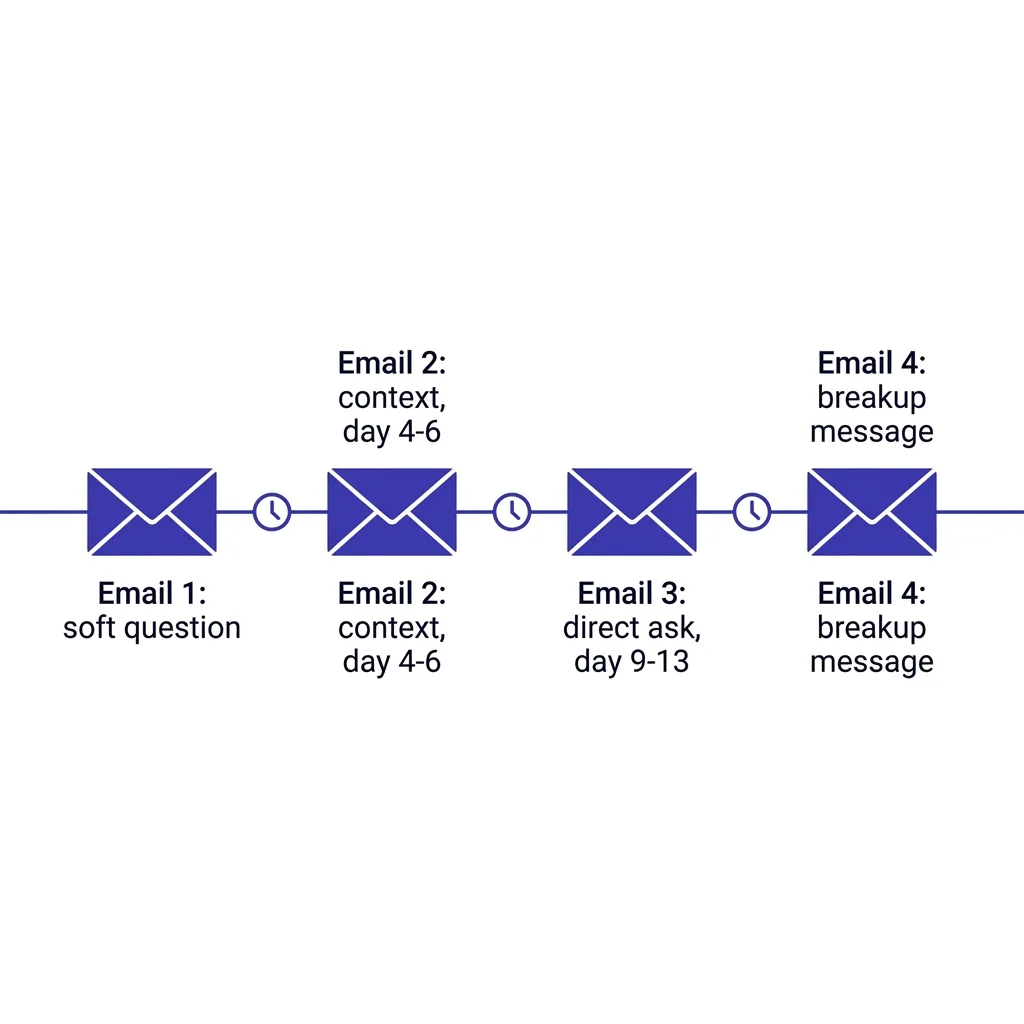 The email sequence that gets replies
The first email is not a pitch. It is a question.
Owners who built a business over decades do not respond to "I would like to discuss acquiring your company" in the subject line.
They respond to specific, low-pressure curiosity about their business, paired with a credible reason you are reaching out.
Email 1 should reference something specific: years in business, a recent award, a niche the company occupies. Keep it under 100 words. End with a soft question, not a meeting ask.
Email 2, sent 4 to 6 days later, adds context about who you are and why this specific type of business fits what you look for. Still no hard ask for a call.
Email 3, another 5 to 7 days out, asks directly whether they have thought about succession planning or would be open to a confidential conversation.
Email 4 is a short breakup message. Owners who were not ready often reply to this one because it removes pressure entirely.
This mirrors the structure in follow-up email strategy: most replies come from touches two through four, not the first email.
A single-email approach fails hard in deal sourcing specifically, because the decision being asked is enormous and owners need multiple credible touches before they trust a stranger with it.
#What to say when an owner writes back
The reply is not the win. It is the start of a much longer relationship.
Owners who reply, even skeptically, need a human response within hours, not days.
The first call should be almost entirely listening.
Ask about the business history, not your acquisition thesis.
Ask what a good outcome looks like for them personally, financially and otherwise.
Most first-time buyers make the mistake of pitching deal structure on the first call.
That is premature and it signals you care more about the transaction than the business or the person who built it.
Save NDA and financials requests for the second conversation, once trust exists.
#Multi-channel deal sourcing that beats email alone
Email alone underperforms in this specific use case compared to standard B2B SaaS outbound.
Owners in their 50s and 60s check email less obsessively than SaaS buyers and often ignore anything that looks like a sales pitch.
Direct mail, sent as a physical letter to the business address, gets opened because it is rare and feels deliberate.
Combining a mail piece with an email follow-up a week later, referencing the letter, lifts response meaningfully above either channel alone.
This is the same logic behind email and LinkedIn multichannel outreach: stacking channels compounds trust signals instead of relying on one inbox.
Phone follow-up after two unanswered emails, placed to the business's main line and asking to speak with the owner directly, closes gaps that digital channels alone leave open.
Local networking, industry association events, and accountant or attorney referrals round out a sourcing program that treats email as one input, not the whole strategy.
#Common mistakes that kill a sourcing campaign
Generic templates are the fastest way to get ignored or flagged as spam by an owner's assistant.
Sending from a brand new domain with no inbox warmup history triggers spam filters before the message ever reaches the owner.
Asking to buy the business in the first sentence reads as presumptuous and gets deleted.
Ignoring email sending limits and blasting a full list in one day burns domain reputation permanently and tanks every subsequent campaign.
Failing to track which owners replied but went quiet means re-engaging them at the wrong time, or worse, never re-engaging a warm lead who just needed six more months.
Treating a "no" as final. Succession timing shifts. A no today can become a yes in 18 months if the relationship stayed warm.
#Segmenting owners by deal readiness
Not every owner on a target list is equally reachable.
Treat the list in three tiers instead of one flat batch.
Tier one is owners showing active succession signals: age near or past 60, no visible next-generation involvement, recent news mentioning retirement plans or health issues affecting the business.
Tier two is owners with none of those signals but who fit the thesis on size, industry, and geography.
Tier three is owners you are unsure about, often because public data is thin or conflicting.
Send tier one your most researched, highest-effort emails first, since the probability of a productive reply is highest there.
Tier two gets a slightly more templated but still personalized sequence, since volume matters more than precision at that stage.
Tier three gets a lighter-touch, single-email test to see if a reply reveals more about readiness before investing further effort.
This tiering mirrors the discipline in outbound lead scoring models: rank before you email, not after.
Searchers who skip this step burn the same effort on a business with zero succession pressure as they do on one actively looking for an exit, and that math never works over a 12 to 24 month search.
#Sample first-touch email structures
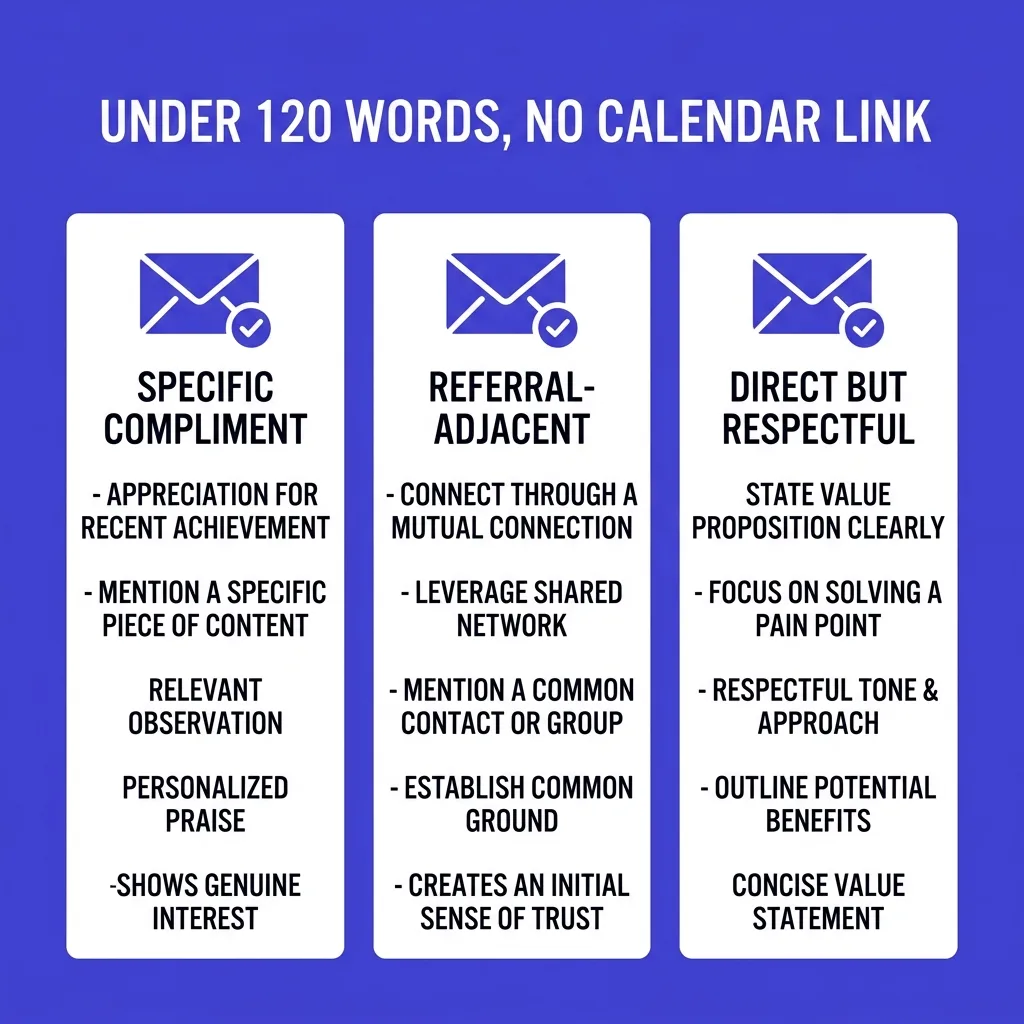 Sample first-touch email structures
Concrete examples help more than abstract advice here, so consider three real structures searchers use.
Structure one, the specific compliment: Open with a genuine, specific observation about the business (a review, an award, a niche it serves), then briefly explain that you invest in and operate businesses like theirs, then ask if they would be open to a short call sometime in the next month or two.
Structure two, the referral-adjacent: Reference that you have looked at several businesses in their specific trade or region, mention one general observation about the space, and ask a genuinely curious question about how they see the next few years playing out for the business.
Structure three, the direct but respectful: State plainly that you are a buyer actively looking in their industry and size range, note that many owners you talk to are not planning to sell but are open to a confidential conversation, and ask if that describes them too.
All three avoid pressure language, avoid mentioning price or valuation, and end with a low-commitment question rather than a calendar link.
A calendar link in email one, borrowed from typical SaaS cold email templates, reads as presumptuous in this context and tends to lower reply rates rather than raise them.
Keep every version under 120 words. Owners skim on a phone between meetings just like any other reader.
#Legal and etiquette considerations
Deal sourcing email sits under the same core compliance rules as any other cold outreach, including CAN-SPAM requirements around sender identification and unsubscribe options.
Some states and industries carry additional disclosure requirements for solicitations related to business sales, so confirm local rules before scaling volume in a new region.
Etiquette matters as much as legal compliance here.
Never reference confidential financial estimates you cannot substantiate, and never imply an offer exists before real diligence has started.
Respect a hard no immediately and remove that contact from active sequences, noting the date for a respectful re-engagement much later rather than an immediate follow-up.
Searchers who blur these lines burn trust across an entire local business community fast, since owners in the same trade association or town often compare notes.
#Tools and stack for deal sourcing outreach
Search funds run lean, so the stack matters for cost and deliverability, not just features.
A dedicated sending domain separate from any personal email protects your primary identity if deliverability issues come up, following the same logic in subdomain vs separate domain guidance for cold outreach.
Verification tools that check whether an email is real before you send cut bounce rates, which matters even more here because sourcing lists often come from scraped or outdated public registries.
Platforms built for AI-assisted drafting with human review, like FirstSales, help searchers personalize hundreds of first-touch emails without losing the specific, researched detail that separates a reply from a delete.
CRM tracking that flags "went quiet" contacts for a re-engagement touch six months out turns a one-time campaign into a compounding pipeline.
Combine that with a simple spreadsheet tracking outreach date, channel, and owner age estimate, and most searchers have enough infrastructure to run a serious sourcing motion without enterprise tooling.
#The ROI math behind a sourcing campaign
Run the numbers before committing to a channel mix, because deal sourcing economics look nothing like SaaS outbound.
At a 3% reply rate and roughly 3,000 total emails sent over a search, expect around 90 replies.
Of those 90, maybe 20 to 30 convert into a real conversation once you filter out flat rejections and non-responsive owners who replied only to unsubscribe.
From 20 to 30 conversations, a disciplined searcher typically advances 3 to 6 into serious diligence, and closes one.
That funnel means every closed deal traces back to roughly 2,500 to 3,500 outbound touches across the full search, a number consistent with what independent search fund practitioners report publicly.
Compare that against the cost of a business broker's commission, often 8% to 12% of transaction value on a small deal, and the outbound math looks favorable even accounting for a year of part-time sourcing effort.
The same cost per meeting framework used in B2B sales outbound applies directly here: know your cost per touch, your conversion rate at each stage, and your target number of closed opportunities before scaling volume blindly.
Searchers who track this funnel weekly catch stalled stages early, whether that is a list quality problem, a copy problem, or simply not enough total volume in the pipeline yet.
#Tools and stack, expanded
Beyond the core sending and verification tools, a few additions matter specifically for deal sourcing volume and cadence.
A dedicated CRM view or spreadsheet tab for "warm but not ready" owners prevents good leads from disappearing into a general inbox after the first no.
Calendar reminders tied to that list, set for 4 to 6 months out, keep the re-engagement motion consistent instead of dependent on memory.
Domain and inbox rotation across two or three sending domains protects deliverability at the volume a serious search requires, following the same principle as email domain rotation used in higher-volume B2B campaigns.
Most solo searchers underinvest in this infrastructure early, then hit a wall around month four when reply rates crater because a domain got flagged.
Building the sending infrastructure correctly from week one, even at low volume, avoids that mid-search reset that costs searchers weeks of momentum.
#Pacing a sourcing campaign across a full search
A 12 to 24 month search needs a sending cadence that survives the whole timeline, not a burst that burns out in month two.
Front-loading 3,000 emails in the first six weeks tanks deliverability and exhausts the target list before the searcher has learned what copy and thesis adjustments actually move reply rates.
A steadier cadence, something like 150 to 300 new first-touch emails per month alongside ongoing follow-ups and re-engagement, keeps domains healthy and leaves room to refine the thesis as data comes in.
Early months should weight toward tier one, high-signal targets, since those replies teach the most about what resonates before scaling to the wider tier two list.
Mid-search, once reply patterns are clear, volume can increase because copy and targeting are dialed in, and this is usually when most searchers see reply rates stabilize in that 2% to 4% range described earlier.
Late-search, roughly months 10 through 18, revisiting the earliest "not now" replies from tier one often produces some of the strongest conversations, since 6 to 12 months is enough time for an owner's thinking to shift.
Searchers who treat month one's rejections as permanent miss this entirely and never circle back, leaving real opportunities on the table simply because of poor follow-up discipline rather than a bad list or bad copy.
Building this cadence into a calendar or CRM from day one turns deal sourcing from a scramble into a system, which matters more than any single email template ever will.
#Subject lines that get opened by owners
Owners of small, closely held businesses do not read email the way corporate buyers do.
Most check a single inbox from a phone between calls, so a subject line has to survive a glance, not a scroll.
A first name and a plain reference to the business, something like "Question about [Company Name]," outperforms anything that sounds like a mail merge.
Avoid words that read as broker language, like "acquisition opportunity" or "investment inquiry," since owners have seen those from actual brokers and file them as spam on sight.
A short question works better than a statement, because a question implies the reply is easy and low-commitment.
Testing two or three subject line styles across the first few hundred sends, then locking in whichever gets the highest open rate before scaling volume, saves months of guessing later, as covered in more depth in cold email subject line best practices.
One pattern worth avoiding entirely: subject lines that promise something the email does not deliver, like "Big opportunity for you," since owners open once, feel misled, and never open a follow-up from that domain again.
#Frequently asked questions
#What is deal sourcing by cold email?
Deal sourcing by cold email means reaching business owners directly to gauge interest in selling, before the company is listed with a broker or appears on a marketplace.
#What response rate should I expect from deal sourcing emails?
Most sourcing campaigns land between 1% and 5% reply rates, lower than typical B2B SaaS outbound, because the ask involves a major life and financial decision for the owner.
#How many emails should a deal sourcing sequence include?
Three to five emails spaced 4 to 7 days apart works well, ending with a low-pressure breakup message that often generates late replies.
#Should the first email mention acquisition directly?
No. The first email should reference something specific about the business and ask a soft question, saving the direct acquisition conversation for email two or three.
#What is the difference between a search fund and an independent sponsor?
A search fund raises committed capital upfront specifically to find one company; an independent sponsor lines up capital deal by deal once a target is identified.
#How do I build a target list for deal sourcing?
Start with a narrow thesis on industry, revenue, and geography, then cross-reference state business registries, trade associations, and paid data sources against owner tenure and succession signals.
#Why does owner tenure matter for sourcing?
Owners who have run a business for 20-plus years have a higher probability of nearing succession or retirement, making them more receptive to a sourcing conversation.
#Is direct mail better than email for deal sourcing?
Direct mail gets higher reply rates, often 5% to 11%, because it is rare and feels deliberate, but it costs more per touch and moves slower than email.
#How do I avoid sounding like a broker or spam email?
Reference specific, researched details about the business, keep the message short, avoid pressure language, and never send from a cold, unwarmed domain.
#Should I ask for financials in the first call?
No. The first conversation should focus on listening to the owner's history and goals; financials and NDAs belong in the second or third conversation once trust exists.
#What is a good breakup email for deal sourcing?
A short message that removes pressure entirely, something like acknowledging the timing may not be right and leaving the door open, often generates replies from owners who were quietly considering it.
#How long does a deal sourcing campaign take to produce a closed deal?
Search fund practitioners commonly report needing 2,000 to 3,000 total touches across 12 to 24 months to generate one closed acquisition.
#What industries respond best to cold sourcing outreach?
Fragmented, owner-operated industries like home services, niche manufacturing, and specialty distribution tend to respond better than industries already saturated with PE roll-up activity.
#Should I use a separate domain for sourcing emails?
Yes. A dedicated sending domain protects your primary identity and isolates any deliverability risk from the high volume of a sourcing campaign.
#How do I handle an owner who says no?
Keep the relationship warm with an occasional, low-pressure check-in every six months, since succession timing shifts and a no today often becomes a yes later.
#Can AI help with deal sourcing email personalization?
AI drafting tools with human review, like FirstSales, can speed up researching and drafting hundreds of individually personalized first-touch emails without losing the specific detail that earns a reply.
#What is the biggest mistake in deal sourcing outreach?
Sending generic, template-heavy emails that ignore the specific business, which reads as impersonal and gets deleted or reported as spam.
#Should I combine email with cold calling for deal sourcing?
Yes. Phone follow-up after two unanswered emails, placed to the business's main line, closes gaps that email alone leaves open, especially with owners who check email infrequently.
#How do I track deal sourcing outreach over time?
A CRM or spreadsheet tracking outreach date, channel, and re-engagement timing turns a one-time campaign into a compounding, long-term pipeline instead of a single send-and-forget effort.
#What makes deal sourcing email different from sales outbound?
Deal sourcing asks an owner to consider selling their life's work, not adopt a new tool, so the copy, pacing, and patience required are fundamentally different from typical B2B sales sequences.
#Key takeaways
Deal sourcing by email works, but only as one channel in a patient, multi-touch, multi-year pipeline built around a narrow acquisition thesis.
Expect reply rates in the low single digits, treat every response as the start of a relationship rather than a transaction, and stack mail, calls, and referrals around email instead of relying on it alone.
The searchers who close deals are the ones still sending thoughtful, specific outreach 18 months in, long after less patient buyers gave up.
Sources: