#Link prospecting outreach: what still works in 2026
Copy page
TL;DR: Link prospecting outreach still works, with average response rates around 8.5% and a strong campaign hitting 8-12%, roughly double what generic cold email pulls today. The channel did not die, the generic version of it did. Personalized, specifically-timed outreach referencing real content still earns backlinks reliably, while templated batch pitches get filtered before they are ever read.
"SEO cold email is dead" gets repeated often enough that it sounds settled.
The data says otherwise.
What actually died is the mass-blast version of link outreach, the one built entirely around a fake compliment and a link request buried in paragraph two.
The mechanics that still work look almost identical to what makes any cold outreach convert: a real reason grounded in the target's actual content, a small and specific ask, and a follow-up cadence that respects the recipient's time without disappearing after one try.
This piece walks through the current benchmarks, the pitch types still landing links, and the mistakes that quietly cap most campaigns well below their potential.
#What the current numbers show
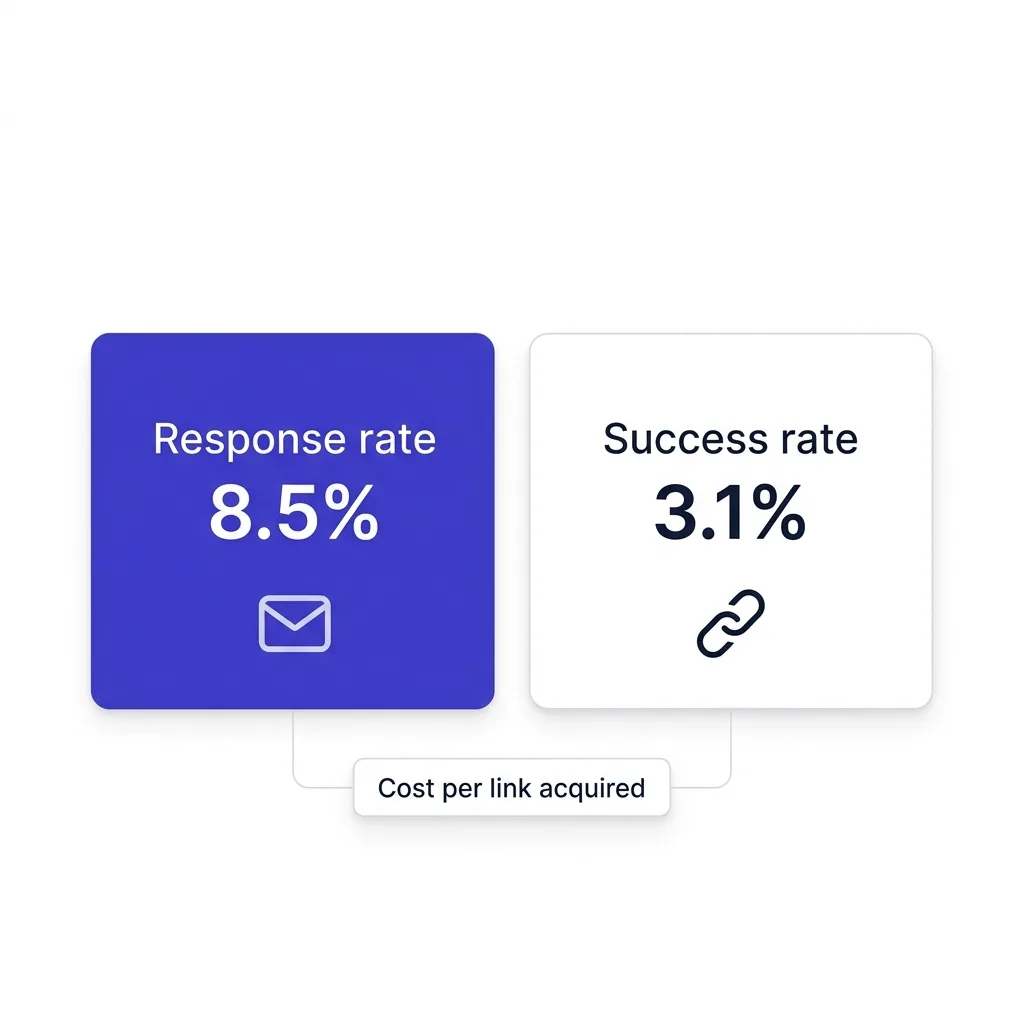
Email outreach for link building carries an average 8.5% response rate and a 3.1% success rate, meaning links actually acquired per email sent.
A reply rate between 8% and 12% counts as a strong result for link building specifically, and the email-to-backlink conversion rate for well-run campaigns lands around 3-5%.
That is meaningfully better than the roughly 4% average across general cold email today.
At an 8.5% response rate and 3.1% success rate, expect to contact around 30-35 prospects to land one backlink through cold outreach.
Systematic, well-targeted campaigns push that closer to 15-20% success, cutting the volume needed nearly in half.
Personalization alone reportedly doubles response rates over generic templates, and adding a structured follow-up sequence increases success rates by roughly 65% over single-touch outreach, with three follow-ups spaced four to seven days apart performing best.
Timing matters too: outreach sent Tuesday through Thursday sees about 23% higher response rates than Monday or Friday sends, when inboxes are either backlogged or already checked out for the week.
#Why "SEO cold email is dead" became the popular narrative
The volume of generic link outreach exploded over the past several years as SEO tooling made list-building and mail-merge outreach nearly free.
That flood trained site owners and editors to filter aggressively, the same dynamic that pushed general cold email reply rates down across every industry.
A generic "I love your blog, would you link to my article" email is now recognized and deleted in under two seconds by anyone who runs a site with any traffic.
The category did not die.
The low-effort version of it did, the same way low-effort sales cold email has stopped working while researched, specific outreach still lands meetings.
#What separates a working link pitch from a filtered one
A working pitch references a specific piece of the target site's content, not a vague compliment about the blog overall.
It states a real, verifiable reason the target's audience would benefit from the link, ideally tied to something the linked resource does that existing citations on the page do not.
It comes from a real person with an identifiable name and, ideally, a site or profile the recipient can quickly verify is legitimate.
It asks for one specific thing, a link addition to one specific page, not a vague "would you consider linking to us sometime."
And it is short.
Editors and site owners receiving link outreach skim in seconds, the same as any other cold inbox, and a five-paragraph pitch loses the reader before reaching the actual ask.
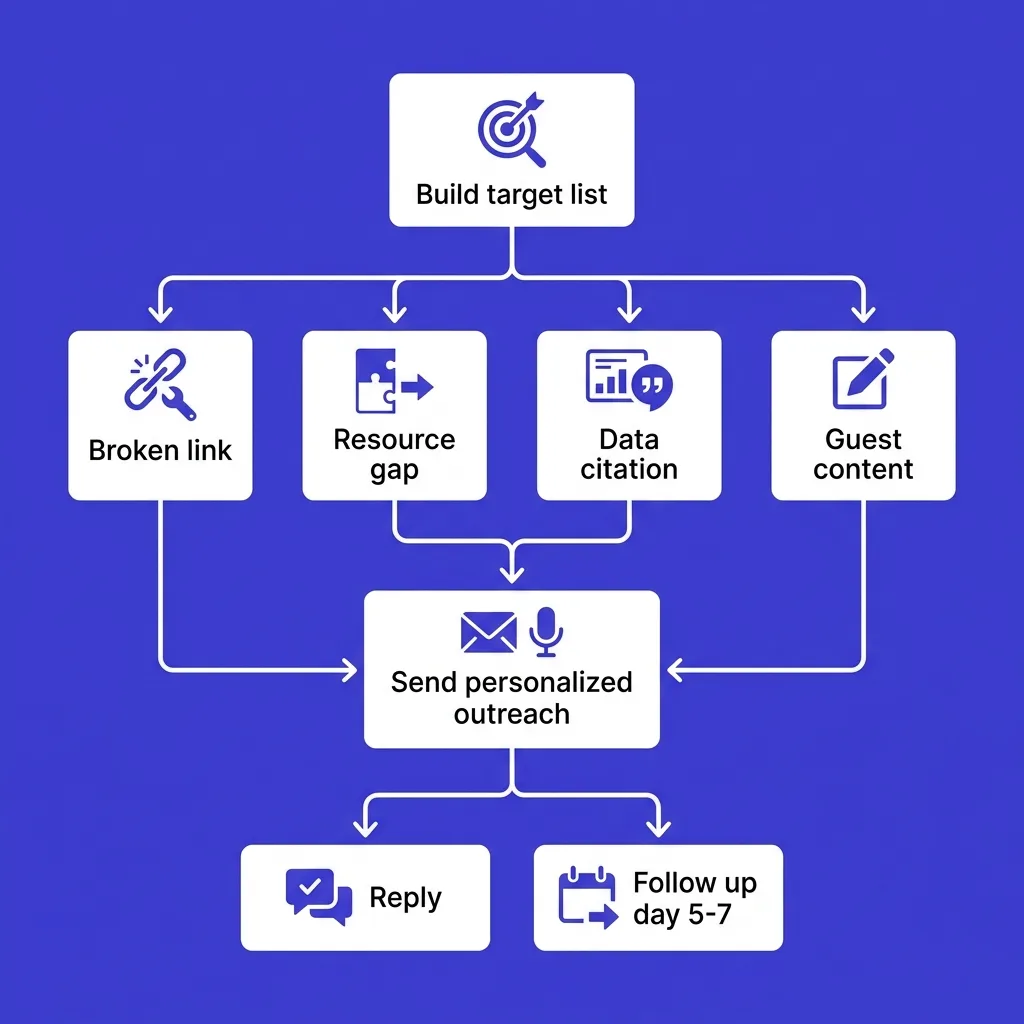
#The four pitch types that still convert
Broken link replacement finds a dead link on the target page and offers a working resource as the replacement, framed as a favor to the site owner (fixing something broken) rather than a pure ask.
Resource gap outreach identifies a page that lists several related resources but is missing one relevant option, and pitches inclusion as completing an already-existing list rather than requesting something new.
Original data or research citation pitches a specific data point or original research as worth citing in a piece that currently makes a claim without a source, which works especially well against content published by sites that value citation accuracy.
Guest contribution with a natural link offers a full piece of content in exchange for a byline and a contextual link, which takes more upfront effort per pitch but converts at a meaningfully higher rate since it removes the "why should I do this for you" friction entirely.
#A ✓/✗ table for link prospecting outreach
| Element | ✓ Works | ✗ Backfires |
|---|---|---|
| Opening line | References specific page or content | Generic compliment about "the blog" |
| Ask | One specific link on one specific page | Vague "consider linking to us" |
| Sender identity | Real name, verifiable profile | No-reply address, anonymous outreach |
| Pitch length | Under 150 words | Long pitch burying the ask |
| Send timing | Tuesday through Thursday | Monday or Friday |
| Follow-up | 2-3 touches, different angle each time, 4-7 days apart | Single send, no follow-up, or repeated identical nudge |
| Target selection | Sites with topical relevance and real traffic | Any site with a domain rating above a number |
#Targeting: relevance beats domain authority
A common mistake in link prospecting is building target lists purely off a domain authority or rating threshold, ignoring topical relevance entirely.
A high-authority site with no topical connection to the linked content is both less likely to accept the pitch and less valuable even if it does, since search engines and readers alike weigh topical relevance in how much a link actually matters.
Build lists starting from a content gap or citation opportunity, not a metrics threshold, then filter by authority second.
This mirrors how effective signal-based prospecting works in sales outbound: start from a real, specific reason to reach out, then apply firmographic filters, rather than starting from a filtered list and hoping a reason to reach out appears.
#A pitch template worth adapting
 A pitch template worth adapting
Structure matters more than clever phrasing.
A broken link pitch that converts consistently looks close to this: "Hi [name], I was reading your guide on [specific topic] and noticed the link to [source] in the section on [specific section] returns a 404. I put together [resource] that covers the same ground and might work as a replacement if useful. Either way, wanted to flag the broken link."
Notice what is missing: no opening compliment about the site overall, no multi-paragraph company introduction, no aggressive close.
The pitch leads with a genuine favor, the broken link flag, and offers the replacement as optional, which lowers the perceived pressure of the ask and, counterintuitively, increases acceptance.
A resource-gap pitch follows a similar shape: name the specific page, name what is missing, offer the resource as an addition rather than a replacement, and keep the tone matter-of-fact rather than salesy.
Avoid superlatives about your own content, "the ultimate guide," "the best resource," in the pitch itself.
Let the recipient judge the resource's value directly rather than being told to believe it is excellent.
#Finding the right contact instead of guessing
A large share of link prospecting failures trace back to sending the pitch to the wrong address, a generic info@ inbox that never reaches an editor, or a contact form that funnels into an unmonitored queue.
Check the site's About or Team page first for a named editor or content lead tied to the specific vertical the target page falls under.
For larger publications, the byline on the specific article is often a better contact than a generic editorial address, since the actual author has direct context on the page's content and links.
Verify any guessed email pattern against a verification tool before sending at any volume, since bounce rates on guessed addresses run meaningfully higher than on directly sourced ones and a high bounce rate damages the sending domain's reputation over time.
#Deliverability rules apply here too
Link prospecting email is still cold email, and it is subject to the same inbox placement rules as sales outbound.
A domain sending hundreds of unpersonalized link pitches a week without proper SPF, DKIM, and DMARC configuration will land in spam regardless of pitch quality, and once that happens even a genuinely well-researched pitch never reaches the recipient's primary inbox.
Verify target email addresses before sending, since guessing at editor or webmaster addresses produces a higher bounce rate than most outreach categories, given how many sites obscure or rotate contact addresses specifically to reduce spam.
Warm a dedicated outreach domain if link prospecting runs at meaningful volume, separate from a company's primary sales or transactional sending domains, for the same reason recruiting and sales domains benefit from separation.
#Follow-up sequencing that actually moves the needle
A single send with no follow-up leaves real reply volume on the table.
Structured follow-ups increase success rates by roughly 65% over one-touch outreach, and the data favors three follow-ups spaced four to seven days apart over either a single touch or an aggressive daily cadence.
Each follow-up should shift the angle slightly rather than repeating the same ask verbatim.
The first follow-up can restate the specific value briefly, in case the original email was missed.
The second can offer something slightly different, an additional data point, a shorter version of the ask, or a different specific placement suggestion on the same page.
After three total touches with no response, close the prospect out and move to the next target rather than continuing to chase, since a fourth or fifth follow-up rarely converts and increases the risk of a spam complaint.
Our piece on follow-up email strategy covers the underlying cadence logic that applies across cold outreach categories, link prospecting included.
#Where AI genuinely helps in link prospecting
AI research tools can meaningfully speed up the identification step: finding broken links on a target page, surfacing content gaps in a resource list, or pulling recent posts that might lack a citation for a claim a company can support with real data.
That research compression is valuable, since manual link prospecting research has always been the most time-consuming part of the process.
What AI should not do is generate the pitch itself without a human reviewing the specific claim being made about the target's content.
An inaccurate reference, claiming a broken link exists when it does not, or misdescribing what a page covers, destroys credibility instantly and confirms the recipient's suspicion that the message was not actually read or researched.
FirstSales applies the same human-in-the-loop model to outbound generally: AI handles the research and drafting groundwork, a person reviews before anything sends, which keeps the specific factual claims a pitch depends on accurate.
#Where link prospecting overlaps with other outreach types
Link prospecting shares more mechanics with creator and newsletter collaboration outreach and podcast guest pitching than it does with sales cold email, since all three depend on offering genuine value to a content owner rather than pitching a product a recipient has to buy.
The core discipline transfers across all three: research the target's actual content, identify a real fit, and make the ask small and specific.
Teams running content-adjacent outreach programs, link building, PR, partnerships, benefit from treating them as one connected discipline rather than entirely separate playbooks, since the research and personalization skills are the same skill applied to different targets.
#Measuring a link prospecting program honestly
 Measuring a link prospecting program honestly
Track response rate and success rate separately, since a healthy response rate with a low success rate suggests the ask itself, not the outreach, needs work.
Track cost per link acquired, factoring in research time, not just the send itself, since the research step is where most of the real time investment sits in a well-run program.
Compare that cost against other acquisition channels, paid links where a site permits them, guest posting fees, or organic content marketing that earns links passively over time, to judge whether outreach-driven link building deserves the headcount hours it demands.
A program landing 15-20% success rates on well-targeted lists is performing well by current benchmarks and likely worth the continued investment.
A program stuck near the 3% floor typically has a targeting or personalization problem, not a channel problem.
Review a sample of unanswered pitches every quarter and read them as a skeptical recipient would, since the gap between a pitch that felt personalized while writing it and one that reads as personalized to a stranger is often larger than it seems from the sender's side of the inbox.
#Industry-specific notes worth knowing before scaling
Ecommerce link prospecting tends to work best around original data, sales trend reports, category-level pricing research, buying behavior studies, since retail and lifestyle publications frequently cite fresh statistics but rarely commission their own research.
SaaS and B2B tech link prospecting sees stronger results from comparison content and original benchmark data, similar to the kind of reply-rate and deliverability data cited throughout this piece, since technical and marketing publications actively look for citable, sourced statistics to support their own claims.
Local business link prospecting looks different entirely, focused more on local press, community organization sites, and regional business directories than the broader publisher outreach this piece mostly covers, and it rewards genuine local relevance, a real local address, local event participation, over generic authority metrics.
Nonprofit and cause-driven link prospecting often converts at higher rates than commercial outreach, since editorial sites are frequently more willing to link to genuinely public-interest resources than to a for-profit company's content, even when the underlying pitch mechanics stay the same.
#Common mistakes that quietly cap success rates
Sending the same pitch angle to every target regardless of whether a broken link, resource gap, or citation opportunity actually exists on that specific page is the most common mistake, since it produces a generic pitch dressed up in personalized language rather than a pitch grounded in something real.
Overstating the resource's value, claiming it is the definitive guide on a topic when it covers familiar ground, erodes trust the moment the recipient actually checks the link.
Pitching a resource that does not genuinely fit the target page's context, a tangentially related tool pitched as a citation-worthy source for an unrelated claim, gets rejected immediately by anyone paying attention, and it damages the sender's credibility for any future outreach to that same site.
Batch-sending without list segmentation, using the same subject line and opening structure across ecommerce, SaaS, and local targets, ignores how differently those audiences respond to pitch framing, and segmenting the approach by vertical consistently outperforms a one-size-fits-all campaign.
#When link prospecting outreach is not worth running
Skip it for extremely low-authority target sites where even a successful placement adds negligible value, since the research time cost is the same regardless of the target's actual worth.
Skip mass outreach entirely if the available research time per prospect cannot support genuine personalization, since generic link pitches now perform close to the bottom of any cold outreach category.
Consider alternatives, digital PR campaigns built around a genuinely newsworthy asset, or paid placements on select high-relevance sites, when a company's content itself does not yet offer enough unique value to justify the ask being made in outreach.
#Using proof points without sounding like a sales pitch
Link prospecting outreach benefits from the same evidence discipline that makes case-study-driven cold email convert better than unsupported claims.
If the resource being pitched has already earned coverage or citations elsewhere, a single, specific mention, "this same data was cited by [outlet] last month", adds credibility without turning the email into a promotional pitch.
Skip vague social proof like follower counts or generic praise, since those signals matter far less to an editor evaluating whether a specific link belongs on a specific page than evidence the resource is accurate and genuinely useful.
Keep any proof point to one sentence.
The pitch should still read as a favor or a genuine resource offer, not a sales case being built.
#Building a repeatable pipeline instead of one campaign
Treat link prospecting the way a sales team treats cold email templates: as a living set of structures refined over time based on what actually converts, not a one-off campaign built and abandoned after the first send.
Track which pitch angle, broken link, resource gap, data citation, or guest content, converts best for each vertical, and weight future prospecting time toward the angles proven to work for that specific audience.
A standing monthly cadence of list-building and outreach sustains link growth far better than sporadic pushes tied only to a content launch, since editors and site owners see fewer signs of a mass campaign when outreach volume stays steady and modest rather than spiking around a single publish date.
This same standing-pipeline principle applies across outreach types, including competitor win-back campaigns in sales, where consistency over time consistently outperforms sporadic bursts of effort.
#Frequently asked questions
#Is link building outreach dead in 2026?
No. Average response rates sit around 8.5%, and well-targeted campaigns reach 8-12%, both meaningfully above general cold email averages. The generic, unpersonalized version of the tactic has declined, not the channel itself.
#What response rate should I expect from link prospecting outreach?
Around 8.5% on average, with strong, well-targeted campaigns reaching 8-12%. Success rate, links actually acquired, typically runs 3-5%.
#How many prospects do I need to contact to get one backlink?
At average response and success rates, expect to contact roughly 30-35 prospects per link. Well-run campaigns targeting genuinely relevant sites can cut that closer to 15-20%.
#What is the best day to send link prospecting outreach?
Tuesday through Thursday performs about 23% better than Monday or Friday sends, when inboxes tend to be either backlogged or already checked out.
#How many follow-ups should a link prospecting campaign use?
Three follow-ups spaced four to seven days apart increases success rates by roughly 65% over a single touch, based on current outreach benchmarking data.
#Does domain authority matter more than topical relevance for target selection?
Topical relevance matters more. A high-authority but topically irrelevant site is both less likely to accept a pitch and less valuable even if it does.
#What is a broken link replacement pitch?
A pitch that identifies a dead link on the target page and offers a working, relevant resource as the replacement, framed as fixing something broken rather than a cold ask.
#Should I use AI to write link prospecting outreach?
AI works well for the research step, finding broken links, content gaps, or unsourced claims. Sending AI-generated pitches without human review of the specific claims made risks factual errors that destroy credibility instantly.
#How long should a link prospecting email be?
Under 150 words. Editors and site owners skim quickly, and a long pitch loses the reader before reaching the actual ask.
#Do I need email deliverability infrastructure for link prospecting?
Yes. Link prospecting is still cold email and needs the same SPF, DKIM, and DMARC setup and domain warmup as any cold outbound channel to reach the primary inbox.
#What is the difference between link prospecting and general SEO outreach?
Link prospecting specifically targets earning a backlink placement. General SEO outreach can include broader activities like partnership building or content syndication that do not always center on a link ask.
#Should link prospecting use a separate sending domain?
Yes, at meaningful volume. Keeping it separate from primary sales or transactional domains prevents deliverability issues in one program from affecting the other.
#What makes a guest content pitch convert better than a simple link ask?
It removes the "why should I do this for you" friction by offering something of clear value, a full piece of content, in exchange for the placement, rather than asking for a favor with no direct return.
#How do I find broken links to pitch as replacements?
Broken link checker tools can scan a target page's outbound links and flag dead ones. Manual review of high-value target pages also works for smaller, more curated campaigns.
#Is personalization really worth the extra time in link prospecting?
Yes. Personalized outreach reportedly doubles response rates over generic templates, which more than offsets the added research time per prospect for most campaigns.
#What KPI matters most for a link prospecting program?
Cost per link acquired, factoring in research time, not just response rate alone. A high response rate with a low success rate signals the ask itself needs refinement.
#Can link prospecting outreach hurt my sending domain's reputation?
Yes, if run without proper deliverability groundwork or sent to invalid, unverified addresses at high volume. Treat it with the same rigor as any cold outbound program.
#How does link prospecting relate to podcast guest pitching?
Both depend on offering genuine value to a content owner rather than pitching a product, and both reward specific, researched personalization over templated batch outreach. See our guide to podcast guest pitching for the adjacent mechanics.
#Should I pay for links instead of pitching for them?
Paid placements can work on select, highly relevant sites, but many sites and search engines treat undisclosed paid links as a policy violation. Outreach-earned links carry less risk and, when well-targeted, a comparable or better success rate.
#What is the single biggest reason a link pitch gets ignored?
A generic opening that could apply to any site, no reference to the target's specific content. That single tell is usually enough for an experienced site owner to stop reading.
#Key takeaways
Link prospecting outreach still works, with response rates around 8.5% and strong campaigns reaching 8-12%, well above the current general cold email average.
What changed is the tolerance for generic pitches, not the underlying channel.
Personalize the opening around specific target content, keep the ask small and singular, follow up two to three times with a shifted angle each time, and apply the same deliverability discipline any cold outbound program needs.
The teams still winning links through outreach in 2026 look a lot like the teams still winning meetings through cold email done right: specific research, a real reason to reach out, and a human reviewing the pitch before it sends.
Volume never fixed a weak pitch. It just made the weak pitch reach more people who ignored it.
A smaller list built on real relevance will keep earning links long after a bigger, generic one has burned through every editor willing to open a message from an unfamiliar sender.
Build the list slowly, pitch it carefully, and the response rate holds up campaign after campaign.
That consistency, more than any single tactic in this piece, is what separates a link building program that compounds over years from one that fizzles after the first outreach push.