#Train AI on your won deals to build a house style
Copy page
TL;DR: Closed-won email threads contain the exact language, framing, and objection handling that actually worked, and most teams never feed that data back into their AI drafting tools. This guide walks through extracting the pattern from won deals, turning it into a reusable style model, and closing the feedback loop so every future draft improves instead of drifting toward generic AI copy.
#The gap between what worked and what gets reused
Most sales teams have a library of templates.
Almost none of them have a library built from what actually closed.
Templates get written once, based on a guess about what should work, and then get copied forward for years without anyone checking whether the language in them resembles the language in deals that actually closed.
Won-deal threads are a different kind of data entirely.
They contain the specific phrasing that got a reply, the framing that survived an objection, and the exact moment in a sequence where a prospect's tone shifted from skeptical to interested.
That data sits in your CRM right now, mostly unused, while AI drafting tools generate new outreach from generic prompts that have never seen a single one of your actual wins.
#Why generic AI drafting plateaus
An AI drafting tool prompted with only your product description and a generic "write a cold email" instruction produces competent, forgettable copy.
It sounds like every other AI-assisted SDR tool on the market, because it is drawing from the same training distribution every other tool draws from.
AI slop in cold email documents exactly what this generic output looks like, and prospects are getting faster at recognizing it every quarter.
The fix is not a better prompt engineer.
It is better source material, and the best source material available to any sales team is its own closed-won history.
| Training input | Produces house-style output | Produces generic AI output |
|---|---|---|
| Closed-won email threads, full sequence | ✓ | |
| Generic "write a cold email" prompt only | ✗ | |
| Call transcripts from won deals | ✓ | |
| Product one-pager alone | ✗ | |
| Objection-handling replies that led to a meeting | ✓ | |
| Marketing website copy | ✗ | |
| Rep's own voice notes on why a deal closed | ✓ | |
| Competitor's public marketing emails | ✗ |
#Extracting the pattern from a won deal
A won deal is not just the final email that got a "yes."
It is the full sequence, including the first-touch email, the follow-ups, the reply that handled an objection, and the meeting-booking message.
Pull the full thread, not just the highlight, because the pattern that matters is often in the second or third email, not the first.
#Step 1: pull the full thread, not the highlight
Export every message in the sequence, in order, including any internal notes a rep left about why a particular line worked.
#Step 2: tag each message by function
Label each email as an opener, a follow-up, an objection reply, or a meeting-booking message.
This tagging step is what lets you build a house-style reference for each stage of a sequence, rather than one undifferentiated blob of "good copy."
Follow-up email strategy is useful context here, since follow-ups that closed deals often use a completely different structure than openers that closed deals.
#Step 3: extract the pattern, not just the words
Do not copy the exact sentences into a new template and call it done.
Extract what made the sentence work: a specific number, a direct question, a short sentence after a long one, or a reference to a real detail about the prospect's company.
Cold email objection handling templates shows the difference between a template that copies surface language and one that captures the underlying structure of a good objection response.
#Step 4: build the house-style reference
Compile the tagged, pattern-extracted examples into a reference document the AI drafting tool can pull from, either as a prompt-level style guide or as a fine-tuning or retrieval reference set, depending on what your platform supports.
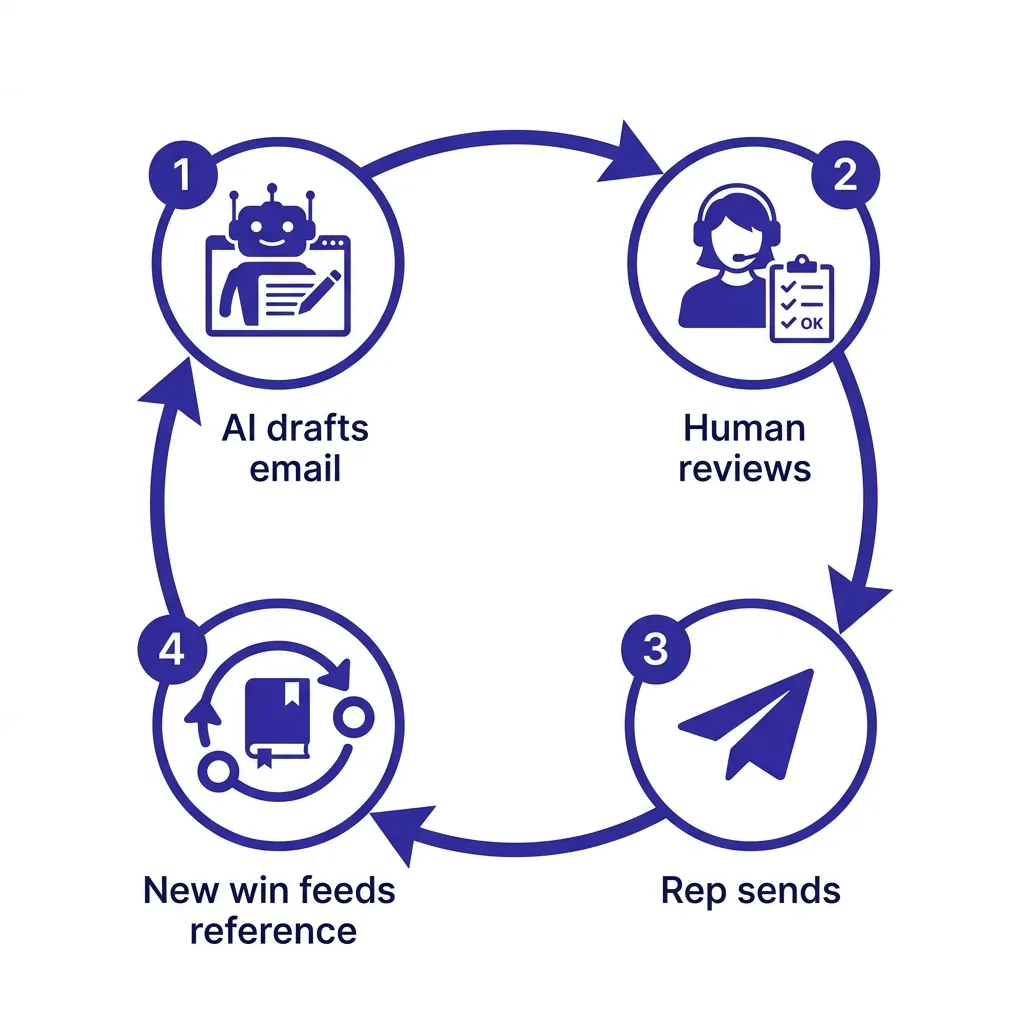
#Step 5: draft with the house-style reference, review, and reinject wins
New drafts should pull from this reference instead of a generic prompt.
Every new closed-won deal gets added back into the reference set, so the house style compounds over time rather than staying static after the initial build.
#What to pull from call transcripts, not just email
Won deals rarely close on email alone.
If your team runs discovery or demo calls, the transcript often contains the exact objection language a prospect used, word for word, which is more valuable than a rep's paraphrase of the objection weeks later.
BANT sales methodology and MEDDIC sales methodology both give you a framework for tagging which part of a transcript maps to budget, authority, need, or timeline signals, which makes the extraction step in your training pipeline far more structured than free-form note-taking.
A prospect's own words about why they were hesitant, and how that hesitation resolved, is close to the highest-value training data available for objection-handling copy.
#Avoiding the overfitting trap
A house style built from five won deals is not a house style.
It is five anecdotes wearing a system's clothing.
Aim for at least 15 to 20 won deals across a reasonable spread of segments before treating the extracted pattern as reliable, and revisit the reference set quarterly as new wins come in and market conditions shift.
Ideal customer profile work should happen alongside this, since a house style built entirely from one segment's wins will underperform when applied to a different segment with different priorities.
#Keeping a human in the loop as the style compounds
 Keeping a human in the loop as the style compounds
An AI drafting tool trained on your own wins is still generating unsupervised text, and that text still needs a human review step before it goes out.
AI drafts, human sends covers why this hybrid approach performs better than full automation even after the AI has been trained on strong source material.
A well-trained AI produces fewer edits per draft over time, which is the actual measurable payoff of this whole process.
It is not zero edits, and treating a trained model as fully autonomous defeats the purpose of building the training loop carefully in the first place.
#Measuring whether the training actually improved output
Track edit distance between the AI's first draft and the version a rep actually sends.
If that distance shrinks over several weeks as more won deals feed into the reference set, the training loop is working.
Track reply rate on AI-drafted emails using the house-style reference against a baseline period using generic prompts, and compare against cold email reply rate benchmarks 2026 to see where you land relative to the wider market.
A house style built from real wins should meaningfully outperform generic AI drafting, since it is trained on language that has already survived contact with real prospects instead of language optimized only for sounding plausible.
#What to exclude from the training set
Not every closed-won deal is a good training example.
Exclude deals that closed despite a weak email sequence, where the win came entirely from an inbound signal, an existing relationship, or aggressive discounting that will not generalize.
Non-discount urgency in B2B is a useful companion read here, since a training set full of discount-driven wins will teach your AI to lean on price rather than relevance, which is a habit that gets expensive fast at scale.
Also exclude deals where the sequence was heavily manually rewritten by a top rep in a way that is not repeatable by the rest of the team, since the goal is a house style the whole org can use, not one star performer's personal voice.
#Building this into an ongoing operating rhythm
The one-time build is the easy part.
The hard part is making reference-set updates a habit rather than a project that happens once and goes stale.
Assign a specific owner, usually a sales enablement lead or RevOps function, to review newly closed deals monthly and decide which ones earn a place in the training reference.
Sales team management covers the broader operating cadence this fits into, and treating the house-style reference as a living document rather than a one-time deliverable is what separates teams that keep improving from teams that build it once and watch it drift stale within two quarters.
#What this looks like across a full team, not one AI tool
The training loop described here is not tied to a single vendor.
Any AI drafting workflow, whether built in-house or through a platform like FirstSales, benefits from being fed real won-deal language instead of running purely on generic prompts.
Platforms that support signal-based prospecting alongside AI drafting have an advantage here, since the same system that identifies a strong buying signal can also pull the closest-matching won-deal pattern to draft against, rather than treating research and drafting as two disconnected steps.
The mechanism matters more than the specific tool: extract real patterns from real wins, tag them by function, keep a human reviewing output, and keep feeding new wins back in.
#A worked example from a mid-market SaaS team
Take a hypothetical 12-person sales team that closed 22 deals in the last two quarters.
Pulling the full email threads from those 22 deals and tagging each message by function produced 61 openers, 88 follow-ups, 34 objection replies, and 22 meeting-booking messages.
The objection replies turned out to be the most valuable category, since a recurring pattern showed up across 19 of the 34 messages: leading with a specific number that addressed the objection directly, rather than a reassurance sentence followed by the number further down.
That single pattern, extracted and turned into an explicit instruction in the house-style reference, became the highest-leverage change to the team's AI-drafted follow-up sequences.
None of the reps had consciously noticed they were all doing this until the tagging process surfaced it across the full set.
That is the real value of this exercise: patterns that individual reps do intuitively but cannot articulate become visible once you look across enough won deals at once, and only then can they be turned into something an AI system can consistently reproduce.
#How to structure the house-style reference document
 How to structure the house-style reference document
A reference document that is too long defeats the purpose, since most AI drafting tools perform worse with a bloated context than with a tight, well-curated one.
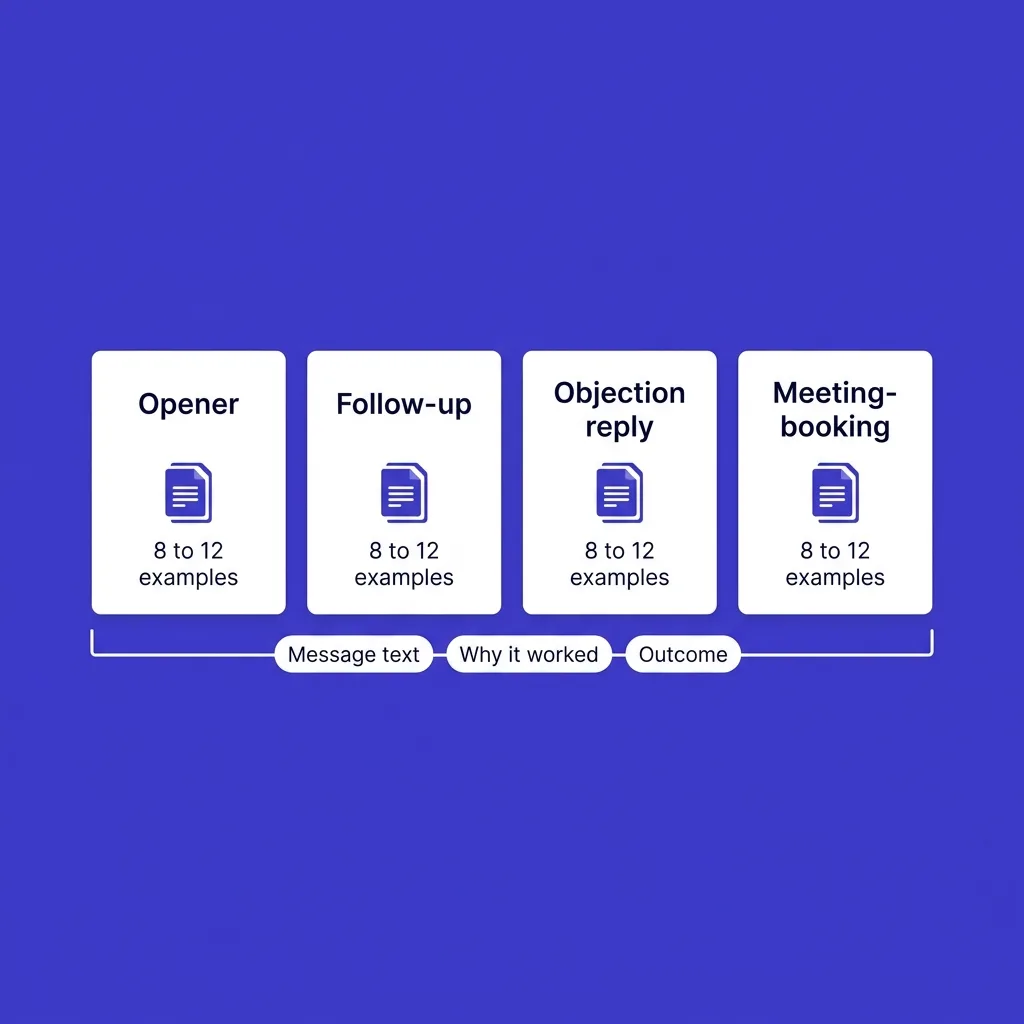
Aim for 8 to 12 examples per tagged category (opener, follow-up, objection reply, meeting-booking message), chosen for how clearly they represent the pattern rather than for recency alone.
For each example, include three things: the actual message text, a one-line note on what made it work, and the outcome (reply, meeting booked, or objection resolved).
That third field matters more than it seems, because it lets whoever reviews the reference later distinguish between an example that is stylistically interesting and one that is empirically proven to move a prospect forward.
Strip out anything specific to the exact deal, like a prospect's real name or a confidential figure, and replace it with a bracketed placeholder, so the reference teaches structure without leaking deal-specific information into unrelated future drafts.
#Common mistakes teams make when building this reference
#Pulling only the final "yes" email
The email that got the meeting booked is rarely the reason the deal moved forward.
It is usually the third or fourth message in a sequence that changed the prospect's mind, with the final email just formalizing what was already decided.
#Treating the reference as permanent once built
Market conditions, buyer priorities, and even the specific objections prospects raise shift over quarters, and a reference built in one quarter without updates will start producing output that feels slightly out of step within two or three quarters.
#Letting the training set skew toward one rep's voice
If one rep closes disproportionately more deals than the rest of the team, their language will dominate the reference set unless you deliberately balance it, which risks training the whole team's AI drafting to sound like one specific person rather than a repeatable system.
#Confusing correlation with causation in won-deal analysis
Not every phrase in a won-deal thread caused the win.
Some deals close despite a weak email, driven by timing, budget, or a champion internally pushing the deal forward regardless of outreach quality.
Cross-reference with rep notes or a quick debrief question ("what actually moved this forward?") before assuming every sentence in a won thread is worth training on.
#Connecting this to your broader outbound cadence design
A house-style reference works best when it is mapped against your actual sequence structure, not built in isolation from it.
Outbound cadence by deal size shows how touch count and spacing differ for mid-market versus enterprise deals, and your tagged reference examples should be organized the same way, so the AI knows which pattern to pull from depending on where in the sequence, and for which deal size, it is drafting.
A single undifferentiated reference set applied uniformly across a 4-touch SMB sequence and a 14-touch enterprise sequence will produce output that fits neither well.
#What good looks like six months in
Teams that run this process consistently for two quarters tend to describe a similar shift: the first AI draft a rep sees needs noticeably fewer edits than it did at the start, and the edits that remain are usually small, tone-level adjustments rather than full rewrites.
That is a measurable outcome, not a vague impression, and it is worth tracking explicitly through the edit-distance metric described earlier.
A second, less obvious shift also tends to show up: reps start referencing the house-style reference themselves when writing manually, not just when reviewing AI drafts, because the tagged, proven patterns become a shared vocabulary for the team rather than something only the AI system uses.
That spillover effect is a good sign the reference has become a real enablement asset rather than a one-off AI training exercise, and it is usually the point where teams start treating the quarterly review of the reference set as a standing agenda item rather than an occasional cleanup task.
#Where this fits relative to broader sales enablement work
Training AI on won deals is a narrower, more mechanical version of what good sales enablement has always tried to do: capture what works and make it repeatable across the team.
The difference now is that an AI drafting system can consume that captured pattern directly and apply it at the speed and volume manual coaching never could.
Sales experience and best sales coaching software both cover adjacent pieces of this same problem from a human-coaching angle, and the two approaches reinforce each other rather than compete: coaching improves what reps do live on calls, while the AI training loop described here improves what gets written when a rep is not available to write it personally.
#Handling data privacy when using deal history for training
Won-deal threads often contain a prospect's name, company details, and sometimes pricing information discussed during negotiation.
Before feeding this into any AI system, strip personally identifying details and replace them with placeholders, keeping only the structural and language pattern that matters for training.
Check your CRM and AI vendor's data handling terms to confirm customer communication data is not being used to train a model shared across other customers, since that would create a real confidentiality problem regardless of how useful the training data is internally.
Most reputable AI drafting platforms, FirstSales included, keep customer-specific training data isolated to that customer's own account rather than pooling it across a shared model, and that isolation should be a specific, confirmed detail rather than an assumption.
#Onboarding new reps into the house-style system
A new rep joining the team inherits none of the pattern recognition that built the house-style reference.
They have not read the closed-won threads, they do not know why a specific opener works, and left alone they will draft outreach that sounds nothing like what has actually closed for the team.
Treat the reference document as onboarding material, not just an AI training input.
Walk a new hire through five or six tagged examples in their first week, and ask them to explain in their own words what makes each one work, not just read it passively.
SDR roles and responsibilities covers where this kind of ramp fits into the broader responsibilities of the role, and pairing a structured reference walkthrough with the standard ramp checklist shortens the gap between a rep's first send and a send that actually reflects the team's proven language.
New reps should also see the AI drafts before they see a blank page.
Ask them to review and edit three or four AI-drafted emails pulled from the house-style reference before writing anything from scratch, so their first independent attempts are anchored to a pattern that has already worked rather than built from whatever generic instinct they walked in with.
Human in the loop cold email is worth pairing with this step, since the review skill a new rep builds while editing AI drafts is close to the same skill they will need for the rest of their tenure, regardless of how much of their outreach ends up AI-assisted versus manually written.
A second, easy-to-miss benefit of doing this during onboarding: new reps often notice things the tagging process missed.
Someone reading the reference cold, without the assumptions a tenured rep carries, will sometimes ask why a particular phrase works, and that question is worth capturing rather than dismissing.
It can surface a gap in the pattern extraction that nobody caught the first time through.
Build a short feedback loop where new reps flag anything in the reference that felt confusing or contradictory during their first month, and route that feedback to whoever owns the reference set.
This does two things at once.
It improves the document for the next new hire, and it gives a new rep a sense of ownership over the system rather than treating it as a one-way handout from management.
Teams that skip this step tend to see new reps either ignore the reference entirely, defaulting back to generic instincts, or copy it too literally, sending near-identical versions of old won-deal emails that read as stale the second time a similar prospect sees a similar phrase.
Neither outcome is what the reference was built for, and both are avoidable with a short, deliberate onboarding pass rather than assuming a new rep will absorb the house style on their own.
#FAQs
#How many won deals do I need before this is worth doing?
At least 15 to 20 across a reasonable spread of segments, though even a smaller set focused on one segment can produce a usable starting reference.
#Does this work for outbound calls, not just email?
Yes, call transcripts from won deals contain objection language and framing that transfers directly into email and call-script training material.
#How often should the reference set be updated?
Monthly at minimum, with a full review each quarter to remove patterns that no longer reflect current market conditions.
#Should I include lost deals in the training data?
Lost-deal analysis is valuable but serves a different purpose; keep it in a separate reference used for objection-handling gaps rather than mixing it into the house-style set for what to say.
#Who should own this process on the team?
A sales enablement lead or RevOps function typically owns it best, since the process needs consistent structure rather than ad hoc attention from individual reps.
#Can I use this with any AI drafting tool, or does it require a specific platform?
The extraction and tagging process works regardless of platform, though tools that support retrieval-based prompting or fine-tuning make the reference set easier to operationalize.
#How do I avoid the AI just copying old emails verbatim?
Extract the underlying pattern and structure rather than feeding raw text as a template, and instruct the AI to generate new phrasing based on that pattern, not to reuse exact sentences.
#What is the risk of overfitting to a small set of wins?
The AI will generalize poorly to segments or situations not represented in the training data, producing output that works for one type of account and misses badly on others.
#Does call transcript data need special handling for compliance?
Yes, confirm your call recording and transcript usage complies with applicable consent laws before using transcript content for AI training purposes.
#How do I measure whether the training loop is actually improving output?
Track edit distance between AI first drafts and final sent versions over time, alongside reply rate on AI-drafted emails compared to a pre-training baseline.
#Should discount-driven wins be included in the training set?
Generally no, since a training set skewed toward discount-driven closes will teach the AI to lean on price rather than relevance-based framing.
#What is the difference between a house style and a template library?
A template library is static and copied forward regardless of results; a house style is a living reference built and updated from what has actually closed.
#Can a single top-performing rep's language dominate the training set unintentionally?
Yes, watch for this specifically and balance the reference set across multiple reps so the house style reflects a repeatable pattern, not one person's individual voice.
#How does this connect to objection handling specifically?
Tagging won-deal messages by function, including objection replies, lets you build a separate, focused reference for how successful objection responses were framed and worded.
#Is this only useful for large sales teams with lots of closed deals?
No, even a small team with 15 to 20 wins over a year or two can build a meaningful house-style reference, and smaller teams often benefit more since every win carries proportionally more signal.
#How do I keep the AI from sounding stale as market conditions shift?
Quarterly reference set reviews should specifically flag patterns tied to outdated market conditions or messaging angles that no longer get replies, removing them even if they closed deals previously.
#Does this replace the need for human review of AI drafts?
No, human review remains necessary even after training, since the AI is still generating unsupervised text that needs a final accuracy and tone check.
#What role does the ideal customer profile play in this process?
Segmenting the training set by ICP ensures the house style generalizes correctly across different buyer types rather than producing one-size-fits-all copy that underperforms outside its original segment.
#Can this training process improve cold calling scripts too?
Yes, the same extraction and tagging approach applies to call transcripts and can inform script structure and objection-handling language for cold calling.
#What is the biggest mistake teams make when starting this process?
Treating it as a one-time build instead of an ongoing loop, which causes the house style to freeze at whatever the market looked like on the day it was built.
Your closed-won deals already contain the language that works.
The only step most teams skip is turning that language into something an AI drafting tool can actually learn from, rather than letting it sit unused in a CRM thread.
Build the extraction process once, keep a human reviewing every draft, and feed new wins back in every month so the house style keeps improving instead of freezing in place.