TL;DR: Discounting trains buyers to wait for the next markdown and erodes margin on every future deal. Non-discount urgency, price-lock windows, capped onboarding cohorts, and fiscal-year deadlines, moves the same deal forward without touching price. This guide covers seven levers that create real urgency in B2B sales and cold outreach, with the data behind why they work and templates for using them without sounding manipulative.
#Why discount urgency backfires in B2B
A 15% discount before quarter-end feels like urgency.
It is actually a signal.
The signal says your price is negotiable, your quota matters more than the buyer's timeline, and next quarter will bring another discount if they wait.
Procurement teams learn this fast.
Once a buyer has seen one end-of-quarter markdown, every future negotiation starts from the assumption that your list price is fiction.
FirstSales customers running enterprise outbound report the same pattern: reps who discount to close hit their number this quarter and inherit a worse ask next quarter, because the buyer's finance team now anchors on the discounted rate as the real price.
Non-discount urgency avoids that trap.
It creates a reason to act now that has nothing to do with the price going down, and everything to do with something else becoming unavailable: a rate lock, an onboarding slot, a contract term, or a budget window that closes regardless of vendor.
That distinction matters more in 2026 than it did five years ago.
Buyers run more competitive RFPs, compare quotes across three or four vendors before a call ever happens, and treat discount-driven urgency as a tell that a vendor's real price is lower than the number on the page.
Procurement software has made price comparison nearly instant, which means a discount offered to close one deal is often screenshotted and forwarded to the next vendor in the same RFP.
That single leaked discount can reset the floor for every competing quote in the process, costing the vendor margin on deals it has not even started negotiating yet.
Non-discount levers do not leak the same way, because locking in a rate or reserving a cohort slot is specific to one buyer's timeline and does not translate into a transferable number a competitor can use.
Related reading: B2B cold email guide and signal-based cold email cover how to find the moment a buyer is actually ready, which is the foundation any urgency lever sits on top of.
#What the research says about scarcity and B2B buyers
Scarcity works on B2B buyers, but only when it is structural rather than manufactured.
B2B buyers are 40% more likely to purchase when they perceive they are getting access to something not widely available, according to research summarized by sales psychology firm EBQ.
That number applies to genuine exclusivity: limited onboarding cohorts, capped integration partner slots, early access programs.
It does not apply to a countdown timer on a pricing page that resets every time the buyer refreshes.
A separate finding from conversion research firm Crobox found that a visible timer alone produced an 8.6% lift in conversion, while limited-time offers paired with an authentic trigger produced lifts as high as 332% in controlled tests.
The gap between those two numbers is the whole argument for this article.
A timer with no real constraint behind it moves the needle a little.
A real constraint, an actual rate increase, an actual capacity ceiling, moves it by an order of magnitude, because buyers can smell the difference between a deadline and a stage prop.
| Urgency type | Real constraint behind it | Buyer trust impact | Typical B2B use |
|---|---|---|
| ✓ Price-lock before announced increase | Yes, pricing actually changes on the stated date | Builds trust if the increase is real | SaaS renewal and expansion deals |
| ✓ Capped onboarding cohort | Yes, implementation team has finite capacity | Builds trust when capacity is genuinely limited | Services-heavy B2B, consulting, AI SDR rollouts |
| ✓ Fiscal year-end budget window | Yes, unused budget reverts regardless of vendor | Neutral to positive, buyer already knows this | Enterprise deals closing in Q4 |
| ✗ Fake "only 3 spots left" counter | No, resets or is fabricated | Destroys trust once discovered | Common on low-trust SaaS landing pages |
| ✗ "Price goes up tomorrow" with no history of it happening | No, price rarely actually changes | Destroys trust after first broken promise | Aggressive SDR sequences |
| ✗ Artificial countdown timer with no backing event | No | Neutral at best, ignored by most B2B buyers | Ecommerce tactics misapplied to B2B |
The pattern across every checkmark row: the urgency exists whether or not the vendor mentions it.
The buyer would face the same deadline even if no one sent a follow-up email about it.
#Price-lock urgency
Price-lock urgency works when a real pricing change has a real date attached.
Twilio announces API pricing changes 90 days in advance, which gives customers both transparency and a genuine deadline to lock in the current rate before it moves.
That 90-day window does two things a discount cannot.
It respects the buyer's procurement process, which usually needs weeks of lead time anyway, and it frames the current price as the deal rather than framing a temporary markdown as the deal.
For cold outreach, price-lock urgency shows up in two forms: an announced list price increase, or a grandfather clause for existing pricing tiers being retired.
Both require the change to be real and dated before you write a single email about it.
A sample line: "Our enterprise tier moves from $X to $Y on March 1. Contracts signed before then keep the current rate for the full term."
That sentence contains no adjective, no exclamation point, and no manufactured scarcity.
It states a fact and lets the buyer's own math create the urgency.
See cold email for B2B sales for how to sequence a price-lock message inside a broader outbound cadence, and cold email objection handling for responses when a buyer pushes back on the timeline.
#Onboarding capacity urgency
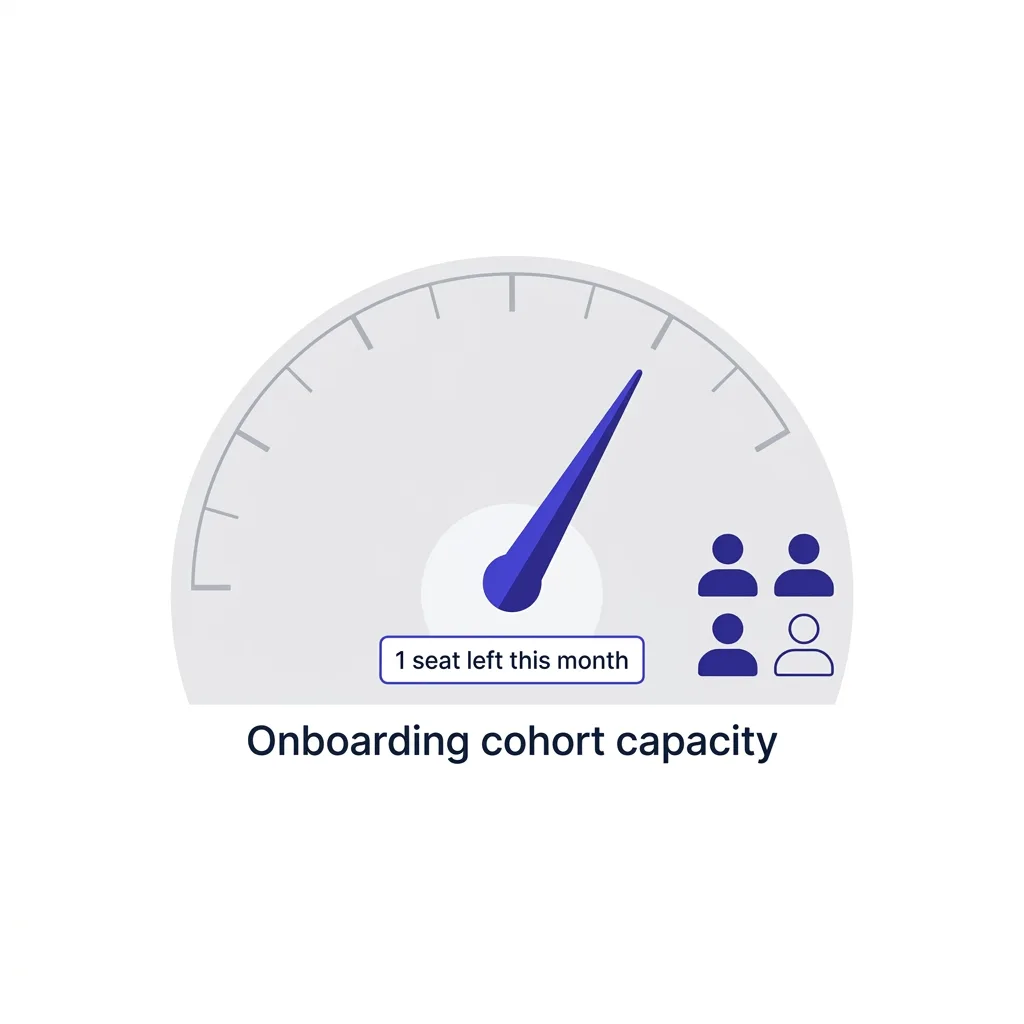 Onboarding capacity urgency
Implementation teams are not infinite.
A services-heavy B2B product, anything involving white-glove setup, data migration, or dedicated onboarding, has a real ceiling on how many new customers it can start per month.
FirstSales runs cohort-based onboarding for larger accounts specifically because deliverability warmup and campaign setup need hands-on attention in the first two weeks, and that attention does not scale infinitely across unlimited simultaneous starts.
Naming that ceiling honestly creates urgency without touching price.
"We start four new enterprise accounts per month so the onboarding team can give each one full attention in week one. The March cohort has one seat left."
That sentence is either true or it is not.
If it is true, it converts, because the buyer is weighing a real tradeoff: start now with full attention, or start next month.
If it is fabricated, it collapses the first time a prospect asks a follow-up question about the other three seats.
#Fiscal year-end urgency
About 75% of companies end their fiscal year on December 31, and budget that goes unspent by that date does not roll over into January.
That fact alone creates urgency no vendor invented.
Decision-makers who were slow to respond in August come back in Q4 with a list of vendors to evaluate and a hard deadline to spend what remains, because unused budget simply disappears rather than carrying forward.
Sales organizations that reference this directly, "your Q4 budget doesn't roll over, and we can have you live before your fiscal year closes", are stating a fact the buyer's own finance team has already told them.
That framing works because it is the buyer's constraint, not the vendor's.
Industry benchmarks put the required pipeline-to-quota ratio at 3x for most B2B sales organizations to hit their number, which is part of why Q4 outbound volume spikes: reps are working the same math the buyer's finance team is working, from the opposite side.
For the full seasonal playbook, see Q4 budget-flush outbound and fiscal-year timing as a buying signal.
#Contract term urgency
A multi-year contract lock creates urgency that has nothing to do with the initial price.
Offering a three-year term at the current rate, with standard annual increases waived for the contract length, gives a buyer a reason to move now that survives any internal debate about whether this quarter or next quarter is the "right" time.
The lever here is protection from future increases, not a discount on the current one.
That distinction keeps the conversation anchored on value rather than price, because the buyer is weighing certainty against the risk of a rate hike two years out.
Grandfather clauses work the same way for existing customers facing a pricing model change: lock into the old model before a stated cutover date, or move to the new one automatically after it.
Enterprise software vendors use this constantly during platform migrations.
A vendor retiring a legacy pricing tier in favor of usage-based billing can offer existing customers a window to lock the old flat rate for the length of a new multi-year term, which converts a forced migration into a retention win instead of a churn risk.
The same logic applies in reverse for new logos: "sign a two-year term now and the per-seat rate stays fixed even if our list price rises next year" gives a buyer a hedge against inflation in software spend, which finance teams increasingly ask about directly.
#Cohort and rollout urgency
Feature rollouts and beta programs create legitimate urgency when the rollout genuinely has phases.
"We're rolling deliverability monitoring out to 50 accounts in phase one. Phase two starts in Q2 for everyone else."
That message works because the buyer either gets early access to something useful or waits, and both outcomes are real.
The trap here is running the same "beta" framing for eighteen months, which turns a legitimate rollout into a permanent marketing gimmick that experienced buyers stop believing after the second email.
graph TD
    A[Identify the real constraint] --> B{What is actually limited?}
    B -->|Price changes on a date| C[Price-lock urgency]
    B -->|Onboarding team capacity| D[Cohort urgency]
    B -->|Buyer's own budget cycle| E[Fiscal year-end urgency]
    B -->|Nothing is actually limited| F[Do not manufacture urgency]
    C --> G[State the date and the mechanism plainly]
    D --> G
    E --> G
    F --> H[Lead with value instead]
    G --> I[Let the buyer's own math create the pressure]
#How urgency levers differ by industry
Professional services firms, agencies, consultancies, and implementation partners, rely almost entirely on capacity urgency, because their core constraint is billable hours, not software licenses.
A consultancy that can only staff four new client engagements per quarter is not manufacturing scarcity when it says so.
SaaS vendors selling to enterprise IT lean harder on price-lock and contract-term urgency, because software pricing changes are dated, announced, and verifiable in a way that consulting capacity is not.
A vendor can point to a public pricing page update; a services firm usually cannot point to anything external, which is why capacity claims need more internal proof (a shared calendar, a named onboarding manager, a real start date) to land as credible.
Financial services and regulated industries respond best to fiscal and regulatory deadlines rather than vendor-created ones, since compliance dates and budget cycles are already fixed by outside forces the buyer cannot negotiate.
Referencing a known regulatory deadline, an upcoming audit cycle, or a mandated compliance date, works because the vendor did not invent the constraint and cannot be accused of manufacturing it.
Recruiting and talent-adjacent B2B tools see the sharpest response to cohort urgency, because hiring managers already think in terms of open requisitions and headcount windows that close when a role gets filled or a budget freeze hits.
#Writing urgency into cold email without sounding fake
 Writing urgency into cold email without sounding fake
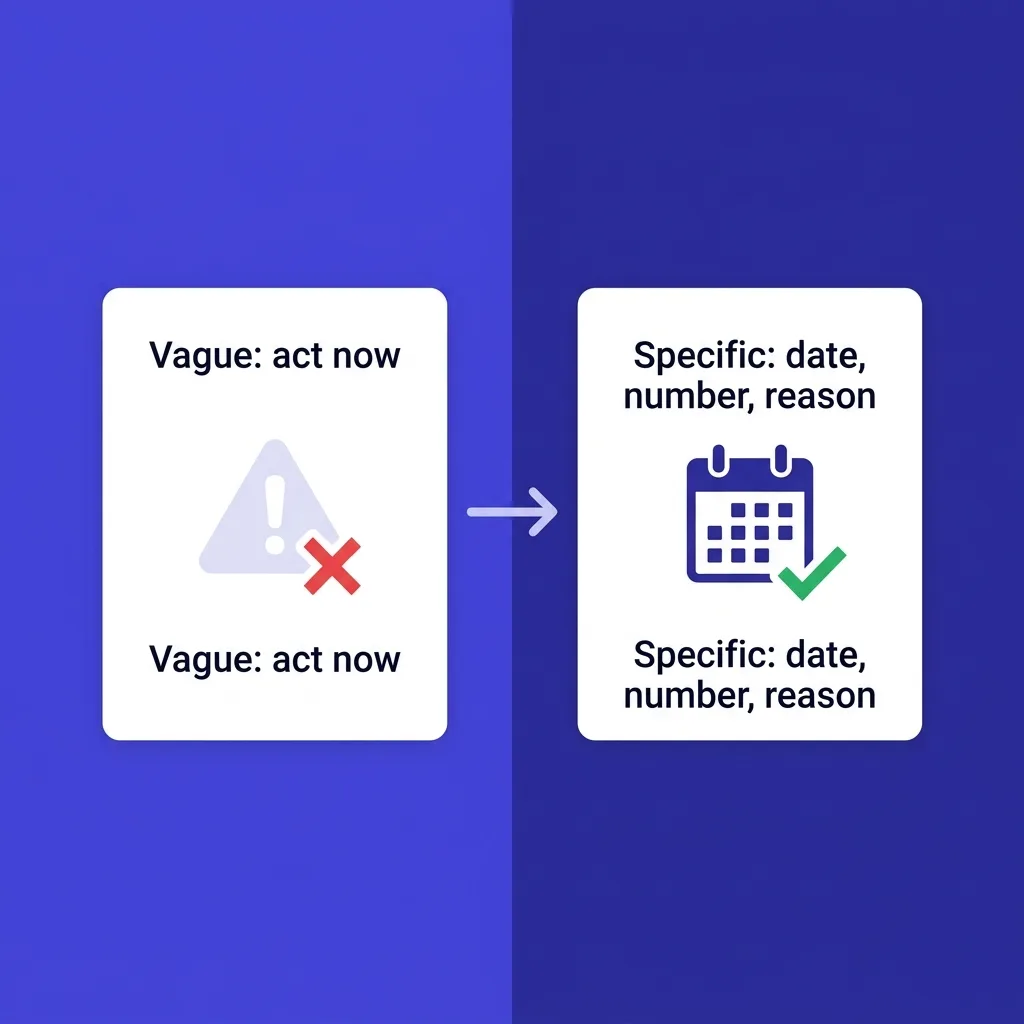
The mechanics that separate a trustworthy urgency line from a manipulative one come down to specificity.
Vague urgency ("act now", "don't miss out", "limited time only") reads as filler because it names no mechanism.
Specific urgency names the date, the number, and the reason in one sentence, then stops talking.
A cold email urgency line should answer three questions in order: what is changing, when, and what happens to the buyer if they wait.
"Our current implementation pricing holds through the end of Q1. After that, new contracts move to the updated model announced in January."
That line does not ask the reader to feel FOMO.
It states a fact they can verify and lets them decide what it means for their timeline.
Pair the urgency line with proof the deadline is real, a pricing page update, an email from someone else who already locked in, or a public announcement, so the claim does not rest on your word alone.
FirstSales customers writing these sequences typically place the urgency line in the second or third email of a cadence, after value has already been established, rather than opening cold with a deadline before the buyer knows what they would be locking in.
For sequencing guidance, see follow-up email strategy and outbound cadence by deal size.
#Mistakes that turn urgency into a trust problem
The most common failure is repeating a deadline that already passed.
A prospect who received "price goes up Friday" three Fridays in a row now assumes every deadline from that vendor is fiction, and that assumption transfers to every other claim in the email.
The second failure is applying ecommerce urgency tactics, countdown timers, "only 2 left in stock" banners, to enterprise software sales where the buyer is a committee, not an impulse purchaser.
B2B purchases go through procurement, legal, and often a multi-threaded buying committee.
A countdown timer does not survive contact with a six-person buying committee that needs three weeks to review a contract regardless of what the timer says.
The third failure is stacking multiple urgency levers in one email: a price lock, a limited cohort, and a fiscal deadline all in the same paragraph.
Stacking dilutes each one and reads as desperation rather than a genuine constraint.
See bad email examples for more patterns that erode trust before a buyer finishes reading the first sentence.
#Countering a discount request with a non-discount lever
A prospect who asks "can you do better on price" is testing whether your urgency claims are real or negotiable.
Caving immediately confirms every discount-trained instinct that buyer already has.
The stronger response reframes the ask: "I can't move on price, but I can lock this rate for three years instead of one, which is worth more than a one-time markdown."
That response does three things at once.
It holds the line on price integrity, offers something of comparable or greater value, and reframes the conversation around a lever the buyer had not considered.
Sales teams that train reps on this substitution consistently report shorter negotiation cycles, because the buyer stops treating price as the only variable on the table.
A second version works for capacity-constrained businesses: "I can't discount the engagement, but I can move you into this month's onboarding cohort instead of next quarter's, which gets you live six weeks earlier."
Time-to-value is often worth more to a buyer than a percentage off, especially when the buyer's own leadership is asking when results will show up.
The key discipline is preparing this substitution before the negotiation starts, not improvising it under pressure, because an improvised non-discount offer sounds exactly like an improvised discount: reactive and negotiable.
Write the two or three non-discount levers your business can actually offer into your sales playbook before the first objection ever arrives.
#Testing whether urgency actually moves your numbers
Urgency claims are testable, and B2B teams that skip the test usually keep a line that stopped working months ago.
Run two versions of a late-cadence email: one with the urgency lever named specifically, one without it, sent to comparable segments of your list.
Track reply rate and, more importantly, close rate on the resulting meetings, because a line that boosts replies but attracts price-shoppers is not actually working.
A four-to-six week test window covers a full sales cycle for most mid-market B2B deals and gives enough data to separate a real lift from noise.
Document which urgency lever produced which result, because a price-lock line that converts in Q4 may do nothing in Q2 when the buyer has no fiscal-year pressure backing it.
For the broader testing framework, see cold email benchmarks and cold email reply rate benchmarks 2026.
#Getting sales and marketing aligned on what's actually urgent
Non-discount urgency falls apart fast when marketing announces a price increase that sales never mentions in active deals, or when an SDR references an onboarding cohort limit that the implementation team has no record of.
The fix is a shared, single source of truth for every active urgency lever: the exact date, the exact mechanism, and who owns confirming it is still true.
A simple internal doc works better than a complicated system here.
List each active lever (this quarter's price-lock date, this month's onboarding cohort count, the current fiscal-year messaging), the owner who verifies it weekly, and the exact wording approved for outbound use.
Reps who improvise their own version of a deadline are the single most common source of the broken-promise problem covered earlier in this article.
Marketing teams running outbound at scale, including AI-assisted drafting through tools like FirstSales, need this same discipline built into the prompt or template layer, so an automated sequence never references a deadline that already passed or a cohort that already filled.
Review the list monthly at minimum, and immediately after any pricing or capacity change, since a stale urgency claim does more damage than no urgency claim at all.
#FAQ
#What is non-discount urgency in B2B sales?
Non-discount urgency is a reason to act now that does not involve lowering price, such as a price-lock window, limited onboarding capacity, or a fiscal-year budget deadline.
#Why does discounting to create urgency backfire in B2B?
It teaches buyers and their procurement teams that your list price is negotiable, which anchors every future renewal and expansion conversation to the discounted rate instead of the real one.
#Does scarcity actually work on B2B buyers?
Yes, when it reflects a real constraint. Research summarized by EBQ found B2B buyers are 40% more likely to purchase when they perceive access to something genuinely limited.
#What is price-lock urgency?
Price-lock urgency offers a buyer the ability to sign at the current price before an announced increase takes effect on a specific date, without any discount involved.
#How much lead time should a price-lock window give buyers?
Twilio uses 90 days for API pricing changes, which gives procurement enough lead time to act without feeling rushed. Match your window to your buyer's typical decision cycle.
#What is onboarding capacity urgency?
It is naming a real ceiling on how many new customers your implementation or onboarding team can start in a given period, which creates urgency without any price change.
#Is fiscal year-end urgency manufactured or real?
It is real for most buyers. About 75% of companies end their fiscal year on December 31, and unspent budget typically does not roll over into the next year.
#Should cold email mention a countdown timer?
No. Countdown timers are an ecommerce pattern that reads as manipulative in B2B, where purchases go through committees and procurement rather than impulse decisions.
#How do I know if my urgency claim is genuine or manufactured?
Ask whether the constraint would exist even if you never mentioned it. A real price increase happens regardless of your email; a fake countdown resets on refresh.
#What happens when a prospect catches a fake deadline?
Trust in every future claim from that sender collapses, including claims that were true, because the prospect now assumes all deadlines from that source are fabricated.
#Where should urgency go in a cold email sequence?
Typically the second or third email, after value has been established, rather than the opening message before the prospect knows what they would be locking in.
#Can I use multiple urgency levers in one email?
Avoid stacking a price lock, a capacity limit, and a fiscal deadline in the same message. Stacking dilutes each claim and reads as pressure rather than a genuine constraint.
#How do I test whether an urgency line works?
Run it against a comparable segment without the line for four to six weeks, and track close rate on resulting meetings, not just reply rate, since urgency can attract price-shoppers who never close.
#Does urgency work the same in every quarter?
No. A fiscal year-end urgency line that converts in Q4 may do nothing in Q2 when the buyer has no year-end budget pressure behind it.
#What is contract term urgency?
Offering a multi-year lock at the current rate with future increases waived, which creates urgency around protection from price hikes rather than a discount on the current price.
#How does cohort-based rollout urgency work?
Naming a real phased rollout, such as early access for a limited group of accounts before general availability, creates urgency as long as the phases are genuine and not a permanent marketing frame.
#Can non-discount urgency work for SMB deals, not just enterprise?
Yes, though the levers shift. SMB buyers respond more to capacity and cohort urgency (limited onboarding slots) than to fiscal-year budget cycles, which matter more at the enterprise level.
#How does FirstSales handle urgency in outbound sequences?
FirstSales uses signal-based timing, referencing a prospect's actual budget cycle, hiring activity, or renewal date, rather than manufactured deadlines, so the urgency in a sequence reflects something real about that account.
#What's the difference between urgency and pressure?
Urgency states a real constraint and lets the buyer decide what it means for them. Pressure tries to force a decision faster than the buyer's own process allows, which usually backfires in B2B.
#Should urgency ever appear in the subject line?
Rarely, and only when the constraint is specific and verifiable, such as a dated price change. Vague urgency in a subject line ("Don't miss out!") reduces open rates because it reads as spam.
Non-discount urgency works because it tells the truth about a real constraint and lets the buyer's own math do the persuading.
Price-lock windows, capped onboarding cohorts, and fiscal-year deadlines all share the same property: they exist whether or not you send the email.
That is what separates them from a countdown timer that resets on refresh.
Pick the lever that is actually true for your business this quarter, name it plainly, and stop there.
Test it against a no-urgency control for a full sales cycle before rolling it out across every rep and every sequence, and retire it the moment the underlying constraint stops being true.
The buyers who convert on a real deadline become the customers who trust your next renewal conversation, which is worth more than the margin any single discount would have protected.
If you are building the outbound sequences that carry these lines, FirstSales handles the research, drafting, and human-approved sending so each urgency message reaches the right account at the moment the constraint is real for them.