#One-line cold emails: the format that books meetings
Copy page
TL;DR: One-line cold emails cut cognitive load and read as a real person asking a real question, which is why they often out-reply longer pitches, but they only work with sharp targeting and a genuine reason for the ask, and they should not replace every touch in a sequence.
A one-line cold email has no room to hide.
There is no paragraph of context to explain a weak idea, no bullet list to disguise a vague ask.
Either the line earns a reply or it doesn't, and that constraint is exactly why the format works when most cold email fails.
Most cold email templates try to do too much in one message: company background, product pitch, social proof, and a meeting ask, stacked into eight sentences the prospect skims in four seconds. A one-line email forces you to pick the single most useful thing to say and say only that.
That constraint is uncomfortable to write toward.
Most senders default to more words because more words feel like more effort, and more effort feels like it should earn more trust.
Reply data rarely rewards that instinct.
A sharp, single line that respects the reader's time often earns more trust than a longer message that spends three sentences justifying its own existence before getting to the point.
#Why ultra-short emails work
Reading a cold email costs a prospect something even before they decide to reply. It costs attention, and attention on a phone between meetings is scarce.
A five-sentence email asks the reader to parse a claim, a proof point, and an ask, then decide whether any of it applies to them. A one-line email asks for one decision: yes or no.
That single-decision structure lowers the mental cost of engaging, which is the actual mechanism behind higher reply rates on short formats. Short is not inherently persuasive on its own.
It removes friction between reading and responding, and that friction reduction is what shows up in the reply rate.
Short emails also read as human by default. A four-paragraph pitch with a subhead-style opener and a bolded value proposition looks like it was assembled from a template, because it usually was.
A single sentence that asks a specific, plausible question looks like something a busy person typed on their phone. That resemblance matters more now than it did five years ago.
Inboxes score mail before a human ever opens it. Google, Microsoft, and Yahoo all weight engagement signals, and a message that reads as templated mass mail collects fewer opens and more silent ignores, which quietly drags down sender reputation over time.
There is also a reply-mechanics reason one-liners work. A single question is trivially easy to answer from a phone: "yes," "not right now," or "who handles this on our end." A five-paragraph pitch requires the reader to compose an equally substantial reply or ignore it, and most people ignore it.
Average cold email reply rates sit around 3.4%, with top-performing segments reaching 10 to 20%. The gap between average and top performers usually traces back to specificity and effort required to respond, not length for its own sake.
A one-line email that asks a specific, low-effort question is a direct play for that gap.
#When a one-line email beats a longer one
One-line emails are not universally better. They win in specific situations, and understanding those situations matters more than defaulting to short for every send.
They win on first touch to a cold, unfamiliar contact where you have one real signal and nothing else to say yet. A hiring signal, a funding announcement, or a job change gives you exactly one sentence worth writing, so write exactly one sentence.
They win when the ask is small. "Worth a look?" or "Is this still a priority for you this quarter?" fits a one-line format because the cognitive commitment matches the size of the question.
They win on a re-engagement touch after silence, where a long re-pitch reads as pushy but a short check-in reads as low-pressure. This is the same logic behind the breakup email, which often outperforms every prior touch precisely because it asks for so little.
They lose when the prospect genuinely needs context to say yes. If nobody at the target account knows your company, a one-line email with zero explanation just looks like spam with extra steps.
They also lose when the offer requires proof. A case-study cold email that cites a specific number from a comparable customer needs more than one line to land the number and the comparison, and shortening it destroys the exact detail that made it credible.
The deciding question is simple: does the reader already have enough context to say yes without more information? If yes, go short.
If no, a longer email that supplies the missing context will outperform a one-liner every time.
#Three formulas that actually work
Short formats fail more often from a lack of structure than from being short. Below are three patterns worth testing, each built around a distinct mechanism for prompting a reply.
#The single-question opener
This is the purest form: one sentence, one question, no setup.
"Are you the right person to ask about [specific process] at [company]?"
The mechanism is routing, not persuasion. You are not trying to convince anyone of anything yet, you are trying to find the right person and get a one-word answer that opens the thread.
This works best on accounts where you are not sure who owns the buying decision, which is common in mid-market companies with fuzzy titles. It performs worse at enterprise accounts where role clarity is high and a vague question reads as under-researched, so match the formula to account size the same way you'd match outbound cadence to deal size.
#The permission-ask
"Mind if I send over how [comparable company] cut [specific metric] by [specific number]?"
This formula asks for permission before pitching, which flips the psychology. Most cold email pushes content at the reader uninvited.
A permission-ask makes the reader an active participant in the decision to receive more information, and people are more likely to engage with something they opted into, even in a small way.
The permission-ask only works when the follow-up content is real and ready to send the moment someone says yes. Promising a case study and then sending something generic breaks the trust the first email built, so the second message needs to deliver on the specific number named in line one.
#The observation-plus-question
"Noticed [company] just [specific, verifiable event], curious if [specific consequence] is on your radar."
This pairs a fact the prospect can verify about themselves with a question that connects the fact to a decision they are plausibly making right now. The observation has to be something the reader immediately recognizes as true and specific to them, not a generic industry trend restated as personalization.
Weak version: "Noticed your company is growing, curious if hiring is a priority." Strong version: "Noticed you posted three ops roles in the last two weeks, curious if onboarding process is keeping pace." The second version proves you actually looked, which is the entire point of using this formula instead of the other two.
An AI drafting layer can help generate the observation-plus-question line at scale by pulling the specific signal (a job posting, a funding round, a leadership change) and drafting the connecting question, but a human still needs to check that the line reads like it came from someone who actually looked. Teams using FirstSales for this workflow keep a human review step before send for exactly that reason: an AI-drafted one-liner that misreads the signal is worse than no personalization at all.
#Where one-line emails go wrong
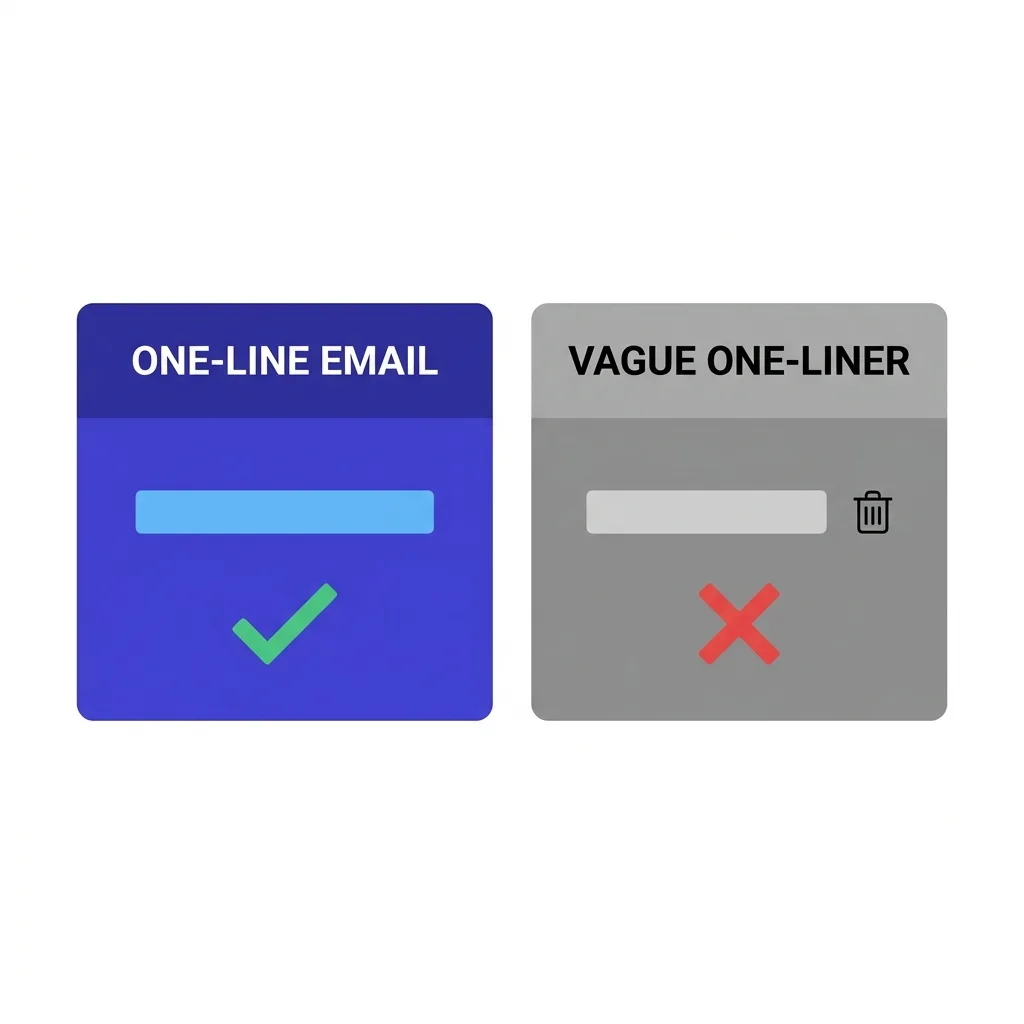 Where one-line emails go wrong
Short is not automatically good. The same brevity that makes a strong one-liner land can make a weak one-liner look worse than a longer, mediocre email.
The most common failure is vagueness disguised as brevity. "Quick question, do you have 15 minutes this week?" is short, but it is not specific, and specificity is what makes brevity work in the first place.
A one-line email with zero context also fails when there is no shared reference point. If the reader has never heard of you and the line gives them nothing to anchor to, the shortest possible response is delete, not reply.
There is a deliverability angle too. A very short subject line paired with a very short body is a pattern spam filters have learned to flag, particularly when the combination repeats across a large send volume from the same domain.
Google and Microsoft's bulk sender rules weight complaint rate and engagement heavily, and a template that gets marked as spam by even a small share of recipients compounds fast across thousands of sends.
Keep the complaint rate threshold in mind before you scale any one-line format. Staying under the spam complaint rate threshold matters more for a high-volume short-format campaign than for a low-volume, highly targeted one, because volume amplifies whatever signal the format sends.
The table below compares traits of one-line and multi-paragraph emails across the situations where each format tends to win.
| Trait | One-line email | Multi-paragraph email |
|---|---|---|
| First touch on a strong signal | ✓ | ✗ |
| Prospect needs proof to say yes | ✗ | ✓ |
| Re-engagement after silence | ✓ | ✗ |
| Complex or unfamiliar offer | ✗ | ✓ |
| High-volume send to a broad list | ✗ | ✓ |
| Small, low-commitment ask | ✓ | ✗ |
| Enterprise buyer needing context | ✗ | ✓ |
| Reads as personally written | ✓ | Depends on execution |
None of these traits are absolute rules. They describe where each format's mechanism naturally fits, and the best sequences use both depending on what the touch needs to accomplish.
#Pairing the subject line with a one-line body
A one-line body needs a subject line that matches its register, or the mismatch undercuts the entire point. A punchy, curiosity-driven subject followed by a flat, formal one-line body reads as bait and switch.
The safest approach is a subject line that sounds like the first half of a real thought and a body that finishes it. "quick one" as a subject with "Are you the one who handles vendor renewals?" as the body reads as continuous, like a text message split across two fields.
Avoid subject lines that promise more than a single sentence can deliver. "3 ways to cut your CAC" as a subject followed by a one-line body creates an expectation gap the moment the email opens, and prospects notice the mismatch immediately.
Preheader text matters even more with one-line emails, because the preheader is often the only additional context the inbox shows before open. If your email client renders the first line of the body as the preheader by default, and that line is the entire message, there is nothing left to reveal after open, which some readers experience as a letdown rather than a payoff.
Test subject lines the same way you'd test any cold email subject line: lowercase, short, and specific outperforms clever in most datasets, and a one-line body only backs that pattern up.
#How a one-line email fits into a sequence
A single short email rarely closes a deal on its own, and that is fine, because it was never designed to. It is designed to start a low-friction thread that a later touch can build on.
The mistake teams make is writing an entire sequence in the same register. Five one-line emails in a row start to feel less like efficient communication and more like a bot spraying the inbox, and prospects pick up on the pattern by the third touch.
A better structure alternates registers across the sequence: a specific signal-based one-liner to open, a slightly longer touch with proof once you have established some familiarity, then a short check-in or breakup email to close the loop if there's no response. The single-email sequence data showing 8.4% replies in one dataset is worth studying here too, since it demonstrates that a well-targeted single touch, short or not, sometimes beats a poorly sequenced multi-touch campaign.
The diagram below shows one way to decide which format a given touch should use.
Follow-up timing matters as much as format here. A well-sequenced follow-up email strategy spaces touches so each one has a reason to exist, rather than repeating the same ask in a shorter font.
Contact density also interacts with format choice. If you're reaching two or three contacts per company rather than the whole org chart, a signal-based one-liner to each contact reads as targeted; the same one-liner blasted to fifteen contacts at the same company reads as carpet-bombing, regardless of how short each individual message is.
A P.S. line is worth testing as a middle ground between a bare one-liner and a full pitch: a one-sentence body with a one-sentence P.S. that adds a single proof point keeps the low-friction feel while adding just enough context to answer the "why should I care" question a pure one-liner sometimes leaves open.
#What to avoid when writing short
 What to avoid when writing short
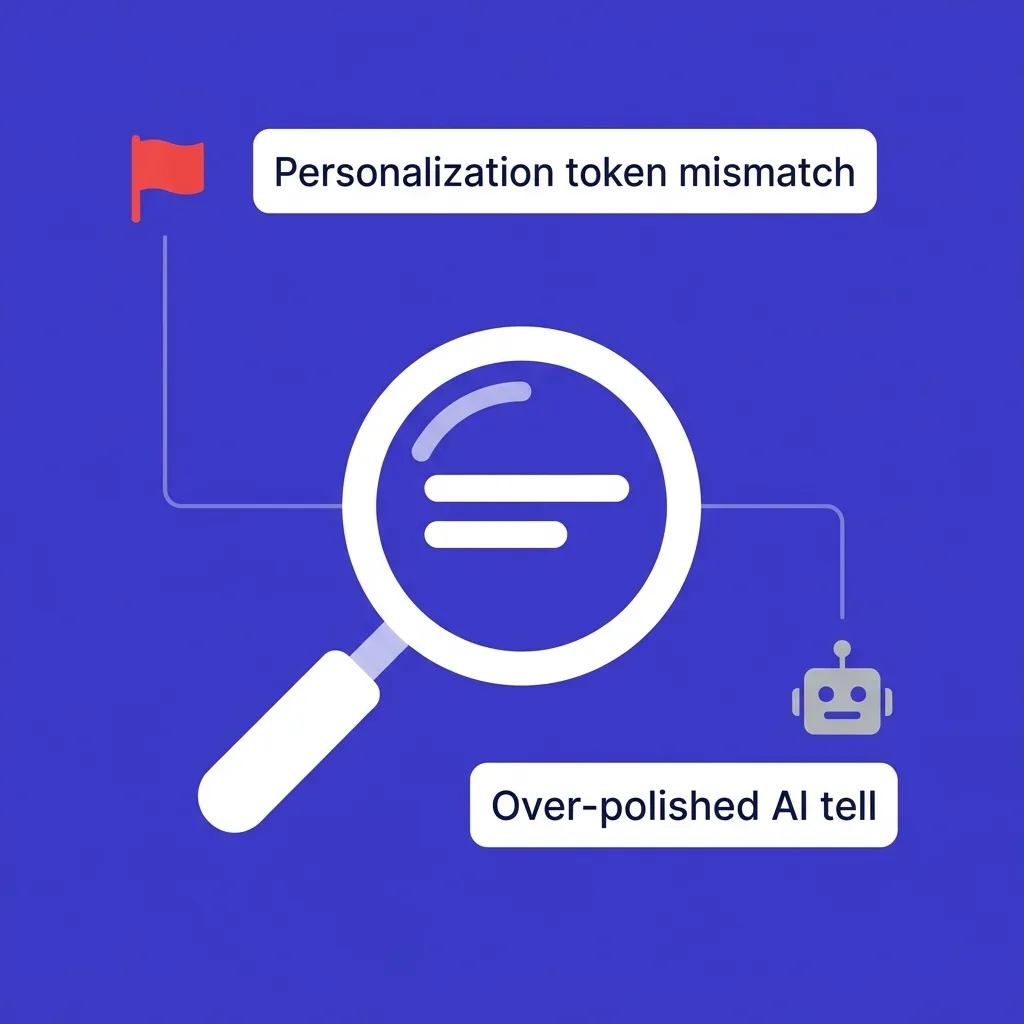
Personalization tokens are the fastest way to ruin a one-line email. A line that reads as a mail-merge with the company name swapped in is worse than no personalization, because it draws attention to the automation instead of hiding it.
Review common cold email personalization mistakes before scaling any short-format template.
AI-generated one-liners have a specific failure mode worth watching for: they tend to over-polish. A perfectly balanced sentence with no filler words can read as more artificial than a slightly rougher one, because real people don't write in perfectly balanced sentences.
Compare your drafts against a list of AI cold email tells before sending at volume, and keep a few bad email examples on hand as a reminder of what not to do.
Volume is the other trap. A one-line format is fast to write and fast to send, which tempts teams into scaling it well past the point where personalization is still real.
That path leads straight into the cold email volume trap, where reply rates fall as volume rises because each individual message gets less actual thought.
Track results the same way you would for any format. Compare a one-line campaign against your baseline using published cold email reply rate benchmarks, and if a short-format test underperforms your longer templates on a specific segment, that's useful data, not proof the format is broken everywhere.
#Testing one-line emails without wasting your list
Do not roll out a one-line format to your full list on day one. Test it against a segment small enough that a bad result costs you a few hundred sends, not your entire pipeline for the quarter.
A clean test needs a control. Send the same segment two versions, a one-line signal-based opener and your current standard first-touch email, split evenly, then compare reply rate and meeting-booked rate after both sides have had a full week to respond.
Watch positive reply rate separately from total reply rate. A one-line email sometimes pulls more total replies because it is easier to decline in one word, but if most of those replies are a fast "not interested," the format is winning on volume while losing on the number that actually matters.
Segment size affects which formula performs best. A single-question opener tends to do better on larger, less-researched segments where you have limited signal per account, while an observation-plus-question line needs enough research time per account that it usually only makes sense on a smaller, higher-intent list.
Give a one-line test at least 150 to 200 sends per variant before drawing a conclusion. Reply rate swings wildly on small samples, and a 6% versus 9% difference on 40 sends is normally noise, not a real signal.
Rerun the test quarterly rather than treating one result as permanent. Inbox provider algorithms shift, your list composition changes, and a format that worked in one quarter can flatten out once every competitor in your space starts sending a version of the same one-liner.
Keep a shared log of which one-line variants you've tested and their results, tied to the segment and the signal type used. Without that log, teams tend to relitigate the same test every few months because nobody remembers it already ran.
#Writing a one-line email step by step
Start with the signal, not the sentence. Pick one specific, verifiable fact about the account or the individual before you write a single word of the email, because the sentence exists to connect that fact to a question.
Write the question first, then cut it down. Most first drafts of a one-line email run 30 to 40 words; the editing pass is where you find the 15 words that actually carry the meaning.
Read the line out loud before sending it. If it sounds like something you'd type into a text message to a colleague you sort of know, it's close.
If it sounds like a headline from a landing page, rewrite it.
Check that the line fails the generic-swap test: could this exact sentence go to any company in your target list unchanged? If yes, the signal isn't specific enough yet, and the email needs another pass of research before it goes out.
Confirm the ask matches the size of the question. A one-line email that opens with a small, easy question and then closes with "let's find 30 minutes this week" creates a mismatch, since the reader hasn't earned that level of commitment from one sentence of context.
Finally, decide where this email sits in the sequence before you send it. A one-liner that opens a sequence needs a different follow-up plan than a one-liner that closes one, and writing the whole sequence together keeps the register consistent from first touch to last.
#Frequently asked questions
#What is a one-line cold email?
A one-line cold email is a message with a single sentence in the body, usually a question, built to prompt a fast, low-effort reply instead of walking the reader through a full pitch.
#Do one-line cold emails actually get more replies?
They can, particularly on first touches and re-engagement sends, because a single low-effort question is easier to answer than a multi-paragraph pitch. The gain depends on specificity, not just brevity.
#What's the ideal length for a one-line cold email?
One sentence, typically under 20 words. If the sentence needs a comma-separated list of qualifiers to make sense, it has grown past the point where the one-line format still applies.
#Should the subject line also be one line?
Yes, and it should match the register of the body. A punchy subject followed by a flat body creates a mismatch that undercuts the effect.
#When should I avoid a one-line email?
Avoid it when the prospect has no context on your company, when the offer needs proof to be credible, or when you're sending high volume to a broad, unqualified list.
#Can a one-line email include the company name?
Yes, but only if the mention is load-bearing to the question, not decorative. "Are you the one who handles vendor renewals at Acme?" earns the company name. A generic sentence with the name inserted does not.
#Do one-line emails hurt deliverability?
A short subject paired with a short body at high volume can trigger spam filters that watch for that pattern, especially from a domain sending thousands of near-identical messages. Targeted, low-volume sends with real personalization carry much less risk.
#How do I personalize a one-line email without it sounding automated?
Reference a specific, verifiable fact about the recipient (a job posting, a product launch, a leadership change) and connect it directly to the question. Generic personalization tokens read as automated even when they're accurate.
#Should every email in a sequence be one line?
No. Alternating between short signal-based touches and slightly longer proof-based touches performs better than a sequence written entirely in one register.
#What's the single-question opener formula?
A one-sentence question aimed at routing, usually asking whether the recipient is the right person or whether a specific topic is a current priority for them.
#What's the permission-ask formula?
A one-sentence question asking for permission to share something specific, such as a metric from a comparable company, which flips the psychology from pitching to being invited.
#What's the observation-plus-question formula?
A one-sentence email that states a specific, verifiable fact about the recipient and asks a question connecting that fact to a decision they're plausibly making right now.
#How do I know if my one-liner is too vague?
If the sentence could be sent to any company in any industry without changing a word, it's too vague. A strong one-liner breaks if you swap out the company name for a competitor's.
#Can AI write one-line cold emails?
AI can draft the observation and connecting question quickly, especially when pulling from a specific signal like a job posting or funding event. A human should still review before send, since AI drafts can misread the signal or over-polish the sentence into something that reads as templated.
#Do one-line emails work for enterprise accounts?
Less reliably. Enterprise buyers usually need more context before responding, and a bare one-line email can read as under-researched at that account size. A longer touch with a specific proof point tends to perform better.
#What's a good first-touch one-liner example?
"Noticed [company] posted three ops roles this month, curious if onboarding process is keeping pace." It cites a specific, checkable fact and asks a question tied directly to that fact.
#Is a one-line breakup email different from a regular breakup email?
The mechanics are the same: a short, low-pressure close-out message after a few unanswered touches. A one-line version simply strips it down to its shortest useful form, which often performs just as well as a longer version.
#Should I A/B test one-line emails against longer ones?
Yes. Run both formats against the same segment and compare reply rate and meeting-booked rate, not just opens, since open-rate tracking is unreliable across most major inbox providers now.
#Does a one-line email need a signature?
Keep it minimal: name and one line of context, not a full block with a logo and five links. A heavy signature under a one-line body creates the same register mismatch as a mismatched subject line.
#What metric actually proves a one-line email is working?
Reply rate and meeting-booked rate per touch, tracked against your account list size and segment, not raw reply count. A small, well-targeted one-line campaign with a 12% reply rate on 200 accounts is doing more than a 3% reply rate on 5,000.
A one-line cold email is not a shortcut around doing the work of research and targeting. It is a format that only works once that work is already done, because there is no room left in the message to fake it.