#The summer slump outbound myth: does August really kill replies?
Copy page
TL;DR: Outbound does slow in July and August, but not for the reason most reps assume. Belkins found cold email reply rates across 7.5 million sends dropped from 0.50% in the first half of 2025 to 0.40% in the second half, with the sharpest fall landing in July and August. That is a real dip, not a dead month, and the drop concentrates in a few buyer segments while others barely move.
Every July, someone on the sales team says the same thing.
"Nobody replies in summer, let's just wait until September."
That advice is half right and half lazy.
Reply rates do soften in July and August. Belkins analyzed 7.5 million cold emails sent in 2025 and found the average reply rate fell from 0.50% in the first half of the year to 0.40% in the second half, with the steepest decline concentrated in those two months.
That is a real, measurable dip. It is not the same as outbound going dark.
Sagefrog's research found two-thirds of B2B companies report slower sales in summer, and among those affected, nearly 75% see drops of 20% or more. Two-thirds is a majority, not everyone.
That remaining third keeps closing deals in July and August like any other month. The gap between "everyone slows down" and "most people slow down, some do not" is where a lot of pipeline gets left on the table.
This article walks through what actually happens to outbound performance during summer, which buyer types and industries hold steady, and how to build a sending calendar that captures the reply rate that is still there instead of shutting the whole channel off for two months.
If you already run signal-based cold email or track buying signals for cold email, summer is actually one of the better times to lean on those signals, since fewer competitors are sending and the prospects who are online are more likely to be the ones actually working.
#What you will learn
- Where the summer slump myth comes from
- What the reply rate data actually shows
- Which industries and roles hold steady
- Why deliverability changes in summer too
- How to build a summer sending calendar
- What to do differently in July and August
- When pausing outbound actually makes sense
- Frequently asked questions
#Where the summer slump myth comes from {#origin}
Sales teams inherited the summer slowdown belief from consumer retail and hospitality, where July and August genuinely are peak vacation months for buyers.
B2B is different.
Most B2B buying committees have three or more people. Multithreading a buying committee means someone on that committee is usually in the office even during peak vacation weeks.
The myth also gets reinforced by anecdote. A rep sends 50 emails in August, gets two replies instead of the usual five, and concludes the whole month is dead.
Two replies from 50 sends is a 4% reply rate. That is still above the 2026 average cold email reply rate benchmark most industries report.
One slow week does not prove a slow quarter.
The pattern shows up across other channels too, not just cold email. Cold calling versus cold email data tends to show a similar summer dip in connect rates, since the same buyers who are slower to reply to email are also harder to reach live on the phone during vacation-heavy weeks.
#What the reply rate data actually shows {#data}
The Belkins dataset gives the clearest published picture: reply rates dropped from 0.50% in H1 2025 to 0.40% in H2, with July and August showing the steepest single-month declines within that period.
A drop from 0.50% to 0.40% is a 20% relative decline. It is meaningful.
It is not a collapse to zero.
Separately, GoHighLevel's August 2025 email marketing performance report found open rates reached 41% and click-through rates hit 6.43% that month, both roughly in line with the rest of the year.
Open and click behavior did not crater in August. Reply behavior softened more.
That pattern points to something specific: people are still checking inboxes and clicking links in summer. They are just slower to write a full reply back, likely because they are triaging between vacation coverage and a normal workload.
"Two-thirds of B2B companies report slower sales in summer, and among those affected, nearly 75% see drops of 20% or more." (Sagefrog Marketing Group, summer B2B sales research)
A 20% drop in reply rate is consistent with a 20% drop in reported summer sales for the affected two-thirds. The data lines up.
The remaining third of companies that do not report a summer slowdown likely sell into segments where summer buying behavior does not change, government contracts, education-cycle software, or categories tied to a fiscal year that does not follow the calendar year (see fiscal-year timing as a buying signal for how that timing works).
#Which industries and roles hold steady {#segments}
Not every buyer takes August off.
Finance, healthcare operations, and government-adjacent B2B tend to run flatter through summer because their operating cadence is regulatory, not seasonal.
Manufacturing and logistics often see summer as a planning window ahead of a Q4 push, since production schedules and vendor contracts get locked in before the holiday shipping season.
Startups and venture-backed companies frequently keep hiring and buying through summer because runway and board deadlines do not pause for vacation season.
Consumer retail, hospitality, education (K-12 specifically), and agencies tied to school-year calendars show the steepest real slowdowns, since decision-makers in those categories are genuinely out or in a seasonal lull.
The mistake is treating "B2B" as one segment. It is dozens of segments with different calendars.
If your ideal customer profile sits in one of the steadier categories, an August pause is a self-inflicted wound. If it sits in retail or education, the slowdown is real and worth planning around.
#Why deliverability changes in summer too {#deliverability}
 Why deliverability changes in summer too {#deliverability}
Lower engagement has a second-order effect beyond reply rate: it can quietly hurt sender reputation.
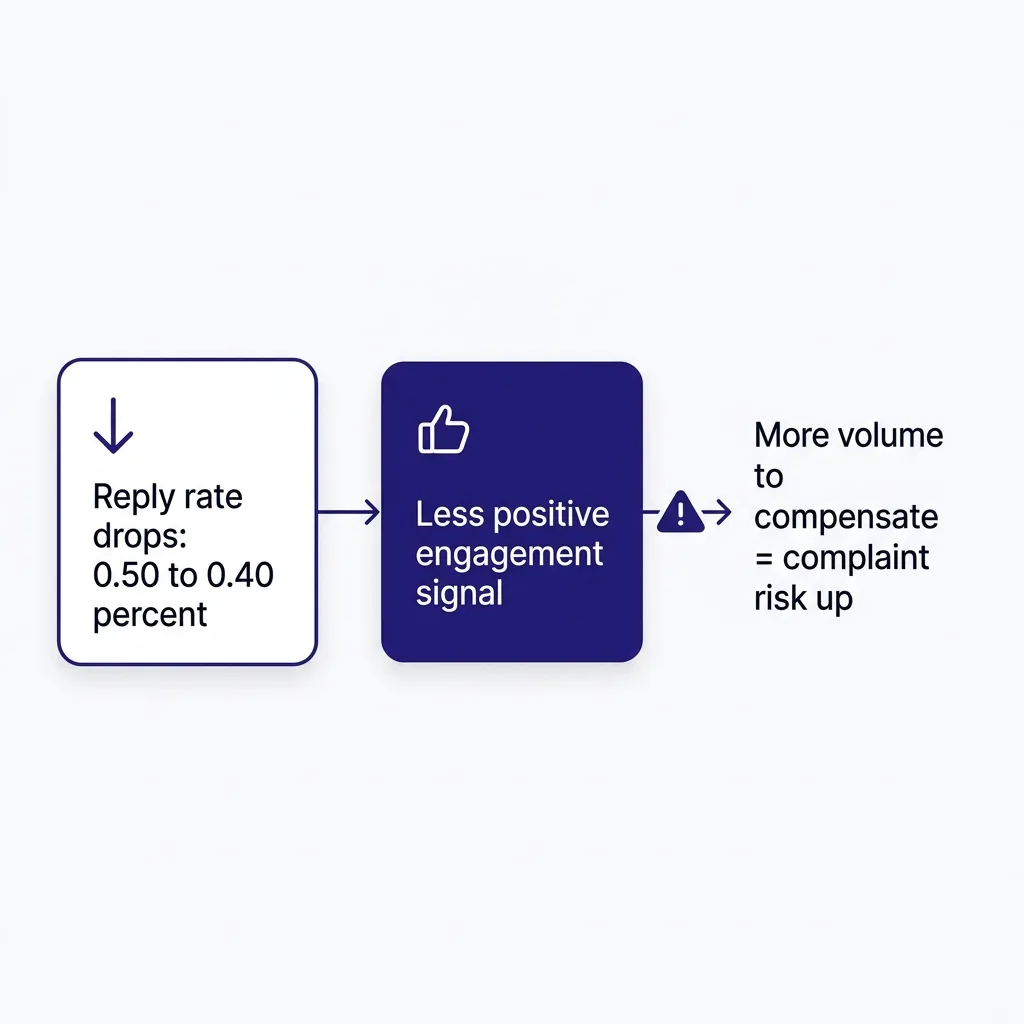
Mailbox providers weight opens, clicks, and replies as positive engagement signals. When a list-wide reply rate drops from 0.50% to 0.40%, the same volume of email is generating less positive signal per send.
That shift alone will not tank a domain. It becomes a problem when a team responds to lower replies by increasing send volume to compensate, which is the opposite of what deliverability needs.
Bulk sender rules from Google and Microsoft still apply in July just as they do in January: spam complaint thresholds stay fixed, bounce rate limits stay fixed, and authentication requirements (SPF, DKIM, and DMARC setup) do not soften for the season.
Volume math still governs risk. If reply rates dip and volume climbs at the same time, complaint rate as a share of total sends tends to climb too, since fewer of those sends are landing as wanted mail.
The safer response to a summer dip is not more volume. It is better targeting, tighter lists, and patience with a slightly lower reply rate on a smaller, more qualified send.
FirstSales customers who lean into waterfall enrichment for B2B data during slower months typically hold list quality steady even as raw reply counts dip, which keeps deliverability metrics stable through the season.
#How to build a summer sending calendar {#calendar}
June stays at normal cadence, since most buying committees have not left for summer yet.
July is where a modest pullback earns its keep. Cutting volume 15 to 20% while keeping the strongest-performing segments running avoids wasting sends on the weakest lists during the softest weeks.
August is the lowest-volume month of the calendar, but it is not zero. Government, finance, and healthcare segments keep running at close to full cadence, while consumer, education, and hospitality-adjacent lists get trimmed hardest.
September ramps back up, and that ramp is worth planning in August, not scrambling for on September 2. See September re-engagement window for how to build that list ahead of time.
#What to do differently in July and August {#tactics}
Shift volume, not messaging quality. The instinct to write shorter, lazier emails because "no one is reading anyway" backfires, since the smaller pool of engaged readers in summer is disproportionately made up of people who are actually working and evaluating vendors.
Lean harder on signal-based targeting. When fewer competitors are sending, a well-timed email tied to a real trigger, a hiring signal, a job change trigger, or a funding round, stands out more than it would during the September rush.
Use the slower weeks for list hygiene. B2B data decay does not pause in summer, and a quieter sending calendar is a good window to run email verification before sending against the full list.
Test subject lines and openers on the lower-volume segments. A/B tests that would take three weeks to reach significance during peak season can still run, just with a longer window, and the learnings carry into the September ramp.
Watch out of office replies as a data goldmine. Summer produces more OOO replies than any other season, and those auto-replies often name a backup contact, a return date, and sometimes a direct phone extension, all useful for building a warmer September follow-up.
Consider timing sends around known regional patterns rather than a flat calendar. A prospect in Germany or France is far more likely to be fully out during the first two weeks of August than a prospect in the US Midwest, so a single global send date ignores real variance in who is actually reachable that week.
Reconsider single-threaded accounts before pausing entirely. Multithreading a buying committee matters more in summer than any other season, since the odds that any one contact is out climb with every week of vacation season, but the odds that all three or four contacts on a committee are out at once stay low.
#When pausing outbound actually makes sense {#pause}
A full pause is rarely the right call, but a partial one sometimes is.
Pausing makes sense when the ICP sits almost entirely in education, hospitality, or consumer retail categories with a documented summer closure pattern, since sending into a genuinely empty inbox wastes list health for no return.
Pausing also makes sense around specific national holiday weeks, like the week of July 4th in the US or the first two weeks of August across much of Western Europe, where entire regional workforces are simultaneously out.
Pausing does not make sense as a default posture for the full two months, especially for teams selling into finance, healthcare, government, manufacturing, or venture-backed startups, where the data shows steadier year-round buying behavior.
The safest middle path most teams land on: trim volume, keep the channel warm, and protect deliverability, rather than shutting outbound off and restarting cold in September.
#Where AI-assisted outreach helps most in summer {#ai-assist}
 Where AI-assisted outreach helps most in summer {#ai-assist}
Summer is when the case for AI-assisted drafting gets easiest to see.
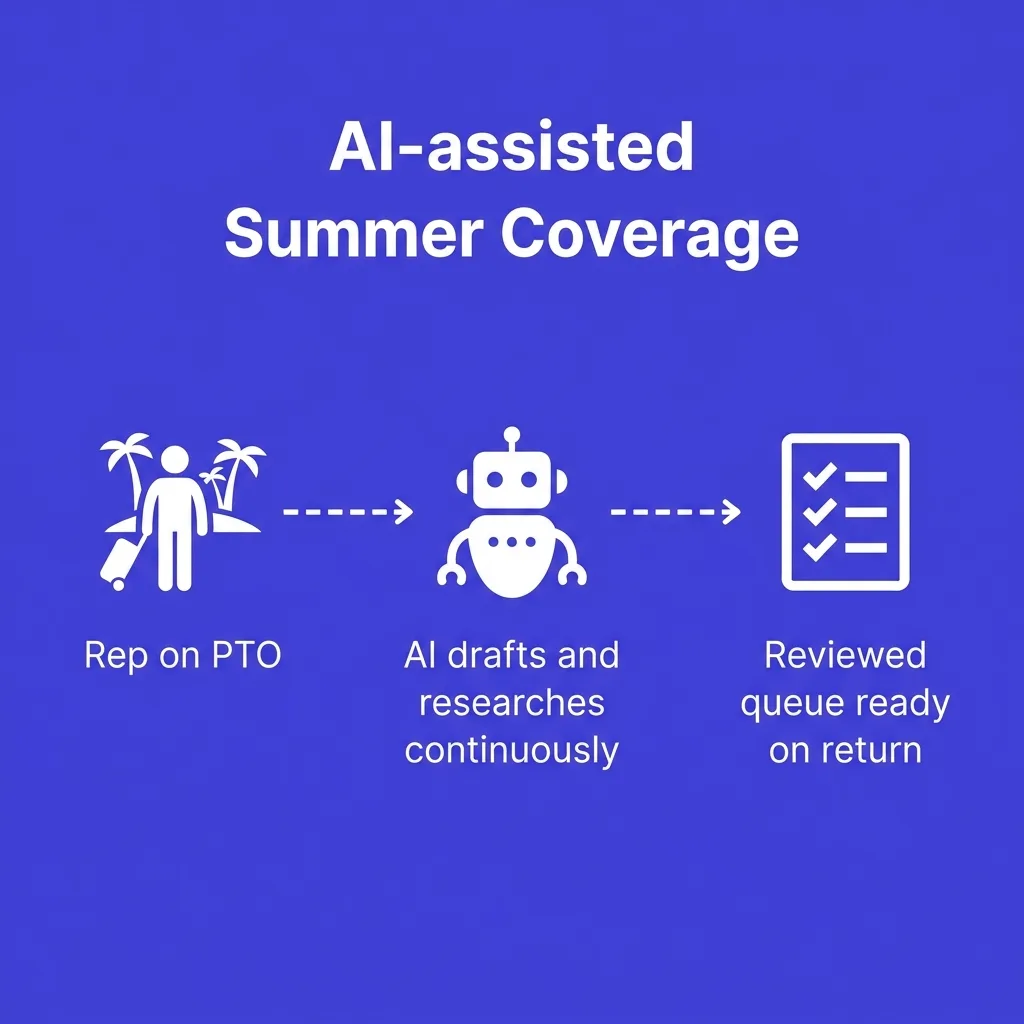
Rep bandwidth drops in July and August, since PTO schedules pull writers off the desk for stretches at a time, and someone still has to keep the sequences moving for the reps who are in.
An AI drafts, human sends hybrid outbound setup covers that gap without leaving prospects untouched for two weeks while a rep is out.
FirstSales handles this by drafting sequences and researching accounts continuously, so a rep returning from vacation finds a queue of reviewed, ready drafts instead of a blank slate and two weeks of catch-up.
That matters more in summer than in any other season, since the cost of a two-week gap compounds when the whole team's coverage is already thinner.
The same logic applies to research. Manually pulling pre-call research on every account takes time a short-staffed summer team does not have, and agentic research tools can keep that step running even when the desk is light.
None of this replaces judgment. A human still needs to review drafts and decide which OOO replies are worth a personal follow-up versus an automated nudge. But the drafting and research legwork does not need to pause just because the team is smaller for six weeks.
#Tie summer prep to the Q4 push {#q4-tie}
The teams that handle summer best are not the ones that ignore it. They are the ones that use it as prep time for the biggest quarter of the year.
Q4 budget-flush outbound campaigns work better when the list going into October is already clean, segmented, and warmed, not freshly built from scratch in the first week of the quarter.
If a rep is behind on number heading into fall, the Q4 quota rescue plan sprint works from whatever pipeline exists at the start of Q4, and a summer that built OOO-sourced contacts and a trimmed, high-intent list gives that sprint more to work with on day one.
Skipping summer outbound entirely does not just cost July and August pipeline. It costs the head start that Q4 depends on.
#How to measure your own summer sensitivity {#measure}
Published benchmarks are a starting point, not a verdict on your specific list.
The fastest way to know if your ICP is summer-sensitive is to pull your own reply rate by month across the last two years.
Filter by segment, not just by total volume. A blended number can hide a steady enterprise segment sitting next to a collapsing SMB retail segment.
Compare July and August against the trailing twelve-month average for each segment separately. A segment within five percentage points of its yearly average is not meaningfully summer-sensitive.
A segment that drops 30% or more in July and August is a real seasonal pattern worth planning around every year, not just reacting to once.
Track this by quarter going forward, and the "does summer kill outbound" question stops being a debate and becomes a number sitting in a dashboard.
Pull the same comparison for bounce rate and complaint rate alongside reply rate, not just reply rate on its own. A segment that holds its reply rate steady but shows a creeping bounce rate in July is usually flagging list decay, not seasonality, and the fix is verification, not a volume change.
Keep the lookback window at two full years where the data exists. One summer is not enough to separate a real seasonal pattern from a one-off dip caused by a bad list, a broken sequence, or an unrelated deliverability issue that happened to land in July.
Teams running an outbound lead scoring model can layer seasonality directly into the score, treating a July lead from a steady segment the same as any other month, while discounting or delaying leads from a segment with a documented summer dip.
#A hypothetical comparison: two teams, same quarter {#comparison}
Imagine two sales teams selling similar mid-market software, both running roughly 3,000 sends a month.
Team A treats July and August as dead months. They cut volume to near zero, stop testing, and plan to "restart" in September.
Team B keeps sending through summer, but trims volume 15 to 20%, shifts more of that volume toward the segments in finance and healthcare that hold steady, and uses the quieter weeks to clean the list and collect out-of-office data.
By September, Team A is starting from scratch. No fresh replies, no updated OOO contact data, and a list that has decayed for two months without verification.
Team B enters September with a warmer list, a set of OOO-sourced return dates to follow up on, and two months of A/B test data from the lower-volume segments that Team A never collected.
Neither team's Q3 number looks dramatically different in this hypothetical, since both saw the same underlying reply rate softening. The gap shows up in Q4, when Team B's September ramp starts faster because the groundwork was already done.
This is not a claim about a real company's results. It illustrates why the choice between a full pause and a trimmed, targeted summer calendar compounds beyond the immediate quarter.
#Verified vs assumed summer outbound behavior
| Claim | Verified by data | Common assumption |
|---|---|---|
| Reply rates drop in July and August | ✓ Belkins, 0.50% to 0.40% H1 to H2 2025 | ✓ correctly believed |
| Open and click rates collapse in summer | ✗ GoHighLevel Aug 2025: 41% open, 6.43% CTR, in line with year | ✗ often wrongly assumed |
| All B2B companies slow down equally | ✗ Sagefrog: two-thirds report a slowdown, one-third does not | ✗ often wrongly assumed |
| Pausing outbound fully is the safest move | ✗ steadier segments lose pipeline for no deliverability gain | ✗ often wrongly assumed |
| Deliverability rules relax in summer | ✗ SPF, DKIM, DMARC, and bulk sender thresholds stay fixed | ✗ sometimes wrongly assumed |
| September ramp benefits from August prep | ✓ list hygiene and OOO data collected in August feed September sends | ✓ underused but correct |
#Key takeaways
- Reply rates fall in July and August, from about 0.50% to 0.40% in one large 2025 dataset, but open and click behavior stays roughly steady.
- Two-thirds of B2B companies report a summer slowdown, meaning a third do not, and those steadier segments (finance, healthcare, government, manufacturing, venture-backed startups) are worth keeping at closer to full volume.
- Deliverability rules do not pause for summer, so a reply dip should trigger tighter targeting, not higher volume to compensate.
- The best use of a quieter July and August is list hygiene, signal-based targeting, and building the September re-engagement list, not shutting the channel off.
Run a smaller, cleaner list through the slow months and the September ramp starts from a warmer base than starting cold. Teams running FirstSales through summer typically use the lighter volume window to tighten segmentation rather than pause entirely, so the September ramp has a clean list to work from.
#Frequently asked questions {#faq}
#Does cold email really slow down in the summer?
Yes, reply rates measurably drop. One 2025 analysis of 7.5 million cold emails found the average reply rate fell from 0.50% in the first half of the year to 0.40% in the second half, with the steepest decline in July and August.
#Should I pause outbound completely in August?
For most B2B categories, no. A full pause makes sense mainly for segments tied to education, hospitality, or consumer retail calendars with documented summer closures, not for finance, healthcare, or enterprise software buyers.
#What percentage of B2B companies actually see a summer slowdown?
Sagefrog's research found two-thirds of B2B companies report slower sales in summer, and among that group, nearly 75% see a drop of 20% or more. The remaining third report no meaningful change.
#Which industries hold steady through summer?
Finance, healthcare operations, government-adjacent B2B, manufacturing, and venture-backed startups tend to keep a flatter cadence through July and August, since their buying cycles are tied to regulation, fiscal deadlines, or runway rather than a seasonal calendar.
#Do open rates drop in summer the same way reply rates do?
No. August 2025 data showed open rates around 41% and click-through rates around 6.43%, both close to typical year-round numbers. The drop shows up more in reply behavior than in opens or clicks.
#Why do replies drop more than opens in summer?
People still check and click through email while managing vacation coverage, but writing a full reply takes more time and mental bandwidth than they have available during a lighter workload week.
#Is it safe to increase sending volume to make up for lower reply rates?
No. Increasing volume while engagement drops raises the risk of a higher complaint rate relative to total sends, which can hurt sender reputation. Tighter targeting, not more volume, is the safer response.
#Do SPF, DKIM, and DMARC rules relax during summer?
No. Authentication and bulk sender requirements from Google and Microsoft apply year-round with no seasonal exception. Deliverability standards in August match January.
#What should I do with the lower-volume weeks in July and August?
Use them for list hygiene, email verification, and signal-based targeting instead of writing weaker emails. The reduced competition from other senders in summer can actually make a well-timed email stand out more.
#How should I build a September re-engagement list during summer?
Track out-of-office replies collected in July and August, since they often list a return date, a backup contact, or a direct extension. That data becomes the backbone of a warm September follow-up sequence.
#Do out-of-office replies actually contain useful sales data?
Yes. OOO auto-replies frequently name a colleague to contact in the sender's absence, along with a specific return date, both of which help time and route a follow-up more precisely than a blind resend.
#Is the summer slump different in Europe versus North America?
Regional holiday patterns shift the timing. Western Europe often sees the steepest slowdown in the first two weeks of August, while North America sees a smaller but real dip around the July 4th holiday week and continuing through August.
#Should sales teams cut their quota targets for Q3 because of summer?
Some teams adjust Q3 targets slightly to reflect the documented 20% reply rate decline, but a blanket cut ignores that a third of B2B segments do not see a real slowdown, so targets should reflect the specific ICP being sold into.
#How many touches should a summer sequence include compared to other seasons?
Sequence length does not need to change for summer. What changes is total sending volume and list size, trimming to the highest-intent segments rather than shortening the number of touches within a sequence.
#Does the summer slump affect LinkedIn outreach the same way as email?
LinkedIn engagement tends to follow a similar seasonal pattern, since it reflects the same underlying buyer availability, though publicly reported benchmark data is sparser for LinkedIn than for cold email.
#What is the fastest way to tell if my ICP is summer-sensitive?
Pull reply rate by month for the past two summers from your own send history. If the July and August numbers track close to the yearly average, the segment is not summer-sensitive and volume should stay steady.
#Should new domain warmup schedules change during summer?
No. Inbox warmup schedules should stay on their normal timeline regardless of season, since domain reputation building depends on consistent, gradually increasing engagement, not calendar timing.
#Is Q4 pipeline actually built in the summer months?
Often yes. Deals that close in Q4 frequently start their sales cycle in July or August, meaning a summer pause can directly shrink the following quarter's pipeline even though the immediate reply rate impact looks small.
#What is the single biggest mistake teams make with summer outbound?
Treating the whole two-month window as uniformly dead and pulling back on every segment equally, instead of checking which parts of the ICP actually slow down and which keep buying at a normal pace.
#How should reps talk about summer timing inside a cold email itself?
Referencing the season briefly and naturally, such as acknowledging a lighter summer schedule while still proposing a specific time, tends to read as considerate rather than desperate, and performs better than ignoring the season entirely or over-apologizing for reaching out in August.