#September re-engagement window: catching prospects back from summer
Copy page
TL;DR: B2B cold email reply rates stabilize around 0.45% in September after a summer slowdown, a weak recovery rather than a sharp rebound. The prospects worth re-engaging are not new contacts, they are the ones who went quiet in July and August and are now back at their desk with a fresh inbox and a fresh set of Q4 priorities. This guide covers exactly who to re-engage, when to send, and what message actually gets a reply after a two-month gap.
#Table of contents
- Why September behaves differently from a normal recovery
- What the reply rate data actually shows
- Who to re-engage first: segmenting the summer-quiet list
- When in September to send
- What to say after a two-month gap
- The list-cleaning step most teams skip
- September versus the January reset
- Building a repeatable September playbook
- FAQ
#Why September behaves differently from a normal recovery
Summer in B2B outbound is not one uniform slow period.
Late June through August sees decision-makers on vacation on a rolling basis, out-of-office replies stacking up, and buying committees that simply cannot assemble a full quorum for a decision.
September is the first month where that rolling absence mostly ends.
Most of the workforce is back, school schedules that shaped vacation timing are settled, and inboxes that accumulated two months of unread email are finally getting triaged.
That triage matters more than most outbound calendars account for.
A prospect clearing 400 unread emails in the first week of September is scanning for anything that looks urgent or relevant to what they are about to prioritize, not reading every message with the attention they might give in a normal week.
September re-engagement outreach competes directly with that triage moment, which means the messages that survive are the ones that look immediately relevant, not the ones that repeat a pitch sent in June that already got ignored once.
See summer slump outbound myth for the data on whether summer outbound actually underperforms as much as most teams assume, and cold email benchmarks for year-round baseline numbers to compare September against.
#What the reply rate data actually shows
B2B cold email reply rates stabilize around 0.45% in September, according to recent benchmark research, representing what researchers describe as a weak autumn recovery following the summer slowdown.
That number is a recovery, but a modest one, not a return to peak performance.
Overall 2026 benchmark data puts average B2B cold email reply rates at 3.43% across the full year, meaning September's 0.45% figure sits well below the annual average even after the summer lull has technically ended.
| Send window | Approximate reply rate behavior | What it means for planning |
|---|---|---|
| ✓ Early September (first two weeks) | Recovering but below average | Inbox triage mode, low patience for generic pitches |
| ✓ Mid-to-late September | Continued gradual improvement | Q4 planning begins, more receptive to relevant outreach |
| ✗ Late June through mid-August | Weakest of the year | Vacation coverage gaps, low committee availability |
| ✓ October onward | Approaching annual average | Full workforce engagement, Q4 urgency building |
The gap between the summer low and September's modest recovery is exactly the opportunity this article is about.
A prospect who ignored three emails in July did not necessarily lose interest, they were more likely out of office, buried in a backlog, or simply not making any vendor decisions during a stretch when half their team was unavailable.
September reopens that decision window, but the message has to acknowledge the gap rather than pretend it never happened.
#Who to re-engage first: segmenting the summer-quiet list
Not every contact who went quiet over the summer deserves the same September message.
Segment the list into three groups before writing anything: prospects who engaged (opened, clicked, or replied) before going quiet, prospects who never engaged at all, and prospects who explicitly said "not now" or "check back later" before the summer break.
The first group, previously engaged, deserves the highest-priority, most personalized re-engagement, since their earlier interest suggests real fit rather than a cold guess.
The second group, never engaged, is functionally still a cold list and should be treated with standard cold outbound sequencing rather than a re-engagement frame, since there is no prior relationship to reference.
The third group, explicit "check back later" responses, is the highest-conversion segment of all three when the timing lines up, because the prospect gave a specific signal about when to return rather than simply going silent.
For that third group, referencing their own stated timeline ("you mentioned checking back once budget planning started, wanted to reconnect now that September's here") performs far better than a generic re-engagement template, because it proves the sender was actually listening the first time.
See outbound lead scoring model for a framework on prioritizing which segment to work first when time is limited.
Deal size and account tier should factor into the prioritization order too, since a mid-funnel enterprise account that went quiet over the summer is worth more re-engagement effort per contact than a small-business lead that never progressed past an initial reply.
A simple weighting, prior engagement level multiplied by account value, gives a rough but workable order for which contacts to reach first when a rep has limited time to work the entire summer-quiet list in the first two weeks of September.
#When in September to send
 When in September to send
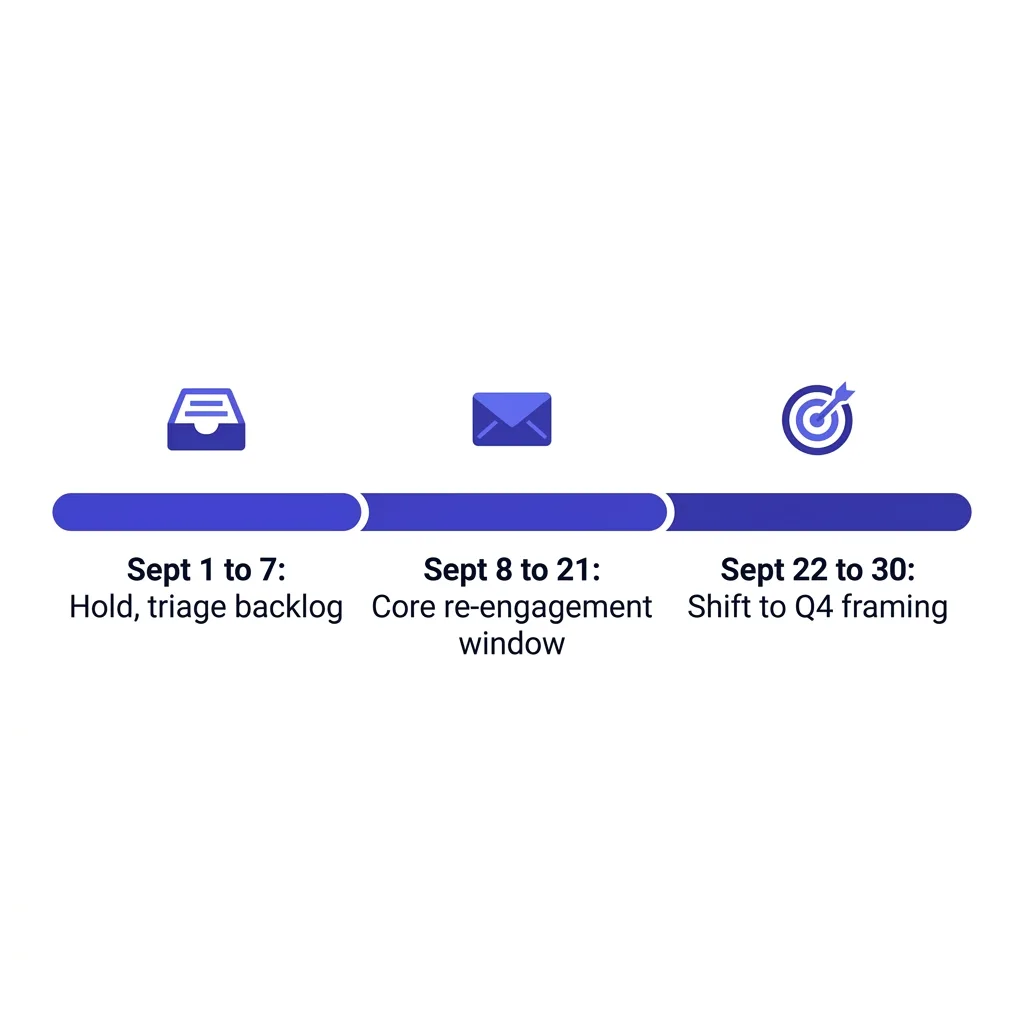
The first week of September (typically after Labor Day in the US) is still triage mode, and messages sent during this window compete against the largest backlog of the year.
That does not mean avoid the first week entirely, but it does mean the message needs to be short enough to survive a scan rather than a careful read.
Week two and three of September see engagement improve as the backlog clears and prospects settle into their actual fall workload, making this the strongest window for a re-engagement sequence's first touch.
By the final week of September, Q4 planning conversations are already underway inside most B2B organizations, which means outreach referencing Q4 priorities specifically starts to land with more relevance than a generic "checking in" message would.
A practical send calendar: hold new re-engagement sends until September 8-10 to avoid the worst of the triage backlog, run the core sequence through the third week, and shift messaging toward Q4-specific framing by the last week of the month.
#What to say after a two-month gap
The instinct to apologize for "bothering" a prospect again after months of silence usually backfires, since it frames the message as an imposition before the prospect has even read the point.
A stronger opener states the gap plainly and gets straight to why now: "Reaching back out now that September's here. Since we last talked in June, [specific relevant update]."
That specific update matters more than the acknowledgment of time passing.
A generic "just checking in" message with no new information gives the prospect no reason to respond differently than they did (or did not) in June.
A message that includes something genuinely new, a product update, a relevant case study from a similar company, a change in the prospect's own business that suggests renewed relevance, gives the prospect an actual reason to re-engage rather than just a reminder that the sender still exists.
For contacts in the "check back later" segment, referencing their specific stated reason for the pause performs best: "You mentioned wanting to revisit once your team finished the platform migration. Curious where that landed."
That kind of specific callback requires good CRM hygiene during the original conversation, which is worth building into the sales process year-round, not just as a September scramble.
See reply handling playbook for how to structure these callback references from CRM notes, and cold email personalization at scale for doing this across a larger list without writing each one from scratch.
#The list-cleaning step most teams skip
Before sending a single September re-engagement email, the list itself needs a pass for basic hygiene.
Two months of no activity is enough time for job changes, role changes, and company changes to accumulate across a meaningful share of any B2B contact list.
Sending a re-engagement email to a contact who left the company in July wastes the send, and repeated sends to a dead address contribute to the bounce rate that damages domain reputation heading into the higher-volume Q4 stretch.
A quick re-verification pass, checking for bounces, confirming the contact still holds a relevant role, and flagging any obvious job changes, takes a fraction of the time a full re-engagement sequence takes to write and pays for itself in avoided deliverability damage.
Running this pass through a dedicated verification tool before the September send catches most of the dead addresses that would otherwise inflate the bounce rate on the very sequence meant to rebuild engagement, which defeats the purpose of the re-engagement effort before it even starts.
This is also the moment to apply email sunset policy logic to contacts who have been unresponsive across multiple prior cadences, not just the summer, since September is a natural checkpoint for deciding which contacts are worth continuing to pursue versus retiring from active outreach.
See b2b data decay list hygiene and email verification before sending for the mechanics of this cleanup pass.
#September versus the January reset
Both September and January represent re-engagement windows after a period of reduced buyer attention, but they carry different framing.
September re-engagement rides the momentum of a fresh school year and a countdown to fiscal year-end for the roughly 75% of companies whose fiscal year ends in December, which gives the messaging a natural Q4-focused angle.
January re-engagement, covered in book January meetings in December and Q4 budget-flush outbound, rides new-year planning and freshly reset budgets instead.
A contact who did not respond to September outreach is not necessarily a dead lead heading into January, since the two windows appeal to different motivations, urgency to spend remaining budget in the first case, fresh budget and new priorities in the second.
Teams that treat September and January as two separate re-engagement attempts, rather than writing off a contact after one non-response, typically recover more of the summer-quiet list than teams that only try once.
#Channel choice for September re-engagement
 Channel choice for September re-engagement
Email is not the only channel worth using during the September window, and for some contacts it is not even the best first move.
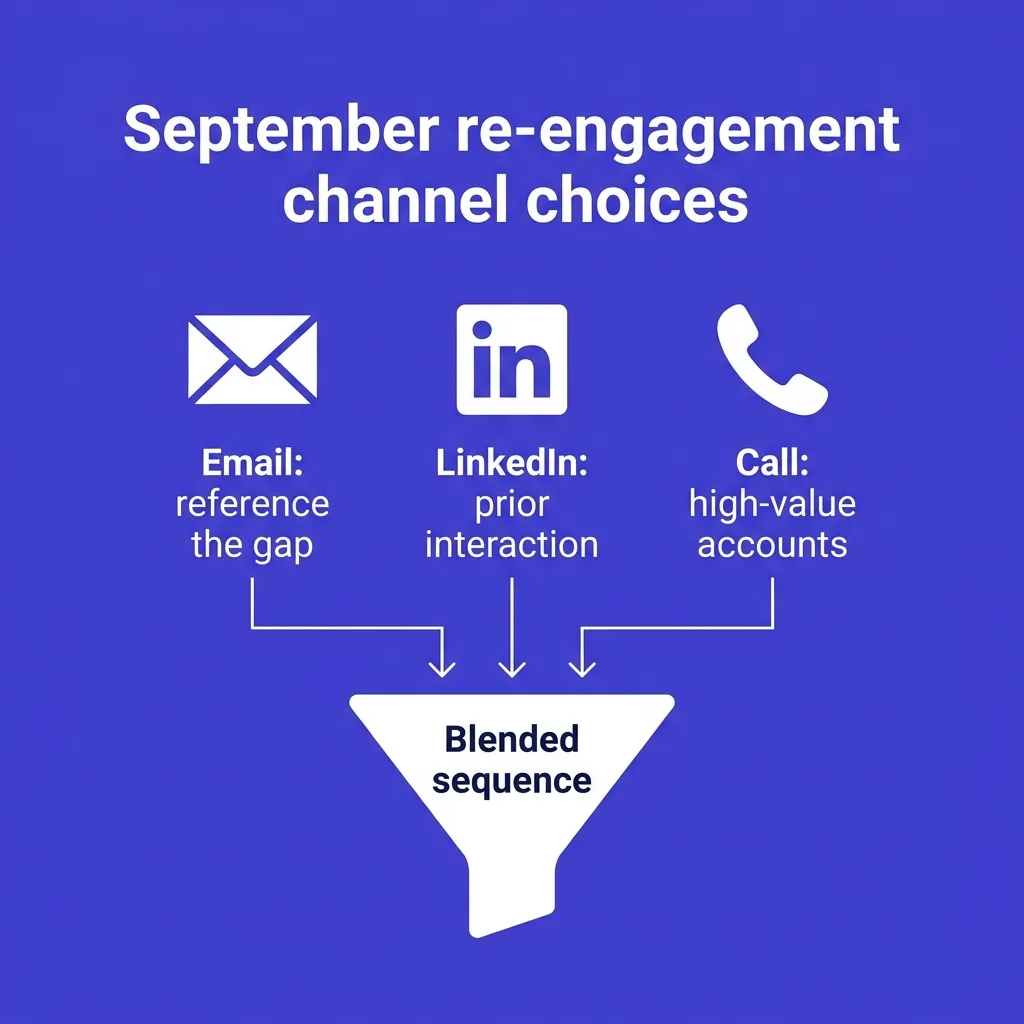
A contact who engaged heavily on LinkedIn before going quiet over the summer often responds better to a LinkedIn message referencing that prior interaction than to a cold-feeling email arriving after a two-month gap.
Multithreading also matters more in September than in a normal-cadence month, since the original contact may have changed roles or priorities over the summer even if they have not left the company.
Reaching a second contact at the same account, particularly if the original conversation stalled due to one person's bandwidth rather than a lack of organizational interest, can revive a deal the primary contact never responds to directly.
See email linkedin multichannel outreach and multithreading outbound buying committee for the mechanics of running this across channels and contacts simultaneously.
Phone and voice channels see a real, if smaller, bump in effectiveness during September re-engagement too, since a short call referencing a specific prior conversation cuts through the inbox backlog in a way email cannot.
A blended sequence, an email referencing the gap, a LinkedIn touch a few days later, and a call attempt if the account is high-value enough to warrant it, typically recovers more of the summer-quiet list than an email-only approach run in isolation.
#Handling summer promises and stalled commitments
Some prospects made real commitments before going quiet: "let's revisit in September," "I'll loop in my manager when we're back," "we'll have budget approved by fall."
These commitments are worth tracking explicitly, separate from the general summer-quiet list, because they carry a different weight than a contact who simply stopped responding with no stated reason.
A prospect who made a specific commitment and then went quiet is not necessarily avoiding the conversation.
They may genuinely be waiting for September to follow through, in which case a reminder framed around their own commitment ("you mentioned looping your manager in once you're back, wanted to check where that stands") respects their stated process rather than pushing past it.
Tracking these commitments requires discipline in the original conversation, logging the specific commitment and the specific timeline in the CRM rather than a vague "follow up in fall" note that loses the actual detail by the time September arrives.
Teams that lose this detail end up sending generic re-engagement messages to contacts who actually gave a specific, trackable commitment, which wastes the strongest re-engagement opportunity in the entire summer-quiet list.
#Building a repeatable September playbook
The tactical value of September re-engagement compounds when it becomes a scheduled part of the annual outbound calendar rather than something rediscovered every year in late August.
A repeatable playbook needs three components set up in advance: the segmentation logic (previously engaged, never engaged, explicit check-back-later) built into the CRM or outbound tool, a message template library for each segment ready before September 1, and the list-cleaning pass scheduled for the last week of August so the list is ready the moment engagement recovers.
Teams using FirstSales can automate the segmentation step directly from CRM activity history, so the previously engaged and check-back-later segments surface automatically rather than requiring someone to manually sort through months of activity logs each September.
Running this as a repeatable playbook, rather than a one-off campaign, also makes it easier to measure year over year: comparing this September's re-engagement reply rate against last September's shows whether the summer-quiet segment is being managed better or worse than the prior year.
#Measuring the September window against the rest of the year
Treating September re-engagement as a one-off tactic makes it hard to know whether the effort is actually worth the time it takes.
Track three numbers specifically for the summer-quiet segment: reactivation rate (the share of quiet contacts who respond to any re-engagement touch), meeting rate from those reactivations, and how that meeting rate compares to a fresh cold list worked during the same period.
A summer-quiet contact who re-engages typically converts to a meeting at a higher rate than a brand-new cold contact, since there is already some baseline familiarity and prior context to build on.
If that is not showing up in the data, the segmentation or messaging in the re-engagement sequence likely needs work, since the theoretical advantage of re-engagement over cold outreach should show up as a measurable gap.
Compare this year's September numbers against last year's using the same list definition (same criteria for what counts as "went quiet over summer") so the comparison is apples to apples rather than skewed by a different-sized starting list.
A rep or team running this measurement consistently for two or three years builds a much stronger sense of exactly how much pipeline the summer-quiet segment is worth recovering, which helps justify the time spent on the segmentation and list-cleaning work covered earlier in this article.
#Why the timing compounds with fiscal year pressure
September's modest recovery gets a second boost from a factor that has nothing to do with vacation schedules ending.
For the roughly 75% of companies whose fiscal year closes on December 31, September marks the point where Q4 budget planning conversations start in earnest inside most finance and procurement teams.
A prospect who went quiet in July because there was genuinely no active initiative to discuss may find themselves back at the table in September precisely because their own Q4 planning cycle has created a reason to move.
This is why September re-engagement messaging benefits from referencing Q4 timing directly, even for contacts with no explicit prior commitment, since the underlying budget cycle creates a real, external reason for renewed interest that has nothing to do with the vendor's own outreach cadence.
Combining the re-engagement angle (referencing the specific prior conversation) with the fiscal-timing angle (referencing the Q4 window closing before year-end) gives September messaging two independent, real reasons to respond rather than relying on either one alone.
See non-discount urgency in B2B for how to frame the fiscal deadline honestly without resorting to manufactured pressure.
#Coordinating September re-engagement across a small team
A September push works best when everyone touching the summer-quiet list knows the same plan, not several reps improvising different messages.
Share the segmentation list and the messaging framework in one document before the first send goes out, so a rep with a smaller book still follows the same structure as the rest of the team.
Assign clear ownership by account rather than letting two reps message the same dormant contact in the same week, which reads as disorganized and often kills the reply.
A shared tracking sheet, even a simple one, showing who was contacted and what they said in July, prevents the awkward moment of a prospect referencing a conversation the sending rep never had.
Set a single date to start the push, rather than letting each rep decide individually, since a coordinated wave lets the team compare reply rates across segments and adjust mid-month if one angle is clearly outperforming another.
Review results as a team roughly two weeks in. If one segment is pulling noticeably higher replies, redirect the remaining sends toward that pattern instead of running the full month unchanged.
#FAQ
#What is September re-engagement outbound?
It is a focused outreach effort targeting B2B contacts who went quiet during the summer slowdown, timed to reach them as they return to full engagement and begin Q4 planning.
#Do B2B cold email reply rates actually recover in September?
Yes, but modestly. Recent benchmark data shows reply rates stabilizing around 0.45% in September, described as a weak autumn recovery rather than a sharp rebound to annual averages.
#Should I send the same message to everyone who went quiet over the summer?
No. Segment by whether the contact previously engaged, never engaged, or explicitly said to check back later, since each group responds to a different framing.
#When in September should I start sending?
Wait until September 8-10 to avoid the worst of the post-Labor Day inbox backlog, and run the core sequence through the third week of the month.
#What should the opening line of a September re-engagement email say?
State the gap plainly and lead with something new: a product update, a relevant case study, or a change in the prospect's business that renews relevance, rather than a generic "just checking in."
#How do I re-engage someone who said "check back later" before summer?
Reference their specific stated reason for the pause directly, which signals the sender was actually listening the first time rather than sending a generic follow-up.
#Should I clean my list before sending September re-engagement emails?
Yes. Two months of inactivity is enough time for job changes and role changes to accumulate, and sending to dead or outdated contacts damages deliverability heading into Q4.
#Is September re-engagement different from January re-engagement?
Yes. September rides year-end fiscal pressure and back-to-work momentum; January rides fresh budgets and new-year planning. Treat them as two separate attempts rather than one.
#What if a contact does not respond to September outreach?
They are not necessarily dead. Fold them into the standard Q4 cadence and try again during the January reset window, since the two periods appeal to different motivations.
#How is September re-engagement different from a cold outreach sequence?
It targets contacts with prior context (a previous conversation, a previous engagement, or an explicit stated timeline) rather than a fully cold list, which changes both the message and the expected response rate.
#Does the summer slowdown affect every industry equally?
No. Industries with school-year-aligned buying cycles (education, some government) see sharper September re-engagement than industries with less seasonal variation, like healthcare or infrastructure.
#What's the biggest mistake teams make with September re-engagement?
Sending a generic "checking in" message with no new information, which gives the prospect no better reason to respond in September than they had in June or July.
#Should re-engagement emails apologize for the gap?
No. Apologizing frames the message as an imposition. State the time gap plainly and move directly into why the message is relevant now.
#How long should a September re-engagement email be?
Short, especially in the first two weeks of the month, since prospects are triaging a large inbox backlog and a long message is unlikely to get a full read.
#Can I automate the segmentation of summer-quiet contacts?
Yes, most modern CRMs and outbound platforms can segment by last engagement date and activity type automatically, removing the need to manually sort through months of history.
#What role does Q4 fiscal timing play in September messaging?
For companies with a December fiscal year-end, September framing can start referencing year-end budget urgency, since Q4 planning is typically already underway inside the buyer's organization by late September.
#Should I retire contacts who have been unresponsive across multiple cadences by September?
Consider it. September is a natural checkpoint to apply a sunset policy to contacts who have not responded across several prior attempts, protecting deliverability for the active portion of the list.
#How do I measure whether my September re-engagement effort worked?
Compare this September's reply rate and reactivation count against the prior year's, using the same segmentation logic, to see whether the summer-quiet list is being managed better over time.
#Does September re-engagement apply to existing customers too, not just prospects?
Yes. Customer success and account management teams can apply the same segmentation and callback logic to accounts that went quiet over the summer, which is a natural fit for renewal and expansion conversations ahead of Q4.
#Should I combine email with LinkedIn or phone for September re-engagement?
Yes, particularly for high-value accounts. A blended sequence across email, LinkedIn, and a call attempt typically recovers more of the summer-quiet list than email alone, since each channel reaches the prospect through a different attention path.
#What if the contact I need to reach changed roles over the summer?
Multithread to a second contact at the same account rather than only retrying the original one, since the stall may have been about that person's bandwidth rather than the account's actual interest.
#What tools help scale September re-engagement across a large list?
Platforms like FirstSales can pull CRM activity history to auto-segment summer-quiet contacts and draft personalized re-engagement messages referencing specific prior context at scale.
September re-engagement works because it targets a specific, real behavior change, prospects coming back from a rolling summer absence, rather than treating every quiet contact as a lost cause.
The reply rate data shows a real but modest recovery, which means the message quality matters more in September than in a normal-volume month, since there is less overall attention to compete for.
Segment the list, reference what actually happened the last time you spoke, and clean the data before you send.
None of those three steps is complicated on its own, but skipping any one of them turns a targeted re-engagement effort back into a generic cold blast with a worse reputation attached.
Contacts who do not respond in September are not gone.
They are candidates for the next natural re-engagement window in January, and treating the two as connected attempts rather than isolated campaigns recovers more of the list than either one alone.
Build the segmentation, the message library, and the list-cleaning pass once, then reuse the same playbook every September rather than reconstructing it from scratch each year.
The teams that treat this as a scheduled, repeatable motion consistently recover a meaningful share of pipeline that would otherwise sit dormant until the next natural touchpoint, if it ever comes at all.