TL;DR: A short voice note on LinkedIn or WhatsApp lifts reply rates 30-40% over a plain text message, because it is harder to ignore and signals a real person on the other end. It works as a mid-sequence step, not an opener, and it fails fast when it is too long, too polished, or sent to someone who never gave you a reason to expect contact.
Text messages get skimmed in half a second and forgotten.
A voice note asks for a different kind of attention.
Someone has to actually listen, even briefly, which is exactly why it breaks through where text stalls out.
Sales and recruiting teams have quietly adopted the format over the past two years, moving it from a niche personal-branding trick to a standard mid-sequence tactic on LinkedIn and, more cautiously, on WhatsApp.
The results are real, but so are the ways the format backfires when it is misused.
This piece covers both.
#The numbers behind the format
Standard LinkedIn cold messages get ignored roughly 80% of the time.
Adding a short voice note to that same outreach lifts reply rates by 30-40%, according to outreach benchmarking reports tracking the format through 2025 and into 2026.
LinkedIn connection requests that include a personalized written message already outperform blank requests, moving reply rates from around 5.4% with no message to 9.4% with one.
Voice adds a further lift on top of that written-message baseline once the connection is accepted.
WhatsApp tells a different story.
Open rates on WhatsApp sit near 95%, among the highest of any outbound channel, but the reply rate on a cold WhatsApp message is closer to 4%, similar to email.
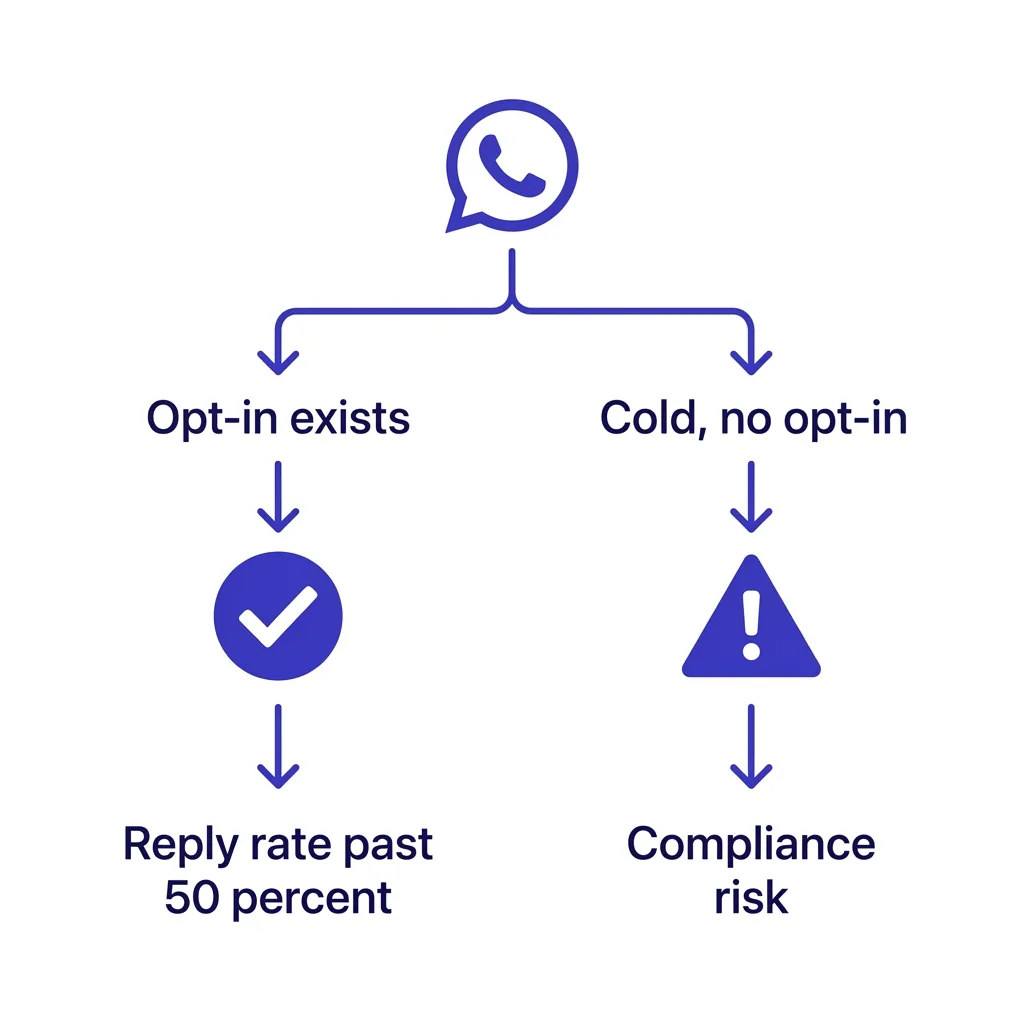
In regions with heavy WhatsApp usage for business, Spain, Italy, and parts of Latin America among them, reply rates on WhatsApp outreach can climb past 50% when the relationship or context already exists.
Cold, unsolicited WhatsApp voice notes to strangers in markets without that cultural norm perform far worse and carry real risk of being reported.
#Why voice notes outperform text in the channels where they fit
A voice note carries tone, pacing, and warmth that text cannot.
It is also asymmetric in effort: the sender records once, but the listener has to actually stop and process it, which raises the psychological cost of ignoring it compared to skimming a message.
That asymmetry is the entire mechanism.
It works in the sender's favor only when the message earns that attention, meaning it needs to be short, specific, and clearly relevant within the first five seconds.
A generic 90-second ramble about a product does the opposite: it burns the goodwill the format creates and gets the sender blocked or ignored on every future channel.
#Where voice notes fit in a sequence
Voice notes rarely work as a true first touch to a complete stranger, particularly on WhatsApp, where an unsolicited voice message from an unknown number reads as intrusive rather than personal.
They perform best as a second or third touch, after a connection request or a first message has already established some context.
On LinkedIn, the natural sequence is: connection request with a short personalized note, a text message once accepted, then a voice note as the pattern-break if the text message goes unanswered.
On WhatsApp, voice notes work best once a prospect has opted into that channel some other way, replying to an email with a phone number, engaging with a chatbot, or through an existing relationship, rather than a cold number pulled from a data provider.
graph TD
    A[LinkedIn connection request + short note] --> B{Accepted?}
    B -->|No| C[Stop, do not chase]
    B -->|Yes| D[Text message: specific reason to connect]
    D --> E{Reply?}
    E -->|Yes| F[Move to call or email]
    E -->|No, after 3-4 days| G[30-45 second voice note]
    G --> H{Reply?}
    H -->|Yes| F
    H -->|No| I[Final short text, then stop]
#What makes a voice note actually get a reply
Length is the first filter.
Voice notes between 30 and 45 seconds perform best, long enough to say something real, short enough that the listener does not have to commit real time to it.
Anything past 60 seconds starts losing listeners before the end, and a voice note nobody finishes might as well not have been sent.
Open with the person's name and the specific reason for the message in the first sentence, exactly like a written cold email opening line needs to earn attention immediately rather than warming up slowly.
Record in a quiet space.
Background noise, echo, or a shaky connection undercuts the professionalism signal the format is supposed to send.
Speak at a natural pace, not rushed and not artificially slow.
A note that sounds nervous or rehearsed loses the authenticity that makes the format work in the first place.
#A ✓/✗ table for voice note outreach
| Practice | ✓ Works | ✗ Backfires |
|---|---|---|
| Timing in sequence | Mid-sequence, after a written touch | Cold open to a total stranger |
| Length | 30-45 seconds | Over 60 seconds |
| Opening | Name plus specific reason, first sentence | Warm-up small talk before the point |
| Channel fit | WhatsApp after opt-in or existing context | Cold WhatsApp voice note to unknown number |
| Recording environment | Quiet space, natural pace | Background noise, rushed delivery |
| Frequency | One voice note per sequence | Multiple voice notes back to back |
| Follow-up | Short text referencing the voice note | Silence after the note goes unanswered |
#LinkedIn-specific mechanics
LinkedIn's native voice message feature only works between connections, or within an InMail conversation for accounts with Sales Navigator or a premium plan.
That structural limit is actually useful discipline: it forces the voice note into the mid-sequence slot rather than tempting senders to blast it as a first touch to strangers.
Recruiters and SDRs alike report the format working especially well for reengaging a connection who accepted the request but never replied to the follow-up message, since the voice note signals renewed, personal effort rather than an automated nudge.
Combine it with the connection-request-message data: personalizing that opening note already moves reply rates from 5.4% to 9.4%, and layering a voice note in later in the thread compounds that initial trust signal rather than replacing it.
See our breakdown of LinkedIn connection request limits for the volume ceilings that apply before any of this messaging strategy matters.
#WhatsApp-specific mechanics and risk
 WhatsApp-specific mechanics and risk
WhatsApp Business API access requires an opt-in trail in most enforcement regimes, and sending unsolicited cold voice notes to numbers scraped from a list carries real risk of account bans and, in the EU, compliance exposure under consent-based messaging rules.
The safer path is treating WhatsApp as a second-channel extension of a relationship that started somewhere consent-friendly: a website chat opt-in, a reply to an email that included a phone number, or an existing customer relationship being reactivated.
Once that opt-in exists, WhatsApp's near-universal 95% open rate makes it an efficient channel for a short voice note nudging toward a call booking or a specific next step, since the recipient is almost certain to see it.
Skip cold WhatsApp voice notes to unqualified numbers entirely.
The reply rate does not justify the compliance and reputation risk.
#How voice notes compare to video
Video and voice notes solve a similar problem through different mechanics.
Video, covered in our piece on video in cold email, works primarily through email and demands more production time, three to eight minutes per prospect for a genuinely personalized clip.
A voice note takes a fraction of that time, often under a minute to record, because there is no visual framing, lighting, or screen share to manage.
That speed advantage makes voice notes a better fit for higher-volume mid-sequence touches, while video suits a smaller, more curated list where the extra production time is justified by deal size.
Some teams run both in the same sequence: a voice note on LinkedIn as touch three, a video by email as touch four, layering formats rather than picking one.
#Common mistakes that kill the format
The most common mistake is treating voice notes like a script to read verbatim, which produces the same flat, rehearsed delivery that undercuts video.
Speak from a short mental outline instead: the person's name, the one specific reason for the message, and a clear, single ask.
A second mistake is sending a voice note as the very first contact.
Even on LinkedIn, where the format performs well mid-sequence, a cold voice note to someone who has never heard from the sender before reads as presumptuous, not personal.
A third mistake is stacking multiple voice notes across a short window, which reads as pressure rather than persistence and tends to trigger a block rather than a reply.
A fourth mistake is ignoring the transcript.
Most platforms auto-transcribe voice notes for recipients who cannot listen immediately, and a note that does not make sense as a written transcript, mumbled, too casual, unclear phrasing, loses the recipient who reads rather than listens.
#A recording setup that takes five minutes to build
A working voice note setup does not require studio gear.
A phone in a quiet room with the door closed produces cleaner audio than most laptop microphones in an open office.
Record two or three practice runs before the one that gets sent, not to perfect a script but to settle nerves and find a natural pace.
Listen back once before sending.
If the note sounds rushed, restart it rather than sending something the recipient will notice as anxious or hurried.
Keep a running list of the five or six specific reasons that tend to justify outreach in your market, a hiring signal, a funding round, a product launch, a competitor's misstep, so each note has a real hook to open with instead of a generic greeting.
#How the format differs for founders versus SDR teams
A founder sending a handful of voice notes a week to strategic accounts can afford more time per note, closer to a minute, with more specific detail woven in since the volume is low and each contact matters disproportionately.
An SDR team running voice notes at scale needs a tighter, more repeatable structure: a 20-25 second note that hits the name, the reason, and the ask without variance in quality across ten or twenty reps.
Founders benefit from voice notes' authenticity premium the most, since a prospect hearing directly from a company's founder carries weight a generic SDR outreach cannot replicate regardless of script quality.
SDR teams get more value from treating voice notes as one lever inside a structured outbound cadence rather than a signature move, since consistency across a large team matters more than any single note's polish.
#A regional playbook for WhatsApp voice outreach
Voice note norms on WhatsApp vary sharply by region, and treating the channel as universal is a common mistake for teams expanding outbound internationally.
In Spain, Italy, Brazil, and much of Latin America, WhatsApp functions as a primary business communication channel, and a voice note from a known company or referral source is a normal, expected format.
In the United States, the United Kingdom, and much of Northern Europe, WhatsApp skews more personal, and unsolicited business voice notes there read as an overreach regardless of content quality.
Teams selling across regions should treat WhatsApp voice outreach as a market-specific tactic, enabled where the cultural fit exists and skipped where it does not, rather than a single global playbook applied uniformly.
Check local data protection rules too.
The EU's ePrivacy and GDPR framework treats unsolicited direct marketing messages, voice included, more strictly than many US-based teams expect, which is one more reason to build the opt-in trail before scaling WhatsApp voice outreach into European markets.
#Building this into a multichannel sequence
 Building this into a multichannel sequence
Voice notes rarely stand alone as a strategy.
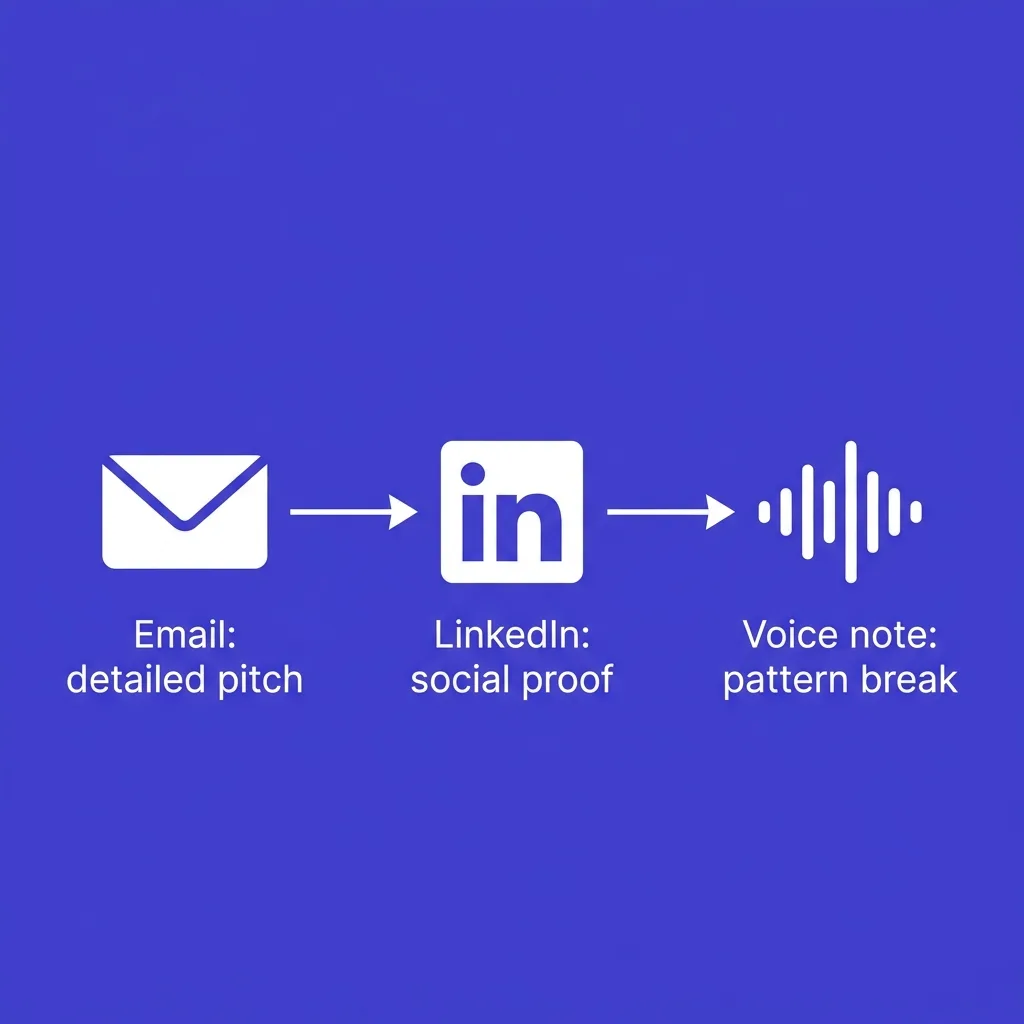
They earn their place inside a broader email and LinkedIn multichannel sequence, where each channel does a specific job: email carries the detailed pitch and case data, LinkedIn carries the social proof and connection, and a voice note on either platform carries the pattern-break moment when text has gone quiet.
Multichannel sequences using three or more channels together produce meaningfully more total responses than any single channel run in isolation, and voice notes are one of the cheapest ways to add a genuinely different channel signal without a large new tool investment.
For teams running AI-assisted drafting with human approval across email, adding a manual voice note touch at the LinkedIn or WhatsApp layer keeps the sequence from feeling entirely automated, since the recipient hears an unscripted human voice at exactly the point where they might otherwise assume a bot sent everything.
#Measuring whether the format is working for your team
Track reply rate on the voice note touch specifically, separate from the sequence's overall reply rate, since blending the numbers hides whether the format is actually earning its keep.
Track how many recipients listen versus read the auto-generated transcript, if your platform surfaces that data, since a channel where nobody actually presses play is not delivering the tone advantage that justifies the extra recording time.
Compare cost in rep-minutes against the text-only cadence it is layered onto, and give the pilot at least three to four weeks before drawing conclusions, since voice notes tend to be used sparingly enough that early sample sizes will be small.
#The ROI math for adding voice notes to a sequence
A voice note costs a rep roughly one to two minutes, recording time plus the moment spent reviewing the account before hitting record.
At that cost, even a modest reply lift pays for itself quickly compared to the three to eight minutes a personalized video demands per prospect.
Run the comparison against your existing sequence's follow-up performance: if a text-only follow-up touch converts at 3% and a voice note touch at the same sequence position converts at 8-10%, the extra two minutes per prospect is an easy trade for most teams.
The math shifts for large SDR teams running thousands of contacts a month, where even a small per-note time cost compounds into meaningful headcount hours.
For those teams, reserve voice notes for accounts that have already shown some engagement, a profile view, a connection acceptance, a partial reply, rather than applying the format across the entire list uniformly.
That keeps the time investment proportional to the account's demonstrated interest.
#A short case pattern worth borrowing
A common working pattern among B2B teams selling into operations and revenue roles looks like this.
Touch one on LinkedIn is a connection request with a one-line, specific reason for connecting, not a form invite.
Touch two, sent two to three days after acceptance, is a short written message referencing that same reason in more detail.
If touch two goes unanswered for four to five days, touch three is a 30-second voice note that references the earlier message directly, acknowledging it may have gotten buried, and restates the ask in a warmer, more human tone.
Reps running this exact structure report the voice note touch carrying a disproportionate share of total sequence replies relative to how few of them get sent, echoing the same pattern seen with mid-sequence video touches in email.
The mechanism is the same in both cases: the pattern break, not the format itself, is what earns the attention.
#When to skip voice notes entirely
Skip cold voice notes on WhatsApp to any number without a documented opt-in trail, given the compliance and reputation risk.
Skip voice notes as a first touch on any channel, since the format depends on some prior context existing.
Skip the format in industries or regions where voice messaging is culturally uncommon for business communication, since an unfamiliar format can read as inappropriate rather than personal regardless of content quality.
Skip it if a rep cannot record a clean, confident 30-45 second message without multiple retakes, since a hesitant or rambling note does more harm than a well-written text.
#Training a team to sound consistent without sounding scripted
The hardest part of scaling voice notes past one or two reps is quality control.
A manager cannot review every note before it sends the way they might spot-check email copy.
The fix is a short recorded onboarding session where new reps listen to three or four strong examples and three or four weak ones, side by side, so the difference in pacing, specificity, and tone becomes obvious rather than abstract.
Pair that with a simple checklist each rep runs through before recording: the prospect's name confirmed correct, one specific reason identified, a single clear ask decided, and a quiet space secured.
Skip formal scripts entirely.
They produce the flat delivery that undercuts the entire point of using voice in the first place.
Spot-check a sample of sent notes weekly, not for compliance but to catch reps drifting back toward over-length or overly salesy delivery before it becomes habit.
Teams that treat this as an ongoing coaching habit, similar to how they'd refine cold email personalization at scale, see the format hold its reply-rate advantage over months rather than fading after the first few weeks of novelty.
#Frequently asked questions
#Do voice notes actually increase reply rates on LinkedIn?
Yes, reported lifts run 30-40% over text-only messages, on top of the baseline improvement personalized written messages already provide over blank connection requests.
#Should a voice note be the first message I send a new LinkedIn connection?
No. Voice notes perform best as a mid-sequence touch after a written message has already established context, not as the opening contact.
#What is the ideal length for an outreach voice note?
30 to 45 seconds. Notes over 60 seconds see meaningfully lower completion rates.
#Are cold voice notes on WhatsApp legal?
It depends on jurisdiction and consent trail. Sending unsolicited voice messages to numbers without an opt-in carries real compliance risk in consent-based regimes like the EU, and can trigger WhatsApp Business account restrictions.
#What is the reply rate for cold WhatsApp outreach?
Around 4% for cold outreach without prior context, despite WhatsApp's roughly 95% open rate. Reply rates climb substantially, sometimes past 50%, once genuine context or an opt-in relationship exists.
#Should I script a voice note word for word?
No. A memorized script tends to sound flat and rehearsed on audio. Work from a short mental outline instead: name, specific reason, single ask.
#How does a voice note compare to a Loom video for cold outreach?
Voice notes take a fraction of the time to record, often under a minute, and work well for higher-volume mid-sequence touches. Video takes 3-8 minutes per prospect and suits a smaller, more curated list. See our full breakdown of video in cold email.
#Can I use LinkedIn voice messages with anyone, or only connections?
LinkedIn's native voice message feature generally requires an existing connection, or an active InMail thread for premium and Sales Navigator accounts.
#What happens if a recipient cannot listen to my voice note right away?
Most platforms auto-generate a transcript. Write your outline so it still reads clearly as text, not just sounds good spoken aloud.
#Is a voice note more effective than a phone call for outreach?
They serve different purposes. A voice note is asynchronous and lower-friction to send and receive; a call requires both parties available at once. Voice notes work well as a bridge toward booking that call.
#Do voice notes work for recruiting outreach?
Yes, and recruiters report them working particularly well for reengaging a passive candidate who accepted a connection but went quiet. See our guide on cold email for recruiting for the broader channel comparison in that context.
#How many voice notes should I send in one sequence?
One is usually enough. Sending multiple voice notes in a short window tends to read as pressure and increases block rates rather than reply rates.
#What background noise level is acceptable for a professional voice note?
Aim for a genuinely quiet room. Even modest background noise, a fan, traffic, an open window, undercuts the professional signal the format depends on.
#Does the format work the same way across regions?
No. Regions with strong existing WhatsApp business culture, parts of Southern Europe and Latin America especially, see far higher engagement than markets where WhatsApp is used mostly for personal messaging.
#Should sales teams standardize voice note scripts across reps?
A shared outline structure helps consistency, but a word-for-word shared script tends to sound robotic across multiple reps. Keep the structure standard and the phrasing personal.
#Can voice notes replace email in an outbound sequence?
No. Voice notes work as a supplementary channel inside a broader sequence, not a replacement for the detailed, scannable case an email can make.
#What tools support voice notes for LinkedIn and WhatsApp outreach?
LinkedIn's native messaging app supports voice notes directly. WhatsApp Business and the WhatsApp Business API both support voice messages, with the API version requiring proper opt-in infrastructure for compliant cold outreach.
#How do I know if a voice note is too long?
If the core message, the reason for reaching out and the ask, cannot be delivered inside 45 seconds, the note needs editing before recording, not padding to fill time.
#Is it worth using voice notes for a small outbound team?
Yes, since the format requires minimal tooling investment, just a phone and a quiet room, making it accessible even for a one or two person outbound motion.
#What is the single biggest reason a voice note gets ignored?
Being sent cold, with no prior context, to someone who has no reason to expect contact from the sender. The format depends entirely on the recipient already recognizing the name or thread.
#Key takeaways
Voice notes work because they demand more attention than text, and that asymmetry only pays off when the content earns it: short, specific, and placed at the right point in a sequence.
LinkedIn voice notes lift replies 30-40% when used mid-sequence after a written touch.
WhatsApp voice notes work well once genuine opt-in context exists and perform poorly, with real compliance risk, when sent cold.
Keep notes under 45 seconds, record in a quiet space, and never stack more than one in a sequence.
Layer voice notes alongside email and a structured multichannel sequence rather than treating them as a standalone channel, and let the human, unscripted tone do the work text and automated drafting cannot.
Teams using FirstSales to handle the drafting and research load on the email side of a sequence often find that freeing up rep time is exactly what makes a manual channel like voice notes sustainable in the first place, since reps only have time for a high-touch format when the repetitive parts of the workflow are not eating their whole day.
A tool cannot record a voice note for a rep and keep it sounding human.
That part stays manual by design, and it is precisely why it still works.
The channels change every few years. The underlying reason a message earns a reply, a real person taking the time to say something specific, does not.
Whatever channel comes after voice notes will reward the same thing: effort the recipient can actually feel.
Build that discipline now, and the next format shift will be easy to adapt to.