#Fiscal year timing as a buying signal in B2B outbound
Copy page
TL;DR: Fiscal year timing is a buying signal because budget gets approved, released, and spent on a schedule that rarely matches the calendar year. Most reps only time outreach around Q4, missing the far larger opportunity window that opens in the first 90 days of a prospect's actual fiscal year, whenever that falls. Map the account's real fiscal calendar, watch for the planning and approval windows inside it, and time your first touch to land when budget is unassigned rather than already spent.
Most cold email calendars assume every company runs January through December.
They do not.
Apple's fiscal year starts in late September. Microsoft's starts July 1.
Walmart closes its books at the end of January.
The US federal government runs October through September.
None of these companies are edge cases. Roughly a quarter of large enterprises run a fiscal year that does not match the calendar year, and inside any reasonably sized target account list, you are almost guaranteed to have a mix.
If your outbound cadence treats every prospect as a January-to-December buyer, you are pitching a meaningful share of your list at exactly the wrong moment.
This article breaks down how fiscal-year timing works as a buying signal, how to find a prospect's real fiscal calendar, and how to build a sending cadence around it instead of around your own quarter.
#What fiscal-year timing actually means as a signal
A buying signal is any observable event or pattern that correlates with a prospect being more likely to buy soon.
Job changes, funding rounds, and new hires are the signals most reps already track.
Fiscal-year timing is a different kind of signal. It is not an event that happens to a company.
It is a recurring window, tied to that company's specific budget calendar, when unspent money is sitting in a line item waiting for a decision.
Budget does not get approved evenly across twelve months.
Most companies front-load planning into a two-to-three month stretch before their fiscal year starts, then spend the next several months turning that plan into purchases.
If you know a prospect's fiscal year starts in April, their real "January" for budget purposes is April, and their real Q4 crunch is January through March.
Time a pitch around their December instead of their real fiscal quarter and you are asking a buyer to fight for money that has not been allocated yet.
For background on how buying signals work as a category before you specialize into fiscal timing, see this breakdown of buying signals for cold email.
#Fiscal years are not all the same, and that is the point
The default assumption, calendar year equals fiscal year, is wrong often enough to matter.
Retailers frequently close their fiscal year at the end of January, after the holiday season is fully booked and returned.
Walmart, Target, and Home Depot all run this way.
Tech giants split further. Apple ends its fiscal year in late September, and Microsoft ends June 30.
Salesforce also closes January 31.
Government contractors and public sector buyers run on the US federal fiscal year, October 1 through September 30, and this single fact drives an entire industry's sales calendar.
Universities and school districts often run July through June, tied to the academic year.
The table below lays out the most common patterns you will run into when building account lists.
| Fiscal year pattern | Typical organizations | FY start | Peak budget-planning window |
|---|---|---|---|
| Calendar year (Jan to Dec) | Most SaaS, most mid-market B2B | January 1 | September to November |
| Retail fiscal year | Walmart, Target, Home Depot | Late January/early February | November to January |
| US federal fiscal year | Federal agencies, gov contractors | October 1 | June to September |
| Tech fiscal year (varies) | Apple (Sept close), Microsoft (June close) | Varies by company | 2 to 3 months before FY start |
| Academic fiscal year | Universities, K-12 districts | July 1 | March to June |
| UK fiscal year | UK public sector, some UK enterprises | April 6 | January to March |
None of these windows overlap with a generic "end of year" outreach push.
That mismatch is exactly why fiscal-year timing works as a differentiator: almost nobody else on the prospect's radar is adjusting for it.
#How a budget cycle actually moves, stage by stage
Budget does not move in one step from "approved" to "spent."
It moves through a sequence, and each stage changes what kind of email lands.
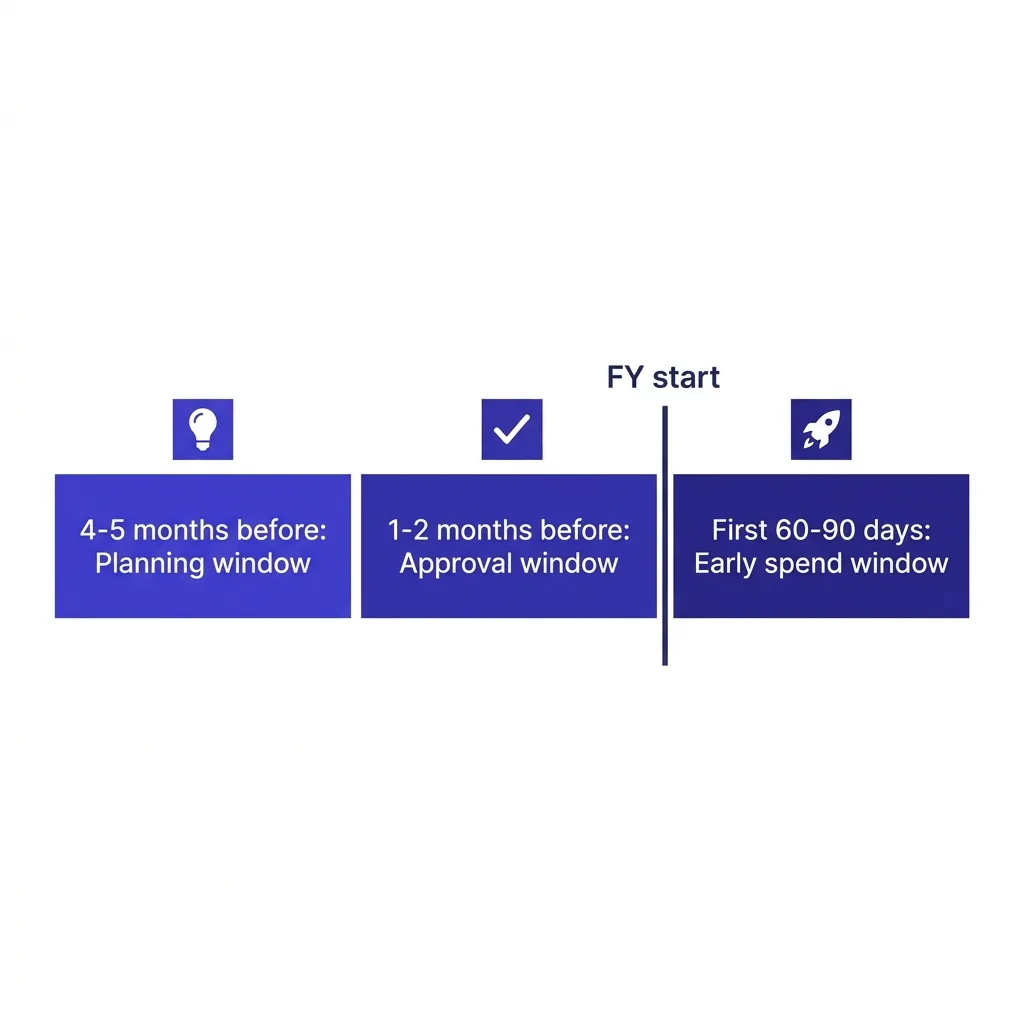
The diagram below maps a typical enterprise budget cycle onto a company with a January-start fiscal year, though the same stages apply to any start month, just shifted.
Two windows inside that loop matter most for outbound.
The first is the planning window, roughly four to five months before the fiscal year starts, when department heads are drafting the requests that become next year's budget.
Reach a buyer here and you can influence what gets requested in the first place.
The second is the early spending window, the first 60 to 90 days after the new fiscal year opens, when budget has just been unlocked and nothing has been committed to a competitor yet.
Both windows beat the final quarter of the current fiscal year, when most reps pile on and most of the money is already spoken for.
#The mistake: treating Q4 budget flush as the only signal
Q4 budget flush is real. Finance teams that see unspent line items at year end sometimes push to spend it before it disappears, and that has its own outreach playbook worth reading if you have not already: Q4 budget flush outbound.
But budget flush and fiscal-year planning are two different signals with two different mechanics, and conflating them costs you the bigger opportunity.
Flush spending is reactive. It is money a team is trying to burn before it evaporates, and the buyer is often price-sensitive and speed-motivated.
Fiscal-year planning is proactive. It is a buyer deciding what to request for a budget that does not exist yet, and the buyer is influence-motivated, not urgency-motivated.
| Signal | Budget flush (end of current FY) | Fiscal-year planning window |
|---|---|---|
| Buyer mindset | Spend it or lose it | What should we request next year |
| Timing relative to FY | Last 4 to 8 weeks of the FY | 4 to 5 months before FY start |
| Deal size | Often smaller, tactical | Often larger, strategic |
| Your edge | Speed and availability | Shaping the requirement itself |
| Risk if you miss it | You lose to whoever answers fastest | Budget gets allocated without you in the conversation |
| Best angle | ✓ Urgency, quick close, existing budget | ✗ Urgency framing (nothing is urgent yet) |
| Best angle | ✗ Long sales cycle pitch | ✓ Positioning, business case building |
Chasing only the flush window means you show up after the requirement has already been written, competing on price against whoever got there first.
Chasing the planning window means you can help write the requirement.
For a deeper look at why manufactured urgency backfires outside the flush window, see non-discount urgency in B2B.
#Finding a prospect's real fiscal year
You cannot time an email to a fiscal calendar you have not identified.
Three sources cover most of your list.
Public companies disclose their fiscal year in every 10-K and 10-Q filing, available free through the SEC's EDGAR database.
The cover page states the fiscal year end explicitly, and it takes under a minute to check.
Government and education buyers almost always follow a known standard: October to September for US federal, July to June for most school districts and universities, April to March for UK public sector.
Private companies are harder, but not opaque.
Job postings for finance and FP&A roles sometimes mention "our fiscal year," LinkedIn posts around planning season reference "next year's budget," and earnings calls (if the company has any public debt) disclose the calendar in filings even without public equity.
When none of that surfaces anything, a direct, low-stakes question during a discovery call, "when does your budget year start," works fine and signals that you understand how enterprise buying actually happens.
Pairing fiscal-year data with other lookup work is where AI-assisted research earns its keep. A structured pre-call research pass, see AI pre-call research, can pull fiscal year, recent leadership changes, and funding status into one profile before the first email goes out.
FirstSales builds this kind of account context automatically as part of its signal-based prospecting layer, so a rep is not manually checking EDGAR filings one account at a time.
#Timing your outreach to the right stage of the cycle
 Timing your outreach to the right stage of the cycle
Once you know the fiscal year, the cadence writes itself around three windows.
Window one: the planning window (4 to 5 months before FY start).
The goal here is not to close a deal. It is to get in front of whoever is drafting next year's budget request before the number gets locked.
An email here should focus on the business case, not the product demo.
Window two: the approval window (1 to 2 months before FY start).
Budget requests are being reviewed and cut here. A prospect you reached in window one may now be fighting to keep your line item alive.
This is a good moment for a proof point, a case study, or a one-pager the champion can forward internally without you in the room.
Window three: the early spend window (first 60 to 90 days of the new FY).
Budget is unlocked and nothing is committed yet. This is when the highest volume of net-new B2B purchases actually get initiated, not in December.
An email here can be direct about implementation timelines and next steps, because the money is real and available.
Missing all three and only reaching out during the final quarter of the current fiscal year means competing for scraps.
Cadence structure should flex by deal size and stage, and if you have not mapped your sequence length against typical deal size yet, outbound cadence by deal size is worth a read alongside this.
#What a fiscal-year-timed email actually says
The angle changes by window, but the mechanics stay simple.
In the planning window, reference the timing directly and briefly: "Teams we work with are usually finalizing next fiscal year's requests around now, so flagging this while it's still easy to include."
That single sentence does two things: it shows you understand how budget actually gets requested, and it gives the reader a concrete reason to open the email now instead of archiving it.
In the approval window, the email should carry proof, not a pitch. A specific number from a comparable customer beats three paragraphs of feature description.
In the early spend window, the email can be more direct about next steps, because the constraint that mattered before (no budget yet) is gone.
None of this requires guessing. Personalization pulled from the account's actual fiscal calendar, industry, and recent signals reads as informed rather than generic, and generic is what gets deleted; see cold email personalization mistakes for the more common failure modes to avoid.
For teams generating first drafts with AI, a prompt library that encodes the fiscal-timing angle by window keeps output consistent across reps; see SDR prompt library for a starting structure.
#Stacking fiscal-year timing with other signals
Fiscal-year timing rarely works alone. It works best stacked with a second signal that confirms the account is actively evaluating something now, not just theoretically in-window.
A new VP of finance hired six weeks before the planning window opens is a stronger combination than either signal alone; see hiring signal outbound for how to read leadership changes as timing signals.
A funding round closed two months before the fiscal year starts often means fresh budget with no incumbent vendor attached yet; funding round cold email covers that angle in more depth.
A recent role change at the target account, someone moving into a budget-owning seat right as planning opens, compounds the timing even further; see job change trigger email.
Compound buying signals convert at meaningfully higher rates than single signals, because each additional confirmed signal reduces the odds you are reading a false positive.
The full framework for stacking multiple signals into one prioritized account list lives in compound buying signals, and it is worth building fiscal timing in as a permanent layer rather than a one-off campaign.
More broadly, moving from static list building to timing-aware prospecting is the shift covered in intent based prospecting vs static lists, and fiscal-year data is one of the cleanest intent proxies available because it does not decay the way a website visit does.
#Segmenting your ICP by fiscal calendar
Most ideal customer profile documents describe firmographics: company size, industry, tech stack.
Almost none of them include a fiscal calendar field, and that is a gap worth closing.
Add fiscal year start month as a required field when building or refreshing your ideal customer profile, even if you leave it blank for accounts you have not researched yet.
Once populated, segment your outbound list into cohorts by fiscal year start month rather than treating the whole list as one calendar-year block.
A list segmented this way lets you run twelve smaller, precisely timed campaigns across the year instead of one enormous push crammed into September through November.
That spreads sending volume more evenly too, which has a secondary benefit for deliverability, since a smoother send pattern is easier on domain reputation than one seasonal spike; see cold email sending frequency for the mechanics.
#Waterfall enrichment for fiscal year data
Fiscal year start date is not a field most standard B2B data providers expose cleanly.
It usually has to be assembled from multiple sources: SEC filings for public companies, a data provider's firmographic record for company size and industry, and manual research or an AI research pass for private companies.
This is a textbook case for waterfall enrichment, running an account through several data sources in sequence until the field gets filled, rather than relying on one provider that is unlikely to carry this specific attribute.
Build the enrichment once at the account level, cache it, and reuse it. Fiscal year start month does not change often, so this is a one-time lookup cost per account, not a recurring one.
#Where human review still belongs
 Where human review still belongs
None of this should ship as fully autonomous outreach.
A fiscal-year-timed email is a hypothesis: that the account's calendar matches your research, and that the timing angle is genuinely relevant to the person receiving it.
Both assumptions are wrong often enough that a human should confirm the account context before the email sends, particularly the fiscal year assumption, which is sometimes stale in enrichment data.
This is the core argument for human in the loop cold email: AI can draft and prioritize, but a person should catch the case where the "fiscal year end September" data point is three years old and the company has since changed its calendar.
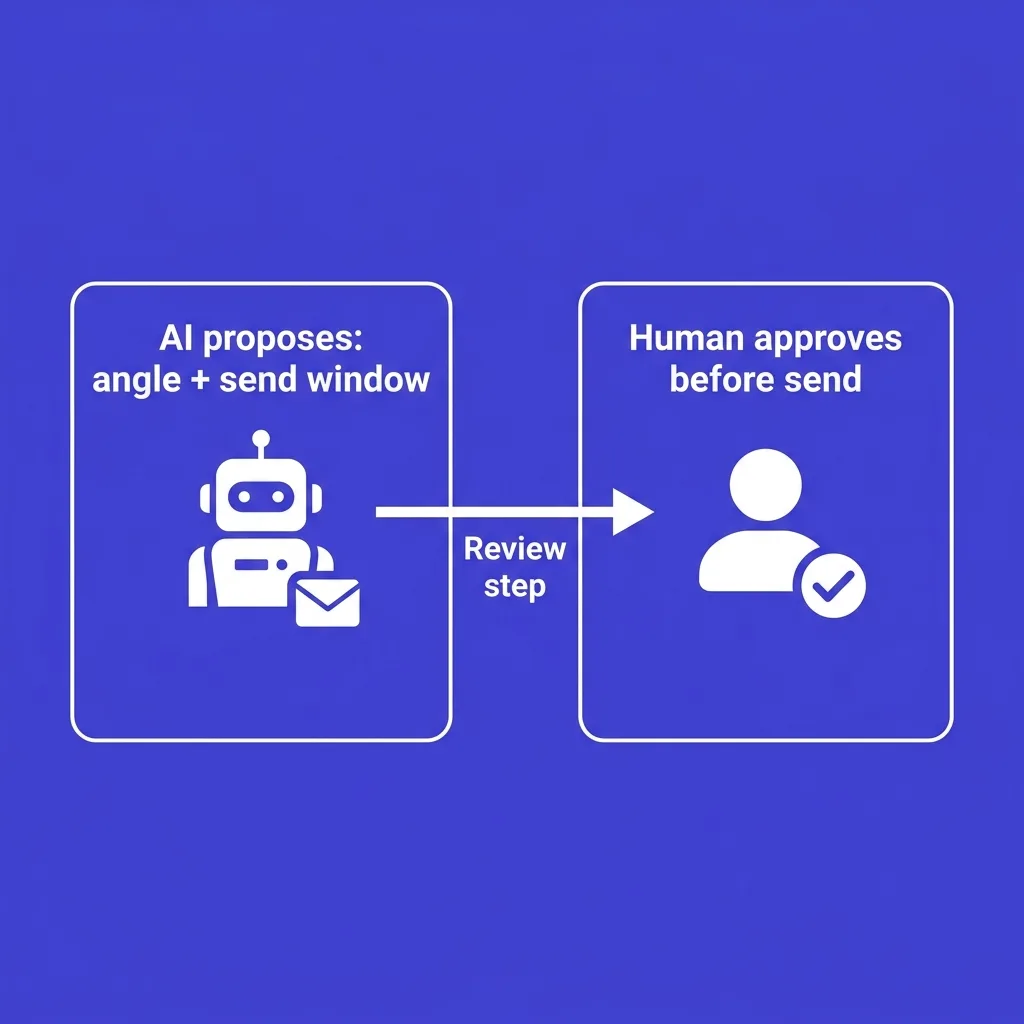
FirstSales builds fiscal-timing context into its AI drafting layer this way: the AI proposes the angle and the send window, a human approves before anything goes to a prospect's inbox. That review step is what keeps a clever timing signal from turning into an embarrassing factual miss.
The broader pattern, AI drafting paired with human approval rather than either extreme, is covered in AI drafts human sends hybrid outbound.
#Multithreading the buying committee across the cycle
A single fiscal-year-timed email to one contact rarely closes a deal on its own, especially at the account sizes where budget planning is formal enough to matter.
Budget requests usually pass through a champion, a finance approver, and sometimes a procurement or legal reviewer, each entering the process at a different stage of the cycle.
The champion needs the business case in the planning window.
Finance needs the proof point in the approval window.
Procurement needs contract and implementation details once budget clears in the early spend window.
Sending the same message to all three at the same time misses this structure entirely, and the fix is multithreading the buying committee, timed to each stakeholder's actual moment in the budget cycle rather than one shot to one inbox.
#Building a fiscal-year outreach calendar
Turning all of this into a repeatable motion means building a calendar, not a one-off campaign.
Start by tagging every account in your target list with a fiscal year start month, using SEC filings, public disclosures, or an enrichment waterfall for the ones you cannot find directly.
Group accounts into cohorts by fiscal year start month, then plan three touchpoints per cohort: one in the planning window, one in the approval window, and one in the early spend window.
Stagger send volume across the twelve cohorts so no single month absorbs the bulk of your outbound capacity.
Review the calendar quarterly, since fiscal years occasionally shift after a merger, an ownership change, or a new CFO who prefers a different close date.
Track reply rate and meeting rate by window, not just by month, so you can see whether the planning-window theory actually holds for your specific market; published averages put cold email reply rates around 3.4 percent overall with top-performing segments reaching 10 to 20 percent, and a well-timed fiscal window email should outperform your untimed baseline by a meaningful margin if the theory is working.
#Measuring whether fiscal-year timing is working
Do not just track whether the email got a reply.
Track cost per meeting and cost per opportunity by timing window, and compare the planning-window cohort against your untimed baseline cohort over a full quarter; see cost per meeting outbound and AI SDR cost per opportunity for the metrics worth watching.
Also track how far into the sales cycle fiscal-timed opportunities travel compared to untimed ones.
A meeting booked during the planning window that later stalls because budget never actually got approved is a different failure mode than a meeting that converts, and separating the two in your funnel reporting, see sales funnel metrics, keeps you from over-crediting a signal that only looks good at the top of the funnel.
If you run a structured qualification framework like MEDDIC or BANT, fiscal-year window is a natural input to the "timeline" or "budget" criterion rather than a separate signal to track in isolation; see MEDDIC sales methodology and BANT sales methodology for how that mapping works.
#Common mistakes when timing outreach to fiscal years
The most common mistake is assuming calendar year for every account without checking, which quietly misfires on a meaningful share of any enterprise or mixed-size list.
The second is treating fiscal-year timing as a replacement for personalization rather than a layer on top of it. A perfectly timed email with generic copy still gets ignored; see custom pain points for what actually needs to be specific.
The third is stopping after one touch in the planning window and going silent until the deal either closes or dies, instead of following up as the account moves into the approval and spend windows; a structured follow-up email strategy should track fiscal stage, not just days since last touch.
The fourth is using stale fiscal-year data without a refresh cycle, since mergers, acquisitions, and leadership changes do sometimes shift a company's fiscal calendar.
The fifth is applying flush-window urgency language to a planning-window email, which reads as confused rather than informed, given the buyer has no budget pressure yet.
#Where fiscal-year timing fits in a broader outbound stack
Fiscal-year timing is one signal among several a mature outbound program should track, alongside hiring, funding, technographic, and intent data.
No single signal, including this one, should be the sole trigger for an account entering a sequence.
The strongest lists combine fiscal timing with at least one confirmed independent signal and score the account accordingly, an approach covered in outbound lead scoring model.
For teams evaluating where a signal-driven platform sits relative to a traditional sales engagement tool, where FirstSales fits in the outbound stack breaks down the difference between a sequencing tool and a research-and-timing layer.
#Key takeaways
- Fiscal year timing is a recurring, calendar-tied buying signal, not a one-time event, and it is distinct from Q4 budget flush.
- Roughly a quarter of large enterprises run a fiscal year that does not match the calendar year, so a January-to-December-only cadence misses a meaningful share of any mixed-size list.
- Public company fiscal years are disclosed in SEC filings and take under a minute to check; private companies need enrichment or a direct question.
- Three windows matter: planning (4 to 5 months before FY start), approval (1 to 2 months before), and early spend (first 60 to 90 days of the new FY).
- Stack fiscal timing with a second signal, hiring, funding, or a role change, for a meaningfully stronger account priority score.
- Keep a human reviewing the fiscal-year assumption before send, since enrichment data on this specific field goes stale more often than most.
Building a fiscal-year-aware cadence by hand across a few hundred accounts is manageable. Across a few thousand, it needs research automation, timing logic, and a review step that does not bottleneck every send.
#Frequently asked questions
#What is a fiscal year buying signal in B2B sales?
A fiscal year buying signal is the recurring pattern where a prospect's budget approval and spending activity clusters around their specific fiscal year, not the calendar year. It matters because reaching a buyer during their planning or early-spend window has a meaningfully higher chance of landing on unallocated budget than reaching them during their final fiscal quarter.
#How do I find a company's fiscal year end date?
For public companies, check the cover page of their most recent 10-K or 10-Q filing on the SEC's EDGAR database, which states the fiscal year end explicitly. For private companies, look at job postings mentioning budget cycles, LinkedIn posts around planning season, or ask directly during a discovery call.
#Is fiscal year timing the same as Q4 budget flush?
No. Budget flush happens in the final weeks of a company's current fiscal year, when a team tries to spend remaining budget before it disappears. Fiscal year planning timing happens months earlier, when budget for the next year is still being requested and shaped, and the two require different messaging.
#When does a company's fiscal year planning actually start?
Most organizations begin drafting department budgets 4 to 5 months before their fiscal year starts, with final approval landing 2 to 4 weeks before the new fiscal year begins. The exact timeline varies by company size and industry, with larger enterprises typically starting earlier.
#What percentage of companies use a non-calendar fiscal year?
A meaningful minority of large enterprises, including major retailers and several large technology companies, run fiscal years that do not match January through December. Retail commonly closes in late January, and several large tech companies close in June or September.
#How does the US federal government's fiscal year affect B2B sales?
The US federal fiscal year runs October 1 through September 30, which means budget requests are usually finalized in the preceding summer and agencies often accelerate spending in July through September to avoid losing unused funds. Vendors selling to government or heavily regulated buyers plan outreach around this specific window rather than the calendar year.
#Should I mention fiscal year timing directly in a cold email?
A brief, specific reference works well, for example noting that similar teams are finalizing next year's budget requests around this time. It signals that you understand how the buyer's process actually works, which reads as informed rather than presumptuous, as long as the timing claim is accurate for that specific account.
#How do I combine fiscal year timing with other buying signals?
Treat fiscal year timing as one input into an account priority score rather than a standalone trigger, and combine it with signals like recent hiring, funding events, or leadership changes. Accounts confirming two or more independent signals convert at a meaningfully higher rate than accounts flagged on a single signal alone.
#What is the best time to email a prospect about a new fiscal year budget?
The strongest window is 4 to 5 months before the prospect's fiscal year starts, while department budgets are still being drafted and a business case can still influence what gets requested. A second strong window is the first 60 to 90 days after the new fiscal year opens, when budget has unlocked but nothing has been committed yet.
#How do I track a prospect's fiscal year in my CRM?
Add fiscal year start month as a required field on the account record, populated through SEC filings for public companies or an enrichment waterfall for private ones. Review the field quarterly, since mergers, acquisitions, and leadership changes occasionally shift a company's fiscal calendar.
#Does fiscal year timing work for small businesses too?
Most small and mid-sized private companies default to a calendar fiscal year, so the signal matters less there than it does for larger enterprises and public companies. It still pays to confirm rather than assume, since some private companies inherit a non-calendar fiscal year from an acquisition, an investor requirement, or an industry norm.
#How is fiscal year timing different from seasonal buying patterns?
Seasonal buying patterns track demand tied to the calendar, like retail spikes before the holidays. Fiscal year timing tracks budget availability tied to a specific company's internal accounting calendar, which can fall in any month and often has nothing to do with external seasonality.
#Can AI tools identify a prospect's fiscal year automatically?
AI research tools can pull fiscal year data from public filings and structured data sources as part of account enrichment, saving significant manual lookup time. A human should still confirm the finding before it drives outreach timing, since the underlying data can be stale or incorrectly parsed.
#What happens if I email a prospect right after budget flush spending?
Emailing immediately after the fiscal year closes usually lands in a low-budget window, since flush spending has just consumed whatever was left and new budget has not been approved yet. It is often better to wait for the new fiscal year to open, or to shift focus to the planning window for the year after.
#How do sales teams typically use MEDDIC or BANT with fiscal timing?
Fiscal year window fits naturally into the timeline and budget criteria of frameworks like MEDDIC or BANT, since both explicitly ask when budget becomes available and whether it has been approved. Adding fiscal calendar data makes qualification calls more accurate than relying on a prospect's self-reported timeline alone.
#Why do enterprise deals often close near a prospect's fiscal year end?
Deals often accelerate near fiscal year end because budget owners face a use-it-or-lose-it deadline on approved spending that has not yet been committed. This is a separate pattern from the planning window described earlier in this article, and both deserve separate tracking in a pipeline.
#How often should I refresh fiscal year data on my accounts?
A quarterly review is usually enough, since fiscal year changes are uncommon outside of mergers, acquisitions, or a change in ownership structure. Flag any account that has gone through a leadership change or acquisition for a manual recheck outside the normal review cycle.
#What is the risk of getting a prospect's fiscal year wrong?
Referencing the wrong fiscal calendar in an email reads as a research failure and can undercut the credibility the timing angle was supposed to build. It is safer to keep the framing general when the fiscal year is unconfirmed, and save the specific date reference for accounts where the data is verified.
#Does fiscal year timing apply outside of enterprise software sales?
Yes. Any B2B category with a formal budget approval process, including hardware, professional services, and agency retainers, follows similar planning and approval windows tied to the buyer's fiscal calendar. The specific windows shift by industry, but the underlying mechanic of unallocated versus committed budget stays the same.
#How does fiscal year timing affect email deliverability if I run several timed campaigns a year?
Spreading sends across twelve fiscal-year cohorts instead of one seasonal push actually helps deliverability by smoothing sending volume over the year rather than spiking it. Sudden volume spikes are one of the patterns mailbox providers watch for, so a steadier, timing-driven cadence tends to be gentler on domain reputation than a single concentrated campaign.