TL;DR: A straight Black Friday discount rarely works the same way in B2B cold email as it does in consumer retail, since most B2B buying decisions run through a budget process a 24-hour sale cannot speed up. Converteo's research on B2B promotions found 82% of B2B decision-makers say incentives positively influence how they perceive a vendor, but the incentive that works is usually tied to budget cycles and onboarding timing, not a blanket percentage-off email blast.
Every November, B2B sales teams borrow a page from retail.
Subject lines start including "Black Friday," "Cyber Monday," or "year-end deal," and a discount code shows up in the first paragraph of a cold email.
Sometimes it works. More often, it reads as a mismatch, since the buyer evaluating a $40,000 annual contract is not making the same kind of snap decision as someone buying a $40 pair of shoes.
The instinct is understandable. Consumer Black Friday campaigns are everywhere in November, and it is tempting to borrow language that already has cultural recognition rather than build a B2B-specific framing from scratch. But that shortcut is exactly what makes the resulting email feel generic to a buyer who spends most of their week evaluating vendor pitches, not holiday sales.
Converteo's research on B2B promotions found that 82% of B2B decision-makers say incentives positively influence their perception of a vendor. That is a real, documented lift.
The same research also found that over 60% of companies do not measure promotional effectiveness at all, and the 40% that do often track metrics too fragmented to drive real decisions.
That gap, between "incentives help" and "most companies cannot actually prove which incentives helped," is where most Black Friday B2B outbound goes wrong. This article breaks down what tends to work, what tends to backfire, and how to build a year-end offer that reads as considered rather than desperate.
If your outbound already runs on non-discount urgency levers most of the year, this is about knowing when the calendar itself gives you a legitimate reason to add a real offer on top of that.
#What you will learn
- Why consumer Black Friday tactics misfire in B2B
- What the data actually shows about B2B incentives
- When a year-end offer genuinely helps
- How to structure a B2B year-end offer
- What to avoid in the subject line and copy
- A safer framework than a straight discount
- How this connects to Q4 budget-flush timing
- Frequently asked questions
#Why consumer Black Friday tactics misfire in B2B {#misfire}
Consumer Black Friday works because the buying decision is fast, personal, and impulse-friendly. A shopper sees a discount, decides in minutes, and completes checkout alone.
B2B decisions rarely work that way. Most deals over a few thousand dollars involve a buying committee, a procurement process, and a budget line that was likely set months earlier.
A 24-hour discount cannot compress a six-week procurement cycle. The buyer who wants the deal still has to get it approved, and an artificial deadline that ignores their actual approval timeline reads as pressure tactics rather than a genuine opportunity.
Multithreading a buying committee usually matters more during a year-end push than any other time of year, since a single champion cannot approve a deal alone on a compressed timeline even if they want the discount.
There is also a trust cost. A steep, unexplained discount can signal that the regular price was inflated in the first place, which undercuts the vendor's credibility with a sophisticated B2B buyer more than it would with a casual consumer shopper.
#What the data actually shows about B2B incentives {#data}
The Converteo research is worth sitting with, since it cuts against the instinct to skip promotions in B2B entirely.
82% of B2B decision-makers reporting a positive perception shift from incentives is a strong number. It says incentives are not inherently wrong for B2B buyers, contrary to what some sales teams assume.
The measurement gap is the more important finding for anyone planning a campaign. Over 60% of companies running promotions cannot actually prove which ones worked, which means most published "our Black Friday campaign was a huge success" claims in B2B marketing are unverified.
That gap explains why so much B2B Black Friday copy feels generic. Teams are copying a tactic they cannot prove works, applied to a template borrowed from retail, without their own data confirming it converts for their specific buyer.
It also explains why the same generic subject lines show up across so many unrelated B2B vendors every November. Without a feedback loop showing which version actually moved reply rate or close rate, teams default to whatever felt closest to what a competitor sent last year, and the tactic spreads by imitation rather than evidence.
The fix is not avoiding incentives. It is designing a specific, trackable offer instead of a copy-paste discount code, and measuring reply rate, meeting rate, and close rate on that specific campaign against a normal month's baseline.
#When a year-end offer genuinely helps {#helps}
A year-end offer tends to work when it aligns with something the buyer's calendar already cares about, not when it invents urgency from nothing.
Q4 budget-flush outbound targets a real phenomenon: budget owners with unspent funds facing a use-it-or-lose-it deadline before their fiscal year closes. A year-end offer timed to that deadline is solving a real problem the buyer already has.
A price-lock offer for the next fiscal year works because it removes a real, predictable risk (next year's price increase) rather than manufacturing a fake one.
An accelerated onboarding slot before year-end works for buyers who want to start using a tool before their internal planning cycle resets in January, giving them a head start that a January signing would not.
A contract-length incentive, such as better terms for signing a two-year deal instead of one, works because it ties the discount to something the vendor genuinely values (retention and predictable revenue) rather than giving away margin for no return.
#How to structure a B2B year-end offer {#structure}
 How to structure a B2B year-end offer {#structure}
Start with what the vendor actually wants to trade, not with an arbitrary percentage off.
A discount tied to contract length gives up margin in exchange for retention. A discount tied to a fast signing date gives up margin in exchange for closing before quarter end. Both are trades, not giveaways.
Set a real, defensible deadline. If the offer expires December 31st because that genuinely aligns with a fiscal year or a Q4 close target, say so plainly. A deadline invented purely for urgency, with no real reason behind it, is easy for a sophisticated buyer to spot.
Keep the offer specific and quantified. "Lock in 2026 pricing before December 31st" is concrete and checkable. "Special year-end savings" is vague and reads as filler.
Apply it selectively, not as a blanket blast. Buying signals for cold email can help identify which accounts are actually in a position to move on a compressed timeline, rather than sending the same offer to a full list regardless of where each account sits in its own budget cycle.
#What to avoid in the subject line and copy {#avoid}
Avoid borrowing retail language wholesale. "Black Friday Sale," "Doorbuster Deal," and "50% Off Everything" signal a mismatch the moment a B2B buyer opens the email, since nothing about an enterprise software purchase resembles a doorbuster.
Avoid inflating the discount to look bigger than it is. A "was $10,000, now $5,000" framing invites the obvious question of why the price was $10,000 in the first place, and a sharp buyer will ask it directly or simply distrust the number.
Avoid stacking urgency language on top of the offer itself. "Only 3 spots left" combined with "48 hours only" combined with "act now" reads as manufactured pressure, and B2B buyers evaluating a real business decision tend to discount (no pun intended) copy that piles on artificial scarcity.
Avoid sending the offer cold to accounts with no prior engagement. A year-end incentive lands better as a follow-up to an account already in conversation than as the opening line of a first-touch cold email, where it reads as a generic mass blast rather than a considered offer.
#A safer framework than a straight discount {#framework}
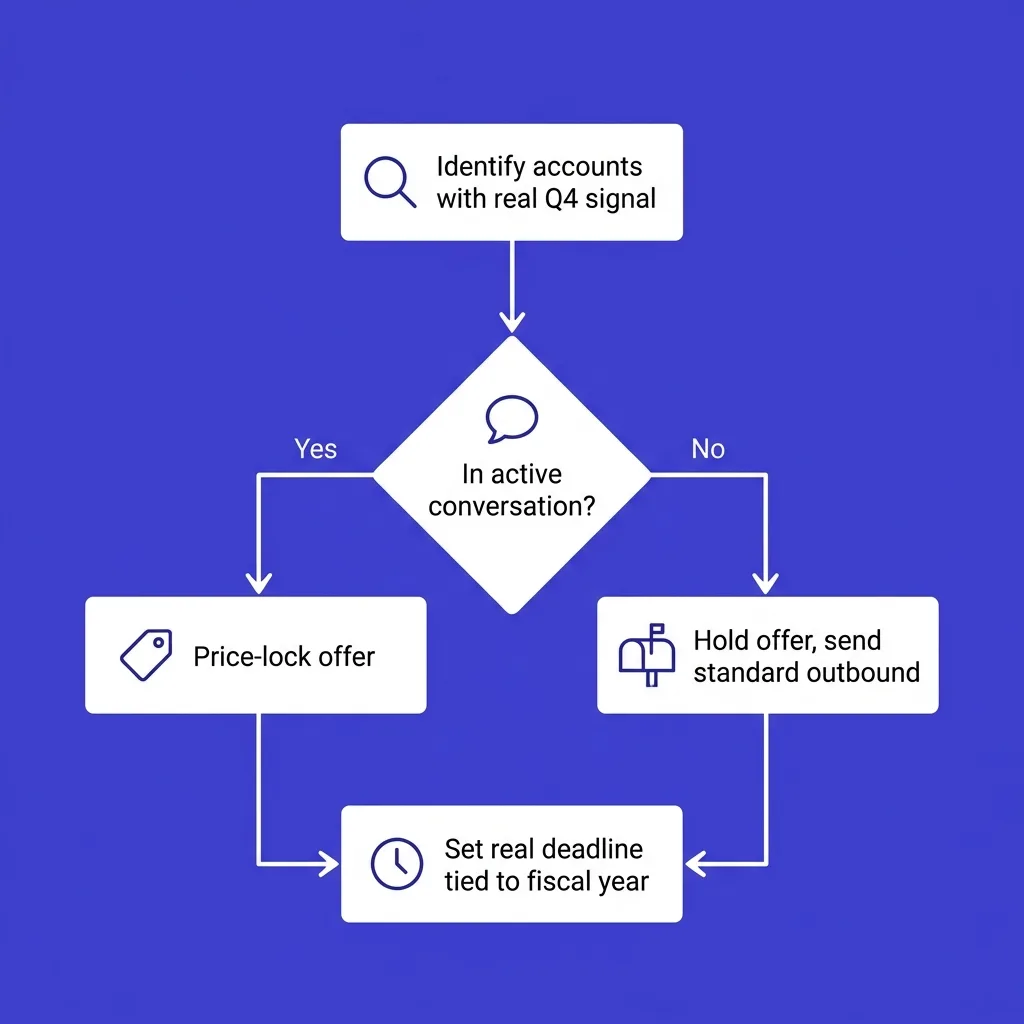
flowchart TD
    A[Identify accounts with real Q4 signal] --> B{In active conversation already?}
    B -->|Yes| C[Offer price-lock or onboarding acceleration]
    B -->|No| D[Send standard outbound, hold the offer]
    C --> E[Set a real deadline tied to fiscal year or budget cycle]
    E --> F[Track reply rate and close rate vs baseline month]
    D --> G[Reassess once account engages]
This framework routes the offer only to accounts already showing real signal or already in an active conversation, rather than blasting it across the full list.
It also builds in measurement from the start, addressing the gap Converteo's research flagged, where most companies never actually confirm whether their promotion worked.
Holding the offer for accounts with no prior engagement avoids the trust cost of a cold, generic discount pitch while still giving the sales team a real lever to use once a conversation is underway.
#How this connects to Q4 budget-flush timing {#connect}
A year-end B2B offer works best layered on top of budget-flush targeting, not as a standalone campaign.
Fiscal-year timing as a buying signal explains why not every account's "year-end" falls in December, since many organizations run on a fiscal calendar that closes in March, June, or September instead.
Sending a "Black Friday" themed offer to an account whose fiscal year ends in June misses the actual budget window entirely, since their use-it-or-lose-it pressure has nothing to do with the calendar November.
This is a segmentation problem before it is a copywriting problem. A list pulled without fiscal year data attached will always default to treating every account as if it runs on a January to December calendar, which quietly misfires on a meaningful share of enterprise and government accounts.
Building a fiscal-year field into the account record, even a rough estimate pulled from public filings or industry norms, lets a single outbound calendar route the right offer to the right account at the right time instead of running one blanket campaign in November and hoping it lands broadly enough to matter.
#A hypothetical comparison: two approaches to the same list {#comparison}
 A hypothetical comparison: two approaches to the same list {#comparison}
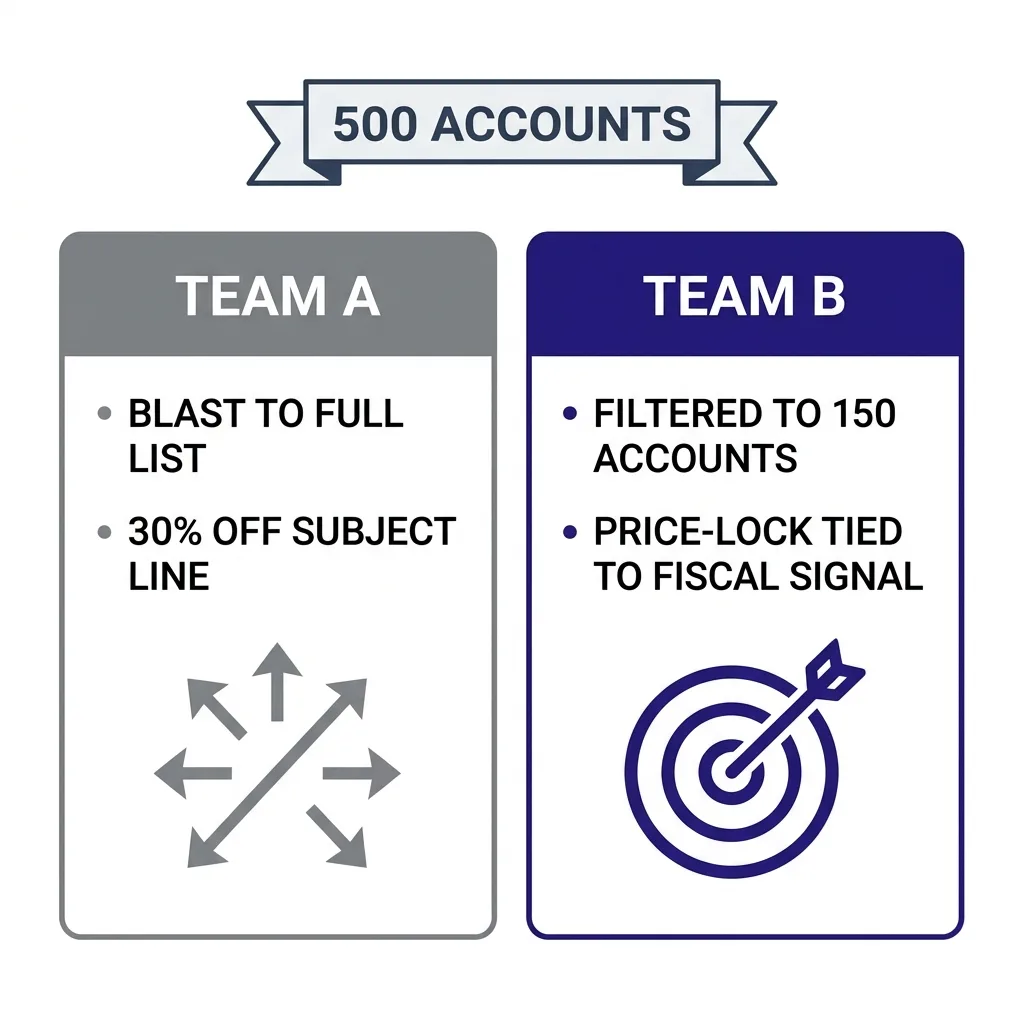
Imagine two teams selling similar mid-market software, both with a list of 500 accounts heading into November.
Team A sends one email to the full list with the subject line "Black Friday deal: 30% off your first year," timed to go out the Monday after Thanksgiving.
Team B first checks which accounts show budget-flush signals or a fiscal year end within the next 90 days, filters the list down to roughly 150 accounts that actually fit that window, and sends each one a message referencing their specific timing along with a price-lock offer rather than a percentage discount.
Team A's email likely gets a respectable open rate, since the subject line is attention-grabbing, but a much smaller share of recipients are in any position to act on a 30% discount that has nothing to do with their actual budget calendar.
Team B's smaller, targeted send reaches fewer people, but every recipient has a real reason the offer might matter to them right now, which tends to produce a higher reply rate and a higher rate of offers that convert into real conversations rather than being ignored as noise.
This is a hypothetical illustration, not a claim about verified results for either approach. It demonstrates why segmentation by real signal, rather than broad reach on a calendar date, tends to be the deciding factor in whether a year-end campaign performs.
The stronger approach maps each account's real fiscal year end, then times the corresponding offer to that account's specific budget deadline rather than a single blanket calendar-year push.
That means a true "Black Friday for B2B" campaign, if it exists at all, is really dozens of smaller campaigns timed to each segment's actual fiscal calendar, layered with the kind of urgency levers in non-discount urgency in B2B rather than one mass discount email sent the week after Thanksgiving.
#What a year-end email sequence should actually look like {#sequence}
A year-end offer works better as the closing beat of an existing sequence than as a standalone blast.
The first touch in November should establish context, not lead with the offer. Referencing the account's likely fiscal year end or a recent trigger event gives the email a reason to exist beyond the calendar date.
Job change triggers and hiring signals are worth checking again in November specifically, since a new budget owner or a growing team often means fresh, unallocated funds heading into year-end.
The middle touches can introduce the specific trade, whether that is a price-lock, an onboarding acceleration slot, or better contract terms, framed as a genuine option rather than a countdown.
The final touch, sent closer to the actual deadline, can restate the real date and what happens after it passes, without resorting to manufactured scarcity language. A calm, factual close ("the current terms are available through December 31st, and standard pricing applies after that") tends to convert better with sophisticated buyers than an artificially urgent one.
Outbound cadence by deal size still applies here. A compressed year-end sequence for a smaller deal can move faster than the same sequence for an enterprise account, where multiple stakeholders still need time to review terms internally.
#Measuring whether the offer actually worked {#measure}
Given how many companies skip measurement entirely, building a simple before-and-after comparison is worth the extra hour it takes.
Pull reply rate, meeting rate, and close rate for the segment receiving the year-end offer, then compare against the same segment's performance in a normal month earlier in the quarter.
Separate accounts that were already in an active sales conversation from accounts that received the offer cold. Blending the two groups hides which effect is doing the work: the offer itself, or the fact that some accounts were already close to a decision regardless.
Track how many deals that closed under the offer would likely have closed anyway on standard terms, based on where they sat in the pipeline before the offer was introduced. This is the honest version of the ROI question most companies skip, according to the Converteo research on measurement gaps.
If the data shows the offer genuinely accelerated deals that would not have closed this quarter otherwise, that is a real, defensible win worth repeating next year with the same structure. If it mostly discounted deals that were closing anyway, the offer gave away margin for no incremental benefit, and that is worth knowing before running it again.
FirstSales customers running a year-end push typically layer the offer onto waterfall enrichment for B2B data to confirm fiscal year and budget signals before the campaign goes out, rather than guessing which accounts are actually in a position to move before their calendar closes.
#Consumer Black Friday tactics vs B2B year-end offers
| Tactic | Works in consumer retail | Works in B2B outbound |
|---|---|---|
| Blanket percentage-off discount code | ✓ drives impulse purchases | ✗ mismatched with committee-based buying |
| 24 to 48 hour countdown urgency | ✓ effective for fast personal decisions | ✗ cannot compress a procurement cycle |
| Price-lock ahead of next year's increase | ✗ rarely relevant to consumer purchases | ✓ removes a real, predictable risk |
| Accelerated onboarding before year-end | ✗ not applicable | ✓ aligns with a buyer's internal planning calendar |
| Contract-length incentive for signing longer terms | ✗ not applicable | ✓ trades margin for retention, a fair exchange |
| Offer sent cold with no prior engagement | ✓ works via broad reach and impulse | ✗ reads as generic and lowers trust |
| Timing tied to the buyer's actual fiscal year end | ✗ not a consumer concept | ✓ aligns with real budget pressure |
#Key takeaways
- 82% of B2B decision-makers report incentives positively shift their view of a vendor, so a well-designed offer is not off-limits in B2B outbound, but a blanket discount blast rarely captures that lift.
- Over 60% of companies never measure whether their promotions actually worked, which explains why so much generic B2B Black Friday copy exists without proof it converts.
- The offers that work most reliably (price-locks, onboarding acceleration, contract-length incentives) trade something the vendor values for something the buyer values, rather than giving away margin for no return.
- Timing the offer to each account's real fiscal year end, not a single calendar-year Black Friday date, captures far more of the genuine year-end urgency than a mass campaign timed to the week after Thanksgiving.
Build the offer around a real trade, target it at accounts already showing signal, and measure the result against a normal month's baseline. That is the version of Black Friday that actually fits how B2B deals close.
The version that fails is the one copied wholesale from consumer retail, sent to a full list with no segmentation, and never measured against what would have closed anyway.
Teams already running structured outbound cadence by deal size and signal-based cold email year-round have most of the infrastructure this needs already in place. A year-end offer is simply one more variable layered onto a system that was already targeting the right accounts at the right time, not a separate campaign bolted on for one month a year.
#Watching deliverability signals during the seasonal push
A year-end offer campaign usually means a short burst of higher volume aimed at a specific account list, sent in a compressed window before the calendar year closes out.
That kind of burst is worth watching closely, since inbox providers weigh sudden volume changes more heavily than steady, predictable sending.
Check bounce rate and spam complaint rate daily while the campaign is active, not just once at the end.
Spam complaint rate threshold explains how quickly a rising complaint rate can affect inbox placement for every email you send afterward, not just the ones tied to the seasonal offer, which makes daily monitoring during this specific window worth the extra few minutes it takes.
Keep the seasonal offer list separate from your always-on cold outbound sending, ideally on its own subdomain, so a spike in one does not put your baseline sending reputation at risk if something about the seasonal list performs worse than expected.
A short, well-monitored campaign that stays inside normal sending thresholds protects the infrastructure you will still be relying on in January, after the seasonal push is long over.
#Frequently asked questions {#faq}
#Do Black Friday discounts work in B2B cold email?
A blanket discount rarely works well, since B2B buying decisions usually run through a multi-person approval process a short-term sale cannot speed up. Offers tied to a real budget deadline or contract trade tend to perform better than a generic percentage-off email.
#What percentage of B2B buyers say incentives influence their decision?
Converteo's research on B2B promotions found 82% of B2B decision-makers say incentives positively influence how they perceive a vendor, indicating incentives can work when designed for the buyer's actual situation.
#Why do most companies not know if their B2B promotions actually worked?
The same research found over 60% of companies do not measure promotional effectiveness at all, and the minority that do often track metrics too fragmented to inform real decisions.
#What kind of year-end offer works better than a straight discount?
Price-lock offers ahead of a price increase, accelerated onboarding before year-end, and contract-length incentives for longer commitments all tend to outperform a generic percentage-off discount, since each trades something specific for something specific.
#Should I send a Black Friday offer to cold prospects with no prior contact?
It generally lands better as a follow-up to accounts already in conversation. A cold, first-touch email leading with a discount tends to read as a generic mass blast rather than a considered offer.
#How do I know which accounts are actually ready to move on a year-end deadline?
Look for accounts already showing buying signals, active engagement in a sequence, or budget-flush indicators tied to their fiscal year end, rather than applying the offer uniformly across the full list.
#Does every company's fiscal year end in December?
No. Many organizations run fiscal years ending in March, June, or September. A campaign built around the calendar-year Black Friday date misses the actual budget window for accounts on a different fiscal cycle.
#What is a price-lock offer and why does it work in B2B?
A price-lock offer guarantees current pricing through the next contract term before a scheduled increase takes effect. It works because it removes a real, predictable cost risk rather than manufacturing artificial urgency.
#Is a countdown timer or "only 3 spots left" message effective in B2B outbound?
These tactics tend to backfire with sophisticated B2B buyers, since they read as manufactured pressure applied to a decision that typically depends on internal approval timelines the sender cannot influence.
#How does multithreading affect a year-end promotional push?
A single champion usually cannot approve a deal alone, even with a compelling offer, so reaching multiple stakeholders on the buying committee matters more during a compressed year-end timeline than during a normal-paced quarter.
#Should the discount percentage be large to make the offer feel worthwhile?
An inflated discount can raise more questions than it answers, since buyers may wonder why the original price was set where it was. A specific, well-justified trade tends to build more trust than a large arbitrary percentage.
#How does a B2B year-end offer relate to Q4 budget-flush timing?
They work best combined. A year-end offer becomes far more effective when targeted at accounts already showing budget-flush signals, since the offer then matches a real deadline the buyer is already facing.
#What metrics should I track to know if a year-end offer worked?
Reply rate, meeting rate, and close rate on the specific campaign, compared against a normal month's baseline for the same segment, gives a real read rather than an assumed one.
#Can a year-end offer hurt my brand's credibility with B2B buyers?
Yes, particularly if the discount looks inflated or the urgency feels manufactured. A specific, well-reasoned offer tied to a real deadline tends to protect credibility better than a generic markdown.
#Is it worth running a year-end promotion if I cannot properly measure the result?
It is worth designing the offer with measurement built in from the start rather than skipping tracking, since the research shows most companies that skip measurement cannot tell whether the campaign helped or simply coincided with deals that would have closed anyway.
#What should the subject line avoid in a B2B year-end outreach email?
Avoid retail-style language like "Black Friday Sale" or "Doorbuster Deal," since it signals a mismatch with the kind of considered, multi-stakeholder decision a B2B buyer is actually making.
#How long should a B2B year-end offer stay open?
The deadline should tie to something real, a fiscal year close, a specific onboarding cohort, or a genuine internal deadline, rather than an arbitrary 24 or 48 hour window borrowed from consumer retail.
#Does contract length matter when structuring a year-end incentive?
Yes. Offering better terms in exchange for a longer contract trades a real, valuable concession (multi-year retention) for the discount, which tends to feel fairer to both sides than a discount given for no return.
#Should sales reps or marketing own the year-end promotion?
Both need to align, since marketing typically owns campaign design and messaging while sales owns the account-level judgment about which accounts are actually ready to respond to a compressed timeline offer.
#What is the single biggest mistake teams make with B2B Black Friday campaigns?
Copying consumer retail urgency tactics wholesale, rather than designing an offer around the buyer's actual budget calendar and the specific trade the vendor is willing to make.