
TL;DR: Reps who wait until January to start booking January meetings start the quarter with an empty calendar and a month of ramp-up before real pipeline activity begins. December, specifically the first three weeks before the holiday dead zone, is when buyers finalize Q1 priorities and calendars are still open. This guide covers how to book meetings for January delivery while sending in December, without pushing for a decision the buyer cannot make until the new year.
#Why December is the best month to book January
Most sales teams treat December as a month to close what is already in motion and treat January as the month to start filling the pipeline back up.
That sequencing wastes December's actual advantage: buyer calendars in December are comparatively open, because most people have cleared major commitments before the holidays and are looking ahead at January with less on their plate than usual.
December is traditionally one of the strongest months in B2B sales, as organizations finalize plans and often find additional budget to spend before the fiscal year closes.
About 75% of companies end their fiscal year on December 31, and decision-makers who were unavailable in the summer come back into Q4 with a specific list of vendors to evaluate before the books close.
That list-making happens in December, which means a rep reaching out in December with a specific, low-pressure ask for a January meeting is catching the buyer at exactly the moment they are organizing their own priorities for the new year.
Waiting until January to make that same ask means competing against every other vendor's January outreach, all landing in the same newly-reopened inbox during the same first-week-back scramble.
See holiday cold email calendar for the exact send-timing windows this strategy operates inside, and Q4 budget-flush outbound for the fiscal-year mechanics behind why December works.
#The mechanics of a future-dated meeting ask
A meeting booked in December for a January date behaves differently from a normal meeting request in one important way: the ask is not for immediate attention, it is for a slot on a calendar that does not fill up as fast in December as it does in a normal busy month.
That lower-friction ask changes the tone of the email itself.
Instead of "do you have 15 minutes this week," the December version asks "would the second week of January work for a quick call to walk through [specific relevant topic]."
That framing removes the immediate-decision pressure that makes cold outreach hard to say yes to during a busy stretch, since the buyer is not committing to anything happening now, only to holding a slot on a calendar that is still mostly empty three or four weeks out.
Calendar tools make this mechanically simple: a scheduling link with January availability open, sent in a December email, lets the buyer book the slot in seconds without a back-and-forth negotiation over timing.
The psychological effect matters as much as the mechanical one.
A buyer asked to commit to something happening today, during a month full of competing priorities, hesitates more than a buyer asked to hold a slot three weeks out, when their calendar genuinely has more room.
| Approach | Competing vendor volume | Buyer calendar pressure | Typical outcome |
|---|---|---|---|
| ✓ Book in December for January | Low, most vendors wait until January | Low, calendar still has open slots | Meeting secured before the January flood starts |
| ✓ Book in December with a specific week named | Low | Low, easy yes/no decision | Higher response rate than an open-ended ask |
| ✗ Wait and send cold outreach in January | High, every vendor runs the same reset play | High, calendar fills fast in week one | Message competes with dozens of similar "happy new year" emails |
| ✗ Send a December ask for a meeting this week | Low volume, but wrong timing | High, December itself is often booked solid | Lower response rate than a future-dated ask |
#What to say in December that lands in January
The message needs to do two things at once: give the buyer a specific reason to want the January conversation, and make clear that nothing is being asked of them right now beyond holding a calendar slot.
A working template: "Wanted to get ahead of the January rush. Worth 20 minutes in the second week to walk through [specific relevant angle for their business] before your Q1 planning locks in?"
That line references the buyer's own Q1 planning process, which is a real thing happening on their calendar regardless of the vendor's outreach, rather than inventing urgency that does not exist.
Referencing a specific angle, not a generic "let's connect," matters more in December than in a normal month, because the buyer is fielding a higher volume of year-end vendor outreach and a vague ask is easy to defer indefinitely.
A second, complementary structure works for accounts already showing a relevant signal: "Saw [specific trigger, hiring, funding, product launch] and wanted to grab time in January before things get busy. Does the week of the 12th work?"
Naming a specific week, rather than leaving the timing fully open, gives the buyer a concrete decision to make (yes, that week, or a counter-offer of a different week) rather than an open-ended "whenever works" that is easy to leave unanswered.
See buying signals for cold email and cold email for b2b sales guide for the signal research and message structure this template builds on.
#Working with fiscal year-end urgency without discounting
 Working with fiscal year-end urgency without discounting
December meeting-booking outreach sits naturally alongside fiscal year-end urgency, since the same budget deadline that makes December a strong sending month also gives the January meeting ask real weight.
The urgency here is the buyer's own calendar and budget cycle, not a vendor-created deadline, which keeps the framing honest.
"Before your Q1 planning locks in" and "ahead of the January rush" both reference something true about how B2B organizations actually operate at year-end, not a manufactured scarcity claim.
That distinction matters because a December meeting-booking email that leans on fake urgency (a countdown, an artificial "only booking three more calls this month" claim) undercuts the credibility of the entire ask.
A buyer who catches one fabricated deadline in a December email will read every subsequent claim from that sender with the same skepticism, including the parts of the pitch that were entirely true.
Stick to what is actually happening on the buyer's calendar, their own fiscal year closing, their own Q1 planning starting, and let that do the persuading instead of manufacturing pressure that was never real.
For the full framework on using real constraints instead of manufactured pressure, see non-discount urgency in B2B, which covers price-lock, capacity, and fiscal-deadline levers that apply the same logic this meeting-booking strategy uses.
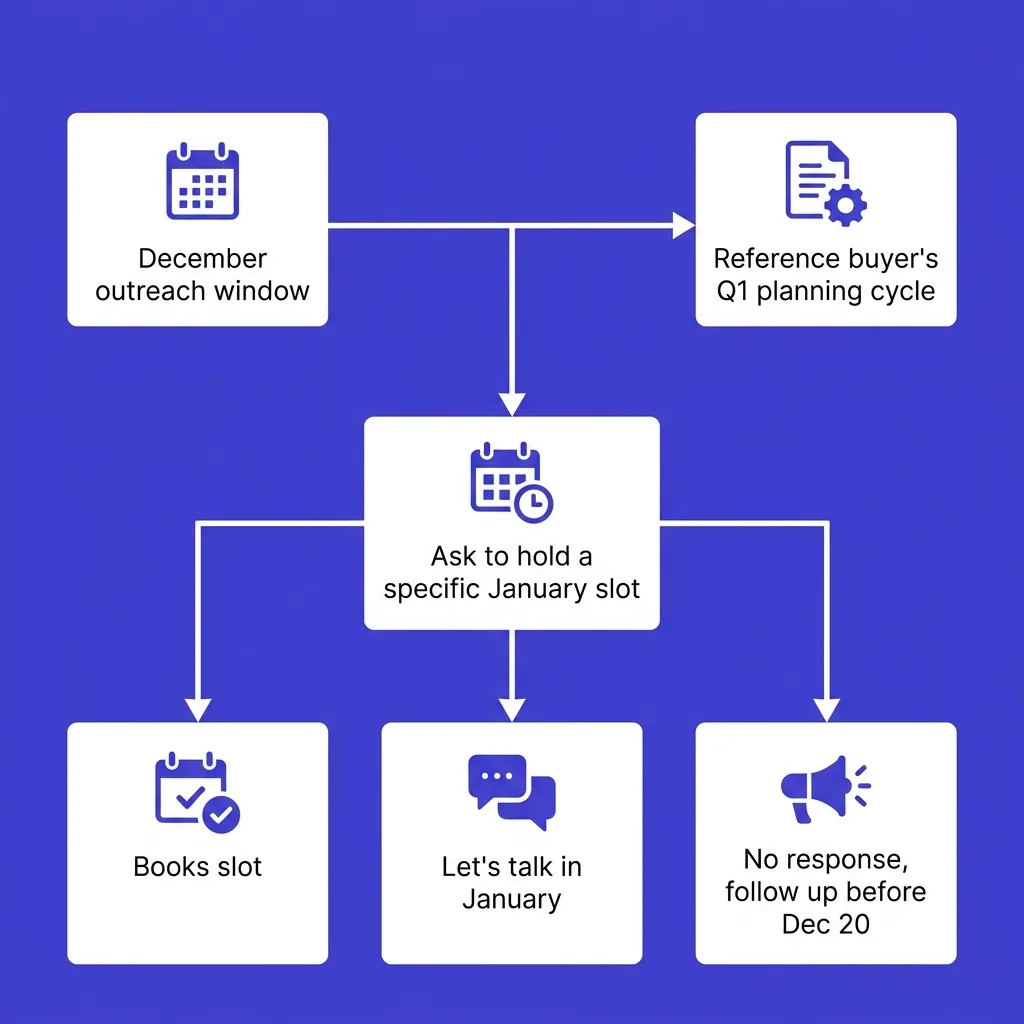
graph TD
    A[December outreach window] --> B[Reference buyer's own Q1 planning cycle]
    B --> C[Ask to hold a specific January slot, not immediate time]
    C --> D{Response type}
    D -->|Books January slot| E[Confirm and send calendar hold]
    D -->|Says 'let's talk in January instead'| F[Get a specific date now, don't leave it open]
    D -->|No response| G[Follow up once before Dec 20 pause]
    E --> H[Meeting happens first two weeks of January]
    F --> H
#The December sending calendar within this strategy
This strategy depends on hitting the right window inside December, not the whole month uniformly.
The first three weeks of December, roughly December 1 through 19, see engagement at or above normal levels, with HubSpot data showing open rates running about 6% higher in the week before December 25 specifically.
That window is when the meeting-booking outreach described in this article should run at full strength, since it captures buyers who are actively organizing their January calendar and have not yet checked out for the holiday break.
December 20 onward falls into the low-engagement dead zone covered in holiday cold email calendar, where open rates drop sharply and a meeting-booking ask is unlikely to get read, let alone acted on.
Sending the meeting-booking sequence in the first three weeks, rather than trying to squeeze it in through December 23, respects both the engagement data and the buyer's actual availability to think about January while they are still paying attention.
A rep who starts this outreach on December 1 has three full weeks to work through a target list before the window closes, which is enough time for a proper sequence with two or three touches rather than a single rushed attempt.
Starting later, say the second week of December, still works but compresses the sequence into fewer touches, which is why building the target list and message templates in November matters as much as the send timing itself.
A rep who waits until December 10 to even start compiling the list has lost roughly a third of the effective window before sending a single email, which is the most common reason this strategy underperforms when teams try it without preparing in advance.
#Handling "let's talk in January" responses correctly
A common response to December outreach is some version of "let's connect once things settle down in January," which sounds like a deferral but is actually an opening if handled correctly.
The mistake most reps make is accepting the vague deferral and moving on, which leaves the meeting unscheduled and dependent on the buyer remembering to follow up once January arrives, during exactly the week when their inbox is most backed up.
The correct response asks for a specific date immediately: "Happy to reconnect then, does the second week of January work, or would the third be better?"
That question turns a vague deferral into a concrete calendar hold, which is the entire point of booking in December rather than waiting.
Most buyers respond well to this directness, since offering two specific weeks rather than an open-ended question actually makes the decision easier for them, not harder.
A buyer who has to invent their own preferred week from scratch is more likely to defer the whole decision than one who simply has to pick between two concrete options already on the table.
If the buyer still will not commit to a specific week, sending a calendar link with open January slots removes the friction of a back-and-forth negotiation and lets them pick a time on their own schedule.
A deferral that never converts into a specific date usually does not convert into a meeting at all, since the buyer's January backlog will bury an unscheduled "let's connect sometime" the moment the new year starts.
#Measuring December's effect on Q1 pipeline
The value of this strategy shows up most clearly in a specific metric: how many meetings are already on the calendar for the first two weeks of January before January 1 arrives.
A team running this strategy well should see a meaningful share of January's first-two-weeks meetings booked before the holiday break, rather than starting January with an empty calendar and no meetings until the second or third week.
Track this number explicitly each year: meetings booked in December for January delivery, compared against meetings booked in January itself for January or February delivery.
A growing share of December-booked meetings year over year signals the strategy is working and worth expanding to more reps and more of the target account list.
The secondary metric worth tracking is show rate on these future-dated meetings, since a meeting booked three or four weeks in advance carries more risk of a no-show or reschedule than one booked for the same week.
A confirmation touch in the first days of January, a day or two before the meeting itself, reduces no-show risk on these future-dated bookings and is worth building into the sequence as a standard step.
See automated meeting booking outbound and cost per meeting outbound for the broader metrics framework this measurement plugs into.
#Why this beats waiting for the January reset
 Why this beats waiting for the January reset
The competing strategy, simply waiting until January and sending a fresh round of outreach once the new year begins, is not a bad strategy on its own.
January genuinely does bring renewed attention and fresh budget, and the holiday cold email calendar shows engagement recovering by the first full working week.
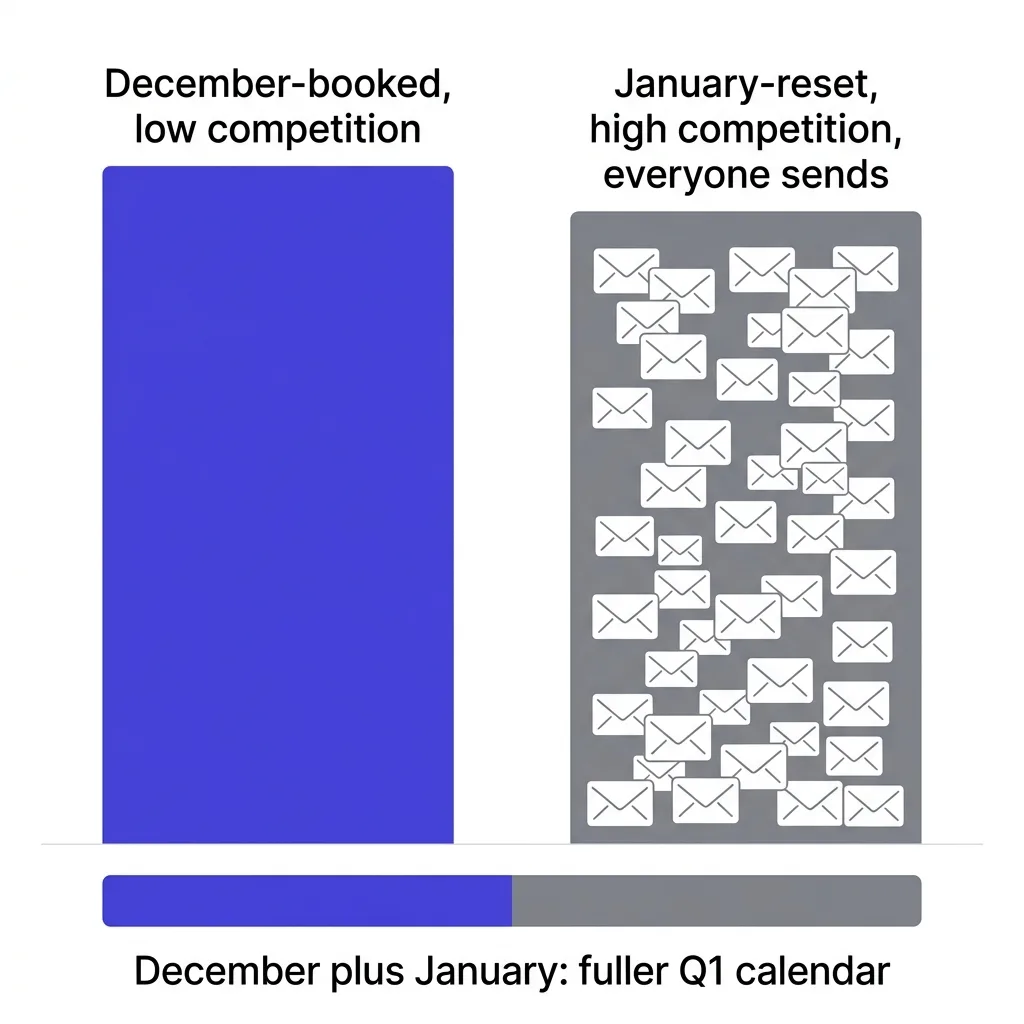
The problem is volume, not quality: every competing vendor runs the same January-reset playbook at the same time, which means a rep starting cold outreach on January 5 is competing against the same flood of "happy new year, let's connect" messages every buyer receives from every vendor trying the identical approach.
A meeting already booked in December has no such competition, because it was secured before the January flood even started.
The rep who books in December is not skipping the January opportunity, they are securing a piece of it in advance, then adding fresh January-sourced meetings on top once the new year's outreach begins.
That combination, December-booked meetings plus January-sourced ones, produces a fuller Q1 calendar than either approach run alone, since the two windows draw on different underlying buyer motivations (year-end planning versus new-year reset) and different competitive dynamics (low competition in December, high competition in January).
Teams that measure both streams separately can see exactly how much each contributes to Q1 pipeline, which makes it easier to justify the extra December effort to a team that might otherwise wait for the more obvious January opportunity.
#Building this into a repeatable quarterly motion
The strategy described in this article is really a specific application of a broader pattern: booking meetings during a lower-competition window for delivery during a higher-competition one.
That pattern repeats at other points in the year too, most notably the September window covered in september re-engagement outbound, where a similar dynamic (buyers reorganizing after a quiet period) creates a comparable opportunity.
Building a repeatable version of the December strategy means having the target list ready before December 1, a message template that references Q1 planning specifically, and calendar links pre-loaded with January availability, so the sequence can launch on the first business day of December without a scramble.
Teams running this through FirstSales can queue the December sequence in advance and have it fire automatically once the calendar window opens, with human review on each draft before it sends, so the timing discipline does not depend on someone remembering to launch the campaign manually on December 1.
Reviewing the prior year's December booking numbers each November, before planning the current year's push, helps calibrate how large a target list is needed to hit a specific January meeting-count goal, rather than guessing at volume each year.
A team that books 40 December meetings from a list of 400 accounts one year has a rough conversion rate to work from the next year, which turns "how big should the target list be" from a guess into a calculation based on the specific January meeting-count goal for that quarter.
That kind of year-over-year calibration is the difference between running this as a one-off experiment and running it as a dependable part of the annual sales calendar that finance and leadership can actually plan around.
#Segmenting the December target list
Not every account on a target list deserves the same December meeting-booking treatment.
Accounts already showing a relevant trigger, a leadership change, a funding round, a hiring surge in a department relevant to the product, should get priority, since a specific trigger gives the outreach a concrete reason to reference beyond the generic Q1-planning framing.
Accounts with no recent trigger but a strong ideal-customer-profile fit still belong on the list, but the message needs to lean more heavily on the fiscal-calendar angle since there is no recent event to point to instead.
A third category, accounts that went quiet earlier in the year without a clear reason, benefits from combining this strategy with the re-engagement approach: reference the prior conversation and offer a specific January slot in the same message, rather than treating it as a purely cold ask.
Ranking the list this way before December 1 lets a rep or team spend the limited three-week window on the accounts most likely to convert, rather than working the list in whatever order it happens to sit in the CRM.
See ideal customer profile and hiring signal outbound for building the trigger-based segmentation this prioritization relies on.
#What happens after the meeting gets booked
A booked meeting for January delivery is not the finish line, and treating it as one leads to avoidable no-shows and cold starts once the call actually happens.
The gap between a December booking and a January meeting, often three to five weeks, is long enough for the original context to go stale in the buyer's mind if there is no touchpoint in between.
A single confirmation email sent two to three days before the meeting, restating the specific topic and time, keeps the meeting anchored in the buyer's calendar and reduces the chance of a no-show caused by a forgotten booking rather than a change of interest.
That confirmation is also a natural place to attach one piece of relevant material, a short case study, a specific data point tied to their industry, so the buyer arrives at the call with some context rather than starting cold despite having agreed to the meeting weeks earlier.
Reps who skip this confirmation step see a measurably higher no-show rate on future-dated meetings than reps who send it, since a booking made three weeks in advance is easier to forget than one made for later the same week.
#FAQ
#Why is December a good time to book January meetings?
Buyer calendars are comparatively open in December because most major year-end commitments have already been handled, and buyers are actively organizing Q1 priorities during this window.
#Doesn't sending in December risk hitting the holiday dead zone?
Only if timed poorly. The first three weeks of December (through roughly December 19) see normal or above-normal engagement; the dead zone starts around December 20.
#What should a December meeting-booking email say?
Reference the buyer's own Q1 planning process, offer a specific week in January rather than an open-ended ask, and avoid manufactured urgency.
#Should I use a calendar link or ask for a preferred time?
Both work, but a calendar link with January availability pre-loaded reduces friction and lets the buyer book without a back-and-forth email exchange.
#How do I handle a buyer who says "let's talk in January" without committing to a date?
Ask immediately for a specific week rather than accepting the vague deferral, since an unscheduled "let's connect sometime" rarely survives the January inbox backlog.
#What if the buyer does not respond to the December outreach at all?
Send one follow-up before December 20, then fold the contact into the standard January cadence rather than continuing to push into the low-engagement holiday window.
#Is this strategy different from standard fiscal year-end urgency messaging?
It is complementary. Year-end urgency messaging pushes toward closing deals now; this strategy books meetings now for delivery later, using the same underlying fiscal-calendar timing.
#How many touches should the December sequence include?
Two to three touches within the first three weeks of December is usually enough, given the shorter effective window before the holiday pause begins.
#Should I offer a discount to get someone to commit to a January meeting?
No. The ask is for a calendar slot, not a purchase decision, so there is no need to introduce pricing pressure into what should be a low-friction scheduling conversation.
#What metric shows whether this strategy is working?
Track the number of meetings already booked for the first two weeks of January before January 1 arrives, and compare it year over year.
#Do future-dated meetings have a higher no-show risk?
Yes, somewhat, since they are booked further in advance. A confirmation touch a day or two before the meeting reduces this risk significantly.
#Does this work for cold accounts, or only warm ones?
Both, though warm accounts (those with prior engagement or a relevant signal) respond at a higher rate than fully cold outreach, similar to any other outbound motion.
#How does this relate to the September re-engagement window?
It follows the same underlying pattern: identify a lower-competition sending window that lands ahead of a higher-competition period, and book for later delivery rather than immediate action.
#Should every rep run this strategy, or just enterprise reps?
It applies at any deal size, though the specific framing (referencing Q1 planning) resonates most with buyers who have a formal annual planning process, which skews toward mid-market and enterprise.
#What happens if a booked January meeting needs to be rescheduled?
Treat it like any other meeting reschedule, but confirm the new date lands within the strong engagement windows covered in the holiday sending calendar rather than sliding it into a low-engagement stretch.
#Can this strategy be automated?
Yes. The target list, message templates, and calendar links can all be prepared in advance and queued to launch automatically on December 1, with human review on individual drafts before sending.
#How far in advance should the target list be built?
Ideally by mid-to-late November, so the sequence can launch on the first business day of December without a scramble to compile the list first.
#Does this strategy still work if a company's fiscal year does not end in December?
The core mechanic (booking during a lower-competition window for a specific future date) still works, but the messaging should reference that company's actual planning cycle instead of a generic December fiscal-year framing.
#Should I send a confirmation email before a future-dated January meeting?
Yes. A confirmation two to three days before the meeting, restating the topic and time, meaningfully reduces no-show risk on bookings made three or more weeks in advance.
#Which accounts should get priority on the December target list?
Accounts with a recent, specific trigger (leadership change, funding, hiring surge) first, followed by strong ICP-fit accounts with no recent trigger, then previously-quiet accounts using a combined re-engagement and booking approach.
#What's the single biggest mistake reps make trying this strategy?
Accepting a vague "let's talk in January" response without pinning down a specific date, which turns a promising deferral into a meeting that never actually gets scheduled.
#Does this strategy replace January outreach entirely?
No. It runs alongside a normal January outreach push, adding a stream of December-secured meetings on top of whatever fresh pipeline January's own outreach generates.
Booking January meetings in December is not about pushing harder in a slow month.
It is about recognizing that December's comparatively open calendars, combined with a buyer's own Q1 planning cycle, create a real window where a specific, low-pressure ask converts better than the same ask made in January's crowded inbox.
Reference the buyer's actual planning process, ask for a specific week rather than an open-ended "let's connect," and get any vague deferral converted into a real date before the conversation ends.
Do that consistently through the first three weeks of December, and January starts with a calendar that already has meetings on it, instead of a month spent rebuilding pipeline from zero.
Layer the December-booked meetings on top of a normal January outreach push rather than treating the two as competing strategies, and Q1 opens with two separate streams of pipeline feeding the same calendar.
That combination is the actual advantage this article describes: not one clever trick, but a small, repeatable scheduling discipline that most competing vendors simply never bother to run.