TL;DR: A job posting is one of the richest free intent signals in outbound sales. It tells you a budget has been approved, a pain point is live, and a decision-maker is actively thinking about the problem you solve - often 60-90 days before they start vendor research. This guide walks through how to read job ads as buying signals, which titles map to which offers, what to say in your first email, and how to build a repeatable hiring-signal cadence that books meetings while your competitors are still blasting static lists.
#Why Job Postings Beat Most Intent Data
Intent data has become a staple of the modern outbound stack. Third-party providers track which companies are researching topics related to your product - reading articles, downloading reports, visiting comparison sites - and surface that activity as a score or signal.
It is useful. But it has a problem: the companies registering intent data activity are often already deep into an evaluation. By the time your platform flags a company as "surging" on a topic, they may already have three vendor demos on the calendar.
You are entering a conversation that started without you.
Job postings work differently. When a company writes a job description and pays to promote it, they are making a visible commitment. The budget conversation with finance has already happened.
Headcount approval has been signed. The company has an acute need, and they are doing something concrete about it.
Research across outbound sales teams consistently shows that hiring signals reveal buying intent 60 to 90 days before companies formally start vendor research. You are not arriving late to an RFP - you are showing up at the moment the pain becomes real.
There is another structural advantage: job postings are free and public. LinkedIn, Indeed, Glassdoor, company careers pages, and tools like the Google Jobs index expose this data without a six-figure intent data contract. Teams that learn to read job ads as buying signals can build a high-precision prospecting engine on a fraction of the budget that traditional intent data requires.
The comparison matters for signal-based cold email in general: the specificity of the signal determines the quality of the message, and the quality of the message determines reply rate. Generic lists produce generic messages. Hiring signals produce specific, timely messages that reference something happening at the prospect's company right now.
#What a Job Post Actually Reveals
The most valuable thing about a job posting is not who the company is hiring. It is what the posting reveals about the company's current state.
Every well-written job description answers several questions you would otherwise have to guess:
Budget has been approved. Hiring is expensive. A mid-level role in a major market might cost $80,000 to $150,000 in salary alone, plus benefits, recruiting fees, and onboarding time. No company posts and promotes a role without going through a budget approval process.
If they are advertising, the money has been allocated.
A pain point is acute enough to require headcount. Companies do not add people speculatively. They add people because existing capacity is failing to handle existing demand. The role tells you exactly which function is under strain.
A decision-maker is personally motivated. The hiring manager on that job posting has a problem to solve. They are spending real time writing job specs, reviewing resumes, and doing interviews. If your product could solve the same problem faster or at lower cost than a full-time hire, that hiring manager is motivated to hear about it.
The tech stack is often visible. Job descriptions routinely list the tools a candidate needs experience with. "Experience with Salesforce, Outreach, and ZoomInfo" tells you what the company already uses. "Experience with HubSpot preferred" tells you they are a HubSpot shop.
"Familiarity with SQL required" tells you their data infrastructure has gaps. Every tool mentioned is a data point about their current setup and the gaps in it.
Growth trajectory is implied. A single role is a data point. Five roles across the same function in six weeks is a trend. When you see a company posting multiple headcount additions in a short window, you are watching a scaling motion in real time - and scaling companies buy more tools, faster.
Knowing how to read these layers of a job ad is what separates teams that use hiring signals intelligently from teams that just filter for "company is hiring" and spray the same generic email.
#The Hiring Signal to Offer Map
The specific role a company posts determines which problem they are trying to solve - and therefore which offer you should lead with. The table below maps common hiring signals to the implied pain and the outreach angle.
| Job Title / Role Posted | What It Signals | Pain to Address | Offer Angle |
|---|---|---|---|
| VP of Sales / CRO | Sales motion is changing or scaling; leadership reset | Pipeline generation, forecast accuracy, rep productivity | "Your new VP will want pipeline on day one - here is how teams ramp fast" |
| SDR / BDR (multiple) | Building or scaling outbound motion | Outbound infrastructure, data, sequencing, training | "Most SDR teams waste the first 90 days on tooling - this removes that" |
| Revenue Operations Manager | GTM ops are breaking at scale | CRM hygiene, attribution, workflow automation | "RevOps hires inherit months of cleanup - we cut that to days" |
| Demand Generation Manager | Inbound is not keeping up; need more top-of-funnel | Ad tech, content syndication, lead gen tools | "Demand gen leaders choose tools in week one - worth a 20-min call?" |
| Director of Customer Success | Churn is rising or customer base is growing fast | CS platforms, health scoring, onboarding automation | "CS directors at your growth stage consistently cite X as their first hire regret" |
| CISO / Security Engineer | Compliance pressure or security incident driving change | Security tools, compliance automation, pen testing | "CISOs joining post-incident have 90 days to show the board a plan" |
| Data Engineer / Analytics Lead | Reporting is broken; decisions are flying blind | Data pipelines, BI tools, data quality | "Data engineers joining new teams spend the first month on technical debt - here is what fixes that fastest" |
| Head of Partnerships | Company is moving toward a channel or ecosystem motion | Partner tech, attribution, co-sell infrastructure | "Heads of Partnerships launching a program need the infrastructure in place before the first partner signs" |
| Marketing Ops / MOps | Marketing stack is fragmented or underperforming | Marketing automation, attribution, CRM integration | "MOps hires inherit broken attribution 80% of the time - we fix that in a week" |
| CFO / Controller | Financial function is maturing; likely Series B or later | Financial planning tools, spend management, ERP | "CFOs joining growing companies are evaluating the financial stack in their first 30 days" |
This table is not exhaustive, but it illustrates the core logic: every role maps to a problem, and every problem maps to an opening for a timely offer. Your job is to connect those dots before your competitors do.
The mapping exercise is also useful for refining your ICP. If you consistently book meetings when a company posts for RevOps roles but rarely when they post for SDRs, that is signal about which hiring trigger actually correlates with closed revenue for you. Track it and tighten your filters.
#Signal-to-Message: What to Say and When
The biggest mistake teams make with hiring signals is treating them as a segmentation variable rather than a message ingredient. They filter their list to "companies currently hiring SDRs" and then send the same email they would send to anyone else. The signal improves targeting but does nothing for the message.
The power of a hiring signal is in the specificity it gives you for the first sentence of your email. That first sentence is the only thing standing between your email and the delete button, and it needs to prove - in under ten words - that this email is not a blast.
Here are three templates that use a hiring signal directly in the opening:
Template 1 - Hiring surge: > "Saw you posted three SDR roles last week - congrats on the growth. Most teams scaling outbound right now hit the same bottleneck in week four: the data is clean, the reps are trained, but the sequences aren't converting. That's usually a personalization problem, not a volume problem.
Worth a 15-minute call to walk through what's working for teams at your stage?"
Template 2 - Leadership hire: > "Noticed you're bringing on a new VP of Sales. In our experience, the first thing new sales leaders do is audit the outbound motion - and the first thing they change is the sequencing stack. If that audit is coming, I'd rather you have the right data going in.
Can I send over a 3-minute breakdown of what companies at your stage typically find?"
Template 3 - Specific role pain:
"Your job posting for a Revenue Operations Manager mentions 'cleaning up the CRM and improving attribution reporting' in the requirements - which usually means the current setup isn't giving leadership the numbers they need. We help RevOps teams fix exactly that without a six-month implementation. Open to a quick call this week?"
Notice what all three do: they reference the specific posting, name the implied pain, and offer something concrete - not "a demo" but a piece of insight, a breakdown, or a framework. The hiring signal turns cold outreach into something that reads like a warm, contextual observation.
For more on crafting signal-driven messages, the buying signals for cold email guide covers the broader framework. And if you want to understand how hiring signals compare to funding rounds as a trigger, the funding round cold email playbook is worth reading alongside this one.
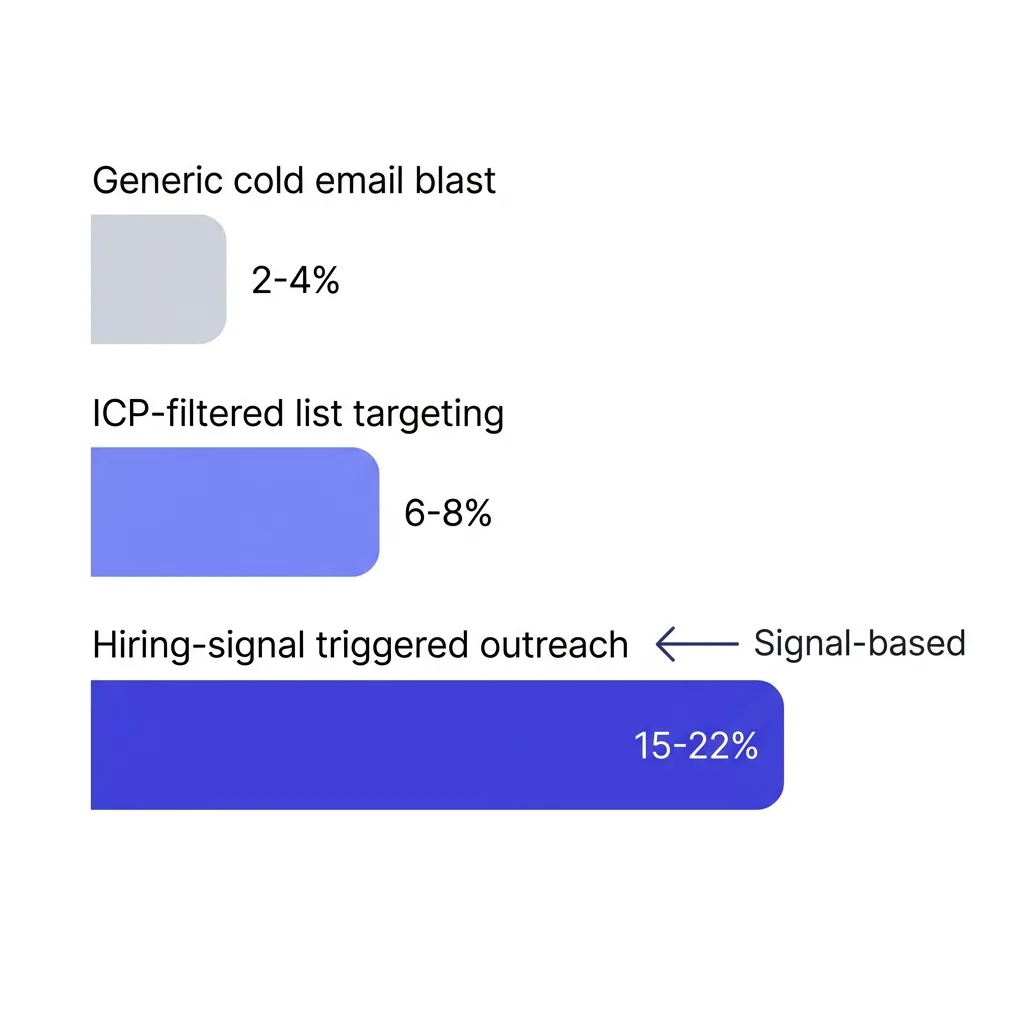 Chart showing reply rate comparison between generic cold email (2-4%), list-filtered targeting (6-8%), and hiring-signal triggered outreach (15-22%)
#The 48-Hour Rule: Why Speed Decides Reply Rate
Hiring signals decay fast. When a company posts a new role, there is a narrow window - typically the first 24 to 48 hours - when the signal is freshest and your outreach is most relevant. After that window, a few things happen:
First, the hiring manager shifts focus from the posting itself to reviewing applications. Their mental bandwidth is consumed by resume stacks, not vendor conversations. Second, other reps find the same posting and start sending their own outreach, so your message competes with three or four similar emails.
Third, the role starts to feel routine rather than urgent - the initial energy of "we're building something new" fades into administrative process.
Research across outbound teams consistently finds that triggered outreach sent within 48 hours of a signal yields roughly 3x higher response rates than the same outreach sent two weeks later. The math is simple: timing is a multiplier on message quality.
This has operational implications. Signal-based outbound cannot run on a weekly list-pull schedule. If you check job postings every Friday and send emails every Monday, you are systematically missing the window.
You need a monitoring process that surfaces new postings daily - ideally in real time - and a workflow that gets emails out within hours, not days.
This is where speed to lead outbound thinking applies to signal-based prospecting. The same urgency that drives fast lead follow-up in inbound should drive fast outreach on outbound signals. The signal is the lead.
Treat it accordingly.
#How to Find Hiring Signals Without Paid Tools
You do not need a $50,000 intent data contract to run hiring-signal outbound. The free and low-cost options cover most use cases well.
LinkedIn Jobs is the most obvious starting point. You can set up saved searches filtered by job title, company size, location, and date posted. LinkedIn also lets you follow target companies and get notified when they post new roles.
The limitation is volume - LinkedIn rate-limits heavy search activity and blocks scraping - but for a focused ICP of a few hundred accounts, manual monitoring is manageable.
Google Jobs surfaces postings from dozens of job boards in a single interface. Search for site:jobs.google.com "SDR" "Series B" or use the Jobs tab in Google Search with specific filters. Google Jobs also has structured data you can monitor via RSS or automation tools like Make or Zapier connected to a Google Sheets trigger.
Company careers pages are the most direct source and often list roles before they appear on aggregators. If your ICP is a defined list of target accounts, you can monitor their careers pages with a tool like Distill.io or a simple change-detection script.
LinkedIn Sales Navigator (paid but widely available) adds velocity tracking - you can see not just that a company is hiring, but how quickly their headcount is growing across specific functions. A company that grew its sales team 30% in the last quarter is in active expansion mode.
Specialized tools like PredictLeads, Crunchbase, and Bombora layer hiring signal data with other firmographic and technographic signals. These are useful when you need volume and want to automate the signal-to-sequence workflow end-to-end.
The workflow that works for most teams starting out: build a target account list, set up LinkedIn Job Alerts for each account, monitor daily, and flag new postings in a shared Slack channel. A single SDR can process 20 to 30 new signals per day this way and get emails out the same morning.
If you are thinking about how hiring signals fit within a broader prospecting framework, the intent-based prospecting vs static lists breakdown covers the full comparison of approaches.
#Building the Trigger Cadence
A single email off a hiring signal is better than a blast, but a structured trigger cadence is better still. The goal is a short, high-precision sequence that references the signal in the opener and builds a coherent narrative across four to five touches.
Here is a cadence structure that works:
Day 1 (Signal fires) - Email 1: Reference the specific job posting. Name the implied pain. Offer a relevant insight or piece of data - not a demo request.
Keep it under 100 words.
Day 3 - Email 2: Share a concrete example. A specific customer story, a stat from your data, or a framework that addresses the pain you named in email 1. One sentence teaser, then "reply if you want the full breakdown."
Day 6 - LinkedIn connection request + message: Short note referencing the same context. "Reached out over email about your SDR hiring push - wanted to connect in case LinkedIn is a better channel for you." Do not pitch in the connection request.
Day 10 - Email 3: Shift the angle. If the first two emails focused on the hiring manager's pain, this one focuses on the downstream risk - what happens if the pain is not solved before the new hire starts, or what typically goes wrong in the first 90 days.
Day 17 - Email 4 (Breakup): Acknowledge the silence, keep the door open, make it easy to respond. "I'll stop sending for now - but if [trigger context] changes and you want to revisit, happy to reconnect."
The four to five touch structure over 17 days respects deliverability (no daily hammering of the same contact) while maintaining enough presence to stay visible through the decision window. It also aligns with the 60 to 90 day buying cycle that hiring signals tend to precede - you are staying in front of the prospect through the period when they are most likely to start vendor evaluation.
Keep the sending volume per inbox in the safe range. The spec-driven rules of 2026 are clear: 20 to 30 emails per day per warmed inbox is the ceiling for most sending infrastructure. If you are monitoring a list of 200 accounts and each fires a signal every few weeks, that is manageable volume with two or three sending domains.
If you are running signals across 2,000 accounts, you need a properly configured multi-inbox infrastructure. The signal-based cold email framework covers how to connect the signal layer to the infrastructure layer without burning domains.
#Mistakes That Kill Hiring-Signal Campaigns
Most teams that try hiring-signal outbound see mediocre results at first - not because the approach does not work, but because they make one of four common mistakes.
Mistake 1: Referencing the signal too literally. "I saw you posted a job for an SDR on LinkedIn" reads like surveillance. Prospects find it slightly unsettling, and it sets the wrong tone. The better approach is to reference the implied context rather than the posting itself: "Looks like you're scaling your outbound team" or "Sounds like you're building out the sales motion at [Company]."
Same signal, less creepy framing.
Mistake 2: Leading with the product instead of the pain. "We help companies like yours with outbound sales software" does not become interesting just because a hiring signal justified sending it. The signal only earns you a better first sentence - you still have to use that sentence to show you understand the pain, not to introduce your product.
Mistake 3: Over-segmenting without enough volume. Some teams build such narrow trigger criteria ("company must be between 50 and 200 employees, Series A only, posting for a VP of Sales with exactly five years of experience required in the job spec") that they fire three emails a month. Signal-based outbound needs enough volume to generate learnings. Broaden the signal criteria and use the messaging to do the filtering.
Mistake 4: Ignoring the wrong signals. Not every hiring signal is bullish. A company posting a lot of support roles while simultaneously posting for a Customer Success Director might be dealing with a churn problem, not a growth story. A company posting for a CFO at Series Seed might be burning cash faster than planned.
Reading the context of who is being hired - not just what function - matters for tone and relevance.
For a related look at what happens when prospecting goes wrong from the deliverability side, the job change trigger email piece covers the analogous timing window for executive changes, which often fire alongside hiring surges.
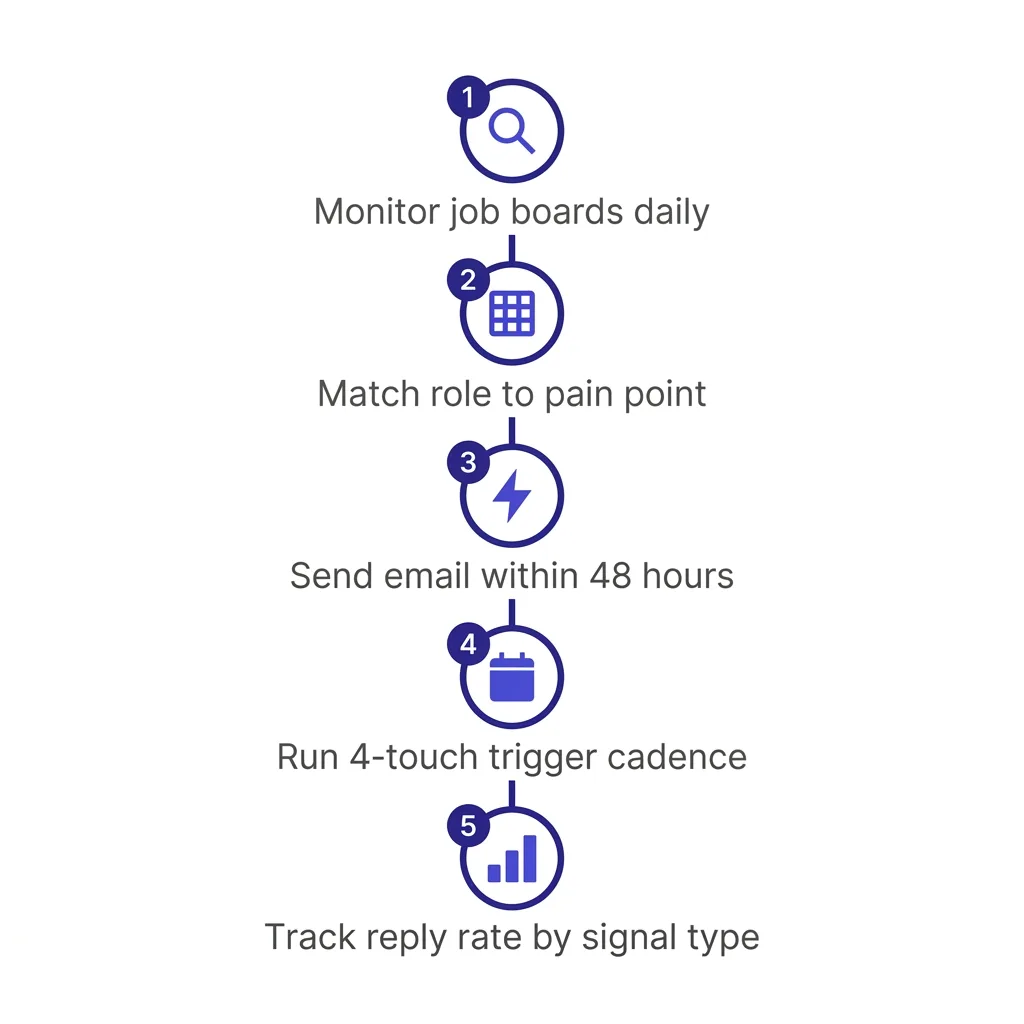 Infographic showing a 5-step hiring signal workflow: Monitor job boards daily, identify role-to-pain mapping, draft trigger email within 48 hours, build 4-touch cadence, track reply rate by signal type
#Measuring Hiring-Signal Outbound
Any signal-based program lives and dies by measurement. The metrics that matter are slightly different from those in a standard outbound program.
Signal-to-send latency: How quickly does your team get an email out after a signal fires? Target under 48 hours. If your average is 5 days, the timing advantage of the signal is largely wasted.
Track this weekly and set a hard threshold.
Reply rate by signal type: Not all hiring signals are equal for your offer. You might see 18% reply rates when you trigger off VP of Sales postings but only 6% when you trigger off CTO postings - even if the CTO hire is logically relevant. Track reply rates by role category and prune the low-performers from your trigger list.
Reply rate by job posting age: Segment your sends by whether the posting was 0-2 days old, 3-7 days old, or 8-14 days old when you sent. The decay curve will become visible quickly. This data justifies investing in real-time signal monitoring rather than weekly list pulls.
Meeting rate by signal type: Reply rate is a leading indicator; meeting rate is what matters for pipeline. Some signal types generate curious replies that do not convert to calls. Others generate fewer replies but almost every one books.
Know which is which.
Pipeline sourced by signal: At the account level, flag whether the initial outreach was signal-triggered. After six months, you will have enough data to compare ACV, cycle length, and win rate for signal-sourced pipeline versus non-signal pipeline. Most teams find signal-sourced deals close faster because the prospect was already in a buying motion.
FirstSales's AI SDR software makes it straightforward to connect signal data to sequence triggers and track these metrics per campaign. If you are running hiring-signal outbound manually today, those metrics still apply - you just need a spreadsheet and discipline to track them.
#Stacking Signals for Higher Precision
Hiring signals are powerful on their own. They become genuinely exceptional when you stack them with one or two other signals that confirm the same underlying momentum.
Hiring + funding: A company that received a Series B three months ago and is now posting aggressively for go-to-market roles is in active investment mode. The funding gave them the budget; the hiring is how they are deploying it. Funding rounds are a well-documented outbound trigger in their own right, and when they precede a hiring surge, the confidence level on timing is high.
Hiring + technology change: If a company is posting for "Salesforce admins" and you sell a Salesforce-native tool, the signal is obvious. If they are posting for "HubSpot specialists" and you sell a competing or complementary CRM, the signal tells you they are actively building on that platform. Tech stack signals and hiring signals together give you a much tighter picture.
Hiring + leadership change: A new VP of Sales who arrives at a company that is simultaneously posting for SDRs is in a particular kind of pain - they have inherited both a hiring mandate and an infrastructure gap. They need tools fast, because their credibility depends on showing results before the next board meeting. The job change trigger email playbook covers this scenario in depth, and combining it with a hiring signal makes for some of the highest-converting outreach in the playbook.
Hiring + headcount velocity: A single SDR posting is a data point. Six SDR postings over three weeks is a trend. Tools that track hiring velocity - the rate at which a company adds postings in a given function - let you catch companies that are mid-ramp rather than just starting.
Mid-ramp companies are often in the market for infrastructure to support the people they are already hiring, which creates an urgent buying window.
Stacking signals requires more data infrastructure than single-signal monitoring, but the lift in reply rates and pipeline quality is significant. Teams running three-signal stacks consistently see 20 to 25% reply rates on triggered outreach, compared to 15 to 18% on single-signal and 2 to 4% on non-triggered. The incremental effort pays for itself quickly.
The broader context for this kind of precision prospecting is covered in the intent-based prospecting vs static lists guide, which explains why the shift to signal-based ICP selection is structural rather than tactical.
#FAQs
#What is a hiring signal in outbound sales?
A hiring signal is an observable event - typically a new job posting - that indicates a company has an approved budget, an acute pain point, and a decision-maker actively working on that problem. In outbound sales, hiring signals are used as timing triggers to reach prospects at the moment they are most likely to be receptive to a relevant offer. The key advantage over static lists is that the signal confirms momentum rather than just firmographic fit.
#How do I find hiring signals for free?
LinkedIn Jobs, Google Jobs, and individual company careers pages are the three most accessible free sources. Set up job alerts on LinkedIn for target roles within your ICP, use Google Jobs search with date filters to surface recent postings, and use a site change-monitoring tool like Distill.io to watch careers pages for accounts you are actively targeting. Most early-stage teams can build a solid hiring-signal workflow from these free tools before investing in paid signal providers.
#How quickly should I reach out after a hiring signal?
Within 48 hours is the target. Research consistently shows that triggered outreach sent in the first 48 hours after a signal fires yields approximately 3 times higher response rates than outreach sent two weeks later. The hiring manager's mindset is freshest immediately after posting - they have just articulated the problem they need to solve, and a relevant message in that moment feels timely rather than cold.
#What should my first email say when triggered by a hiring signal?
Reference the implied context of the posting rather than the posting itself. Lead with the pain the hire is supposed to solve, not with your product. "Looks like you're scaling the outbound function - most teams hitting your stage find the bottleneck shows up in [specific problem area]" is more effective than "I saw you posted an SDR role and wanted to reach out."
The goal of the first email is to prove you understand their situation, not to sell them anything.
#Which job titles are the strongest hiring signals for my outbound?
That depends on your offer, and the only way to know for certain is to track reply rates and pipeline by signal type. As a general rule, signals closest to the buying decision for your product are strongest: if you sell outbound software, SDR and RevOps hires are high-signal; if you sell HR tech, CHRO and People Operations hires are high-signal. The hiring signal to offer map table in this article gives a starting framework to test against.
#Can I automate hiring-signal outbound entirely?
Partial automation is the right model in 2026. Monitoring job postings and routing them into a CRM or outreach tool can be fully automated. The actual message - especially the first email - should have a human review step before sending.
Fully automated hiring-signal outreach tends to produce generic trigger messages that lose the specificity advantage of the signal in the first place. The intent-based prospecting vs static lists guide covers where automation helps and where it hurts in signal-based programs.
#Conclusion
Hiring signals represent one of the few remaining free advantages in outbound sales. While most teams are competing on the same static lists with the same sequencing tools and the same generic personalization tokens, a prospect who has just posted a job is broadcasting their pain publicly - budget approved, problem confirmed, urgency real.
Reading that signal correctly, matching it to your offer, and getting a relevant message out within 48 hours is not a tactical trick. It is a fundamentally different prospecting model - one that aligns your outreach with the moments when companies are actually ready to buy rather than the moments when your CRM says you should follow up.
The teams winning in outbound right now are not the ones sending the most emails. They are the ones sending the right email at the right moment, to a prospect who feels like the message was written specifically for them. Hiring signals give you that moment.
Start with your top 50 target accounts. Set up job alerts for each. Monitor daily.
When a relevant role fires, get a message out that day. Track what works. Tighten the signal criteria.
Build the cadence. The compounding effect of a well-run hiring-signal program shows up in your pipeline within 60 days.
Start your first hiring-signal campaign on FirstSales for $1 - your first triggered sequence can be running before the end of the week.