
**TL;DR: Fully autonomous AI outbound fails 70% of the time within a year. Pure human outbound cannot compete on scale. The hybrid model - where AI handles research and drafting while a human reviews, personalizes, and sends - delivers 200-400% ROI and protects your sender reputation at the same time.
This article breaks down exactly where the human checkpoint goes, what it should catch, and how to wire the whole workflow together.**
#Why Both Extremes Are Broken
Here is the situation most sales teams find themselves in by mid-2026: the fully autonomous AI SDR they bought or built last year is either sitting underused, burning through their domain reputation quietly in the background, or both. On the other side, the teams that stuck with pure manual outbound are getting outpaced on volume by competitors who figured out how to use AI without letting it run wild.
Both extremes have a fatal flaw, and understanding each one specifically is the starting point for building something better.
Fully autonomous outbound removes the human from a process that, at its core, requires human judgment. Prospects are not API endpoints. They are people with specific contexts, timely concerns, and a finely tuned radar for detecting when they are being processed by a bot.
Research from 2025-2026 found that 70% of AI SDR deployments fail within a year - not because the technology is useless, but because it was deployed without supervision. Unsupervised systems hallucinate facts, reference outdated company information, misread prospect seniority, and quietly torch your sender reputation before anyone notices the metrics slipping.
The problem with unsupervised AI outbound is not just reply rates. It is relationship capital. A VP of Sales who receives a sequence of six obviously automated emails referencing a company detail that is two years out of date does not just ignore them - they form a negative brand impression that survives well past their next vendor evaluation.
When that same VP enters a real sales conversation six months later, they remember. You cannot measure that cost in a dashboard.
The other extreme - human SDRs doing everything manually from list research to first draft to send - is simply not competitive at scale. A single SDR might send 30 to 50 well-crafted emails per day. That ceiling is not going to move without structural change.
Meanwhile, a hybrid setup with the right AI tools lets that same SDR review and send 150 to 300 emails daily, spending their actual cognitive effort on the moments where judgment matters rather than the moments where pattern-matching and data retrieval are sufficient.
The math on manual outbound compounds badly over time. If your competitor is running a well-structured hybrid model at five times your volume, they are filling the top of their pipeline faster, learning from more data faster, and optimizing their sequences faster. Pure manual outbound is not a quality advantage anymore - it is a volume disadvantage.
The answer sitting between these two broken extremes is human-in-the-loop cold email: a workflow architecture where AI handles the repeatable, data-heavy work and a human sits at every checkpoint where getting it wrong is expensive to fix.
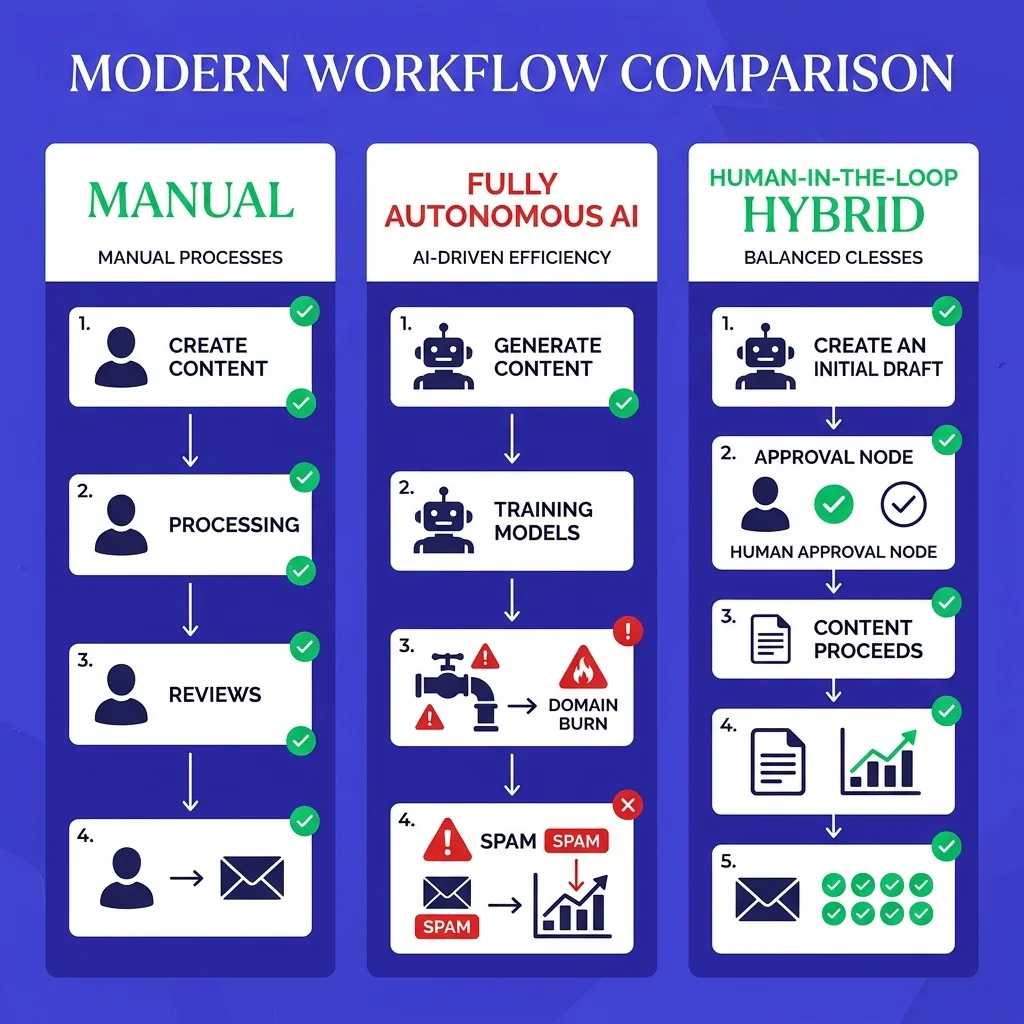 AI vs manual vs hybrid outbound comparison diagram
#What "Human-in-the-Loop" Actually Means in Cold Email
The phrase "human-in-the-loop" comes from machine learning, where it describes systems that route uncertain cases to human reviewers before acting. In cold email, the concept is the same but the stakes are different. You are not just managing model accuracy - you are managing your sender reputation, your prospect relationships, and your brand.
In a cold email context, human-in-the-loop means one specific thing: no email leaves your account without a person reading it first.
That sounds simple. It is deceptively hard to maintain when you are under pressure to hit volume targets. The temptation is always to flip a setting and let the AI send autonomously "just for the boring follow-ups" or "just for the lower-priority segments."
That is exactly where things fall apart. Domain burn accelerates, spam complaint rates creep past Google's 0.10% threshold, and by the time you notice, you have a deliverability problem that takes months to fix.
Human-in-the-loop is also not just about sending. It shows up at three distinct points in the workflow, and each one serves a different purpose:
At targeting: A human reviews the list before any drafting begins. This catches ICP mismatches, duplicate contacts, accounts that are current customers, and lists built on stale data. Catching a bad list at this stage costs zero.
Catching it after you have sent a thousand emails costs your domain health.
At message approval: A human reads every draft before it is sent. This catches hallucinated facts, tone problems, sensitivity issues, and CRM context errors that the AI does not have visibility into.
At reply handling: A human reviews the AI's suggested responses to inbound replies before those responses are sent. This keeps active conversations human-led from the moment a prospect engages.
Human-in-the-loop does not mean humans do all the work. AI agents now handle roughly 80% of the research, sequencing, and draft generation work in the most efficient outbound teams. What it means is that humans own the send decision on every email that matters, and they sit at every point in the process where a mistake is hard to reverse.
This model pairs well with the broader shift described in the AI drafts, human sends hybrid outbound approach, where the division of labor between machine and person is explicit, documented, and enforced in the workflow rather than left to individual discretion.
#The Four-Stage Hybrid Workflow
Before getting into each stage, here is the full workflow at a glance. The human checkpoints are marked clearly so you can see exactly where the review layer fits.
[AI Research] -> [AI Draft] -> [Human Review + Edit] -> [Human Send] -> [AI Monitor] -> [Human Reply Handling]
Four stages. Two are fully AI-owned. One is fully human-owned.
One is split. That split - reply handling - is where most teams make their biggest mistake, and we will come to it.
#Stage 1: AI-Powered Research and List Building
The first place AI belongs in your outbound workflow is research. This is where automation saves the most time with the least risk - because nothing is sent yet and no decisions are irreversible.
In this stage, the AI agent is doing the work your SDR used to spend two to three hours a day on: pulling company data, identifying the right contacts, surfacing buying signals, and building the list that will feed the drafting stage. For an SDR spending two hours per day on research for 30 emails, that is roughly four minutes of research per contact. An AI research agent can do the equivalent work in seconds per contact, at scale, without quality degradation from fatigue.
Good AI research at this stage includes:
- Identifying companies that match your ICP based on firmographic criteria (headcount, revenue band, tech stack, geography)
- Flagging recent trigger events - funding rounds, new executive hires, job postings that suggest a budget category you sell into, or leadership changes in the past 30 to 90 days
- Pulling the correct contact for each account (job title, LinkedIn profile, direct email) with real-time verification
- Annotating each contact with a signal summary - one to three sentences that explain why this person, at this company, right now
That signal summary becomes the input for the drafting stage. It is the raw material that makes personalization possible without requiring a human to do the research themselves. The quality of the signal summary directly determines the quality of the AI-generated draft - garbage in, generic draft out.
One important constraint: AI research is only as good as the data sources feeding it. If your enrichment provider is returning stale contact data, the AI will confidently draft emails to the wrong person, referencing outdated context. This is not a hypothetical - 62% of AI SDR failures trace directly back to data accuracy problems.
Email verification before your list goes anywhere near a sending queue is non-negotiable in 2026.
A single bad-data batch sending at volume will do more damage to your domain health than a month of conservative sends can recover.
Trigger-based signals deserve special attention here. An AI that can identify a company that posted three engineering job listings in the past two weeks, just announced a Series B, and brought in a new VP of Revenue in the past 60 days is surfacing a meaningfully different prospect than one that matches your ICP on firmographics alone. Those timing signals are what separates a relevant cold email from one that arrives at the wrong moment and gets deleted.
This stage should output a structured list: contact, company, verified email, signal summary, and ICP fit score. That list is what the human reviews before drafting begins - a quick sanity check on targeting quality before any cycles are spent on message writing. The human review at this stage should take ten to fifteen minutes for a list of 50 to 100 contacts, and it pays off by preventing the worst targeting mistakes from ever reaching the drafting queue.
#Stage 2: AI Drafting - What to Let the Machine Write
With a verified, signal-annotated list in hand, the AI drafting stage can produce first drafts that actually reference something real and timely about the prospect. This is the version of AI cold email that works - not mass-blasted generic sequences, but structured drafts built on specific inputs.
What AI handles well in the drafting stage:
- Opening lines that reference the signal summary (the funding round, the job posting, the executive hire)
- Mapping that signal to a pain point your product solves
- Writing a clear value proposition paragraph in your brand voice
- Generating a soft CTA that asks for a specific, low-friction next step
- Creating subject line variations for A/B testing
What AI does not handle well on its own:
- Tone calibration for a specific account or executive relationship
- Knowing when a prospect has already been contacted by your team (CRM context that is not always surfaced correctly)
- Catching hallucinated facts - incorrect product claims, wrong company details, outdated pricing references
- Judging whether a particular signal is too sensitive to reference (a company layoff, a failed funding round, a recent negative press mention)
That second list is exactly what the human review stage is for.
The goal in this stage is speed and coverage. AI can draft 200 emails in the time a human would write five. The constraint is quality, which is why every draft moves to review before it moves to send.
If you want to understand how this compares to the older model of full AI autonomy, the difference between AI workers and AI copilots is useful framing - the copilot model is what actually works in outbound.
#Stage 3: Human Review - The Checkpoint That Saves Everything
This is the most important part of the hybrid model. It is also the stage that is most often cut when teams feel pressure to move faster. Do not cut it.
The human reviewer in this stage is not rewriting every email from scratch. They are doing a fast, structured quality check on each draft before approving it for send. A skilled reviewer can process 30 to 50 emails per hour with this approach - significantly faster than writing them from scratch, but with enough scrutiny to catch the failure modes that autonomous systems miss.
Here is what the review checklist looks like in practice:
Fact check: Is every claim in this email accurate? Is the signal reference real and current? Is the company name, product category, or role description correct?
Tone check: Does this sound like a human wrote it to another human? Does it avoid the AI-tell phrases that prospects now recognize on sight - things like "I hope this finds you well," "I wanted to reach out," or any variation of "I came across your profile and was impressed"?
Sensitivity check: Is the signal reference appropriate? Referencing a layoff announcement as a buying trigger is a fast way to get marked as spam and remembered negatively. A human catches this.
An AI probably does not.
Relationship check: Has this person already been in a sequence? Are they a former customer, a current customer at a different product tier, or someone your AE is already working? CRM hygiene errors surface here.
CTA check: Is the ask specific, low-friction, and clear? "Would you be open to a 15-minute call this week or next?" is different from "Let me know if you'd like to learn more" - one creates a decision point, the other creates ambiguity.
After review, the human either approves the email as-is, makes a quick edit and approves, or rejects it and flags the reason (which feeds back into improving the AI prompts over time). Approved emails move to send. Rejected emails go back to the AI drafting queue with the reviewer's notes attached.
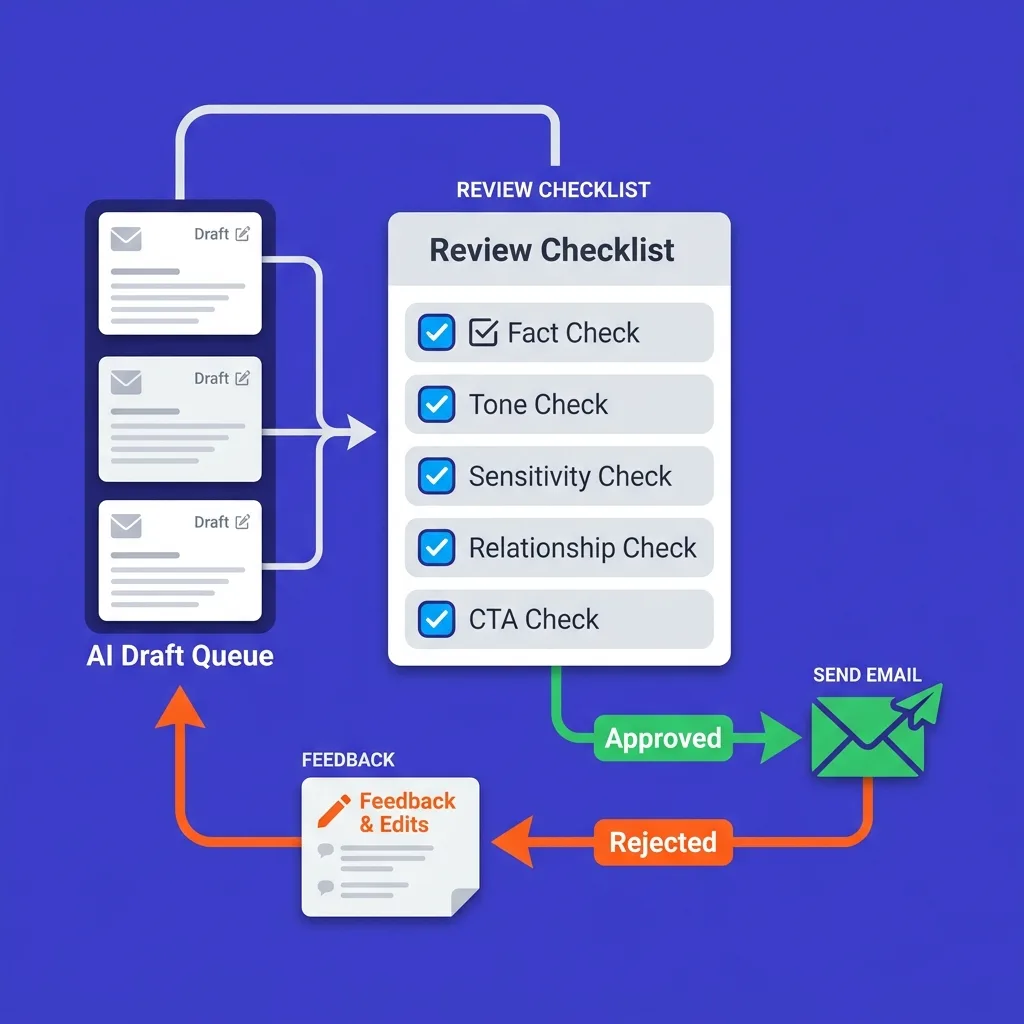 Human review workflow checkpoint diagram showing email queue, review criteria, and approve/reject flow
This review layer is what separates AI-assisted SDRs from fully autonomous AI SDRs. The assisted model keeps the human in the decision seat on every outbound touch. The autonomous model removes them.
The performance gap between the two is measurable - and it shows up in reply rates, deliverability, and prospect relationship quality.
#Stage 4: Reply Handling - Splitting the Handoff
Reply handling is where most hybrid workflows get the split wrong. The instinct is to automate reply handling the same way you automated drafting - have the AI classify inbound replies and generate responses, then send them without review. This is a mistake for a specific reason: replies are conversations, not cold outreach.
When a prospect replies to your first email, the relationship is live. They have made a decision to engage. How you handle that moment determines whether it becomes a booked meeting or a dead thread.
That decision requires context that AI systems frequently lack: the tone of the reply, what is between the lines, whether the prospect is genuinely interested or just asking you to stop emailing them politely, and whether there is a subtext that changes how you should respond.
Consider the reply: "Interesting timing - we're actually evaluating a few options right now." To a human, that is a clear buying signal that warrants an immediate, specific, personalized response that moves toward a meeting. To an AI without proper context, it might get classified as "neutral interest" and receive a generic follow-up template.
That gap in reading the room is exactly why this stage needs human judgment.
The right split for reply handling looks like this:
AI handles: Classification of replies (positive, negative, objection, out of office, referral), flagging replies that need immediate attention, drafting a suggested response for human review, updating the CRM record with the reply classification and timestamp, and handling clear opt-out confirmations automatically.
Human handles: Reviewing the AI's suggested response for every substantive reply, editing for tone and context, sending the reply, booking the meeting when the prospect is ready, and escalating to an AE when the conversation has moved past initial qualification.
Speed matters more in reply handling than at any other stage. When a prospect replies to a cold email, their attention window is open. Every hour you take to respond is a measurable drop in conversion probability.
The hybrid approach - AI classifies and drafts immediately, human reviews and sends within the hour - captures that window without sacrificing the quality of the response.
For teams handling high reply volume, the reply handling playbook goes deep on how to structure this split without creating a bottleneck. The short version: the AI should make the first pass on every reply, but a human should make the final send decision on anything that is not a clear out-of-office or an explicit opt-out. Treating reply handling as fully automatable is the fastest way to convert an interested prospect into a lost deal.
#Where Fully Autonomous Outbound Breaks Down
It is worth being specific about how fully autonomous outbound fails, because the failure mode is not always dramatic. It usually starts quietly.
The pattern is predictable: a team deploys an autonomous AI SDR, volumes go up immediately, and reply rates look acceptable for the first few weeks. Then, gradually, deliverability degrades. Open rates drop.
The domain starts showing elevated spam complaint rates in Google Postmaster Tools. By the time anyone notices, the damage is done.
Here is what is happening in the background during that decline:
Data scale failure. The biggest failure mode with autonomous AI SDRs is when they hit bad data at scale. An AI agent sending 500 emails a day to a list with 15% invalid addresses will burn your domain faster than six months of careful warming can recover. Human review catches bad targeting before it becomes a deliverability incident.
Hallucination at volume. Language models hallucinate. In a human-reviewed workflow, a reviewer catches a hallucinated product claim or an incorrect reference to a company's recent news before it goes out. In a fully autonomous workflow, those emails go out, prospects notice, and your brand takes the hit.
At high volume, even a small hallucination rate means dozens of factually wrong emails per day.
Tone drift. AI-generated emails that are not periodically reviewed and recalibrated start to feel formulaic. Prospects in the same industry start comparing notes - they receive similar structures from different senders using the same tools. What felt fresh in Q1 2025 now reads as obvious AI slop.
A human reviewer catches tone drift early; autonomous systems do not self-correct.
The 0.10% spam threshold. Google's bulk sender rules require keeping your spam complaint rate under 0.10% (with a hard fail at 0.30%). In a hybrid model with human review, your targeting quality stays high enough to stay well under this threshold. In an autonomous model sending at volume to imperfect lists, you can breach it in a matter of weeks.
Recovery from a domain reputation hit can take three to six months.
Relationship burning. Some of the most damaging autonomous outbound failures are not technical - they are relational. A VP who receives six automated follow-ups that clearly come from a bot is not just unsubscribing. They are forming an opinion about your company that will affect future conversations.
The common AI SDR mistakes that teams make most often are not about technology - they are about using technology to do things that annoy people at scale.
#Hybrid vs. Manual vs. Autonomous: The Numbers
The data on hybrid model performance is now solid enough to make direct comparisons. Here is what the numbers look like across the three configurations.
| Metric | Manual (Human Only) | Fully Autonomous AI | Human-in-the-Loop Hybrid |
|---|---|---|---|
| Emails per SDR per day | 30-50 | 500-2,000 | 150-300 |
| Average reply rate | 5-8% (high quality) | 1-3% (volume-depressed) | 4-7% (quality + scale) |
| Cost per qualified opportunity | High (time-intensive) | Low upfront, high failure cost | 54% lower than manual |
| Domain burn risk | Very low | High to very high | Low with proper review |
| Spam complaint rate | Below 0.05% | Often exceeds 0.10% | Below 0.08% when reviewed |
| SDR ramp time | 4-6 months | 24-48 hours | 24 days (with training) |
| AI SDR deployment failure rate | N/A | 70% within 12 months | Under 20% |
| ROI range | Moderate, linear | Variable, often negative | 200-400% when tracked |
The hybrid pod configuration that performs best in 2026 production environments is one human SDR paired with two to three AI seats, supported by a shared revenue operations function. The human's job in that configuration is not to do what the AI does - it is to do what the AI cannot.
Volume is up 6.4 times compared to pure manual teams. Raw reply rates are down about 38% versus the best pure-human rates - but cost per qualified opportunity has fallen 54% because the volume gains more than compensate. The math works.
The hybrid model is not a compromise between two bad options.
It is strictly better than either extreme once you account for full-cycle economics.
#Common Mistakes When Building a Hybrid Workflow
Most teams that attempt a hybrid model make predictable errors in the setup. Here are the ones worth anticipating.
Mistake 1: Treating AI review as optional for follow-ups. The second and third emails in a sequence carry the most deliverability risk because they go to the same domains as the first. Skipping review on follow-ups is where autonomous drift usually starts. Every email in the sequence goes through the same review checkpoint.
Mistake 2: Not feeding reviewer notes back to the AI. If your reviewer rejects a draft and the reason is "referenced a fact that is not accurate," that feedback needs to improve the AI's prompts or data sources. A review process that does not feed back into draft quality is just adding overhead without fixing the root problem.
Mistake 3: Human review as bottleneck. If your review queue is more than four hours deep, your workflow is broken. Either you are reviewing emails that do not need this level of scrutiny, your reviewer is doing too much rewriting (which means AI draft quality needs to improve), or you need more reviewers. The review step should be fast - minutes per email, not an hour.
Mistake 4: Letting AI handle opt-out replies autonomously. When someone asks to be removed from a list, that action needs to happen immediately, correctly, and across all sequences they may be enrolled in. Autonomous handling of opt-outs has a meaningful error rate. A human needs to verify the action is complete.
Mistake 5: Building the hybrid workflow around a single sending domain. Domain burn is real even with human review, because volume is higher than pure manual. Running multiple sending domains in rotation - with each domain properly aged and warmed - is the infrastructure layer underneath the hybrid workflow. Without it, even a well-reviewed sequence will degrade your primary domain over time.
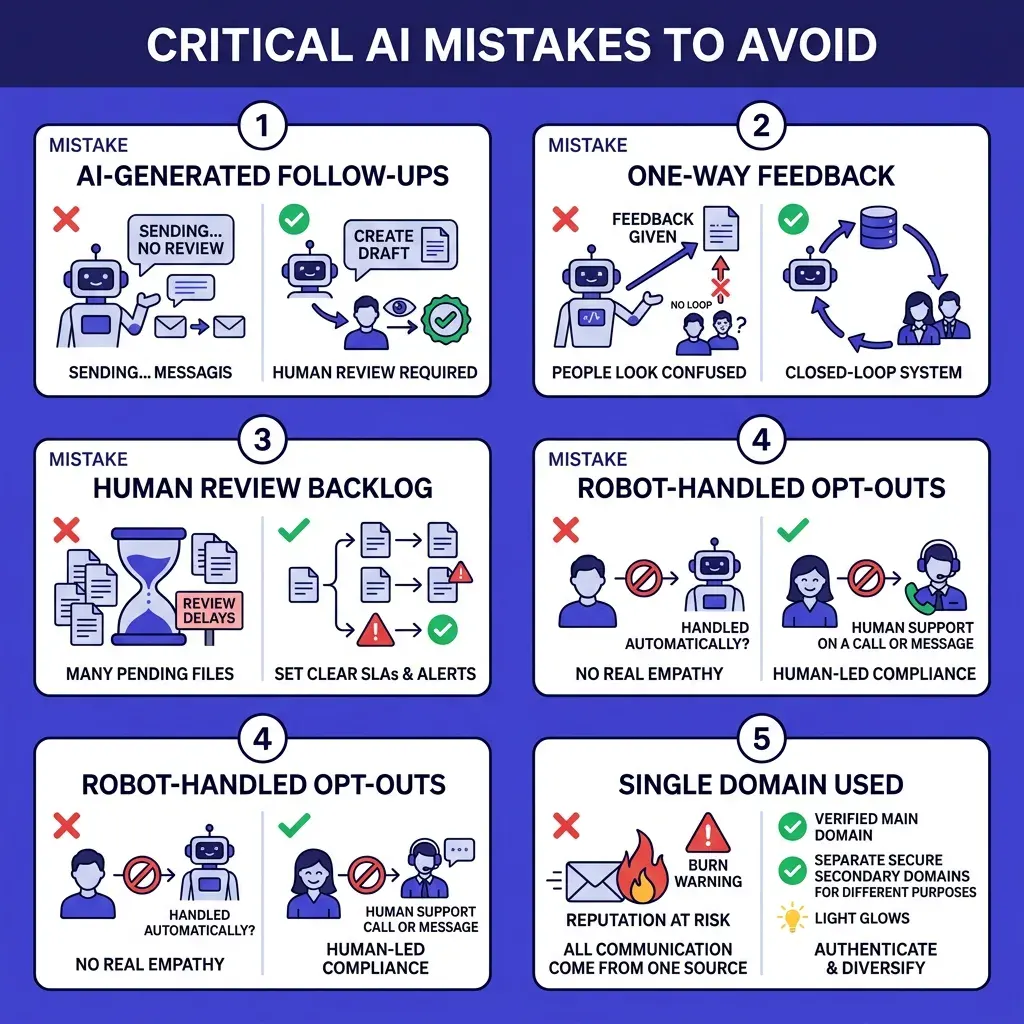 Infographic of 5 hybrid workflow mistakes with correct vs incorrect process flows
#FAQs
#What does "human-in-the-loop" mean in the context of cold email outbound?
Human-in-the-loop cold email means a human reviewer reads and approves every outbound email before it is sent, even when AI has drafted the content. The AI handles research, personalization data gathering, and first-draft generation. The human handles quality control, fact verification, tone calibration, and the final send decision.
No email goes out without a person signing off on it.
#How many emails can one SDR review per hour in a hybrid model?
A trained reviewer using a structured checklist can review 30 to 50 emails per hour comfortably. This is significantly faster than writing from scratch - which averages three to eight emails per hour for a skilled SDR. The review step should take two to four minutes per email, covering the fact check, tone check, sensitivity check, and CTA check.
If reviews are taking longer than that, either AI draft quality needs improvement or the checklist needs to be tightened.
#Does human-in-the-loop slow down outbound too much to be worth it?
No, and the data is clear on this. The volume a hybrid model generates - 150 to 300 emails per SDR per day versus 30 to 50 for pure manual - far outweighs the review overhead. The ramp time for a hybrid setup is about 24 days versus four to six months for a pure manual SDR.
The cost per qualified opportunity is roughly 54% lower.
The slowdown from review is a fraction of the speed gain from AI-assisted drafting.
#Where exactly should the human checkpoint be in the workflow?
There are three non-negotiable checkpoint positions: after the target list is built (human reviews targeting quality before drafting), after AI generates first drafts (human reviews every email before send), and after AI classifies inbound replies (human reviews and sends all non-automated responses). A fourth optional checkpoint - human approval before a prospect is enrolled in a sequence at all - adds quality control for high-value target accounts.
#Can AI handle reply classification and response drafting safely?
AI can handle reply classification (positive interest, negative, objection, out of office, referral request) with high accuracy. It can also draft suggested responses efficiently. Where it should not operate autonomously is on the send decision for anything other than automated opt-out confirmations.
A human should review and send every substantive reply, because active conversations require tone judgment and context that AI systems still miss reliably in 2026.
#How does this model affect email deliverability compared to fully autonomous outbound?
The difference is significant. Fully autonomous outbound systems, especially those operating at volume with imperfect lists, tend to breach Google's 0.10% spam complaint threshold within weeks of deployment. Human review improves targeting quality (catching bad data before send) and message quality (catching tone and relevance issues), which keeps spam complaint rates well below the threshold.
Hybrid model teams with active review processes consistently report spam complaint rates below 0.08%, compared to autonomous systems that frequently exceed 0.15% before operators intervene.
#Conclusion
Human-in-the-loop cold email is not a cautious middle ground between two better options. It is the only configuration that scales outbound without self-destructing. The AI layer handles the research volume, the draft generation, and the reply classification that no human team can match at speed.
The human layer handles the judgment calls, the fact verification, the tone calibration, and the relationship decisions that no AI can yet be trusted to make without supervision.
The teams winning in outbound right now are not the ones who went fully autonomous and are now dealing with burned domains and blacklisted accounts. They are not the ones running pure manual sequences that cannot compete on volume. They are the ones who built a clean handoff between machine and person, put the human checkpoint at the right place in the workflow, and kept it there even when the temptation to automate the whole thing was strong.
If you want to run your first hybrid outbound campaign this week, FirstSales is built for exactly this model - AI-powered research and drafting with the human review layer built in, starting at $1. You could have your first reviewed, verified sequence running before the end of the day.