**TL;DR: The ai sdr vs ai assisted sdr debate is not really a technology question - it is a risk tolerance question. Fully autonomous AI SDRs look cheap on a spreadsheet and have a 70-80% failure rate at the three-month mark. AI-assisted SDRs (human rep + AI copilot) cost more per seat but produce higher-quality meetings, protect deliverability, and actually close deals.
For most B2B teams in 2026, the assisted model wins. Here is why, with numbers.**
#What We Mean by Each Model
Before comparing, it helps to define the two camps precisely, because vendors blur the language constantly.
Autonomous AI SDR means a software agent that handles the entire top-of-funnel outbound motion without a human in the loop on individual sends. The agent sources prospects, enriches data, writes personalized emails, manages follow-up sequences, handles basic reply triage, and books meetings - all without a rep approving each message. You set the ICP, connect your calendar, and the system runs.
Common examples include tools marketed as "AI SDR agents" that promise zero-touch pipeline.
AI-assisted SDR (also called the copilot model) means a human rep who uses AI tools to do their job faster and better. The AI drafts messages, surfaces relevant signals, scores leads, suggests the next best action, and summarizes replies. But a human reviews, edits, approves, and sends.
The human stays in control of every outbound touch. This is what the human-in-the-loop cold email model looks like in practice.
The distinction matters a lot. Marketing copy from both camps often sounds identical - "AI writes personalized emails at scale" - but the operational reality and the risk profile are completely different.
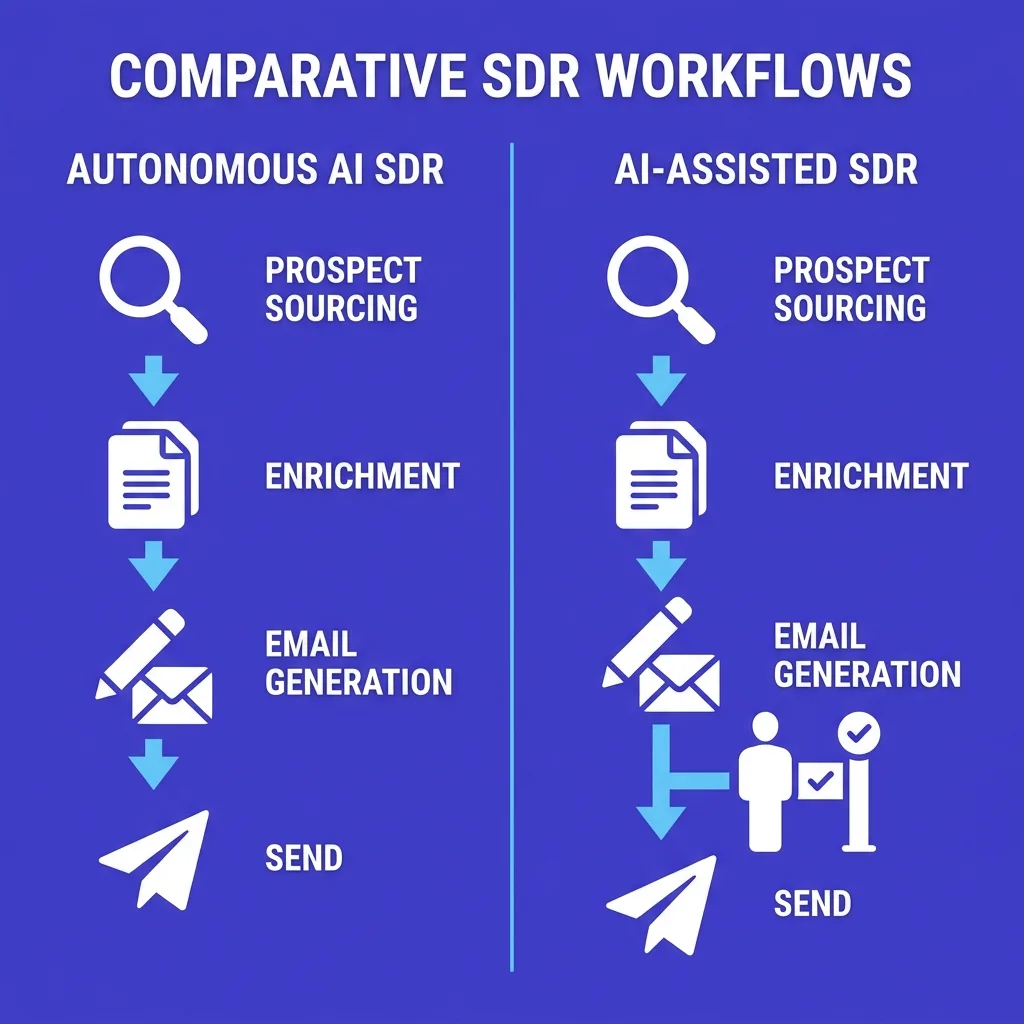 Diagram showing the two workflow models side by side - autonomous vs copilot
#The State of Outbound in 2026
Cold email in 2026 is harder than it was in 2022. That is not an opinion - it is a deliverability fact.
Google's bulk sender rules now require authenticated domains, one-click unsubscribe, and spam complaint rates below 0.10% (with a 0.30% hard cutoff that triggers permanent rejection). Microsoft has rolled out similar sender reputation requirements for Outlook and M365. The era of blasting 5,000 emails per inbox per day is gone.
Most practitioners now cap per-inbox cold sends at 20-30 per day on warmed, aged, reputation-clean domains.
Meanwhile, buyers have gotten extremely good at recognizing AI-generated outreach. Research across multiple 2026 cohorts shows that reply rates on AI-SDR outbound campaigns decay more than 60% within 18 months as recipients pattern-match on the template structure. The "hyper-personalized" line about their recent LinkedIn post no longer fools anyone.
Against this backdrop, the ai sdr vs ai assisted sdr question carries real stakes. The wrong choice does not just waste budget - it can burn your sending infrastructure and damage real prospect relationships in ways that take months to recover from.
The sales landscape data tells a clear story about where the industry has landed: 22% of sales teams have fully replaced human SDRs with AI, while 45% are running hybrid models. The majority are choosing assistance over autonomy, and for good reason.
#Cost Comparison: Sticker Price vs Total Cost
This is where the autonomous AI SDR pitch sounds most compelling - and where the math most often misleads buyers.
Autonomous AI SDR pricing ranges from roughly $500 to $5,000 per month depending on the platform and volume. At the low end, you might pay $1,000-$2,000 per month for a platform that claims to replace one or two SDRs. A mid-level B2B SDR in the US costs $60,000-$90,000 in salary alone, plus benefits, management overhead, ramp time, and churn.
On paper, the ROI calculation looks obvious.
AI-assisted SDR costs are the platform license (typically $200-$800 per seat per month for a capable AI writing and sequencing tool) plus the human rep's fully-loaded cost. You are not replacing the rep - you are making them more productive.
But the sticker price comparison misses four real costs that matter enormously in practice.
Domain replacement costs. At high volume, 10-20% of sending domains degrade or die each month. Each new domain needs aged hosting, email warmup (3-6 weeks minimum), and SPF/DKIM/DMARC configuration. Multiply that by the domains an autonomous system burns through at scale and the infrastructure cost climbs fast.
Meeting quality costs. This is the number that does not appear in any vendor ROI calculator. Human SDRs convert booked meetings to qualified opportunities at around 25%. AI-only deployments average closer to 15%.
That 10-point gap means your AEs spend more time on discovery calls that go nowhere. When you account for AE time at $150-$200 per hour, a high-volume autonomous SDR that books twice as many useless meetings is not a bargain.
Cancellation costs. The managed AI SDR contract cancellation rate for the 2025-2026 vintage is 50-70%. When an autonomous system burns relationships with your target accounts, those are not just lost deals - they are accounts that now have a negative association with your brand. That damage does not show up on a cost-per-meeting report.
Recovery costs. Teams that shut down a failed autonomous AI SDR deployment typically need 2-3 months and significant deliverability remediation work before outbound volume is safe to resume. The cost of that gap in pipeline rarely gets attributed back to the AI SDR experiment.
The benchmark that actually holds up across multiple 2026 studies: cost per qualified opportunity fell from $487 in human-only pods to $224 in hybrid AI-plus-human pods - a 54% reduction. Note that the winning model here is not fully autonomous. It is AI assisting humans who are focused on qualified pipeline, not raw volume.
#Reply Rate and Meeting Quality
Let's talk about the number that actually predicts revenue: qualified reply rate.
Signal-based, well-targeted outbound from experienced reps using AI assistance hits 15-25% positive reply rates. Generic AI-blasted outbound sits at 1-5%. That is not a marginal difference - it is a 5x to 25x gap in response effectiveness.
The gap exists for a few interconnected reasons.
First, autonomous AI SDRs optimize for throughput. They are built to process thousands of prospects quickly. That velocity bias makes it structurally hard to send the slow, thoughtful, genuinely researched messages that earn replies from busy buyers.
Second, AI-written messages at scale have detectable patterns. The personalization tokens (recent funding round, LinkedIn post, company news) feel formulaic because they are formulaic - they come from the same enrichment APIs that every other AI SDR tool uses. Buyers who receive 20 AI-personalized emails per week develop an immunity to the format.
Third, human reps using AI assistance bring genuine judgment. They can decide when a prospect is actually a bad fit for the ICP and skip them rather than send a technically-personalized but contextually-wrong message. That filtering is invisible in a dashboard but it is what protects relationship quality.
You can compare approaches across platforms by looking at the sales engagement platform vs AI SDR analysis, which breaks down how different tool architectures affect deliverability and reply rates. The pattern holds: human judgment in the loop consistently outperforms fully automated sends on the metrics that matter for revenue.
The meeting quality difference compounds over time. A fully autonomous AI SDR that books 40 meetings per month with a 15% show-and-qualify rate delivers 6 qualified meetings. An AI-assisted rep booking 25 meetings per month with a 25% qualify rate delivers more than 6 qualified meetings - with far less AE time wasted.
And the assisted rep's domain reputation stays healthier, which means the numbers hold up over 6-12 months rather than decaying.
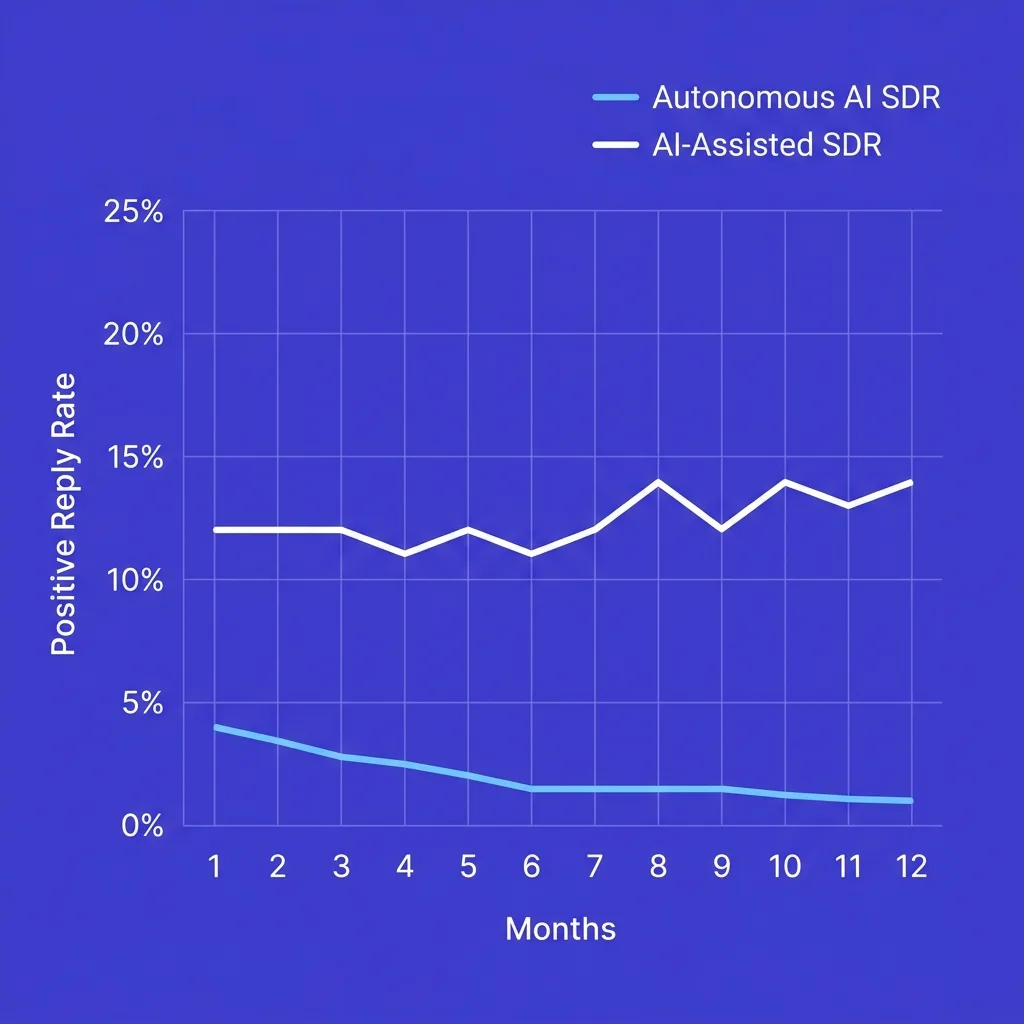 Chart showing reply rate decay curve for autonomous AI SDR vs AI-assisted SDR over 12 months
#Deliverability and Domain Risk
This section is where the ai sdr vs ai assisted sdr debate gets decided for most mature outbound teams.
Deliverability is not a technical detail you hand off to your email tool. It is the foundation that all outbound revenue sits on. And autonomous AI SDRs create structural deliverability risks that the assisted model simply does not.
Volume control. Autonomous systems are designed to send at scale. That is the pitch. But scale is precisely what triggers Google and Microsoft filtering systems.
A human rep making deliberate send decisions naturally throttles volume in ways that protect domain reputation.
The assisted model creates organic volume caps that actually serve your long-term interests.
Complaint rate management. Google's 0.10% spam complaint threshold is not a lot of runway. If you send 1,000 emails and 1 person hits "spam," you are already at 0.10%. Autonomous AI SDRs that run high-volume campaigns on poorly-targeted lists can blow through this threshold in a single day.
A human rep reviewing outreach before it goes is a natural filter against the most complaint-prone sends.
Bounce rate from stale data. LinkedIn profiles are stale on title changes by a median of seven months. Autonomous systems that pull directly from enrichment databases and send without validation produce higher hard bounce rates, which is another signal that degrades sender reputation. A human in the loop naturally catches obvious data quality problems before they become deliverability problems.
Domain rotation pressure. When autonomous systems do burn domains (and they do - at significant rates), the response is typically to spin up new domains and restart warming. That creates an operational treadmill that consumes time and money and means you are perpetually sending from relatively unaged infrastructure. The AI-assisted model, because it sends less volume per domain, naturally extends domain lifespan.
If you want to understand this dynamic in depth, the AI copilots vs AI workers breakdown explains the structural difference between tools that amplify human judgment and tools that bypass it entirely - and why that distinction maps directly to deliverability outcomes.
#Ramp Time and Setup Complexity
Both models require real setup work to function. The honest comparison is which one gets you to reliable pipeline faster and with less ongoing maintenance.
Autonomous AI SDR setup looks simpler on day one. You connect your email accounts, upload your ICP, write (or let the AI generate) your sequences, and flip the switch. In practice, reliable autonomous systems require significant investment in:
- ICP definition tight enough to keep the AI from targeting the wrong segment
- Copy QA to ensure the AI is not generating off-brand or legally risky messages
- Domain infrastructure with properly warmed inboxes and correct authentication records
- Intent data integrations so the system targets accounts that are actually in-market
- Ongoing monitoring to catch deliverability problems before they become irreversible
Teams that skip any of these steps are among the 70-80% that fail within three months. The setup is not hard - it is just not as simple as the vendor demo suggests.
AI-assisted SDR setup has a different shape. The tooling is simpler because human judgment compensates for data gaps and model errors. But you need a rep who actually uses the AI features rather than ignoring them (which is its own change management challenge).
Training reps to use AI assistance well - accepting suggestions, giving feedback, building efficient workflows - takes 2-4 weeks and varies significantly by rep.
Ramp time to first qualified meetings: autonomous AI SDRs can theoretically produce meetings within days of launch, but first-30-day meetings from autonomous systems are often the lowest quality. AI-assisted reps with 2 weeks of onboarding produce better-qualified meetings faster because the human judgment layer is already calibrated to your ICP.
#The Autonomous AI SDR Failure Pattern
The 70-80% three-month failure rate is specific enough that it is worth understanding the mechanism, not just the statistic.
The typical failure arc looks like this:
Weeks 1-4: The system is running and booking meetings. The dashboard looks great. Reply rates are decent because the sending infrastructure is fresh and the novelty of the outreach style has not worn off with your target segment yet.
Weeks 5-8: Reply rates start to soften. Booked meetings are not converting in discovery calls. AEs start to notice that the prospects who show up are not well-qualified.
Someone raises the concern that the system is targeting slightly-off ICP accounts. Adjustments are made to the targeting parameters.
Weeks 9-12: Deliverability starts to degrade. Open rates drop. A domain gets flagged.
The volume that produced 40 meetings per month in week 2 now produces 15. Reply rates have decayed. The cost-per-meeting number that looked so compelling in the ROI model is now approaching human SDR territory, without the meeting quality.
Month 4: The organization either cancels the contract or dramatically scales back volume and adds human oversight - effectively converting to the assisted model anyway.
One documented case study illustrates the extreme version: an autonomous agent that sent 9,000 emails and booked 47 meetings generated zero closed revenue. The meetings came from companies that could not afford the product. By the time the team caught it, they had burned through a significant portion of their addressable market with outreach that associated their brand with low-quality, high-volume AI spam.
Understanding why AI SDRs fail is not just forensic interest - it is the information you need to decide whether the autonomous model is worth the risk for your specific situation.
#Where Autonomous AI SDRs Actually Work
To be fair: the autonomous model is not universally wrong. There are specific contexts where it performs reasonably well.
Very large TAM with commodity ICP. If your total addressable market is 500,000+ companies and your ICP is broad and well-defined (e.g., any Series A-C company with 50-500 employees using Salesforce), autonomous systems can process volume that no human team could match. The per-relationship risk is low because there are always more accounts to reach.
Low-ACV transactional products. If your ACV is $2,000-$5,000 and the sales motion is largely self-serve with a brief demo, meeting quality matters less and volume matters more. The math works differently when AEs do not spend significant time on unqualified calls.
Outbound to cold audiences for brand-new markets. When no one in your TAM knows your company, the relationship-burning risk is lower because there is no relationship to burn. Autonomous outreach can establish initial awareness at scale.
As one channel in a multi-channel strategy. Autonomous email outreach paired with LinkedIn touches from real humans and paid retargeting can work because the email is not the only relationship-building touchpoint. The autonomy is less damaging when it is not the whole motion.
But if you are selling a product with $15,000+ ACV into a TAM of 5,000-50,000 accounts - which describes most B2B SaaS companies - the autonomous model creates existential risk to your outbound function. You are one bad month away from having burned a meaningful percentage of your potential customers with low-quality AI outreach.
#Head-to-Head Comparison Table
Here is the honest comparison across the dimensions that matter for 2026 outbound teams.
| Dimension | Autonomous AI SDR | AI-Assisted SDR |
|---|---|---|
| Monthly platform cost | $500 - $5,000 | $200 - $800 per rep seat |
| Human headcount required | Minimal (oversight only) | 1 rep per seat |
| Total cost per qualified meeting | $150 - $400 (before degradation) | $200 - $350 (stable) |
| Positive reply rate | 1-5% (decays over time) | 8-20% (stable with good targeting) |
| Meeting-to-opportunity conversion | ~15% | ~25% |
| Deliverability risk | High (volume, less human filter) | Low (human controls send decisions) |
| Domain lifespan | 2-6 months at volume | 12+ months typical |
| Ramp to first meeting | Days to 2 weeks | 2-4 weeks |
| 3-month failure rate | 70-80% | Low (tied to rep performance) |
| Setup complexity | High (ICP, infra, monitoring) | Medium (rep onboarding, tool adoption) |
| Relationship risk | High (uncontrolled messages) | Low (human review before send) |
| Scales with ACV | Better for low ACV ($2k-$5k) | Better for mid-high ACV ($10k+) |
| Regulatory risk | Higher (autonomous claims) | Lower |
| Best for TAM size | Very large (500k+) | Any size |
| Recommended in 2026? | Situational | Yes, for most B2B teams |
The cost-per-qualified-meeting number is the one to watch most carefully. The $54% reduction benchmark (from $487 to $224) that gets cited across 2026 studies comes from hybrid AI-plus-human pods, not from fully autonomous deployments. Teams that replaced humans entirely with autonomous AI have not replicated those numbers in a durable way.
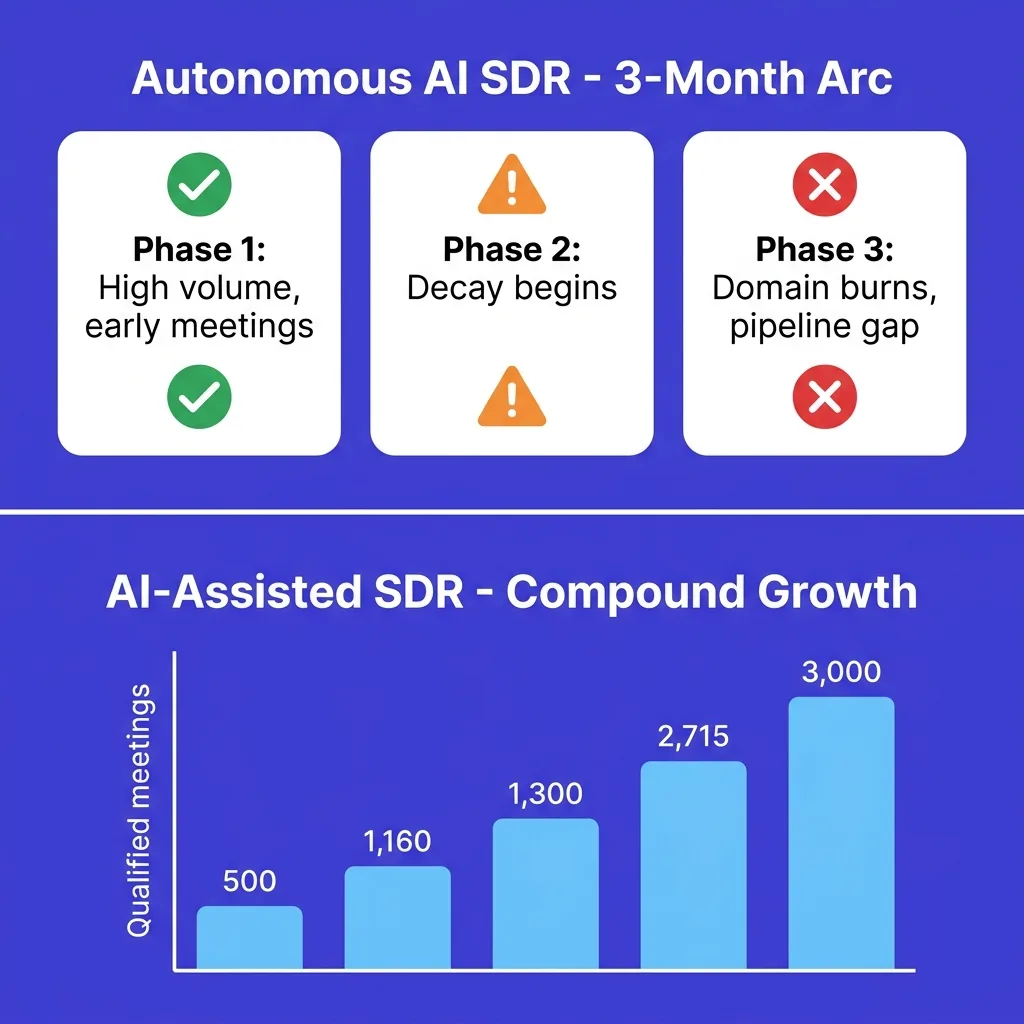 Infographic showing the 3-month failure arc of autonomous AI SDR deployments vs the stable growth curve of AI-assisted teams
#The Hybrid Middle Ground
Here is what many practitioners have landed on in 2026: a structured hybrid that uses autonomous AI for specific high-volume, low-risk tasks while keeping humans in the loop for anything that touches relationship quality.
The workflow that is emerging as a best practice looks something like this:
AI handles autonomously: prospect sourcing from intent signals, data enrichment, initial lead scoring, sequence template generation, bounce detection, unsubscribe management, and reply classification.
Human reviews and approves: final ICP fit judgment, message editing before send, tone and brand voice check, any reply that requires a nuanced response, meeting preparation research, and discovery call execution.
AI assists during human steps: suggesting edits, flagging factual errors in personalization tokens, recommending timing based on engagement signals, summarizing prospect history before calls.
This structure captures most of the efficiency gains that make AI compelling while keeping the relationship risk under human control. The AI cost per opportunity analysis shows that this layered approach consistently produces the best economics across company stages.
The practical implication for staffing: rather than one autonomous AI SDR replacing two human SDRs, one AI-assisted human SDR can often do the productive work of 1.5-2 traditional SDRs. That is a real efficiency gain - just not the infinite leverage that autonomous AI SDR vendors market.
For teams exploring what this looks like in practice, AI-assisted outbound software tools now offer configurable human-in-the-loop controls that let you set exactly how much the AI does autonomously versus what requires rep approval before sending.
#Measuring What Actually Matters
One of the clearest signs that an outbound program is drifting toward vanity metrics is when the team starts optimizing for numbers that feel good on a weekly report but do not predict revenue. This problem is especially acute with autonomous AI SDRs, which produce large volumes of activity-level data that can mask poor pipeline quality for 60-90 days before the damage becomes undeniable.
Here is the measurement framework that separates teams running sustainable ai sdr vs ai assisted sdr programs from teams that are about to have a very uncomfortable quarterly review.
Track qualified meetings, not booked meetings. A booked meeting means someone agreed to a calendar invite. A qualified meeting means the account is in ICP, the contact has budget authority, and there is a recognizable business problem your product addresses. These two numbers can diverge by 40-60% in autonomous AI SDR deployments where the targeting is even slightly off.
Report both, calculate the ratio, and watch for degradation over time. A ratio below 50% (qualified to booked) is a warning sign that the system is optimizing for calendar volume rather than pipeline.
Watch domain health weekly, not monthly. Google Postmaster Tools gives you spam rate, IP reputation, and domain reputation data in near-real-time. Most teams look at this monthly, which means they are already weeks into a deliverability problem before they catch it. If you are running any AI SDR program - autonomous or assisted - checking domain health should be a Monday morning habit, not a quarterly audit.
A domain reputation moving from "High" to "Medium" is a yellow flag. "Low" means stop sending from that domain immediately.
Measure revenue per meeting, not meetings per month. This is the metric that exposes the meeting-quality gap between autonomous and assisted models. If your AEs are closing deals from 25% of qualified meetings under the assisted model and 12% under the autonomous model, the revenue per meeting difference is significant even if the autonomous model books more absolute meetings. This number also holds the autonomous model accountable for the downstream AE time cost it creates.
Track reply decay rate over 90 days. Pull your positive reply rate for month 1, month 2, and month 3 of any outbound program. Under the AI-assisted model, this number should be relatively stable (varying with list quality and seasonality). Under autonomous AI SDR deployments, expect meaningful decay - often 30-50% decline from month 1 to month 3 - as your target segment develops immunity to the outreach style and as deliverability softens.
If your month-3 reply rate is less than 60% of your month-1 rate, something structural is wrong.
Cost per closed-won, not cost per meeting. This is the final judge. It forces the comparison all the way through the funnel rather than stopping at pipeline generation. Autonomous AI SDR programs that look efficient on cost-per-meeting often look expensive on cost-per-closed-won once you account for meeting quality, AE time on unqualified discovery calls, and the revenue impact of deliverability degradation in months 3-6.
The hybrid AI-plus-human model's 54% cost-per-opportunity improvement is most durable when measured this way.
The reason these metrics matter for the ai sdr vs ai assisted sdr choice is that autonomous systems can game the early-funnel metrics well enough to survive an initial review cycle while quietly destroying the metrics that actually matter. Teams that measure only at the top of the funnel tend to keep underperforming autonomous programs running too long, accumulating relationship damage that compounds every week the system stays on.
#FAQs
#Can a small startup afford an AI-assisted SDR model?
Yes, and it is usually the right choice. A single rep using a solid AI writing and sequencing tool ($200-$500 per month for the software) can produce the outbound volume of 1.5-2 traditional SDRs. For a seed or Series A company with a focused ICP and TAM of 5,000-50,000 accounts, this model protects relationship quality in markets where you cannot afford to burn accounts with mass automation.
#What is the realistic ramp time before an autonomous AI SDR produces qualified meetings?
Vendors will say 2-4 weeks. Reality across most deployments is closer to 6-8 weeks before you can trust the quality of what is being booked. The first month's meetings almost always require significant human triage because the system has not been tuned enough to filter out poor-fit accounts.
Factor this into your pilot timeline before drawing conclusions.
#How do I know if my product is a good fit for the autonomous AI SDR model?
Three signals suggest the autonomous model might work for you: ACV below $5,000, TAM above 500,000 addressable accounts, and a sales motion that is primarily inbound-assisted (the email just needs to start a conversation, not carry the whole relationship). If your ACV is above $15,000, your TAM is focused, or deals require multi-stakeholder navigation, the assisted model almost always wins.
#Do AI-assisted SDRs actually use the AI, or do they ignore it?
This is a real adoption problem. Studies suggest 30-40% of reps at companies that license AI writing tools use them rarely or inconsistently. The solution is making the AI workflow the default path rather than an optional feature - integrating it into CRM, sequence tools, and daily reporting so the rep's path of least resistance is using AI assistance.
Change management matters here as much as tool selection.
#What happens to my outbound when an autonomous AI SDR fails?
The damage varies by how long the system ran unchecked. In mild cases, you have a couple of burned domains and a pipeline gap while you rebuild. In severe cases, you have flagged your brand with a significant portion of your TAM and need months of deliverability remediation before safe sends can resume.
This is why starting with the assisted model is lower risk even if it means slower ramp.
#Is there a way to test autonomous AI SDR without risking your primary domains?
Yes, and you should always do this. Run autonomous campaigns from dedicated sending domains that are completely separate from your primary domain. Use aged domains (12+ months) with properly configured SPF, DKIM, and DMARC records.
Start at low volume (15-20 sends per inbox per day maximum) and monitor Google Postmaster Tools daily. Never connect your main brand domain to an autonomous sending system until you have proof of stable deliverability at the volume you plan to run.
#Conclusion
The ai sdr vs ai assisted sdr comparison in 2026 comes down to a simple trade-off: speed of setup and theoretical cost savings on one side, reliability and relationship protection on the other.
Autonomous AI SDRs fail 70-80% of the time at the three-month mark. When they fail, they often take your deliverability and prospect relationships with them. The scenarios where they work are genuinely narrow - very large TAMs, low ACV, transactional sales motions.
AI-assisted SDRs - humans using AI to move faster, write better, and target more precisely - consistently produce better-qualified meetings, better meeting-to-opportunity conversion (25% vs 15%), and more durable outbound infrastructure. The 54% cost-per-opportunity reduction that the industry cites as proof of AI in outbound comes from hybrid human-plus-AI pods, not from fully autonomous systems.
For most B2B teams in 2026: hire the rep, give them a great AI tool, keep the human in the loop, and protect your domains. That is the model that compounds.
If you want to see what this looks like in practice, try FirstSales for $1 and run your first AI-assisted campaign this week at https://app.firstsales.io.