
TL;DR: AI SDRs fail when teams treat them as fire-and-forget volume machines. The seven mistakes that consistently destroy pipelines in 2026 are: running outbound without human review, blasting volume beyond safe per-inbox limits, skipping signal-based targeting, using lazy personalization that prospects instantly recognize as bot-generated, neglecting deliverability infrastructure, ignoring reply handling, and deploying unsupervised bots that damage client relationships at scale. Every one of these mistakes has a specific, repeatable fix.
#Why AI SDR Mistakes Are So Expensive in 2026
The promise of AI SDRs was compelling: automate the top of the funnel, scale outreach without scaling headcount, and let the machine handle the tedious parts of prospecting. For a window in 2023 and early 2024, the novelty held up. Prospects hadn't yet been conditioned to recognize AI-generated copy.
Inboxes weren't flooded with the same predictable cadence structures. Deliverability filters hadn't adapted to the patterns AI tools produce at scale.
That window closed.
By early 2026, between 50 and 70 percent of teams that deployed AI SDRs had churned off the tools within three months. The companies that stayed were not the ones who bought more powerful tools - they were the ones who stopped treating AI as a set-and-forget replacement for human judgment. Those that doubled down on pure automation found that their domains were degrading, their reply rates were collapsing, and in the worst cases, their outreach had actively poisoned relationships with the prospects they most wanted to reach.
The good news is that the failure patterns are not mysterious. The same seven ai sdr mistakes show up across failed deployments, and each one has a concrete, actionable fix. Understanding them is the fastest way to build outbound that actually works.
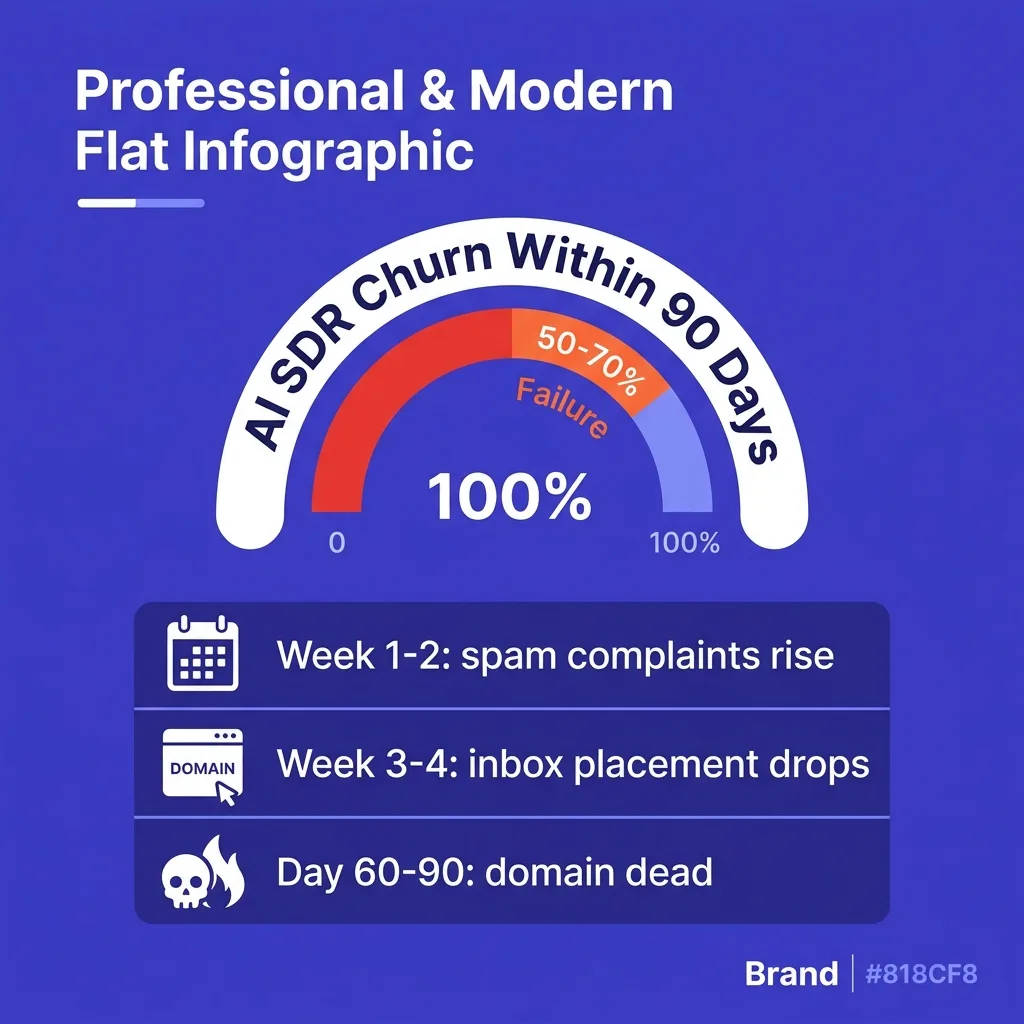 AI SDR failure rate diagram showing the 50-70% churn within 90 days
#Mistake 1: Running AI Outbound Without Human QA
The first and most foundational ai sdr mistake is deploying an AI agent to write and send emails with no human in the review loop before messages go out.
This sounds obvious when stated plainly. But the entire pitch of most AI SDR tools is that you remove the human from the loop. The tool researches the prospect, writes a personalized opener, selects a sequence, and sends - all without a person touching it.
Teams buy into this framing because the labor savings look enormous on a spreadsheet.
What the spreadsheet doesn't capture is what happens when the AI gets the context wrong. It misreads the prospect's role. It references a company initiative that was cancelled six months ago.
It writes a subject line that the prospect's spam filter catches because it resembles patterns their provider has learned to flag. It follows up three times with a contact who responded with "please don't email me again" - because the AI didn't parse the negative sentiment in an out-of-office autoresponse. All of these scenarios happen without human oversight, and they happen at the volume AI tools operate at: hundreds or thousands of sends per day.
The failure mode is not just a wasted email. It is a burned relationship with a prospect who may have been the right buyer at the right company. Once a prospect has a bad experience with AI-automated outreach, the probability of re-engaging them drops sharply.
You don't get many chances to make a first impression with a cold prospect, and AI without QA squanders those chances at machine speed.
The fix: Insert a human review step before sequences go live. This doesn't require reviewing every individual email - it means reviewing the AI's output at the template and personalization-variable level before a sequence runs. Spot-check five to ten examples from each batch.
If the AI is consistently getting a context element wrong (company size, industry, tech stack), fix the prompt or the data source before it scales that error across hundreds of sends. The human-in-the-loop cold email model, where AI drafts and humans approve, has become the default for teams with consistent pipeline results.
#Mistake 2: Blasting Volume Beyond Safe Per-Inbox Limits
The second ai sdr mistake is treating email like a numbers game and ratcheting up send volume until the pipeline fills up. This was already a bad idea in 2023. In 2026, it is the fastest way to destroy your sending infrastructure.
The math that used to justify high-volume blasting has completely inverted. Back when you could send five thousand emails per inbox per day and land in the primary inbox, volume was a reasonable lever. That era is over.
Safe per-inbox cold volume now sits at ten to twenty emails per day for most senders, and you can push to thirty or fifty only on warmed, aged domains with clean reputation histories and careful ramp protocols.
Why did the limits drop so dramatically? Because email providers - Google in particular - got much better at detecting and penalizing patterns associated with bulk cold outreach. They look at send cadence, the ratio of outbound to inbound, bounce rates, spam complaint rates, and dozens of other signals.
When an inbox sends fifty cold emails on day one of its existence, that pattern is detectable. When it sends two hundred, it becomes a near-certain spam signal.
The result of ignoring these limits is domain burn. Research across AI SDR deployments in 2025 and 2026 shows that domains running AI outbound at production volume see their sender reputation drop by 38 points within ninety days. Inbox placement rates fall below sixty percent by week four.
Spam complaint rates push past 0.3 percent within weeks - the level at which Google removes your ability to mitigate the damage. Google's guidelines are explicit: keep complaint rates below 0.10 percent, with a practical operating target of 0.08 percent or below. At scale, most teams blow past this threshold without knowing it because they're not monitoring it.
One outbound agency that tracked their own data found that AI SDR-style sending pushed roughly 6.4 times more volume while reply rates came in about 38 percent lower. More volume actively hurt their results because each incremental email reduced deliverability for the whole domain.
Industry estimates suggest that ten to twenty percent of sending domains degrade or die every month at high outbound volume. If you have one sending domain, you lose your entire outbound capability inside a few months. If you have ten, you're replacing one or two per month indefinitely - a recurring infrastructure cost that erases the economics of AI outbound.
The fix: Cap per-inbox sends at twenty emails per day until you have at least ninety days of clean sending history on that domain. Use multiple domains with proper SPF, DKIM, and DMARC setup. Rotate sending across inboxes so no single inbox exceeds safe thresholds.
Monitor your sender reputation weekly using Google Postmaster Tools. The cold email volume trap is real and well-documented - treat volume as a variable to optimize carefully, not a dial to turn up whenever pipeline looks thin.
#Mistake 3: Skipping Signal-Based Targeting
The third ai sdr mistake is sending cold email to static lists without any timing signal - no event, no trigger, no evidence that the prospect has a reason to care about your message right now.
This is the targeting equivalent of cold calling a phone book. You might reach the right person, but you're almost certainly reaching them at the wrong time. And timing matters more than almost any other variable in cold outreach.
A prospect who isn't actively evaluating your category, who hasn't just had a business event that creates urgency, who hasn't given any signal that they're in a buying motion - that prospect has no reason to reply. The message lands as noise.
The data confirms this gap is large. The average cold email reply rate in 2026 sits at 3.43 percent according to Instantly's benchmark report, consistent with other industry sources. That average includes both terrible and excellent campaigns.
When you look specifically at signal-based outreach - emails triggered by funding rounds, hiring surges, leadership changes, technology stack shifts, or other intent indicators - reply rates climb to fifteen to twenty-five percent. When multiple signals are stacked (a job change at a target account coinciding with a hiring surge and recent funding), reply rates have been observed as high as twenty-five to forty percent.
That's roughly a five to twelve times improvement over static-list outreach, from targeting alone, without changing the copy.
Most AI SDR deployments are configured against static lists: a CSV of companies in a target industry, a Salesforce export of accounts that haven't been touched in a year, a LinkedIn Sales Navigator search that ran six weeks ago. These lists are not wrong - the companies on them may be genuinely good prospects. But without a timing signal, you're guessing that today is the right day to reach them.
Signal-based outreach knows it is.
The fix: Before building sequences, build your signal detection. Define the three to five triggers that indicate a prospect is likely in a buying window - common ones include funding announcements, new executive hires in relevant roles, job postings for the category your product replaces, and technology stack changes visible in job descriptions. Route prospects into sequences only when a qualifying signal fires, not on a fixed schedule.
This approach is covered in detail in the signal-based cold email playbook.
#Mistake 4: Lazy Personalization That Screams "Bot"
The fourth ai sdr mistake is using personalization that looks like personalization but reads like a template fill-in. Prospects in 2026 have been trained by hundreds of these emails. They can spot the pattern in three seconds.
Here's what lazy AI personalization looks like in practice. The email opens with something like: "I noticed you recently joined Acme Corp as VP of Sales - congratulations on the new role!" This is technically personalized.
It references a real fact about the prospect. But it is also the exact opener that thousands of AI SDR tools default to when they detect a job change signal. Prospects in senior roles receive multiple versions of this email every week.
The opener that was supposed to demonstrate research now signals automation.
The same problem applies to company-level personalization. "I saw that Acme Corp recently raised a Series B - impressive growth!" reads as AI-generated to any prospect who has received cold outreach in the past year. It's a public fact combined with a filler compliment, wrapped in a sentence structure that AI tools produce reliably.
The how prospects spot AI-written emails patterns are now well-documented: predictable opener structures, vague compliments, the absence of any genuinely specific observation, overly formal transitions, and a uniform voice that doesn't vary the way human writing does.
Using multiple custom fields beyond first name and company can boost replies by 142 percent according to 2026 benchmark data. But that lift comes only when the fields contain genuinely specific, researched observations - not when they're additional template slots filled with surface-level facts any data provider can supply.
The deeper issue is that lazy personalization doesn't just fail to help - it actively hurts. When a prospect can tell within two sentences that your email was generated by a machine, you've confirmed that you don't value their time enough to write something real. That signal is worse than no personalization at all, because it tells them exactly how you operate.
If you send lazy AI copy to a prospect you actually want to close, you've made the subsequent outreach harder.
The fix: Use AI to do the research - company news, recent press, relevant job postings, technology signals, LinkedIn activity - and then use a human to translate that research into something genuinely specific. The observation in your opener should be something the prospect would recognize as real effort. "I saw the job post for a Revenue Operations Manager and noticed you're specifically asking for HubSpot-to-Salesforce migration experience - that's an unusual stack shift for a company at your stage" is harder to write, but it's also impossible to mass-produce.
That specificity is the point. Pair this with the ai-slop cold email diagnostic to audit your current templates.
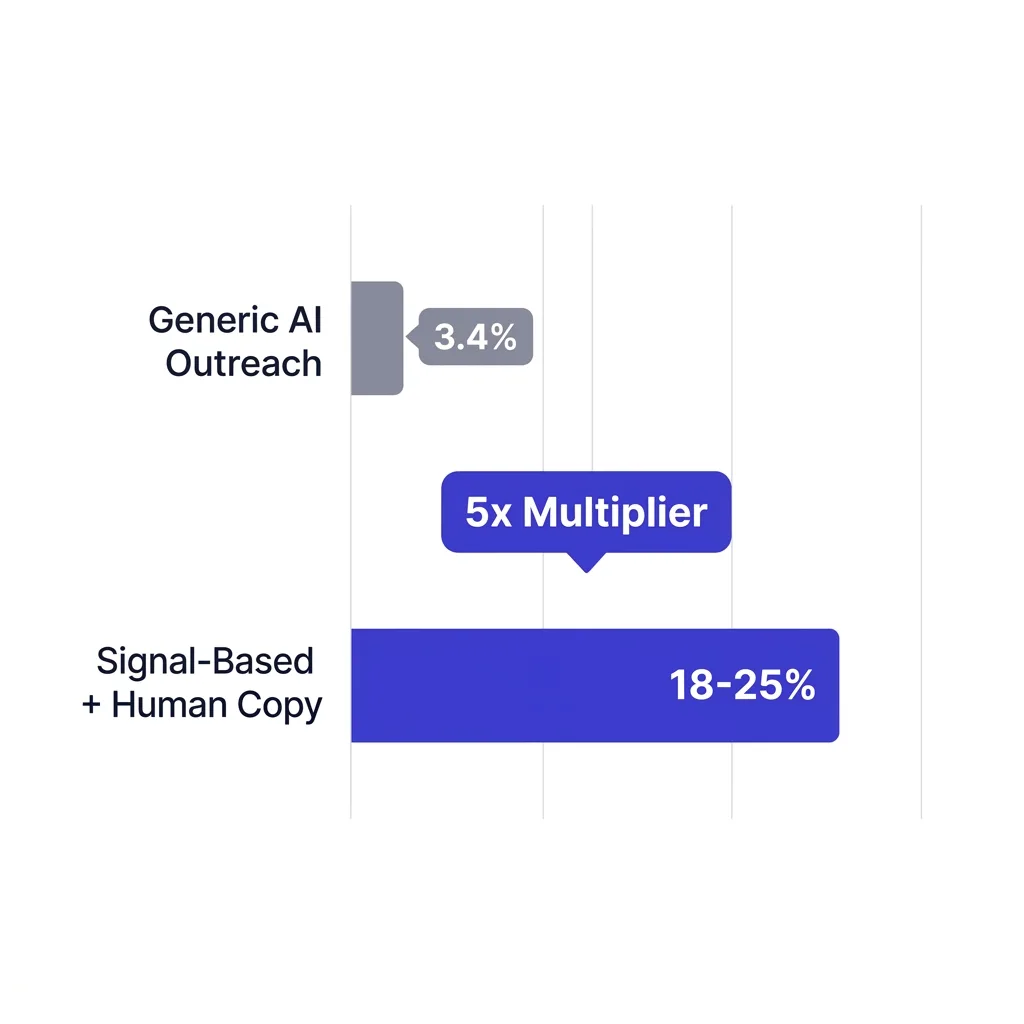 Chart comparing reply rates: lazy AI personalization 1-2% vs signal-specific research-backed copy 15-25%
#Mistake 5: Neglecting Deliverability Infrastructure
The fifth ai sdr mistake is treating deliverability as something you think about after you've burned a domain - rather than as the foundation you build before you send the first email.
Most teams deploying AI SDRs set up a sending tool, connect a domain, import a list, and start sending. They don't check whether their SPF, DKIM, and DMARC records are correctly configured. They don't warm the domain before sending cold volume.
They don't monitor Google Postmaster Tools to watch sender reputation in real time. They don't set up domain rotation to distribute sending risk across multiple inboxes. They just send.
This works fine for the first few weeks, before any reputation signals have built up. Then the metrics start to drift. Open rates drop because emails are landing in spam.
Reply rates collapse because the emails that do reach the primary inbox are being ignored at higher rates (a secondary signal that affects future deliverability). Complaint rates tick up because a small percentage of prospects who don't recognize the sender simply mark the email as spam rather than looking for an unsubscribe link.
By the time the damage is visible, it's often irreversible for that domain. You can't rehabilitate a domain with a badly degraded reputation in any reasonable timeframe. You abandon it and start over - except now you've also potentially burned some of your best prospect relationships in the process.
Google's 2026 bulk sender requirements are not suggestions. SPF, DKIM, and DMARC are mandatory for anyone sending to Gmail at any meaningful volume. One-click unsubscribe is required.
Spam complaint rates must stay below 0.10 percent (target below 0.08 percent as a buffer). Microsoft has implemented parallel requirements for Outlook and M365 that emphasize domain age and ramp rate. Sending a new domain at high volume in its first thirty days will get it flagged on both platforms.
The fix: Before your first send, set up full email authentication on every domain you plan to use. Warm each inbox over four to six weeks with low-volume, high-engagement sends. Set up Google Postmaster Tools monitoring from day one.
Establish domain rotation across multiple sending domains so no single domain carries full risk. Cap daily sends per inbox at conservative levels until each domain has earned a clean reputation. The infrastructure work is not glamorous, but it's the only reason your emails reach inboxes at all.
Tools like FirstSales handle this as part of the sending infrastructure so you're not doing it manually.
#Mistake 6: No Reply Handling System
The sixth ai sdr mistake is building a system that's excellent at generating outbound but has no coherent plan for what happens when someone replies.
This sounds like a good problem to have - replies mean the outreach is working. But how you handle replies determines whether working outreach translates into pipeline, and a surprising number of AI SDR deployments have exactly zero structure around this. A prospect replies asking for a demo.
The AI tool marks the thread as "replied" and stops the sequence. The reply sits in an inbox. Three days later, a human SDR finds it and books the call - but the prospect has moved on, scheduled a demo with a competitor, or simply lost interest because the response time signaled low urgency.
Reply handling is also where the AI limitations become most expensive. A prospect who replies with a question or objection needs a real, context-aware response - not an AI-generated follow-up that misreads the intent of their message. An AI that responds to "We already use a competitor" with "Great, I'd love to show you what makes us different" is burning a relationship that could have been salvaged with the right human response.
The problem compounds when you're running AI-generated sequences at scale. If you have two thousand active contacts in sequences and three percent reply in a given week, that's sixty replies - a manageable number for a small team, but only if the system to route and prioritize those replies exists. Without it, high-intent replies get lost in the noise, and you're leaving the best part of your pipeline unworked.
The fix: Build the reply handling system before you scale the outbound. Define routing rules: positive replies (demo requests, questions) go to a human within four hours; neutral or question replies go to a human within twenty-four hours; negative replies (opt-outs, not interested) get logged and suppressed immediately. Use AI to classify intent, but use humans to draft the response.
The reply handling playbook is worth reading in full before you scale sequences past a few hundred active contacts.
#Mistake 7: Letting Bots Run Unsupervised at Scale
The seventh and most dangerous ai sdr mistake is the one that caused the 2025-2026 AI SDR backlash: letting fully autonomous bots run outbound campaigns for weeks or months without any human reviewing what they're sending, who they're targeting, or what's happening to your domain reputation.
This mistake is qualitatively different from the others. The others are execution errors - things you can fix with better process. Unsupervised bots at scale is a governance failure, and its consequences reach beyond your own pipeline into the broader market's ability to trust cold outreach at all.
Here's what unsupervised AI outbound does in practice. The bot finds a prospect list, generates personalized-looking emails, and sends at volume. Without human oversight, it doesn't notice that it's sending to contacts who have already replied negatively and opted out.
It doesn't catch when its templates start producing copy that sounds increasingly robotic as the prompt drift compounds over weeks. It doesn't stop when domain reputation metrics start flashing warning signs. It doesn't recognize that a particular prospect segment has responded uniformly with "not interested" - a signal that the targeting or messaging needs adjustment.
It just sends.
The result is what multiple agency case studies from late 2025 described as "client relationship incineration." One agency running unsupervised AI outbound for a B2B software client sent the same personalization error - a misconfigured company name variable rendering as a raw template placeholder - to eleven thousand contacts over four days before anyone noticed. Another had its AI continue following up on a prospect who had replied with a detailed and polite opt-out, sending two more follow-ups referencing the "conversation we haven't had yet."
These are not hypotheticals. They are documented failure modes from the unsupervised AI outbound era.
The market has adapted. Prospects who receive AI slop have become less likely to engage with any cold email from an unknown sender. Reply rates have declined industry-wide partly because the pool of generic AI outreach has risen so dramatically that prospects apply a higher skepticism filter to everything.
The teams running unsupervised bots didn't just hurt their own pipeline - they raised the bar for everyone.
The fix: Establish a weekly review cadence for every active AI outbound campaign. Check domain reputation metrics in Google Postmaster Tools. Review the AI's output against a sample of twenty-five to fifty emails per campaign.
Monitor opt-out rates and spam complaint rates as leading indicators of a problem before it becomes a domain death. Set hard caps on what the AI can do without human approval - new segments, new templates, and any send over a certain volume should require sign-off. Read the ai sdr pilot failure analysis for the most common governance gaps and how to close them.
#The AI SDR Mistake Benchmark Table
The table below summarizes what each mistake costs and the benchmark targets that indicate you've fixed it.
| Mistake | Risk Level | Warning Signal | Fixed When |
|---|---|---|---|
| No human QA | Critical | AI context errors in 10%+ of emails | Human reviews every batch before live sends |
| Volume beyond safe limits | Critical | Spam complaint rate rising week-over-week | Per-inbox daily sends capped at 20; complaint rate <0.08% |
| No signal targeting | High | Reply rate <2% across all sequences | Signal-triggered sequences achieving 10%+ reply rate |
| Lazy personalization | High | Open-to-reply conversion rate <8% | Opener references genuinely specific, researched detail |
| Weak deliverability infra | Critical | Inbox placement dropping below 85% | SPF, DKIM, DMARC set; domains warmed; Postmaster tracking |
| No reply handling | High | Positive replies converting to calls <30% | Routing rules live; human response within 4 hours |
| Unsupervised bots | Critical | Complaint rate >0.10%; domain reputation "Low" | Weekly review cadence and hard send caps enforced |
The "Critical" risks can end your outbound program entirely. The "High" risks erode performance over time until the program is no longer generating meaningful pipeline.
#How the Hybrid Model Fixes All Seven
The ai sdr mistakes listed above share a common root: they all happen when AI is treated as a full replacement for human judgment rather than a force multiplier for human-directed outreach.
The hybrid model - where AI handles research, list building, draft generation, sequence management, and classification, while humans handle review, copy approval, reply routing, and governance - resolves all seven failure modes simultaneously.
The math on this model is compelling. Elite outbound teams in 2026 use AI for roughly eighty percent of the research and sequencing work, freeing humans to focus on the thirty to forty percent of the work that actually determines whether the outreach converts. That's not less automation - it's better automation, applied to the right tasks.
Signal-personalized emails in a properly governed hybrid setup achieve reply rates of fifteen to twenty-five percent in 2026, versus the 3.43 percent industry average for generic AI blasting. The infrastructure costs are lower because domains don't burn. The reply conversion rates are higher because humans handle the replies.
The prospect relationships are intact because no one sent eleven thousand emails with a broken template variable.
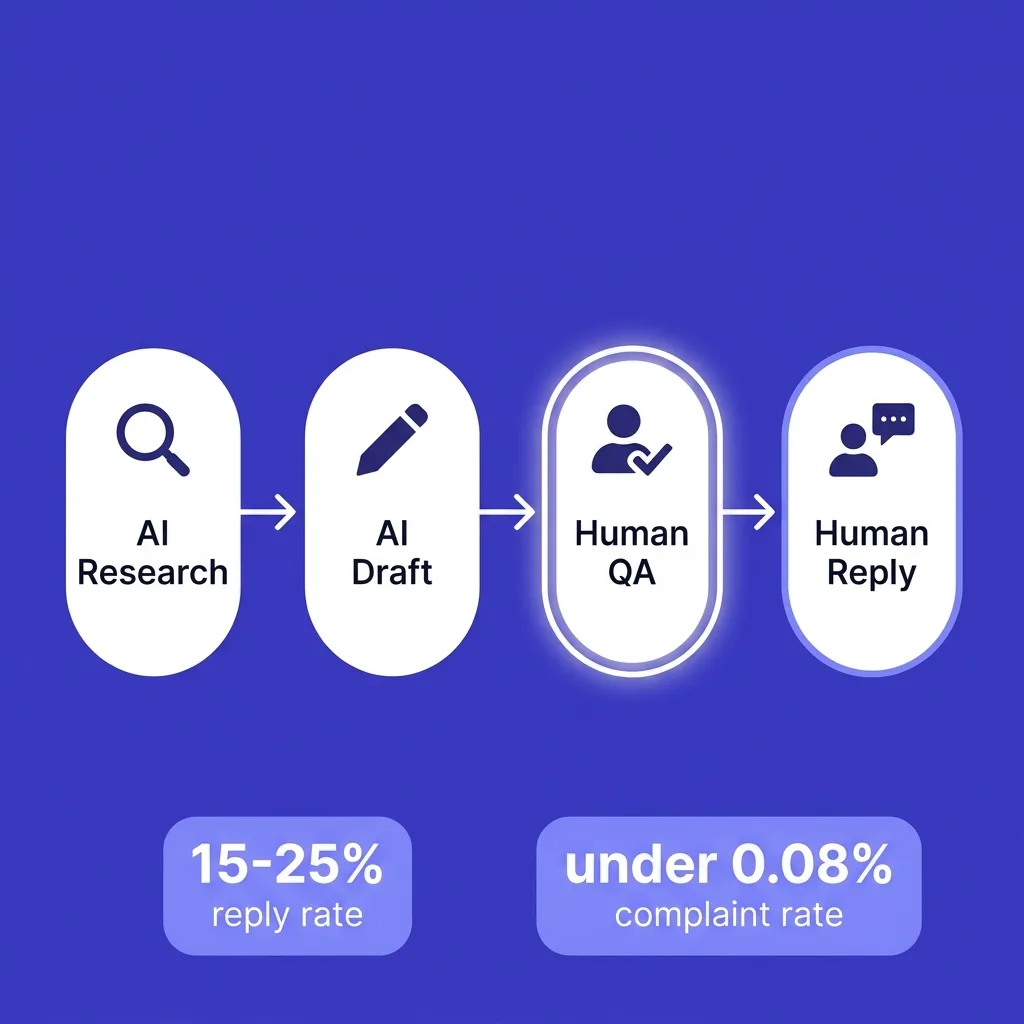 Infographic showing hybrid AI-human outbound workflow: AI for research and drafts, human for QA and reply handling
The question isn't whether to use an AI SDR in 2026 - it's whether to use one correctly. The difference between the teams that are building pipeline and the teams that are burning through domains and prospect lists is not the technology they're using. It's whether a human is in the loop at the right points in the process.
For teams that have already experienced the ai sdr pilot failure pattern - fast initial excitement, then ninety-day collapse - the hybrid model is the rebuild path. It's slower to start than plugging in an AI tool and turning it loose. It scales faster once the foundation is right.
#FAQs
#What is the most common AI SDR mistake teams make in 2026?
The most consistent failure across deployments is running AI outbound without any human quality review before emails go live. Teams buy AI SDR tools for the labor savings, which creates pressure to remove humans from the review step entirely. This allows the AI's context errors, misread personalization signals, and deliverability risks to compound at volume before anyone catches them.
The fix is straightforward: a human reviews batch samples before sequences run, not after complaints start arriving.
#How quickly can an AI SDR burn a sending domain?
Faster than most teams expect. At high send volumes - defined as anything above twenty to thirty emails per inbox per day on a new or unwarmed domain - reputation degradation becomes visible within two to four weeks. Spam complaint rates push past the 0.10 percent threshold Google enforces, inbox placement rates fall below 60 percent, and the domain's sender reputation score drops to "Low" in Google Postmaster Tools.
The full burn cycle typically completes in thirty to ninety days, at which point the domain is effectively useless for cold outreach.
#What reply rate should I expect from signal-based vs generic AI outreach?
Generic AI outreach at volume averages 3.43 percent reply rates in 2026, based on Instantly's benchmark report covering over one hundred million emails. Signal-based outreach - emails triggered by buying events like funding rounds, hiring surges, leadership changes, or job role transitions - achieves fifteen to twenty-five percent reply rates. When multiple signals are stacked on a single prospect, rates as high as twenty-five to forty percent have been documented.
The gap is driven almost entirely by timing and relevance, not copywriting.
#Can prospects tell when an email was written by AI?
Yes, with increasing reliability. Prospects who receive significant cold email volume have pattern-matched the structural tells of AI-generated copy: predictable opener formats that reference a single public fact, vague compliments ("impressive growth"), formal transitions that don't match conversational tone, and a uniform voice that doesn't vary across paragraphs. Research from 2026 shows that the openers that AI tools default to - job change congratulations, funding round acknowledgments - are now so common that they function as spam signals rather than personalization signals.
The only way around this is to include genuinely specific observations that require real research.
#Why do AI SDRs have such high churn rates in 2026?
Between fifty and seventy percent of teams that deploy AI SDRs churn off the tools within three months. The primary reasons are: reply rates that don't meet expectations (because of lazy targeting and personalization), domain deliverability issues that reduce inbox placement before teams understand what's happening, and the absence of infrastructure to handle the replies that do come in. Teams that stay on AI SDR tools beyond ninety days are almost universally the ones who built human review and signal-based targeting into the process from the start.
#What is the safest number of cold emails to send per inbox per day?
For a new or recently warmed domain, ten to twenty emails per inbox per day is the safe range. For warmed domains with at least ninety days of clean sending history and a confirmed "High" reputation in Google Postmaster Tools, you can push to thirty to fifty. Beyond fifty per inbox per day, you are taking on meaningful deliverability risk regardless of domain age, because the ratio of outbound to inbound traffic becomes anomalous to email providers.
Most successful teams spread sending across multiple inboxes on aged domains rather than pushing a single inbox above safe thresholds.
#Conclusion
The ai sdr mistakes that burned pipelines in 2025 and 2026 were not caused by bad technology. They were caused by teams that treated automation as a replacement for judgment rather than a multiplier for it. Every mistake on this list - from unsupervised bots to volume blasting to lazy personalization - traces back to the same root: removing the human from the parts of outbound where human judgment is what makes the difference.
The fix is not to abandon AI SDRs. It's to use them the way the teams with fifteen to twenty-five percent reply rates use them: AI handles the research, the drafting, and the sequencing; humans handle the review, the response, and the governance. That combination scales your output without scaling your risk.
If your current AI outbound is underperforming, start with the benchmark table in this article. Identify which of the seven mistakes your program is making, fix the critical ones first, and build the monitoring to catch problems before they become domain deaths.
Ready to run outbound that actually converts? Try FirstSales for $1 and run your first signal-based campaign this week.