TL;DR: WhatsApp is the most-opened messaging channel in business, with open rates measured between 68% and 98% versus about 21% for email, and median reply times of 45 to 90 seconds. That makes it tempting for cold outbound. The honest answer is that WhatsApp works as a warm follow-up channel, not a cold first touch.
In WhatsApp-heavy regions like India, Brazil, and the UAE, a researched cold message can pull 15-20% replies. Sent at volume to strangers with no opt-in, the same approach gets your number throttled or permanently banned, because Meta requires documented affirmative consent and treats unsolicited marketing as a policy violation. The reps winning on WhatsApp earn the channel with a signal and an earlier touch, then use it to nudge a conversation that already started.
#What counts as WhatsApp cold outreach
WhatsApp cold outreach means sending a sales message to a business contact who has not asked to hear from you, using their personal or business WhatsApp number. The number usually comes from a scrape, a data vendor, or a phone field on a lead list. No prior reply.
No opt-in.
Just a message landing in the same app where the person texts their family.
That last part is why WhatsApp feels different from email. Email has always been a semi-public channel for work. People expect cold pitches there and built mental filters for it.
WhatsApp is personal space. A pitch that would read as normal in an inbox can read as an intrusion in a thread that sits between a spouse and a dentist appointment.
WhatsApp cold outreach is not one tactic. It splits into two very different motions that get lumped together and produce wildly different results:
- A researched one-to-one message to a specific person at a specific company, sent because something real prompted it
- A templated blast to a list of scraped numbers, sent because the numbers existed
The first can work. The second gets your number banned, often within days. Most of the failure stories you read are the second kind wearing the clothes of the first.
By early 2026, WhatsApp reached 3.3 billion monthly active users and is projected to cross 3.5 billion by year end, according to figures compiled by Infobip. Over 200 million businesses now use WhatsApp Business products. The reach is real.
The question is whether cold B2B sales is a fit for it, or a fast way to lose a phone number you cannot easily replace.
#Why the numbers make WhatsApp look irresistible
Start with the stat that launched a thousand growth experiments. A Twilio Messaging Engagement Benchmark study that analyzed 4.8 billion WhatsApp messages across roughly 62,000 business accounts reported an average open rate of 98.2%, compared with about 21% for email. That gap is the entire pitch for the channel.
A word of honesty here, because the seo-blog discipline demands it. The 98% figure gets repeated across hundreds of articles without a clean primary source, and independently measured open rates run lower, closer to 68% in some datasets. So the truthful version is a range.
WhatsApp opens land somewhere between 68% and 98% depending on how you measure, and even the floor of that range crushes email's ceiling.
Speed is the other hook. People reply to WhatsApp messages in a median of 45 to 90 seconds, against 6 or more hours for email, based on engagement benchmarks cited across messaging platforms. When you are running a speed-to-lead motion, a channel where the reply comes back before your coffee cools changes what is possible.
A lead who fills a form at 2pm can be in a live chat by 2:02.
The engagement metrics keep going. Median WhatsApp click-through rates have climbed to around 58%, with AI-personalized sequences pushing higher, and broadcast campaigns to opted-in audiences convert in the 15-25% range. Those are conversational-commerce numbers, mostly B2C, but they explain why every B2B founder eventually asks the same question.
If the channel is this hot, why am I still grinding email?
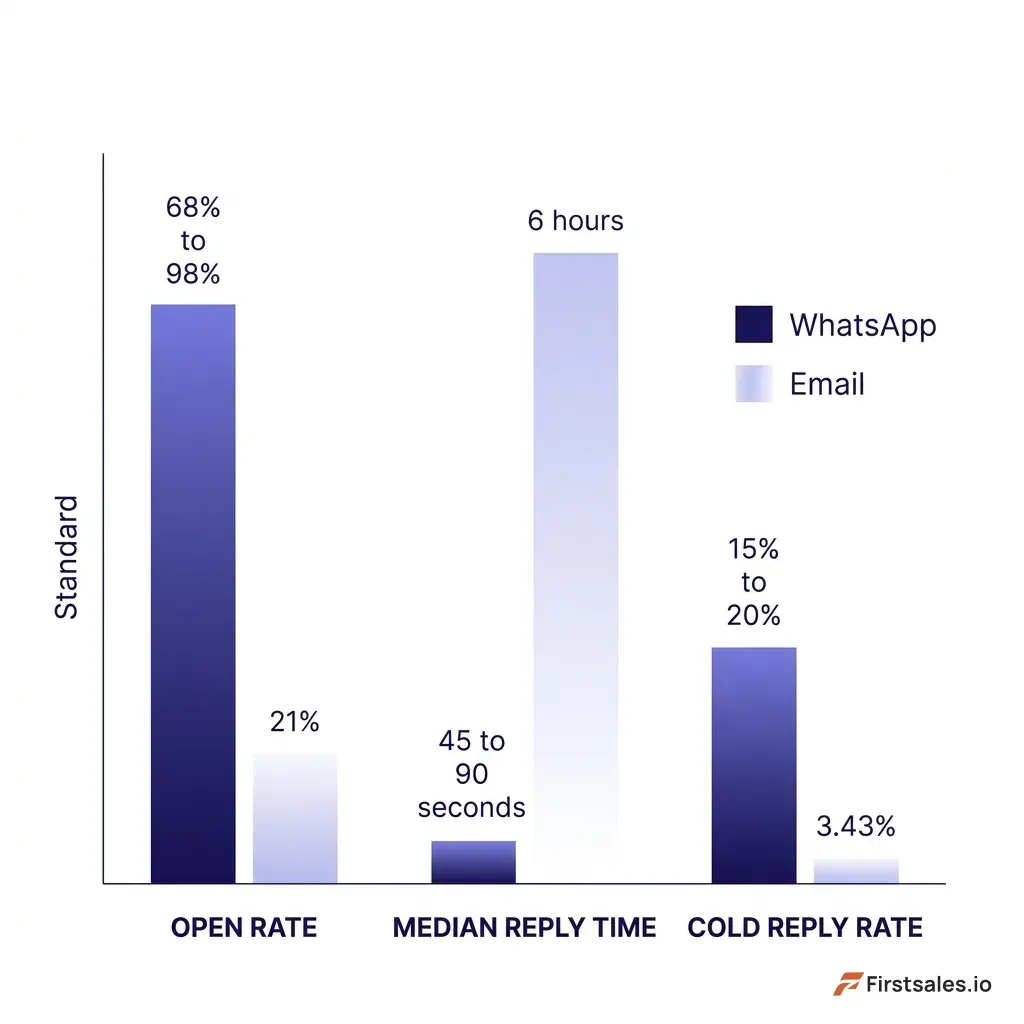 Side by side bar chart comparing WhatsApp and email on three metrics: open rate showing WhatsApp 68 to 98 percent versus email 21 percent, median reply time showing WhatsApp 45 to 90 seconds versus email 6 hours, and cold reply rate showing WhatsApp 15 to 20 percent in opted-in regions versus email 3.43 percent, deep indigo background with white and light indigo bars
The answer is that the hot numbers come from audiences who agreed to be there. Strip out the consent, and the same channel turns hostile fast. That distinction is the whole article.
#Cold first touch versus warm follow-up
Here is a real example that captures the trap. A Reddit user described scraping 300 leads from Google Maps, pulling their phone numbers, and sending cold WhatsApp messages. They got 40 replies.
They closed zero deals. The replies were real, the pipeline was empty, and the number was now flagged.
That story is the channel in miniature. WhatsApp will get you replies cold. It is so personal that people respond on reflex, even to say "who is this?"
But a reply is not interest, and reflexive replies from people who never wanted the message do not become revenue. They become wasted sends and a degraded sender reputation.
Now flip the motion. Prospeo's analysis of WhatsApp cold outreach found that for genuinely cold prospects approached with a well-researched, personalized message based on public information, reply rates hit 15-20%, against email's typical 1-10%. The variable that separates the 0-deal scrape from the 20% reply rate is not the channel.
It is whether the message earned its place.
The cleanest framing comes straight from practitioner data: WhatsApp works best as a follow-up nudge, not a cold open. Email introduces you in a place built for introductions. WhatsApp then nudges the conversation forward in a place built for fast back-and-forth.
Run it in that order and the personal nature of the channel becomes an asset. Run it as the opener and the same personal nature reads as a boundary violation.
Think about your own behavior. A stranger emailing your work address barely registers. A stranger texting your WhatsApp makes you wonder how they got the number and whether you should be worried.
The closer a channel sits to your private life, the more permission it demands before a sales message feels acceptable. That is the rule WhatsApp punishes you for breaking.
This is the same logic that governs cold calling versus cold email. Interruptive channels carry more risk and more reward. They reward you when the timing and the reason are right, and they punish you harder than email when they are wrong, because the intrusion is sharper.
#The opt-in and ban reality nobody warns you about
WhatsApp is not a neutral pipe you can send through however you like. It is a walled platform with a policy team and an enforcement engine, and that engine is the single biggest reason cold WhatsApp blasts fail as a strategy rather than as individual messages.
The core rule is simple and strict. Businesses may only contact people on WhatsApp if those people gave their phone number and took an affirmative action to opt in to receiving messages. Pre-checked boxes do not count.
Implied consent from accepting terms of service does not count. Assumed consent from a past purchase does not count. The user has to actively say yes.
Failure to obtain and document proper consent is the leading cause of WhatsApp Business account restrictions in 2026, according to compliance guidance from multiple WhatsApp providers. This is not a slap on the wrist. Persistent violations trigger temporary sending restrictions of 24 to 72 hours, then escalate to 1 to 30 day blocks, account locks, and permanent phone number bans for repeat offenders.
Lose the number and you lose the warm-up history, the contacts, and the conversations attached to it.
There is a practical ceiling on top of the policy ceiling. New numbers need a warm-up period of two to three weeks before messaging strangers, and even warmed numbers top out around 50 messages per day before quality flags start firing. Compare that with email, where a warmed inbox handles meaningfully more daily volume.
WhatsApp is structurally a low-volume channel. Any plan that treats it as a place to send thousands of cold messages misunderstands what it is.
One more change caught a lot of teams off guard. As of January 15, 2026, Meta banned mainstream general-purpose AI chatbots from running on the WhatsApp Business API. Businesses can still run purpose-built automation flows like booking bots and order bots, but the "point a large language model at the inbox and let it sell" play is now against policy.
The platform is steering hard toward consented, structured, business-initiated messaging and away from open-ended automated outreach.
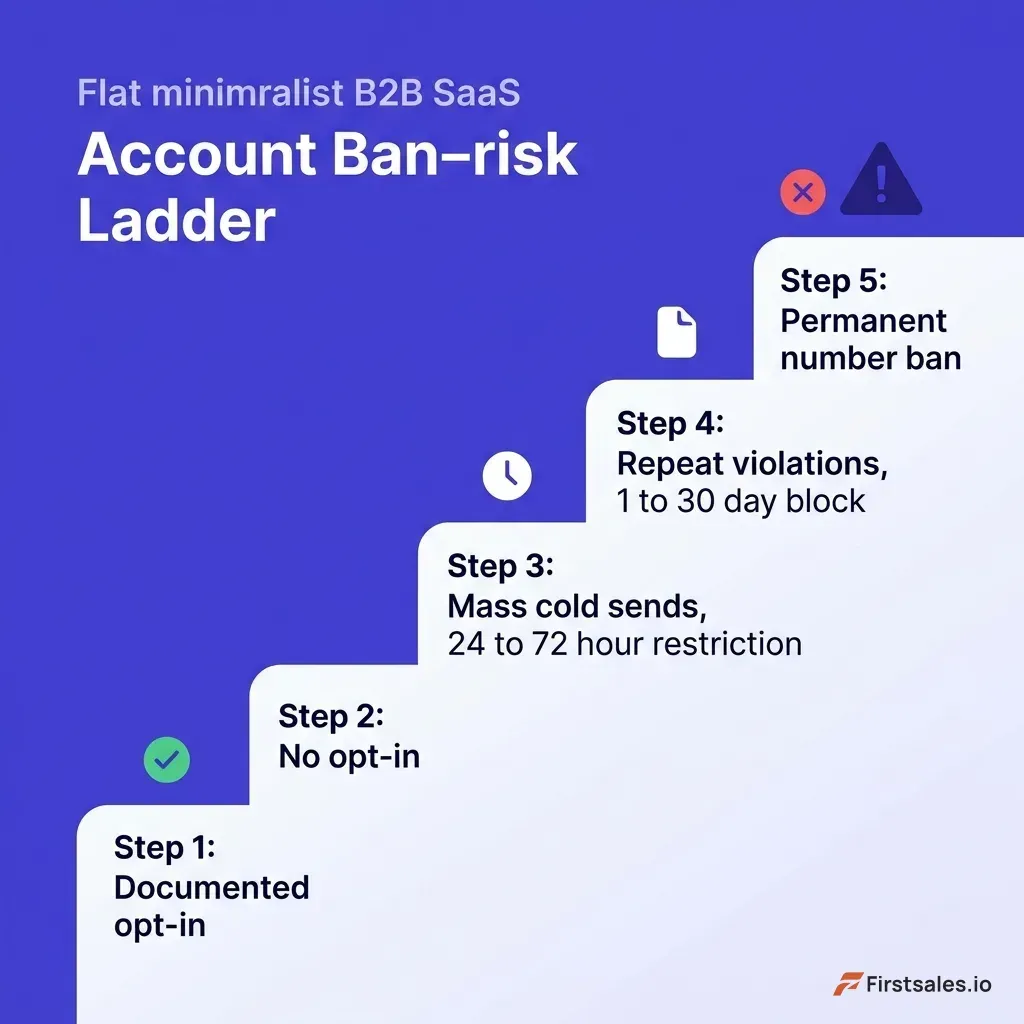 Flat infographic of a WhatsApp account ban-risk ladder showing five escalating stages from left to right: documented opt-in marked safe with a green check, no opt-in marked risky, mass cold sends triggering a 24 to 72 hour restriction, repeat violations triggering a 1 to 30 day block, and persistent abuse ending in a permanent number ban marked with a red cross, deep indigo background with white icons and a single indigo warning accent
The takeaway is not that WhatsApp is closed to outbound. It is that WhatsApp outbound has to be earned through consent or kept small enough and human enough to stay under the enforcement radar. The mass-blast economics that some teams still run on email simply do not transfer.
#The legal layer: GDPR, TCPA, and consent
Platform policy is only the first wall. The law sits behind it, and the penalties are larger.
In the United States, the Telephone Consumer Protection Act governs marketing messages to mobile numbers, and WhatsApp messages can fall under its reach. TCPA violations carry statutory damages of $500 to $1,500 per message. Per message.
A list of 300 cold sends is not a $5 mistake. It is a potential six-figure exposure if the wrong recipient decides to act on it. The FCC can layer on penalties of up to $23,727 per violation on top of private claims.
In Europe, the General Data Protection Regulation treats a phone number as personal data and requires a lawful basis to process it. For live B2B calls to corporate numbers you can sometimes rely on legitimate interest after a documented assessment, but automated marketing messages to individuals sit on much shakier ground and usually need explicit consent. Regulators have shown they will act.
An Italian enforcement case produced a GDPR fine of 27.8 million euros for aggressive marketing practices. That is the order of magnitude at the top end.
The compliance pattern that keeps you safe is the same across both regimes. Collect affirmative opt-in. Document exactly when, how, and where each person consented, including the disclosure language they saw.
Keep consent per channel and per brand, since permission to email you is not permission to WhatsApp you, and consent cannot be shared or sold between entities. Provide an easy opt-out and honor it immediately.
None of this makes WhatsApp unusable. It makes WhatsApp a channel you graduate contacts into after they have shown interest, rather than a channel you push contacts into from a cold list. The legal exposure on cold WhatsApp is high enough that the responsible default for most teams is to treat opt-in as the price of entry.
#Regional nuance: where WhatsApp earns its place
The single biggest mistake in this debate is assuming WhatsApp behaves the same everywhere. It does not. The channel is woven into daily business life in some markets and treated as private space in others, and that cultural fact drives outcomes more than any subject line ever will.
In India, WhatsApp is business infrastructure. The country has around 15 million active WhatsApp Business accounts, and buyers expect to transact, negotiate, and follow up there. In Brazil and the wider LATAM region, the pattern is even stronger on the commerce side.
About 72% of Latin American consumers have purchased through a messaging app, against 45% in Europe, and Brazil leads global WhatsApp Business API adoption. In the MENA region, WhatsApp is the dominant chat app, with penetration around 90% in the UAE and double-digit platform growth through 2025.
The United States and much of Western Europe look different. WhatsApp adoption is growing, up around 22% among US local retailers in 2025, but it remains a smaller and more personal channel for business contact. A cold WhatsApp message to a US enterprise buyer is more likely to read as a privacy breach than a normal touch.
A cold WhatsApp message to a Brazilian SMB owner can read as the obvious way to reach them.
| Region | WhatsApp business context | Cold first-touch risk | Best role |
|---|---|---|---|
| India | Core sales and support channel | Moderate | Early touch with research |
| Brazil and LATAM | Dominant commerce channel | Moderate | Early touch with research |
| MENA (UAE, Gulf) | Dominant chat app, high penetration | Moderate | Early touch with research |
| United States | Growing but personal | High | Warm follow-up only |
| Western Europe | Mixed, privacy-sensitive | High | Warm follow-up only, opt-in first |
The practical rule writes itself. In WhatsApp-first regions, the channel can sit earlier in the sequence, provided the message is researched and human. In the US and EU, WhatsApp belongs later, after a contact has engaged, and ideally after they have opted in.
Same tool, opposite placement, decided entirely by geography.
#Where WhatsApp fits in a multichannel sequence
The strongest case for WhatsApp is not as a standalone channel at all. It is as one instrument in a coordinated sequence where each channel does the job it is best at.
The data backs the sequence approach hard. Multichannel cadences using three or more channels generate around 287% more responses than single-channel outreach, and well-spaced sequences can reach response rates near 40%. WhatsApp on its own, used as a final touchpoint to opted-in contacts, shows a reply rate around 4% in some benchmarks, which sounds low until you remember it is recovering replies the earlier channels missed.
The order that practitioners converge on looks like this. Email goes first, because it is the place built for a professional introduction and it carries the lowest risk if the timing is off. LinkedIn adds a face and social proof.
WhatsApp comes later, referencing the earlier touches, as the nudge that turns a stalled thread into a live conversation. The spacing matters as much as the order. Leave 2 to 3 days between channels, and never fire email, LinkedIn, and WhatsApp on the same day, which reads as a swarm rather than a sequence.
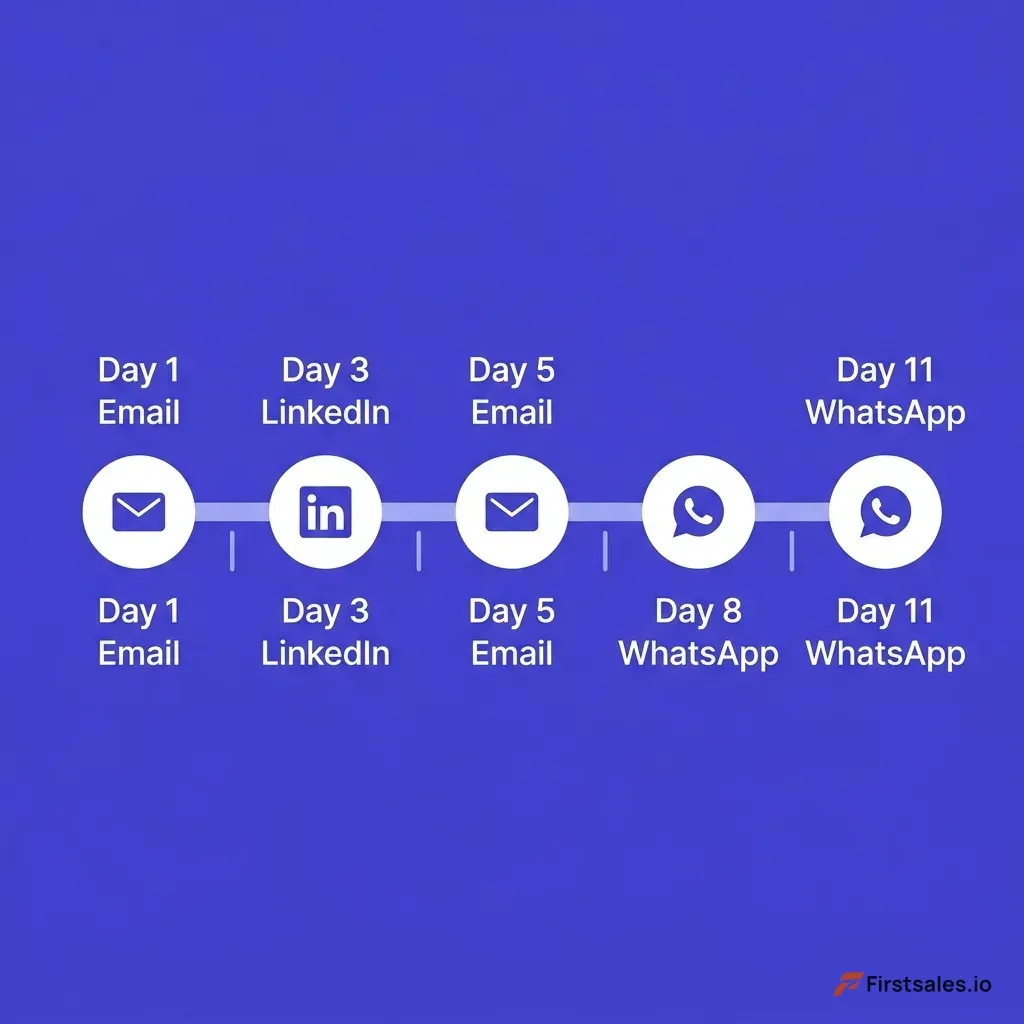 Horizontal timeline diagram of a five-step B2B multichannel sequence reading left to right: day one email introduction, day three LinkedIn connection, day five second email, day eight WhatsApp follow-up referencing the earlier emails, and day eleven a final WhatsApp nudge, each step shown as a labeled node with a channel icon and the spacing marked between nodes, deep indigo background with white nodes and light indigo connecting line
One rule separates a sequence from a nuisance. Each channel needs its own tone and its own message. Copying your email body into a WhatsApp text undoes the whole point, because the value of WhatsApp is that it feels like a person typing, not a template arriving.
The WhatsApp touch should reference what came before. Something like "Hi Marco, I sent a note last week about the SDR roles you posted. Easier to chat here if that works for you?" carries the thread forward and respects the channel.
This is the model covered in depth in the email and LinkedIn multichannel playbook. WhatsApp slots into that framework as the high-intimacy, late-stage touch. It is the channel you spend your earned trust on, not the channel you use to ask for trust you have not earned.
#How signal-based timing makes WhatsApp land
A channel this personal needs a reason to exist in the thread. Without one, even a perfectly worded WhatsApp message reads as "how did you get my number?" The reason is a signal, and timing the touch to that signal is what turns an intrusion into a welcome message.
A signal is something real and recent that makes your outreach relevant to this person right now. A funding round. A burst of hiring in the department you sell to.
A new VP who is evaluating every tool in the stack. A product launch. When one of these exists, the WhatsApp message writes itself honestly, because you are reflecting a reason that already exists rather than inventing relevance from a job title.
Compare the two openers. "Hi, we help sales teams book more meetings, do you have 15 minutes?" is a cold pitch on a personal channel, and it will read as spam no matter how polite it is. "Saw you just brought on a new head of demand gen and posted four SDR roles.
That usually means a fresh look at the outbound stack. Worth a quick chat?" is a message anchored to a moment, and the personal channel now works in your favor because it signals you actually paid attention. This is the same principle behind signal-based cold email, only the stakes are higher because the channel is more intimate.
Timing is the other half. A signal has a short window of relevance. A new hire is most receptive in their first 90 days.
A funding announcement is freshest in the weeks after it breaks. The whole point of moving fast on a lead is to reach the person while the reason is still true. WhatsApp's 45-second reply times make it the ideal channel for acting inside that window, but only if you have the signal feeding the timing.
This is the model FirstSales is built around. It watches for buying signals, drafts the outreach with a human reviewing before anything sends, and times the touch to the moment the signal is freshest. The point is not to automate WhatsApp blasts, which the platform now actively bans.
The point is to make sure that when a personal channel like WhatsApp is the right move, you reach for it with a real reason and a human hand on the send button rather than a scraper and a template.
When a prospect does reply, how you handle that first message decides everything, which is why a tight reply-handling playbook matters more on WhatsApp than anywhere else. The reply comes in seconds, the expectation of a fast human answer is high, and a slow or robotic response wastes the entire advantage the channel gave you.
#The cost math most teams skip
WhatsApp is not free to send through at scale, and the pricing changed in a way that matters for outbound planning. As of July 1, 2025, Meta moved from conversation-based pricing to per-message pricing, billing each delivered template message individually.
Marketing messages are the expensive tier, running roughly $0.01 to $0.14 per message depending on the country, and they do not qualify for the volume discounts that utility and authentication messages get. Utility messages cost 80 to 90% less. There is one genuinely useful free window: when a customer messages your business first, a 24-hour service window opens, and every reply you send inside it is free with no template and no per-message charge.
Read that pricing structure as a design hint. Meta charges you to initiate cold marketing contact and gives you free messaging once the customer starts the conversation. The economics push you toward earning the inbound message, then responding freely, which is the same direction the policy pushes.
For a B2B team, the cost per message is rarely the binding constraint anyway. The 50-messages-per-day ceiling and the ban risk cap volume long before the per-message fee becomes the issue. The real cost of cold WhatsApp is not the cents per send.
It is the replacement cost of a banned number and the legal exposure of an unconsented list.
#WhatsApp versus email for cold B2B, side by side
Here is the direct comparison on the dimensions that decide whether a channel belongs in your cold motion.
| Factor | Cold email | |
|---|---|---|
| Open rate | 68-98% | ~21% |
| Median reply time | 45-90 seconds | 6+ hours |
| Cold reply rate (researched, opted-in regions) | 15-20% | 1-10% (avg 3.43%) |
| Daily volume per number/inbox | ~50 messages | Much higher when warmed |
| Opt-in required to send cold | ✓ (affirmative, documented) | ✗ (B2B norms more permissive) |
| Ban risk for cold blasts | ✓ High (number bans) | Lower (deliverability hit) |
| Works as cold first touch | ✗ (region-dependent, risky) | ✓ |
| Works as warm follow-up | ✓ Strong | ✓ |
| Legal exposure (TCPA/GDPR) | ✓ High ($500-$1,500/msg TCPA) | Moderate |
| Best region fit | India, LATAM, MENA | Global |
The pattern is clear once it is laid out. WhatsApp wins decisively on engagement and loses decisively on safety and scale. Email wins on volume, global fit, and tolerance for cold sends, and loses on attention.
They are not competitors. They are a relay team, and the handoff order matters.
The row that should reset most teams' thinking is "works as cold first touch." Email earns a checkmark there and WhatsApp earns a cross, with a regional asterisk. That single difference is why "should I do cold WhatsApp outreach?" has a different answer than "should I do cold email?"
The channels look similar from the outside and behave like opposites in practice.
#A practical playbook for using WhatsApp without getting burned
If you want WhatsApp in your B2B motion, here is the approach that captures the upside without inviting a ban or a fine.
Lead with email, not WhatsApp. Use email or LinkedIn for the first touch. Let the contact know you exist in a channel built for cold introductions. Save WhatsApp for after they have engaged, or for regions where it is the cultural default and your message is genuinely researched.
Earn opt-in wherever you can. The cleanest path is to get the contact to message you first or to actively agree to WhatsApp contact. An inbound message opens a free 24-hour window and removes most of the legal and policy risk in one move. Build opt-in into your forms, your email CTAs, and your LinkedIn conversations.
Keep it one to one and human. WhatsApp punishes templates. Every message should reference a specific signal or a prior touch and read like a person typed it. If you would not send it to a single named person you respect, do not send it to 50.
Respect the volume ceiling. Warm new numbers for two to three weeks. Stay near 50 sends a day. Treat WhatsApp as a precision tool for your best-fit accounts, not a volume channel for your whole list.
Document consent like a compliance officer. Record when, how, and where each person opted in, and the exact language they saw. Keep consent per channel. Honor opt-outs instantly.
This is the difference between a defensible program and a six-figure TCPA exposure.
Match the channel to the region. Place WhatsApp early in India, Brazil, and the Gulf, where it is normal business contact. Place it late and opt-in-gated in the US and EU, where it reads as private space.
Follow that and WhatsApp becomes a sharp closing instrument in a sequence, recovering replies the earlier channels missed and reaching prospects in seconds when the timing is right. Ignore it and WhatsApp becomes the fastest way to lose a number, a list, and possibly a lawsuit.
#FAQs
#Does WhatsApp cold outreach actually work for B2B?
It works as a warm follow-up channel, not a cold first touch. For researched, personalized messages to specific contacts in WhatsApp-heavy regions, reply rates of 15-20% are documented, well above email's typical 1-10%. Sent as a mass blast to scraped numbers with no opt-in, it produces reflexive replies that rarely close and gets your number restricted or banned.
#Is cold messaging on WhatsApp against the rules?
Yes, in effect. WhatsApp policy requires recipients to take an affirmative action to opt in before you send them business messages, and unsolicited marketing is a policy violation. Failure to document consent is the leading cause of WhatsApp Business account bans in 2026.
You can send cold one-to-one human messages at low volume, but mass cold sending breaks the rules and triggers enforcement.
#What happens if I send too many cold WhatsApp messages?
Meta escalates enforcement in stages. First come temporary sending restrictions of 24 to 72 hours, then 1 to 30 day blocks, then account locks, and finally permanent phone number bans for repeat offenders. A new number also needs two to three weeks of warm-up and tops out around 50 messages per day before quality flags fire.
#How does WhatsApp open rate compare to email?
WhatsApp open rates are measured between 68% and 98% depending on methodology, against about 21% for email. The widely repeated 98.2% figure comes from a Twilio benchmark of 4.8 billion messages but lacks a clean primary source, so the honest range starts at roughly 68%. Even the floor of that range far exceeds email.
#Where in a sequence should WhatsApp go?
Later, as a nudge after an earlier email or LinkedIn touch. The proven order is email first for a professional introduction, then LinkedIn, then WhatsApp referencing the earlier messages, with 2 to 3 days between channels. Never send email, LinkedIn, and WhatsApp on the same day, and never copy the same message across channels.
#Is WhatsApp cold outreach legal under GDPR and TCPA?
It carries real legal risk. Under US TCPA, marketing messages to mobile numbers without written consent can cost $500 to $1,500 per message, plus FCC penalties up to $23,727 per violation. Under GDPR, a phone number is personal data and automated marketing usually needs explicit consent, with fines reaching tens of millions of euros for aggressive practices.
Documented opt-in is the safe path.
#Which regions are best for WhatsApp B2B outreach?
India, Brazil and the wider LATAM region, and the MENA region, where WhatsApp is normal business infrastructure. India has around 15 million WhatsApp Business accounts, and 72% of Latin American consumers have purchased through messaging versus 45% in Europe. The US and Western Europe treat WhatsApp as more personal, so it belongs later in the sequence there and ideally behind an opt-in.
#How much does it cost to send WhatsApp business messages?
Since July 2025, Meta charges per delivered template message. Marketing messages run roughly $0.01 to $0.14 each depending on country and do not get volume discounts. Utility and authentication messages cost 80 to 90% less.
Replies sent within 24 hours of a customer-initiated message are free, which rewards earning the inbound contact rather than initiating cold.
#Can I automate WhatsApp outreach with AI?
Not the open-ended way you might expect. As of January 15, 2026, Meta banned mainstream general-purpose AI chatbots from the WhatsApp Business API. Purpose-built automation flows like booking and order bots are still allowed.
The platform now favors consented, structured, human-supervised messaging over autonomous outreach, so the practical model is AI-assisted drafting with a human reviewing before send.
#What is the difference between a reply and real interest on WhatsApp?
A reply on WhatsApp is cheap because the channel is personal enough to trigger reflexive responses, including "who is this?" One practitioner scraped 300 leads, got 40 cold replies, and closed zero deals. Real interest comes from messages anchored to a genuine signal and a prior touch, which is why researched, well-timed WhatsApp nudges convert and cold blasts do not.
#How many WhatsApp messages can I send per day safely?
Around 50 per day per number after a two to three week warm-up period. WhatsApp is structurally a low-volume channel compared with email. Pushing past that ceiling, especially to unconsented contacts, accelerates quality flags and bans.
Treat it as a precision tool for your best-fit accounts rather than a place to send at scale.
#Conclusion
WhatsApp is the most engaged channel in business messaging and one of the riskiest places to run cold outbound. Both things are true at once, and the tension between them is the whole story. Open rates between 68% and 98%, reply times under a minute, and 15-20% cold reply rates in the right regions make it impossible to ignore.
Mandatory opt-in, a 50-message daily ceiling, permanent number bans, and TCPA exposure of up to $1,500 per message make it impossible to blast.
The resolution is not to pick a side. It is to place WhatsApp correctly. It belongs late in a multichannel sequence, after email has made the introduction and a real signal has given you a reason.
It belongs early only in markets like India, Brazil, and the Gulf where it is normal business contact, and even there only when the message is researched and human. It belongs behind an opt-in wherever the law and the platform demand one, which is increasingly everywhere.
The teams winning on WhatsApp are not the ones sending the most messages. They are the ones earning the channel with a signal, an earlier touch, and a human who decides each send is worth making. That is harder than scraping numbers and hitting blast.
It is also the only version that survives Meta's enforcement and produces revenue instead of reflexive replies.
If you want WhatsApp to work as the precision closing touch it can be, the rest of the sequence has to feed it. FirstSales watches for the buying signals that justify a personal channel, drafts the outreach with a human in the loop, and times each touch to the moment it is most relevant, so that when WhatsApp is the right move, you reach for it with a reason instead of a scraper. Start your first campaign for $1 at https://app.firstsales.io and build a sequence that earns the reply before it asks for one.