
#Website visitor deanonymization for warm outbound
Copy page
TL;DR: Website visitor deanonymization matches anonymous traffic to companies and, in the US, sometimes to named people. Company-level matching is solid and privacy-safe, with realistic rates of 30 to 65% on US B2B traffic. Person-level matching is narrower and legally heavier, landing around 5 to 20% of US visitors and mostly off-limits in the EU.
The payoff is warm outbound: a visit is a buying signal, and signal-triggered sequences reply at 15 to 25% against a 3.43% cold-email average. The catch is timing and tact. Reach out fast, lead with relevance, and never say "I saw you on our site."
#Table of contents
- What website visitor deanonymization actually means
- How the identification stack works
- Company-level vs person-level: the match-rate reality
- Why a deanonymized visit is a warm outbound signal
- The privacy line: what GDPR and CCPA actually allow
- How to sequence a visit signal without being creepy
- Timing windows: the visit signal decays fast
- Combining visit intent with other signals
- Where this breaks: accuracy and honesty limits
- FAQs
- Conclusion
#What website visitor deanonymization actually means
Most people who visit your website never fill out a form. Industry trackers put the share of anonymous traffic above 95% on a typical B2B site. They read a page, maybe two, and leave without a name, an email, or a trace you can act on.
Deanonymization is the set of methods that put a name back on some of that traffic.
Website visitor deanonymization is the process of matching an anonymous web visit to a known company or person using IP data, cookies, device signals, and third-party identity graphs. The word sounds darker than the practice usually is. At the company level it reads an IP address and tells you which business is browsing.
At the person level it tries to tie the visit to a specific human with a name, title, and work email.
That gap between "which company" and "which person" is the whole story. One side is mature, cheap, and on safe legal ground. The other side is newer, thinner, and where almost all the privacy risk lives.
Teams that blur the two end up either wasting the data or getting themselves into trouble.
The reason this matters now is intent. A visit is not a vanity metric. Someone at a target account read your pricing page on a Tuesday afternoon.
That is a buying signal sitting in your analytics, going to waste, while your reps cold-email a static list that has no idea you exist. Turning that visit into a timed, relevant message is what separates warm outbound from the spray-and-pray version that buyers delete on sight.
#How the identification stack works
There is no single trick behind visitor identification. Modern tools stack several signals and resolve them against identity databases. Understanding the stack tells you why match rates are what they are and why some claims are nonsense.
The base layer is reverse IP lookup. When a visitor loads your page, a pixel or server call captures their IP address and checks it against an IP-to-company database. Providers like MaxMind, IPinfo, and specialized B2B graphs map corporate IP ranges to company records, then enrich them with industry, employee count, revenue, and domain.
If the visitor sits behind a recognized corporate network, you get the company. If they sit behind a home router or a phone carrier, you usually get nothing useful.
That second case is the problem reverse IP has been losing to for years. Remote and hybrid work scattered employees off corporate networks. Some estimates now put identifiable corporate-IP traffic below 20% for many B2B sites, down from a time when most B2B browsing happened from an office.
Reverse IP on its own catches roughly 30 to 60% of B2B visits, and that ceiling keeps drifting down.
An IP address tells you the building. It does not tell you who is in the room.
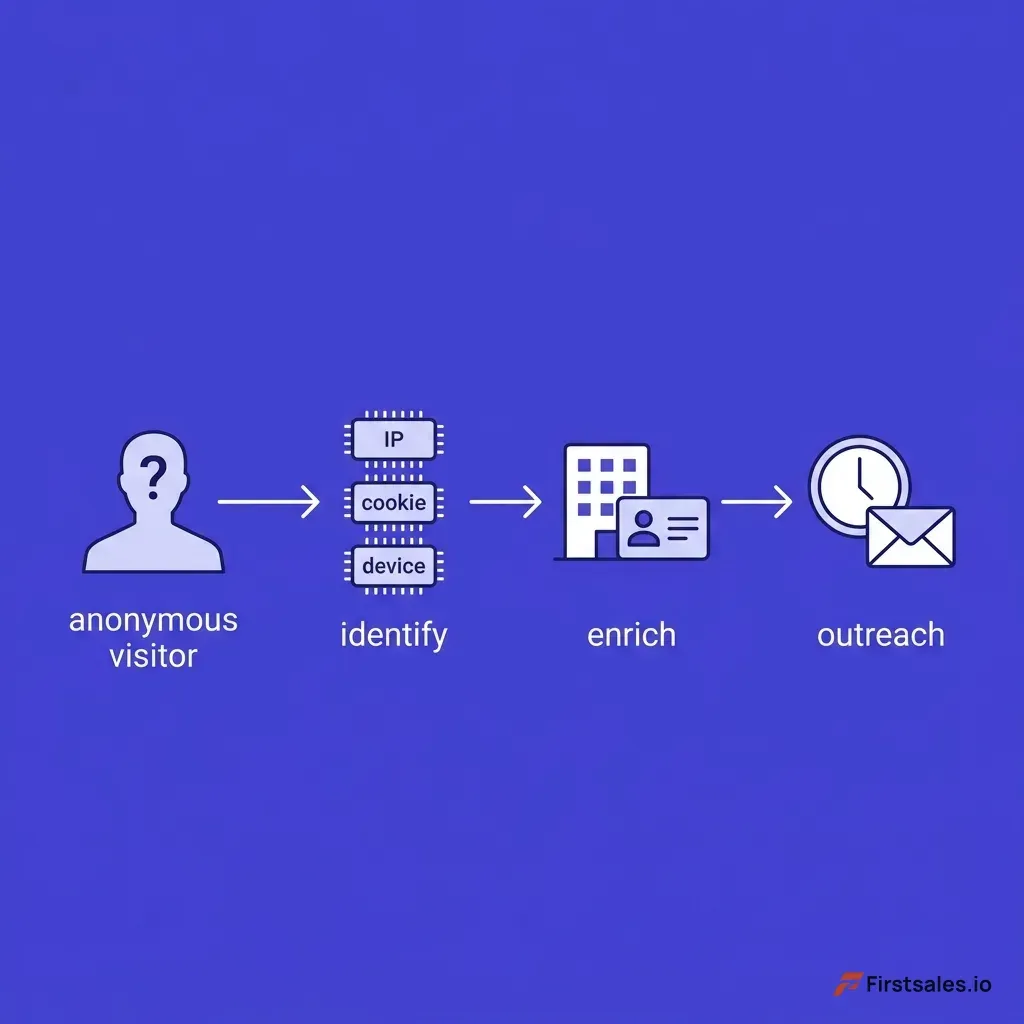 Flat indigo and white diagram of the visitor deanonymization pipeline: an anonymous visitor icon flows to an identify step (IP plus cookie plus device fingerprint), then an enrich step (company and contact data), then a signal-timed outreach step with a clock and an envelope
To make up the difference, tools add layers on top of the IP. A first-party cookie dropped from your own domain tracks the same browser across visits. A device fingerprint combines screen resolution, fonts, timezone, user agent, and a canvas hash into a fairly stable identifier for one device.
On top of that sit identity graphs: large pools of cookie-to-email and device-to-person mappings that vendors build or buy, often seeded by deterministic matches where a person logged in somewhere with a known email.
Those two data types behave very differently. Deterministic matching uses hard identifiers like a hashed email a person actually entered, which gives high accuracy at low volume. Probabilistic matching infers identity from IP, device, and timing patterns, which gives broader reach at lower confidence.
Person-level vendors lean on the probabilistic side to scale, and that is exactly why their numbers come with an asterisk.
The output of the stack is a record: a company or a person, plus firmographic and contact data, attached to the pages they viewed. That record is the raw material for warm outbound. What you do with it next decides whether it earns replies or complaints.
#Company-level vs person-level: the match-rate reality
The single most useful thing you can learn here is to stop treating "visitor identification" as one feature. It splits into two products with different match rates, different privacy exposure, and different jobs in your pipeline.
Company-level identification answers "which account is here." It is built on reverse IP plus firmographic enrichment, it does not name a human, and an IP address is not personal data under most frameworks. That makes it both the cheaper option and the one regulators care least about.
Realistic rates run 30 to 65% on US B2B traffic with a strong corporate-buyer mix, and lower-end tools land closer to 10 to 30%.
Person-level identification answers "which human is here." It names an individual with title, email, and often a LinkedIn profile. It is mostly a US capability, it carries real privacy obligations, and its match rate is the number vendors most often inflate.
Independent reviews put person-level resolution around 5 to 20% of US traffic for most tools. Deterministic providers reach 30 to 40% in good conditions, and a few premium tiers claim 70 to 80% with extra resolution enabled, though those figures rarely survive an independent test.
Here is the side-by-side that should shape how you budget and deploy.
| Factor | Company-level identification | Person-level identification |
|---|---|---|
| What you get | Account name, firmographics, pages viewed | Named person, title, work email, LinkedIn |
| Realistic US match rate | 30 to 65% | 5 to 20% (deterministic tiers higher) |
| Works in the EU/UK | ✓ (legitimate interest basis) | ✗ (consent required, usually geofenced off) |
| Privacy exposure | Low (IP is not personal data) | High (names a natural person) |
| Best outbound use | ABM, account routing, sales alerts | Direct SDR follow-up to a person |
| Cost | Lower | Higher |
| Vendor inflation risk | ✓ moderate | ✗ severe, verify before you buy |
The practical read: company-level is your default and your volume. Person-level is a targeted add-on you deploy carefully, in the US, on accounts worth the extra scrutiny. Treating person-level as your primary engine is how teams overpay for thin data and walk into a compliance problem at the same time.
A warning on vendor math. Most providers quote a match rate without telling you the denominator. A "70% match rate" measured against only the traffic the tool already thinks it can identify is meaningless.
The number that matters is matches divided by total unique visitors. Ask for that, in writing, before you sign anything.
#Why a deanonymized visit is a warm outbound signal
Cold outbound is in rough shape. Average cold-email reply rates have slid to about 3.43% in 2026, down from roughly 7% two years earlier, and by some measures around 91% of cold emails get no reply at all. The reason is not your subject line.
It is that the recipient has no relationship to the message and no reason to care.
A website visit flips that. The person already chose to look at you. They typed your URL, clicked an ad, or followed a link because something pulled them in.
That is the difference between a name pulled off a static list and a name attached to a real action. The first is a guess. The second is a signal.
The reply-rate data follows that logic. Warm introductions convert to a first conversation roughly 10 to 20 times more often than pure cold outreach. Signal-based outbound, the category a deanonymized visit belongs to, consistently runs 15 to 25% reply rates against the 3.43% cold baseline.
The pattern repeats across documented cases. One cybersecurity vendor reported an 11% reply rate on intent-triggered targeting versus under 1% on cold sequences. Docebo's team reported a 16% average reply rate using stacked signals against a 2 to 3% baseline.
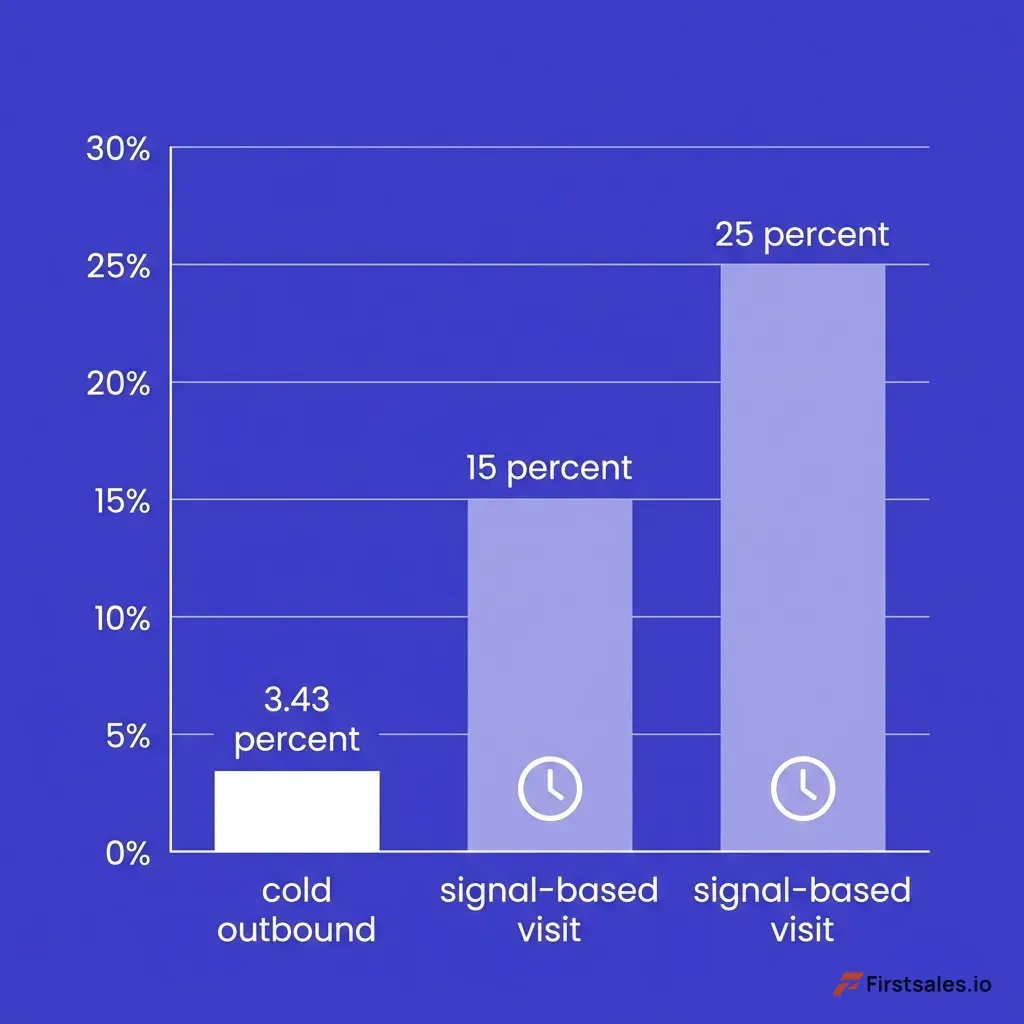 Flat indigo and white bar chart contrasting reply rates: cold outbound at 3.43 percent as a short bar, signal-based outbound from a website visit at 15 to 25 percent as tall bars, with a small clock icon marking faster follow-up
Notice what is doing the work here. The lift does not come from the data point alone. It comes from what the data point lets you say.
A visit gives you a true, specific, current reason to reach out, and specificity is the thing buyers reward because it proves a person paid attention. This is the same engine behind signal-based cold email, where the message is built around a real event instead of a persona guess.
One honest caveat. Reply rate is a leading indicator, not the scoreboard. A flood of replies from low-fit visitors who happened to bounce on your homepage will not turn into pipeline.
Measure deanonymized outbound against meetings booked and pipeline sourced, not just how many people wrote back. The point of the signal is better conversations, and that only shows up further down the funnel.
#The privacy line: what GDPR and CCPA actually allow
This is where people get nervous, and where most of the real risk sits. The short version: company-level identification is on firm footing almost everywhere, and person-level identification is a regulated activity you cannot do casually. Get this part right before you scale anything.
Under GDPR, you need a lawful basis to process personal data. Identifying a company by its IP is generally fine because a legal entity is not a natural person, so most company-level use runs on the legitimate-interest basis in Article 6(1)(f). Naming an individual EU visitor is a different matter.
Recital 47 requires you to balance your interest against that person's rights, and quietly resolving someone's name and email from an anonymous visit tilts that balance against you. In practice, reputable tools geofence EU and UK traffic down to company-level only, and serious person-level use there needs consent plus a Data Protection Impact Assessment. If a vendor tells you they do person-level ID across Europe with no consent step, that is a red flag, not a feature.
The US picture changed too, and a lot of sales teams missed it. The CCPA's B2B exemption expired in January 2023. Work emails, direct phone numbers, and job titles of California residents are now protected personal information, not a carve-out.
The CPRA amendments tightened the definitions of selling and sharing data, which means tools that pool cookie graphs across many customers may trigger an opt-out obligation on the site running the pixel. Person-level identification is legal and widely deployed in the US, but "legal" is not "do whatever you want."
The cost of getting it wrong is not abstract. CAN-SPAM penalties in the US can reach 46,517 dollars per email. GDPR fines top out at 20 million euros or 4% of global revenue.
You do not need to hit a cap to feel pain. A spike in spam complaints from people who feel surveilled will wreck your domain reputation long before a regulator ever calls.
The defensible setup is boring and effective. Run company-level identification as your broad layer everywhere. Reserve person-level identification for US traffic, with a visible privacy policy, a working opt-out, and a documented basis for what you collect.
The legality of the outreach itself is a separate question worth understanding on its own, which is why whether cold email is legal in 2026 is a conversation every outbound team should have before they press send.
#How to sequence a visit signal without being creepy
Here is the mistake that ruins this entire play in one sentence: "Hi, I saw you visited our website." Do not write that. Ever.
It tells the prospect you are watching them, it makes the relationship adversarial before it starts, and it converts a useful private signal into a public accusation.
Some visitor tools say outright that they will not even show you the exact person, because surfacing that to a rep tends to produce exactly this kind of weird message. The signal is for you, not for the email. Think of a visit the way a good salesperson treats a tip from a mutual contact.
You use it to be relevant and well-timed. You do not announce where it came from.
So what does a non-creepy sequence look like? You let the visit decide who you contact and when, then you write a message that stands on its own merit. If someone from a target account read your pricing and integrations pages, that tells you they are evaluating, so you reach out about the evaluation, not the browsing.
A clean opener references the account's situation, not their clicks. "Teams your size moving from spreadsheets to a real outbound stack usually hit a wall on deliverability around the 50-rep mark. Curious whether that is on your radar this quarter."
That message is true, specific, and timed by the visit, yet it never reveals the visit. The prospect reads it as a relevant note, not a stalker memo.
Three rules keep you on the right side of the line. First, never quote behavior back at the prospect, not the pages, not the time on site, not the visit count. Second, lead with a problem or an observation about their world that the visit told you is relevant right now.
Third, make the call to action small and matched to the evaluation stage, a specific question rather than a 30-minute demo ask. This is the same discipline that separates buying signals for cold email that earn replies from the ones that earn unsubscribes.
There is also a routing decision. Company-level signals are usually best handled as an account alert to the owning rep, who already has context and existing contacts. Person-level signals can go to a direct sequence, but only with the tact above.
Either way, the human reviewing the draft is the safety valve that catches the creepy line before it ships.
#Timing windows: the visit signal decays fast
A visit is perishable. Its value drops by the hour. The person who read your pricing page at 2pm is in an evaluation mindset at 2pm.
By next Tuesday they have moved on, talked to two competitors, or forgotten you entirely. Outbound built on stale signals is just cold outbound with extra steps.
Speed is the lever almost nobody pulls correctly. The classic lead-response research from Dr. James Oldroyd found that contacting a web lead within five minutes makes them far more likely to enter a real conversation than waiting even 30 minutes, and the odds collapse after an hour. Deanonymized visits are not inbound forms, so you cannot and should not auto-fire a reply in five minutes.
The principle still holds: same-day beats next-day, and next-day beats next-week by a wide margin.
That creates a real tension with the privacy and quality rules above. You want human review on every message, and you want to send while the signal is hot. The way out is to pre-stage the work.
Build the account research and the message frame before the visit happens, so that when an account lights up, the rep is adding one specific sentence and hitting send, not starting from a blank page. The broader case for moving fast on warm signals is covered in speed to lead in outbound, and it applies directly here.
A workable cadence looks like this. Treat a fresh visit from a fit account as a same-day or next-morning task. Treat a repeat visit, the same account back again within a week, as a stronger signal worth jumping the queue.
Let a single visit from three weeks ago expire quietly rather than reaching out cold and pretending it is warm. The signal had a shelf life, and you missed it. That is fine.
Another one will come.
This is the part where tooling earns its keep. FirstSales watches for the moment an account or person re-engages and surfaces it as a timed prompt, so the reach-out lands inside the window instead of in a weekly batch that has already gone stale. The data is only as good as how fast you act on it, and a pile of week-old visits in a dashboard nobody checks is worth nothing.
#Combining visit intent with other signals
A lone visit is a weak signal. It could be a job seeker, a competitor doing research, or a student writing a paper. The play gets much stronger when you stack the visit against other evidence that the account is actually in a buying motion. Layered signals are how you separate the real intent from the noise.
The visit tells you who is paying attention. Other signals tell you whether attention means anything. A recent funding round means budget and new problems to solve.
A spike in relevant hiring, say a company posting ten SDR roles, means they are building the exact capacity your product supports. A new VP of Sales in the last 90 days means someone is reviewing every tool in the stack. When a visit lands on top of one of those, the account moves to the front of the line.
The math is simple. A visit alone might be a 5% reply opportunity. A visit from an account that also just raised a Series B and posted three RevOps roles is a different animal, because now three independent facts point the same direction.
You are not guessing that they have a reason to buy. You are reading it off the record. Stacking visit intent with firmographic and event data is the core idea behind moving from static lists to live triggers, which intent-based prospecting versus static lists breaks down in full.
There is a sequencing benefit too. Multiple signals give you more honest things to say without ever touching the visit. You can open on the funding, reference the hiring, or note the leadership change, and the message reads as well-informed rather than surveillant.
The visit quietly does its job in the background, deciding timing and priority, while the email talks about facts the prospect would happily discuss in public.
The honest limit: signal stacking shrinks your list. You will find far fewer accounts with three aligned signals than accounts with a single visit. That is the point.
Fewer, better-qualified conversations beat a bigger pile of weak ones, and your domain reputation will thank you for the restraint.
#Where this breaks: accuracy and honesty limits
This approach is good, not magic. Selling it as magic is how teams burn money and trust. A few limits are worth saying plainly.
Match rates are lower than the brochure. Across both tiers, you will identify a minority of your traffic, not most of it. If a vendor promises to name 80% of your visitors, ask for the denominator and watch the number shrink.
Plan for company-level on a third to two-thirds of US B2B traffic and person-level on a much smaller slice, and treat anything above that as a pleasant surprise.
The data carries errors. A shared office IP can mislabel a visitor's employer. A probabilistic person-match can attach the wrong name to a device.
Acting on a wrong match is worse than acting on no match, because a confidently personalized email sent to the wrong person reads as both creepy and incompetent. Build in a sanity check before high-effort outreach, and weight deterministic matches over probabilistic ones when the stakes are real.
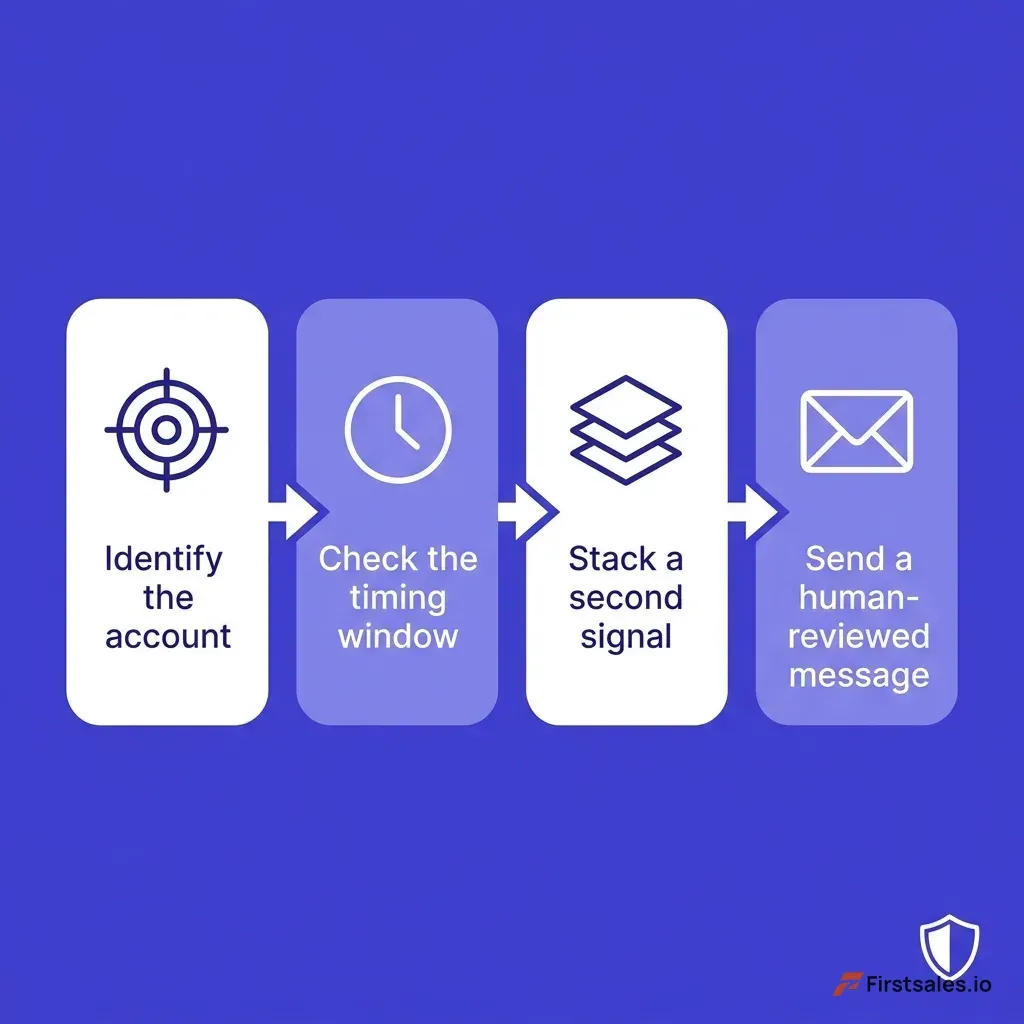 Flat indigo and white infographic of the visit-to-reply framework: four steps shown as connected blocks reading identify the account, check the timing window, stack a second signal, then send a human-reviewed message that never mentions the visit, with a small shield icon marking the privacy guardrail
Geography caps the person-level play. Outside the US, you are mostly working at the company level whether you like it or not, and trying to route around that with an offshore vendor is a fast path to a GDPR problem. Build your motion around what is defensible in each region rather than what is technically possible somewhere.
None of this makes deanonymization a bad bet. It makes it a tool with a known shape. Used inside its limits, with company-level as the base, person-level as a careful US add-on, fast timing, stacked signals, and human-reviewed messages that respect the privacy of the visit, it turns a slice of wasted traffic into the warmest outbound list you have.
That is a real edge. It just is not a miracle, and pretending otherwise is how good tactics get a bad name.
#FAQs
#What is website visitor deanonymization?
Website visitor deanonymization is the process of matching anonymous web traffic to a known company or person using IP lookups, cookies, device fingerprints, and third-party identity graphs. Company-level matching tells you which business visited, while person-level matching tries to name a specific individual with a title and work email. Most B2B sites see over 95% of traffic stay anonymous without it.
#What is a realistic visitor identification match rate?
For company-level identification, 30 to 65% of US B2B traffic is realistic, with weaker tools closer to 10 to 30%. Person-level identification is much lower, around 5 to 20% of US visitors for most tools, with deterministic providers reaching 30 to 40% in good conditions. Any vendor claiming to name 80% or more of your visitors is almost certainly measuring against a misleading denominator.
#Is website visitor identification legal under GDPR and CCPA?
Company-level identification is generally legal because an IP address tied to a business is not personal data, and it usually runs on the GDPR legitimate-interest basis. Person-level identification of EU and UK visitors requires consent and is mostly geofenced off by reputable tools. In the US, person-level ID is legal, but the CCPA B2B exemption expired in January 2023, so California work contacts are now protected personal information.
#Should I say "I saw you visited our website" in my outreach?
No. Quoting the visit back to a prospect makes the outreach feel like surveillance and is the single fastest way to kill the conversation. Use the visit privately to decide who to contact and when, then write a message about the account's situation that stands on its own.
The signal is for your targeting, not for the email body.
#How fast should I reach out after a visit?
As fast as you can while still keeping a human review step, which usually means same-day or next-morning for a fresh visit from a fit account. A visit is perishable and loses most of its value within days, so a weekly batch process wastes the signal. Pre-stage your account research so a rep can add one specific sentence and send quickly when an account lights up.
#What is the difference between company-level and person-level identification?
Company-level identification names the business behind a visit using reverse IP and firmographic data, with no individual named and low privacy risk. Person-level identification names a specific human with contact details, which is narrower, costlier, US-focused, and legally heavier. Use company-level as your broad default and person-level as a careful add-on for high-value US accounts.
#Why does warm outbound from website visitors convert better than cold outbound?
A visit is a real, current action that gives you a true reason to reach out, unlike a name pulled from a static list. Signal-based outbound built on that intent runs 15 to 25% reply rates against a 3.43% cold-email average, and warm introductions convert to a first conversation roughly 10 to 20 times more often than cold. The lift comes from relevance and timing, not from the data point by itself.
#Can I identify EU website visitors at the person level?
In almost all cases, no, not without explicit consent and a Data Protection Impact Assessment. GDPR requires you to balance your interest against the individual's rights, and naming an anonymous EU visitor tilts that against you. Most reputable tools geofence EU and UK traffic to company-level identification only, which remains a useful and defensible signal for account-based outreach.
#What signals should I combine with a website visit?
Stack the visit against buying signals that show an active purchase motion, such as a recent funding round, a spike in relevant hiring, or a new sales or revenue leader in the last 90 days. A visit alone is weak and could be a job seeker or competitor, but a visit on top of two aligned signals is a strong, well-qualified opportunity. Stacking also gives you honest talking points so the email never has to mention the visit.
#What are the biggest risks of using visitor deanonymization for outbound?
The main risks are inflated match-rate expectations, wrong matches from shared IPs or probabilistic guesses, privacy exposure on person-level data, and the creepiness of referencing a visit directly. Each one is manageable: verify match rates against total traffic, prefer deterministic data for high-effort outreach, run company-level as your default, and keep a human review step on every message. Used inside its limits, the approach turns wasted traffic into your warmest list.
#Conclusion
Most of your website traffic walks out the door without a name, and most of it could be telling you something useful. Visitor deanonymization is how you read it. Done well, it turns a quiet analytics number into the warmest outbound list your team has, because every name on it took a real action that gives you a real reason to reach out.
The discipline is what makes it work. Run company-level identification as your broad, privacy-safe base and reserve person-level matching for US accounts worth the extra care. Expect to identify a minority of your traffic, not most of it, and treat any vendor promising more as a vendor to question.
Act fast while the signal is hot, stack the visit against other buying signals to separate intent from noise, and keep a human reviewing every message.
Most of all, respect the line. The visit is a private signal that earns you relevance and timing. It is not a line to quote back.
The teams that win with this never say "I saw you on our site." They just show up at the right moment, talking about the right problem, sounding like someone who did the work, because they did.
FirstSales is built for that motion: spotting the moment an account re-engages, surfacing it inside the timing window, and drafting signal-based outreach with human review built into the workflow so nothing creepy and nothing stale ever ships. Start your first campaign for $1 at https://app.firstsales.io and turn your anonymous traffic into conversations worth having.