#Waterfall Enrichment: Why One Data Provider Fails
Copy page
TL;DR: A single B2B data provider matches roughly 40-70% of your target list, which means a third to a half of your prospects get no email or phone at all. Waterfall enrichment queries providers in sequence, calling the next one only when the previous returns nothing or a low-confidence value, and that pushes match rates above 85% with three to four sources. In one test of 1,000 records, a single source found 62% of emails while a 15-source waterfall found 98%.
Clean, verified data feeds better signal-based outbound. Garbage data feeds bounces, burned domains, and a delete reflex.
#Table of Contents
- What waterfall enrichment actually is
- Why one provider is never enough
- Single-provider vs waterfall match rates
- Email waterfalls vs mobile waterfalls
- The cost-per-verified-record math
- Verification is the part everyone skips
- When waterfall enrichment is overkill
- How clean data feeds signal-based outbound
- Setting up your first waterfall
- Provider match-rate and cost ranges
- FAQs
- Conclusion
#What waterfall enrichment actually is
Waterfall enrichment is the practice of querying several B2B data providers in a set order, and only moving to the next provider when the previous one fails to return a usable result. You check provider one. If it returns a verified email, you stop and pay for that single lookup.
If it returns nothing, or a value the system flags as low confidence, the request cascades down to provider two, then three, then four, until something hits or the list runs out.
That is the whole idea. It sounds almost too simple to matter. It matters a lot.
The reason it works comes down to a fact most outbound teams learn the expensive way: no single database knows everyone. A provider that is strong on US enterprise tech contacts will be thin on European SMBs. A source that nails mobile numbers for sales leaders will whiff on engineering managers.
When you rely on one vendor, you inherit every gap that vendor has, and you never see the records it quietly fails to find. They just show up as blanks in your CRM.
Picture a record dropping through a stack of sieves. Each sieve catches some contacts and lets the rest fall through to the one below. By the time a record reaches the bottom, it has had four or five chances to find a match instead of one.
That cascade is where the lift comes from.
The sequential structure is also what keeps it affordable. You are not paying every provider for every contact. You pay provider one for the whole list, then pay provider two only for the leftovers, provider three only for the leftovers of the leftovers, and so on.
The expensive vendors sit at the bottom of the waterfall and get called least.
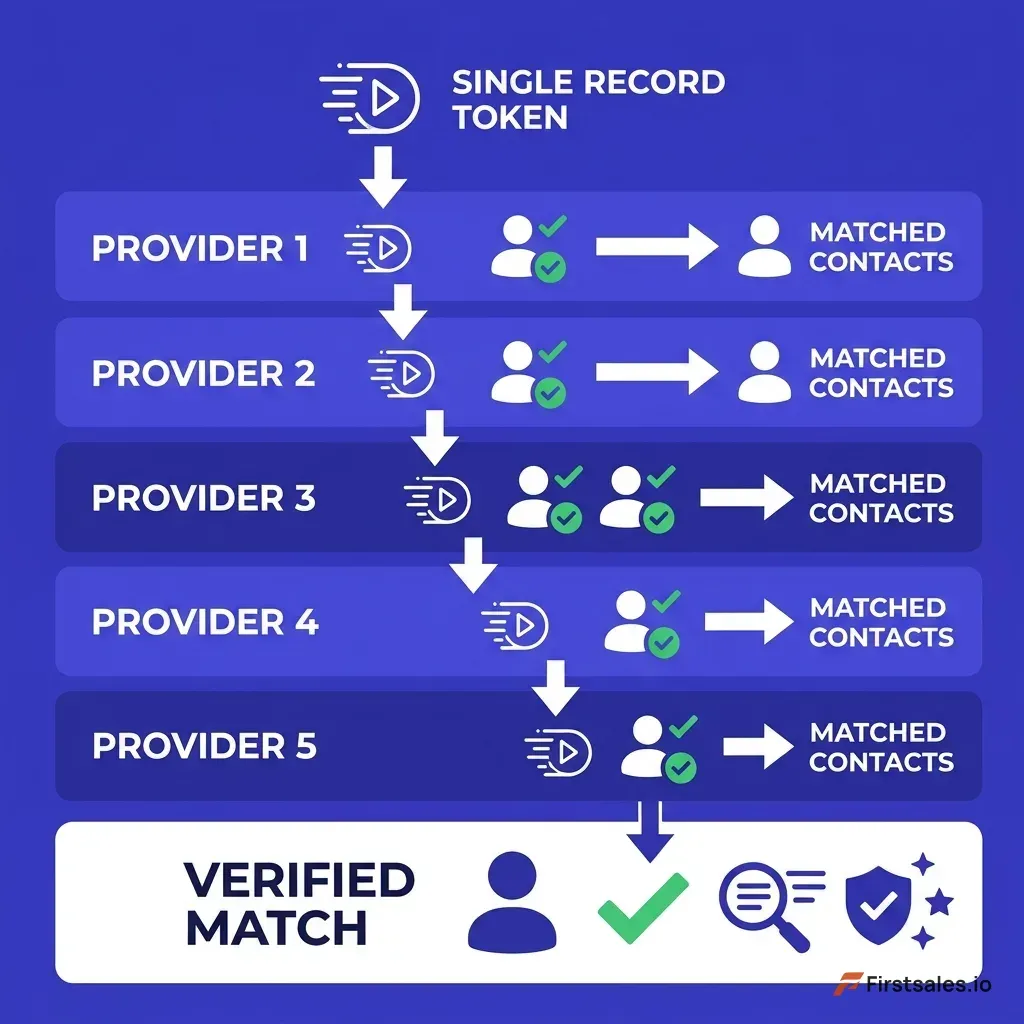 Diagram of records cascading through five stacked B2B data provider layers, each layer catching some matched contacts and passing unmatched records down to the next, with a verified-match output at the bottom
#Why one provider is never enough
Here is the uncomfortable number. Single-provider enrichment typically returns coverage somewhere between 40% and 70% of a clean target list. Unify, which runs waterfall across 30+ sources, puts the single-source industry average at 55-70%.
That means on a list of 1,000 well-defined prospects, a single vendor hands back blanks for 300 to 450 of them.
Those blanks are not random. They cluster around exactly the contacts a single database is weak on. Smaller companies.
Non-US regions. Newer hires whose details have not propagated yet. Senior people who keep a low public footprint.
If your ideal customer happens to live in one of those clusters, a single provider can fail on a huge slice of your best-fit accounts and you would never know the difference between "this contact does not exist" and "my vendor just does not have them."
The second problem is decay. B2B contact data goes stale fast. Cleanlist pegs annual decay at around 22%, and other analysts put it as high as 30% a year, with email lists losing roughly 2.1% of valid addresses every month. People change jobs.
Companies merge. Departments restructure. An email list that was fully deliverable 18 months ago has lost close to one in four addresses to ordinary churn.
A single provider that refreshes on its own schedule cannot keep pace with that across every segment at once.
When you stack providers, their gaps and their refresh cycles do not line up. Where one is stale, another is fresh. Where one has no record, another caught the job change last week.
The overlap fills holes that no individual source could fill alone, which is the entire point.
#Single-provider vs waterfall match rates
The match-rate gap between one provider and a waterfall is not marginal. It is the difference between a workable list and a half-empty one.
A Cleanlist test on 1,000 B2B records is the cleanest example. A single-source provider found valid emails for 62% of the records. A waterfall running across 15+ providers found 98%.
That is a 36 percentage point swing, which on a 1,000-record list means 360 extra reachable contacts from the same starting set.
You do not need 15 providers to capture most of that gain. The research is consistent on the curve:
- Single provider: 40-70% match rate (commonly cited 55-70%).
- Two to four complementary sources in a waterfall: 80-90%+ match rates.
- Adding a second provider to a one-source setup typically recovers 15-25% of the gaps the first one left.
- Beyond four providers, incremental coverage usually drops under 5% while cost, latency, and integration overhead keep climbing.
One team documented going from 60% on a single provider to roughly 85% after moving to a three-source waterfall. That jump from 60% to 85% is the sweet spot most teams should target. The march from 85% to 98% is real, but it costs disproportionately more for each additional point, because you are paying premium niche vendors to find the hardest, rarest contacts on your list.
So the practical takeaway is not "use every provider you can buy." It is "use three or four that cover different segments, and stop when the next one stops earning its keep."
#Email waterfalls vs mobile waterfalls
Email and mobile numbers behave differently in a waterfall, and treating them the same is a common mistake.
Email is the more forgiving of the two. Coverage is higher across most providers, the data is cheaper, and you can verify a result before you ever send to it. A well-built email waterfall on a US-heavy list can clear 90%+ match rates without much trouble.
The work is less about finding an address and more about confirming the one you found is real, which is where verification comes in later.
Mobile numbers are harder and pricier. Direct-dial and personal mobile coverage is thinner at every provider, the numbers decay just as fast as emails, and there is no clean equivalent of an SMTP check to confirm a number is live without actually dialing it. This is why mobile waterfalls usually need more providers stacked to reach the same coverage an email waterfall hits with fewer, and why the cost per found mobile runs several times higher than the cost per found email.
The pricing tells the story. Across waterfall tools, emails commonly cost $0.12 to $0.35 per address found, while direct phone numbers run $0.58 to $1.15 each. A found mobile is roughly three to five times the price of a found email, before you factor in that mobiles match at a lower rate, so you burn more provider calls per success.
The practical rule: run separate waterfalls for the two fields, with a deeper provider stack for mobile, and only enrich mobile for the segments where calling is actually part of your motion. Paying $1 a number to find mobiles you will never dial is a fast way to make waterfall enrichment look expensive.
#The cost-per-verified-record math
The single most misread thing about waterfall enrichment is cost. Stacking five providers sounds like it should cost five times more than one. It does not, because of how the cascade is structured.
Walk through a realistic 1,000-record list with a four-provider email waterfall.
Provider one runs against all 1,000 records and matches, say, 60%. You pay for 1,000 lookups, but 600 records are now done and exit the waterfall. Provider two runs against the remaining 400 and matches half, so 200 more resolve.
Provider three runs against 200 and gets 100. Provider four runs against the last 100 and finds 50. You finish at 95% coverage, but the expensive providers at the bottom only ever touched a few hundred records, not the full thousand.
The premium vendor that charges the most got called the least.
That is why the blended cost per record on a waterfall often lands close to single-provider pricing while delivering far better coverage. Apollo's enrichment runs roughly $0.12-0.18 per record, ZoomInfo charges about $0.15-0.30 per enriched record at scale, and waterfall tools that aggregate 30+ vendors frequently come out around $0.10 per successfully enriched contact once you account for only paying on hits.
The number that actually matters is not cost per lookup. It is cost per verified, reachable record, because an unverified or unmatched record has zero value to your campaign. A provider that charges $0.10 per lookup but only matches 55% costs you $0.18 per usable record.
A waterfall that charges a blended $0.14 per lookup but matches 90% costs you about $0.16 per usable record, with far more total records in hand. Cheaper per result, and more results. The headline price per lookup hides this completely.
The economics get more lopsided once you price in the downstream cost of bad data. Every unverified email you send to is a bounce risk, and bounces do not just fail quietly. They degrade your sending reputation, which raises the cold email bounce rate across your whole program and drags down inbox placement for the contacts whose addresses were fine.
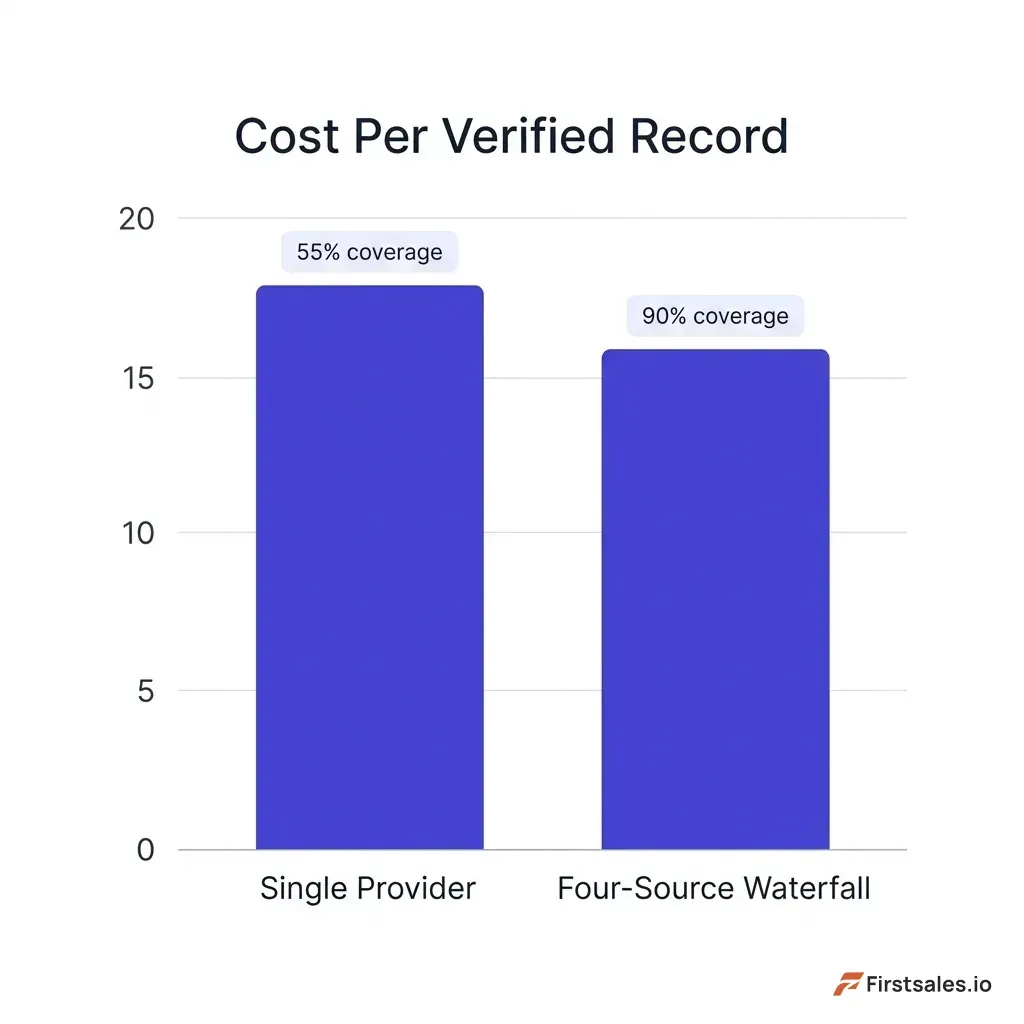 Bar chart comparing cost per verified reachable record across a single provider at about 18 cents and a four-source waterfall at about 16 cents, with the waterfall also showing 90 percent coverage versus 55 percent for the single provider
#Verification is the part everyone skips
Finding an email is half the job. Confirming it will not bounce is the other half, and it is the half most teams underinvest in.
Here is why it matters so much. Catch-all domains account for roughly 23-31% of B2B email databases. A catch-all accepts mail to any address at the domain, so a provider can return firstname@company.com and report it as valid when the mailbox does not actually exist.
Actual deliverability on catch-all addresses ranges from 40% to 85% depending on the domain.
If you trust raw provider output on catch-alls, you are gambling on a coin flip with your domain reputation as the stake.
Verification fixes this. With consistent pre-send checking, B2B senders can pull hard bounce rates below 0.5%, against an unverified B2B technology baseline closer to 3.2%. That gap is the difference between a healthy sending domain and one that lands in spam folders within a few weeks.
A good waterfall does verification inline. As each provider returns a candidate value, the system runs an SMTP-level check and a confidence score before accepting it. If the check fails, the record keeps cascading instead of stopping on a bad match.
This is the part that separates a real waterfall from a list-merge: it is not just stacking sources, it is validating each candidate and only stopping the cascade when it finds one that passes. The depth of this topic is why email verification before sending deserves its own treatment, but the short version is that an enrichment pipeline without verification is just a faster way to build a bounce list.
Re-verification matters too, because of the decay problem. A verified email is only verified as of the day you checked it. Quarterly re-verification is the minimum most B2B databases need to hold the line on bounce rates, and lists that sit untouched for six months can see 20%+ of addresses go invalid.
#When waterfall enrichment is overkill
Waterfall enrichment is not free and it is not always worth it. There are clear cases where a single good provider is the right call, and pretending otherwise just wastes money and time.
You probably do not need a waterfall when your target list is small and tightly scoped. If you are running 50 high-touch accounts a month where a human researches each one anyway, the marginal contacts a waterfall recovers do not justify the setup. A researcher will find the missing email manually in the same time it takes to configure provider routing.
You also do not need it when your single provider already matches well on your specific segment. If you sell exclusively into US enterprise SaaS and your current vendor hits 85% on that segment, a waterfall might only add a few points. Test before assuming.
The 55-70% single-provider average is exactly that, an average, and your real number on your real ICP could be higher or lower.
And the latency trade-off is real. Single-source lookups hit one database and return in seconds. Waterfall enrichment checks multiple sources per record, so bulk jobs take minutes rather than seconds.
For batch enrichment that runs overnight, nobody cares. For real-time enrichment the instant a lead fills out a form, that extra latency can matter, and you may want a shallower waterfall or a single fast provider on the hot path with a deeper batch waterfall running behind it.
The honest framing: waterfall enrichment earns its place when your coverage gap is costing you reachable pipeline and your list is large enough that manual research does not scale. Below that threshold, it is overhead. The point of clean data is better outbound, not a more impressive enrichment stack.
#How clean data feeds signal-based outbound
Enrichment is not the goal. It is the input to the thing that actually generates replies, which is timely, relevant outreach to the right person.
Signal-based prospecting depends on reaching a specific person at a specific moment. A company just raised a Series B. A team just posted six SDR roles. A new VP of Sales started last month.
Those signals are only worth anything if you can actually contact the person they point to. A funding signal with no verified email for the buyer is a missed opportunity dressed up as intelligence. This is the link most teams miss between data quality and reply rates, and it is why intent-based prospecting beats static lists only when the contact data underneath the intent is real.
Clean data also lets you act on signals fast. The window on a buying signal is short. A new VP evaluates the stack in the first 90 days, not the first 9 months.
If your enrichment takes a week and bounces half the addresses, the signal is stale by the time you reach the inbox.
A waterfall that returns verified contacts quickly turns a fresh signal into a sent email while the signal still means something. The mechanics of writing to that moment are covered in signal-based cold email, but none of it works without reachable contacts feeding it.
There is a compounding effect worth naming. Better match rates mean you can run signal-based outbound on a wider set of accounts, because more of the accounts where a signal fires turn out to be reachable. A 55% match rate quietly throws away nearly half your triggered opportunities.
An 85% match rate keeps most of them in play. Same signals, far more sent emails, because the data underneath did its job.
This is the model FirstSales is built around. Signals identify who to contact and why, waterfall-grade enrichment makes sure those contacts are real and reachable, and a human reviews the draft before anything sends. The enrichment is invisible to the prospect.
They just notice the email reached them, named something true about their company, and did not read like it went to 5,000 people.
#Setting up your first waterfall
You do not need a complicated build to get most of the value. A first waterfall comes down to a few decisions made in order.
Start with your ICP, not your providers. Define exactly who you are trying to reach before you pick sources, because the right providers depend entirely on segment and geography. A waterfall tuned for US tech sales leaders looks nothing like one tuned for European manufacturing ops. Getting the ideal customer profile right first means you choose providers that are actually strong where your buyers live, instead of paying for coverage you will never use.
Order providers by coverage and cost together. Put the source with the best coverage-to-cost ratio for your segment first, so it resolves the largest, cheapest slice of your list. Then layer providers that cover the gaps the first one leaves, ending with the expensive niche vendors that only get called on the hardest records. The cheapest, broadest provider at the top, the priciest, most specialized at the bottom.
Build verification into the cascade, not after it. Verify each candidate value inline so a bad match keeps cascading instead of ending the lookup. A waterfall that finds an address but does not check it has only done half the work.
Cap the depth where the curve flattens. Three to four providers captures most of the achievable lift for email. Going deeper is a deliberate choice for hard segments, not a default. Watch the incremental match rate at each layer and stop adding providers when the next one returns under 5%.
Re-enrich on a schedule. Set quarterly re-verification at minimum, and re-enrich blanks when you have new signal-triggered reasons to reach an account. Data decays whether you look at it or not.
Most teams either build this with a dedicated waterfall tool that aggregates dozens of vendors behind one API, or let a platform like FirstSales handle the routing so the verified contact just appears in the campaign without anyone wiring up providers by hand. Either way, the principles are the same.
#Provider match-rate and cost ranges
This table compares the single-provider approach against a waterfall on the metrics that decide whether enrichment pays off. The ranges are drawn from published 2026 testing across multiple analysts and should be read as general ranges, not a specific vendor's guarantee.
| Metric | Single provider | Waterfall (3-4+ sources) |
|---|---|---|
| Email match rate | 40-70% (avg 55-70%) | 85-98% |
| Mobile match rate | Lower, segment-dependent | Higher with deeper stack |
| Gap recovery from adding a source | n/a | 15-25% per added provider |
| Coverage past 4 providers | n/a | Under 5% incremental |
| Cost per email found | varies by vendor | $0.12-0.35 |
| Cost per direct phone found | varies by vendor | $0.58-1.15 |
| Blended cost per enriched record | $0.12-0.30 | ~$0.10-0.16 (pay on hits) |
| Pre-send verification built in | ✗ (usually separate) | ✓ (inline per candidate) |
| Hard bounce rate (with verification) | 3.2% baseline unverified | Under 0.5% |
| Latency per record | Seconds | Minutes (bulk) |
| Best fit | Small lists, strong single segment | Large lists, mixed segments |
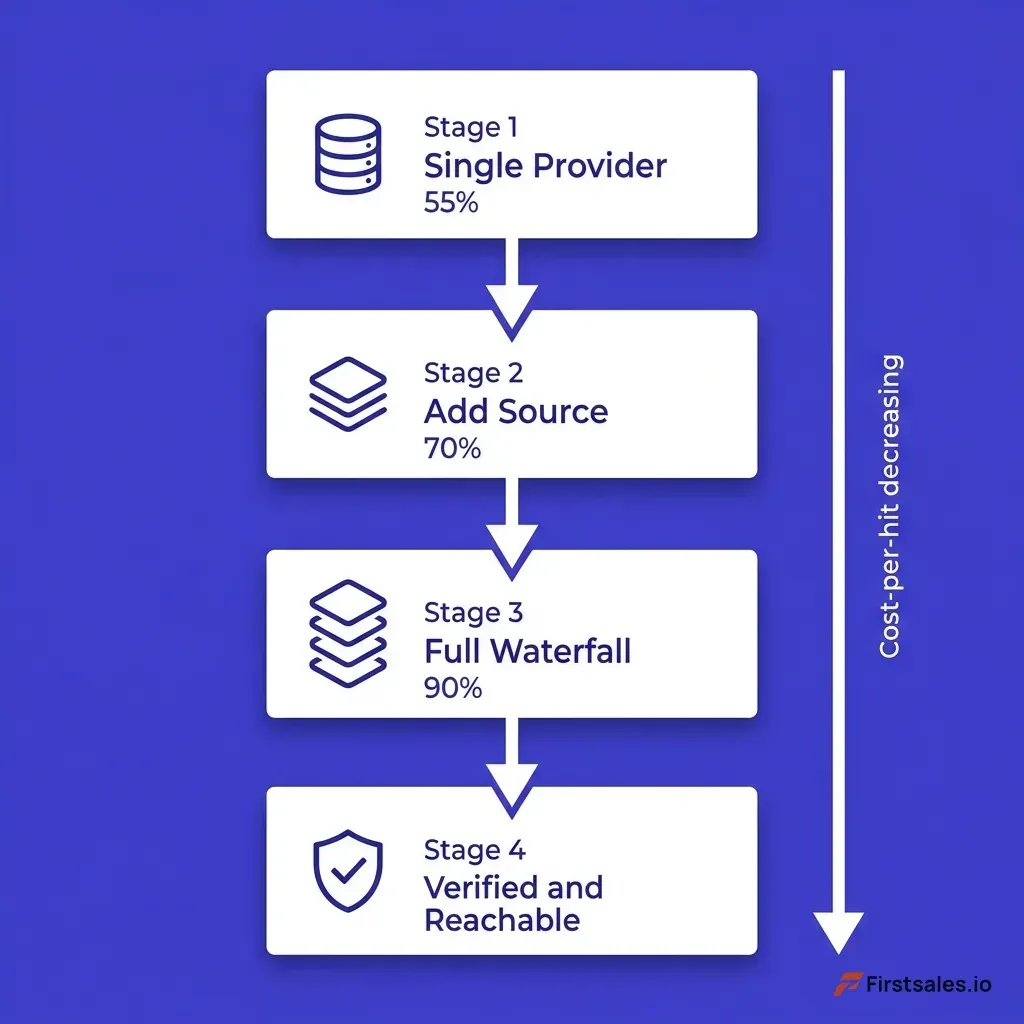 Infographic summarizing the waterfall enrichment payoff: a single provider matching 55 percent of a list versus a four-stage waterfall reaching 90 percent, with cost-per-hit decreasing down the stack and a verified-and-reachable badge at the bottom, deep indigo and white flat design
The row that surprises people is the blended cost. The intuition that more providers means more money is wrong, because the cascade only pays premium vendors for the few records cheaper sources could not find. You get more usable contacts at a lower cost per usable contact.
The single-provider approach looks cheaper per lookup and is more expensive per result.
#FAQs
#What is waterfall enrichment in B2B data?
Waterfall enrichment is a method that queries multiple B2B data providers in a fixed order, moving to the next provider only when the previous one fails to return a usable, verified result. It fills the coverage gaps that any single database leaves, typically lifting email match rates from 55-70% on one source to 85% or higher across three to four sources.
#How much does waterfall enrichment improve match rates?
Single-provider enrichment usually matches 40-70% of a list, while a waterfall across three to four sources reaches 85-90%+. In one test of 1,000 records, a single source found 62% of emails and a 15-source waterfall found 98%. Adding a second provider to a single-source setup commonly recovers 15-25% of the gaps the first left.
#Is waterfall enrichment more expensive than a single provider?
Usually not, on a per-result basis. The cascade only pays each provider for the records the cheaper providers above it could not find, so premium vendors get called least. Blended cost often lands near $0.10-0.16 per enriched record, close to single-provider lookup pricing, while delivering far more usable contacts.
#How many data providers should a waterfall use?
Three to four providers captures most of the achievable lift for email enrichment. Beyond four, incremental coverage usually drops under 5% while cost, latency, and integration overhead keep rising. Mobile waterfalls often need a deeper stack because direct-dial coverage is thinner at every source.
#What is the difference between an email waterfall and a mobile waterfall?
Email waterfalls reach high coverage with fewer providers and cost $0.12-0.35 per found address, and you can verify results before sending. Mobile waterfalls need more providers to hit comparable coverage, cost $0.58-1.15 per found number, and cannot be verified as cleanly because there is no equivalent of an SMTP check for a phone line.
#Does waterfall enrichment reduce email bounce rates?
It can, but only when verification is built into the cascade. Catch-all domains make up 23-31% of B2B databases and can return addresses that look valid but bounce. A waterfall that verifies each candidate inline and keeps cascading on failures helps pull hard bounce rates below 0.5%, against a 3.2% unverified B2B baseline.
#How often should I re-enrich my B2B data?
Quarterly is the minimum for most B2B databases, because contact data decays roughly 22-30% per year and about 2.1% per month. A list left untouched for six months can see 20%+ of its addresses go invalid. Re-enrich blanks sooner when a fresh buying signal gives you a reason to reach an account.
#When is waterfall enrichment overkill?
It is overkill when your list is small enough that a human researches each account anyway, or when your single provider already matches above 85% on your specific segment. The latency cost also matters for real-time enrichment, where waterfall lookups take minutes instead of the seconds a single source needs.
#Why does a single data provider miss so many contacts?
No single database covers the whole market, and each one is weak on particular segments such as non-US regions, smaller companies, or newer hires. A provider strong on US enterprise tech will be thin on European SMBs. You inherit every gap your one vendor has, and missing records show up as blanks rather than as obvious failures.
#How does enrichment quality affect signal-based outbound?
Signal-based outreach only works if you can actually reach the person the signal points to. A 55% match rate quietly discards nearly half your triggered opportunities, while an 85%+ match rate keeps most of them in play. Clean, verified data turns fresh buying signals into sent emails before the signal goes stale.
#What does cost per verified record mean and why does it matter?
Cost per verified record is the price you pay for each contact that is both matched and confirmed reachable, not the price per lookup. A provider charging $0.10 per lookup at a 55% match rate costs about $0.18 per usable record, while a waterfall at a blended $0.14 per lookup and 90% match costs about $0.16, with far more total records. The per-lookup price hides this.
#Can I run waterfall enrichment without building it myself?
Yes. Dedicated waterfall tools aggregate dozens of vendors behind one API, and outbound platforms like FirstSales route enrichment and verification automatically so the verified contact appears in the campaign without wiring up providers by hand. The underlying principles of provider ordering, inline verification, and capped depth stay the same.
#Conclusion
A single B2B data provider hands you a list that is a third to a half empty, and you cannot see which contacts it failed to find versus which ones do not exist. Waterfall enrichment fixes the coverage problem by chaining providers in sequence, paying each one only for the records the cheaper sources above could not match, and verifying every candidate before it stops the cascade. The result is 85%+ match rates at a cost per usable record that often beats the single provider you started with.
Key takeaways:
- One provider matches 40-70% of a list. A three to four source waterfall reaches 85-90%+.
- The cascade keeps cost down by calling premium vendors only on the hardest records.
- Verification is not optional. Without it, you are building a bounce list faster.
- Mobile waterfalls need more depth and cost more per result than email waterfalls.
- Stop adding providers when incremental coverage drops under 5%, usually past four sources.
- Clean data is the input to signal-based outbound, not the goal in itself.
The teams getting real results from outbound in 2026 are not the ones with the biggest contact lists. They are the ones whose lists are actually reachable, verified, and tied to a real reason to reach out. FirstSales pairs waterfall-grade enrichment with signal-based prospecting and human-reviewed drafts, so the contact is real, the timing is right, and the email reads like a person wrote it.
Start your first campaign for $1 at https://app.firstsales.io and see what reachable data does to your reply rate.