TL;DR: Average cold email reply rates have collapsed from 8.5% in 2019 to 3.43% in 2026. The primary culprit is AI slop - mass-generated, interchangeable outreach that floods inboxes and triggers a near-instant delete reflex in 73% of recipients. Campaigns built on ChatGPT templates and list-blasting average 1-3% reply rates.
Campaigns anchored to real buying signals - funding rounds, hiring spikes, leadership changes - consistently hit 15-25%. The difference is not your subject line. It is whether your email proves you did the work.
#What Is AI Slop in Cold Email?
"AI slop" is not a technical term - it is a label that has stuck because it captures something real. It refers to cold email output that is grammatically correct, reasonably formatted, and completely hollow. Generated at scale.
Stripped of any genuine observation about the recipient. Designed to sound personalized while being anything but.
You have seen it. You have probably received it today. It goes something like this:
"Hi [First Name], I came across your profile and was impressed by your work at [Company]. We help companies like yours achieve [vague outcome] through our [vague product]. Would you be open to a 15-minute call?"
Every token in that email was predicted by a language model given a prompt like "write a cold email for a B2B SaaS company selling to [persona]." The model produced something grammatically sound. The rep copy-pasted it into a sequence tool, swapped in a CSV of 2,000 contacts, and hit send.
That is the slop pipeline. And it is everywhere.
By 2026, over 40% of all cold email traffic is AI-generated, according to data cited by multiple outreach platforms. Buyers are not slow to catch on. The volume of AI-assisted outreach hitting enterprise inboxes is high enough that many procurement leads, CTOs, and VP-level buyers have developed what researchers at SmartLead call a "delete reflex" - an almost unconscious ability to scan the first line and bin the email in under a second.
The problem is not that AI wrote the email. The problem is that AI wrote it without any real signal feeding it. Without a specific reason to reach out.
Without a sentence the prospect could not imagine reading in any other email they received this week.
That is the definition: AI slop is outreach where the AI did all the thinking and none of the knowing.
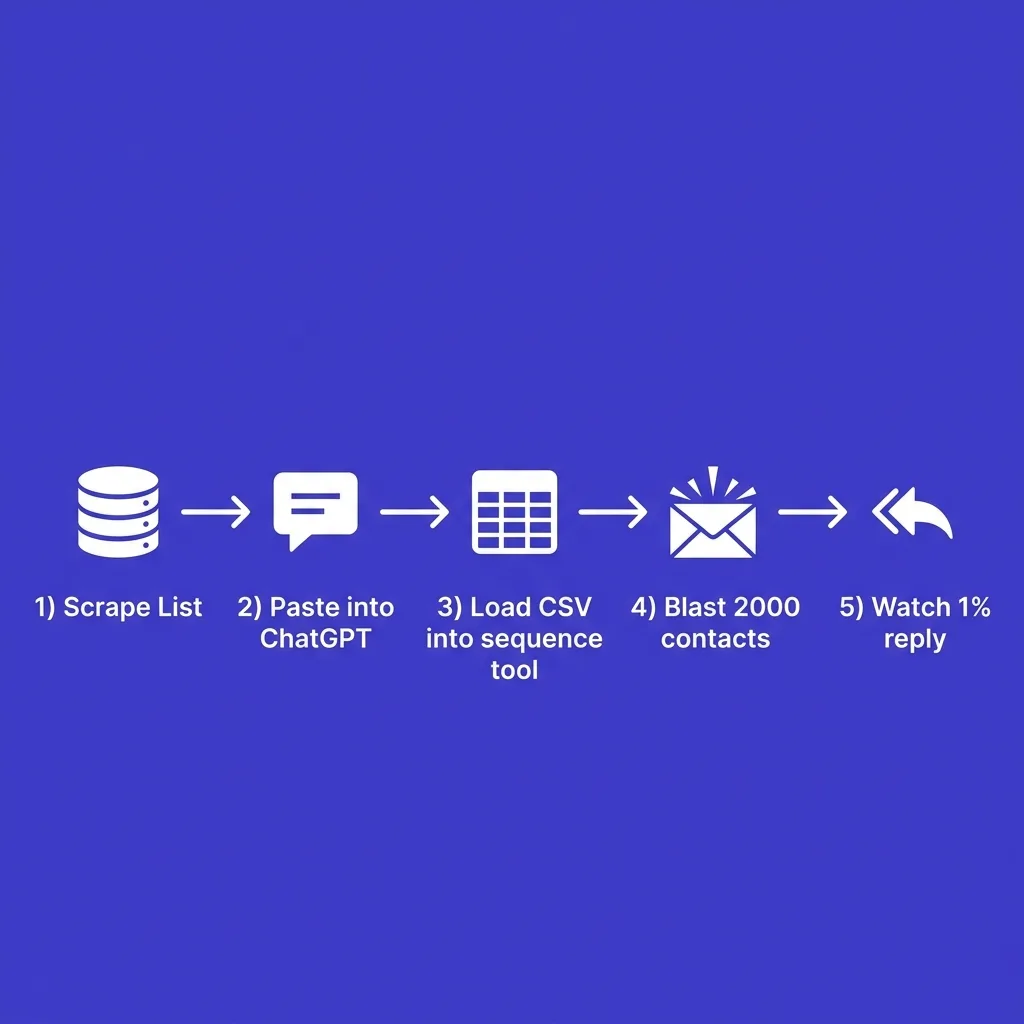 Diagram showing the AI slop pipeline: scrape list, paste into ChatGPT, load CSV into sequence tool, blast 2,000 contacts, watch 1% reply
#The Numbers That Should Make You Stop and Read This
Cold email as a channel is not dead. But the version of cold email that most teams are running is delivering results that should trigger a serious rethink.
Average cold email reply rates have fallen 60% over seven years:
- 2019: 8.5% average reply rate
- 2023: 7% average reply rate
- 2025: 5% average reply rate
- 2026: 3.43% average reply rate (Instantly's 2026 Benchmark Report)
The year-over-year drop from 2025 to 2026 was 27%, according to Engagekit's benchmark analysis. That is not a slow decline. That is an accelerating one.
The mass-volume tier looks even worse in isolation. Campaigns sending to 500 or more contacts without advanced personalization average just 2.1% reply rates. At that level, you are generating roughly 21 replies per 1,000 emails sent.
Factor in the time to build the list, write the sequence, handle bounces, manage unsubscribes, and deal with spam complaints - and the economics fall apart before you close anything.
Meanwhile, the top quartile of senders is not suffering at all. Campaigns anchored to real buying signals - funding announcements, active hiring in target departments, leadership transitions, technology stack changes - consistently hit 15-25% reply rates. That is a 5x to 12x gap between the bottom and the top.
The channel has not declined uniformly. It has bifurcated. High-volume, low-signal outreach is drowning.
High-signal, low-volume, human-reviewed outreach is thriving.
The variable that explains the gap is not deliverability. It is not subject lines. It is not send time.
It is whether the email contains a real reason to reply that only makes sense for that specific recipient on that specific week.
#Seven Tells That Scream "Bot Wrote This"
Buyers do not need to run your email through an AI detector. They have pattern-matched enough generic outreach that they recognize it structurally. Here are the specific signals that get emails binned in milliseconds.
1. The "I noticed" opener that noticed nothing specific
"I noticed you recently posted about leadership" or "I noticed your company is growing" are opener templates so common they have become white noise. When the observation is vague enough to apply to any company in a given category, it reads as a mail-merge field, not a real observation.
2. Outcome claims with no mechanism
"We help companies like yours increase pipeline by 3x" with no explanation of how. No specifics about what actually changes. No context about which companies, in which situations, saw that result.
The vaguer the claim, the more it sounds like a template.
3. Perfect paragraph structure
Real human email is messier. It has a short line. Then a thought that runs a bit longer before the point lands.
AI-generated cold email tends toward three tidy paragraphs: opening hook, value prop, call to action. Experienced buyers read that structure and reach for the archive button.
4. "I know your time is valuable" and its cousins
Phrases that acknowledge the reader's time - "I'll be brief," "I know your inbox is full," "I won't take much of your time" - are almost exclusively found in AI-drafted sales emails. Nobody writes those phrases in genuine one-to-one correspondence. They appear because they were in the training data for "polite cold email."
5. The feature list dressed up as a benefit
"Our platform uses AI to automate prospecting, personalize outreach, and integrate with your CRM" is a feature list. It does not tell the reader what problem it solves for them specifically. AI models are good at generating feature-benefit translations but bad at connecting them to the individual's actual situation.
6. Generic social proof
"We work with companies like [Fortune 500 company name] and [another big name]" - when those companies are in completely different industries from the recipient - signals that the email is a template. Relevant social proof names a company in the same vertical, at a similar scale, facing a similar problem.
7. A CTA that asks for too much too soon
"Would you be open to a 30-minute call to discuss how we can help?" after two paragraphs the prospect did not ask for is a textbook AI close. The better-converting CTAs ask a specific question relevant to the signal that prompted the outreach, or offer something genuinely low-commitment.
If your email has three or more of these tells, your prospect spotted the pattern before they finished reading the first sentence. Understanding how prospects spot AI-written emails in detail can help you audit your own sequences before they hit inboxes.
#Why the ChatGPT Blast Strategy Backfires
There is a specific failure mode worth naming. It goes like this:
A team decides to "use AI for cold email." They open ChatGPT, write a prompt asking for a 150-word cold email for their SaaS product targeting VP of Sales at mid-market SaaS companies. They get a decent-sounding email.
They run variations. They load 3,000 contacts from Apollo or a similar data provider. They launch a sequence with three touchpoints.
They get a 1.2% reply rate. Some of those replies are negative. A few contacts mark it as spam.
Their domain reputation takes a hit. The next campaign performs worse because the sending infrastructure is degraded.
The failure is not that AI was involved. The failure is in the sequence of decisions:
The list had no signal filter. Anyone matching "VP of Sales, mid-market SaaS" was included, regardless of whether anything was happening at their company that made the product relevant right now.
The prompt had no real context to work with. The model cannot invent a specific reason to reach out. It can only interpolate from the product category and persona.
The output sounds like every other email in that category.
The volume overwhelmed the quality. Even if 5% of the list was genuinely well-suited, the 95% of irrelevant sends dragged down reputation and triggered spam filters.
The math on AI vs human cold email reply rates makes the cost of this approach clear when you account for domain degradation over time, not just the single-campaign reply rate.
And the problem compounds. When your reply rate is 1.2% and your spam complaint rate ticks above 0.1%, Google's bulk sender rules - which require staying below a 0.10% spam complaint rate and holding a hard limit at 0.30% - start applying consequences. Inbox placement drops.
Future campaigns go to spam for recipients who never complained. The blast strategy poisons the well for signal-based outreach you might want to run later.
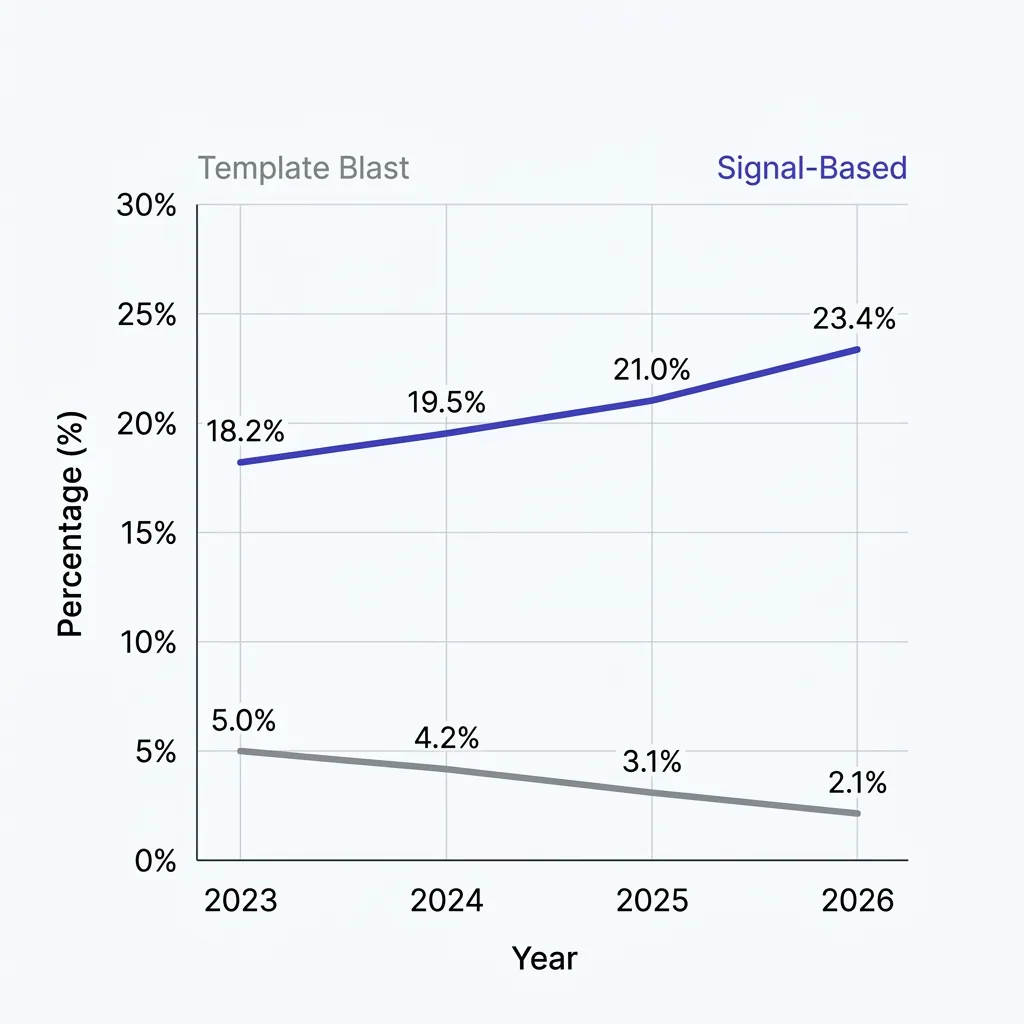 Chart showing reply rate divergence: blasted campaigns declining from 5% to 2.1% over 2023-2026, signal-based campaigns stable at 15-25%
#The Deliverability Tax You Are Already Paying
There is a secondary cost to AI slop outreach that does not show up in reply rate dashboards but shows up in your send economics over time.
When you blast generic email at volume, a predictable percentage of recipients mark it as spam. That percentage tends to be higher than it would be for signal-based outreach because the email is genuinely irrelevant to many recipients. Even a 0.15% spam complaint rate - not far above Google's threshold - starts generating deliverability consequences within weeks.
Google and Microsoft's sender requirements in 2026 are non-negotiable in practice. SPF, DKIM, and DMARC are mandatory. Spam complaint rates must stay below 0.10%, with 0.08% being the practical safe ceiling.
One-click unsubscribe is required for bulk senders. And domain age and ramp history matter: new domains get scrutinized more aggressively than established ones.
The consequence of running a slop-heavy volume strategy is that 10-20% of sending domains in active outreach programs degrade or become effectively unusable per month. Teams running at that velocity spend a disproportionate amount of time on domain acquisition, warmup, rotation, and replacement rather than on improving the quality of outreach that might actually generate pipeline.
Seventeen percent of cold emails never reach the inbox at all, according to analysis from prospeo.io, even before you account for spam folders. That figure is higher for domains with degraded reputation from high-complaint campaigns. The deliverability tax on AI slop is real, compounding, and difficult to reverse once it accumulates.
This is the context for understanding cold email personalization mistakes not just as a reply-rate problem but as an infrastructure problem. Bad personalization - or the fake kind - does not just fail to convert. It actively erodes your ability to reach anyone.
#What Signal-Based Outreach Actually Looks Like
Signal-based outreach starts with a reason that exists before the email is written - and that reason is specific to the recipient at a specific point in time.
The highest-converting signals in 2026 include:
- Funding announcements (Series A through C are particularly rich windows - companies are hiring, evaluating vendors, and solving new problems)
- Active hiring in departments your product serves (a company that just posted 12 SDR roles is clearly building outbound capacity)
- Leadership changes (a new VP of Sales in the last 90 days is evaluating every tool in the stack)
- Technology stack changes visible via job posts or product reviews
- Company growth signals - headcount increases, new office locations, recent press coverage
When one of these signals exists, the email writes itself more honestly. You are not trying to invent relevance. You are reflecting relevance that already exists.
A signal-triggered email might open like this: "Saw that you brought on a new Head of Demand Generation last month - that usually means a fresh look at the outbound stack. Happy to show you how [Company] teams at your stage are handling [specific challenge]."
That opener is specific to this company at this moment. It cannot be repurposed for the next contact on the list. That specificity is exactly what drives replies - because it signals that someone paid attention, which is still rare enough to be notable.
The reply rates on signal-triggered campaigns consistently run 15-25%, according to data from Autobound's 2026 benchmark and Prospeo's signal-based outbound playbook. That compares to 1-3% for generic template blasts. The cold email reply rate benchmarks for 2026 show this gap has widened year over year as the inbox has gotten noisier.
The volume is necessarily lower. You can not find a genuine signal for 3,000 contacts in a week. But you do not need to.
At 20% reply rate on 150 well-targeted contacts, you generate 30 replies - more than a 1.2% rate on 2,000 generic contacts produces, with a fraction of the domain risk and none of the list management overhead.
#The Human-Edited Advantage: What Lavender's Data Shows
One of the most practically important findings in recent cold email research comes from Lavender's 2025 analysis of 100 million emails. The analysis compared three categories: fully AI-generated emails, fully human-written emails, and AI-drafted emails that a human edited before sending.
The AI-assisted-and-human-edited category outperformed both the fully AI-generated and the fully human-written categories on reply rate.
This finding is worth sitting with. It means the answer is not "stop using AI" - it is "stop letting AI be the last person in the room."
What human editing typically adds:
- A specific observation that requires knowing something about this company or person that is not in the AI's context window
- Adjustments to tone that reflect how this specific prospect actually communicates (based on their LinkedIn posts, their company blog, their recent interviews)
- Removal of the tells listed earlier - the "I noticed" vagueness, the tidy paragraph structure, the CTA that asks for too much
- A sentence or two that could not appear in any other email sent this week
The editing time is not large. Five to ten minutes per account, focused on the opener and the call to action, often produces a dramatically different result. The AI handles the structural work - the value proposition framing, the relevant context from the product, the sequence logic.
The human adds the sentence that makes the prospect feel seen.
This is the human-in-the-loop cold email model that is emerging as the default for teams that are serious about outbound in 2026. AI drafts, humans QA, humans send. The supervision layer is not optional overhead - it is the feature that makes the output work.
Five minutes of account research before writing increases reply rates 3-5x compared to template-based outreach, according to data from multiple outreach platforms. That multiplier holds even when the email itself is AI-drafted, as long as a human inserts the research into the draft before it goes out.
Using a purpose-built AI email writer that incorporates signal data into the draft - rather than starting from a blank "write me a cold email" ChatGPT prompt - gets you partway there. But even purpose-built tools need human review to catch the tells that make a draft read as automated.
#A Framework for Escaping the Slop Trap
If your current outreach is producing sub-5% reply rates, the fix is not a better prompt or a different subject line. It is a structural change to how you identify who to contact and why.
Here is a four-step framework that consistently produces different results:
Step 1: Define the signal before you build the list
Before adding anyone to a sequence, ask: what is happening at this company right now that makes our product relevant? If the answer is "nothing specific, they just fit the ICP," do not send yet. Wait for a signal or find a smaller list where signals exist.
Step 2: Let AI handle the scaffolding, not the specifics
Use AI to generate the structure - a value proposition framing for the product category, a sequence template with appropriate spacing (three-day gaps between follow-ups outperform daily sends), a set of subject line options. Do not let AI write the opening line. That line needs a human who has looked at the signal.
Step 3: The human writes one sentence that could not be recycled
Every email going out should have at least one sentence - ideally in the opener - that is specific to this account at this moment. "I saw your job post for a RevOps Manager and figured the timing might be right" is recyclable. "Your Q1 hiring push in RevOps and the announcement about moving upmarket last month both point to a stack evaluation coming up - curious if [specific product capability] has come up in those conversations" is not recyclable.
The second version takes four more minutes to write and generates materially more replies.
Step 4: Cap volume and protect domains
Running 10-20 emails per day per inbox on aged, warmed domains is the 2026 safe ceiling for most sending setups. That volume feels slow to teams used to blasting thousands. But 15 well-targeted emails per day at 20% reply rate generates three replies per day per rep - more than most teams are getting from ten times the volume.
Understanding cold email personalization at scale requires accepting that the word "scale" means something different when you shift to signal-based outreach. You are not scaling the number of sends. You are scaling the quality of signals you can identify and act on quickly.
#Benchmarks: Slop vs. Signal Side by Side
Here is a direct comparison of the two approaches on the metrics that matter for outbound programs:
| Metric | AI Slop (Template Blast) | Signal-Based + Human Review |
|---|---|---|
| Average reply rate | 1-3% | 15-25% |
| Spam complaint rate | 0.15-0.40% | Under 0.05% |
| Domain lifespan | Degrades in 4-8 weeks at volume | 12+ months when managed carefully |
| Emails per inbox per day | Often 50-200 (unsustainable) | 10-20 (sustainable) |
| List size per campaign | 500-5,000+ | 50-200 targeted |
| Time per contact | Under 30 seconds | 5-10 minutes |
| Replies per 1,000 contacts | 10-30 | 150-250 |
| Inbox placement rate | Declining over campaign life | Stable |
| Brand damage risk | High (burns prospect relationships) | Low |
| Cost per meeting | High once domain replacement factored in | Lower despite higher per-contact time |
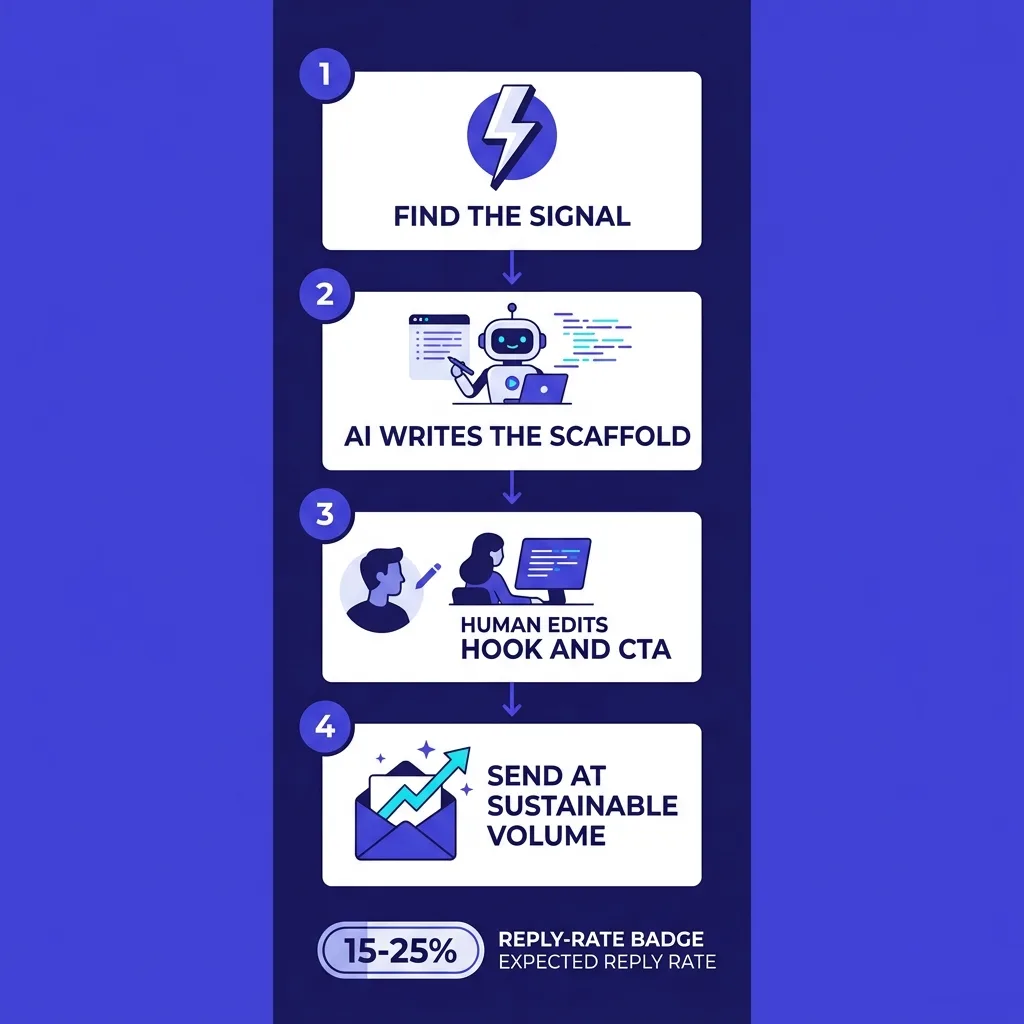 Infographic showing the slop-to-signal framework: four steps from signal identification to human-edited draft to inbox, with reply rate improvement arrows at each stage, deep indigo and white flat design
The row that tends to surprise teams is "replies per 1,000 contacts." Even though signal-based outreach only contacts 200 people where a blast might contact 5,000, the total reply count from the 200 is often higher. You get more from less - and you do not burn infrastructure getting there.
The cost-per-meeting math on AI vs human cold email reply rates reinforces this: when you factor in domain acquisition and replacement costs, warmup time, and the SDR hours managing bounce and complaint hygiene from slop campaigns, the per-meeting cost of the blast strategy frequently exceeds the per-meeting cost of the targeted approach. The illusion of cheap volume evaporates once the full stack is priced.
#FAQs
#What exactly is "AI slop" in the context of cold email?
AI slop refers to cold email that was generated by a language model - typically via a prompt like "write a cold email for [product] targeting [persona]" - without any specific, real-time information about the recipient being fed into the generation process. The result looks professional on the surface but contains no observation that is unique to the recipient. It could have been sent to anyone in the same ICP segment.
Buyers recognize the pattern quickly, and the reply rates reflect that recognition.
#How can I tell if my existing sequences qualify as AI slop?
Run a simple test: take any email in your sequence and ask whether any sentence in it would need to change if you sent it to a different contact in the same ICP. If the answer is "no, it all applies equally to anyone in this segment," you have AI slop. A good email should have at least one sentence - usually the opener - that is specific to this company at this moment and would need to be rewritten for the next contact.
#Is AI still useful for cold email if slop is such a problem?
Yes, but the role shifts. AI is most useful for the parts of cold email that benefit from scale: generating value proposition variants, structuring sequences, suggesting subject line options, drafting the middle paragraphs where the product case is made. The parts AI should not handle alone are the opening hook (which needs a specific real-world observation) and the call to action (which should reflect the specific signal that triggered the outreach).
Human review at those two points changes the outcome significantly.
#What is a realistic reply rate to aim for in 2026?
For well-run signal-based outreach - targeting accounts where a genuine buying signal exists, with human review of the opening line and CTA - 15-25% is achievable and documented across multiple platforms. For general ICP outreach without strong signal filtering, a realistic target is 5-9% with solid personalization beyond just name and company. The 3.43% industry average largely reflects the template blast strategy that dominates outbound volume.
Your goal should be to not be part of that average.
#Why do generic "I noticed you" openers keep appearing if they do not work?
Because they were effective enough in 2021 and 2022 that they became widespread, and once they became widespread, they became noise. The "I noticed you recently posted about leadership" opener worked when it felt like someone had actually looked at your LinkedIn. By 2024, it was the default AI opener for the persona type, and buyers adapted.
The phrases that felt personal when few people used them became tells when everyone used them. Any personalization tactic that is easy to automate at scale will follow the same arc.
#How many cold emails is safe to send per inbox per day in 2026?
For a warmed, aged domain with good reputation, the practical ceiling for sustainable cold outreach is 10-20 emails per day per inbox. Some teams push to 30-50 on strong domains with careful monitoring, but domain degradation accelerates above those thresholds. The era of sending 200-500 emails per day from a single inbox is over - the deliverability consequences make it a losing strategy even when the short-term reply numbers look acceptable.
Volume needs to be distributed across multiple domains with proper rotation, warmup, and reputation monitoring.
#Conclusion
AI slop in cold email is not a niche problem affecting careless senders. It is the dominant strategy in outbound right now - and it is why average reply rates have dropped 60% in seven years and are still falling. When over 40% of cold email traffic is AI-generated without genuine signal input, and 73% of recipients delete templated emails on sight, the math on volume-first outreach no longer works.
The antidote is not complicated. It is signal-first prospecting - identifying real reasons to reach out before building a list. It is AI for scaffolding, human judgment for the hook.
It is volume that your domains and your reputation can sustain, not volume that generates short-term sends and long-term inbox placement problems.
The teams hitting 15-25% reply rates are not using fundamentally different tools. They are applying a discipline that most outbound programs skip: they do not send until they have a real reason to.
If your sequences are sitting at sub-5% and you know they are running on ChatGPT templates and list blasts, the fastest move you can make is to cut your contact volume by 80% and put that saved time into signal research for the 20% that remains. Your reply count will go up. Your domain health will improve.
Your cost per meeting will drop.
FirstSales is built for exactly this model - signal-based prospecting, AI-drafted outreach with human review built into the workflow, and sending infrastructure that protects your domains while you scale. Start your first campaign for $1 at https://app.firstsales.io and see what 15-25% reply rates actually feel like.