**TL;DR: The average human SDR costs $98,000 to $173,000 per year fully loaded, and books 10 to 15 meetings per month - putting your true cost per meeting somewhere between $560 and $1,440. A well-configured AI SDR stack costs $8,000 to $42,000 per year, books a comparable or higher volume, and drives cost per meeting down to $50 to $300. The math is not subtle.
But AI wins only when quality holds, which is not guaranteed. This article shows you how to build the real numbers for your situation.**
#Why Cost Per Meeting Outbound Matters More Than CPL
Most sales teams measure cost per lead. That is the wrong metric for outbound.
A lead is a form fill, a content download, or a list entry. It might be a legitimate prospect or it might be a student doing research. Cost per lead tells you almost nothing about whether your outbound motion is financially healthy.
Cost per meeting - specifically cost per booked, held, qualified meeting with a real decision maker - is the number that connects directly to revenue. Every dollar you spend on outbound either produces a meeting or it does not. Divide total spend by total qualified meetings held and you have the only number that tells you whether your outbound is working at a unit economics level.
In 2026, this calculation matters more than ever. The landscape has shifted significantly. Cold email volume is constrained by Google and Microsoft inbox rules, domain burn is real (10 to 20 percent of sending domains degrade monthly at high volumes), and buyers have developed a sharp instinct for AI-generated outreach.
Getting a meeting is harder. Which means each meeting costs more - and the difference between a $200 CPM and a $1,200 CPM is not a rounding error. On a target of 50 qualified meetings per month, that gap is $50,000 in monthly spend.
Understanding the true cost per opportunity your outbound generates is the foundation of any serious go-to-market financial model.
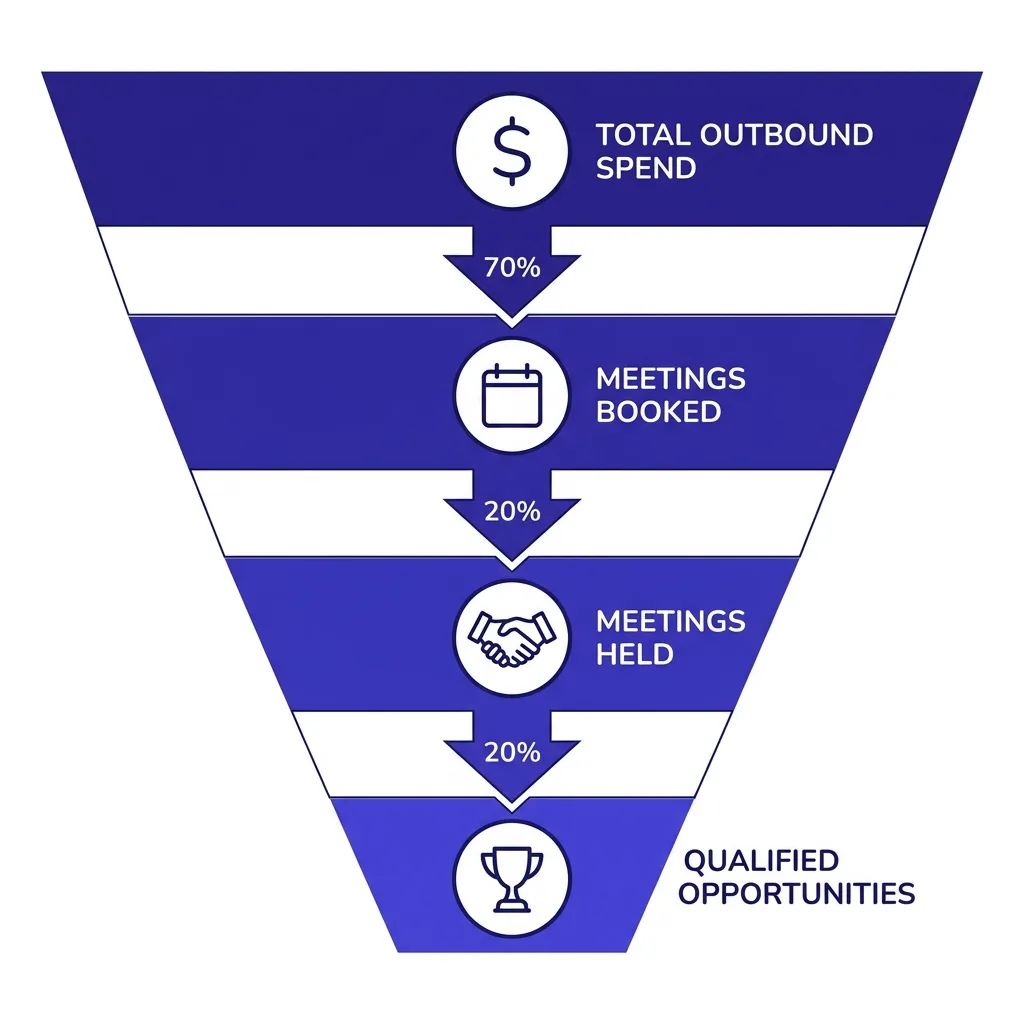 Diagram showing cost per meeting funnel: total outbound spend divided by meetings held, with conversion stage labels
#How to Calculate Your True Cost Per Meeting
The formula looks simple but most teams get it wrong because they undercount the denominator and undercount the numerator simultaneously.
The formula:
Cost Per Meeting = Total Fully Loaded Outbound Spend / Qualified Meetings Held
Three things that typically go wrong:
1. Using salary instead of fully loaded cost. A $60,000 base salary SDR does not cost $60,000. Benefits, payroll taxes, tools, manager time, recruiting amortization, and ramp loss typically add another $40,000 to $113,000 on top.
We cover the full breakdown in the next section.
2. Counting meetings booked rather than meetings held. Show rates for cold outbound meetings sit between 60 and 75 percent for most B2B teams. If your SDR books 15 meetings in a month and 10 actually happen, your CPM is based on 10 - not 15.
3. Ignoring the qualification filter. If your AE closes out half the meetings as wrong fit after the first call, your real cost per qualified pipeline opportunity is double your CPM. Track both numbers separately: cost per meeting held, and cost per meeting that converted to a qualified opportunity.
A clean CPM formula for a human SDR team looks like this:
- Annual fully loaded SDR cost: $130,000
- Meetings booked per month: 13
- Show rate: 70 percent
- Meetings held per month: 9.1
- Annual meetings held: 109
- Cost per meeting held: $1,193
Most teams, when they run this honestly, land somewhere between $900 and $1,400 per qualified meeting. That number tends to produce a quiet moment of recalibration.
#The Fully Loaded Human SDR Cost in 2026
Let's build the number from the ground up.
The average SDR base salary in the United States sits at $55,000 to $60,000 in 2026. On-target earnings (OTE) range from $83,000 to $85,000. But most SDRs hit 60 to 80 percent of OTE, so total cash compensation realistically lands at $68,000 to $76,000.
Now stack the employer costs on top of that:
Payroll taxes and benefits: Employer-side FICA, health insurance, dental, vision, 401(k) match, and paid time off add approximately 25 to 35 percent of base salary - call it $15,000 to $21,000.
Tools and data: A modern SDR needs a sales engagement platform, a data provider, an email verification tool, a CRM seat, and likely LinkedIn Sales Navigator. Budget $3,000 to $8,000 annually per rep for this stack.
Manager overhead: Every SDR needs management time. A typical SDR manager runs a team of 5 to 8 reps. Allocating their fully loaded cost across direct reports adds $15,000 to $19,000 per SDR per year.
Recruiting and onboarding: Average time to fill an SDR role is 45 to 60 days. Recruiting costs (agency fee or internal recruiter time) typically run $6,000 to $12,000 per hire. Onboarding and training add another $3,000 to $5,000.
Amortized over a 14-month average SDR tenure, that is $6,400 to $12,000 per year.
Ramp productivity loss: A new SDR takes 3 to 4 months to reach full productivity. During that period they are running at 20 to 40 percent of target output. For a rep earning $130,000 fully loaded annually, a 3.5-month ramp at 30 percent productivity represents roughly $25,000 in cost for near-zero output.
Amortized over the full tenure, that is $14,000 to $21,000 per year.
Add it up:
| Cost Component | Low | High |
|---|---|---|
| Base salary | $55,000 | $60,000 |
| Variable compensation (actual) | $13,000 | $16,000 |
| Payroll taxes and benefits | $15,000 | $21,000 |
| Tools and data | $3,000 | $8,000 |
| Manager overhead allocation | $15,000 | $19,000 |
| Recruiting and onboarding (amortized) | $6,400 | $12,000 |
| Ramp productivity loss (amortized) | $14,000 | $21,000 |
| Attrition replacement cost (annual avg) | $8,000 | $16,000 |
| Total Fully Loaded Annual Cost | $129,400 | $173,000 |
The $98,000 to $173,000 range you see cited across industry sources is real. The lower end represents a low-cost geography, lean benefits, and strong retention. The higher end represents San Francisco or New York, full benefits, and average attrition.
Most US-based teams land between $110,000 and $150,000.
This is the number you divide by to get CPM. Not the base salary.
#The Hidden Costs Nobody Puts in the Spreadsheet
Beyond the cost model above, three categories of cost routinely go uncounted.
Attrition and its compounding effect. SDR attrition in 2025 and 2026 continues to run at 35 to 45 percent annually. When an SDR leaves, you do not just incur recruiting and ramp costs. You lose the pipeline in their sequence, the relationships they were building, and typically 60 to 90 days of output while the seat is open.
For a 5-person SDR team with 40 percent attrition, that is 2 full rep-years of lost output per year on top of $16,000 to $30,000 in direct replacement costs. One industry estimate puts total annual attrition cost for a 5-person team at $260,000 to $500,000 per year in combined direct and indirect losses.
Domain and deliverability infrastructure. Cold email in 2026 requires multiple sending domains, careful rotation, ongoing warmup, and constant monitoring. If your SDRs own their own outreach, factor in the cost of domain registration ($12 to $15 per domain per year), email warmup tools ($50 to $100 per month per domain), and data cleaning (email verification services run $0.003 to $0.01 per contact). For a team sending 3,000 emails per week across 6 domains, infrastructure costs run $8,000 to $18,000 per year - per SDR.
These costs exist whether you use humans or AI, but they often get buried in IT budgets and never appear in CPM calculations.
Opportunity cost of manager time. SDR managers spend 30 to 50 percent of their time on coaching, call reviews, sequence critique, and one-on-ones. That time is not free. Every hour a VP of Sales spends reviewing cold call recordings is an hour not spent on deal strategy, forecast accuracy, or hiring senior closers.
This cost is real but almost impossible to quantify, which is why it never shows up in the spreadsheet.
If you want to understand why AI SDR pilots fail despite the obvious cost savings, part of the answer is that teams compare AI costs to the listed salary - not the full picture. The comparison looks less dramatic, and the motivation to change is weaker than it should be.
#AI SDR Stack: What You Actually Pay
AI SDR pricing in 2026 falls into three broad tiers:
Entry tier ($500 to $1,500 per month / $6,000 to $18,000 per year): Tools like Salesforge's Agent Frank start around $499 per month. These handle personalized email outreach, basic follow-up sequences, and some reply detection. Volume is moderate, customization is limited.
Best for small teams testing the model.
Mid-market tier ($1,500 to $4,000 per month / $18,000 to $48,000 per year): Platforms in this range offer higher sending volumes, multi-step sequence logic, CRM sync, intent signal triggers, and more sophisticated personalization. Tools like AiSDR, 11x, and Artisan sit here. This is where most B2B SaaS teams operating at scale land.
Enterprise tier ($4,000 to $8,000+ per month / $48,000 to $96,000+ per year): Full-service AI SDR platforms with dedicated infrastructure, custom integrations, ICP-tuning support, and often a human success team layer. Some include managed deliverability, domain rotation, and A/B testing at scale.
Beyond the platform cost, add:
- Data provider: $4,000 to $12,000 per year for a contact data subscription (Apollo, Clay, ZoomInfo, etc.)
- Email verification: $1,200 to $3,000 per year depending on volume
- Sending domains and warmup: $3,000 to $8,000 per year for infrastructure
- CRM integration and setup: $1,000 to $3,000 one-time, ongoing negligible
A realistic mid-market AI SDR annual total cost looks like this:
| Cost Component | Low | High |
|---|---|---|
| AI SDR platform | $18,000 | $48,000 |
| Data provider | $4,000 | $12,000 |
| Email verification | $1,200 | $3,000 |
| Domain and warmup infrastructure | $3,000 | $8,000 |
| Setup and integration | $1,000 | $3,000 |
| Human oversight time (0.25 FTE) | $15,000 | $25,000 |
| Total Annual AI Stack Cost | $42,200 | $99,000 |
That human oversight line is important. An AI SDR running completely unsupervised is a liability, not an asset. You need someone reviewing reply handling, approving sequences before they run, and catching cases where the AI sends something embarrassing to a prospect.
That is roughly a quarter of a full-time person's attention - either a dedicated person or distributed across your existing team.
The fully autonomous zero-oversight model is what produces the AI SDR horror stories about burned client relationships and permanently damaged domains. Do not skip the oversight budget.
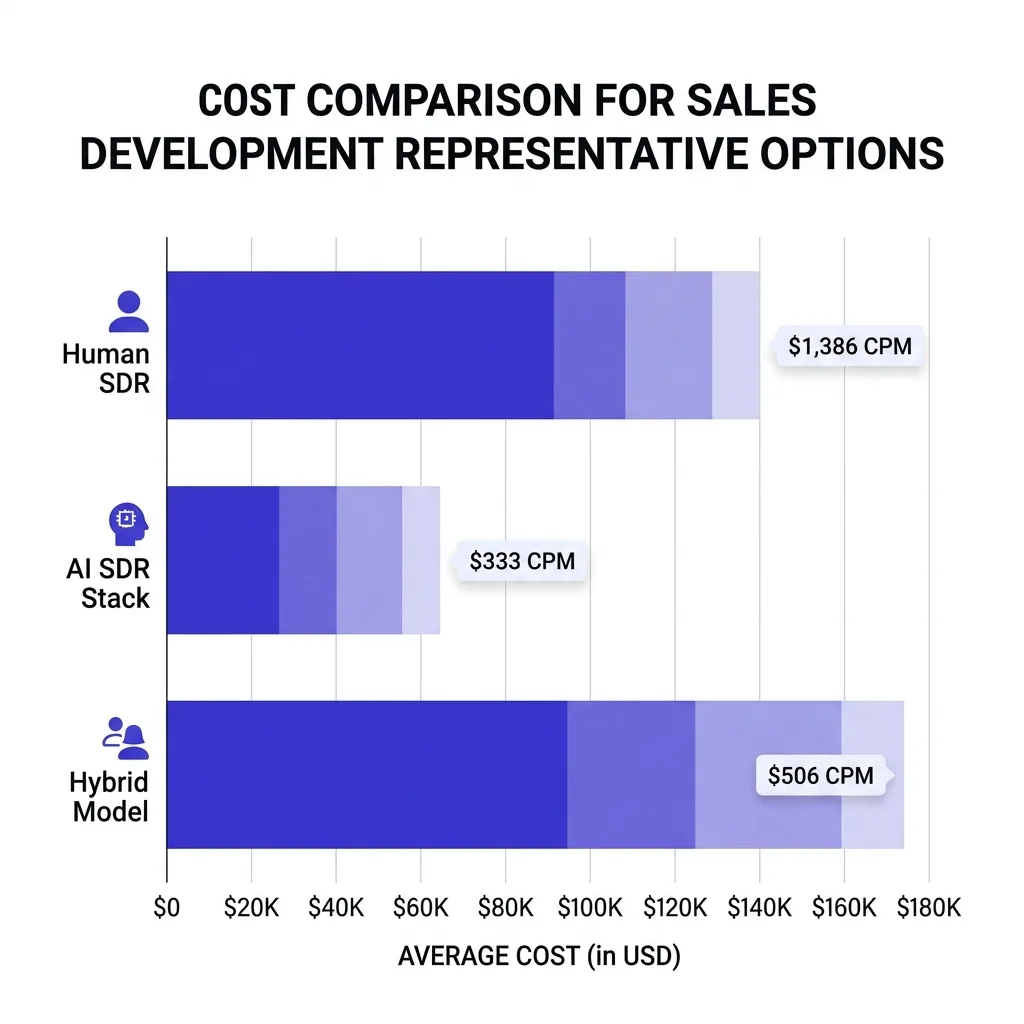 Chart comparing annual total cost: human SDR bar at $130K-$173K vs AI SDR stack bar at $42K-$99K, with cost per meeting annotations
#Side-by-Side Cost Model Table
Here is the full comparison at the unit economics level, using midpoint estimates:
| Metric | Human SDR (midpoint) | AI SDR Stack (mid-tier) | Hybrid (1 human + AI) |
|---|---|---|---|
| Annual fully loaded cost | $140,000 | $65,000 | $175,000 |
| Meetings booked per month | 12 | 25 | 40 |
| Show rate | 70% | 65% | 72% |
| Meetings held per month | 8.4 | 16.3 | 28.8 |
| Annual meetings held | 101 | 195 | 346 |
| Cost per meeting held | $1,386 | $333 | $506 |
| Qualification rate (to opp) | 55% | 40% | 52% |
| Opportunities per year | 55 | 78 | 180 |
| Cost per opportunity | $2,545 | $833 | $972 |
| Ramp time to full output | 3-4 months | 2-4 weeks | 3-4 months |
| Scalability | Linear (hire more) | Near-instant | Moderate |
| Attrition risk | High (35-45%/yr) | None | Low |
A few notes on the table:
The AI SDR show rate is slightly lower (65 percent vs 70 percent) because AI-generated outreach, even when good, can produce slightly lower intent on the prospect side. Some people agree to a meeting out of curiosity rather than genuine need. This is not universal - well-configured AI with proper signal-based targeting can match or beat human show rates - but it is a real pattern worth budgeting for.
The qualification rate gap (40 percent for AI vs 55 percent for human) is the most contested number in the industry. AI-booked meetings tend to have slightly weaker ICP fit at scale because the AI casts a wider net. This gap narrows significantly when you pair AI outreach with tight signal-based targeting - funding rounds, job changes, hiring signals.
Teams using intent-based prospecting vs static lists consistently report better qualification rates from their AI channels.
The hybrid model wins on cost per opportunity at $972 because it combines AI volume with human qualification judgment. You run more experiments, catch the promising signals faster, and your AE is working from a larger, better-sorted funnel.
#Where Human SDRs Still Win on CPM
The cost math favors AI in most scenarios, but there are specific situations where a human SDR produces a demonstrably better cost per qualified meeting.
Complex, high-ACV enterprise deals. When average contract value is above $150,000 and the buying committee has 6 to 12 stakeholders, the quality of the first touchpoint matters enormously. A human SDR who has researched the account, read the annual report, and had a genuine insight about the company's current challenge will book a meeting with a Chief Revenue Officer where an AI email would generate an unsubscribe. For deals of this size, paying $1,200 to $1,500 per meeting is rational when each meeting represents $150,000 to $1,000,000 in potential contract value.
Deep technical or regulated industries. Healthcare, financial services, government, and defense procurement have relationship norms, compliance requirements, and communication expectations that AI systems struggle to navigate reliably. A human SDR who understands HIPAA implications or knows what "the procurement cycle closes in Q3" actually means operationally will outperform an AI that produces technically correct but contextually tone-deaf outreach.
Named account or ABM motions. When you have a list of 50 to 200 target accounts and you need deep, multi-threaded engagement across each one, human SDRs with dedicated account ownership tend to outperform AI on the metrics that matter: multi-stakeholder engagement, account-level response rate, and the ability to escalate from an email thread to a phone call naturally. Sales engagement platforms vs AI SDR comparisons consistently show that for high-value ABM motions, a well-configured SEP with a skilled human beats full AI automation on qualified opportunity rate.
Highly personal referral-driven markets. Some markets run almost entirely on professional reputation and warm introductions. If your best meetings come from "I heard about you from X" - then investing in human SDRs who build genuine professional networks and can leverage those introductions is a better capital allocation than AI email volume.
#Where AI Wins on CPM and When to Switch
AI SDR stacks outperform human reps on cost per meeting in the following scenarios:
High-volume, mid-market prospecting. If your ICP is Director to VP level at 500 to 5,000-person companies in a reasonably well-defined industry vertical, AI can find, research, personalize, and sequence these prospects at 3 to 5x human volume with 40 to 70 percent lower cost per meeting. This is the core use case and it works well when executed properly.
Inbound follow-up and speed-to-lead. AI SDRs excel at instant response to inbound signals. A prospect downloads a whitepaper at 11pm on a Tuesday - the AI fires a personalized follow-up at 8am Wednesday with context from the download. A human team catches this on Monday morning at best.
Speed to lead matters: responding within 5 minutes of an inbound signal generates 21x more qualified conversations than responding after 30 minutes.
AI never sleeps.
Scaling without headcount. If your pipeline target doubles, a human SDR team requires doubling headcount - which means 3 to 4 months of recruiting plus another 3 to 4 months of ramp, plus attrition risk from the new cohort. An AI stack scales in days. For growth-stage companies that need pipeline velocity faster than the recruiting cycle allows, AI is the only option that makes financial sense.
Testing and iteration speed. Human SDRs can run one or two sequence variants at a time. AI platforms can test 20 subject line variants, 8 opening hooks, and 4 call-to-action formulations simultaneously across thousands of contacts. The learning loop is 10 to 20x faster.
For teams trying to find what works in a new segment or geography, this matters a lot. See the comparison in AI SDR vs AI-assisted SDR for how different configurations affect iteration speed.
The signal to switch to AI - or to add AI to your human team - is straightforward: when your cost per meeting held exceeds $1,000 and your deal size is below $80,000 ACV, the math on human-only SDRs does not hold. You are spending too much to generate too little pipeline at current conversion rates.
#The Hybrid Model Math
The most compelling number in the cost model table above is not the pure AI option. It is the hybrid.
One human + AI stack producing 346 meetings per year at $506 per meeting outperforms both alternatives on cost per qualified opportunity. Here is why the hybrid works better than either extreme.
AI handles volume, human handles judgment. The AI generates the initial sequences, manages follow-ups, handles basic reply sorting, and books discovery calls. The human SDR reviews flagged replies, handles warm responses that need nuance, manages account-level escalations, and does the high-EQ work that AI still does poorly. This division of labor is not a compromise - it is genuinely the optimal allocation of each input.
Quality improves when humans QA the AI output. Teams using fully autonomous AI outreach report meaningful quality degradation over time - sequence copy gets repetitive, personalization tokens start to feel mechanical, and reply handling produces occasional embarrassments. A human SDR spending 30 percent of their time reviewing and improving AI output keeps quality high while capturing most of the volume benefit. Human-in-the-loop cold email is increasingly the default model for teams that want sustainable outbound economics.
The math at the team level is even better. A team of 4 human SDRs costs $520,000 to $692,000 per year fully loaded. Replace 3 of them with AI and keep 1 human SDR managing the AI stack: total cost drops to $175,000 to $250,000 and meeting output increases. The 3 freed headcount budget can go to AE capacity, CS investment, or product - all of which compound revenue in ways that more SDR headcount does not.
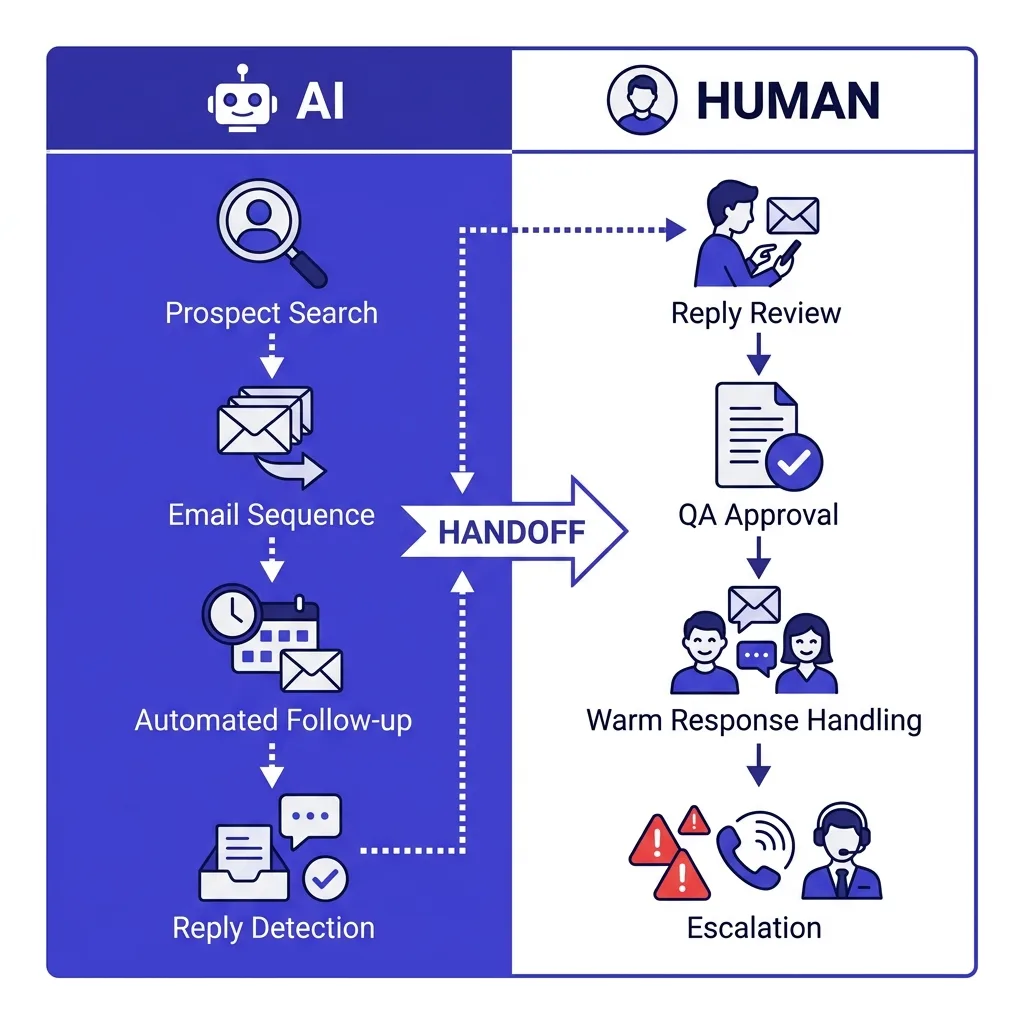 Infographic showing hybrid model workflow: AI handles prospecting, sequencing, and initial outreach while human manages replies, QA, and high-value follow-up - deep indigo and white flat design
Teams that have moved to this model report a 35 percent productivity boost per human involved and, in several documented cases, 2.5x revenue growth from the same or lower outbound headcount investment.
#How to Run Your Own CPM Calculation
Here is a clean framework you can use in a spreadsheet today.
Step 1: Calculate your fully loaded human SDR cost
Start with annual base salary. Add:
- Variable compensation paid (not OTE - actual paid)
- Benefits at 20 to 30 percent of base
- Tools: CRM seat + SEP + data + verification
- Manager overhead: (manager fully loaded cost) divided by team size
- Recruiting and onboarding amortized over average tenure
- Ramp loss: 3 months at 30 percent productivity, annualized
If you have multiple SDRs, use the average across the team.
Step 2: Pull your actual meeting data
From your CRM, pull for the last 90 days:
- Meetings booked by outbound SDRs
- Meetings held (actually showed)
- Meetings that converted to qualified opportunities
Calculate your show rate (held / booked) and qualification rate (opps / held). Do not use industry benchmarks here - your actual numbers are what matter.
Step 3: Calculate CPM and CPO
Divide annual fully loaded SDR cost by annual meetings held. That is your cost per meeting held.
Divide annual fully loaded cost by annual qualified opportunities generated. That is your cost per opportunity.
Step 4: Compare to AI alternative
Price out the AI SDR stack you would use. Add data costs, infrastructure costs, and the human oversight allocation (20 to 30 percent of one person's time). Use the vendor's projected meeting volume with a 20 percent haircut for conservatism.
Calculate the equivalent CPM and CPO for the AI option.
Step 5: Factor in quality adjustment
If AI-booked meeting quality is likely lower (lower ACV, lower ICP fit), apply a quality multiplier. A common approach is to value an AI-booked meeting at 75 to 85 percent of a human-booked meeting's expected value. Adjust the effective CPM accordingly.
The exercise usually produces one of three outcomes: the human team is clearly more cost-effective (rare, usually high-ACV enterprise), the AI option is clearly better (common, mid-market high-volume), or it is close enough that the hybrid model is the obvious answer.
If you want the full comparison for how this feeds into pipeline economics, read about SDR roles and responsibilities in the modern outbound stack and where each motion fits in a mature GTM structure.
#FAQs
#What is a good cost per meeting for outbound B2B?
A healthy cost per meeting held for outbound B2B in 2026 sits below $800 for mid-market deals (ACV $20,000 to $80,000) and below $1,500 for enterprise deals (ACV above $100,000). If your CPM is above $1,500 at mid-market deal sizes, your unit economics are broken and you should restructure the outbound motion before adding more headcount or budget. Teams with strong ICP targeting, signal-based sequencing, and good email deliverability typically land at $400 to $700 per meeting held using a hybrid AI plus human model.
#How much does a human SDR actually cost per year fully loaded?
In the United States in 2026, a fully loaded human SDR costs $98,000 on the absolute low end (low-cost geography, no frills, strong retention) up to $173,000 in major metro markets with standard benefits and average attrition. The most common range for a US-based SDR at a mid-size B2B SaaS company is $110,000 to $150,000 per year when you account for salary, variable comp, benefits, tools, management overhead, recruiting amortization, and ramp loss.
#How many meetings per month should an SDR book?
Industry benchmarks put average SDR meeting production at 10 to 15 meetings booked per month. Top performers in well-resourced programs hit 18 to 22. However, meeting quality matters more than volume.
A rep booking 20 meetings per month with a 40 percent show rate and 30 percent qualification rate produces 2.4 qualified opportunities. A rep booking 12 meetings with a 75 percent show rate and 60 percent qualification rate produces 5.4 qualified opportunities. Volume alone is a misleading SDR KPI.
#Are AI SDRs cheaper than outsourced SDR agencies?
It depends on the volume tier. Outsourced SDR agencies charge $2,500 to $7,500 per month for a managed service, which puts cost per meeting at $175 to $450 depending on performance. AI SDR platforms at the mid-tier run $1,500 to $4,000 per month for the platform alone, producing 20 to 50 meetings per month at $50 to $200 per meeting.
At moderate volumes (above 15 meetings per month), AI is cheaper. At low volumes or for markets requiring deep human context, agencies may outperform. The agency model also carries less setup risk - you are paying for expertise and execution, not just a software license.
#What is the biggest hidden cost in a human SDR program?
Attrition. SDR turnover runs 35 to 45 percent annually in 2025 and 2026. When you model the full cost - recruiting, ramp, lost pipeline, management distraction, and morale impact on the remaining team - a 5-person SDR team with 40 percent annual attrition is effectively running at 3.5 productive FTEs while paying for 5.
The per-rep hidden attrition cost runs $8,000 to $25,000 annually when combined replacement and productivity loss is properly accounted for. Teams that do not model this consistently underestimate their true SDR program cost by 15 to 30 percent.
#When should I choose AI over a human SDR?
Choose AI when: your ACV is below $80,000, your ICP is reasonably well-defined, you need pipeline faster than a 4 to 6 month SDR recruiting and ramp cycle allows, or your current CPM is above $1,000 and deal economics do not justify it. Keep or hire humans when: ACV is above $150,000, the buying process is relationship-driven or technically complex, you are doing named account ABM with fewer than 200 targets, or regulatory and communication norms in your industry require human judgment in early-stage outreach. When in doubt, run the hybrid model and measure the CPM difference on real data from your own funnel.
#Conclusion
The cost per meeting outbound calculation is not a theoretical exercise. It is the fundamental unit of economic accountability for your sales development function.
A fully loaded human SDR costs $110,000 to $150,000 per year in most US markets. At 10 to 12 meetings held per month after show rate adjustments, that works out to $760 to $1,250 per qualified meeting. A mid-tier AI SDR stack costs $42,000 to $99,000 per year including data, infrastructure, and human oversight - and produces 15 to 25 held meetings per month at $175 to $550 each.
The hybrid model, one human managing an AI stack, produces 25 to 40 held meetings per month at $400 to $600 each while cutting cost per qualified opportunity by 40 to 60 percent compared to a human-only team.
None of this means AI SDRs are magic. Meeting quality, ICP fit, deliverability discipline, and the human judgment layer all determine whether the math holds in practice. But the directional case is overwhelming, and the teams deferring this shift are compounding a cost disadvantage month by month.
Run the numbers on your own program using the framework in this article. Most teams that do it honestly find the answer faster than they expected.
Ready to see what your cost per meeting looks like with an AI outbound stack? Start your first campaign for $1 at FirstSales and have your first sequences running this week.