#Q4 budget-flush outbound: find use-it-or-lose-it spend
Copy page
TL;DR: Unspent departmental budget that resets at fiscal year-end creates a real, time-boxed buying window most outbound teams underuse. This playbook covers how to identify accounts likely to have unspent budget, when to run campaigns across the different fiscal year-end calendars, and how to message buyers who need to spend before a specific date without sounding like a discount pitch.
#Why unspent budget is a real signal, not a gimmick
Most corporate budgets operate on a use-it-or-lose-it model.
A department that does not spend its allocated budget by fiscal year-end risks getting a smaller allocation the following year, since finance teams often treat underspend as evidence the department was over-budgeted in the first place.
That incentive structure pushes budget owners toward spending in the final weeks of a fiscal year, regardless of whether the timing is ideal from a planning standpoint.
This is not a secret buyers hide.
Procurement teams, finance leaders, and department heads all know this dynamic exists, and it shows up consistently in how B2B software and services purchases cluster toward fiscal year-end across industries.
The opportunity for outbound is straightforward: accounts approaching fiscal year-end with unspent budget are more receptive to a well-timed pitch than the same accounts are three months earlier, when spending discipline is tighter and budget flexibility has not yet become urgent.
#The three fiscal year-end calendars that matter
Not every company's fiscal year ends December 31, and treating Q4 budget-flush outbound as a purely calendar-Q4 phenomenon misses a meaningful share of the addressable window.
| Fiscal year-end | Common in | Budget-flush window to target |
|---|---|---|
| December 31 (calendar year) | Most private companies, many public companies | October through mid-December |
| June 30 | Many government contractors, some enterprises, higher education | April through June |
| September 30 | U.S. federal government and related contractors | July through September |
| March 31 | Some international enterprises, particularly APAC-headquartered companies | January through March |
Segmenting your target list by actual fiscal year-end, not just assuming everyone follows the calendar year, expands the addressable budget-flush window across the full year rather than compressing all of your effort into one quarter.
#Identifying accounts likely to have unspent budget
Fiscal year-end alone is not enough of a signal.
You need a way to estimate which specific accounts are likely sitting on unspent allocation rather than blasting every account with a generic "use it or lose it" message.
#Signal 1: recent hiring in the relevant department
A department that added headcount earlier in the fiscal year often has budget allocated for tools and services to support that headcount, and unspent tooling budget is common when hiring outpaces procurement decisions.
Hiring signal outbound covers how to build this signal into your prospecting workflow more broadly, and it applies directly here.
#Signal 2: recent tool evaluation activity without a purchase
If a prospect engaged with your content, attended a demo, or was otherwise in an active evaluation earlier in the year but did not close, they may still have the budget allocated and simply need a reason to move before it disappears.
Speed to lead outbound is relevant to revisit here, since a stalled evaluation from Q2 or Q3 is a warmer re-engagement target than a cold account with no prior touchpoint.
#Signal 3: company size and typical allocation patterns
Mid-market and enterprise accounts are far more likely to operate on formal departmental budgets with a use-it-or-lose-it rule than early-stage startups, which often run leaner and more discretionary spending models.
Prioritize the segment of your list where this dynamic is most likely to exist rather than assuming it applies uniformly across company sizes.
#Signal 4: public sector and government-adjacent accounts
Federal fiscal year-end on September 30 is one of the most reliably documented budget-flush periods in B2B, and government contractors and agencies are known for compressed, urgent procurement in the final weeks before that date.
If any part of your ICP touches public sector or government contracting, treat this window as a distinct campaign, separate from your calendar-year Q4 push.
#Timing the campaign correctly
Sending a budget-flush message too early undercuts the urgency, and sending it too late misses the window entirely, since procurement and legal review can take two to four weeks even for a fast-moving deal.
For a calendar-year fiscal close, the effective window to start outreach is early October, giving enough runway for a full sales cycle including procurement before December 31.
Waiting until the first week of December to start a budget-flush campaign leaves too little time for anything beyond the smallest, fastest-moving deals to close before the deadline.
Fiscal-year timing as a buying signal covers the broader mechanics of aligning outbound cadence to a prospect's internal budget calendar, and it is worth reading alongside this piece since the two topics overlap significantly.
#Messaging that avoids sounding like a discount pitch
The instinct many teams have is to lead with urgency through price: "spend it before you lose it, get 20% off."
That framing works occasionally, but it trains the buyer to associate your outreach with discounting rather than with solving a real problem, and it can also signal desperation that undercuts your positioning for the following year's renewal conversation.
Non-discount urgency in B2B lays out the alternative: framing urgency around onboarding timelines, implementation capacity, or price-lock terms rather than a straight discount.
A budget-flush email works better when it leads with the buyer's own incentive (avoiding a smaller budget next cycle) rather than your incentive (closing the deal before your own quarter ends).
"The strongest budget-flush messages read like they are helping the buyer solve their own internal problem, not like the vendor is trying to hit a number before month-end."
#A framing that tends to perform well
Lead with the specific fiscal timing detail relevant to the account's industry or segment, name the actual tradeoff the buyer faces (losing unspent allocation versus using it on something with clear ROI), and close with a specific, time-bound next step rather than a vague "let's talk."
Avoid generic subject lines like "don't lose your budget" that could apply to any vendor selling anything, and instead reference something specific about the account's likely situation based on the signals gathered earlier in this playbook.
#Signal checklist before you send
| Account signal | Include in priority budget-flush segment | Route to standard cadence |
|---|---|---|
| Recent hiring in the target department | ✓ | |
| Stalled evaluation earlier in the fiscal year | ✓ | |
| Mid-market or enterprise headcount with formal budget process | ✓ | |
| Public sector or government contractor | ✓ | |
| Early-stage startup with discretionary spending | ✗ | |
| No prior engagement and no hiring or evaluation signal | ✗ | |
| Fiscal year-end unknown or unconfirmed | ✗ |
#Building the campaign inside your existing outbound cadence
 Building the campaign inside your existing outbound cadence
A budget-flush campaign does not need to be a separate motion built from scratch.
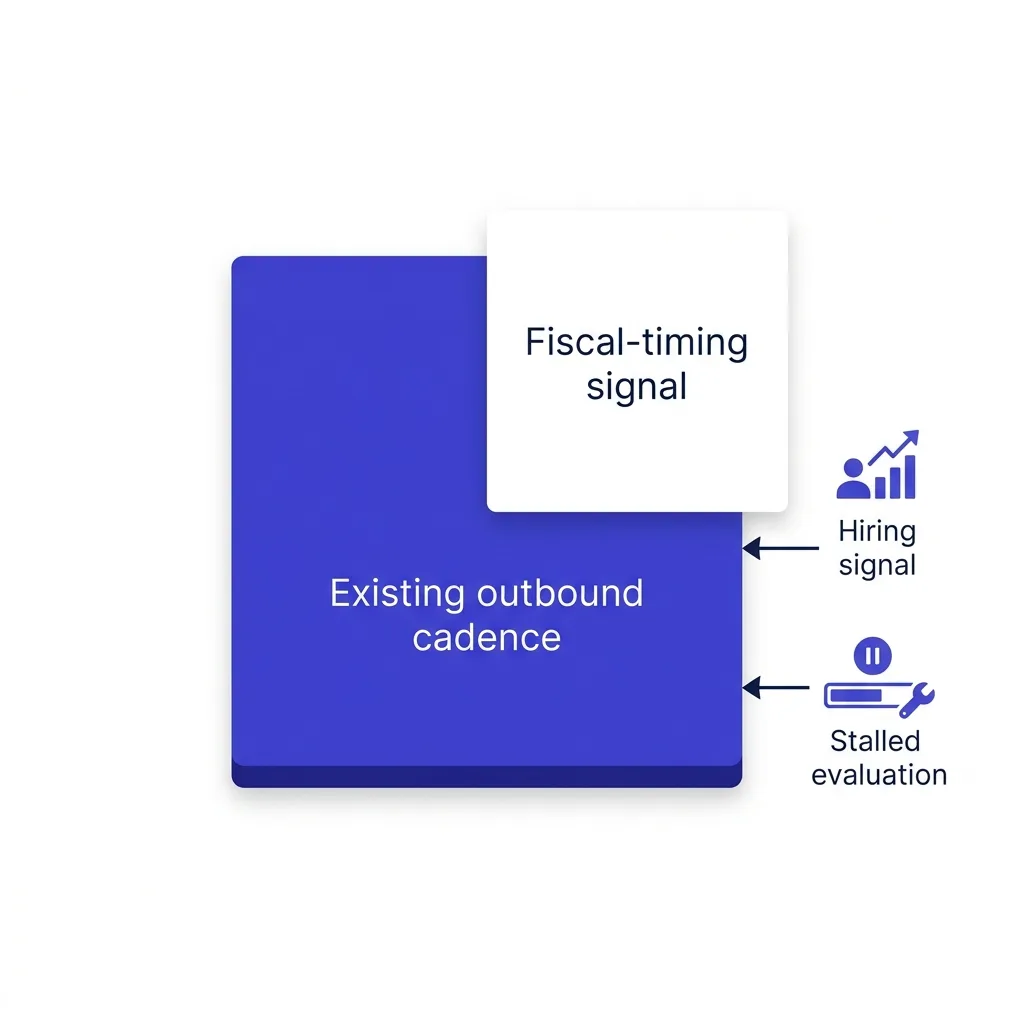
It works best layered onto an existing signal-based prospecting workflow, where the fiscal-timing signal becomes one more input alongside the usual buying signals your team already tracks.
Buying signals for cold email and compound buying signals both cover how stacking multiple weaker signals (fiscal timing plus recent hiring plus a stalled evaluation, for example) produces a stronger overall signal than any single one alone.
Platforms that support signal-based prospecting, including FirstSales, can layer a fiscal-year-end filter on top of existing account scoring so budget-flush accounts surface automatically as the relevant window approaches, rather than requiring a manual list-building exercise every quarter.
#What to do with accounts that do not close before year-end
Not every budget-flush conversation closes before the deadline, and that is expected rather than a failure of the campaign.
An account that engaged seriously in November but could not finish procurement before December 31 is a strong candidate for book January meetings in December, since the relationship and urgency built during the budget-flush window often carries directly into a new fiscal year's fresh allocation.
Track these near-miss accounts separately and prioritize them at the start of the next fiscal year rather than letting them fall back into a generic nurture cadence alongside cold accounts.
#Avoiding the mistake of treating every Q4 account as budget-flush
Not every account you contact in October through December has unspent budget or urgency to spend it.
Applying budget-flush framing indiscriminately across your entire Q4 outbound list will misfire on the accounts that do not actually match the pattern, and it risks making your messaging feel formulaic rather than genuinely relevant.
Reserve the specific budget-flush framing for accounts that meet at least two of the four signals covered earlier in this playbook, and run your standard messaging for everyone else, including any accounts affected by typical holiday cold email calendar considerations around Thanksgiving and the December holidays.
#Coordinating with your sales and CS teams
Budget-flush deals often move faster than a typical sales cycle, which means the handoff between marketing-sourced or SDR-sourced leads and an account executive needs to be tighter than usual during this window.
Make sure AEs know which accounts are flagged as budget-flush so they can prioritize response time and procurement support accordingly, since a slow internal handoff can eat the entire window's runway before the deal even reaches a proposal stage.
Cost per meeting outbound is worth tracking specifically for this segment, since budget-flush campaigns often produce a different cost profile than standard outbound, given the compressed timeline and higher buyer urgency.
#Measuring the effectiveness of a budget-flush campaign
Compare reply rate, meeting rate, and close rate for accounts flagged with two or more budget-flush signals against your standard outbound baseline for the same period.
If the flagged segment does not meaningfully outperform the baseline, the signal criteria likely need tightening, or the messaging is not differentiating itself enough from standard outreach.
Cold email reply rate benchmarks 2026 gives you the general baseline to compare against, with the expectation that a well-targeted budget-flush segment should land toward the higher end of that range given the added urgency and relevance.
#A worked example across two segments
Take a hypothetical vendor selling a mid-market analytics platform, with a target list split roughly evenly between calendar-year and June 30 fiscal-year accounts.
For the calendar-year segment, the team builds a signal-flagged list in the last week of September, prioritizing accounts that show a hiring signal in data or analytics roles plus a stalled evaluation from earlier in the year.
Outreach starts the first week of October, with a subject line referencing the specific department's likely allocation timeline rather than a generic year-end message.
For the June 30 segment, the same process runs in April, targeting accounts in industries known to follow a mid-year fiscal close, including several higher education and government-adjacent accounts identified during list segmentation.
Running two separate, correctly timed campaigns instead of one calendar-Q4-only push captures budget-flush activity across roughly twice the addressable window over a full year, without doubling the total volume of outreach sent.
#Building the list segmentation step by step
 Building the list segmentation step by step
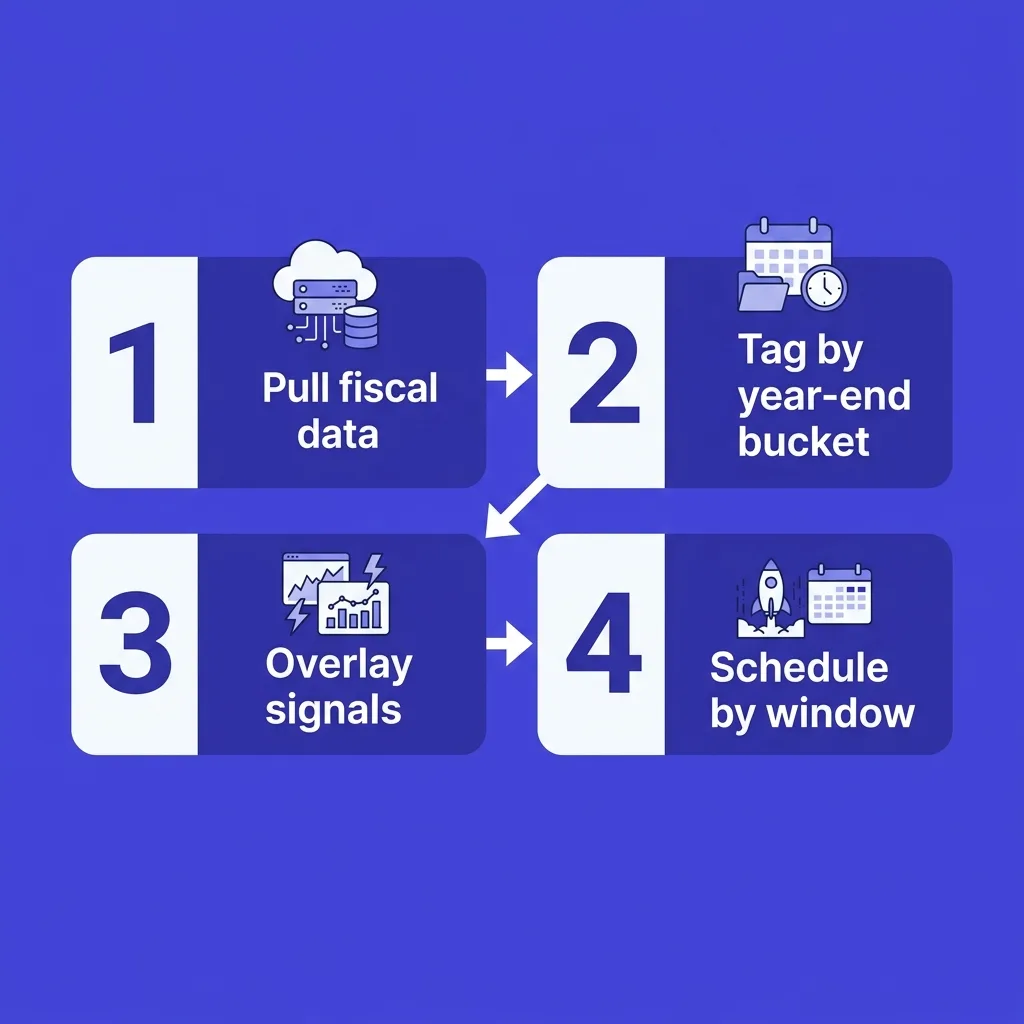
#Step 1: pull fiscal year-end data where available
Public company filings and investor relations pages are the most reliable source, and for private companies, a mix of inference from press releases and direct confirmation during earlier sales conversations fills the gap.
#Step 2: tag accounts by fiscal year-end bucket
Four buckets cover the vast majority of B2B accounts: December 31, June 30, September 30, and March 31, with a smaller residual bucket for less common dates.
#Step 3: overlay the four budget-flush signals
Layer hiring signals, stalled evaluation history, company size, and public sector status on top of the fiscal-year-end tagging to produce a prioritized subsegment within each bucket, rather than treating the entire bucket as equally ready to buy.
#Step 4: schedule campaigns against each bucket's window
Set calendar reminders or automated triggers 8 to 10 weeks ahead of each bucket's fiscal year-end, so campaign preparation and list-building happen with enough lead time to hit the optimal outreach window.
#Adjusting messaging by buyer role
A budget owner and a budget approver respond to different framing, and a single generic message sent to both roles undersells the specific urgency each one feels.
A department head managing the actual allocation cares primarily about not losing next year's budget, while a finance or procurement stakeholder cares more about documented ROI and a clean audit trail for the spend.
Segment your messaging accordingly: department heads get outreach framed around the allocation reset risk, while finance and procurement contacts get outreach framed around measurable outcomes and a fast, well-documented approval process.
Multithreading the buying committee covers the mechanics of reaching both roles inside the same account without the messages contradicting each other.
#Handling objections specific to budget-flush timing
The most common objection in this window is not price, it is timeline: "we don't have enough time to properly evaluate this before year-end."
The strongest response acknowledges the real constraint and offers a scoped-down first step, such as a smaller initial commitment or a phased rollout, rather than pushing for the full deal size within an unrealistic window.
Cold email objection handling templates has broader guidance on structuring these responses, and the budget-flush version of this objection benefits from leading with a concrete, smaller next step rather than more urgency-driven pressure, which tends to backfire when a buyer is already stating a real logistical constraint.
#Building a repeatable annual playbook instead of a one-off push
Teams that run this well treat budget-flush outbound as a recurring, scheduled motion rather than a scramble that gets rebuilt from scratch each year.
Document the four fiscal-year-end buckets, the signal criteria used to prioritize accounts within each one, and the messaging templates that performed best, so next year's version starts from a proven baseline instead of an empty page.
Sales plan covers how to build this kind of recurring motion into a broader annual planning cycle, so budget-flush outbound is not treated as a separate, ad hoc campaign disconnected from the rest of the team's quarterly targets.
Review results after each fiscal-year-end window closes: which signal combinations produced the highest close rate, which messaging angle got the strongest reply rate, and which accounts closed versus which stalled despite meeting the signal criteria.
That review turns a good first attempt into a genuinely repeatable, improving system by the second or third year of running it.
#Why this window keeps working even as buyers get more sophisticated
A reasonable objection to this whole playbook is that buyers are not naive, and sophisticated procurement teams already know vendors target them during budget-flush season.
That is true, and it does not make the window less real.
The underlying incentive, avoiding a reduced budget allocation next cycle, does not disappear just because a buyer recognizes the pattern.
What changes is that generic, discount-led budget-flush messaging performs worse every year as buyers get more pattern-aware, while specific, well-timed, non-discount messaging tied to a real signal continues to work, because it is addressing a genuine internal constraint rather than exploiting a naive buyer.
That is the core argument for the signal-based approach detailed throughout this playbook instead of a blanket "year-end sale" campaign sent to an entire list regardless of fit.
#How deal size changes the playbook
A small, self-serve or low-touch deal can realistically close within a compressed two to three week budget-flush window, since procurement is often minimal or nonexistent for spend below a certain internal threshold.
A larger, multi-stakeholder deal usually cannot compress its procurement timeline no matter how motivated the buyer is, since legal review, security assessment, and multi-level sign-off all take a fixed minimum amount of time regardless of urgency.
For larger deals, the realistic goal during budget-flush season is not always a signed contract by year-end.
It is getting far enough into the procurement process that the deal has momentum and priority carrying into the new fiscal year, rather than starting cold in January.
Outbound cadence by deal size is useful to revisit here, since the touch count and pacing for a budget-flush campaign should follow the same deal-size logic as your standard cadence design, just compressed into a shorter overall window.
Setting the right internal expectation, that enterprise budget-flush outbound is often about securing priority rather than a closed deal, prevents the team from judging the campaign a failure when a genuinely well-run enterprise motion produces strong pipeline but few closed-won deals by December 31 itself.
#Protecting deliverability during the volume spike
A budget-flush push almost always means a short-term increase in send volume, concentrated into a few compressed weeks rather than spread evenly across the quarter.
That spike is exactly the pattern that inbox providers watch for when deciding whether to trust a sending domain.
Ramp volume gradually into the campaign window instead of jumping straight from your normal cadence to a full budget-flush list on day one.
Cold email domain burn rate covers why a sudden jump in volume, even from an otherwise healthy domain, can trigger the same spam filtering response as a genuinely low-quality sender, and a Q4 push is one of the more common ways teams accidentally trip that threshold.
Check your current sending limits before committing to the campaign's target account count.
Email sending limits walks through how daily caps interact with domain reputation, and a budget-flush list that looks reasonable on paper can still exceed what your current warm-up stage safely supports if you have not planned around it.
Split the campaign across multiple sending domains or subdomains if the account list is large enough that a single domain would need to carry an unusual volume spike for two or three straight weeks.
Subdomain vs separate domain explains the tradeoffs, and for a time-boxed push like this, a subdomain dedicated to the campaign is often the cleaner choice, since it isolates any reputation risk away from your primary sending domain without requiring a full new domain purchase and warm-up cycle.
Monitor bounce rate and spam complaints daily during the active window, not just at the end of the campaign.
A budget-flush list is often built quickly under time pressure, which raises the odds of stale or mistyped addresses slipping through, and catching a rising bounce rate on day three is far cheaper than discovering it after the domain has already taken a reputation hit from a full week of bad sends.
Verify every address against a validation pass before the campaign starts, rather than relying on whatever hygiene the list already carried from an earlier quarter.
A list pulled together in a hurry for a time-sensitive push is precisely the kind of list that skips this step, and it is also precisely the kind of list where skipping it costs the most.
#FAQs
#When should I start a Q4 budget-flush campaign for calendar fiscal-year accounts?
Early October gives enough runway for a full sales cycle, including procurement, before the December 31 deadline.
#Do all companies operate on a calendar fiscal year?
No, common alternatives include June 30, September 30 for U.S. federal and related contractors, and March 31 for many international and APAC-headquartered enterprises.
#How do I find out a prospect's actual fiscal year-end?
Public companies disclose this in SEC filings or investor relations pages, and for private companies, it is often inferable from press releases, annual reports, or direct conversation with a contact.
#Is budget-flush messaging just a discount pitch?
It works better when framed around the buyer's own incentive to avoid a reduced budget next cycle, rather than leading with a price discount.
#What signals indicate an account likely has unspent budget?
Recent departmental hiring, a stalled evaluation earlier in the year, mid-market or enterprise company size, and proximity to a known fiscal year-end all combine to strengthen the signal.
#Should I apply budget-flush framing to my entire Q4 outbound list?
No, reserve it for accounts meeting at least two of the relevant signals, and use standard messaging for the rest of the list to avoid the framing feeling generic.
#How does this apply to government and public sector accounts?
Federal fiscal year-end on September 30 creates a well-documented, compressed procurement window that should be treated as a distinct campaign from calendar-year Q4 outreach.
#What happens to budget-flush leads that do not close before year-end?
Track them separately and prioritize them for early outreach in the new fiscal year, since the relationship and urgency built during the window often carries forward.
#Does budget-flush outbound work for small businesses too?
It is less reliable for early-stage startups and small businesses that often run more discretionary, less formally allocated budgets than mid-market and enterprise accounts.
#How long does a typical budget-flush sales cycle take?
It varies by deal size and procurement complexity, but two to four weeks minimum should be assumed for legal and procurement review even on a fast-moving deal.
#Should I coordinate budget-flush campaigns with account executives?
Yes, flag qualified accounts to AEs so response time and procurement support are prioritized, since the compressed timeline leaves little room for a slow internal handoff.
#How do I measure whether my budget-flush segment is actually more effective?
Compare reply rate, meeting rate, and close rate for signal-flagged accounts against your standard outbound baseline for the same period.
#Does the holiday season interfere with Q4 budget-flush outbound?
Yes, response rates typically dip around Thanksgiving and the December holidays, which is why starting the campaign in early October rather than late November matters.
#Can I combine fiscal timing with other buying signals?
Yes, stacking fiscal timing with signals like recent hiring or a stalled evaluation produces a stronger combined signal than fiscal timing alone.
#What is the risk of leading a budget-flush email with a discount?
It trains the buyer to associate your outreach with discounting, which can undercut future renewal conversations and signal urgency on your side rather than theirs.
#How is a budget-flush campaign different from a standard Q4 push?
A budget-flush campaign specifically targets accounts showing signals of unspent, expiring allocation, while a standard Q4 push treats the whole quarter uniformly without that filter.
#Do international companies follow the same budget-flush pattern?
The underlying use-it-or-lose-it dynamic is common globally, but the specific fiscal year-end date varies by region and company, so segmentation by actual fiscal calendar matters more for international accounts.
#What is the best way to re-engage a stalled evaluation during budget-flush season?
Reference the specific point where the evaluation stalled and frame the fiscal deadline as a reason to revisit the decision now, rather than sending a generic re-engagement message.
#How does this playbook connect to booking meetings for the following January?
Accounts that engage during budget-flush season but cannot close before year-end are strong candidates for early outreach once the new fiscal year's budget resets in January.
#Should marketing and sales use the same signal criteria for flagging budget-flush accounts?
Yes, shared criteria keep the handoff between marketing-sourced leads and sales follow-up consistent, avoiding mismatched expectations about which accounts are genuinely time-sensitive.
Unspent budget resets on a clock, and that clock is one of the most reliable, underused timing signals in B2B outbound.
Segment your list by actual fiscal year-end, layer in hiring and evaluation signals, and lead your messaging with the buyer's own incentive rather than a discount.
The accounts that close during this window often move faster than any other segment in your pipeline, precisely because the deadline is real and it belongs to them, not to your quota.